

This episode of Space Nuts is brought to you by NordVPN, your reliable partner for online security. To take advantage of our exclusive offer, including four extra months for free, visit www.nordvpn.com/spacenuts.
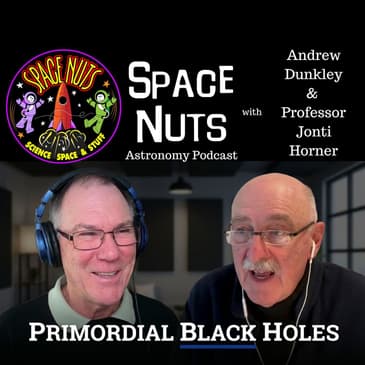
Space Exploration: Blue Origin's Explosive Test and the Mysteries of the Universe In this thrilling episode of Space Nuts, hosts Andrew Dunkley and Professor Fred Watson reunite to discuss a range of captivating topics, including the recent explosive test of Blue Origin's New Glenn rocket, primordial black holes, and the ongoing debate around dark energy. Buckle up as we delve into the cosmos and explore these fascinating themes.
Episode Highlights:
- Blue Origin's Test Launch: The episode kicks off with an analysis of the dramatic Blue Origin test that resulted in an explosive incident at Cape Canaveral, raising questions about the future of the Artemis programme and the implications for upcoming lunar missions.
- Primordial Black Holes: Andrew and Fred Watson discuss a recent microlensing event observed in the Large Magellanic Cloud, exploring the possibility that the mysterious object, dubbed Phoebe, could be a primordial black hole, a concept first proposed by Stephen Hawking.
- Gravitational Microlensing Explained: The hosts break down the phenomenon of gravitational microlensing, illustrating how invisible objects can magnify the light of distant stars and what this means for our understanding of dark matter and the universe.
- Dark Energy: A Possible Furphy? A thought-provoking discussion ensues about the nature of dark energy, with insights from a recent paper suggesting that our current model of the universe may be oversimplified, raising the possibility that dark energy may not be necessary at all.
For more Space Nuts, including our continuously updating newsfeed and to listen to all our episodes, visit our website. Follow us on social media at SpaceNutsPod on Facebook, Instagram, and more. We love engaging with our community, so be sure to drop us a message or comment on your favourite platform.
If you’d like to help support Space Nuts and join our growing family of insiders for commercial-free episodes and more, visit spacenutspodcast.com/about.
Stay curious, keep looking up, and join us next time for more stellar insights and cosmic wonders. Until then, clear skies and happy stargazing.
Become a supporter of this podcast: https://www.spreaker.com/podcast/space-nuts-astronomy-insights-cosmic-discoveries--2631155/support.
- Blue Origin's Explosive Test
- Understanding Primordial Black Holes
- Gravitational Microlensing Phenomenon
- The Debate Around Dark Energy
- Implications for Future Space Exploration
00:00:02 --> 00:00:04 Andrew Dunkley: Hello again. Thank you for joining us. This
00:00:04 --> 00:00:07 is Space Nuts where we talk astronomy and
00:00:07 --> 00:00:10 space science. My name is Andrew Dunkley.
00:00:10 --> 00:00:12 Great to have your company. Well, you've
00:00:12 --> 00:00:14 probably been listening to Jonty for the last
00:00:14 --> 00:00:17 few weeks with Fred Watson, uh, overseas
00:00:17 --> 00:00:19 gallivanting as he does. He loves to
00:00:19 --> 00:00:21 gallivant. And
00:00:22 --> 00:00:24 he's back. And what we're going to talk about
00:00:24 --> 00:00:26 today, uh, all sorts of things. A, uh, blue
00:00:26 --> 00:00:29 origin blowout. You've probably seen the
00:00:29 --> 00:00:31 footage. Wow. Uh, primordial black hole,
00:00:32 --> 00:00:34 gravitational micro lensing and is dark
00:00:34 --> 00:00:37 matter A. Ah, Furphy. We'll deal with all of
00:00:37 --> 00:00:39 that today on Space nuts.
00:00:39 --> 00:00:42 Generic: 15 seconds. Guidance is internal.
00:00:42 --> 00:00:45 10, 9. Ignition
00:00:45 --> 00:00:46 sequence start.
00:00:46 --> 00:00:47 Professor Fred Watson: Space nuts.
00:00:47 --> 00:00:50 Generic: 5, 4, 3, 2. 1. 2, 3, 4,
00:00:50 --> 00:00:52 5, 5, 4, 3, 2, 1.
00:00:52 --> 00:00:53 Andrew Dunkley: Space nuts.
00:00:53 --> 00:00:55 Generic: Astronauts report it feels good.
00:00:56 --> 00:00:59 Andrew Dunkley: And he's back and he's looking well. It's
00:00:59 --> 00:01:01 Professor Fred Watson Watson, Astronomer at
00:01:01 --> 00:01:02 large. Hello, Fred Watson.
00:01:03 --> 00:01:04 Professor Fred Watson: Hello Andre. You're looking well too. It's
00:01:04 --> 00:01:05 nice to see you.
00:01:05 --> 00:01:08 Andrew Dunkley: Yeah, it's good to see you too. I mean uh,
00:01:08 --> 00:01:10 it's been a while for both of us because,
00:01:10 --> 00:01:13 um, we had to do a lot of catch up
00:01:13 --> 00:01:15 episodes but we didn't quite have enough time
00:01:15 --> 00:01:17 to cover everything so we brought Jonty in.
00:01:17 --> 00:01:20 Uh, but he and I had to do catch up episodes
00:01:20 --> 00:01:22 to cover an absence of mine.
00:01:23 --> 00:01:25 So um, I haven't actually
00:01:25 --> 00:01:27 recorded with you for quite a while.
00:01:28 --> 00:01:30 Professor Fred Watson: It's uh. Yeah, it must be a couple of months
00:01:30 --> 00:01:30 or so.
00:01:30 --> 00:01:32 Andrew Dunkley: Yeah, it would be. But it doesn't sound like
00:01:32 --> 00:01:33 that to the audience really.
00:01:34 --> 00:01:35 Professor Fred Watson: No, probably not.
00:01:35 --> 00:01:37 Andrew Dunkley: Yes, it's all witchery.
00:01:39 --> 00:01:41 Well, we. Yeah, I think so. I think so.
00:01:41 --> 00:01:41 Professor Fred Watson: Yeah.
00:01:41 --> 00:01:43 Andrew Dunkley: There's at least two or three of them.
00:01:43 --> 00:01:44 Professor Fred Watson: Yeah. Okay, good.
00:01:44 --> 00:01:46 Andrew Dunkley: So where did you go?
00:01:46 --> 00:01:49 Professor Fred Watson: You were all over the place. Yes. So it was
00:01:49 --> 00:01:52 uh, a conference in Germany that took me up
00:01:52 --> 00:01:55 to Europe and that, that actually was
00:01:55 --> 00:01:58 really interesting, um, because in
00:01:58 --> 00:02:00 fact I was going to Scotland before that. I
00:02:00 --> 00:02:03 had a week with my daughters in Scotland and
00:02:03 --> 00:02:05 then off to Germany. But the trip there,
00:02:06 --> 00:02:08 course, um, we can't fly through the Middle
00:02:08 --> 00:02:11 east at the moment because of the war going
00:02:11 --> 00:02:13 on there. And so my flight
00:02:14 --> 00:02:17 via Dubai, they were long cancelled, but
00:02:17 --> 00:02:20 Mali managed to pull me a flight up to
00:02:20 --> 00:02:23 Seoul in Korea and then
00:02:23 --> 00:02:26 on thin air from Seoul over
00:02:26 --> 00:02:28 the North Pole. And I've actually got a
00:02:28 --> 00:02:30 certificate to prove that I've been over the
00:02:30 --> 00:02:32 North Pole. It's over there. I can't go and
00:02:32 --> 00:02:34 grab it. And then into
00:02:35 --> 00:02:37 Helsinki and then, uh, yes, it was cold.
00:02:38 --> 00:02:40 Then uh, um, uh, across to
00:02:40 --> 00:02:42 Edinburgh. So the Polar Flight was really
00:02:42 --> 00:02:45 interesting because we started off in Seoul
00:02:45 --> 00:02:48 in Korea, uh, and then, you know,
00:02:48 --> 00:02:50 took off, uh, with thin air. And
00:02:50 --> 00:02:53 I expected us to head towards
00:02:53 --> 00:02:56 the, towards the west, because that's what
00:02:56 --> 00:02:59 you do. But no, we headed to the east.
00:02:59 --> 00:03:02 Wow. And we actually went up between
00:03:03 --> 00:03:05 Russia and America, so up the Bering
00:03:05 --> 00:03:08 Strait. So it went far enough
00:03:08 --> 00:03:10 east that you could turn north right up the
00:03:10 --> 00:03:13 Bering Strait. So you got Russia on one side,
00:03:13 --> 00:03:14 America on the other, and then over the North
00:03:14 --> 00:03:17 Pole, uh, with a little polar
00:03:17 --> 00:03:19 certificate to prove it. Nice touchdown in
00:03:19 --> 00:03:22 Helsinki. Yeah. Uh, an hour or so there. Then
00:03:22 --> 00:03:25 a nice flight over to Edinburgh. And I was
00:03:25 --> 00:03:28 with my daughter directly. It was great.
00:03:28 --> 00:03:31 Andrew Dunkley: Yeah, fantastic. Um, I've got an Arctic
00:03:31 --> 00:03:32 Circle certificate, I think.
00:03:32 --> 00:03:34 Professor Fred Watson: Yes, you will have. Yeah, I've got one of
00:03:34 --> 00:03:36 those as well. I got a cape certificate in
00:03:36 --> 00:03:36 fact.
00:03:36 --> 00:03:38 Andrew Dunkley: Oh, yeah, yeah, yeah.
00:03:38 --> 00:03:41 Professor Fred Watson: Um, but the conference I went to in Germany,
00:03:41 --> 00:03:44 uh, was, um, it was the 60th birthday
00:03:44 --> 00:03:46 conference of a colleague with whom I've
00:03:46 --> 00:03:49 worked very closely on um, the RAVE survey
00:03:49 --> 00:03:51 which we've talked about before. The radial
00:03:51 --> 00:03:53 velocity experiment. Uh, Matthias
00:03:53 --> 00:03:55 Steinmetz. Herr Doctor, Professor Matthias
00:03:55 --> 00:03:58 Steinmetz. Uh, very senior German astronomer
00:03:58 --> 00:04:01 now. He, uh, led the project. I was the
00:04:01 --> 00:04:03 project manager. So we worked very closely
00:04:03 --> 00:04:05 together with a team of people, most of whom
00:04:05 --> 00:04:08 were at the conference to celebrate his 60th
00:04:08 --> 00:04:10 birthday. So I was the sole Australian
00:04:10 --> 00:04:12 representative. So they made a bit of a fuss
00:04:12 --> 00:04:15 of me, which was nice. Uh, I got the
00:04:15 --> 00:04:18 kickoff talk and uh, they looked after me.
00:04:18 --> 00:04:20 Uh, so it was very, very good. And I
00:04:20 --> 00:04:23 picked up a lot of what's happening currently
00:04:23 --> 00:04:25 in the field of science that we're doing. Or
00:04:25 --> 00:04:26 we might mention some of that a bit later on
00:04:26 --> 00:04:27 in the show.
00:04:27 --> 00:04:28 Andrew Dunkley: Sounds good.
00:04:28 --> 00:04:30 Uh, my trip, uh, was a little closer to home,
00:04:30 --> 00:04:33 only a nine hour flight away. We went to
00:04:34 --> 00:04:36 Vietnam for two and a half weeks. Uh,
00:04:36 --> 00:04:38 people jokingly said to me, don't mention the
00:04:38 --> 00:04:41 war. But don't mention the war.
00:04:42 --> 00:04:44 It's uh, it's still very sensitive subject
00:04:44 --> 00:04:47 and, and what blew my mind.
00:04:47 --> 00:04:50 And this will be of interest to, um, I
00:04:50 --> 00:04:52 suppose American listeners because of
00:04:52 --> 00:04:54 America's involvement in the Vietnam War. But
00:04:54 --> 00:04:57 um, there is still strong
00:04:57 --> 00:04:58 division between north and South.
00:04:59 --> 00:05:02 And uh, it hasn't been forgotten even 50
00:05:02 --> 00:05:05 years after it ended. There's still very much
00:05:05 --> 00:05:08 focused on the aftermath of that
00:05:08 --> 00:05:11 conflict. I
00:05:11 --> 00:05:13 suppose because it was such a defining time
00:05:13 --> 00:05:16 in their history. And uh, I mean the
00:05:16 --> 00:05:18 Vietnam War was only a part of what they
00:05:18 --> 00:05:19 dealt with. They'd been dealing with
00:05:20 --> 00:05:22 colonialism prior to that from
00:05:22 --> 00:05:25 France for um,
00:05:25 --> 00:05:28 decades and decades. Uh, so
00:05:28 --> 00:05:30 it's uh, quite uh, extraordinary. There was a
00:05:30 --> 00:05:33 great documentary, uh, series,
00:05:33 --> 00:05:36 I think it was on SBS in Australia called the
00:05:36 --> 00:05:39 Birth of a Nation. And uh, one of our
00:05:39 --> 00:05:41 guides actually mentioned it and said we'd
00:05:41 --> 00:05:43 love to see it over here but we're not
00:05:43 --> 00:05:46 allowed. Uh, so I
00:05:46 --> 00:05:49 watched it and um, I'm going to try and
00:05:49 --> 00:05:51 figure out how to get it to him. But I don't
00:05:51 --> 00:05:52 know. I don't know.
00:05:52 --> 00:05:55 Professor Fred Watson: We'll see. You could get, you could run afoul
00:05:55 --> 00:05:58 of diplomatic uh, niceties if you tried
00:05:58 --> 00:05:59 that. Who knows?
00:05:59 --> 00:06:01 Andrew Dunkley: Could do. Could do. Anyway.
00:06:01 --> 00:06:02 Professor Fred Watson: Especially if you talk about it on a public
00:06:03 --> 00:06:05 podcast. Yeah, maybe like you are doing now.
00:06:08 --> 00:06:09 Andrew Dunkley: They're probably not allowed to watch this
00:06:09 --> 00:06:11 over in Vietnam either.
00:06:11 --> 00:06:13 Professor Fred Watson: Maybe not. No, maybe not.
00:06:13 --> 00:06:14 Andrew Dunkley: It was funny though because I was pasting
00:06:14 --> 00:06:17 posting uh, some little videos. I like to do
00:06:17 --> 00:06:19 little videos while I'm away and I was
00:06:19 --> 00:06:22 posting them on Tick Tock. I picked up 140
00:06:22 --> 00:06:23 Vietnamese followers.
00:06:24 --> 00:06:26 Professor Fred Watson: Oh, that's fantastic. Yeah, I thought it was
00:06:26 --> 00:06:29 cool. There you go. At least I can watch your
00:06:29 --> 00:06:30 Tick Tock stuff.
00:06:30 --> 00:06:33 Andrew Dunkley: Yeah, yeah. Uh, particularly the one I did at
00:06:33 --> 00:06:36 Harlong Bay. It's beautiful part of the world
00:06:36 --> 00:06:39 and I only did a 60 second sort of three
00:06:39 --> 00:06:42 60 degree scan of the place. But uh, for some
00:06:42 --> 00:06:45 reason that video has gone nuts. It's uh, at
00:06:45 --> 00:06:47 Last count had 14 and a half thousand views.
00:06:48 --> 00:06:48 Professor Fred Watson: Whoa.
00:06:49 --> 00:06:51 Andrew Dunkley: I don't understand it.
00:06:51 --> 00:06:53 Professor Fred Watson: But uh, yeah, that was nice.
00:06:54 --> 00:06:56 Andrew Dunkley: And we did all the other stuff. Train street,
00:06:56 --> 00:06:57 you know where the train runs next to the
00:06:57 --> 00:06:59 cafes in, in um.
00:06:59 --> 00:07:01 Professor Fred Watson: No, I didn't. Yeah, yeah, it's very popular
00:07:01 --> 00:07:02 somewhere I should go.
00:07:02 --> 00:07:05 Andrew Dunkley: Yeah, up in Hanoi and many, uh, other places
00:07:05 --> 00:07:08 I went. I won't bore people to tears with it.
00:07:08 --> 00:07:10 We've got to get down to business. Uh, our
00:07:10 --> 00:07:12 first topic, Fred Watson, is very
00:07:12 --> 00:07:13 explosive.
00:07:13 --> 00:07:16 This is the um, Blue
00:07:16 --> 00:07:19 Origin Knot launch that happened the
00:07:19 --> 00:07:21 other day. Uh, in fact I don't even think it
00:07:21 --> 00:07:23 got an inch off the ground before it went up
00:07:23 --> 00:07:25 in a beautiful nuclear um,
00:07:26 --> 00:07:27 plume.
00:07:27 --> 00:07:30 Professor Fred Watson: It was very like a nuclear plume. And no, it
00:07:30 --> 00:07:31 wasn't actually meant to get off the ground.
00:07:31 --> 00:07:34 This was a fire test. Oh, it spied all
00:07:34 --> 00:07:36 right. Yeah, it did. Uh, it was
00:07:37 --> 00:07:39 um, um, yes,
00:07:39 --> 00:07:42 basically testing out the engines for a
00:07:42 --> 00:07:44 launch that was forthcoming. That was going
00:07:44 --> 00:07:46 to take a whole lot of uh,
00:07:47 --> 00:07:49 ah, telecommunications satellites,
00:07:50 --> 00:07:52 uh, up, uh, into orbit. Uh,
00:07:52 --> 00:07:55 they were fortunately not on the rocket.
00:07:55 --> 00:07:58 Uh, I think they were uh, the
00:07:58 --> 00:08:00 Apple Leo, uh, satellites which is
00:08:01 --> 00:08:03 what used to be called Kuiper, uh, and is
00:08:03 --> 00:08:06 perhaps the principal competitor
00:08:06 --> 00:08:08 potentially to Starlink.
00:08:08 --> 00:08:11 Um, anyway, the satellites were not
00:08:12 --> 00:08:14 on the booster, uh
00:08:14 --> 00:08:17 and uh, it basically was to
00:08:17 --> 00:08:20 test fire its seven engines. This is
00:08:20 --> 00:08:23 the new Glenn booster, which is Blue Origin's
00:08:23 --> 00:08:26 heavy lift booster. It's not as heavy
00:08:26 --> 00:08:29 lift as the SpaceX, uh,
00:08:29 --> 00:08:32 super heavy, uh, booster that takes the
00:08:32 --> 00:08:32 starship up.
00:08:32 --> 00:08:34 Andrew Dunkley: It's not lifting anything now, is it?
00:08:34 --> 00:08:37 Professor Fred Watson: It's not, no. And uh, what.
00:08:38 --> 00:08:41 It's got sort of serious ramifications
00:08:41 --> 00:08:44 because not only did they blow up the rocket,
00:08:44 --> 00:08:47 they also blew up the launch pad. Uh,
00:08:47 --> 00:08:49 effectively there's a lot of damage, uh, to
00:08:49 --> 00:08:51 the launch pad, which is, if I remember
00:08:51 --> 00:08:52 rightly, it is at Cape Canaveral.
00:08:52 --> 00:08:53 Andrew Dunkley: Yeah, I think so.
00:08:53 --> 00:08:56 Professor Fred Watson: Uh, and um,
00:08:56 --> 00:08:59 that explosion, uh, has caused damage that
00:08:59 --> 00:09:01 people are now talking about several months,
00:09:01 --> 00:09:04 if not a year or so to repair.
00:09:05 --> 00:09:07 Uh, and that's bad because that's the only
00:09:07 --> 00:09:10 facility in the world that can launch the new
00:09:10 --> 00:09:12 Glenn booster. And the new Glenn booster
00:09:12 --> 00:09:14 is needed for the Artemis programme.
00:09:15 --> 00:09:17 Uh, in particular,
00:09:19 --> 00:09:21 uh, later this year there was supposed to be
00:09:21 --> 00:09:23 a test launch of
00:09:24 --> 00:09:27 their Blue Moon lander. This is Blue
00:09:27 --> 00:09:30 Origins Lunar Lander, um, which
00:09:30 --> 00:09:32 is uh, um,
00:09:32 --> 00:09:35 basically uh, the competition, if
00:09:35 --> 00:09:38 I can put it that way, with the SpaceX
00:09:38 --> 00:09:41 Starship. So NASA contracted both SpaceX
00:09:41 --> 00:09:44 and Blue Origin to develop a
00:09:44 --> 00:09:46 lander, lunar lander for the moon. SpaceX
00:09:46 --> 00:09:49 has theirs based on the starship.
00:09:49 --> 00:09:52 Um, what is it, four to
00:09:52 --> 00:09:55 50 metres tall? It's colossal. Uh, to
00:09:55 --> 00:09:57 land that on a rough surface on the moon. I'm
00:09:57 --> 00:10:00 not sure I'd be that keen on that, but never
00:10:00 --> 00:10:03 mind. Uh, uh, the Blue Origin
00:10:03 --> 00:10:05 version, the uh, uh,
00:10:05 --> 00:10:08 Blue Moon as it's called, uh, that is only
00:10:08 --> 00:10:11 eight storeys high, uh, so
00:10:11 --> 00:10:13 it's uh, shorter. Uh, but these two
00:10:14 --> 00:10:16 are both in the running to land the first
00:10:16 --> 00:10:19 astronauts on the lunar surface in 2028.
00:10:20 --> 00:10:22 Uh, so, um, there was going to be a test of
00:10:23 --> 00:10:25 uh, the new um, Glenn
00:10:25 --> 00:10:28 Heavy Lifter, lifting up a
00:10:28 --> 00:10:31 blue moon, um, landing vehicle,
00:10:31 --> 00:10:34 ah, a prototype landing vehicle, uh,
00:10:34 --> 00:10:36 into orbit and actually to touch it down on
00:10:36 --> 00:10:38 the moon. And that was supposed to happen
00:10:38 --> 00:10:40 this year. That's clearly off the agenda now.
00:10:41 --> 00:10:43 Uh, and so, um, it's not going to happen
00:10:43 --> 00:10:45 actually. It's a little bit, because I've
00:10:45 --> 00:10:48 just read today that that lunar lander,
00:10:48 --> 00:10:50 um, which of course wasn't on board the
00:10:50 --> 00:10:53 rocket when it exploded, has just passed with
00:10:53 --> 00:10:56 flying colours. It's uh, environmental
00:10:56 --> 00:10:58 test. There's an environmental test that
00:10:58 --> 00:10:59 everything goes through. It's in A huge
00:10:59 --> 00:11:02 vacuum chamber, um, which is, um, a
00:11:02 --> 00:11:05 NASA facility, uh, and
00:11:05 --> 00:11:08 you can change, uh, uh, the temperature
00:11:08 --> 00:11:11 to match those huge extremes of
00:11:11 --> 00:11:13 temperature that you will get on the moon.
00:11:13 --> 00:11:16 Uh, so their prototype lunar lander, the
00:11:16 --> 00:11:19 blue MO Mark 1, which is called
00:11:19 --> 00:11:21 Endurance, which is a great name
00:11:21 --> 00:11:23 because, uh, that's not what's happened to
00:11:23 --> 00:11:25 the booster. But Endurance has passed with
00:11:25 --> 00:11:27 flying colours. Sadly, at the moment there's
00:11:27 --> 00:11:29 nothing to take it into space, so we'll have
00:11:29 --> 00:11:31 to see how that evolves.
00:11:31 --> 00:11:34 Andrew Dunkley: Yeah, I think you and I spoke
00:11:34 --> 00:11:37 about NASA looking at other options other
00:11:37 --> 00:11:40 than SpaceX, um, not long before you, you
00:11:40 --> 00:11:42 went away and, um,
00:11:43 --> 00:11:46 now this is kind of, for want of
00:11:46 --> 00:11:48 a better term, blown up in Blue Origin's
00:11:48 --> 00:11:50 face. That takes them off the table.
00:11:50 --> 00:11:53 Professor Fred Watson: Doesn't, uh, seems to for a
00:11:53 --> 00:11:55 while, unless they can do some very
00:11:55 --> 00:11:57 rapid repairs to the launch
00:11:58 --> 00:12:00 vehicle, sorry, the launch site,
00:12:01 --> 00:12:03 uh, the launch facility. So, yeah, it could
00:12:03 --> 00:12:06 push back. So the idea was that late next
00:12:06 --> 00:12:09 year, uh, there would be the
00:12:09 --> 00:12:12 Artemis III flight, which would consist
00:12:12 --> 00:12:14 of these two potential lunar landing
00:12:14 --> 00:12:17 vehicles, um, the Starship on SpaceX's
00:12:17 --> 00:12:20 side, the Blue Moon on Blue Origin,
00:12:21 --> 00:12:23 both going to be launched into Earth orbit,
00:12:23 --> 00:12:26 uh, to have, um, rendezvous
00:12:26 --> 00:12:28 tests, uh, to demonstrate their viability,
00:12:29 --> 00:12:32 uh, when you link them to the space launch
00:12:32 --> 00:12:34 System. Basically the Orion spacecraft, which
00:12:34 --> 00:12:37 is what took the Artemis, uh, II
00:12:37 --> 00:12:39 astronauts around the moon. Ah, that will
00:12:39 --> 00:12:42 take Artemis iii, beg your pardon, Artemis IV
00:12:42 --> 00:12:45 astronauts to the moon. But to land, they've
00:12:45 --> 00:12:47 got to transfer into another spacecraft and
00:12:47 --> 00:12:50 land on the lunar surface. So all that
00:12:50 --> 00:12:53 I think, is being thrown into question,
00:12:53 --> 00:12:56 uh, with this explosion. We will wait to see.
00:12:56 --> 00:12:57 It's still too early. We don't even know what
00:12:57 --> 00:13:00 caused it yet. Uh, it was only
00:13:01 --> 00:13:04 less, uh, than a week ago as we speak.
00:13:04 --> 00:13:07 Uh, so we don't actually know
00:13:07 --> 00:13:09 what the consequences are likely to be, but
00:13:09 --> 00:13:11 they could be quite serious for the
00:13:11 --> 00:13:12 Artemis programme.
00:13:12 --> 00:13:15 Andrew Dunkley: Yeah, Uh, I mean, uh, I
00:13:15 --> 00:13:17 think, uh, Elon Musk calls these things,
00:13:18 --> 00:13:19 um, successful failures.
00:13:20 --> 00:13:22 Professor Fred Watson: Uh, I don't know, a rapid
00:13:22 --> 00:13:24 unscheduled disintegration.
00:13:24 --> 00:13:26 Andrew Dunkley: Yes. I don't know what Jeff Bezos calls them,
00:13:26 --> 00:13:29 but, um, yeah,
00:13:29 --> 00:13:31 hopefully they can get down to the bottom of
00:13:31 --> 00:13:33 it. But, yeah, it does throw a spanner into
00:13:33 --> 00:13:34 the works. Maybe it was a spanner thrown into
00:13:34 --> 00:13:37 the works that caused the explosion. Who
00:13:37 --> 00:13:37 knows?
00:13:38 --> 00:13:40 Professor Fred Watson: The one good news storey part, ah, of the
00:13:40 --> 00:13:43 storey is nobody was injured. Yeah.
00:13:43 --> 00:13:43 Andrew Dunkley: Wow.
00:13:43 --> 00:13:46 Professor Fred Watson: Because as you said, it looked like a nucle
00:13:46 --> 00:13:49 explosion. It was incredible. Uh,
00:13:49 --> 00:13:52 and, um, so there was huge
00:13:52 --> 00:13:55 potential for injury there, but everybody was
00:13:55 --> 00:13:55 Accounted for.
00:13:56 --> 00:13:58 Andrew Dunkley: I actually read today that some people
00:13:59 --> 00:14:01 who watched the explosion,
00:14:01 --> 00:14:04 um, this sort of demonstrates how big and
00:14:04 --> 00:14:06 powerful it was. Took 37
00:14:07 --> 00:14:09 seconds to feel the shockwave. Uh,
00:14:11 --> 00:14:13 Professor Fred Watson: really? So they must have been a long way
00:14:13 --> 00:14:13 away.
00:14:13 --> 00:14:16 Andrew Dunkley: Yeah, but they could see it quite clearly. It
00:14:16 --> 00:14:18 was such a big explosion that the shockwave
00:14:18 --> 00:14:20 took 37 seconds to reach there.
00:14:21 --> 00:14:24 That's amazing. Yeah. All
00:14:24 --> 00:14:26 right. Um, so, uh, yeah, it does
00:14:26 --> 00:14:28 sort of throw into question the future of
00:14:28 --> 00:14:31 Blue Origin, um, partnering with NASA
00:14:31 --> 00:14:34 for Artemis 3. But, uh,
00:14:34 --> 00:14:36 never write these people off.
00:14:36 --> 00:14:39 Professor Fred Watson: I've discovered we're not doing
00:14:39 --> 00:14:42 that. They will rise,
00:14:42 --> 00:14:44 Phoenix, like from the ashes. But the
00:14:44 --> 00:14:46 question is how soon and what it will do to
00:14:46 --> 00:14:47 NASA's schedule.
00:14:47 --> 00:14:48 Andrew Dunkley: Exactly.
00:14:48 --> 00:14:49 Professor Fred Watson: With Artemisia.
00:14:49 --> 00:14:51 Andrew Dunkley: More to come on that, and you can read about
00:14:51 --> 00:14:53 it, uh, at the Conversation website.
00:14:54 --> 00:14:56 This is Space Nuts, Andrew Dunkley with
00:14:56 --> 00:14:58 Professor Fred Watson Watson.
00:15:00 --> 00:15:03 Generic: Okay, we checked all four systems and
00:15:03 --> 00:15:04 Professor Fred Watson: being with a go, Space Nuts.
00:15:05 --> 00:15:07 Andrew Dunkley: Now, our next storey, Fred Watson,
00:15:07 --> 00:15:10 uh, has a lot of moving parts as well.
00:15:10 --> 00:15:13 Nothing explosive, but, uh, uh, we're
00:15:13 --> 00:15:15 talking, what, primordial black holes and
00:15:15 --> 00:15:17 gravitational microlensing. Is that, Is that,
00:15:17 --> 00:15:19 that what it's about?
00:15:19 --> 00:15:21 Professor Fred Watson: Yes, uh, it's certainly, uh, the
00:15:21 --> 00:15:24 gravitational microlensing. What, uh, it
00:15:24 --> 00:15:26 means for primordial black holes
00:15:27 --> 00:15:29 remains to be seen. But, uh, it's a good
00:15:29 --> 00:15:31 opportunity to talk about it and talk about
00:15:31 --> 00:15:33 the latest research on this. So what's the
00:15:33 --> 00:15:36 storey? Um, on the night of the 18th of
00:15:36 --> 00:15:38 December, 2019,
00:15:39 --> 00:15:41 uh, there was a
00:15:41 --> 00:15:44 microlensing event observed with
00:15:44 --> 00:15:47 a star in the Large Magellanic Cloud,
00:15:47 --> 00:15:50 the nearest of our. Our sort of large, ish
00:15:50 --> 00:15:52 galactic neighbours. Um,
00:15:53 --> 00:15:55 the satellite galaxy of our Milky Way,
00:15:55 --> 00:15:58 165 light years away, as the
00:15:58 --> 00:16:00 crow flies, as far as I remember.
00:16:01 --> 00:16:03 So, um, what's a microlensing event? Well,
00:16:04 --> 00:16:05 something passes in front of a star.
00:16:06 --> 00:16:08 Uh, you can't actually see the something
00:16:08 --> 00:16:11 because it's too faint. You can see the light
00:16:11 --> 00:16:13 of the star. And you might think there's
00:16:13 --> 00:16:15 something passing in front of a star. It
00:16:15 --> 00:16:18 would dim the light of the star. But
00:16:18 --> 00:16:20 actually, if the geometry is right, in other
00:16:20 --> 00:16:22 words, if there's something that passes
00:16:22 --> 00:16:25 between you and the star is far enough away
00:16:25 --> 00:16:27 from the star, you get the opposite effect.
00:16:27 --> 00:16:30 The, um, distortion of the space around
00:16:30 --> 00:16:33 the invisible object, uh, actually
00:16:33 --> 00:16:36 acts as a magnifying glass. And so you
00:16:36 --> 00:16:38 get a brightening of the light of the distant
00:16:38 --> 00:16:41 star. Uh, and this is a phenomenon known as
00:16:41 --> 00:16:43 gravitational microlensing. It's well
00:16:43 --> 00:16:46 established, well observed. Uh, there's a
00:16:46 --> 00:16:49 team in New Zealand which, um, he's Very,
00:16:49 --> 00:16:51 very adept at these microlensing
00:16:51 --> 00:16:53 observations. Uh, so
00:16:55 --> 00:16:58 what we see when that happens is a
00:16:58 --> 00:17:01 rise in the brightness of the star and then
00:17:01 --> 00:17:03 a fall in the brightness of the background
00:17:03 --> 00:17:05 star which
00:17:07 --> 00:17:10 we call a light curve. It's the way the light
00:17:10 --> 00:17:12 changes over time. You can plot it out as a
00:17:12 --> 00:17:14 graph. And it's got a very characteristic
00:17:14 --> 00:17:17 shape. It's a bit like a rather elongated
00:17:17 --> 00:17:19 volcano. It's got a steady ris,
00:17:20 --> 00:17:23 a peak and then a rapid fall, uh,
00:17:23 --> 00:17:25 that falls away very like the flanks of a
00:17:25 --> 00:17:28 volcano. So that's the sort of shape.
00:17:28 --> 00:17:31 So this uh, was the event that was
00:17:31 --> 00:17:33 observed on 18th December.
00:17:35 --> 00:17:36 Can't remember which telescope it was used.
00:17:37 --> 00:17:40 Uh, but we have a group
00:17:40 --> 00:17:41 of Australians who uh, are
00:17:42 --> 00:17:44 directly involved with this.
00:17:45 --> 00:17:48 Uh, so the, the question is
00:17:48 --> 00:17:51 what was the object that passed in front of
00:17:51 --> 00:17:52 the star?
00:17:52 --> 00:17:55 Andrew Dunkley: I'm going to guess maybe a
00:17:55 --> 00:17:56 primordial black hole.
00:17:57 --> 00:17:59 Professor Fred Watson: Well, that's
00:17:59 --> 00:18:02 perhaps the most, um, provocative
00:18:03 --> 00:18:06 explanation. Uh, they've given it
00:18:06 --> 00:18:07 a name, this thing, they've called it Phoebe,
00:18:07 --> 00:18:09 which is I think a lovely name actually.
00:18:10 --> 00:18:13 Um, but uh, the issue
00:18:13 --> 00:18:16 is it is kind
00:18:16 --> 00:18:18 of too small to be
00:18:19 --> 00:18:21 anything normal, if I
00:18:21 --> 00:18:24 put it that way. Um,
00:18:24 --> 00:18:27 so what are the possibilities? One
00:18:27 --> 00:18:30 is what we
00:18:30 --> 00:18:32 sometimes call a rogue planet or an
00:18:32 --> 00:18:35 orphan planet, better known perhaps as a free
00:18:35 --> 00:18:37 floating planet. In other words a planetary
00:18:37 --> 00:18:40 sized object, maybe something that's been
00:18:40 --> 00:18:43 ejected from its solar system or something
00:18:43 --> 00:18:46 that never gained enough mass to become a
00:18:46 --> 00:18:48 star and it's just sort of wandering,
00:18:49 --> 00:18:52 uh, through the galaxy. Uh, we know there are
00:18:52 --> 00:18:54 many of these things, uh, so that could be
00:18:56 --> 00:18:58 uh, one of the explanations for it. But
00:18:59 --> 00:19:02 uh, the issue is this thing
00:19:02 --> 00:19:05 has basically got a
00:19:05 --> 00:19:08 very, very small mass. Uh,
00:19:08 --> 00:19:10 it's only about three times the mass of the
00:19:10 --> 00:19:12 moon. Uh, and that's
00:19:13 --> 00:19:16 kind of small for a planet. Uh, so it
00:19:16 --> 00:19:19 suggests it's an object
00:19:19 --> 00:19:22 that is not a dwarf
00:19:22 --> 00:19:25 planet or, sorry, a rogue planet or an orphan
00:19:25 --> 00:19:28 planet. And it points towards this
00:19:28 --> 00:19:31 much more exotic notion
00:19:31 --> 00:19:34 of a primordial black hole, uh,
00:19:34 --> 00:19:36 which you've kind of, you've already flagged.
00:19:37 --> 00:19:40 And that's where it gets really exciting. So,
00:19:40 --> 00:19:42 so primordial black holes, we've
00:19:42 --> 00:19:45 talked about them before. They were predicted
00:19:45 --> 00:19:48 by Stephen Hawking. They um,
00:19:49 --> 00:19:52 were predicted by him to have been
00:19:52 --> 00:19:54 a byproduct of the Big Bang. In other words,
00:19:54 --> 00:19:57 these are things that don't form from
00:19:57 --> 00:20:00 collapsing stars like the stellar mass black
00:20:00 --> 00:20:03 holes that we see, but from,
00:20:03 --> 00:20:05 um, well, basically, um,
00:20:05 --> 00:20:08 fluctuations in the density,
00:20:08 --> 00:20:11 uh, in the first few
00:20:11 --> 00:20:14 milliseconds after The Big Bang, the density
00:20:14 --> 00:20:17 of that hot medium. Uh, in other words, you
00:20:17 --> 00:20:19 know, if you could get these little spots
00:20:19 --> 00:20:22 that collapse instantaneously to become a
00:20:22 --> 00:20:25 black hole, what you'll produce in the Big
00:20:25 --> 00:20:27 Bang is not just time and space, but
00:20:27 --> 00:20:30 you litter it with these primordial
00:20:30 --> 00:20:33 black holes. And I think it's
00:20:33 --> 00:20:36 from Hawking's work that we assume that
00:20:36 --> 00:20:39 they can be any size you like. Um, they
00:20:39 --> 00:20:41 can be, you know, perhaps,
00:20:42 --> 00:20:44 uh, supermassive black holes, which we know
00:20:44 --> 00:20:47 are the centres of galaxies or, uh,
00:20:47 --> 00:20:49 smaller than stellar mass black
00:20:49 --> 00:20:52 holes. And so by a stellar mass black hole,
00:20:52 --> 00:20:55 we mean one that has a mass of about not
00:20:55 --> 00:20:57 too different from a star. In fact, typically
00:20:57 --> 00:21:00 about five times the mass of the sun. Um,
00:21:00 --> 00:21:02 and they are, ah, thought to have been caused
00:21:02 --> 00:21:05 by a star exploding at the end of its life.
00:21:05 --> 00:21:07 The core collapses, uh, nothing will stop the
00:21:07 --> 00:21:09 collapse and it goes into becoming a black
00:21:09 --> 00:21:12 hole. And but for a star to behave like
00:21:12 --> 00:21:15 that, it's got to be massive, it's got to be
00:21:15 --> 00:21:17 at least, well, five to ten times the mass of
00:21:17 --> 00:21:20 the sun. Um, so that does not
00:21:20 --> 00:21:22 account for things that are, uh, three times
00:21:22 --> 00:21:25 the mass of the Moon. Uh, but,
00:21:27 --> 00:21:29 um, if you can have primordial
00:21:29 --> 00:21:32 black holes of any mass, then
00:21:32 --> 00:21:35 that makes Phoebe a
00:21:35 --> 00:21:37 very distinct candidate for
00:21:39 --> 00:21:41 a primordial black hole. Um, I
00:21:41 --> 00:21:44 might mention that the researchers who've
00:21:44 --> 00:21:47 done this, uh, work are at Swinburne
00:21:47 --> 00:21:49 University in Melbourne, Uh, uh, a university
00:21:50 --> 00:21:53 very active in its studies of actually
00:21:53 --> 00:21:56 most phenomena to do with our galaxy.
00:21:56 --> 00:21:58 Uh, they've got some extremely talented
00:21:58 --> 00:22:00 scientists there, uh, some of whom I know
00:22:00 --> 00:22:03 quite well. Um, so, uh,
00:22:03 --> 00:22:06 it's definitely a microlending event.
00:22:06 --> 00:22:08 Something has caused this phenomenon. Uh, the
00:22:08 --> 00:22:10 question is, what is it?
00:22:11 --> 00:22:13 So let me, um,
00:22:14 --> 00:22:17 segue, if I may, to one of
00:22:17 --> 00:22:20 the talks at, uh, the conference that I was
00:22:20 --> 00:22:22 at in Germany, uh, given by
00:22:23 --> 00:22:25 people who, uh, are. Well, in this case, it
00:22:25 --> 00:22:27 was a black hole specialist. And he was
00:22:27 --> 00:22:29 saying that
00:22:30 --> 00:22:32 the evidence for
00:22:33 --> 00:22:35 primordial black holes is
00:22:36 --> 00:22:39 growing. Uh, and this is just one more
00:22:39 --> 00:22:41 example of it, the example of Phoebe here.
00:22:42 --> 00:22:45 Uh, but he also said he thought this was
00:22:45 --> 00:22:48 the next big thing in black hole
00:22:48 --> 00:22:50 science, uh, to actually
00:22:51 --> 00:22:54 determine the reality of primordial
00:22:54 --> 00:22:56 black holes, whether they are there or
00:22:56 --> 00:22:58 whether they're just, ah, a wild prediction
00:22:58 --> 00:23:00 of professor, uh, Hawking.
00:23:00 --> 00:23:03 Um, but he also made the comet
00:23:04 --> 00:23:06 the comment. Sorry, not the comet. He made
00:23:06 --> 00:23:09 the comment that. But, uh, it
00:23:09 --> 00:23:12 was his belief that the next Nobel Prize in
00:23:12 --> 00:23:15 astronomy or physics is the way it goes
00:23:15 --> 00:23:18 would be the discovery of a
00:23:18 --> 00:23:20 primordial black hole. In other words,
00:23:21 --> 00:23:24 uh, finding absolutely rock solid evidence.
00:23:24 --> 00:23:27 That primordial black holes exist. Now,
00:23:27 --> 00:23:29 Phoebe is not that rock solid evidence.
00:23:29 --> 00:23:32 Because we've got multiple theories.
00:23:32 --> 00:23:34 Uh, yeah, multiple theories. It could even
00:23:34 --> 00:23:37 be, uh, you know, a
00:23:37 --> 00:23:39 lost satellite of a planet. That's been
00:23:39 --> 00:23:42 chucked out of its solar system. So it could
00:23:42 --> 00:23:44 be an object like the moon or Mercury or
00:23:44 --> 00:23:46 something like that. But that seems
00:23:46 --> 00:23:48 unlikely. And, in fact,
00:23:49 --> 00:23:52 um, the primordial
00:23:52 --> 00:23:54 mass black hole idea, I think, is much more
00:23:54 --> 00:23:57 interesting. It's one that I'm sure
00:23:57 --> 00:24:00 will be looked at in detail. The problem with
00:24:00 --> 00:24:02 these gravitational microlensing events,
00:24:02 --> 00:24:05 Andrew, is you only get one shot at it. You
00:24:05 --> 00:24:07 never see the object. So Phoebe's
00:24:08 --> 00:24:10 basically never going to be seen again. All
00:24:10 --> 00:24:13 we've seen is the effect of it passing in
00:24:13 --> 00:24:16 front of a star. Um, so
00:24:16 --> 00:24:19 what we've got to look for is other, perhaps
00:24:19 --> 00:24:22 other similar phenomena. Or
00:24:22 --> 00:24:25 something that is unequivocally a
00:24:25 --> 00:24:27 black hole. But has a mass less than the sun.
00:24:27 --> 00:24:29 And we did talk about a candidate object,
00:24:30 --> 00:24:32 uh, before we both went on our various
00:24:32 --> 00:24:35 sojourns. Uh, we did talk about an object
00:24:35 --> 00:24:37 like that. I'd need to look it up to find out
00:24:37 --> 00:24:40 what it was. And if we can nail one
00:24:40 --> 00:24:42 of these things and say that is definitely
00:24:42 --> 00:24:45 what it is. Um, in fact, the object we talked
00:24:45 --> 00:24:47 about was, uh, the result of, I think, a
00:24:47 --> 00:24:49 collision that was measured with
00:24:49 --> 00:24:51 gravitational waves. So all this is
00:24:51 --> 00:24:54 perhaps pointing to the idea of primordial
00:24:54 --> 00:24:56 mass black holes. Somebody will nail it
00:24:56 --> 00:24:58 before too long, and, uh, they'll probably
00:24:58 --> 00:24:59 get the Nobel Prize.
00:24:59 --> 00:25:02 Andrew Dunkley: Well, I suppose we shouldn't be surprised.
00:25:02 --> 00:25:05 Because in the past we've had theories
00:25:05 --> 00:25:08 about things existing, and voila, suddenly we
00:25:08 --> 00:25:11 find an exoplanet. And we've found thousands
00:25:11 --> 00:25:13 and thousands of them. So it stands to reason
00:25:13 --> 00:25:15 that this is just another progression in that
00:25:15 --> 00:25:18 regard. The evidence is
00:25:18 --> 00:25:21 stacking up. We haven't confirmed one yet,
00:25:21 --> 00:25:23 but it sounds like it's going to happen.
00:25:24 --> 00:25:27 Professor Fred Watson: Yeah, I think that's right. I think we're on
00:25:27 --> 00:25:30 the track of, uh, a whole new
00:25:30 --> 00:25:33 regime of physics. And,
00:25:33 --> 00:25:36 of course, primordial black
00:25:36 --> 00:25:38 holes are, uh, one potential candidate for
00:25:38 --> 00:25:41 dark matter. Um, which
00:25:41 --> 00:25:44 was ruled out in
00:25:44 --> 00:25:47 the 1990s, maybe
00:25:47 --> 00:25:49 prematurely. It was ruled out because we
00:25:49 --> 00:25:52 didn't see a whole lot of these
00:25:52 --> 00:25:54 microlensing events. Which you'd expect to
00:25:54 --> 00:25:56 see if there was a lot of primordial mass
00:25:56 --> 00:25:59 black holes. Maybe it's just that we weren't
00:25:59 --> 00:26:01 looking hard enough that we missed them.
00:26:01 --> 00:26:03 Andrew Dunkley: Maybe, um, yeah, I never look hard enough for
00:26:03 --> 00:26:04 anything.
00:26:05 --> 00:26:07 Professor Fred Watson: Well, that's because you're. You're a male.
00:26:07 --> 00:26:10 Yeah. You're a bloke. And we don't. We,
00:26:10 --> 00:26:13 we look at something and we just don't see
00:26:13 --> 00:26:13 it.
00:26:13 --> 00:26:15 Andrew Dunkley: No, no.
00:26:16 --> 00:26:19 Which is, you know, not real good for
00:26:19 --> 00:26:21 human history. Because weren't we the
00:26:21 --> 00:26:21 hunters?
00:26:21 --> 00:26:23 Professor Fred Watson: Like we were supposed to be able to see
00:26:23 --> 00:26:26 stuff. Quite so. Oh.
00:26:26 --> 00:26:28 Andrew Dunkley: Ah, dear. Uh, it's a really fascinating
00:26:28 --> 00:26:31 storey and I venture to say there'll be more
00:26:31 --> 00:26:33 on this in the not too distant future. But
00:26:33 --> 00:26:35 you can read about it. Great, uh, article
00:26:35 --> 00:26:37 about it on the Univers
00:26:39 --> 00:26:41 website. You're listening to and possibly
00:26:41 --> 00:26:44 viewing Space Nuts with Andrew Dunkley and
00:26:44 --> 00:26:46 Professor Fred Watson Watson.
00:26:48 --> 00:26:49 Generic: Roger, your lot clearer.
00:26:49 --> 00:26:52 Andrew Dunkley: Also Space Nuts. A Final Storey, Fred Watson
00:26:52 --> 00:26:55 intrigues me for one very good reason. It's
00:26:55 --> 00:26:58 one of the pet topics of our audience. We get
00:26:58 --> 00:27:00 a lot of questions about dark energy.
00:27:00 --> 00:27:03 But uh, this storey ponders the
00:27:03 --> 00:27:06 question. Did we actually invent dark
00:27:06 --> 00:27:09 energy for nothing? Why are they suggesting
00:27:09 --> 00:27:09 that?
00:27:11 --> 00:27:13 Professor Fred Watson: Um. Yeah,
00:27:14 --> 00:27:16 it's all mathematics.
00:27:17 --> 00:27:19 And I'd like just to refer, uh,
00:27:19 --> 00:27:22 listeners and viewers, uh, at the outset to a
00:27:22 --> 00:27:25 very nice article, uh, on this
00:27:25 --> 00:27:28 uh, from um, our much admired
00:27:28 --> 00:27:31 Universe Today uh, website that's
00:27:31 --> 00:27:34 kind of an old friend of um,
00:27:34 --> 00:27:36 of Space Nuts, an article written by Mark
00:27:36 --> 00:27:39 Thompson, uh, which really very
00:27:39 --> 00:27:42 eloquently puts this storey
00:27:42 --> 00:27:44 into perspective. And I'm going to quote
00:27:44 --> 00:27:47 Mark, I hope he won't mind me doing that. Um,
00:27:47 --> 00:27:50 because he introduces uh, this
00:27:50 --> 00:27:53 article by saying, stand a pencil on its end
00:27:53 --> 00:27:56 and mathematically speaking it's perfectly
00:27:56 --> 00:27:58 balanced. Every force is accounted for and
00:27:58 --> 00:28:00 the equations are satisfied. And yet you
00:28:00 --> 00:28:03 already know what happens next. The slightest
00:28:03 --> 00:28:06 disturbance and it topples a solution that
00:28:06 --> 00:28:09 exists on paper but can never survive
00:28:09 --> 00:28:12 contact with reality. In other words,
00:28:12 --> 00:28:15 um, something that's stable, but only
00:28:15 --> 00:28:18 stable. Briefly, I uh, think I'm
00:28:18 --> 00:28:21 paraphrasing what he's getting at with that.
00:28:21 --> 00:28:23 Uh, but just to read a little bit further,
00:28:23 --> 00:28:25 uh, from Mark's article, that's the image
00:28:25 --> 00:28:27 Blake Temple, a mathematician at the
00:28:27 --> 00:28:29 University of California Davis, uses to
00:28:29 --> 00:28:32 describe our um, best model of the universe.
00:28:32 --> 00:28:35 And it's a deeply uncomfortable. And
00:28:35 --> 00:28:37 so I think the way this storey evolves
00:28:37 --> 00:28:40 is that yes, we've uh, for
00:28:40 --> 00:28:42 30 years, almost 30 years. It's
00:28:42 --> 00:28:45 1998 when the
00:28:45 --> 00:28:47 accelerated expansion of the universe was
00:28:47 --> 00:28:50 discovered, uh, by
00:28:51 --> 00:28:53 uh, my colleague, um, Brian Schmidt and
00:28:54 --> 00:28:57 uh, uh, his actually competitors
00:28:57 --> 00:29:00 over the Pacific, uh, Saul Perlmutta
00:29:00 --> 00:29:03 and his team, uh, they jointly won the Nobel
00:29:03 --> 00:29:05 Prize in 2011 for that
00:29:05 --> 00:29:08 discovery that um,
00:29:09 --> 00:29:10 the expansion of the universe is
00:29:10 --> 00:29:13 accelerating. And so, um, the
00:29:13 --> 00:29:15 issue was to try and explain that.
00:29:15 --> 00:29:18 And that's why dark energy was
00:29:18 --> 00:29:21 introduced as a concept.
00:29:21 --> 00:29:24 Uh, an invisible, ah, outward
00:29:24 --> 00:29:27 pressure, um, that is part of space,
00:29:27 --> 00:29:30 uh, just pushes space and everything in it
00:29:30 --> 00:29:33 apart. Um, and so
00:29:33 --> 00:29:35 that's where we get our idea
00:29:36 --> 00:29:38 of dark energy from. But
00:29:39 --> 00:29:41 um, this um, mathematician,
00:29:42 --> 00:29:44 uh, Blake Temple has
00:29:44 --> 00:29:47 said, okay, maybe we're
00:29:47 --> 00:29:49 taking too simplistic a view
00:29:50 --> 00:29:53 of all this. Uh, and
00:29:53 --> 00:29:55 uh, I think it's a group of, uh,
00:29:56 --> 00:29:59 mathematicians led by Dr. Temple. Uh,
00:29:59 --> 00:30:00 they've got a paper in the Proceedings of the
00:30:00 --> 00:30:02 Royal Society. You don't get papers in there
00:30:02 --> 00:30:05 if they're rubbish. So, uh, there's
00:30:05 --> 00:30:07 something to think about there. And they've
00:30:07 --> 00:30:10 actually um, mathematically
00:30:10 --> 00:30:12 demonstrated that
00:30:12 --> 00:30:15 our, um, model of
00:30:15 --> 00:30:18 the expansion of the universe with dark
00:30:18 --> 00:30:21 energy in it is unstable.
00:30:21 --> 00:30:23 Uh, it's something that can't
00:30:24 --> 00:30:27 survive. And
00:30:28 --> 00:30:30 that almost,
00:30:30 --> 00:30:33 uh, means that you can rule it
00:30:33 --> 00:30:36 out, uh, in the world of
00:30:36 --> 00:30:38 physics, uh, if you've got a solution that's
00:30:38 --> 00:30:41 unstable, uh, then it
00:30:41 --> 00:30:43 shouldn't happen. And so,
00:30:44 --> 00:30:46 um, what um, uh, Dr.
00:30:46 --> 00:30:49 Temple and his associates are proposing
00:30:49 --> 00:30:52 is that we've got it wrong. Ah, and that
00:30:52 --> 00:30:55 uh, the. The model of the universe
00:30:56 --> 00:30:58 that we have, which
00:30:59 --> 00:31:02 assumes that matter is basically
00:31:02 --> 00:31:04 spread throughout the universe, the universe
00:31:04 --> 00:31:07 is isotropic, it's the same in all
00:31:07 --> 00:31:10 directions. Uh, is
00:31:10 --> 00:31:12 suggesting that that is also
00:31:13 --> 00:31:15 unstable. Um, and
00:31:15 --> 00:31:18 that really we have to take into account the
00:31:18 --> 00:31:20 fact that the universe is, isn't the same
00:31:20 --> 00:31:23 everywhere. Um,
00:31:23 --> 00:31:26 uh. I can't really
00:31:26 --> 00:31:28 go in deeply to the mathematics because I
00:31:29 --> 00:31:31 actually looked at the original
00:31:31 --> 00:31:34 paper. Um, and so I haven't followed
00:31:34 --> 00:31:37 the mathematical um,
00:31:37 --> 00:31:40 steps in the process. And between you and me,
00:31:40 --> 00:31:42 Andrew, I probably couldn't anyway, even if I
00:31:42 --> 00:31:45 looked at the paper because I do
00:31:45 --> 00:31:47 remember what some of the equations,
00:31:47 --> 00:31:50 um, that govern this sort of thing look like.
00:31:50 --> 00:31:52 And I do remember the emotional response
00:31:52 --> 00:31:55 that my psyche gets to
00:31:55 --> 00:31:58 them. But basically what they're
00:31:58 --> 00:32:00 saying is that
00:32:00 --> 00:32:02 uh, that
00:32:03 --> 00:32:05 accelerated expansion, um,
00:32:07 --> 00:32:09 is actually part of what
00:32:09 --> 00:32:12 Einstein suggested in the first
00:32:12 --> 00:32:15 place. And um, without the need
00:32:15 --> 00:32:17 to invoke dark energy,
00:32:18 --> 00:32:19 uh, and
00:32:21 --> 00:32:24 I'm simplifying, I guess, what,
00:32:24 --> 00:32:27 um. Mark, the author of this
00:32:27 --> 00:32:29 article has written. But the bottom line is
00:32:29 --> 00:32:32 that um, our view, uh,
00:32:33 --> 00:32:35 of the universe on its largest scale
00:32:36 --> 00:32:39 is probably naive. It's probably.
00:32:40 --> 00:32:42 We've perhaps oversimplified it and as a
00:32:42 --> 00:32:44 result of that we've come out with the wrong
00:32:44 --> 00:32:47 answer. Um, I might just, uh.
00:32:47 --> 00:32:49 Andrew Dunkley: That's a really big call though, isn't it?
00:32:49 --> 00:32:52 Professor Fred Watson: It's a huge call. Absolutely huge call.
00:32:53 --> 00:32:53 Uh,
00:32:55 --> 00:32:58 let me just wind up with the last paragraph
00:32:58 --> 00:32:59 that, uh.
00:32:59 --> 00:33:00 Andrew Dunkley: Yeah, I was just looking at that
00:33:00 --> 00:33:02 Professor Fred Watson: myself because that's the. Yeah. That Mark
00:33:02 --> 00:33:05 Thompson's written. I think it really sums it
00:33:05 --> 00:33:07 up. Dark energy has never felt
00:33:07 --> 00:33:09 entirely comfortable to many scientists.
00:33:09 --> 00:33:12 Einstein him, introduced something very like
00:33:12 --> 00:33:13 it, which he called his cosmological
00:33:13 --> 00:33:16 constant, then subsequently called it his
00:33:16 --> 00:33:18 biggest blunder. It was quietly resurrected
00:33:18 --> 00:33:21 in the 1990s when the data demanded it.
00:33:21 --> 00:33:23 That's when the accelerated expansion was
00:33:23 --> 00:33:26 discovered. Now the mathematics might be
00:33:26 --> 00:33:27 telling us it was never needed in the first
00:33:27 --> 00:33:30 place. The universe, it turns out, may be
00:33:31 --> 00:33:33 stranger and simpler than we
00:33:33 --> 00:33:36 thought, only both at, ah, the same time.
00:33:36 --> 00:33:38 It's a great article. I encourage all our
00:33:38 --> 00:33:40 listeners to have a look at it.
00:33:40 --> 00:33:42 Andrew Dunkley: Yes, it's at the Universe Today dot com
00:33:43 --> 00:33:45 website or you can read the paper at the
00:33:45 --> 00:33:48 Proceedings of the Royal Society. But, uh, I
00:33:48 --> 00:33:50 dare say we haven't heard the last of this.
00:33:51 --> 00:33:53 Uh, and what if, what if we have got it
00:33:53 --> 00:33:56 wrong? What if dark energy is a furfy? Um,
00:33:57 --> 00:33:59 that's the big question. But, uh, they seem
00:33:59 --> 00:34:02 to be erring towards the probability
00:34:03 --> 00:34:05 that it is in fact a furphy.
00:34:05 --> 00:34:08 Professor Fred Watson: That's right. Um, you know,
00:34:09 --> 00:34:11 uh, I
00:34:11 --> 00:34:14 suspect that, um, this theory,
00:34:15 --> 00:34:17 uh, if you eliminate the need for
00:34:17 --> 00:34:20 dark energy, you might well eliminate the
00:34:20 --> 00:34:21 need for dark matter as well.
00:34:23 --> 00:34:25 Or it might turn out to be primordial black
00:34:25 --> 00:34:28 holes. We've covered two potential
00:34:29 --> 00:34:31 solutions, uh, to the dark matter problem in
00:34:32 --> 00:34:35 this episode. Uh, nobody can accuse us
00:34:35 --> 00:34:37 of not addressing the big question, Andrew.
00:34:37 --> 00:34:39 Andrew Dunkley: Absolutely. We just don't give them the big
00:34:39 --> 00:34:40 answers.
00:34:40 --> 00:34:41 Professor Fred Watson: We don't give them answers. No, that's right.
00:34:41 --> 00:34:44 Leave that to somebody else because we don't
00:34:44 --> 00:34:45 know. No, we don't.
00:34:45 --> 00:34:47 Andrew Dunkley: No, we don't. But, uh, no. Fascinating.
00:34:47 --> 00:34:49 Fascinating storey. A couple of fascinating
00:34:49 --> 00:34:52 storeys. Uh, and it all started with a big
00:34:52 --> 00:34:53 bang called Blue Origin.
00:34:54 --> 00:34:56 Professor Fred Watson: Yes, it did. That's right. It was a huge
00:34:56 --> 00:34:57 bang. It was.
00:34:58 --> 00:34:58 Generic: Um.
00:34:58 --> 00:35:00 Andrew Dunkley: That brings us to the end. Fred Watson, thank
00:35:00 --> 00:35:00 you very much.
00:35:01 --> 00:35:03 Professor Fred Watson: It's a pleasure, Andrew. Always good to have
00:35:03 --> 00:35:06 a chat and uh, bring to the forefront
00:35:06 --> 00:35:08 exactly what's happening in the deep depths
00:35:08 --> 00:35:08 of the.
00:35:09 --> 00:35:11 Andrew Dunkley: Indeed. And good to have you back too.
00:35:11 --> 00:35:12 Professor Fred Watson: Thank you.
00:35:12 --> 00:35:14 Andrew Dunkley: Professor Fred Watson Watson, astronomer M at
00:35:14 --> 00:35:16 large. Don't forget to visit us online at our
00:35:16 --> 00:35:18 website if you so desire. SpaceNightsPodcast.
00:35:18 --> 00:35:21 Uh, dot com. You can click on the
00:35:21 --> 00:35:23 AMA link at the top and ask us anything.
00:35:24 --> 00:35:27 Or ask, uh, anybody anything really. But we
00:35:27 --> 00:35:29 make comments. You can sign up for the
00:35:29 --> 00:35:32 Astronomy AstroDailyPod feed. Uh, you can
00:35:32 --> 00:35:34 become a supporter if you so desire. And
00:35:34 --> 00:35:36 don't forget to leave, uh, reviews at your
00:35:36 --> 00:35:39 favourite podcasting platform wherever you
00:35:39 --> 00:35:40 listen to us. Reviews are really useful
00:35:40 --> 00:35:43 unless they're bad. But then again, there are
00:35:43 --> 00:35:45 some people who like bad because they want to
00:35:45 --> 00:35:47 see what all the fuss is about. Uh, but don't
00:35:47 --> 00:35:49 do it unless you want to. I'm not going to
00:35:49 --> 00:35:52 tell you what to do. Um, but anyway, that's
00:35:52 --> 00:35:52 it.
00:35:52 --> 00:35:54 Thanks to Huw in the studio who couldn't be
00:35:54 --> 00:35:57 with us today because he's a furphy and from
00:35:57 --> 00:35:58 me, Andrew Dunkley. Thanks for your company
00:35:59 --> 00:36:01 on this edition. We'll catch you on the next
00:36:01 --> 00:36:03 episode of Space Nuts. Bye Bye.
00:36:04 --> 00:36:07 You've been listening to the Space Nuts
00:36:07 --> 00:36:07 Generic: podcast
00:36:09 --> 00:36:12 Andrew Dunkley: available at Apple Podcasts, Spotify,
00:36:12 --> 00:36:14 iHeartRadio or your favourite podcast
00:36:14 --> 00:36:17 player. You can also stream on demand at
00:36:17 --> 00:36:18 bytes.
00:36:18 --> 00:36:20 Professor Fred Watson: Com. This has been another quality podcast
00:36:20 --> 00:36:22 production from bytes. Com.
00:36:22 --> 00:36:24 Andrew Dunkley: Um.