

Become a supporter of this podcast: https://www.spreaker.com/podcast/astronomy-daily-latest-space-news--5648921/support.
Sponsor Details:
Ensure your online privacy by using NordVPN. To get our special listener deal and save a lot of money, visit www.astronomydaily.io/nordvpn. You'll be glad you did!
Get the best secure and private email on the planet. Stop your Government, google and who knows who else spying on every email you write. Do what we did and use ProtonMail. They beleive in privacy and there are no ads in their business model...yet they still provide a free forever service. Check them out and get out special deal at www.astronomydaily.io/protonmail
Become a supporter of Astronomy Daily by joining our Supporters Club. Commercial free episodes daily are only a click way... Click Here
This episode includes AI-generated content.
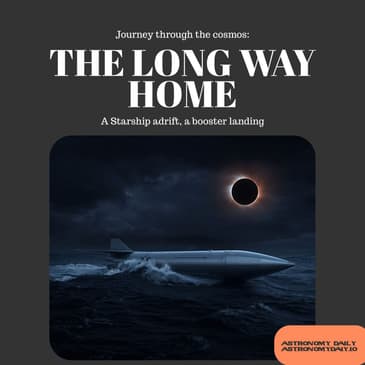
00:00:00 --> 00:00:03 Anna: Picture a rocket the height of a 15 storey
00:00:03 --> 00:00:05 building lying on its side in The Indian
00:00:05 --> 00:00:08 Ocean, 800 kilometres off
00:00:08 --> 00:00:10 Western Australia, and a rope running from
00:00:10 --> 00:00:13 its nose to a tug trying to drag it home
00:00:13 --> 00:00:14 through a rising swell.
00:00:15 --> 00:00:17 Avery: That's not a thought experiment. That's where
00:00:17 --> 00:00:20 the top half of a SpaceX Starship has spent
00:00:20 --> 00:00:21 the last two weeks.
00:00:21 --> 00:00:24 Anna: And whether it ever reaches an Australian
00:00:24 --> 00:00:26 port is right now genuinely up in the
00:00:26 --> 00:00:29 air. Good day and welcome to Astronomy
00:00:29 --> 00:00:30 AstroDailyPod. I'm Anna.
00:00:30 --> 00:00:32 Avery: And I'm avery. It's Monday 10th
00:00:33 --> 00:00:34 August 2026.
00:00:34 --> 00:00:36 Anna: There's a thread running through today's
00:00:36 --> 00:00:39 show. Things taking the long way home, A
00:00:39 --> 00:00:42 starship under tow, a Chinese booster trying
00:00:42 --> 00:00:45 to fly itself back to the pad. Tonight,
00:00:45 --> 00:00:48 40 year old Voyager 2 data still turning up.
00:00:48 --> 00:00:51 Surprises at, ah, Uranus and eclipse
00:00:51 --> 00:00:53 chasers heading to the top of the world for
00:00:53 --> 00:00:56 two minutes of darkness and three days from
00:00:56 --> 00:00:56 now.
00:00:56 --> 00:00:59 Avery: And plus the best meteor shower of the year
00:00:59 --> 00:01:02 peaking under a new Moon. It's a big week,
00:01:02 --> 00:01:03 let's get into it.
00:01:03 --> 00:01:06 So let's go back to the 24th of July,
00:01:06 --> 00:01:09 Starship's ah, 13th full test flight lifts
00:01:09 --> 00:01:12 off from Starbase in South Texas. And this
00:01:12 --> 00:01:15 one goes well, really well. The upper
00:01:15 --> 00:01:18 stage, the part SpaceX just calls ship,
00:01:18 --> 00:01:21 flies its suborbital arc and comes down for a
00:01:21 --> 00:01:23 splashdown in the Indian Ocean off the coast
00:01:23 --> 00:01:26 of Western Australia and exactly where it was
00:01:26 --> 00:01:26 aimed.
00:01:27 --> 00:01:29 Anna: And here's the first ever. Every
00:01:29 --> 00:01:32 previous ship that came down over the ocean,
00:01:32 --> 00:01:34 broke up or was deliberately destroyed.
00:01:35 --> 00:01:38 This one ship, 40, made what observers
00:01:38 --> 00:01:40 called the softest starship water landing
00:01:40 --> 00:01:43 yet, tipped over as it hit the waves and
00:01:43 --> 00:01:45 then just stayed in one piece.
00:01:46 --> 00:01:48 Avery: It floated airtight, bobbing in the
00:01:48 --> 00:01:51 swell. Onboard cameras showed all six
00:01:51 --> 00:01:53 Raptor engines with no visible external
00:01:53 --> 00:01:56 damage. Water lapping at the lens. A
00:01:56 --> 00:01:59 SpaceX spokesperson called it on the live
00:01:59 --> 00:02:01 webcast a dream scenario, which it
00:02:01 --> 00:02:04 Anna: was, because SpaceX genuinely did not
00:02:04 --> 00:02:07 expect to get this vehicle back. The whole
00:02:07 --> 00:02:10 point of the flight was the data. The heat
00:02:10 --> 00:02:12 shield is the thing that kept Elon Musk up at
00:02:12 --> 00:02:15 night for years, the tiles that protect ship
00:02:15 --> 00:02:17 on the way back through the atmosphere. And
00:02:17 --> 00:02:19 on this flight, it held.
00:02:19 --> 00:02:22 Avery: In fact, on 4 August, on the company's
00:02:22 --> 00:02:25 first ever quarterly earnings call, its first
00:02:25 --> 00:02:28 since going public, Musk said, and I'm
00:02:28 --> 00:02:30 paraphrasing only slightly, that he doesn't
00:02:30 --> 00:02:32 want to jinx it, but he'd consider the heat
00:02:32 --> 00:02:34 shield problem solved.
00:02:34 --> 00:02:37 Anna: That's a big claim for a rocket meant to be
00:02:37 --> 00:02:40 fully and rapidly reusable. The Heat shield
00:02:40 --> 00:02:43 was the last great unknown. So a ship
00:02:43 --> 00:02:45 that survives reentry, survives the water
00:02:45 --> 00:02:48 and floats there intact is suddenly
00:02:48 --> 00:02:49 a floating laboratory.
00:02:50 --> 00:02:52 Avery: Um, and that changed the maths. On
00:02:52 --> 00:02:55 28 July, Musk posted simply,
00:02:56 --> 00:02:59 we're sending a ship out to recover Starship.
00:02:59 --> 00:03:02 The SpaceX vessel Go Australis had been
00:03:02 --> 00:03:05 shadowing it since splashdown. Two
00:03:05 --> 00:03:07 Norwegian tugs, A, uh, Normand Ranger and
00:03:07 --> 00:03:10 Skimmer Tide steamed out to join.
00:03:11 --> 00:03:14 By early August, satellite imagery showed all
00:03:14 --> 00:03:16 three working. The vehicle with a towline
00:03:16 --> 00:03:19 already made fast to the nose section.
00:03:19 --> 00:03:22 Anna: For context, this thing had already drifted
00:03:22 --> 00:03:24 more than 400 kilometres. The whole
00:03:24 --> 00:03:27 convoy is over 1300 kilometres off the
00:03:27 --> 00:03:30 Australian coast, aiming according to
00:03:30 --> 00:03:32 imagery based reporting for a Western
00:03:32 --> 00:03:35 Australian port. Dampier and Port Hedland
00:03:35 --> 00:03:37 have both been floated as the likely
00:03:37 --> 00:03:37 destination.
00:03:38 --> 00:03:40 Avery: And then on the 7th of August, the tone
00:03:40 --> 00:03:42 shifted. Musk posted an update.
00:03:43 --> 00:03:45 Unfortunately, ship recovery is not looking
00:03:45 --> 00:03:48 good right now. The team's been fighting
00:03:48 --> 00:03:51 increasingly rough seas. But, and this is
00:03:51 --> 00:03:53 the important part, he added that they were
00:03:53 --> 00:03:55 still able to get close up photos of critical
00:03:55 --> 00:03:57 regions of the heat shield and the engines
00:03:57 --> 00:03:59 for future upgrades though.
00:03:59 --> 00:04:02 Anna: Read that carefully. Even if the tow
00:04:02 --> 00:04:05 fails, Even if ship 40 never reaches a
00:04:05 --> 00:04:08 jetty, SpaceX has already banked most of what
00:04:08 --> 00:04:10 it wanted. The inspection imagery.
00:04:10 --> 00:04:13 Honestly, a ship soaked in saltwater for two
00:04:13 --> 00:04:16 weeks was never going to be refurbished and
00:04:16 --> 00:04:17 flown again anyway.
00:04:17 --> 00:04:19 Avery: Uh, alright. The prize was never the
00:04:19 --> 00:04:21 hardware, it was the look at the hardware.
00:04:21 --> 00:04:24 Which is why as of our recording, the storey
00:04:24 --> 00:04:27 is beautifully unresolved. A giant rocket
00:04:27 --> 00:04:29 still afloat, still under tow in a race
00:04:29 --> 00:04:31 against the weather off Western Australia.
00:04:31 --> 00:04:34 Anna: Worth remembering how big giant is here.
00:04:34 --> 00:04:36 Stacked starship stands about
00:04:36 --> 00:04:39 124 metres tall. The
00:04:39 --> 00:04:41 biggest, most powerful rocket ever built.
00:04:41 --> 00:04:44 The ship on its own is 52 metres.
00:04:44 --> 00:04:46 That's what's on the end of that rope.
00:04:46 --> 00:04:48 Avery: And the flight did its day job too. During
00:04:48 --> 00:04:51 the mission, ship deployed 20 next generation
00:04:51 --> 00:04:53 Starlink V3 satellites. The bigger
00:04:53 --> 00:04:56 broadband bird SpaceX wants to fly by the
00:04:56 --> 00:04:59 hundred thousand. Those particular 20
00:04:59 --> 00:05:01 came straight back down by design, but it was
00:05:01 --> 00:05:02 a dress rehearsal for the future.
00:05:03 --> 00:05:05 Anna: The booster, meanwhile, the super heavy had a
00:05:05 --> 00:05:08 rougher day. Engine trouble on descent and it
00:05:08 --> 00:05:10 came down hard in the Gulf of Mexico and
00:05:10 --> 00:05:13 exploded. So a triumphant ship, a lost
00:05:13 --> 00:05:16 booster and a two week sea drama that may or
00:05:16 --> 00:05:17 may not have a tidy ending.
00:05:17 --> 00:05:20 Avery: And the look ahead is quick. Musk says the
00:05:20 --> 00:05:22 next one, Flight 14 is targeted for late
00:05:22 --> 00:05:25 August and it's meant to be Starship's first
00:05:25 --> 00:05:27 crack at reaching operational orbit while
00:05:27 --> 00:05:30 carrying production Starlink satellites, so
00:05:30 --> 00:05:33 the pace isn't slowing. But for our part of
00:05:33 --> 00:05:35 the world, this is the rare week the Starship
00:05:35 --> 00:05:37 Storey washed up on an Australian shore.
00:05:38 --> 00:05:39 Almost literally.
00:05:39 --> 00:05:40 Anna: Almost literally.
00:05:40 --> 00:05:42 Let's bring it home from the other direction
00:05:42 --> 00:05:44 now because someone else is trying to land a
00:05:44 --> 00:05:47 booster tonight. Because reusability isn't
00:05:47 --> 00:05:50 just a SpaceX storey anymore. Tonight,
00:05:50 --> 00:05:53 our tonight, a, uh, Chinese company called
00:05:53 --> 00:05:56 Landspace is going to try something only
00:05:56 --> 00:05:59 SpaceX has truly mastered. Flying
00:05:59 --> 00:06:01 an orbital class booster back down and
00:06:01 --> 00:06:03 landing it on its legs.
00:06:03 --> 00:06:06 Avery: And Landspace is a private outfit founded in
00:06:06 --> 00:06:09 Beijing back in 2015. Their rocket is the
00:06:09 --> 00:06:12 Zhuque 3, stainless steel, methane and
00:06:12 --> 00:06:15 liquid oxygen engines, about 66 metres
00:06:15 --> 00:06:18 tall in capability. It's broadly a Falcon
00:06:18 --> 00:06:18 9 rival.
00:06:18 --> 00:06:21 Anna: And the timing for local listeners, liftoff
00:06:21 --> 00:06:23 is targeted to a quarter to 8 on Monday
00:06:23 --> 00:06:25 evening US Eastern Time, which is a quarter
00:06:25 --> 00:06:28 to midnight UTC. And for us in Sydney, it's
00:06:28 --> 00:06:31 about a quarter to 10 on Tuesday morning. It
00:06:31 --> 00:06:33 goes from Zhuquan in China's northwest.
00:06:34 --> 00:06:36 Avery: Now here's what we need to be precise because
00:06:36 --> 00:06:38 the headlines get this slightly wrong. This
00:06:38 --> 00:06:41 isn't China's first booster landing, it's
00:06:41 --> 00:06:43 China's fourth orbital class recovery
00:06:43 --> 00:06:46 attempt. And one of those already worked back
00:06:46 --> 00:06:49 on the 10th of July, a long March 10th B was
00:06:49 --> 00:06:52 caught using a net capture system, which made
00:06:52 --> 00:06:54 China the second nation ever to land an
00:06:54 --> 00:06:55 orbital booster.
00:06:55 --> 00:06:57 Anna: So what makes tonight different is the
00:06:57 --> 00:06:59 method. Landspace isn't going for a net,
00:07:00 --> 00:07:02 it's going for the full Falcon 9 move. A, uh,
00:07:02 --> 00:07:05 powered descent, a powered landing, burn and
00:07:05 --> 00:07:08 legs, setting itself down on a pad downrange
00:07:08 --> 00:07:11 in Gansu Province. If it works, Landspace
00:07:11 --> 00:07:13 becomes the first Chinese company to pull off
00:07:13 --> 00:07:15 that kind of propulsive booster landing.
00:07:15 --> 00:07:18 Avery: And they've been close before. The Zhukui 3's
00:07:18 --> 00:07:20 maiden flight last December actually did its
00:07:20 --> 00:07:23 main job. The second stage reached orbit. It
00:07:23 --> 00:07:25 was the first stage that let them down. The
00:07:25 --> 00:07:28 landing burn faltered a few kilometres up and
00:07:28 --> 00:07:31 the booster came down in a fireball. By some
00:07:31 --> 00:07:33 accounts they were within about 17 seconds of
00:07:33 --> 00:07:34 a landing.
00:07:34 --> 00:07:37 Anna: 17 seconds. That's the margin they're trying
00:07:37 --> 00:07:40 to close tonight. A clean static fire test at
00:07:40 --> 00:07:42 the end of June set it up and airspace
00:07:42 --> 00:07:44 closure notices point to this evening.
00:07:44 --> 00:07:46 Avery: Why does it matter to the rest of us? Because
00:07:46 --> 00:07:49 landing and reflying boosters is what dragged
00:07:49 --> 00:07:51 the cost of getting to orbit down in the
00:07:51 --> 00:07:54 first place. A second company doing it on a
00:07:54 --> 00:07:57 different continent with a methane rocket is
00:07:57 --> 00:07:59 how a, uh, one company capability becomes an
00:07:59 --> 00:08:00 industry.
00:08:00 --> 00:08:02 Anna: We'll be recording before the window opens so
00:08:02 --> 00:08:04 we're calling it forward. If you're listening
00:08:04 --> 00:08:07 later in the day. Cheque astronomydaily IO
00:08:07 --> 00:08:08 we'll have the result
00:08:09 --> 00:08:11 Avery: now, from rocket recoveries to a planet lying
00:08:11 --> 00:08:12 on its side.
00:08:12 --> 00:08:14 There's a lovely result due in the rounds
00:08:14 --> 00:08:16 this week about Uranus. And it comes with an
00:08:16 --> 00:08:17 old friend attached.
00:08:18 --> 00:08:20 Anna: Set the scene first. Because Uranus is the
00:08:20 --> 00:08:23 oddball of the solar system, it doesn't spin
00:08:23 --> 00:08:26 upright like Earth, it's tipped right over,
00:08:26 --> 00:08:29 rolling around the sun on its side. And its
00:08:29 --> 00:08:31 magnetic field is stranger still, tilted
00:08:31 --> 00:08:34 about 60 degrees from its spin axis and
00:08:34 --> 00:08:36 offset from the planet's centre. Nothing
00:08:36 --> 00:08:38 about it is neat, which matters
00:08:38 --> 00:08:41 Avery: for something called the bow shock. That's
00:08:41 --> 00:08:43 the boundary out in front of a planet where
00:08:43 --> 00:08:45 the solar wind, the constant stream of
00:08:45 --> 00:08:48 particles off the sun, slams into the
00:08:48 --> 00:08:51 planet's magnetic field and abruptly slows
00:08:51 --> 00:08:54 down. At Earth, that boundary sits there
00:08:54 --> 00:08:56 fairly steadily. It only really moves when
00:08:56 --> 00:08:57 the sun kicks up.
00:08:57 --> 00:09:00 Anna: But at, uh, Uranus, this new modelling shows
00:09:00 --> 00:09:02 the bow shock is anything but study. It
00:09:02 --> 00:09:05 swells and shrinks, it breathes over the
00:09:05 --> 00:09:07 course of a single Uranian day, which is
00:09:07 --> 00:09:08 about 17 hours.
00:09:09 --> 00:09:12 Avery: And here's the clever Because Uranus is so
00:09:12 --> 00:09:15 tilted and lopsided, every few hours a
00:09:15 --> 00:09:17 different part of that wonky magnetic field
00:09:17 --> 00:09:20 is turned to face the wind, so the
00:09:20 --> 00:09:22 shape of the shield keeps changing. The team
00:09:22 --> 00:09:25 ran simulations where they held the solar
00:09:25 --> 00:09:28 wind perfectly steady and the breathing still
00:09:28 --> 00:09:30 happened. Which means it's driven by the
00:09:30 --> 00:09:32 planet's own rotation, not by the sun.
00:09:33 --> 00:09:36 Anna: The studies in the journal AGU Advances, led
00:09:36 --> 00:09:39 by Tsin Kao and colleagues. And this is where
00:09:39 --> 00:09:41 our old friend comes in. Because to anchor
00:09:41 --> 00:09:43 the model, they leaned on the only direct
00:09:43 --> 00:09:46 measurements m humanity has ever taken inside
00:09:46 --> 00:09:47 the uranian system.
00:09:47 --> 00:09:50 Avery: Voyager 2, which regular listeners will
00:09:50 --> 00:09:52 remember from last week. It's the same
00:09:52 --> 00:09:54 spacecraft whose team just pulled off that
00:09:54 --> 00:09:57 Big Bang power manoeuvre to keep it alive.
00:09:57 --> 00:10:00 Voyager 2 swept past Uranus back in
00:10:00 --> 00:10:03 January 1986, caught a single
00:10:03 --> 00:10:05 crossing of that bow shock and moved on.
00:10:06 --> 00:10:09 Forty years later, that one dataset is
00:10:09 --> 00:10:11 still the ground truth. Every Uranus model
00:10:11 --> 00:10:12 has to match.
00:10:12 --> 00:10:15 Anna: I love that a 40 decade old flyby
00:10:15 --> 00:10:18 still doing frontline science. And it's not
00:10:18 --> 00:10:21 just trivia about one weird planet. A lot of
00:10:21 --> 00:10:23 the exoplanets we're finding out there are
00:10:23 --> 00:10:26 ice giants like Uranus. So understanding how
00:10:26 --> 00:10:28 a tilted off kilter world handles the stellar
00:10:28 --> 00:10:31 wind gives us a template for worlds around
00:10:31 --> 00:10:32 other stars entirely.
00:10:33 --> 00:10:35 Avery: Fair to say too, this is a modelling result
00:10:35 --> 00:10:37 that's been quietly out for a little while
00:10:37 --> 00:10:39 and only got its moment in the spotlight this
00:10:39 --> 00:10:42 week. But it's a genuinely new way of
00:10:42 --> 00:10:45 seeing an old planet and a, uh, reminder that
00:10:45 --> 00:10:47 the next mission to Uranus can't come soon
00:10:47 --> 00:10:47 enough.
00:10:48 --> 00:10:48 Anna: Right.
00:10:48 --> 00:10:51 Three days from now, on Wednesday the 12th,
00:10:51 --> 00:10:53 the moon's shadow sweeps across the Earth for
00:10:53 --> 00:10:56 the only total solar eclipse of 2026.
00:10:56 --> 00:10:59 And this one is strange in the best way.
00:10:59 --> 00:11:00 Avery: Strange how?
00:11:00 --> 00:11:03 Anna: Most eclipse paths race west to east across
00:11:03 --> 00:11:06 the planet. This one goes up and over the top
00:11:06 --> 00:11:08 of the world. It begins in the Arctic over
00:11:08 --> 00:11:11 remote Siberian Russia, arcs across
00:11:11 --> 00:11:14 the North Pole and comes down over eastern
00:11:14 --> 00:11:16 Greenland, then the west coast of Iceland,
00:11:17 --> 00:11:19 then northern Spain, clipping a tiny
00:11:19 --> 00:11:22 corner of Portugal and finishes out over the
00:11:22 --> 00:11:25 Balearic Islands right at sunset.
00:11:25 --> 00:11:27 Avery: And because it's so far north, totality is
00:11:27 --> 00:11:30 short and the sun sits low. Greatest
00:11:30 --> 00:11:32 eclipse is about a quarter to six in the
00:11:32 --> 00:11:35 evening UTC just off Iceland's
00:11:35 --> 00:11:38 west coast. And even there, totality lasts
00:11:38 --> 00:11:41 only 2 minutes and 18 seconds with the sun
00:11:41 --> 00:11:43 barely 26 degrees above the horizon.
00:11:43 --> 00:11:44 Anna: For, uh, the places in the path, it's
00:11:44 --> 00:11:47 history. Iceland hasn't seen a total eclipse
00:11:47 --> 00:11:50 since 1954 and for Rygji, it's the first
00:11:50 --> 00:11:52 in 593 years. Totality there
00:11:52 --> 00:11:55 lands around a quarter to six in the evening
00:11:55 --> 00:11:57 local time. Spain hasn't had one since
00:11:57 --> 00:12:00 1905. From Oviedo and Gihon,
00:12:00 --> 00:12:02 it's about half past eight in the evening,
00:12:02 --> 00:12:03 low in a sunset sky.
00:12:03 --> 00:12:06 Avery: Audience question what about North America?
00:12:06 --> 00:12:09 Anna: North America gets a partial, no totality,
00:12:09 --> 00:12:12 but a real bite out of the sun. NASA has
00:12:12 --> 00:12:14 it visible right across the northern tier
00:12:15 --> 00:12:17 from Alaska all the way to North Carolina
00:12:17 --> 00:12:20 and over most of Canada. The deepest
00:12:20 --> 00:12:23 coverage is up in the far north in Alaska.
00:12:23 --> 00:12:26 By the time you're down on the US east coast,
00:12:26 --> 00:12:28 it's a shallower bite, under 10% for
00:12:28 --> 00:12:30 somewhere like New York.
00:12:30 --> 00:12:31 Avery: And um, the timing for the U.S.
00:12:32 --> 00:12:34 Anna: it's a late morning into early afternoon
00:12:34 --> 00:12:37 event, depending on how far west you are. The
00:12:37 --> 00:12:40 simplest anchor, NASA begins its live
00:12:40 --> 00:12:42 broadcast at a, ah, quarter past one in the
00:12:42 --> 00:12:43 afternoon eastern
00:12:43 --> 00:12:46 time@NASA.gov live.
00:12:47 --> 00:12:49 So even if you're nowhere near the path, you
00:12:49 --> 00:12:52 can watch totality from Greenland and Spain
00:12:52 --> 00:12:54 in real time, which is
00:12:54 --> 00:12:56 Avery: exactly what our Southern Hemisphere
00:12:56 --> 00:12:57 listeners will be doing because from
00:12:57 --> 00:13:00 Australia this uh, eclipse simply isn't
00:13:00 --> 00:13:03 visible at all. Nothing from Sydney. But
00:13:03 --> 00:13:05 don't worry, your night sky this week has
00:13:05 --> 00:13:07 plenty going on and we're getting to that
00:13:07 --> 00:13:07 right now.
00:13:08 --> 00:13:11 Anna: We are, because the eclipse is only half of
00:13:11 --> 00:13:13 a genuine Skywatch double feature
00:13:13 --> 00:13:15 Avery, take us home.
00:13:15 --> 00:13:18 Avery: Here's the gift of this week. 12 August
00:13:18 --> 00:13:20 gives you an eclipse by day and that same
00:13:20 --> 00:13:23 night into the 13th, the Perseids at their
00:13:23 --> 00:13:26 peak under a brand new moon. No
00:13:26 --> 00:13:28 moonlight to wash them out. It doesn't line
00:13:28 --> 00:13:29 up like this often.
00:13:29 --> 00:13:32 Anna: Let's do the north first because that's where
00:13:32 --> 00:13:35 both events favour Northern hemisphere
00:13:35 --> 00:13:36 listeners. This is your year for the
00:13:36 --> 00:13:39 Perseids. Dark skies, no moon,
00:13:39 --> 00:13:42 the radiant climbing high. Best viewing
00:13:42 --> 00:13:45 is after midnight into the pre dawn hours of
00:13:45 --> 00:13:48 the 12th and 13th. From a properly dark
00:13:48 --> 00:13:51 site, you could see 50 to 100 an hour.
00:13:51 --> 00:13:54 For North America, the small hours before
00:13:54 --> 00:13:56 dawn on the 13th are the sweet spot.
00:13:56 --> 00:13:59 Avery: Um, and the bonus for northern watchers, the
00:13:59 --> 00:14:01 sun's been active. A uh, geomagnetic storm
00:14:01 --> 00:14:04 lit up auroras across high latitudes over the
00:14:04 --> 00:14:06 weekend and there's a chance of more around
00:14:06 --> 00:14:09 the 11th and 12th. So if you're up north
00:14:09 --> 00:14:11 chasing meteors, keep one eye on the horizon
00:14:11 --> 00:14:12 for
00:14:12 --> 00:14:15 Anna: the lights, then the eclipse recap for our
00:14:15 --> 00:14:17 North American listeners. A partial on
00:14:17 --> 00:14:19 Wednesday, late morning to early afternoon,
00:14:19 --> 00:14:22 your time deepest in the far north. And
00:14:22 --> 00:14:25 NASA's stream starts a uh, quarter past one
00:14:25 --> 00:14:27 eastern if the sky won't cooperate.
00:14:28 --> 00:14:30 Avery: Now, south of the equator, Australia, New
00:14:30 --> 00:14:33 Zealand. The eclipse passes you by and the
00:14:33 --> 00:14:36 Perseids barely clear your northern horizon.
00:14:36 --> 00:14:38 So rates are modest at best. But your
00:14:38 --> 00:14:40 sky is far from empty.
00:14:41 --> 00:14:43 Anna: Not at all. Step out before dawn and
00:14:43 --> 00:14:46 there's a spread of planets strung across the
00:14:46 --> 00:14:49 sky. Look west after sunset and Venus
00:14:49 --> 00:14:52 is unmistakable brilliance climbing
00:14:52 --> 00:14:54 higher each evening, heading for its
00:14:54 --> 00:14:56 brightest around the 22nd of September.
00:14:57 --> 00:14:59 And lo in the pre dawn south, Comet
00:14:59 --> 00:15:02 10P Kempel 2 is still within reach
00:15:02 --> 00:15:05 of a small telescope or good binoculars from
00:15:05 --> 00:15:08 a dark site from Sydney. Give yourself that
00:15:08 --> 00:15:10 clear eastern to southern horizon before
00:15:10 --> 00:15:11 first light.
00:15:11 --> 00:15:14 Avery: So wherever you are, north or south,
00:15:14 --> 00:15:16 there's something to look up at this week.
00:15:17 --> 00:15:20 But before anyone points anything at the sun,
00:15:20 --> 00:15:23 only during the brief moments of totality and
00:15:23 --> 00:15:25 only if you are standing inside the narrow
00:15:25 --> 00:15:28 path, can you ever look at the sun without
00:15:28 --> 00:15:30 protection everywhere else, and that
00:15:30 --> 00:15:33 includes all of North America, all of the
00:15:33 --> 00:15:35 Sun's partial phases. You must keep
00:15:35 --> 00:15:37 certified ISO
00:15:37 --> 00:15:39
00:15:39 --> 00:15:42 eclipse glasses on the entire time.
00:15:43 --> 00:15:45 Never look through an unfiltered camera,
00:15:45 --> 00:15:47 binoculars or telescope. The
00:15:47 --> 00:15:50 concentrated light causes instant permanent
00:15:50 --> 00:15:53 eye damage. If in doubt, watch the light
00:15:53 --> 00:15:53 stream.
00:15:53 --> 00:15:56 Anna: And that's the show for today. Everything we
00:15:56 --> 00:15:58 covered, the starship tow, tonight's
00:15:58 --> 00:16:01 landspace landing attempt, the Arenas study
00:16:01 --> 00:16:04 and full eclipse and Perseid timings for both
00:16:04 --> 00:16:05 hemispheres is written
00:16:05 --> 00:16:08 up@astronomydaily.IO with
00:16:08 --> 00:16:08 sources.
00:16:09 --> 00:16:11 Avery: While you're there, sign up for the daily
00:16:11 --> 00:16:13 newsletter, leave us a review, and send us
00:16:13 --> 00:16:15 your Perseid and eclipse photos through the
00:16:15 --> 00:16:17 contact page. We love featuring them.
00:16:17 --> 00:16:20 Anna: We're at Astronomy AstroDailyPod. Pod
00:16:20 --> 00:16:21 everywhere. I'm Anna.
00:16:22 --> 00:16:24 Avery: And I'm, um, Avery. Whether the skies are
00:16:24 --> 00:16:27 dark for meteors or the sun goes out for two
00:16:27 --> 00:16:30 Anna: minutes over Iceland, we hope yours are
00:16:30 --> 00:16:31 clear until tomorrow.
00:16:31 --> 00:16:32 Avery: Clear skies,
00:16:46 --> 00:16:47 Anna: Sam. Hm.