
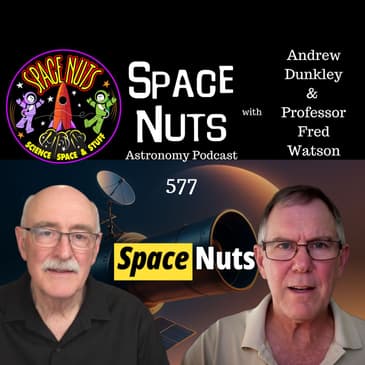

This episode of Space Nuts is brought to you with the support of NordVPN. To get our special Space Nuts listener discounts and four months free bonus, all with a 30-day money-back guarantee, simply visit www.nordvpn.com/spacenuts or use the coupon code SPACENUTS at checkout.
Exploring Theia, Near-Earth Asteroids, and Enceladus
In this exciting episode of Space Nuts, hosts Andrew Dunkley and Professor Fred Watson dive into a wealth of astronomical discoveries and insights. From new revelations about the ancient collision between Earth and Theia to the astounding discovery of 40,000 near-Earth asteroids, this episode is packed with cosmic revelations that will spark your curiosity about the universe.
Episode Highlights:
- Theia and Earth's Relationship: Andrew and Fred discuss groundbreaking research from the Max Planck Institute that redefines our understanding of Theia, the protoplanet that collided with Earth. They explore how isotopic similarities suggest Theia was not just a random object, but likely a companion planet in the early solar system.
- 40,000 Near-Earth Asteroids: The hosts celebrate the milestone of 40,000 discovered near-Earth asteroids, discussing the implications for planetary defense and the importance of monitoring potentially hazardous objects that could pose a threat to Earth.
- Life on Enceladus: A thrilling discussion emerges around the latest findings from the Cassini mission, revealing new organic compounds in the icy plumes of Enceladus. Andrew and Fred ponder the exciting possibility of life existing in the subsurface ocean of this intriguing moon of Saturn.
- Updates on Comet 3I Atlas: The episode wraps up with an update on the interstellar comet 3I Atlas, including stunning new images captured from Mars. The hosts discuss the significance of these observations and what they might reveal about the comet's characteristics as it continues its journey through our solar system.
For more Space Nuts, including our continuously updating newsfeed and to listen to all our episodes, visit our website. Follow us on social media at SpaceNutsPod on Facebook, X, YouTube Music Music, Tumblr, Instagram, and TikTok. We love engaging with our community, so be sure to drop us a message or comment on your favorite platform.
If you’d like to help support Space Nuts and join our growing family of insiders for commercial-free episodes and more, visit spacenutspodcast.com/about.
Stay curious, keep looking up, and join us next time for more stellar insights and cosmic wonders. Until then, clear skies and happy stargazing.
Become a supporter of this podcast: https://www.spreaker.com/podcast/space-nuts-astronomy-insights-cosmic-discoveries--2631155/support.
00:00:00 --> 00:00:02 Andrew Dunkley: Hi there. Thanks for joining us on Space
00:00:02 --> 00:00:04 Nuts, where we talk astronomy and space
00:00:04 --> 00:00:06 science. My name is Andrew Dunkley. Great to
00:00:06 --> 00:00:09 have your company. Coming up on this episode,
00:00:09 --> 00:00:12 uh, a new study from the Max Planck Institute
00:00:12 --> 00:00:14 shedding some new light on the theia, uh,
00:00:14 --> 00:00:17 Earth relationship, which might surprise you.
00:00:18 --> 00:00:19 And just when you thought it was safe to go
00:00:19 --> 00:00:22 back, uh, to sleep at night. 40
00:00:22 --> 00:00:25 new near earth asteroids have been
00:00:25 --> 00:00:28 discovered. Only 40? And they're all
00:00:28 --> 00:00:30 coming our way. No, they're not. Uh, the
00:00:30 --> 00:00:32 search for life just got another, um,
00:00:33 --> 00:00:36 a bit closer. Thanks uh, to some Cassini
00:00:36 --> 00:00:38 data. And 3i atlas still
00:00:38 --> 00:00:41 making the news. We'll talk about all of that
00:00:41 --> 00:00:44 on this episode of space nuts. 15
00:00:44 --> 00:00:44 seconds.
00:00:44 --> 00:00:47 Professor Fred Watson: Guidance is internal. 10, 9,
00:00:47 --> 00:00:50 uh, ignition sequence start.
00:00:50 --> 00:00:51 Space nuts.
00:00:51 --> 00:00:54 5, 4, 3, 2, 1, 2, 3, 4,
00:00:54 --> 00:00:56 5, 5, 4, 3, 2,.
00:00:56 --> 00:00:57 Andrew Dunkley: Space nuts.
00:00:57 --> 00:00:59 Professor Fred Watson: Astronauts report it feels.
00:01:00 --> 00:01:01 Andrew Dunkley: And we rolled out the red carpet because.
00:01:01 --> 00:01:04 He's back. It's Professor Fred Watson,
00:01:04 --> 00:01:06 astronomer at large. Hello, Fred.
00:01:06 --> 00:01:08 Professor Fred Watson: Hi, Andrew. I'm actually looking for the red
00:01:08 --> 00:01:09 carpet.
00:01:09 --> 00:01:12 Andrew Dunkley: Yeah, I rolled it back up again. It's had
00:01:12 --> 00:01:13 a few moth holes in it.
00:01:14 --> 00:01:16 Professor Fred Watson: Yeah, but, yeah, it's glad to hear it. Good.
00:01:17 --> 00:01:20 And you too. And, um, well, we've missed you.
00:01:20 --> 00:01:22 No, wait a minute. No, you've missed one or
00:01:22 --> 00:01:23 the other.
00:01:23 --> 00:01:25 Andrew Dunkley: Yes, we did have a few people starting to,
00:01:25 --> 00:01:28 um. I found in radio, if you're away for
00:01:28 --> 00:01:30 more than about three or four weeks, people
00:01:30 --> 00:01:33 started ringing the station and emailing to
00:01:33 --> 00:01:35 say, where's Joe Bloggs? Or where's. You
00:01:35 --> 00:01:37 know, this started happening with you, Fred?
00:01:37 --> 00:01:38 So.
00:01:38 --> 00:01:39 Professor Fred Watson: Oh, seriously, where's Fred?
00:01:39 --> 00:01:41 Andrew Dunkley: Where's Fred? What's going on with Fred? What
00:01:41 --> 00:01:44 happened to Fred? Uh, and funnily enough,
00:01:44 --> 00:01:46 I was able to say, yeah, I don't know.
00:01:48 --> 00:01:51 Professor Fred Watson: We haven't seen him for weeks. He's just
00:01:51 --> 00:01:51 disappeared.
00:01:51 --> 00:01:53 Andrew Dunkley: But no, he's back. He's back.
00:01:54 --> 00:01:56 So where did you go? What was the. Give us
00:01:56 --> 00:01:59 the. Give us the precede version of your
00:01:59 --> 00:02:00 seven weeks away.
00:02:01 --> 00:02:04 Professor Fred Watson: Three weeks, um, leading one of Marnie's
00:02:04 --> 00:02:06 tours, uh, which, uh, is the third
00:02:06 --> 00:02:09 big one we've done this year, actually. Um,
00:02:09 --> 00:02:11 after the Arctic in January and
00:02:11 --> 00:02:14 February. And then it was, uh, Western
00:02:14 --> 00:02:16 Australia in the middle of the year. And then
00:02:16 --> 00:02:18 this time we went to Japan. Uh, so we had a
00:02:18 --> 00:02:21 tour that took in interesting, uh, places
00:02:21 --> 00:02:23 like Osaka and Kyoto and
00:02:23 --> 00:02:26 Tokyo. And, um, Marnie and I actually made
00:02:26 --> 00:02:29 a side trip down to Hiroshima, which is a
00:02:29 --> 00:02:31 place I've always wanted to visit and I'm
00:02:31 --> 00:02:34 very glad I did. Very sobering place to
00:02:34 --> 00:02:37 be. Uh, But a welcoming city as well.
00:02:37 --> 00:02:39 Um, it was a pleasure to be there. Uh, and
00:02:39 --> 00:02:42 then, um, we wound up actually in Hokkaido,
00:02:42 --> 00:02:45 right in the north of Japan, where it was
00:02:45 --> 00:02:47 essentially coming onto winter. Uh, they get
00:02:47 --> 00:02:50 lots and lots of snow up there. It's a lot
00:02:50 --> 00:02:52 similar to, um, the Arctic, even though it's
00:02:52 --> 00:02:55 at a much lower latitude. Um, yeah, that was
00:02:55 --> 00:02:57 all fun. So we came back, we had four nights
00:02:57 --> 00:02:59 in Sydney, at home in our own bed, do the
00:02:59 --> 00:03:01 washing, and then off again to a conference.
00:03:01 --> 00:03:03 Conference on dark skies in County Mayo in
00:03:03 --> 00:03:06 Ireland. Uh, we were in Ireland for about a
00:03:06 --> 00:03:08 week, a little bit more than a week. We did
00:03:08 --> 00:03:10 some touring down in the South. We blew
00:03:10 --> 00:03:12 a kiss to the Blarney Stone.
00:03:12 --> 00:03:13 Andrew Dunkley: I did.
00:03:13 --> 00:03:16 Professor Fred Watson: Uh. Yeah, I wasn't game to
00:03:16 --> 00:03:17 kiss the Blarney Stone because you have to be
00:03:17 --> 00:03:18 upside down.
00:03:18 --> 00:03:19 Andrew Dunkley: Yeah.
00:03:19 --> 00:03:20 Professor Fred Watson: Doesn't suit me at all.
00:03:20 --> 00:03:21 Andrew Dunkley: We didn't do that either.
00:03:22 --> 00:03:24 Professor Fred Watson: No. So we blew it a kiss, which is, uh,
00:03:24 --> 00:03:25 enough, apparently, to get the gift of the
00:03:25 --> 00:03:28 gab. And then, uh, in fact, Blarney was a
00:03:28 --> 00:03:29 delightful place. It was the one sunny
00:03:29 --> 00:03:32 afternoon we had in, um. And it was
00:03:32 --> 00:03:34 lovely. Such an amazing castle. And the
00:03:34 --> 00:03:37 grounds are picture perfect. Uh, then we went
00:03:37 --> 00:03:40 over to Scotland, spent some time with my two
00:03:40 --> 00:03:42 daughters, had a great time with them. Took a
00:03:42 --> 00:03:45 weekend out. Uh, we all beetled off to St.
00:03:45 --> 00:03:47 Andrews, where I was educated. A, uh, town
00:03:47 --> 00:03:49 that's very close to my heart. We had a great
00:03:49 --> 00:03:51 time there. Uh, didn't do any golf. I'm
00:03:51 --> 00:03:53 sorry. But we did walk past the old course
00:03:53 --> 00:03:56 and thought of you with your golf clubs and
00:03:56 --> 00:03:58 that they don't float and things like that.
00:04:00 --> 00:04:03 And then after that, we, um, took the
00:04:03 --> 00:04:05 train down to Birmingham from Edinburgh, and
00:04:05 --> 00:04:07 that was pleasant. And at Birmingham, we got
00:04:07 --> 00:04:09 on a plane and went to Cyprus, uh, in the
00:04:09 --> 00:04:11 eastern end of the Mediterranean. And we
00:04:11 --> 00:04:13 actually had a holiday, six nights.
00:04:13 --> 00:04:15 Andrew Dunkley: And you found an observatory, a brand new one
00:04:15 --> 00:04:16 called Troodos.
00:04:16 --> 00:04:19 Professor Fred Watson: Troodos Observatory. Yes, we did. Marnie had
00:04:19 --> 00:04:20 checked it out, as she does with these
00:04:20 --> 00:04:23 things. And so we made a pilgrimage up into
00:04:23 --> 00:04:25 the hills. Not very far from the highest
00:04:25 --> 00:04:27 point in the island, actually, Mount Olympus.
00:04:27 --> 00:04:29 Uh, but, uh, it's got its own little
00:04:29 --> 00:04:32 mountain, has, uh. Uh, the Troodos
00:04:32 --> 00:04:34 Observatory. Uh, we went up there. We went
00:04:34 --> 00:04:36 completely unannounced. They just had a tour
00:04:36 --> 00:04:38 group through. So there were two coaches
00:04:38 --> 00:04:41 which were just about to set off down this
00:04:41 --> 00:04:43 road that was slightly narrower than a coach.
00:04:44 --> 00:04:47 Ah, and an angle of 45 degrees. Uh, if
00:04:47 --> 00:04:49 we'd been, um, you know, if we'd Been half an
00:04:49 --> 00:04:51 hour later, we'd have probably not been able
00:04:51 --> 00:04:53 to get there because these damn, um, coaches
00:04:53 --> 00:04:55 going by. But when we arrived, um,
00:04:56 --> 00:04:57 you know, they just got rid of all the coach
00:04:57 --> 00:04:59 party, and we turned up and said, we're
00:04:59 --> 00:05:01 astronomers. Can, uh, we have a look? And
00:05:01 --> 00:05:03 they said, oh, no, no, you'll have to wait
00:05:03 --> 00:05:05 till the next tour. Uh, but we managed to get
00:05:05 --> 00:05:07 hold of the events manager who said, yeah,
00:05:07 --> 00:05:09 come in, let's talk about what we do. And all
00:05:09 --> 00:05:11 the rest of it. Had a great time. So that was
00:05:11 --> 00:05:14 very, very nice. Uh, and if she's a Space
00:05:14 --> 00:05:16 Nuts listener, um,
00:05:16 --> 00:05:19 nice to have met you, I think it was. Irena
00:05:19 --> 00:05:22 was her name. Greek version of that. And then
00:05:22 --> 00:05:24 came home, uh, and we came home last week and
00:05:24 --> 00:05:25 we're now jet lagged.
00:05:25 --> 00:05:27 Andrew Dunkley: Yeah, it's hard to get over jet lag. I think
00:05:27 --> 00:05:30 it's. It's an age thing, Fred. We take you.
00:05:30 --> 00:05:32 Professor Fred Watson: Could be. Except, um, my other half is a lot
00:05:32 --> 00:05:34 younger than I am and she's jet lagged too.
00:05:35 --> 00:05:38 Andrew Dunkley: Just goes a bit territory. Yeah.
00:05:38 --> 00:05:40 Well, I've got a golf story for you while
00:05:40 --> 00:05:42 you're away. I won it. I won a championship.
00:05:42 --> 00:05:45 Professor Fred Watson: You did? Yes. Well done. So it
00:05:45 --> 00:05:47 was, um, 17 years between.
00:05:47 --> 00:05:50 Andrew Dunkley: M. Ah, uh, well, no, I came, uh,
00:05:50 --> 00:05:53 in the state championship, So I came third
00:05:53 --> 00:05:56 on handicaps and top, uh,
00:05:56 --> 00:05:59 10. I finished ninth, I think, in the state
00:05:59 --> 00:06:00 championship. But then we had our own, um,
00:06:01 --> 00:06:03 championship at Dubbo Golf Club the other
00:06:03 --> 00:06:05 day, and I managed to win one of those. So,
00:06:05 --> 00:06:07 uh, that's very good. And then today, just
00:06:07 --> 00:06:10 before this, I played in the Pro Am because
00:06:10 --> 00:06:12 we're hosting the New South Wales Women's
00:06:12 --> 00:06:15 Open qualifying event. So. Played with
00:06:15 --> 00:06:18 a young lass from Melbourne. Her name is
00:06:18 --> 00:06:20 Piper. Um, Piper.
00:06:21 --> 00:06:24 Oh, I've gone blank. Um,
00:06:24 --> 00:06:27 anyway, come back to me, lovely, uh, young
00:06:27 --> 00:06:30 lady hits a really mean ball and wishing
00:06:30 --> 00:06:31 her well, hope she makes it to the New South
00:06:31 --> 00:06:34 Wales Open. And, um, I'll be watching her
00:06:34 --> 00:06:36 career closely, so. Very good.
00:06:37 --> 00:06:37 Professor Fred Watson: She beat you.
00:06:38 --> 00:06:40 Andrew Dunkley: Oh, uh, gosh, yes. Oh, uh, yes, well, it was
00:06:40 --> 00:06:42 a teams event today, so we were technically
00:06:42 --> 00:06:44 playing together, but she out drove Smoke
00:06:45 --> 00:06:47 Miles. Yes, Chicken Head is interesting. It
00:06:47 --> 00:06:50 is a long way, but, uh, just a pleasure. Just
00:06:50 --> 00:06:53 a delight. We had a good day. We
00:06:53 --> 00:06:54 should get down to it, Fred.
00:06:55 --> 00:06:56 Professor Fred Watson: Yeah, we should. Yes. We're not here to talk
00:06:56 --> 00:06:59 about golf, are we? Although, no, it doesn't
00:06:59 --> 00:06:59 seem that way.
00:06:59 --> 00:07:00 Andrew Dunkley: Not for a change.
00:07:01 --> 00:07:04 Um, our first story takes us back four
00:07:04 --> 00:07:06 and a half billion years when our neighboring
00:07:06 --> 00:07:09 world, known as Thea, smashed into
00:07:09 --> 00:07:11 Us and all hell broke loose, literally and
00:07:11 --> 00:07:14 figuratively. But, uh, a new study has
00:07:14 --> 00:07:16 just, uh, been released from the Max Planck
00:07:16 --> 00:07:18 Institute Institute that's uh, shed a bit of
00:07:18 --> 00:07:21 new light on the thea Earth relationship. Uh,
00:07:21 --> 00:07:24 it doesn't sound like this was what
00:07:24 --> 00:07:26 we originally thought. Just some m. Random
00:07:26 --> 00:07:27 thing coming in and hitting us.
00:07:29 --> 00:07:31 There's more to the story now.
00:07:32 --> 00:07:34 Professor Fred Watson: There is, yes. Um, sorry Andrew, you broke up
00:07:34 --> 00:07:36 there, but I think I know what you said. Uh,
00:07:37 --> 00:07:40 um, the story of Theia, of course, this has
00:07:40 --> 00:07:43 been the principal theory, uh, for the
00:07:43 --> 00:07:45 origin of the Moon for at least the last 60
00:07:45 --> 00:07:47 years. Uh, when the Apollo astronauts brought
00:07:47 --> 00:07:50 back, what was it, 380 kg of lunar
00:07:50 --> 00:07:52 rock and soil, which is still being analyzed.
00:07:53 --> 00:07:56 Um, so, uh, Theia is the
00:07:56 --> 00:07:59 hypothesized planet, uh,
00:07:59 --> 00:08:01 perhaps protoplanet is a better word because
00:08:01 --> 00:08:04 this was at a time when the solar system was
00:08:04 --> 00:08:06 still in its infancy 4 1/2 billion years ago.
00:08:07 --> 00:08:10 And this object, uh, basically clouted the
00:08:10 --> 00:08:13 Earth. Uh, and uh, we think that what
00:08:13 --> 00:08:15 happened in the aftermath of that collision
00:08:16 --> 00:08:19 was a cloud of debris raised from the surface
00:08:19 --> 00:08:21 of the Earth, went into orbit around the
00:08:21 --> 00:08:22 Earth and eventually coalesced to form the
00:08:22 --> 00:08:25 Moon. And so we've um,
00:08:25 --> 00:08:28 had puzzles which you and I have spoken about
00:08:28 --> 00:08:31 a number of times as to why it is.
00:08:32 --> 00:08:34 Well, let me step back a bit. The first
00:08:34 --> 00:08:37 theory was that because this is
00:08:37 --> 00:08:40 a smaller object hitting a bigger object, so
00:08:40 --> 00:08:42 theories thought to have been half the size
00:08:42 --> 00:08:44 of the Earth to get the dynamics right, um,
00:08:45 --> 00:08:47 the Earth's the bigger planet. Uh, what you
00:08:47 --> 00:08:50 would expect is that the debris cloud
00:08:50 --> 00:08:53 raised from the Earth when the collision
00:08:53 --> 00:08:55 happened would be mostly made of Theia
00:08:55 --> 00:08:57 material. Um, and
00:08:58 --> 00:09:00 that's been a puzzle for a long time because
00:09:01 --> 00:09:04 most of the lunar rocks and soil
00:09:04 --> 00:09:07 have the same isotopic signature
00:09:07 --> 00:09:09 which we've talked about before as well, the
00:09:09 --> 00:09:12 same isotopic signature as the Earth. They're
00:09:12 --> 00:09:15 identical, uh, to the Earth's rocks. And so
00:09:15 --> 00:09:17 that was seen as a puzzle about probably five
00:09:17 --> 00:09:19 years ago or so. We did cover it on space
00:09:19 --> 00:09:22 notes. Some Japanese researchers, um,
00:09:22 --> 00:09:24 figured out that if the Earth were still
00:09:24 --> 00:09:26 effectively molten at that time, if it was
00:09:26 --> 00:09:29 still a magma world when the collision
00:09:29 --> 00:09:32 happened, then you'd get, um, a moon that
00:09:32 --> 00:09:34 was formed largely of Earth
00:09:34 --> 00:09:37 compounds. So, um, what has
00:09:37 --> 00:09:40 now happened is that, um, a close
00:09:40 --> 00:09:43 examination has been made and as you write
00:09:43 --> 00:09:45 it, the Max Planck Institute for Solar System
00:09:45 --> 00:09:47 Research, along with the University of
00:09:47 --> 00:09:50 Chicago, um, they've really honed
00:09:50 --> 00:09:52 in on um,
00:09:53 --> 00:09:55 the exact, uh, details of
00:09:55 --> 00:09:58 the isotopes in rocks from the, uh, Earth,
00:09:59 --> 00:10:01 the Moon and meteorites, because they're part
00:10:01 --> 00:10:04 of the story too. And it's not just
00:10:05 --> 00:10:07 the sort of isotopes that have been looked at
00:10:07 --> 00:10:09 before. These are, uh, iron, chromium,
00:10:09 --> 00:10:11 molybdenum, molybdenum, ah,
00:10:11 --> 00:10:14 zirconium, all these,
00:10:14 --> 00:10:17 um, chemical elements. Their isotope
00:10:17 --> 00:10:20 data have been analyzed to
00:10:20 --> 00:10:23 look again at, uh, what we find, because,
00:10:23 --> 00:10:26 yes, we still find that the Earth and the
00:10:26 --> 00:10:29 Moon have very similar isotopic mixes.
00:10:29 --> 00:10:32 Uh, but then you can identify
00:10:32 --> 00:10:35 some slight differences that are
00:10:35 --> 00:10:38 attributed to be isotopes that have come
00:10:38 --> 00:10:41 from Theia itself. So they can tease out
00:10:41 --> 00:10:44 what was Theia and what was Earth. And it
00:10:44 --> 00:10:47 turns out that when you do that, you still
00:10:47 --> 00:10:50 get a similar picture, that the
00:10:50 --> 00:10:52 isotope ratios, uh, on
00:10:52 --> 00:10:55 Theia were probably very similar to what
00:10:55 --> 00:10:58 they are on Earth. Um, and
00:10:58 --> 00:10:59 that is
00:11:01 --> 00:11:03 symptomatic, if I can put it that way, of
00:11:04 --> 00:11:07 the Earth and Theia being born
00:11:07 --> 00:11:10 close together. And the reason why we think
00:11:10 --> 00:11:12 that is that when you look at the solar
00:11:12 --> 00:11:15 system, you find that these isotope ratios
00:11:15 --> 00:11:18 change depending on how far out you are from
00:11:18 --> 00:11:21 the Sun. So if you've got two planets
00:11:21 --> 00:11:24 with very similar isotope ratios, then
00:11:24 --> 00:11:27 what you can deduce from that is
00:11:27 --> 00:11:29 that they were orbiting the sun close
00:11:29 --> 00:11:32 together. And that makes complete sense
00:11:32 --> 00:11:34 because eventually they run into one another.
00:11:34 --> 00:11:37 Um, but what the outcome of this research
00:11:37 --> 00:11:40 is is that, uh, Theia was not just
00:11:40 --> 00:11:42 a random object that ran into the Earth in
00:11:42 --> 00:11:45 the early solar system. It was actually, if
00:11:45 --> 00:11:48 not a companion of Earth, but something in a
00:11:48 --> 00:11:50 very similar orbit. So, you know, maybe we
00:11:50 --> 00:11:53 had Mercury, Venus, Theia, uh, Earth, Mars as
00:11:53 --> 00:11:56 the rocky planets. Um, although that order,
00:11:56 --> 00:11:58 you know, I've made that up, but that's the
00:11:58 --> 00:12:00 kind of thing it's bringing, bringing
00:12:00 --> 00:12:03 Theia into the picture as something that
00:12:03 --> 00:12:05 would have been maybe, had it not collided
00:12:05 --> 00:12:08 with the Earth, it would have, uh, the ninth
00:12:08 --> 00:12:10 planet, uh, in the inner part of the solar
00:12:10 --> 00:12:13 system. So, uh, a very nice piece of work,
00:12:13 --> 00:12:15 some very, very careful studies there that I
00:12:15 --> 00:12:17 think has raised a lot of, um, interest in
00:12:17 --> 00:12:20 the planetary, uh, science
00:12:20 --> 00:12:20 community.
00:12:21 --> 00:12:23 Andrew Dunkley: Yeah, I suppose that sort of, uh,
00:12:23 --> 00:12:26 confirms that it was part of the solar system
00:12:26 --> 00:12:28 and not just some random thing passing
00:12:28 --> 00:12:30 through, knocking us over in the process.
00:12:31 --> 00:12:34 Professor Fred Watson: That's right, yeah. And, um, I should just
00:12:34 --> 00:12:36 explain how the Theia remnants have
00:12:36 --> 00:12:39 been. The Theia isotopes have been
00:12:39 --> 00:12:41 determined, and it's by looking at things
00:12:41 --> 00:12:42 that we find in the crust of the, uh, Earth,
00:12:43 --> 00:12:46 because we know that the heavy elements would
00:12:46 --> 00:12:48 have already sunk to the. To the center of
00:12:48 --> 00:12:50 the Earth when that collision happened. So
00:12:50 --> 00:12:52 when we think fine things like these
00:12:52 --> 00:12:55 molybdenum, iron, zirconium, things
00:12:55 --> 00:12:58 of that sort, um, we can infer
00:12:58 --> 00:13:00 that some of that actually came from Thee
00:13:00 --> 00:13:03 itself. And that's how the similarity
00:13:03 --> 00:13:06 has been deduced, along with looking at
00:13:06 --> 00:13:08 meteorite samples too. So you're right. Um,
00:13:09 --> 00:13:12 it is not something that's come from
00:13:12 --> 00:13:15 another solar system like our current visitor
00:13:15 --> 00:13:17 3i atlas. Uh, it's
00:13:17 --> 00:13:20 definitely a homegrown planet that, uh, we
00:13:20 --> 00:13:21 collided with.
00:13:21 --> 00:13:23 Andrew Dunkley: Okay. And now it's sort of a. Well, it's not
00:13:23 --> 00:13:25 a part of us. There's bits and pieces of it,
00:13:25 --> 00:13:28 but most, um, of it, it's sort of vanquished
00:13:28 --> 00:13:30 into the never never, didn't it?
00:13:30 --> 00:13:32 Professor Fred Watson: Yeah, a lot of it would have done. But, um,
00:13:32 --> 00:13:34 some of it's in the moon, some of it's on the
00:13:34 --> 00:13:34 Earth as well.
00:13:35 --> 00:13:35 Andrew Dunkley: Yeah.
00:13:35 --> 00:13:36 Professor Fred Watson: All right.
00:13:36 --> 00:13:39 Andrew Dunkley: So, yes, some new information from the
00:13:39 --> 00:13:41 Max Planck Institute about, uh, theia
00:13:42 --> 00:13:44 being a part of the inner solar system. If
00:13:44 --> 00:13:46 you'd like to read about that, uh, there's a
00:13:46 --> 00:13:46 really great
00:13:46 --> 00:13:49 article@scienceblog.com
00:13:49 --> 00:13:51 this is space Nuts with Andrew Dunkley and
00:13:51 --> 00:13:52 Professor Fred.
00:13:56 --> 00:13:57 Space Nuts.
00:13:58 --> 00:14:00 Uh, now to some really good news, Fred.
00:14:00 --> 00:14:03 40 near Earth asteroids have been
00:14:03 --> 00:14:05 discovered. Is that all? Is that all I could
00:14:05 --> 00:14:06 find?
00:14:07 --> 00:14:10 Professor Fred Watson: Well, yeah, I mean, for a long time
00:14:10 --> 00:14:12 we've known 39.
00:14:14 --> 00:14:16 Um, maybe not for very long because we're
00:14:16 --> 00:14:18 discovering asteroids at a very prolific rate
00:14:18 --> 00:14:20 at the moment. And that comes about because
00:14:20 --> 00:14:22 we've got such good technology discovering
00:14:22 --> 00:14:25 them. Um, and so, yes, this is a
00:14:25 --> 00:14:27 milestone that's been celebrated by esa, the
00:14:27 --> 00:14:28 European Space Agency.
00:14:29 --> 00:14:29 Andrew Dunkley: Uh.
00:14:31 --> 00:14:33 Professor Fred Watson: So they've put out a press release saying
00:14:33 --> 00:14:36 40 near Earth asteroids discovered. Uh,
00:14:36 --> 00:14:38 what do we mean by a near Earth asteroid?
00:14:38 --> 00:14:41 It's one that approaches within about
00:14:41 --> 00:14:43 45 million kilometers of
00:14:44 --> 00:14:47 the Earth. Uh, and that's nearly a third
00:14:47 --> 00:14:49 of the distance to the sun. So when you
00:14:49 --> 00:14:52 say near, it's a fairly
00:14:52 --> 00:14:55 relative term. It's one, uh, with objects
00:14:55 --> 00:14:57 that can get within that distance of Earth.
00:14:58 --> 00:15:00 Then there's another subset of those, though,
00:15:00 --> 00:15:02 that we tend to call PHAs,
00:15:02 --> 00:15:05 potentially hazardous asteroids.
00:15:05 --> 00:15:08 Uh, and, um, there are something like. I
00:15:08 --> 00:15:09 think if I remember rightly, it's about two
00:15:09 --> 00:15:12 and a half thousand of those. And they're the
00:15:12 --> 00:15:14 ones whose orbits cross the orbit of the
00:15:14 --> 00:15:16 Earth. Um, and so they are potentially
00:15:16 --> 00:15:18 hazardous. And they're the ones that we keep
00:15:18 --> 00:15:20 an eye on all the time, uh,
00:15:21 --> 00:15:23 monitoring where they are, uh, and
00:15:24 --> 00:15:27 checking forward, uh, in computers.
00:15:27 --> 00:15:29 Once we know their orbits, checking forward
00:15:29 --> 00:15:31 as to whether there's any likelihood of
00:15:31 --> 00:15:33 collision. The good news is is that there's
00:15:33 --> 00:15:35 not. Uh, over the next hundred years or so
00:15:35 --> 00:15:38 we've got a fairly clean sweep of things.
00:15:38 --> 00:15:40 At least things bigger than about 140
00:15:41 --> 00:15:44 meters across and they can be very dangerous.
00:15:44 --> 00:15:47 They could be city destroyers or even state
00:15:47 --> 00:15:50 destroyers. So um, keeping an eye on
00:15:50 --> 00:15:52 those is important. Uh, and I think the
00:15:52 --> 00:15:55 reason why ESA has highlighted this is
00:15:55 --> 00:15:58 because it does highlight the whole regime
00:15:58 --> 00:16:01 of planetary defense. Uh, that's a very
00:16:01 --> 00:16:04 active area in astronomy and um,
00:16:04 --> 00:16:06 m actually almost civil defense as well. It's
00:16:06 --> 00:16:08 not just astronomy that is concerned with
00:16:08 --> 00:16:11 that. I think I probably mentioned before
00:16:11 --> 00:16:13 when I was at the IAU a couple of years ago,
00:16:13 --> 00:16:16 I actually got myself into a meeting uh,
00:16:16 --> 00:16:18 which was the Planetary Defense Agency,
00:16:19 --> 00:16:22 uh talking about uh, their next activities
00:16:22 --> 00:16:25 which included uh, um,
00:16:25 --> 00:16:28 a mock threatened uh, planetary asteroid
00:16:28 --> 00:16:30 impact and how all the services would deal
00:16:30 --> 00:16:33 with that. And from the astronomers
00:16:33 --> 00:16:36 right to the, the people who get the fire
00:16:36 --> 00:16:38 engines out to put out the fires and things
00:16:38 --> 00:16:40 of that sort. It's a very interesting thing
00:16:40 --> 00:16:42 to watch. So uh, what it did was
00:16:42 --> 00:16:45 reassured me that we're in quite good hands.
00:16:45 --> 00:16:48 Uh but yeah, the bottom line, 40 uh, thousand
00:16:48 --> 00:16:51 near Earth asteroids known. Uh, the
00:16:51 --> 00:16:53 good news is always that the big ones which
00:16:53 --> 00:16:55 uh, are the most dangerous ones, they're the
00:16:55 --> 00:16:58 easiest to find. And we think we know pretty
00:16:58 --> 00:17:01 well all of the asteroids bigger
00:17:01 --> 00:17:03 than a uh, kilometer which would be
00:17:03 --> 00:17:06 um, dinosaur killers, they would wipe out,
00:17:06 --> 00:17:09 you know, there'd be mass extinction objects.
00:17:09 --> 00:17:12 Uh, we think one of those hits the earth
00:17:12 --> 00:17:15 roughly every 200 million years. It's uh,
00:17:15 --> 00:17:18 66 million years ago since the last one did,
00:17:18 --> 00:17:20 which was, was the one that wiped out we, the
00:17:20 --> 00:17:23 dinosaurs. Um, since then though we've
00:17:23 --> 00:17:25 learned a lot about, not only about asteroids
00:17:25 --> 00:17:28 but about how we might deflect uh an
00:17:28 --> 00:17:31 asteroid if uh, if there was
00:17:31 --> 00:17:33 one that could be shown to be on a collision
00:17:33 --> 00:17:35 course with Earth. And you and I have talked
00:17:35 --> 00:17:38 at length and with great enthusiasm about the
00:17:38 --> 00:17:41 dart mission back in 2022 and the double
00:17:41 --> 00:17:44 asteroid redirection test, a uh,
00:17:44 --> 00:17:47 really well put together experiment by NASA
00:17:47 --> 00:17:50 which succeeded uh, in changing the
00:17:50 --> 00:17:52 orbit of a little world called Dimorphos.
00:17:53 --> 00:17:56 Uh, and that's great news because we know
00:17:56 --> 00:17:58 that it's now possible to do that. And just
00:17:58 --> 00:18:01 as a postscript to this story, um, ESA
00:18:01 --> 00:18:04 currently has a spacecraft called Hera H E R
00:18:04 --> 00:18:07 A on um, its way to Dimorphos
00:18:07 --> 00:18:10 to check out what the result of that impact
00:18:10 --> 00:18:12 was. It's going to study that little world,
00:18:12 --> 00:18:15 look at the debris that was raised by the
00:18:15 --> 00:18:18 impact, get uh, a much better idea of whether
00:18:19 --> 00:18:21 it really is just a rubble pile, which we
00:18:21 --> 00:18:24 think it probably is, and just uh, learn more
00:18:24 --> 00:18:26 about what an impact by uh,
00:18:27 --> 00:18:29 a spacecraft does to an asteroid. Because
00:18:29 --> 00:18:31 that's the key thing. If we're going to have
00:18:31 --> 00:18:34 to save ourselves one day by, by doing this.
00:18:34 --> 00:18:36 We want to know as much about it as possible.
00:18:36 --> 00:18:38 And if I remember rightly, Hera will reach
00:18:39 --> 00:18:41 Dimorphous. I think it's late next year. I
00:18:41 --> 00:18:42 think it's towards the end of next year.
00:18:43 --> 00:18:46 Andrew Dunkley: Very exciting. Yeah, nice to get a follow up
00:18:46 --> 00:18:49 on that story too. Yeah. Um, and of course
00:18:49 --> 00:18:51 this is not the end of finding these kinds of
00:18:51 --> 00:18:54 things because, uh, the Vera C. Rubin
00:18:54 --> 00:18:55 Observatory in Chile,
00:18:57 --> 00:18:59 it's not its primary role, but it will be
00:19:00 --> 00:19:02 looking for other, um, Near Earth
00:19:02 --> 00:19:05 objects. And they expect it to find
00:19:05 --> 00:19:06 tens of thousands of them.
00:19:06 --> 00:19:09 Professor Fred Watson: Absolutely, that's right. By this time next
00:19:09 --> 00:19:11 year we might be Talking about, uh, 80 or
00:19:11 --> 00:19:14 100 near Earth asteroids
00:19:14 --> 00:19:16 discovered. And of course again that's a good
00:19:16 --> 00:19:18 news story because as soon as you discover
00:19:18 --> 00:19:20 one of these things, first thing you do is
00:19:20 --> 00:19:23 put its orbital elements into the computer
00:19:23 --> 00:19:26 grind away, look at its trajectory in the
00:19:26 --> 00:19:28 future. And that is all done automatically.
00:19:28 --> 00:19:31 And if there is a need, uh, the system will
00:19:31 --> 00:19:33 raise alerts that there could be a collision,
00:19:34 --> 00:19:36 uh, in a certain window in the future. So
00:19:37 --> 00:19:39 um, that whole process is really part of
00:19:39 --> 00:19:41 planetary defense. It's what's safeguarding
00:19:41 --> 00:19:43 us from the asteroid hazard.
00:19:43 --> 00:19:46 Andrew Dunkley: Yeah, yeah. Um, I read a
00:19:46 --> 00:19:48 story the other day, I think Vera C. Rubin,
00:19:48 --> 00:19:51 um, had had it took its first
00:19:51 --> 00:19:53 picture, first light. I think they refer to
00:19:53 --> 00:19:55 it as in, was it June or July this year?
00:19:56 --> 00:19:57 Professor Fred Watson: Yeah, I think it's about then.
00:19:57 --> 00:20:00 Andrew Dunkley: Yeah, yeah. Uh, so we're almost at
00:20:00 --> 00:20:02 the pointy end of that, um, observatory
00:20:02 --> 00:20:03 kicking into action.
00:20:04 --> 00:20:06 Professor Fred Watson: That's right. If I remember rightly, I might
00:20:06 --> 00:20:07 have these figures slightly wrong, but it was
00:20:07 --> 00:20:10 something like. Was it a 10 hour set of
00:20:10 --> 00:20:11 observations they took and they discovered
00:20:11 --> 00:20:13 more than a thousand asteroids in that
00:20:13 --> 00:20:16 period. So imagine what it's going to be
00:20:16 --> 00:20:18 like. This thing looks at the entire southern
00:20:18 --> 00:20:21 sky every three nights. That's incredibly
00:20:21 --> 00:20:23 remarkable. Yeah, it's quite, yeah.
00:20:23 --> 00:20:26 Andrew Dunkley: Um, like we, we were so blessed to be able to
00:20:26 --> 00:20:28 get so much information out of, um.
00:20:30 --> 00:20:33 My brain's not working today. Um, the
00:20:33 --> 00:20:35 other observatory, the one that's out on in
00:20:35 --> 00:20:37 the L2.
00:20:37 --> 00:20:39 Professor Fred Watson: Oh yeah, you mean the James Webb Telescope.
00:20:39 --> 00:20:40 Andrew Dunkley: James Webb. Gosh, why Couldn't I think of
00:20:40 --> 00:20:43 that? But, um, working side by
00:20:43 --> 00:20:45 side with VC Rubin, this is just going to
00:20:45 --> 00:20:47 open up a whole new.
00:20:47 --> 00:20:50 Professor Fred Watson: Yep, that's right. At least a new registry of
00:20:50 --> 00:20:52 new discoveries. Yeah, yeah. Very, very
00:20:52 --> 00:20:53 exciting.
00:20:54 --> 00:20:56 Andrew Dunkley: If you would like to read about those 40
00:20:56 --> 00:20:59 Near Earth Objects, if you
00:20:59 --> 00:21:01 really, you know, you can go to a horror
00:21:01 --> 00:21:03 movie instead, probably much more fun. But,
00:21:03 --> 00:21:06 um, 40 near earth objects, you can do
00:21:06 --> 00:21:08 that through the European Space Agency
00:21:08 --> 00:21:08 website.
00:21:11 --> 00:21:13 Professor Fred Watson: Okay. We checked all four systems and being
00:21:13 --> 00:21:15 with a girl space nats.
00:21:15 --> 00:21:17 Andrew Dunkley: Now this, this is a story that really excites
00:21:17 --> 00:21:20 me because, because, um, we've talked about
00:21:20 --> 00:21:23 this so many times, but, um,
00:21:23 --> 00:21:26 this story I saw pop up last weekend
00:21:26 --> 00:21:29 and we have been talking so much
00:21:29 --> 00:21:30 about the potential for life
00:21:31 --> 00:21:34 elsewhere. Haven't found it yet, but the
00:21:34 --> 00:21:37 signs are starting to build, particularly
00:21:37 --> 00:21:39 within our own solar system. And
00:21:40 --> 00:21:41 this particular story
00:21:42 --> 00:21:45 is one again where we have taken a bit of
00:21:45 --> 00:21:48 old data and reanalyzed it.
00:21:49 --> 00:21:51 And this involves the Cassini
00:21:51 --> 00:21:53 mission, uh, which has been taking
00:21:54 --> 00:21:56 samples of the eruptions
00:21:57 --> 00:22:00 from Enceladus. And what they've
00:22:00 --> 00:22:02 discovered is very, very, uh,
00:22:02 --> 00:22:03 exciting.
00:22:04 --> 00:22:06 Professor Fred Watson: It is, uh, that's right. And uh, yes,
00:22:06 --> 00:22:09 Cassini, you know, uh, was active, if I
00:22:09 --> 00:22:12 remember rightly, between 2000
00:22:13 --> 00:22:15 and I think. Was it 2004? Yes,
00:22:15 --> 00:22:18 and 2017. So that was the period when
00:22:19 --> 00:22:22 Cassini collecting its data. And as you've
00:22:22 --> 00:22:24 just said, we're still learning things from
00:22:24 --> 00:22:27 those data. Uh, and in particular
00:22:27 --> 00:22:30 what has been identified is some
00:22:30 --> 00:22:33 previously unknown organic
00:22:33 --> 00:22:35 chemicals in the ice grains that
00:22:35 --> 00:22:38 Cassini flew through, which are
00:22:38 --> 00:22:40 erupting, as you said, from the ice
00:22:40 --> 00:22:43 geysers near the southern, uh,
00:22:43 --> 00:22:46 pole, the south pole of enceladus, that
00:22:46 --> 00:22:49 little 500 kilometer diameter world which
00:22:49 --> 00:22:51 is, uh, one of Saturn's moons with the
00:22:51 --> 00:22:53 structure that we think is fairly common out
00:22:53 --> 00:22:56 in that part of the solar system. Ah, a rocky
00:22:56 --> 00:22:59 body overlaying with a liquid ocean
00:22:59 --> 00:23:01 with ice on top of that. And the pressure of
00:23:01 --> 00:23:03 the ice is what's keeping that ocean liquid,
00:23:03 --> 00:23:06 along with the squeezing and squashing of the
00:23:06 --> 00:23:09 rocky part of the body by the,
00:23:09 --> 00:23:12 uh, tidal forces exerted by the giant planet
00:23:12 --> 00:23:14 Saturn, uh, next door. And Saturn, by the
00:23:14 --> 00:23:17 way, um, we've just gone through its ring
00:23:17 --> 00:23:19 plane. So Saturn. If you looked at Saturn
00:23:19 --> 00:23:21 through a telescope tonight or anytime within
00:23:21 --> 00:23:23 the next couple of weeks, you won't see any
00:23:23 --> 00:23:25 sign of the rings because we're the edge onto
00:23:25 --> 00:23:25 us.
00:23:25 --> 00:23:26 Andrew Dunkley: Oh, okay.
00:23:26 --> 00:23:29 Professor Fred Watson: Yep. Just a little aside there. Um, so,
00:23:29 --> 00:23:31 uh, what has happened is
00:23:32 --> 00:23:35 that, uh, we've known about
00:23:35 --> 00:23:38 these organic chemicals in
00:23:38 --> 00:23:41 Ice grains, which we know come
00:23:41 --> 00:23:43 from Enceladus because they actually
00:23:43 --> 00:23:46 feed into the outer ring of Saturn,
00:23:46 --> 00:23:48 something called the E ring, which is a very
00:23:48 --> 00:23:51 diffuse ring. And we know that the
00:23:51 --> 00:23:53 material in that ring, the ice crystals in
00:23:53 --> 00:23:56 that E ring, actually come from the south
00:23:56 --> 00:23:59 pole of Enceladus. And those
00:23:59 --> 00:24:02 have been well analyzed, um, by Cassini
00:24:02 --> 00:24:05 and also by other observations. And
00:24:05 --> 00:24:07 so it was known that there were organics in
00:24:07 --> 00:24:09 there. But the question was
00:24:10 --> 00:24:12 these ice crystals may have been in
00:24:12 --> 00:24:14 orbit, they may have been in space for
00:24:14 --> 00:24:16 centuries. And so their
00:24:17 --> 00:24:19 chemical structure might well have been
00:24:20 --> 00:24:23 modified first of all by the sun's
00:24:23 --> 00:24:25 ultraviolet radiation, which tends to change
00:24:25 --> 00:24:28 chemistry. Uh, and the solar
00:24:28 --> 00:24:30 wind, the wind of subatomic particles that
00:24:30 --> 00:24:33 comes from the sun, that too can change the
00:24:33 --> 00:24:35 chemistry of particles, uh,
00:24:36 --> 00:24:39 grains of, um, ice
00:24:39 --> 00:24:42 with their organics on them, the organic
00:24:42 --> 00:24:44 chemicals, uh, it can, can change their
00:24:44 --> 00:24:46 chemistry. And so there was always a question
00:24:47 --> 00:24:50 whether these quite complex organic
00:24:50 --> 00:24:52 chemicals that were identified, uh, in
00:24:52 --> 00:24:55 the E ring, uh, whether they are
00:24:55 --> 00:24:58 telling you that that's how the
00:24:58 --> 00:25:00 ice crystals were when they came, when they
00:25:00 --> 00:25:03 were spat out from M. Cassini's south
00:25:03 --> 00:25:06 pole, um, it puts doubt on it.
00:25:06 --> 00:25:08 And so what this new analysis
00:25:08 --> 00:25:11 does is looks back to one of the
00:25:11 --> 00:25:14 fly throughs of, uh, Cassini
00:25:14 --> 00:25:16 through the ice plumes back in
00:25:16 --> 00:25:19 2008. Uh, Cassini
00:25:19 --> 00:25:21 flew through the plume at about, um, 18
00:25:21 --> 00:25:24 kilometers per second at Ah, a height of
00:25:24 --> 00:25:27 about 20 kilometers above the surface of
00:25:27 --> 00:25:29 Cassini. And so the
00:25:30 --> 00:25:32 ice crystals that it passed through,
00:25:33 --> 00:25:36 um, only a few minutes earlier were actually
00:25:36 --> 00:25:38 water in the ocean of
00:25:38 --> 00:25:41 Enceladus. So these are fresh
00:25:41 --> 00:25:44 crystals of ice straight from the ocean. In
00:25:44 --> 00:25:45 other words, they're, you know, they're
00:25:45 --> 00:25:48 effectively samples of the ocean water. And
00:25:48 --> 00:25:50 what they've succeeded in showing, uh, what
00:25:50 --> 00:25:52 the scientists who've done this succeeded in
00:25:52 --> 00:25:55 showing is that the chemistry is still there.
00:25:55 --> 00:25:58 The, the organic, the complex organics
00:25:58 --> 00:26:00 are uh, there in this fresh
00:26:01 --> 00:26:03 ocean spray, as they call it. I love that
00:26:03 --> 00:26:05 idea. It's an ocean spray, uh, but it's ice
00:26:05 --> 00:26:08 crystals and there's a whole, you
00:26:08 --> 00:26:11 know, a whole list of um, things
00:26:11 --> 00:26:14 like esters, aromatics, heteroatom
00:26:14 --> 00:26:17 bearing organics. These are chemical terms
00:26:17 --> 00:26:19 that, um, I'm not that familiar with
00:26:19 --> 00:26:22 because chemistry was not my strong point.
00:26:22 --> 00:26:25 Uh, but these chemicals are, ah, yes, they
00:26:25 --> 00:26:27 are there in the ocean of Enceladus.
00:26:28 --> 00:26:31 And what that has done is raised
00:26:31 --> 00:26:33 again the possibility that living organisms
00:26:33 --> 00:26:36 might exist in that ocean. Uh, and that
00:26:36 --> 00:26:39 because these chemicals are, as we keep on
00:26:39 --> 00:26:42 saying, the building blocks of life uh, so
00:26:42 --> 00:26:44 just maybe there's something swimming around
00:26:44 --> 00:26:46 in the ocean of Enceladus that we are yet to
00:26:46 --> 00:26:46 discover.
00:26:47 --> 00:26:49 Andrew Dunkley: Yes. And wouldn't it be exciting? And, uh,
00:26:49 --> 00:26:52 hopefully in the not too distant future we'll
00:26:52 --> 00:26:54 be able to confirm it. Um,
00:26:55 --> 00:26:56 I think people are starting to get very
00:26:56 --> 00:26:58 confident about the possibility, though.
00:26:59 --> 00:26:59 Professor Fred Watson: Yep.
00:26:59 --> 00:27:02 Andrew Dunkley: Yeah, that's right. Fingers crossed. But, uh,
00:27:02 --> 00:27:04 yeah, the signs are starting to really build.
00:27:04 --> 00:27:06 And even though it'll be
00:27:06 --> 00:27:09 probably one of the most exciting things ever
00:27:09 --> 00:27:11 discovered, should we succeed in finding
00:27:11 --> 00:27:14 evidence of life elsewhere, we
00:27:14 --> 00:27:17 also probably shouldn't be surprised because
00:27:17 --> 00:27:20 water, we now know is prolific
00:27:20 --> 00:27:23 throughout the universe. We know there are,
00:27:23 --> 00:27:26 uh, probably exoplanets orbiting almost
00:27:26 --> 00:27:29 every star in the universe. Stands to
00:27:29 --> 00:27:32 reason that somewhere, somewhere out there,
00:27:32 --> 00:27:34 there's. There's got to be some form of life,
00:27:34 --> 00:27:37 even if it's only microbial, but.
00:27:38 --> 00:27:41 Professor Fred Watson: Or krill. Krill would be
00:27:41 --> 00:27:43 exciting. Green slime is what we're likely to
00:27:43 --> 00:27:46 find. I think green slime. Green slime will
00:27:46 --> 00:27:49 do. Green slime would do it. That's right. It
00:27:49 --> 00:27:49 would indeed.
00:27:49 --> 00:27:51 Andrew Dunkley: Indeed. If you'd like to read up on that
00:27:51 --> 00:27:54 story about the latest from Enceladus,
00:27:55 --> 00:27:57 you can find it in the journal Nature
00:27:57 --> 00:27:58 Astronomy.
00:28:01 --> 00:28:02 Space Butts.
00:28:02 --> 00:28:05 One last story in this episode, Fred, and
00:28:05 --> 00:28:07 it's a bit of an update on 3i Atlas the
00:28:07 --> 00:28:10 XO comet that is currently,
00:28:11 --> 00:28:13 um, doing its thing. It's doing whatever it
00:28:13 --> 00:28:16 wants, really. Um, but, um,
00:28:16 --> 00:28:19 it's, uh. It's. It's sort of reappeared. And
00:28:19 --> 00:28:21 they're getting some great pictures of it,
00:28:21 --> 00:28:23 not only from Earth, but from Mars. And,
00:28:24 --> 00:28:27 um. Some of these photos are extraordinary.
00:28:28 --> 00:28:30 Professor Fred Watson: Yes, they are. When you look at them, they're
00:28:30 --> 00:28:32 a little bit underwhelming until you realize
00:28:32 --> 00:28:35 that they've been taken by telescopes not on
00:28:35 --> 00:28:38 Earth, but, um, in one case on the surface of
00:28:38 --> 00:28:41 Mars. But, um. Uh, also, uh, from
00:28:41 --> 00:28:44 Mars orbit. Uh, and there's a little bit of
00:28:44 --> 00:28:46 a story to this because these images were
00:28:46 --> 00:28:49 taken, um, when, um,
00:28:50 --> 00:28:52 the interstellar comet 3I Atlas uh,
00:28:53 --> 00:28:56 made its closest passage, uh,
00:28:56 --> 00:28:59 closest flyby of Mars, basically, uh, 30
00:28:59 --> 00:29:02 million kilometers of Mars. That's quite a
00:29:02 --> 00:29:04 close approach compared with, um, the
00:29:04 --> 00:29:07 distances that we are from it on
00:29:07 --> 00:29:09 Earth. Uh, and that took place
00:29:10 --> 00:29:12 actually nearly two months ago, uh, in early
00:29:12 --> 00:29:15 October. Um, but what's held up the
00:29:15 --> 00:29:18 release of the, uh, of the images, uh,
00:29:18 --> 00:29:21 is the US Um government shutdown, which,
00:29:21 --> 00:29:24 yeah, prevented these images being
00:29:24 --> 00:29:25 situated.
00:29:25 --> 00:29:27 Andrew Dunkley: He spoke about that at length. Oh, getting
00:29:27 --> 00:29:29 back previous episode.
00:29:29 --> 00:29:31 Professor Fred Watson: So, yeah, I think, yes, we're pretty.
00:29:31 --> 00:29:34 Andrew Dunkley: Well squared away on the issue um, but he
00:29:34 --> 00:29:36 had colleagues that was so badly affected by
00:29:36 --> 00:29:39 that because, yes, the, um, you know, well,
00:29:39 --> 00:29:42 basically no income for as long as the
00:29:42 --> 00:29:43 shutdown existed.
00:29:43 --> 00:29:44 Professor Fred Watson: It's very, very difficult situation.
00:29:44 --> 00:29:47 Andrew Dunkley: But, yeah, so we, we know why
00:29:47 --> 00:29:49 NASA couldn't do anything at the time.
00:29:50 --> 00:29:52 Professor Fred Watson: Yeah, so that's right.
00:29:52 --> 00:29:55 Um, but we now have these images revealed now
00:29:55 --> 00:29:57 that things are up and running again. And
00:29:57 --> 00:30:00 perhaps the best one has come
00:30:00 --> 00:30:02 from the, um, HiRise
00:30:03 --> 00:30:06 camera on board Mars Reconnaissance Orbiter.
00:30:06 --> 00:30:09 And that's quite a detailed image of Comet
00:30:09 --> 00:30:12 3I Atlas with its short
00:30:12 --> 00:30:15 tail and its coma. That's the region around
00:30:15 --> 00:30:18 the nucleus where, uh, material is outgassing
00:30:18 --> 00:30:21 and, and um, shining because of, um,
00:30:21 --> 00:30:22 excitation by the sun.
00:30:24 --> 00:30:27 There's some interesting images from,
00:30:27 --> 00:30:30 uh, the Maven, uh, spacecraft
00:30:30 --> 00:30:33 as well, which, uh, has cameras on looking
00:30:33 --> 00:30:35 in the ultraviolet. And in fact it's got a
00:30:35 --> 00:30:38 spectrometer on that allows you to, uh, split
00:30:38 --> 00:30:41 the light up into its component colors. Uh,
00:30:41 --> 00:30:44 so we see the glow of hydrogen actually from,
00:30:44 --> 00:30:47 uh, from 3i Atlas, uh, photographed by the
00:30:47 --> 00:30:50 Maven spacecraft
00:30:50 --> 00:30:52 cameras and the Mastcam camera, uh,
00:30:53 --> 00:30:56 on the, uh, it's Mastcam
00:30:56 --> 00:30:59 Z, it's called on Perseverance on the
00:30:59 --> 00:31:01 surface of Mars, actually managed to capture
00:31:01 --> 00:31:04 a very, very faint image, uh, of
00:31:04 --> 00:31:07 uh, three Eye Atlas against a background of
00:31:07 --> 00:31:10 stars. It's faint because that's. That
00:31:10 --> 00:31:13 mastcam was never designed to do
00:31:13 --> 00:31:15 astronomy. It's all designed to navigate on
00:31:15 --> 00:31:18 the surface of Mars. But yet it's managed to
00:31:18 --> 00:31:20 catch a picture, uh, by being pointed
00:31:20 --> 00:31:23 upwards, obviously, uh, at this
00:31:23 --> 00:31:25 celestial visitor. So the hope is that as
00:31:25 --> 00:31:28 these images are analyzed, Andrew, we'll find
00:31:28 --> 00:31:31 out more about 3i Atlas, maybe even to
00:31:31 --> 00:31:34 get a good measurement of how big its nucleus
00:31:34 --> 00:31:36 is, the icy component that gives rise to
00:31:37 --> 00:31:40 all this luminosity. Um, the last
00:31:40 --> 00:31:42 I heard was that the thinking was it was in
00:31:42 --> 00:31:45 the region of 20 km across, which is large
00:31:45 --> 00:31:47 for a comet nucleus. Uh, but I think the jury
00:31:47 --> 00:31:50 is probably still out on that. Um, might find
00:31:50 --> 00:31:51 more from these measurements.
00:31:52 --> 00:31:54 Andrew Dunkley: So how much longer will 3i Atlas be
00:31:54 --> 00:31:55 in our vicinity?
00:31:58 --> 00:32:00 Professor Fred Watson: Quite a while. Uh, it's not. You know,
00:32:02 --> 00:32:04 I, um, think it passes closest to Earth
00:32:05 --> 00:32:07 this month, if I remember rightly. Um, and
00:32:07 --> 00:32:10 then we'll be receding. Uh, it has passed
00:32:10 --> 00:32:12 its closest to the sun, and so it certainly
00:32:12 --> 00:32:14 brightened up when it did that, which is what
00:32:14 --> 00:32:17 you expect as it leaves the
00:32:17 --> 00:32:19 solar system. We'll continue to track it with
00:32:20 --> 00:32:22 the world's big telescopes. Probably the
00:32:22 --> 00:32:23 James Webb will have a few more looks at it.
00:32:24 --> 00:32:27 Uh, and so, um, I Think we're going to
00:32:27 --> 00:32:28 be observing it for several months yet.
00:32:29 --> 00:32:31 Andrew Dunkley: Very good. All right. Keeps making the news.
00:32:31 --> 00:32:34 And uh, I mean it's one of those
00:32:34 --> 00:32:37 things like, like this is only one of a
00:32:37 --> 00:32:40 handful of these things that we've
00:32:40 --> 00:32:42 found, but it's starting to look like this is
00:32:42 --> 00:32:43 not an uncommon thread.
00:32:44 --> 00:32:47 Professor Fred Watson: That's right. And I think once again harking
00:32:47 --> 00:32:49 back to the Vera C. Rubin telescope, we're
00:32:49 --> 00:32:51 going to find more of these. Uh, when that
00:32:51 --> 00:32:53 telescope comes online we're probably going
00:32:53 --> 00:32:55 to have, you know, we've got three known
00:32:55 --> 00:32:57 interstellar objects now. It'll probably be
00:32:57 --> 00:33:00 20 by middle of next year. Who
00:33:00 --> 00:33:03 knows, it'll be quite extraordinary indeed.
00:33:03 --> 00:33:05 Andrew Dunkley: All right, uh, you can read more about the
00:33:05 --> 00:33:08 uh, images that have been taken of 3i
00:33:08 --> 00:33:10 Atlas and you can see them too at the
00:33:10 --> 00:33:13 universetoday.com website.
00:33:14 --> 00:33:17 Fred, that brings us to the end. Thank you so
00:33:17 --> 00:33:17 much.
00:33:17 --> 00:33:20 Professor Fred Watson: It's been a pleasure. Andrew. Um, uh, uh,
00:33:20 --> 00:33:23 I've forgotten how much I miss uh, my
00:33:23 --> 00:33:25 weekly dose of spacenauts. So it's good to be
00:33:25 --> 00:33:26 talking again.
00:33:26 --> 00:33:29 Andrew Dunkley: It's good to have you back. Um, thank you for
00:33:29 --> 00:33:30 deciding to return
00:33:32 --> 00:33:34 even without the red carpet. Oh and by the
00:33:34 --> 00:33:36 way, that golfer uh, I played with today,
00:33:36 --> 00:33:39 Piper Stubbs from Melbourne. Oh good, Stubbs.
00:33:39 --> 00:33:39 Professor Fred Watson: Look up the name.
00:33:40 --> 00:33:42 Andrew Dunkley: She uh, she studied um, at
00:33:43 --> 00:33:44 college uh, in the United States and played
00:33:44 --> 00:33:47 collegiate golf over there. Ah, she's
00:33:47 --> 00:33:50 finished now and she qualified um, as a,
00:33:50 --> 00:33:52 in political science. So.
00:33:52 --> 00:33:53 Professor Fred Watson: Very good.
00:33:53 --> 00:33:56 Andrew Dunkley: Yeah, uh, quite a bright young lady.
00:33:56 --> 00:33:59 Uh, and um, thanks to Huw in the studio.
00:33:59 --> 00:34:00 Although he couldn't be with us today because
00:34:00 --> 00:34:03 he heard there were 40 near of asteroids
00:34:03 --> 00:34:05 discovered. So he built himself a bunker.
00:34:05 --> 00:34:08 He won't come out. And um,
00:34:09 --> 00:34:11 and uh, by the way, if you would like to
00:34:11 --> 00:34:14 become a patron, um, by all means, jump on
00:34:14 --> 00:34:17 our website and, and find uh, out uh, all
00:34:17 --> 00:34:19 about it. I uh, know it's uh, there are
00:34:19 --> 00:34:21 difficult times and we would never expect you
00:34:22 --> 00:34:24 to um, to, to spend money to listen to us.
00:34:24 --> 00:34:27 It's a, it's a free podcast but people choose
00:34:27 --> 00:34:30 to and there are multiple options these
00:34:30 --> 00:34:32 days. So if you want to become a patron, uh,
00:34:33 --> 00:34:36 you'll get commercial free edition of the
00:34:36 --> 00:34:38 podcast. So um, uh, if you'd prefer to be
00:34:38 --> 00:34:40 commercial free, this is the way to do it.
00:34:40 --> 00:34:42 You can do it through Patreon, Supercast,
00:34:42 --> 00:34:45 Spreaker and Apple podcasts. They
00:34:45 --> 00:34:48 all do um, various uh, uh, payment
00:34:48 --> 00:34:51 options if that's your thing. If it's not,
00:34:51 --> 00:34:54 just forget everything I just said and don't
00:34:54 --> 00:34:55 forget to visit us online while you're there.
00:34:55 --> 00:34:58 Or the, uh, or the Facebook group. Uh, the
00:34:58 --> 00:35:00 podcast group on Facebook. Uh, very active.
00:35:00 --> 00:35:02 And you can talk to each other about. About
00:35:02 --> 00:35:04 anything you like to do with space and
00:35:04 --> 00:35:07 astronomy. That's it for this episode.
00:35:07 --> 00:35:09 Join us again soon when we do a Q A episode.
00:35:09 --> 00:35:12 Um, and, and looking forward to having you
00:35:12 --> 00:35:15 join us then from me, Andrew Dunkley. Until
00:35:15 --> 00:35:15 next time.
00:35:16 --> 00:35:16 Professor Fred Watson: Bye.
00:35:16 --> 00:35:19 Andrew Dunkley: Bye. You'll be listening to the
00:35:19 --> 00:35:20 Space Nuts podcast,
00:35:22 --> 00:35:25 available at Apple Podcasts, Spotify,
00:35:25 --> 00:35:27 iHeartRadio, or your favorite favorite
00:35:27 --> 00:35:29 podcast player. You can also stream on
00:35:29 --> 00:35:32 demand@bytes.com. um, this has been another
00:35:32 --> 00:35:35 quality podcast production from bytes.
00:35:35 --> 00:35:35 Professor Fred Watson: Com. Um.