
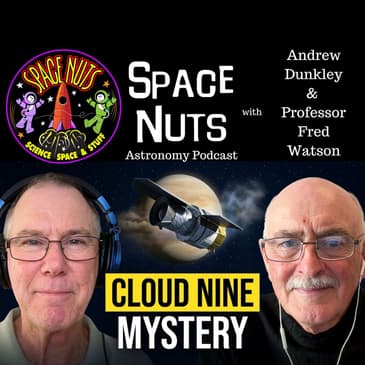
Andrew Dunkley and Professor Fred Watson cover four big astronomy stories in this episode, from Fred’s trip to view a sunset eclipse in Spain to the launch of the Nancy Grace Roman Space Telescope. They also unpack a starless dwarf galaxy called Cloud Nine and a new way of thinking about the strange dark material in Venus’s clouds.
Guests and speakers
Andrew Dunkley - Host, frames the news, asks listener questions, and guides the discussion.
Professor Fred Watson - Astronomer at large, explains the eclipse, the Roman telescope, Cloud Nine, and Venus’s clouds.
Key topics
In this episode, Fred recounts the Spanish eclipse expedition
The eclipse was only 9 degrees above the western horizon at totality, making the viewing conditions unusually challenging.
He and Marnie led a 16-person tour through France, Spain, and Switzerland before settling near Santander in northern Spain.
They staked out a viewing site 2 kilometers from the hotel, set up a gazebo, and had to tie it down to a car to keep it from blowing away.
The weather looked threatening, but a hole opened in the cloud just before totality, giving them a clear view of the corona.
Fred described the yellowish corona, pink hydrogen clouds, and the crowd of around 2,000 people.
We discuss the Nancy Grace Roman Space Telescope launch
Andrew watched the launch live after being nudged by his own brain at the right moment.
Fred noted the launch was flawless, with 27 Merlin motors firing.
The telescope is headed for the L2 Lagrange point, about 1.5 million kilometers away.
Roman is a 2.4-meter Hubble-class telescope but with 100 times the field of view.
Its wide-angle infrared design should enable major surveys of dark matter, dark energy, and exoplanets via its coronagraph.
Fred explains why Cloud Nine matters
Cloud Nine is described as a starless dwarf galaxy about 14 million light years away.
It lies near Messier 94 and was studied using the Gran Telescopio Canarias and its Hypercam instrument.
The deep exposure was 2.36 hours, yet the team found no convincing stellar population.
Fred says theory suggests the gas may be too hot to cool and collapse into stars because of the ultraviolet background radiation after reionization.
He says Cloud Nine may be the first strong example of a galaxy predicted by standard cosmology but never before clearly identified.
Venus’s clouds are still puzzling astronomers
Fred explains that Venus appears yellowish because we see the top of its cloud layer, especially in visible light.
In ultraviolet, Venus shows dramatic global cloud patterns caused by an as-yet unidentified absorber.
The new study uses radiative transfer modeling to constrain what the unknown absorber could be.
The team compares Venus’s cloud droplets to cigarette smoke, tiny particles that look light-colored when dispersed but could become dark sludge in bulk.
The result suggests the absorber must be very efficient, very concentrated, or both, but it is not being claimed as evidence of life.
Become a supporter of this podcast: https://www.spreaker.com/podcast/space-nuts-astronomy-insights-cosmic-discoveries--2631155/support.
00:00:00 --> 00:00:02 Andrew Dunkley: Hi there. Thanks for joining us. This is
00:00:02 --> 00:00:04 Space Nuts. My name is Andrew Dunkley, your
00:00:04 --> 00:00:06 host, and it is good to have your company as
00:00:06 --> 00:00:09 always. Uh, coming up on this
00:00:09 --> 00:00:12 episode, uh, we're going to revisit the
00:00:12 --> 00:00:14 Spanish eclipse. Because the man of the
00:00:14 --> 00:00:16 moment, the man who went there and pointed it
00:00:16 --> 00:00:18 out to everyone and said, that's what an
00:00:18 --> 00:00:20 eclipse looks like, he couldn't join us, but
00:00:20 --> 00:00:23 Fred Watson Watson will talk about it. Uh,
00:00:23 --> 00:00:26 we'll also be, uh, discussing the Nancy,
00:00:26 --> 00:00:28 um, Roman, uh,
00:00:28 --> 00:00:31 observatory launch, which I watched online
00:00:31 --> 00:00:33 the other. The other night, which was
00:00:33 --> 00:00:35 spectacular. Uh, and there's a
00:00:36 --> 00:00:38 galaxy that they're looking at with, um,
00:00:39 --> 00:00:41 a bit of a frown and a scratch of the neck
00:00:41 --> 00:00:43 because, uh, it does not appear to have
00:00:44 --> 00:00:46 many stars. Uh, it's not emitting starlight.
00:00:46 --> 00:00:49 How could that be? And we'll finish
00:00:49 --> 00:00:52 up with the Mystery Clouds of Venus. That's
00:00:52 --> 00:00:55 all coming up on this episode of space nuts.
00:00:55 --> 00:00:58 Professor Fred Watson: 15 seconds. Guidance is internal.
00:00:58 --> 00:01:00 10, 9. Ignition
00:01:00 --> 00:01:01 sequence start.
00:01:02 --> 00:01:02 Professor Fred Watson: Space nuts.
00:01:02 --> 00:01:05 Professor Fred Watson: 5, 4, 3. 2. 1. 2, 3, 4,
00:01:05 --> 00:01:07 5, 5, 4, 3, 2, 1.
00:01:07 --> 00:01:09 Andrew Dunkley: Space nuts.
00:01:09 --> 00:01:10 Professor Fred Watson: Astronauts report it feels good.
00:01:12 --> 00:01:14 Andrew Dunkley: And he's back. After travelling halfway
00:01:14 --> 00:01:16 around the world and, uh, returning and then
00:01:16 --> 00:01:19 getting his leg amputated. Um, well, not
00:01:19 --> 00:01:22 quite, but, uh, he got it rebuilt. $6
00:01:22 --> 00:01:24 million. It was, I think the price of that
00:01:24 --> 00:01:26 it. Professor Fred Watson Watson, astronomer
00:01:26 --> 00:01:27 at large.
00:01:27 --> 00:01:29 Professor Fred Watson: Hello, Fred Watson. Hi, Andrew. Thank you for
00:01:29 --> 00:01:32 that great intro. Yes, $6 million.
00:01:32 --> 00:01:34 Um, and, um, my health fund, um, provided
00:01:34 --> 00:01:36 $42.5, so.
00:01:36 --> 00:01:38 Andrew Dunkley: Yes, that's, uh, usually how it goes in
00:01:38 --> 00:01:40 Australia. That's the going rate. No matter
00:01:40 --> 00:01:42 what it costs you to go and see a doctor, you
00:01:42 --> 00:01:45 get 40 bucks back. Yeah, it's a
00:01:45 --> 00:01:48 great system. Um, yeah. Anyway, we
00:01:48 --> 00:01:49 won't go there. That's politics.
00:01:50 --> 00:01:51 Professor Fred Watson: That's right.
00:01:51 --> 00:01:53 But as you alluded, uh, I have indeed
00:01:53 --> 00:01:56 received a new knee. So I had a.
00:01:56 --> 00:01:59 My second TKR total knee
00:01:59 --> 00:02:02 replacement. Wow. Um, which is, uh, it was a
00:02:02 --> 00:02:05 week ago. Yesterday was the surgery. So I'm
00:02:05 --> 00:02:07 still on painkillers, so. Will not make any
00:02:07 --> 00:02:09 sense whatsoever. Um, I might go to sleep
00:02:09 --> 00:02:11 halfway through the show. That's been one of
00:02:11 --> 00:02:12 the symptoms.
00:02:13 --> 00:02:16 Andrew Dunkley: Well, between you falling asleep and me
00:02:16 --> 00:02:18 sneezing, it should be an interesting show.
00:02:18 --> 00:02:20 Hay fever is running right.
00:02:21 --> 00:02:24 And I cannot control it. Um,
00:02:25 --> 00:02:26 I know there's medications out there, but I'm
00:02:26 --> 00:02:28 gonna let some. I'm not allowed to take
00:02:28 --> 00:02:31 anymore because of my eyes. So, uh, it's made
00:02:31 --> 00:02:34 it more complicated. So, um, I'm, I'm. I'm
00:02:34 --> 00:02:36 well armed. Look, I've got.
00:02:36 --> 00:02:37 Professor Fred Watson: Oh, yes.
00:02:37 --> 00:02:39 Andrew Dunkley: The mandatory box of tissues within arm's
00:02:39 --> 00:02:42 length. So hopefully we'll get through it.
00:02:42 --> 00:02:43 Fred Watson. And, um, I'm glad the knee
00:02:43 --> 00:02:45 operation went well. You're the second person
00:02:45 --> 00:02:48 in a week that I've met who's had a total
00:02:48 --> 00:02:49 knee replacement. A friend of mine,
00:02:51 --> 00:02:53 um, literally stepped into a hole that he
00:02:53 --> 00:02:54 didn't know was there because it was full of
00:02:54 --> 00:02:57 grass and buckled his knee and the damage
00:02:57 --> 00:02:59 was too severe and they had to do a knee
00:02:59 --> 00:03:01 replacement. It's a bit of a shocker, that
00:03:01 --> 00:03:04 one. Yes, but he's still on
00:03:04 --> 00:03:05 crutches.
00:03:06 --> 00:03:08 Professor Fred Watson: Okay, well, I've parked my crutches, although
00:03:08 --> 00:03:11 I did resort to one in the middle of the
00:03:11 --> 00:03:13 night. Uh, when I had to get up. I, uh,
00:03:13 --> 00:03:14 thought, no, I'm just going to use the
00:03:14 --> 00:03:17 crotch. But, yeah, um, it doesn't take
00:03:17 --> 00:03:20 long. But, um, you know, your
00:03:20 --> 00:03:23 colleague, uh, uh, there, he
00:03:23 --> 00:03:25 had much more than just a knee replacement
00:03:25 --> 00:03:28 with that accident damage. Mine was just a
00:03:28 --> 00:03:31 quick one out, one in. Uh, and
00:03:31 --> 00:03:33 so I think it's a lot more predictable and
00:03:33 --> 00:03:35 probably a lot easier for me to recover. Um,
00:03:36 --> 00:03:38 I'm sorry, he's still on crutches and hoopi.
00:03:38 --> 00:03:41 I wish him well. Yes, we used to speak on the
00:03:41 --> 00:03:42 radio a long time ago.
00:03:42 --> 00:03:44 Andrew Dunkley: That's right. One of my old radio mates.
00:03:45 --> 00:03:47 Uh, Fred Watson, let's talk about the Spanish
00:03:47 --> 00:03:49 eclipse. I saw a lot of pictures and footage
00:03:49 --> 00:03:52 online. People getting very artistic with
00:03:52 --> 00:03:55 their photography at times. These
00:03:55 --> 00:03:57 things have become very popular. And,
00:03:58 --> 00:04:00 uh, from what I could tell, it was. It was a
00:04:00 --> 00:04:02 little bit different because it wasn't sort
00:04:02 --> 00:04:05 of up there, it was over there. Is that how
00:04:05 --> 00:04:07 it went? It was more on the horizon than
00:04:08 --> 00:04:09 you'd normally expect.
00:04:09 --> 00:04:12 Professor Fred Watson: That's right. And that was always the
00:04:12 --> 00:04:15 issue for us, uh, because at the time of
00:04:15 --> 00:04:18 totality it was only 9 degrees above
00:04:18 --> 00:04:21 the western horizon, and that's very low
00:04:21 --> 00:04:23 down. Um, but we
00:04:23 --> 00:04:26 figured that we would take that risk.
00:04:27 --> 00:04:30 The storey actually goes back a long way.
00:04:30 --> 00:04:32 So we were leading a tour group. We had,
00:04:33 --> 00:04:36 uh, uh, 16 of us through France and
00:04:36 --> 00:04:38 Spain and Switzerland. We went to the Large
00:04:38 --> 00:04:40 Hadron Collider. We went to two observatories
00:04:40 --> 00:04:42 in France, uh, Haute Provence and Pic du
00:04:42 --> 00:04:44 Midi, both of which were sensational. We
00:04:44 --> 00:04:47 really enjoyed those visits and wound up at
00:04:47 --> 00:04:50 Santander in northern Spain. Uh,
00:04:50 --> 00:04:53 we got there, I think, three days before
00:04:53 --> 00:04:56 the eclipse. Um, and the first thing
00:04:56 --> 00:04:59 Marnie and I did was to basically
00:05:00 --> 00:05:02 stake out where we were going to watch it
00:05:02 --> 00:05:04 from. Um, because, um, in those
00:05:04 --> 00:05:07 resorts in northern Spain on the coast, uh,
00:05:07 --> 00:05:10 they're all built facing eastwards because
00:05:10 --> 00:05:12 they get the morning sun and often there is
00:05:12 --> 00:05:15 high ground behind them. And so we,
00:05:15 --> 00:05:18 um, found a spot about two kilometres from
00:05:18 --> 00:05:20 our hotel. We had a couple of vehicles so we
00:05:20 --> 00:05:23 could, and manipulate everything. Um,
00:05:23 --> 00:05:26 Marnie, um, bought a gazebo,
00:05:26 --> 00:05:29 uh, which we erected on our chosen
00:05:29 --> 00:05:31 spot. There was nobody there at that time,
00:05:31 --> 00:05:34 but we knew it was going to fill up. Uh, so
00:05:34 --> 00:05:37 we had this gazebo. Um, we, the first night
00:05:37 --> 00:05:40 I said, this is going to blow away if we just
00:05:40 --> 00:05:42 leave it here. So, so we parked one
00:05:42 --> 00:05:45 of our vehicles under the gazebo and tied the
00:05:45 --> 00:05:47 gazebo down onto the roof of the car.
00:05:47 --> 00:05:48 Andrew Dunkley: Oh, great idea.
00:05:48 --> 00:05:50 Professor Fred Watson: It's still there the next day. Yeah, yeah,
00:05:50 --> 00:05:51 until the next time, we said.
00:05:51 --> 00:05:52 Andrew Dunkley: But the gazebo was.
00:05:54 --> 00:05:56 Professor Fred Watson: So, yeah, it turned into, uh, quite a big
00:05:56 --> 00:05:59 event. There were, there were very big crowds
00:05:59 --> 00:06:01 there. We'd obviously chosen exactly the
00:06:01 --> 00:06:04 right spot. Lots, um, of people, an ice
00:06:04 --> 00:06:06 cream van was there. That turned up on day
00:06:06 --> 00:06:07 two.
00:06:07 --> 00:06:07 Andrew Dunkley: Oh, wow.
00:06:08 --> 00:06:11 Professor Fred Watson: Uh, day T minus one, Um, a whole lot
00:06:11 --> 00:06:13 of cops came on horseback and in vehicles and
00:06:13 --> 00:06:16 in helicopters. They were obviously all taken
00:06:16 --> 00:06:18 completely by surprise by this event.
00:06:18 --> 00:06:21 What's going on up there? Um, but
00:06:21 --> 00:06:23 yes, on the afternoon. So it was an evening
00:06:23 --> 00:06:26 eclipse, the afternoon, uh, the sky was
00:06:26 --> 00:06:29 completely clear. But, uh, towards the end of
00:06:29 --> 00:06:31 the afternoon, this bank of cloud appeared in
00:06:31 --> 00:06:34 the west. Uh, and you could see that it
00:06:34 --> 00:06:37 was sort of spreading upwards as it
00:06:37 --> 00:06:40 approached. So the sun was effectively
00:06:40 --> 00:06:41 setting into that. The partial phase started
00:06:41 --> 00:06:44 at half past seven. I spotted that
00:06:44 --> 00:06:47 with the binoculars. It was a magical moment
00:06:47 --> 00:06:48 when I first saw the mountains of the moon
00:06:48 --> 00:06:51 just encroaching into the sun's disc. This
00:06:51 --> 00:06:53 was with, uh, binoculars, with filters. Uh,
00:06:53 --> 00:06:56 and then we. You know, eclipses are an
00:06:56 --> 00:06:58 amazing spectacle. You've got this buildup
00:06:59 --> 00:07:01 over an hour or so as the moon's disc
00:07:01 --> 00:07:03 gradually covers the sun, and then that time
00:07:03 --> 00:07:06 of perfection when the two are exactly
00:07:06 --> 00:07:07 aligned. So what happened? We all got
00:07:07 --> 00:07:09 steadily more and more depressed as the sun
00:07:09 --> 00:07:12 was sinking into this bank of cloud. But
00:07:13 --> 00:07:16 about two minutes before totality, a hole
00:07:16 --> 00:07:18 opened up, uh, right where the sun was.
00:07:18 --> 00:07:21 And when the total eclipse happened, we got a
00:07:21 --> 00:07:23 perfect view of the corona. It was just
00:07:23 --> 00:07:25 magical. It was clear. Um,
00:07:25 --> 00:07:28 so we could see the outer atmosphere of the
00:07:28 --> 00:07:30 sun, the corona. It looked slightly yellowish
00:07:30 --> 00:07:31 and that's because the sun was so low.
00:07:32 --> 00:07:34 Normally pure white and
00:07:35 --> 00:07:37 pink clouds of hydrogen, which were bigger
00:07:37 --> 00:07:39 than I've seen before. They were spectacular.
00:07:39 --> 00:07:41 Lots of cheers from the crowd. There were
00:07:41 --> 00:07:44 about 2 people there by then. Uh, we, in
00:07:44 --> 00:07:46 our little uh, tent. There were 20 of us too,
00:07:46 --> 00:07:48 because two members of my UK family, or four
00:07:48 --> 00:07:51 members came out to watch. So, uh, a good
00:07:51 --> 00:07:53 time was had by all. Uh, and we were
00:07:53 --> 00:07:56 delighted to get a great eclipse. And I think
00:07:56 --> 00:07:58 everybody was very happy. Nani and I spent
00:07:58 --> 00:07:59 the next day.
00:08:00 --> 00:08:01 Andrew Dunkley: I was going to say, isn't that twice in a row
00:08:01 --> 00:08:03 that you've been to an eclipse that was
00:08:03 --> 00:08:04 cloudy and it cleared up at the last second?
00:08:04 --> 00:08:07 Professor Fred Watson: Cleared up, that's right. Um, not nearly
00:08:07 --> 00:08:09 twice in a row. It was the one before last, I
00:08:09 --> 00:08:09 think was.
00:08:10 --> 00:08:10 Professor Fred Watson: Uh.
00:08:11 --> 00:08:13 Professor Fred Watson: Nor was it the last one. Yes, it was the last
00:08:13 --> 00:08:16 one. It was in Texas. That's right. And it
00:08:16 --> 00:08:19 was cloudy. Uh, and then the holes
00:08:19 --> 00:08:22 appeared and we saw the eclipse. So,
00:08:22 --> 00:08:24 yeah, somebody's looking after us. I don't
00:08:24 --> 00:08:26 know who it is. Indeed. It was great.
00:08:27 --> 00:08:29 Um, yeah. And that sort of wrapped up the
00:08:29 --> 00:08:29 tour.
00:08:29 --> 00:08:32 Then we had a couple of days. Uh, we had.
00:08:32 --> 00:08:34 Bore you with the details. We had a nightmare
00:08:34 --> 00:08:37 journey home which involved
00:08:37 --> 00:08:40 rebooking flights, uh, two hours before they
00:08:40 --> 00:08:43 left through to Sydney from Barcelona. But
00:08:43 --> 00:08:45 anyway, that's another storey. Travellers
00:08:45 --> 00:08:47 tales. You've got plenty of them as well.
00:08:47 --> 00:08:50 Andrew Dunkley: Yeah, yeah, yeah. Um,
00:08:50 --> 00:08:52 I guess the difference with that eclipse in
00:08:52 --> 00:08:55 Spain was it was happening at sunset.
00:08:55 --> 00:08:57 And normally when you watch one of these
00:08:57 --> 00:09:00 eclipses, it turns, uh, day into night
00:09:00 --> 00:09:03 and then it comes back to day again, but at
00:09:03 --> 00:09:05 sunset, I guess you sort of missed out on
00:09:05 --> 00:09:07 that kind of effect to a certain degree.
00:09:07 --> 00:09:10 Professor Fred Watson: Yeah. Excuse me. To a certain extent.
00:09:10 --> 00:09:12 But it got dark very quickly, as it does.
00:09:13 --> 00:09:15 It's only when something like 80 or
00:09:15 --> 00:09:18 90% of the sun's disc is covered. That's the
00:09:18 --> 00:09:20 only time when you notice that things are
00:09:20 --> 00:09:23 dimming. Um, I think birds did go to
00:09:23 --> 00:09:25 sleep. We didn't really take much notice. It
00:09:25 --> 00:09:28 was 1 minute and 3 seconds was the time m of
00:09:28 --> 00:09:30 totality that we had. Uh, um.
00:09:30 --> 00:09:33 But yes, it did get light again. Uh. Uh,
00:09:33 --> 00:09:35 light enough for us to take lots of
00:09:35 --> 00:09:37 photographs of each other and all the rest of
00:09:37 --> 00:09:39 it. Uh, we demolished the gazebo, gave it
00:09:39 --> 00:09:42 to a guy, a French guy, who thought it was
00:09:42 --> 00:09:44 the bee's knees. He. He had a camper van next
00:09:44 --> 00:09:47 door. We also gave him the inflatable
00:09:47 --> 00:09:48 fridge that we bought.
00:09:48 --> 00:09:49 Andrew Dunkley: Oh, my goodness.
00:09:49 --> 00:09:51 Professor Fred Watson: Did you know there was such a thing?
00:09:51 --> 00:09:52 Andrew Dunkley: I'd never heard of it.
00:09:52 --> 00:09:55 Professor Fred Watson: My wife does. Uh, we had an inflatable fridge
00:09:55 --> 00:09:57 and we gave him some chairs as well, because
00:09:57 --> 00:09:59 we couldn't take all this stuff back to
00:09:59 --> 00:09:59 Australia.
00:09:59 --> 00:10:00 Andrew Dunkley: Yeah, of course.
00:10:00 --> 00:10:01 Professor Fred Watson: Yeah.
00:10:01 --> 00:10:01 Andrew Dunkley: Fantastic.
00:10:02 --> 00:10:02 Professor Fred Watson: Yeah.
00:10:03 --> 00:10:05 Andrew Dunkley: Well, you know, I'm all set for, uh,
00:10:05 --> 00:10:07 Dubbo 2028.
00:10:07 --> 00:10:09 Professor Fred Watson: Yeah, 2028, that's right.
00:10:09 --> 00:10:12 Andrew Dunkley: So less than two years now, not far.
00:10:12 --> 00:10:14 We've just been sitting on this one for 20
00:10:14 --> 00:10:16 years when we first found out about it. But,
00:10:16 --> 00:10:18 uh, yeah, looking forward to that. In fact,
00:10:18 --> 00:10:21 uh, I think that year, um, there's going to
00:10:21 --> 00:10:23 be three or four eclipses in our part of the
00:10:23 --> 00:10:25 world or over those next couple years.
00:10:25 --> 00:10:28 Professor Fred Watson: Over the next few years, yeah, I think till
00:10:28 --> 00:10:31 20, 30 something. I can't
00:10:31 --> 00:10:34 remember what it is. Yeah, I don't know.
00:10:34 --> 00:10:36 There are another three that'.
00:10:36 --> 00:10:39 Andrew Dunkley: Yeah, okay, uh, well, that sounds like fun.
00:10:39 --> 00:10:40 Let's talk about something else
00:10:40 --> 00:10:42 extraordinary. Uh, the other night I was
00:10:42 --> 00:10:45 sitting, uh, in my lounge, just about to pop
00:10:45 --> 00:10:47 off to sleep and my brain said, you know,
00:10:47 --> 00:10:49 they should be launching the Nancy Roman
00:10:49 --> 00:10:51 telescope sometime soon, Andrew.
00:10:51 --> 00:10:52 Professor Fred Watson: So I thought, oh, yeah, yeah.
00:10:52 --> 00:10:55 Andrew Dunkley: So I grabbed my iPad and I logged on and sure
00:10:55 --> 00:10:58 enough, the countdown was five minutes from
00:10:58 --> 00:10:58 launch.
00:10:58 --> 00:10:59 Professor Fred Watson: And I thought, brilliant.
00:10:59 --> 00:11:02 Andrew Dunkley: Isn't the brain an amazing thing? Yeah,
00:11:02 --> 00:11:04 that it, that it reminded me of that five
00:11:04 --> 00:11:07 minutes before the launch and I, uh,
00:11:07 --> 00:11:10 I was oblivious to it at that moment,
00:11:10 --> 00:11:12 so I watched the whole thing. It was
00:11:12 --> 00:11:13 fantastic.
00:11:13 --> 00:11:16 Professor Fred Watson: Yeah, I watched the replay the next day. I
00:11:16 --> 00:11:18 wasn't, um, switched on as you were. I was
00:11:18 --> 00:11:20 probably asleep actually with
00:11:21 --> 00:11:24 the painkillers. But yes, I did,
00:11:24 --> 00:11:26 um, realise that, uh, it was taking place
00:11:26 --> 00:11:28 then, uh, and yeah, flawless launch. It
00:11:28 --> 00:11:29 looked fantastic.
00:11:29 --> 00:11:30 Andrew Dunkley: Oh, it was, wasn't it?
00:11:30 --> 00:11:32 Professor Fred Watson: Um, all 27 of those Merlin motors
00:11:32 --> 00:11:33 firing away there
00:11:35 --> 00:11:38 Andrew Dunkley: and it now makes the 1 million,
00:11:39 --> 00:11:40 is it kilometres or
00:11:40 --> 00:11:43 Professor Fred Watson: miles journey to, uh, Yes, a million
00:11:43 --> 00:11:45 miles. A million and a half kilometres. Uh,
00:11:45 --> 00:11:47 yeah, and I think it's well on the way, this
00:11:47 --> 00:11:49 is to the L2 point, that point
00:11:49 --> 00:11:52 on the far side of the Earth, uh, from the
00:11:52 --> 00:11:54 sun where there's this stable gravitational
00:11:55 --> 00:11:57 thing which we call a Lagrange point. Um,
00:11:57 --> 00:11:59 several spacecraft there already, including
00:11:59 --> 00:12:02 the James Webb and Gaia, Um, that
00:12:02 --> 00:12:04 European, fantastic European project, that's
00:12:04 --> 00:12:05 there a few other ones.
00:12:05 --> 00:12:07 Andrew Dunkley: I'll be running out of room up there. They'll
00:12:07 --> 00:12:08 have to put in traffic lights.
00:12:09 --> 00:12:11 Professor Fred Watson: So it's interesting, um, you kind of think of
00:12:11 --> 00:12:13 that. Oh, if this is a stable point, they
00:12:13 --> 00:12:14 must always trying to get to the same point.
00:12:14 --> 00:12:17 But actually what they are, they're all in
00:12:17 --> 00:12:19 orbit around a stable point. So you're in
00:12:19 --> 00:12:22 orbit around nothing. Um, but the
00:12:22 --> 00:12:25 gravitational forces work to sort of keep you
00:12:25 --> 00:12:27 in orbit there. Um, yep.
00:12:27 --> 00:12:30 So it's, um. Yes. So
00:12:30 --> 00:12:33 I don't know, I haven't really looked at the
00:12:33 --> 00:12:36 commissioning schedule for the Nancy Grace
00:12:36 --> 00:12:39 Roman. Uh, but, um, it's probably already
00:12:39 --> 00:12:41 started because, uh, they don't waste much
00:12:41 --> 00:12:44 time with these things to get as much data as
00:12:44 --> 00:12:46 they can just in case something catastrophic
00:12:46 --> 00:12:49 goes wrong early on. Um, what
00:12:49 --> 00:12:52 we've got here is a Hubble class telescope.
00:12:52 --> 00:12:55 Um, same sort of size as The Hubble,
00:12:55 --> 00:12:57 uh, 2.4 metres, with,
00:12:58 --> 00:13:01 uh, the big difference that
00:13:01 --> 00:13:03 even though it's got the fine detail, the
00:13:03 --> 00:13:06 resolving power of the Hubble, it's got a
00:13:06 --> 00:13:08 hundred times the field of view of the
00:13:08 --> 00:13:11 Hubble, which means it sees 100
00:13:11 --> 00:13:13 times more sky. And so, you know, the
00:13:13 --> 00:13:15 Hubble's always been giving us these,
00:13:16 --> 00:13:19 what you might call pinhole images, just, um,
00:13:19 --> 00:13:21 almost looking through a straw at the sky.
00:13:22 --> 00:13:24 Uh, the Nancy Grace Roman is a wide angle
00:13:24 --> 00:13:27 telescope. It's also infrared. Uh, so, um,
00:13:27 --> 00:13:30 it is actually seeing redder than red
00:13:30 --> 00:13:32 light. And we've got high hopes for what it
00:13:32 --> 00:13:35 might achieve with huge galaxy
00:13:35 --> 00:13:38 surveys which hopefully will show light on,
00:13:38 --> 00:13:41 which shed light on dark matter and dark
00:13:41 --> 00:13:43 energy. And, um, also
00:13:44 --> 00:13:46 it's got a very sophisticated
00:13:46 --> 00:13:49 coronagraph on board. And a coronagraph
00:13:49 --> 00:13:51 is a thing that blots out the light of a star
00:13:51 --> 00:13:54 so you can look for other objects nearby.
00:13:54 --> 00:13:57 And so we should start seeing images of
00:13:57 --> 00:14:00 exoplanets coming from Nancy Grace Roman as
00:14:00 --> 00:14:02 well. So it is lots to talk about down the
00:14:02 --> 00:14:02 track, Andrew.
00:14:02 --> 00:14:05 Andrew Dunkley: Yeah, very exciting. When do they expect it
00:14:05 --> 00:14:08 to actually be ready to roll? It's a bit
00:14:08 --> 00:14:09 of a process, isn't it?
00:14:10 --> 00:14:11 Professor Fred Watson: It is, that's right. I'm not sure what the
00:14:11 --> 00:14:14 schedule is, as I was saying, but, um, we'll
00:14:14 --> 00:14:16 keep, um, we'll keep space notes listeners
00:14:16 --> 00:14:18 posted at the moment. The news is all good
00:14:18 --> 00:14:19 and.
00:14:19 --> 00:14:22 Andrew Dunkley: Yeah, it is, it is. In fact,
00:14:22 --> 00:14:23 um, I'm just looking,
00:14:25 --> 00:14:27 yeah, first observations, maybe early
00:14:28 --> 00:14:29 next year sometime.
00:14:29 --> 00:14:32 Professor Fred Watson: Yeah, they haven't got it in mind. It was
00:14:32 --> 00:14:32 2027.
00:14:33 --> 00:14:33 Andrew Dunkley: Yeah.
00:14:33 --> 00:14:36 Professor Fred Watson: Um, and I mean I, I remember because
00:14:36 --> 00:14:38 we lived it in real time. The commissioning
00:14:39 --> 00:14:41 for the Hubble telescope back in
00:14:41 --> 00:14:44 1990. I was an astronomer at the UK Schmidt
00:14:44 --> 00:14:46 telescope then and we were getting direct
00:14:46 --> 00:14:48 reports from NASA actually about the
00:14:48 --> 00:14:51 commissioning before the Interweb. Um,
00:14:52 --> 00:14:55 and we very quickly realised that
00:14:55 --> 00:14:57 something was wrong because we got, um,
00:14:57 --> 00:14:59 reports of the image diameter as they went
00:15:01 --> 00:15:03 and the image diameter never got small. So it
00:15:03 --> 00:15:06 was quite obvious very early on that there
00:15:06 --> 00:15:08 was a problem with the Hubble and of course
00:15:09 --> 00:15:11 took them three years to build a, a
00:15:11 --> 00:15:14 little device to correct for that. And, uh,
00:15:14 --> 00:15:16 then it was flown on a space shuttle mission
00:15:16 --> 00:15:19 and the rest is History. Yeah.
00:15:19 --> 00:15:22 Andrew Dunkley: A PUFU valve, I think it was, they needed to
00:15:22 --> 00:15:23 put on it. Yeah.
00:15:24 --> 00:15:26 Professor Fred Watson: M. Anyway, it did have a cost bar. Was it
00:15:26 --> 00:15:27 something like that?
00:15:27 --> 00:15:30 Andrew Dunkley: Something like that, yeah. It was lucky that
00:15:30 --> 00:15:32 it was close enough to get to, um.
00:15:32 --> 00:15:33 Professor Fred Watson: Yes, that's right.
00:15:33 --> 00:15:34 Andrew Dunkley: Can't do that with the L2.
00:15:35 --> 00:15:37 Professor Fred Watson: You can't. That's exactly right. Um,
00:15:38 --> 00:15:41 yes, things have moved on a bit since then.
00:15:41 --> 00:15:44 Andrew Dunkley: They have, uh, exciting times. And we will
00:15:44 --> 00:15:46 watch with interest. And of course, uh, when
00:15:46 --> 00:15:49 they achieve first light and we start to see
00:15:49 --> 00:15:51 some other images, we will share them with
00:15:51 --> 00:15:54 you here on Space Nuts. And you are
00:15:54 --> 00:15:56 listening to the latest edition with Andrew
00:15:56 --> 00:15:58 Dunkley and Professor Fred Watson Watson.
00:16:00 --> 00:16:02 Professor Fred Watson: I think we need to do a little more all
00:16:02 --> 00:16:03 weather testing.
00:16:04 --> 00:16:06 Professor Fred Watson: Amen, Space Nuts.
00:16:06 --> 00:16:09 Andrew Dunkley: Okay, Fred Watson, let's talk about this
00:16:09 --> 00:16:12 strange galaxy. Um, some
00:16:12 --> 00:16:14 are saying it's a failed galaxy. Uh, it's
00:16:14 --> 00:16:16 been described as a starless galaxy. And it's
00:16:16 --> 00:16:19 got a name. It's called Cloud 9. What is this
00:16:19 --> 00:16:20 thing?
00:16:21 --> 00:16:24 Professor Fred Watson: Uh, it's, um. Yes, it's
00:16:25 --> 00:16:28 not a mystery galaxy in the sense that people
00:16:28 --> 00:16:30 have speculated that there
00:16:31 --> 00:16:34 may be galaxies without stars. And,
00:16:34 --> 00:16:37 you know, we tend to think of galaxies as
00:16:37 --> 00:16:39 being made of stars. Yes, ours is.
00:16:40 --> 00:16:43 Milky Way is a gigantic spiral of stars
00:16:43 --> 00:16:46 and gas and dust. Very beautiful. If
00:16:46 --> 00:16:47 we could see it from the outside, which sadly
00:16:47 --> 00:16:50 we, we never can. Uh, but,
00:16:50 --> 00:16:53 um, it has always been
00:16:53 --> 00:16:55 speculated that there may be,
00:16:56 --> 00:16:58 uh, galaxies which
00:16:58 --> 00:17:01 contain clouds of hydrogen, the raw material
00:17:01 --> 00:17:03 of stars, which
00:17:04 --> 00:17:07 basically is too hot for
00:17:07 --> 00:17:10 the clouds to collapse into individual stars.
00:17:10 --> 00:17:12 I think I've got the logic the right way
00:17:12 --> 00:17:15 there. Yeah. So you've got the raw
00:17:15 --> 00:17:17 material of stars, but,
00:17:18 --> 00:17:20 um, it doesn't form a stellar
00:17:20 --> 00:17:23 population. Um, and
00:17:24 --> 00:17:26 maybe, um, it's because there's,
00:17:27 --> 00:17:29 you know, as I said, the gas is too hot.
00:17:29 --> 00:17:32 So this particular object, Cloud 9,
00:17:32 --> 00:17:35 it's not very far away. Uh, it
00:17:35 --> 00:17:38 is about 14 million light years away,
00:17:39 --> 00:17:41 which puts it really on our galactic
00:17:41 --> 00:17:44 doorstep. Uh, it's not far from a, uh,
00:17:44 --> 00:17:46 spiral galaxy called Messier 94,
00:17:47 --> 00:17:50 which is a lovely spiral, uh,
00:17:50 --> 00:17:51 if I remember rightly, in the Northern
00:17:51 --> 00:17:54 Hemisphere sky. Uh, well, it must be because
00:17:54 --> 00:17:56 it's being observed by a telescope that, um,
00:17:56 --> 00:17:58 I never really had anything to do with. But I
00:17:59 --> 00:18:01 knew its sight well because it was built on a
00:18:01 --> 00:18:03 place where I used to observe a lot. Uh, this
00:18:03 --> 00:18:06 is the Gran Telescopio Canarias,
00:18:06 --> 00:18:09 uh, which is the Big Canarian
00:18:09 --> 00:18:11 Telescope. It's actually the biggest optical
00:18:11 --> 00:18:12 telescope in the world. It has a 10 metre
00:18:12 --> 00:18:15 mirror, um, and it's
00:18:15 --> 00:18:18 located, uh, In La Palma
00:18:18 --> 00:18:20 in the Canary Islands. And I used to observe
00:18:20 --> 00:18:21 there on a telescope called the William
00:18:21 --> 00:18:24 Herschel Telescope. So uh, gtc as
00:18:24 --> 00:18:27 it's called, Grand Telescopio Canarias has
00:18:27 --> 00:18:30 a camera, um, ah, called
00:18:30 --> 00:18:32 Hypercam, ah, which is the
00:18:32 --> 00:18:35 one that I think has
00:18:35 --> 00:18:38 really given us this research on Cloud nine
00:18:38 --> 00:18:41 because uh, the colleagues who
00:18:41 --> 00:18:44 observed uh, this object, what they did
00:18:44 --> 00:18:46 was they used that big telescope with its um,
00:18:47 --> 00:18:49 wide angle camera in order
00:18:50 --> 00:18:53 to get very, very deep
00:18:53 --> 00:18:55 images. And by deep images we mean ones that
00:18:55 --> 00:18:57 penetrate to the, at really faint levels.
00:18:58 --> 00:19:00 Uh, they got 2.36 hours of
00:19:00 --> 00:19:03 integration, uh, which is um,
00:19:04 --> 00:19:06 quite, quite a long time, uh, and
00:19:06 --> 00:19:09 didn't see any stars. I think they, they
00:19:09 --> 00:19:12 think they might have seen a small number of
00:19:12 --> 00:19:15 stars but not uh,
00:19:15 --> 00:19:18 what we expect in a galaxy. Um,
00:19:19 --> 00:19:22 so the uh, one of the authors of
00:19:22 --> 00:19:24 this paper, um,
00:19:24 --> 00:19:27 basically in offering an explanation as to
00:19:27 --> 00:19:29 how you could have a galaxy with no stars,
00:19:30 --> 00:19:32 uh, I'll quote. The leading theoretical
00:19:32 --> 00:19:35 explanation involves the ultraviolet
00:19:35 --> 00:19:37 background radiation that permeates the
00:19:37 --> 00:19:39 universe after the epoch of
00:19:39 --> 00:19:42 reionization. Uh, that's right at the
00:19:42 --> 00:19:44 beginning, this radiation field heats the gas
00:19:44 --> 00:19:46 in low mass dark matter halos to
00:19:46 --> 00:19:49 temperatures high enough that the gas cannot
00:19:49 --> 00:19:52 cool efficiency and collapse to form stars. I
00:19:52 --> 00:19:53 think that might be what I said earlier,
00:19:53 --> 00:19:56 which is good. Um, when they do
00:19:56 --> 00:19:58 simulations um, of
00:19:59 --> 00:20:02 uh, you know, basically what this galaxy,
00:20:02 --> 00:20:04 how it might have evolved, sure enough it
00:20:04 --> 00:20:06 remains starless. They don't have any stars.
00:20:06 --> 00:20:09 So this looks like uh,
00:20:09 --> 00:20:12 look like, looks uh, like ah, the first real
00:20:12 --> 00:20:15 example of something that people have
00:20:15 --> 00:20:18 thought must exist. Um, and
00:20:18 --> 00:20:20 again quoting from. It's Dr.
00:20:20 --> 00:20:23 Trujillo, who I think I might have worked
00:20:23 --> 00:20:25 with in La Palma many, many years ago.
00:20:26 --> 00:20:29 Uh, says Cloud 9 has a halo mass
00:20:29 --> 00:20:31 consistent with this regime. In this picture,
00:20:31 --> 00:20:33 starless galaxies are not
00:20:34 --> 00:20:37 exotic anomalies, but a natural and
00:20:37 --> 00:20:39 abundant prediction of standard
00:20:39 --> 00:20:41 cosmological models. The challenge has simply
00:20:41 --> 00:20:44 been finding them. So uh, maybe it's
00:20:44 --> 00:20:47 not such an unusual thing after all, uh,
00:20:47 --> 00:20:50 but uh, something that uh, has been
00:20:50 --> 00:20:53 predicted. But yes, the first, I think the
00:20:53 --> 00:20:56 first one that we can really be sure, uh, is
00:20:56 --> 00:20:57 a starless galaxy.
00:20:58 --> 00:21:01 Andrew Dunkley: Yeah, very, very unusual. Um, I'd
00:21:01 --> 00:21:03 suppose the description failed galaxy would
00:21:03 --> 00:21:06 be probably accurate given
00:21:06 --> 00:21:07 the circumstances.
00:21:07 --> 00:21:10 Professor Fred Watson: Yes, if you think of a normal galaxy as
00:21:10 --> 00:21:13 being populated by stars, it is.
00:21:13 --> 00:21:16 Um, but you can see that there's good reason
00:21:16 --> 00:21:18 for it to fail if the temperature of the
00:21:18 --> 00:21:20 background gas and the dark matter that's in
00:21:20 --> 00:21:23 it are too high for stars to form.
00:21:24 --> 00:21:26 Um, and you might consider It a success
00:21:26 --> 00:21:29 because it's a purely gaseous
00:21:29 --> 00:21:30 galaxy.
00:21:30 --> 00:21:33 Andrew Dunkley: Yeah, yeah. Uh, I suppose one
00:21:33 --> 00:21:35 day it might merge with another galaxy and
00:21:35 --> 00:21:38 then, you know, all hell will break loose.
00:21:39 --> 00:21:41 Professor Fred Watson: No, you're right, that's a good point because
00:21:41 --> 00:21:43 it's not that far from M94, which is a big
00:21:43 --> 00:21:46 galaxy. Uh, this is a, it
00:21:46 --> 00:21:48 counts as a dwarf galaxy. I didn't really
00:21:48 --> 00:21:51 make that clear. And of course our
00:21:51 --> 00:21:54 own galaxy has dwarf galaxies in orbit around
00:21:54 --> 00:21:56 it, most of which contain stars. Uh,
00:21:56 --> 00:21:59 and so, and the fate of those dwarf galaxies
00:21:59 --> 00:22:02 is basically to become part of the, of the
00:22:02 --> 00:22:05 bigger galaxy. So it may be that Cloud nine
00:22:05 --> 00:22:08 eventually does that and maybe the conditions
00:22:08 --> 00:22:10 will change so that the, the gas becomes,
00:22:11 --> 00:22:13 um, uh, cool enough or
00:22:13 --> 00:22:16 otherwise relaxed enough, uh, in order to
00:22:16 --> 00:22:17 start and form stars.
00:22:18 --> 00:22:20 Andrew Dunkley: Okay. If you want to, uh, read all about the
00:22:20 --> 00:22:23 Starless Galaxy Cloud 9, there's a great
00:22:23 --> 00:22:25 article on Space dot com.
00:22:26 --> 00:22:29 Um, Fred Watson, we've got a live viewer
00:22:29 --> 00:22:31 who has, is from Dubbo, actually. Hi,
00:22:31 --> 00:22:34 Lynette. Um, she says, uh,
00:22:34 --> 00:22:36 hello from Dubbo. How long did you stay. I
00:22:36 --> 00:22:39 assume she means Spain. Um,
00:22:40 --> 00:22:41 from her earlier conversations.
00:22:41 --> 00:22:44 Professor Fred Watson: Yes, we were in Spain for, uh, roughly
00:22:44 --> 00:22:47 a week actually. Uh, I didn't tell you, but
00:22:47 --> 00:22:50 I, I got, um, I got,
00:22:50 --> 00:22:53 um, thieved from by a pickpocket.
00:22:54 --> 00:22:54 Professor Fred Watson: Oh.
00:22:55 --> 00:22:56 Professor Fred Watson: Yeah.
00:22:56 --> 00:22:58 Andrew Dunkley: Um, but very, very common thing over there.
00:22:59 --> 00:23:01 Professor Fred Watson: It was in Bilberryo and. Oh, we went
00:23:01 --> 00:23:04 there. Lovely place. Did you get your
00:23:04 --> 00:23:05 binoculars nicked as well?
00:23:05 --> 00:23:08 Andrew Dunkley: No, no, I, I'm very, very,
00:23:09 --> 00:23:12 um. We'll
00:23:12 --> 00:23:15 use the word anal about holding on to my
00:23:15 --> 00:23:16 stuff, quite literally.
00:23:16 --> 00:23:16 Professor Fred Watson: Yep.
00:23:16 --> 00:23:18 Andrew Dunkley: I put stuff in my pockets and I'll shove my
00:23:18 --> 00:23:20 hands in my pockets and I will not take them
00:23:20 --> 00:23:23 out. Yeah, I must look weird.
00:23:24 --> 00:23:25 Professor Fred Watson: Well, you look weird anyway, Andrew, but
00:23:25 --> 00:23:28 that's, you know, not good. Not bad news
00:23:28 --> 00:23:31 anyway. Uh, but, but no, you're right. Um,
00:23:31 --> 00:23:34 so I'm like that too. But, um, I, I
00:23:34 --> 00:23:37 had a sort of man bag. Um,
00:23:37 --> 00:23:40 and um, I was walking back
00:23:40 --> 00:23:43 from the Guggenheim exhibition, which you
00:23:43 --> 00:23:45 probably went to see as well, in Bilberry, to
00:23:45 --> 00:23:48 our hotel, and I thought
00:23:48 --> 00:23:50 I noticed a bit of a disturbance
00:23:51 --> 00:23:53 behind me. I had headphones on. Um, noise
00:23:53 --> 00:23:55 cancelling headphones because I was walking.
00:23:55 --> 00:23:56 Andrew Dunkley: Yeah.
00:23:56 --> 00:23:58 Professor Fred Watson: And um, when I got into the hotel, I looked
00:23:58 --> 00:24:01 in my man bag and the zip was open
00:24:01 --> 00:24:04 and I know I, I shut it up and my
00:24:04 --> 00:24:07 binoculars were missing. So Marnie said
00:24:07 --> 00:24:09 go outside and have a look. They might have
00:24:09 --> 00:24:11 thrown them away. So went outside.
00:24:13 --> 00:24:15 Here's four policemen bailing up these two
00:24:15 --> 00:24:16 guys
00:24:18 --> 00:24:20 and they've Been. They've been following them
00:24:20 --> 00:24:22 because they'd created some sort of problems
00:24:22 --> 00:24:25 in a bar. Um, and I approached
00:24:25 --> 00:24:27 one of the policemen and said,
00:24:27 --> 00:24:30 um, I've, uh, lost a pair of binoculars.
00:24:30 --> 00:24:31 And he just said, yeah, we've got your
00:24:31 --> 00:24:34 binoculars. Wow. So I got lucky.
00:24:35 --> 00:24:36 Fantastic.
00:24:38 --> 00:24:40 Yeah, these guys had tried to throw them away
00:24:40 --> 00:24:43 when they saw the police were on them and the
00:24:43 --> 00:24:46 cops had seen it. The cop who dealt
00:24:46 --> 00:24:49 with me spoke great English. He was an
00:24:49 --> 00:24:51 absolute gentleman. It was, uh, such a good
00:24:51 --> 00:24:53 experience that Marnie insisted on taking
00:24:53 --> 00:24:55 our, uh, photographs together and things like
00:24:55 --> 00:24:56 that afterwards.
00:24:56 --> 00:24:58 Andrew Dunkley: Well, you got very lucky, Fred Watson. Very
00:24:58 --> 00:24:59 lucky.
00:24:59 --> 00:25:01 Professor Fred Watson: Very, very lucky indeed. Yeah, absolutely
00:25:01 --> 00:25:03 lucky. Uh, I couldn't believe it. And
00:25:03 --> 00:25:06 actually, those, uh. You know, I can go on
00:25:06 --> 00:25:08 about binoculars ad. Uh, infinitum. M. Having
00:25:08 --> 00:25:10 written the first book in English on the
00:25:10 --> 00:25:13 history of binoculars. Uh, but they were a
00:25:13 --> 00:25:15 special pair as well. Quite new. They're new
00:25:15 --> 00:25:18 to me. They're, um. Basically, they
00:25:18 --> 00:25:21 were made in the 60s. Sorry, the. The 70s.
00:25:21 --> 00:25:23 But they're very, very good ones. And, um,
00:25:23 --> 00:25:25 yeah, they're worth a lot of money.
00:25:25 --> 00:25:28 Andrew Dunkley: So Starchild says, um, we've got a few live,
00:25:28 --> 00:25:30 uh, viewers at the moment. And Starchild
00:25:30 --> 00:25:32 says, quite a few thieves in the Milky Way.
00:25:34 --> 00:25:35 Professor Fred Watson: Yes, that's right, yeah.
00:25:36 --> 00:25:38 Andrew Dunkley: Um, and there was another
00:25:38 --> 00:25:41 question. Uh, uh, good. Uh, says, good to see
00:25:41 --> 00:25:43 you two together again. Moose says, how much
00:25:43 --> 00:25:45 did I miss? Uh, about that much.
00:25:47 --> 00:25:49 I think we're a bit past halfway, Moose. And,
00:25:49 --> 00:25:52 um, another question. Um, how
00:25:52 --> 00:25:55 many light years across is a dwarf galaxy? I
00:25:55 --> 00:25:56 guess they're all different sizes.
00:25:57 --> 00:25:59 Professor Fred Watson: They are, but it's a good question. I mean,
00:25:59 --> 00:26:02 um, so think of our galaxy, which is
00:26:02 --> 00:26:04 kind of 100 light years across.
00:26:05 --> 00:26:07 Um, and that's typical of
00:26:07 --> 00:26:10 a. Of a major spiral galaxy.
00:26:10 --> 00:26:13 Dwarf galaxy would probably be
00:26:13 --> 00:26:16 less than a tenth of that. Um, 10
00:26:16 --> 00:26:18 light years. That sort of size. You know,
00:26:18 --> 00:26:21 just on. On average. Uh, that kind of.
00:26:21 --> 00:26:22 That kind of size.
00:26:23 --> 00:26:25 Andrew Dunkley: Okay. Thanks for the question. It doesn't
00:26:25 --> 00:26:27 happen like this very often, but today
00:26:28 --> 00:26:30 we've got an active audience. That's good.
00:26:32 --> 00:26:34 Yeah. All right. Uh, you're listening to
00:26:34 --> 00:26:36 Space Nuts, by the way, uh, with Andrew
00:26:36 --> 00:26:38 Dunkley and Professor Fred Watson Watson.
00:26:40 --> 00:26:42 Professor Fred Watson: Okay, we checked all four systems.
00:26:43 --> 00:26:46 Andrew Dunkley: Space Nuts, our final topic. Fred Watson
00:26:46 --> 00:26:49 takes us to Venus. Sunny Venus.
00:26:49 --> 00:26:51 Ah, yes. What a place. Go outside, take a
00:26:51 --> 00:26:54 deep breath, drop dead. Um, but
00:26:54 --> 00:26:56 there's some news about Venus which involves
00:26:56 --> 00:26:59 its clouds again. Now, the last time this was
00:26:59 --> 00:27:00 big news was when they thought they might
00:27:00 --> 00:27:03 have found, um, signs of life in the
00:27:03 --> 00:27:05 clouds. That's still under a lot of
00:27:05 --> 00:27:08 speculation and debate. But, uh, what's the
00:27:08 --> 00:27:11 latest with these clouds? These aren't the
00:27:11 --> 00:27:13 ones we were talking about last time. These
00:27:13 --> 00:27:14 are a little bit different again.
00:27:15 --> 00:27:17 Professor Fred Watson: Yes, they are, yeah. So I think that was
00:27:17 --> 00:27:19 sulphur. Was it sulphur dioxide? I can't
00:27:19 --> 00:27:21 remember. Um, the detection, uh, which
00:27:22 --> 00:27:24 people got excited because it might mean
00:27:24 --> 00:27:26 living organisms in the upper atmosphere of
00:27:26 --> 00:27:28 Venus. But I think that's gone away now.
00:27:29 --> 00:27:31 Um, it's great to talk about Venus,
00:27:31 --> 00:27:33 especially just now, because you would know,
00:27:33 --> 00:27:35 Andrew, it's absolutely lighting up the
00:27:35 --> 00:27:38 evening sky. Uh, over there in the west. It
00:27:38 --> 00:27:40 is very bright, very high in the sky,
00:27:41 --> 00:27:43 beautiful object. And when we look at it,
00:27:44 --> 00:27:47 it's kind of got a yellowish colour, uh,
00:27:47 --> 00:27:49 which is because we're seeing reflections
00:27:49 --> 00:27:52 from the top of its cloud layer.
00:27:52 --> 00:27:55 Um, but, uh, it's been known
00:27:55 --> 00:27:58 for a long time that
00:27:58 --> 00:28:00 if you photograph Venus in with
00:28:00 --> 00:28:03 ultraviolet light, you. You
00:28:03 --> 00:28:06 see patterns, really
00:28:06 --> 00:28:08 dramatic patterns. And I've, uh, got one in
00:28:08 --> 00:28:10 front of me now. But I do remember
00:28:10 --> 00:28:12 photographs of this, that these are sort of
00:28:12 --> 00:28:15 global size patterns that actually
00:28:15 --> 00:28:17 move, uh, with the. The
00:28:17 --> 00:28:20 clouds of Venus. Uh, we
00:28:20 --> 00:28:23 know. I think most space notes, uh,
00:28:23 --> 00:28:24 listeners and viewers would know that we
00:28:24 --> 00:28:26 don't actually see the surface of Venus
00:28:26 --> 00:28:29 directly. We can with radar, uh, certain
00:28:29 --> 00:28:31 infrared observations that let you penetrate
00:28:31 --> 00:28:34 to the surface. But basically all we see, uh,
00:28:34 --> 00:28:36 and certainly in ultraviolet is the upper
00:28:36 --> 00:28:39 parts of the cloud belts, cloud
00:28:39 --> 00:28:42 layers. So the markings themselves,
00:28:42 --> 00:28:45 uh, are a puzzle. And,
00:28:45 --> 00:28:47 and this is where it sort of gets
00:28:47 --> 00:28:49 interesting. Although it's not one of these
00:28:49 --> 00:28:51 storeys that's got a neat and tidy answer,
00:28:51 --> 00:28:53 I'm afraid. Um, there's a
00:28:53 --> 00:28:56 chemical that is thought to be in
00:28:56 --> 00:28:59 Venus's upper atmosphere, which is
00:28:59 --> 00:29:01 called the unknown absorber.
00:29:02 --> 00:29:05 Uh, and because, uh, it absorbs
00:29:05 --> 00:29:08 light in the ultraviolet and you get dark
00:29:08 --> 00:29:10 patches from. From this, this stuff.
00:29:11 --> 00:29:14 Um, I was talking to somebody about this the
00:29:14 --> 00:29:15 other day and they said it sounds like a
00:29:15 --> 00:29:18 superhero, the Unknown absorber. Uh,
00:29:18 --> 00:29:20 which, uh, I think probably would work well.
00:29:20 --> 00:29:23 Andrew Dunkley: Yeah, his superhero name would
00:29:23 --> 00:29:24 be the Sponge.
00:29:25 --> 00:29:26 Professor Fred Watson: The Sponge, that's right.
00:29:28 --> 00:29:31 So what's happened is that,
00:29:31 --> 00:29:34 um, a team, an international team
00:29:34 --> 00:29:36 actually, of basically astrobiologists,
00:29:36 --> 00:29:38 people who were looking at,
00:29:39 --> 00:29:42 uh, the origin of life in the universe
00:29:42 --> 00:29:44 and what we need for life to form and all of
00:29:44 --> 00:29:46 those other good things, not necessarily
00:29:46 --> 00:29:48 trying to find life, but trying to understand
00:29:48 --> 00:29:51 life. Um, what they've done, uh,
00:29:51 --> 00:29:53 they've essentially this
00:29:53 --> 00:29:56 research team, I think they've done very
00:29:57 --> 00:29:59 cluey kind of modelling, um,
00:29:59 --> 00:30:02 of the droplets within the
00:30:02 --> 00:30:05 clouds of Venus to try and
00:30:06 --> 00:30:09 not identify what this unknown absorber
00:30:09 --> 00:30:11 is, but sort of, um,
00:30:12 --> 00:30:15 place limits on its properties. You
00:30:15 --> 00:30:17 know, it does this but it doesn't do that.
00:30:17 --> 00:30:19 Uh, and it does this to this extent, but it
00:30:19 --> 00:30:22 doesn't do that to this extent. So, uh,
00:30:22 --> 00:30:25 it's all about trying to model what
00:30:25 --> 00:30:27 cloud droplets would look like to
00:30:27 --> 00:30:30 actually reproduce what we see when we
00:30:30 --> 00:30:33 observe the planet. Um,
00:30:34 --> 00:30:36 so, uh, uh, one of the
00:30:37 --> 00:30:40 authors of the paper basically
00:30:40 --> 00:30:43 poses a question, uh, if
00:30:43 --> 00:30:45 we were to collect Venus's cloud
00:30:45 --> 00:30:48 droplets, and I'm paraphrasing here,
00:30:48 --> 00:30:50 into a bucket, how would the
00:30:50 --> 00:30:53 reformed bulk liquid appear? Uh,
00:30:54 --> 00:30:56 the scientist actually said a spectrometric
00:30:56 --> 00:30:58 cuvette. Uh, but a bucket's as good an
00:30:58 --> 00:31:01 allergy for that as you need. If you could
00:31:01 --> 00:31:03 collect the droplets, what would it look
00:31:03 --> 00:31:06 like? Um, and that
00:31:06 --> 00:31:09 is the sort of key
00:31:09 --> 00:31:11 to the modelling that's been done.
00:31:12 --> 00:31:15 Um, they, there's a comment, um,
00:31:15 --> 00:31:17 I think it might come from the original
00:31:17 --> 00:31:20 paper, but um, phys.org has got a very
00:31:20 --> 00:31:22 nice article on this and I
00:31:22 --> 00:31:25 think it may even come from their press
00:31:25 --> 00:31:28 release. Uh, but basically it's
00:31:29 --> 00:31:31 likening the droplets in
00:31:32 --> 00:31:34 the clouds of Venus to cigarette smoke.
00:31:35 --> 00:31:37 Um, because, um, cigarette smoke is
00:31:37 --> 00:31:40 tiny particles, tarry. Tiny tarry
00:31:40 --> 00:31:42 particles, um, which
00:31:43 --> 00:31:46 look sort of white or bluish because of the
00:31:46 --> 00:31:47 scattering of light. Because these things are
00:31:47 --> 00:31:50 so small they scatter light very effectively.
00:31:50 --> 00:31:53 But if you collected it into a flask, you
00:31:53 --> 00:31:56 got this horrible sludge, uh, tar,
00:31:56 --> 00:31:58 like sludge. Of course that was what ends up
00:31:58 --> 00:32:01 in your lungs if you're a smoker. Um,
00:32:02 --> 00:32:05 yeah. So what they're suggesting is that
00:32:06 --> 00:32:08 there's a similar phenomenon happening in
00:32:08 --> 00:32:11 Venus's clouds, uh, because the particle
00:32:11 --> 00:32:13 size of the droplets in Venus's upper
00:32:13 --> 00:32:16 atmosphere are comparable to the particle
00:32:16 --> 00:32:18 size of cigarette smokes, smoke.
00:32:18 --> 00:32:21 So even though, um, you know, even though
00:32:21 --> 00:32:24 the clouds with the visible light
00:32:25 --> 00:32:28 look that sort of yellowish colour that we've
00:32:28 --> 00:32:30 mentioned already, the actual
00:32:31 --> 00:32:33 droplets themselves could be really,
00:32:33 --> 00:32:36 really dark and it's only because they
00:32:36 --> 00:32:37 scatter the light in a certain way that they
00:32:37 --> 00:32:40 look that they look yellowish. Um,
00:32:41 --> 00:32:43 so this, um, basically this uh, research
00:32:43 --> 00:32:46 is asking that question. What happened? What
00:32:46 --> 00:32:48 would happen if you could collect a cloud of
00:32:48 --> 00:32:50 material from the atmosphere of Venus and put
00:32:50 --> 00:32:53 it into a, um. Basically, you
00:32:53 --> 00:32:55 know, a flask or
00:32:57 --> 00:33:00 um, a beaker or something like that. Um,
00:33:00 --> 00:33:03 and that's where this analysis has
00:33:03 --> 00:33:06 gone and they've used something, it's words
00:33:06 --> 00:33:08 that used to strike terror into me when I was
00:33:08 --> 00:33:10 a student in astronomy. Andrew And I don't
00:33:10 --> 00:33:12 know whether I've uttered them ever since.
00:33:12 --> 00:33:15 Radiative transfer. Uh, radiative
00:33:15 --> 00:33:18 transfer is the way radiation moves around
00:33:18 --> 00:33:21 uh, among atoms. Uh
00:33:21 --> 00:33:23 and it's very, very intense
00:33:23 --> 00:33:26 mathematics. So these scientists
00:33:26 --> 00:33:28 obviously like that kind of thing. I'm afraid
00:33:28 --> 00:33:30 I didn't. Uh, and they've built a radiat
00:33:31 --> 00:33:33 transfer model that uh, actually lets
00:33:33 --> 00:33:36 you um, account for not just
00:33:36 --> 00:33:38 single scattering but multiple scattering
00:33:39 --> 00:33:41 because you've got to um, take into account
00:33:41 --> 00:33:43 that light might scatter from one of those
00:33:43 --> 00:33:45 droplets and then hit another one and scatter
00:33:45 --> 00:33:48 from that. So you've got multiple scattering
00:33:48 --> 00:33:51 phenomena. Um and so
00:33:52 --> 00:33:54 they uh, have basically done that
00:33:54 --> 00:33:57 and produced what is called the
00:33:57 --> 00:34:00 absorption coefficient of the bulk cloud
00:34:00 --> 00:34:03 liquid. That's the, how it would absorb um,
00:34:03 --> 00:34:05 if you just had a flask of this stuff.
00:34:06 --> 00:34:08 Now what they're saying is that they don't
00:34:08 --> 00:34:11 really know what this, these droplets are
00:34:11 --> 00:34:13 but they're not suggesting it's life.
00:34:14 --> 00:34:17 Um, they've put limits on the
00:34:17 --> 00:34:18 absorption coefficient
00:34:19 --> 00:34:22 um, and uh,
00:34:22 --> 00:34:25 essentially again paraphrasing the
00:34:25 --> 00:34:28 uh, Press release from phys.org uh the
00:34:28 --> 00:34:30 result implies that the unknown absorber
00:34:31 --> 00:34:33 must either absorb light very
00:34:33 --> 00:34:36 efficiently, occur at a very
00:34:36 --> 00:34:39 high concentration or both. Um,
00:34:39 --> 00:34:41 my guess is it's going to be both. Um, so uh,
00:34:43 --> 00:34:45 it's some sort of, probably some sort of
00:34:45 --> 00:34:48 organic compound and by that I mean one that
00:34:48 --> 00:34:50 contains carbon rather than one that contains
00:34:50 --> 00:34:53 living organisms. Um and
00:34:53 --> 00:34:56 they've basically you know, they've suggested
00:34:56 --> 00:34:58 some chemicals that might actually
00:34:59 --> 00:35:01 be, be uh, responsible for this.
00:35:01 --> 00:35:04 Uh, excluding they say chlorophyll.
00:35:04 --> 00:35:06 Chlorophyll of course very important in life
00:35:06 --> 00:35:09 processes. Uh but they're excluding, they're
00:35:09 --> 00:35:11 saying they're not proposing chlorophyll as
00:35:11 --> 00:35:14 ah an example. So uh,
00:35:14 --> 00:35:16 as I said it's a storey that doesn't have a
00:35:16 --> 00:35:19 conclusion. But it's
00:35:19 --> 00:35:21 interesting to think of the clouds of
00:35:21 --> 00:35:23 Venus that if you could collect them in a
00:35:23 --> 00:35:26 bucket or a container they could be very very
00:35:26 --> 00:35:29 dark mixtures like tar, a sort of
00:35:29 --> 00:35:32 sludge, um,
00:35:32 --> 00:35:33 would be interesting.
00:35:35 --> 00:35:38 Andrew Dunkley: Yeah, um, it's a
00:35:38 --> 00:35:41 classic example of a failed Earth like world.
00:35:42 --> 00:35:45 Professor Fred Watson: Yes, that's right. Yes indeed. We don't have
00:35:45 --> 00:35:48 things like this in our planet thankfully.
00:35:49 --> 00:35:52 Yeah, I think there's more um, sorry Andrew,
00:35:52 --> 00:35:53 just to finish the storey, I think there's
00:35:53 --> 00:35:56 more research being
00:35:56 --> 00:35:58 designed possibly looking
00:35:58 --> 00:36:01 uh, uh, with a
00:36:01 --> 00:36:04 future mission to Venus, uh, perhaps
00:36:04 --> 00:36:06 looking for fluorescence
00:36:07 --> 00:36:09 uh, in the clouds because that would give
00:36:09 --> 00:36:11 them another angle on what this stuff is.
00:36:12 --> 00:36:15 Andrew Dunkley: Okay, we watch with interest. Uh,
00:36:16 --> 00:36:18 Venus Keeps throwing up curveballs.
00:36:20 --> 00:36:22 The potential for life in the clouds because
00:36:22 --> 00:36:24 of the discovery of phosphine. And now this.
00:36:25 --> 00:36:26 Um, a bucket of tar.
00:36:26 --> 00:36:29 Yay. What a place. Next
00:36:29 --> 00:36:30 holiday, I think.
00:36:31 --> 00:36:33 Professor Fred Watson: Well, yeah, plus you've got the sulfuric acid
00:36:33 --> 00:36:34 as well.
00:36:34 --> 00:36:36 Andrew Dunkley: Oh, that's true. Yes, yes. And. And the, um,
00:36:36 --> 00:36:38 undeniable level of heat. Uh, I think
00:36:38 --> 00:36:40 Australians could handle it and a few other
00:36:40 --> 00:36:42 places in the world, but most, no, most
00:36:42 --> 00:36:44 people couldn't. It's horrible. It's an
00:36:44 --> 00:36:47 horrible place. But very pretty in the sky at
00:36:47 --> 00:36:50 the moment. It is. You can read all about
00:36:50 --> 00:36:52 it@fizz.org as Fred Watson said, or you can
00:36:52 --> 00:36:55 read the entire paper, which was published in
00:36:55 --> 00:36:58 Astrobiology. And that brings us to
00:36:58 --> 00:36:59 the end. Fred Watson, thank you very much.
00:37:01 --> 00:37:03 Professor Fred Watson: Uh, it's a pleasure, Andrew. Um, it's always
00:37:03 --> 00:37:05 good to chat and, um, even better to chat
00:37:05 --> 00:37:08 when you're half asleep. You did
00:37:08 --> 00:37:09 well.
00:37:09 --> 00:37:11 Andrew Dunkley: You did well. For those who joined us late,
00:37:12 --> 00:37:14 um, you'll have to listen to the episode, get
00:37:14 --> 00:37:16 the full explanation of Fred Watson's
00:37:16 --> 00:37:19 sleepiness. Um, it's got something to do
00:37:19 --> 00:37:22 with, um, painkillers. Anyway,
00:37:22 --> 00:37:25 we'll get on. Hopefully he'll
00:37:25 --> 00:37:26 brighten up for the next episode.
00:37:26 --> 00:37:27 Professor Fred Watson: I suspect not.
00:37:27 --> 00:37:29 Andrew Dunkley: Um, thank you, Fred Watson. We'll catch you
00:37:29 --> 00:37:29 soon, dude.
00:37:30 --> 00:37:31 Professor Fred Watson: Sounds great. Thanks, Andrew.
00:37:32 --> 00:37:34 Andrew Dunkley: Professor Fred Watson Watson, astronomer at
00:37:34 --> 00:37:36 large. And don't forget to visit us at our
00:37:36 --> 00:37:38 website between episodes, which you can
00:37:38 --> 00:37:40 do@spacenutspodcast.com or
00:37:40 --> 00:37:43 spacenuts IO have a look around
00:37:43 --> 00:37:46 and, um, see what's there. The shop.
00:37:46 --> 00:37:49 You can send us messages, you can sign up for
00:37:49 --> 00:37:50 Astronomy AstroDailyPod. Plenty of things to
00:37:50 --> 00:37:52 see and do. And don't forget to leave reviews
00:37:52 --> 00:37:54 about our, uh, podcast wherever you listen to
00:37:54 --> 00:37:57 us. And thanks to Huw in the studio, who
00:37:57 --> 00:37:58 couldn't be with us today because he
00:37:58 --> 00:38:01 discovered that, um, he's more at home in a
00:38:01 --> 00:38:04 starless galaxy. And from me, Andrew Dunkley,
00:38:04 --> 00:38:05 thanks for your company. See you on the next
00:38:05 --> 00:38:07 episode of Space Nuts.
00:38:07 --> 00:38:07 Professor Fred Watson: Bye.
00:38:07 --> 00:38:10 Andrew Dunkley: Bye. You've been listening to
00:38:10 --> 00:38:11 the Space Nuts podcast,
00:38:13 --> 00:38:16 available at Apple Podcasts, Spotify,
00:38:16 --> 00:38:19 iHeartRadio or your favourite podcast
00:38:19 --> 00:38:20 player. You can also stream on
00:38:20 --> 00:38:23 demand@bytes.comm this has been another
00:38:23 --> 00:38:25 quality podcast production from
00:38:25 --> 00:38:27 bytes.com.