
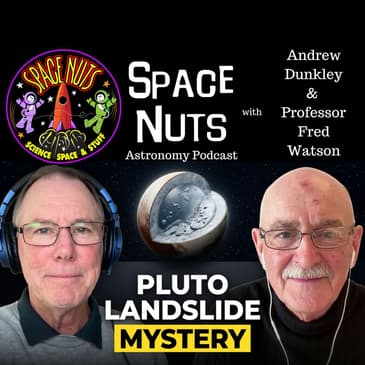

Discover the intriguing discovery of landslides on Pluto, explained through recent image analysis from the New Horizons spacecraft, and learn how these features provide clues about the dwarf planet's geological activity. Plus, explore China's recent achievement in rocket recovery, mimicking SpaceX's successful landing techniques with innovative net capture technology, signaling a significant step forward in space debris management and reusability.
Fred Watson and Andrew Dunkley discuss recent scientific findings on landslides around Sputnik Planitia on Pluto
How climate change on Earth is increasing landslide activity, and how similar processes might be happening on other worlds
The significance of the 2015 flyby of Pluto by the New Horizons spacecraft and what it revealed about planetary geology
Details of China's recent successful rocket booster recovery using a net and its potential impact on space launch economics
Comparison between China's new net capture method and SpaceX's chopsticks system for booster recovery
The rapid advancement of Chinese space capabilities, including lunar and space station missions
The broader context of international space race dynamics and the race to return humans to the Moon
UAP Study Group Led by Avi Loeb and the Search for Extraterrestrial Phenomena
Get an inside look at the White House-formed UAP science advisory council led by Harvard's Avi Loeb, emphasizing scientific rigor in studying unidentified anomalous phenomena. The discussion covers the composition of the council, the importance of unbiased research, and the challenges of interpreting mysterious aerial objects observed over the years.
The formation and purpose of the UAP Science Advisory Council, chaired by Avi Loeb
The diverse backgrounds of experts involved, including physicists, military personnel, computer scientists, and psychologists
How modern technology and data are transforming the study of UAPs, with government and military reports analyzed over decades
The debate over the nature of UAPs: natural phenomena, advanced human technology, or potential extraterrestrial origins
The cultural and political implications of gaps in understanding these phenomena and the importance of scientific methodology
Reader comments reflecting skepticism and intrigue about the investigations and the sensationalism surrounding UAP research
Become a supporter of this podcast: https://www.spreaker.com/podcast/space-nuts-astronomy-insights-cosmic-discoveries--2631155/support.
00:00:00 --> 00:00:01 Andrew Dunkley: Hello again. Thank you for joining us. This
00:00:01 --> 00:00:04 is Space Nuts. My name is Andrew
00:00:04 --> 00:00:06 Dunkley. Great to have your company yet
00:00:06 --> 00:00:08 again. Coming up on this episode,
00:00:09 --> 00:00:11 landslides on Pluto.
00:00:12 --> 00:00:14 Yes, apparently. So, uh, China pulls
00:00:14 --> 00:00:17 off a SpaceX trick. And, uh, this is
00:00:17 --> 00:00:20 a really interesting story. Um, we'll have to
00:00:20 --> 00:00:22 watch our P's and Q's on this, but the White
00:00:22 --> 00:00:24 House has established a UFO study group. And
00:00:24 --> 00:00:27 guess who's in charge? The. No, it's not the
00:00:27 --> 00:00:30 president. Uh, it's someone else. Almost as
00:00:30 --> 00:00:33 wacky. Uh, we'll do all of those stories on
00:00:33 --> 00:00:35 this episode of space nuts.
00:00:35 --> 00:00:37 Professor Fred Watson: 15 seconds. Guidance is internal.
00:00:38 --> 00:00:40 10, 9. Ignition
00:00:40 --> 00:00:41 sequence start.
00:00:41 --> 00:00:42 Professor Fred Watson: Um, space nuts.
00:00:43 --> 00:00:45 Professor Fred Watson: 5, 4, 3, 2. 1, 2, 3, 4,
00:00:45 --> 00:00:47 5, 5, 4, 3, 2, 1.
00:00:47 --> 00:00:49 Andrew Dunkley: Space nuts.
00:00:49 --> 00:00:50 Professor Fred Watson: Astronauts report it feels good.
00:00:51 --> 00:00:54 Andrew Dunkley: And speaking of wacky, uh, we are joined once
00:00:54 --> 00:00:56 again by Professor Fred Watson, astronomer at
00:00:56 --> 00:00:59 large. Uh, sporting rather significant
00:00:59 --> 00:01:00 bump on the head.
00:01:01 --> 00:01:04 Professor Fred Watson: Uh, yes, actually, it's two.
00:01:04 --> 00:01:05 One bigger than the other. It almost looks
00:01:05 --> 00:01:08 like a planet with its moon in orbit around
00:01:08 --> 00:01:10 it. As a visual aid,
00:01:10 --> 00:01:12 uh, walking into
00:01:12 --> 00:01:13 Andrew Dunkley: doors will do that to you.
00:01:13 --> 00:01:16 Professor Fred Watson: It's what happened. And it's all astronomy's
00:01:16 --> 00:01:18 fault because every night I tend to go out on
00:01:18 --> 00:01:20 our. We've got a terrace that faces north,
00:01:21 --> 00:01:22 which is where all the planets are if you're
00:01:22 --> 00:01:25 in the southern hemisphere. I usually go
00:01:25 --> 00:01:27 out and just have a look at the sky before I
00:01:27 --> 00:01:30 go to bed, being an astronomer, but.
00:01:30 --> 00:01:33 And normally, um, I check the screen doors
00:01:33 --> 00:01:35 open. But last night I was thinking of
00:01:35 --> 00:01:36 something else and I just walked right into
00:01:36 --> 00:01:38 the screen door. And it's quite a solid
00:01:38 --> 00:01:41 screen door, so I can see that. Yes,
00:01:41 --> 00:01:43 yeah, yeah.
00:01:43 --> 00:01:44 Andrew Dunkley: Oh, we've all done it, Fred
00:01:46 --> 00:01:46 and
00:01:46 --> 00:01:48 Professor Fred Watson: I. I've done it, too, but not quite as
00:01:48 --> 00:01:51 spectacular as this, fortunately. Um,
00:01:51 --> 00:01:53 if I put a beanie on so I look like a
00:01:53 --> 00:01:56 criminal, you don't see the bullet holes. Uh,
00:01:57 --> 00:01:59 and where are we going next week? Uh, I'll
00:01:59 --> 00:02:01 probably have to have a hat on all the time
00:02:01 --> 00:02:02 anyway, so.
00:02:02 --> 00:02:04 Andrew Dunkley: Yeah, the worst one I ever did was at
00:02:04 --> 00:02:07 golf. I had to duck off to the,
00:02:07 --> 00:02:10 um, gentleman's room, which, uh, they
00:02:10 --> 00:02:11 have them all over the golf course. And this
00:02:11 --> 00:02:13 one's right up one end of the course, but
00:02:13 --> 00:02:15 they've got a water tank next to it, which is
00:02:15 --> 00:02:18 shrouded in trees. And I knew it was there,
00:02:18 --> 00:02:21 so I ducked, but I didn't duck enough. Uh,
00:02:21 --> 00:02:24 and I went. My forehead went straight into
00:02:25 --> 00:02:28 the metal bit that was holding it up like
00:02:28 --> 00:02:31 a big. Oh, my gosh, it nearly knocked me out.
00:02:31 --> 00:02:34 Professor Fred Watson: I bet it Did. Yeah, yeah, I bet you were in.
00:02:34 --> 00:02:35 I bet you were a mess.
00:02:37 --> 00:02:40 Andrew Dunkley: I had a dreadful headache. Um, there was this
00:02:40 --> 00:02:42 awful clang, but no one saw me because I was
00:02:42 --> 00:02:42 in the trees.
00:02:43 --> 00:02:44 Professor Fred Watson: Yeah, yeah.
00:02:44 --> 00:02:46 Andrew Dunkley: But um, yeah, that was not good.
00:02:47 --> 00:02:49 Professor Fred Watson: No, you're lucky, uh, you didn't do yourself
00:02:49 --> 00:02:50 one of those brain injuries.
00:02:51 --> 00:02:52 Andrew Dunkley: Maybe I have, Fred.
00:02:53 --> 00:02:55 Professor Fred Watson: Well, it's funny, funny you should mention
00:02:55 --> 00:02:58 that, Andrew. We'll
00:02:58 --> 00:02:59 see how things go.
00:02:59 --> 00:03:02 Andrew Dunkley: Yes, uh, let's get stuck into our
00:03:02 --> 00:03:05 stories. The very first story is about
00:03:05 --> 00:03:07 landslides. Now we have, we have our fair
00:03:07 --> 00:03:09 share of landslides on Earth. I've uh, seen
00:03:09 --> 00:03:12 some dreadful images, uh, online of um,
00:03:13 --> 00:03:16 huge, I mean massive landslides in some parts
00:03:16 --> 00:03:18 of the world. Yeah, I've um, I've not
00:03:18 --> 00:03:20 witnessed one close up and personal,
00:03:20 --> 00:03:23 thankfully. But I've seen the aftermath of a
00:03:23 --> 00:03:25 few in Australia where um, landslides
00:03:26 --> 00:03:29 are not uncommon. Uh, and I've seen a few
00:03:29 --> 00:03:31 overseas where pieces of mountain have just
00:03:31 --> 00:03:34 slipped off and um,
00:03:35 --> 00:03:37 it can be pretty chaotic and unfortunately
00:03:38 --> 00:03:41 has um, led to fatalities. I uh,
00:03:41 --> 00:03:43 don't think that's a problem on Pluto in
00:03:43 --> 00:03:46 terms of fatalities. But uh, it is something
00:03:46 --> 00:03:48 that happens. Uh, and we've not seen that on
00:03:48 --> 00:03:49 Pluto before.
00:03:50 --> 00:03:53 Professor Fred Watson: Correct. Uh, and just while we're talking
00:03:53 --> 00:03:56 about that, you're absolutely right, um, that
00:03:56 --> 00:03:58 landslides ah, are playing
00:03:59 --> 00:04:01 actually an increasing role on our own
00:04:01 --> 00:04:04 planet. Um, as you know, we were up in
00:04:04 --> 00:04:06 Greenland at the beginning of last year, not
00:04:06 --> 00:04:09 next year, beginning of last year. And um,
00:04:10 --> 00:04:13 met online, um, a researcher
00:04:13 --> 00:04:15 who'd studied this, um, um, basically
00:04:15 --> 00:04:18 a landslide in one of the Greenland
00:04:18 --> 00:04:21 fjords where um,
00:04:21 --> 00:04:24 climate change had reduced the height of a
00:04:24 --> 00:04:26 glacier. And that glacier was propping
00:04:26 --> 00:04:28 up half a mountain.
00:04:29 --> 00:04:32 And as it melted, the half mountain gave
00:04:32 --> 00:04:35 way and tumbled down the 45
00:04:35 --> 00:04:37 degree slope, uh,
00:04:39 --> 00:04:42 onto the glacier, sorry, tumbled
00:04:42 --> 00:04:44 onto the Glacier, down the 45 degree slope
00:04:44 --> 00:04:46 into the fjord and set up this
00:04:47 --> 00:04:50 oscillation, uh, which I think we talked
00:04:50 --> 00:04:52 about a couple of times on Space Nuts.
00:04:53 --> 00:04:55 It's called a sesh or a seash, I think, where
00:04:55 --> 00:04:58 it's like water swelling from side to side in
00:04:58 --> 00:05:00 your bath. But it did it for, what was it,
00:05:00 --> 00:05:03 four days or something? Every nine minutes.
00:05:03 --> 00:05:05 It was extraordinary. And that's how it was
00:05:05 --> 00:05:07 picked up by the world's seismologists.
00:05:08 --> 00:05:11 So a changing climate can increase
00:05:11 --> 00:05:13 landslides. Now we're not saying that's
00:05:13 --> 00:05:16 what's happening on Pluto, uh, but, uh,
00:05:16 --> 00:05:19 there are landslides on Pluto. And of course
00:05:19 --> 00:05:21 pretty well everything we know about Pluto
00:05:21 --> 00:05:24 now comes from that flyby of the New
00:05:24 --> 00:05:26 Horizons spacecraft. If I remember rightly,
00:05:26 --> 00:05:28 it was 14 July 2015,
00:05:29 --> 00:05:32 a momentous occasion uh, for astronomers and
00:05:32 --> 00:05:34 planetary scientists when we got the first
00:05:34 --> 00:05:37 close ups of the dwarf planet Pluto
00:05:37 --> 00:05:39 with that heart shaped plane, uh,
00:05:39 --> 00:05:42 Sputnik Planitia, uh, facing
00:05:42 --> 00:05:45 us that people made into a likeness of Pluto
00:05:45 --> 00:05:48 the dog. It was all great stuff, uh, that
00:05:48 --> 00:05:51 is mostly um, sort of slushy
00:05:51 --> 00:05:53 or solid nitrogen that makes up
00:05:53 --> 00:05:56 that very flat plane. And people think there
00:05:56 --> 00:05:59 are glaciers in, at the edge of that as well.
00:05:59 --> 00:06:02 But the basin in which that plane uh
00:06:02 --> 00:06:05 formed was uh, probably caused by
00:06:05 --> 00:06:08 an impact billions of years ago, uh,
00:06:08 --> 00:06:10 that caused a depression in the surface. But
00:06:10 --> 00:06:13 we think the surface itself is made pretty
00:06:13 --> 00:06:15 well of solid water ice.
00:06:16 --> 00:06:18 Uh, and so what you've got is
00:06:18 --> 00:06:21 this large region on Pluto which
00:06:21 --> 00:06:23 is surrounded by a very
00:06:24 --> 00:06:27 fractured landscape. I remember looking at
00:06:27 --> 00:06:29 some of the mountains around the edge of that
00:06:29 --> 00:06:32 and they look just like ice cubes
00:06:32 --> 00:06:34 at the edge of a drink. And that's probably
00:06:34 --> 00:06:37 what they are, but they're four kilometers
00:06:37 --> 00:06:38 high. You know, these are things that
00:06:39 --> 00:06:41 probably were pushed to one side by whatever
00:06:41 --> 00:06:44 caused that impact. Yeah, but it's in
00:06:44 --> 00:06:47 that area around the edge of Sputnik
00:06:47 --> 00:06:49 Planitia that these
00:06:50 --> 00:06:52 um, uh, landslides have been found
00:06:53 --> 00:06:56 on Pluto. Uh, and it's um, actually
00:06:56 --> 00:06:59 some scientists, um, I think they're in Italy
00:06:59 --> 00:07:01 if I remember rightly, uh, who have
00:07:01 --> 00:07:04 um, national uh, Research Council
00:07:05 --> 00:07:08 in Perugia in Italy, uh, they
00:07:08 --> 00:07:10 have looked more closely at
00:07:11 --> 00:07:14 the images that came back from New
00:07:14 --> 00:07:16 Horizons and they think they've
00:07:16 --> 00:07:18 identified, I think it's about half a dozen
00:07:19 --> 00:07:22 uh, landslides, uh, which are
00:07:22 --> 00:07:25 uh, quite significant in size
00:07:26 --> 00:07:29 but all tend to be around the edge of
00:07:29 --> 00:07:30 that, of that um,
00:07:32 --> 00:07:34 flat plane, the
00:07:34 --> 00:07:36 Sputnik Polynitia.
00:07:36 --> 00:07:39 Andrew Dunkley: So they're sliding into the
00:07:39 --> 00:07:40 crater, is that what we're saying?
00:07:41 --> 00:07:43 Professor Fred Watson: Well what we're seeing is uh,
00:07:44 --> 00:07:46 actually at least one of them is sliding into
00:07:46 --> 00:07:48 a crater. The crater is not far from the edge
00:07:48 --> 00:07:50 of Sputnik Planitia, but it's not the edge.
00:07:51 --> 00:07:53 Um, and what they've done is they've noted,
00:07:54 --> 00:07:57 you know, a region in the crater wall that's
00:07:57 --> 00:07:59 got a break in it, uh, that
00:08:00 --> 00:08:03 corresponds with debris on the crater floor.
00:08:04 --> 00:08:07 Um, and that's the, seems to be
00:08:07 --> 00:08:09 the smoking gun, if I can put it that way.
00:08:10 --> 00:08:10 Um,
00:08:14 --> 00:08:16 the biggest of them is huge, it's 130 square
00:08:16 --> 00:08:19 kilometers, um, which is very large,
00:08:20 --> 00:08:23 um, and certainly would be a very big
00:08:23 --> 00:08:26 landslide on planet Earth. And their
00:08:26 --> 00:08:29 heights are ah, one
00:08:29 --> 00:08:32 and a half to 2.2 kilometers is what
00:08:32 --> 00:08:34 they're Talking about. So that's quite a
00:08:34 --> 00:08:36 high, um, you know, a high
00:08:37 --> 00:08:39 uh, drop zone, if I can put it that way.
00:08:39 --> 00:08:39 Andrew Dunkley: Yes.
00:08:40 --> 00:08:43 Professor Fred Watson: And what they're saying is that
00:08:43 --> 00:08:45 uh, the, the material that
00:08:46 --> 00:08:48 falls down in the landslide down the
00:08:48 --> 00:08:51 slope, uh, actually goes
00:08:51 --> 00:08:54 further into the flat area that
00:08:54 --> 00:08:56 it's running into. And in this case it's the
00:08:56 --> 00:08:59 floor of a crater, um, that
00:08:59 --> 00:09:02 uh, it goes further than it would do
00:09:02 --> 00:09:05 elsewhere in the solar system, for example on
00:09:05 --> 00:09:08 Earth. Uh, and what they are suggesting is
00:09:08 --> 00:09:11 that that means there's less friction uh,
00:09:11 --> 00:09:13 in this material. So it goes
00:09:13 --> 00:09:16 further over the landscape. And um,
00:09:16 --> 00:09:19 and maybe that confirms that
00:09:20 --> 00:09:22 what the material is, that's sliding down is
00:09:22 --> 00:09:24 actually water ice. Although they don't say
00:09:24 --> 00:09:27 that in the report I've read. That's an
00:09:27 --> 00:09:29 inference from me. But uh, it sounds, it
00:09:29 --> 00:09:30 would make sense though.
00:09:31 --> 00:09:34 Andrew Dunkley: Most of the surface of Pluto is water
00:09:34 --> 00:09:37 ice. And of course it's so cold, like minus
00:09:37 --> 00:09:40 230 degrees Celsius. Um,
00:09:40 --> 00:09:42 the ice is like rock.
00:09:42 --> 00:09:45 Professor Fred Watson: Solid rock. That's right. Absolutely hard as
00:09:45 --> 00:09:46 rock. Yeah.
00:09:46 --> 00:09:48 Andrew Dunkley: And the mountains on Pluto are massive.
00:09:48 --> 00:09:50 Massive for a small place.
00:09:50 --> 00:09:51 Professor Fred Watson: Yes, they ah, are huge.
00:09:51 --> 00:09:54 Andrew Dunkley: Like up to 6.2 kilometers in
00:09:54 --> 00:09:55 height, 3.9 miles.
00:09:56 --> 00:09:56 Professor Fred Watson: Yeah.
00:09:56 --> 00:09:59 Andrew Dunkley: Um, up around the 20ft mark. I
00:09:59 --> 00:10:02 mean that would be a big mountain on Earth.
00:10:02 --> 00:10:04 Professor Fred Watson: It would. That's right. And here's a world
00:10:04 --> 00:10:06 that's um, well less than a quarter of the
00:10:06 --> 00:10:08 Earth's diameter. It's smaller than the moon.
00:10:08 --> 00:10:11 Uh, it's remarkable though. And you know,
00:10:11 --> 00:10:14 all credit to these scientists who've been
00:10:14 --> 00:10:17 very patient in their work
00:10:17 --> 00:10:20 combing these images for things that
00:10:20 --> 00:10:22 look like landslides. Because that's the only
00:10:22 --> 00:10:25 clue you've got is the appearance, uh,
00:10:25 --> 00:10:27 from, from above. But the fact that you're
00:10:27 --> 00:10:30 seeing maybe material in the side of a
00:10:30 --> 00:10:33 crater that's, that's different from the, the
00:10:33 --> 00:10:35 walls of the crater around it because it's
00:10:35 --> 00:10:37 been, it's, you know, it's, it's actually
00:10:37 --> 00:10:38 fallen down.
00:10:38 --> 00:10:38 Professor Fred Watson: Yeah.
00:10:39 --> 00:10:40 Professor Fred Watson: Remarkable stuff.
00:10:40 --> 00:10:42 Andrew Dunkley: It is. And, and we've seen landslides on
00:10:42 --> 00:10:43 other planets.
00:10:43 --> 00:10:46 Professor Fred Watson: Yes, yep, uh, certainly. And also
00:10:46 --> 00:10:49 on some of the other moons. Um,
00:10:49 --> 00:10:52 uh, apparently. Well, some of the features on
00:10:52 --> 00:10:55 Phobos, which is a very strange little world
00:10:55 --> 00:10:58 dominated by a huge crater called Stickney,
00:10:59 --> 00:11:01 uh, that has landscape,
00:11:02 --> 00:11:04 sorry, landslides as well. Uh, the asteroid
00:11:04 --> 00:11:07 Vesta, which the new, uh, sorry, the dawn
00:11:07 --> 00:11:09 spacecraft was in orbit around before it went
00:11:09 --> 00:11:11 on to Ceres, that's got landslides.
00:11:12 --> 00:11:14 Um, and so what they're saying is, you know,
00:11:14 --> 00:11:17 you'd expect a world like Pluto also
00:11:17 --> 00:11:19 to have landslides. But um, it's taken
00:11:20 --> 00:11:22 what uh 11 years now since a
00:11:22 --> 00:11:25 flyby uh for anyone to find them.
00:11:25 --> 00:11:27 But they found the evidence of six
00:11:28 --> 00:11:30 features that look like landslides.
00:11:30 --> 00:11:33 Andrew Dunkley: Actually as we record Fred, it's exactly 11
00:11:33 --> 00:11:34 years today.
00:11:34 --> 00:11:35 Professor Fred Watson: So it is.
00:11:36 --> 00:11:37 Andrew Dunkley: I just noticed that.
00:11:37 --> 00:11:40 Professor Fred Watson: So it is the 14th of July. Yes, M
00:11:40 --> 00:11:42 2015 it was. That's right. Well there you go.
00:11:42 --> 00:11:44 Andrew Dunkley: People are saying 14th of July, they're
00:11:44 --> 00:11:45 recording on the 14th of July and this
00:11:45 --> 00:11:47 thing's coming out on the, the uh 7th of
00:11:47 --> 00:11:49 August. What's going on? We're jumping ahead
00:11:49 --> 00:11:50 because Fred's got another trip.
00:11:51 --> 00:11:52 Professor Fred Watson: Yes, sorry about that.
00:11:52 --> 00:11:54 Andrew Dunkley: Not like the trip he had into the screen door
00:11:54 --> 00:11:55 last night.
00:11:56 --> 00:11:59 Professor Fred Watson: No, I'll try and avoid screen doors in
00:11:59 --> 00:11:59 future.
00:12:00 --> 00:12:02 Andrew Dunkley: Now it's a fascinating story. Landslides,
00:12:03 --> 00:12:06 probably made of water. Water ice on Pluto.
00:12:06 --> 00:12:08 You can read all about it. Uh, well there's a
00:12:08 --> 00:12:11 few places um, fizz.org's got a great article
00:12:11 --> 00:12:13 about it and uh, you can also read the paper
00:12:14 --> 00:12:16 which was published in the journal Icarus.
00:12:17 --> 00:12:19 This is Space Nuts. Andrew Dunkley and
00:12:19 --> 00:12:21 Professor Fred Watson.
00:12:23 --> 00:12:25 Professor Fred Watson: Hey, that's one of the better sims, believe
00:12:25 --> 00:12:27 me. We've had a couple of cardiac arrests
00:12:27 --> 00:12:29 down here too Pete. There weren't any
00:12:29 --> 00:12:31 turf.
00:12:31 --> 00:12:33 Andrew Dunkley: Space Nuts. Okay Fred, let's
00:12:33 --> 00:12:35 move on to our uh, next story.
00:12:36 --> 00:12:39 And we've seen a lot lately
00:12:39 --> 00:12:42 about SpaceX and its exploits and its success
00:12:42 --> 00:12:44 with uh, reusable
00:12:44 --> 00:12:47 boosters that uh, land themselves back
00:12:47 --> 00:12:50 on ocean going platforms and other
00:12:50 --> 00:12:52 places. Places um, they've had some
00:12:52 --> 00:12:54 deconstructive events as well. Yes,
00:12:55 --> 00:12:58 um, but uh, and a few other players have
00:12:58 --> 00:13:00 attempted this not so successfully. Um,
00:13:00 --> 00:13:03 now it looks like China's in on the game.
00:13:04 --> 00:13:07 Professor Fred Watson: That's correct. We've had um, so uh,
00:13:08 --> 00:13:10 Blue Origin has also managed to
00:13:11 --> 00:13:14 uh, do the soft landing trick at ah, least
00:13:14 --> 00:13:16 once I think. Um, but
00:13:17 --> 00:13:19 this is the first time we've got a record
00:13:20 --> 00:13:22 of a country uh,
00:13:22 --> 00:13:25 other than America uh basically
00:13:25 --> 00:13:27 pulling off this trick of
00:13:28 --> 00:13:30 grabbing your booster before it's thrown
00:13:30 --> 00:13:33 away, uh landing it softly and
00:13:33 --> 00:13:36 saving it for another time. Uh and
00:13:37 --> 00:13:40 the fascinating aspect of this
00:13:40 --> 00:13:43 Andrew is the way it's been done by the
00:13:43 --> 00:13:45 China Aerospace Science and Technology
00:13:46 --> 00:13:48 Corporation. Um, they
00:13:48 --> 00:13:51 have rather than do this you
00:13:51 --> 00:13:54 know, fine needle control uh,
00:13:54 --> 00:13:57 of the rockets,
00:13:57 --> 00:13:59 the basically the, the rockets that are
00:13:59 --> 00:14:01 firing to slow down the spacecraft as it
00:14:01 --> 00:14:04 descends to Earth, uh and basically
00:14:04 --> 00:14:07 pivoting it down onto, onto its
00:14:07 --> 00:14:09 legs, which is certainly what happens with
00:14:09 --> 00:14:12 The Falcon uh nine rockets. SpaceX's
00:14:12 --> 00:14:15 uh, Starship actually has
00:14:15 --> 00:14:17 what they Call them the chopsticks. These two
00:14:17 --> 00:14:20 arms on the launch tower that just
00:14:20 --> 00:14:22 grab them and hold it. And in a way, uh, what
00:14:22 --> 00:14:25 we're seeing from the Chinese, uh, um,
00:14:26 --> 00:14:27 experiment, if I can put it that way, or
00:14:27 --> 00:14:30 project, is similar to that, uh, because
00:14:30 --> 00:14:32 you're sort of grabbing it, but not with
00:14:33 --> 00:14:35 pincers or chopsticks. Uh,
00:14:35 --> 00:14:38 basically you're putting it into a net
00:14:39 --> 00:14:40 as it lands.
00:14:40 --> 00:14:42 Andrew Dunkley: There's a. I reckon they'd be pretty good at
00:14:42 --> 00:14:43 using the chopsticks method.
00:14:43 --> 00:14:46 Professor Fred Watson: Yeah, why did I miss
00:14:46 --> 00:14:48 that one? That's a great one. Yeah, they
00:14:48 --> 00:14:49 probably would.
00:14:50 --> 00:14:51 Andrew Dunkley: They're pretty good at using nets too though.
00:14:51 --> 00:14:53 A lot of fishing over in Asia.
00:14:53 --> 00:14:55 Professor Fred Watson: Yes, that's right. And that's what this is.
00:14:55 --> 00:14:57 So the spacecraft lands, uh,
00:14:58 --> 00:15:01 and into a sort of framework, a huge
00:15:01 --> 00:15:03 thing that looks a bit like a bird cage,
00:15:03 --> 00:15:06 enormous, uh, but it's got a net in it.
00:15:06 --> 00:15:09 And so, uh, this thing gets caught in the
00:15:09 --> 00:15:11 net, uh, the motor switches off,
00:15:12 --> 00:15:15 uh, and it returns, uh,
00:15:15 --> 00:15:17 and is captured. So
00:15:18 --> 00:15:21 the net, they call it a net system. And we
00:15:21 --> 00:15:23 haven't really seen any detail about how this
00:15:23 --> 00:15:26 works because, uh,
00:15:27 --> 00:15:29 you know, it would be, um, it's fine
00:15:29 --> 00:15:31 catching something in a net, but then you've
00:15:31 --> 00:15:33 got to get it out the net and set it up again
00:15:33 --> 00:15:36 for another launch. With Falcon 9,
00:15:36 --> 00:15:39 it's, uh, standing there ready to be reloaded
00:15:39 --> 00:15:40 onto the launch pad.
00:15:42 --> 00:15:45 What is impressive about this, uh,
00:15:45 --> 00:15:47 capture of the booster though, and it's along
00:15:47 --> 00:15:49 March 10th B, I think.
00:15:49 --> 00:15:50 Andrew Dunkley: Yes, it is.
00:15:51 --> 00:15:53 Professor Fred Watson: Uh, this has been, as with
00:15:54 --> 00:15:56 SpaceX, uh, it's a maritime
00:15:57 --> 00:15:59 landing. So the rocket comes down to a
00:16:00 --> 00:16:02 barge basically in the ocean that's equipped
00:16:02 --> 00:16:04 with this net. Rather than just a platform
00:16:04 --> 00:16:06 which both Blue Origin and
00:16:06 --> 00:16:09 SpaceX use, they just have a platform for
00:16:09 --> 00:16:12 their returning booster rockets. Uh, but
00:16:12 --> 00:16:14 this net is a platform, but
00:16:14 --> 00:16:17 with a sort of tower attached to it,
00:16:18 --> 00:16:20 um, really quite remarkable. Uh, and, uh,
00:16:21 --> 00:16:23 uh, yes, a step forward. This is clearly
00:16:23 --> 00:16:26 going to, uh, enhance the rate at which,
00:16:26 --> 00:16:29 uh, Chinese, um, spacecraft are
00:16:29 --> 00:16:31 launched. So we'll see probably much more of
00:16:31 --> 00:16:31 it in the future.
00:16:32 --> 00:16:34 Andrew Dunkley: Yes, and look, you've got to give them a lot
00:16:34 --> 00:16:37 of credit. China has got just
00:16:37 --> 00:16:40 burst ahead in leaps and bounds when it comes
00:16:40 --> 00:16:42 to, uh, the space race and space technology.
00:16:43 --> 00:16:45 They've got their little rover on the dark
00:16:45 --> 00:16:48 side of the moon, and um, they've got their
00:16:48 --> 00:16:50 space station up there, which we've mentioned
00:16:50 --> 00:16:53 in the last few weeks is being expanded.
00:16:53 --> 00:16:56 And now they've managed to um, do something
00:16:56 --> 00:16:58 that only a few have done before and that is
00:16:58 --> 00:17:01 to return a booster, uh, down onto a floating
00:17:01 --> 00:17:04 platform, and who knows what
00:17:04 --> 00:17:07 they'll achieve next. They're just, they're
00:17:07 --> 00:17:09 quite a remarkable entity when it comes to
00:17:09 --> 00:17:12 the, um, the space. I call
00:17:12 --> 00:17:14 it the space race. I don't really like that.
00:17:14 --> 00:17:17 No, but it is. I mean, look, look,
00:17:17 --> 00:17:19 look, look what's happening with the, the
00:17:19 --> 00:17:22 push to get people back on the moon. China's
00:17:22 --> 00:17:25 well into that race and the Americans are
00:17:26 --> 00:17:28 fighting very hard to get people back there
00:17:28 --> 00:17:29 with the Artemis missions.
00:17:29 --> 00:17:30 Professor Fred Watson: Yep.
00:17:30 --> 00:17:33 Andrew Dunkley: Um, so it's no holds
00:17:33 --> 00:17:35 barred at the moment. Thought you'd find this
00:17:35 --> 00:17:37 interesting, Fred. Remember the, um, floating
00:17:37 --> 00:17:40 platforms that SpaceX used to um,
00:17:41 --> 00:17:44 land their rockets? Um, they all had really
00:17:44 --> 00:17:44 funny names. They do.
00:17:44 --> 00:17:45 Professor Fred Watson: That's right.
00:17:45 --> 00:17:47 Andrew Dunkley: Of course, I Still love you was one of them.
00:17:47 --> 00:17:48 Professor Fred Watson: I think that was the first.
00:17:49 --> 00:17:52 Andrew Dunkley: Just read the instructions. That was off
00:17:52 --> 00:17:54 the Florida, um, coast. Uh, the first one I
00:17:54 --> 00:17:57 mentioned was in the Pacific and a shortfall
00:17:57 --> 00:17:59 of gravitas, which is also an
00:18:00 --> 00:18:03 East Coast Atlantic operation. So what do you
00:18:03 --> 00:18:04 think the Chinese have called?
00:18:05 --> 00:18:08 Professor Fred Watson: Ah, I don't have that information
00:18:08 --> 00:18:10 and I'm not sure I want to guess.
00:18:11 --> 00:18:14 Andrew Dunkley: Ling Hang Shu, which uh, stands for
00:18:14 --> 00:18:14 navigator.
00:18:15 --> 00:18:16 Professor Fred Watson: Yeah, it's nice.
00:18:16 --> 00:18:17 Andrew Dunkley: Call it navigator.
00:18:17 --> 00:18:19 Professor Fred Watson: Yes, I like that. Nice.
00:18:19 --> 00:18:22 Andrew Dunkley: It's pretty good. Um, I,
00:18:22 --> 00:18:24 I wouldn't have thought they'd have gone too
00:18:24 --> 00:18:26 far outside the, the limits of
00:18:26 --> 00:18:28 normality in terms of a name. They would.
00:18:29 --> 00:18:32 That's, that's a particular Elon Musk thing,
00:18:32 --> 00:18:34 Professor Fred Watson: I think it is. Uh, that's certainly true. And
00:18:34 --> 00:18:37 Norma, um, uh, a lot of Chinese
00:18:38 --> 00:18:41 names, uh, in terms of their spacecraft and
00:18:41 --> 00:18:42 things like that have got names that come
00:18:42 --> 00:18:43 from Chinese mythology.
00:18:45 --> 00:18:48 Um, ah,
00:18:48 --> 00:18:51 there's the relay, um,
00:18:51 --> 00:18:54 spacecraft that communicates both with the
00:18:54 --> 00:18:57 Earth and uh, the lander on the far side
00:18:57 --> 00:19:00 of the moon. I think it translates as Magpie
00:19:00 --> 00:19:03 Bridge, uh, which is, uh. I can't remember
00:19:03 --> 00:19:05 what the name is, but I think it's translates
00:19:05 --> 00:19:08 as Magpie Bridge, which comes from a Chinese
00:19:08 --> 00:19:10 folk tale of some sort. It's lovely.
00:19:10 --> 00:19:10 Andrew Dunkley: Yeah.
00:19:10 --> 00:19:11 Professor Fred Watson: Ah, yeah.
00:19:11 --> 00:19:14 Andrew Dunkley: Um, I can't wait to see what they do next.
00:19:15 --> 00:19:18 No, no. And, and this actual
00:19:18 --> 00:19:20 success the Chinese have, um,
00:19:20 --> 00:19:22 demonstrated has started a lot of chatter
00:19:22 --> 00:19:25 between people about, um, you know, where
00:19:25 --> 00:19:27 things are at between the United States and
00:19:27 --> 00:19:30 China in space. So, uh, it is
00:19:30 --> 00:19:33 noticed. It's not something that, um,
00:19:33 --> 00:19:36 is being ignored in the United States, but,
00:19:36 --> 00:19:38 um, it is being noticed most definitely.
00:19:38 --> 00:19:38 Professor Fred Watson: Yeah.
00:19:39 --> 00:19:41 Andrew Dunkley: And look, they've made history. This one will
00:19:41 --> 00:19:43 be remembered because, um, it's their first,
00:19:44 --> 00:19:46 um, success at this level. I Think they've
00:19:46 --> 00:19:49 had sort of um, a few rockets that have been
00:19:49 --> 00:19:51 partially recovered. I don't know what that
00:19:51 --> 00:19:54 means exactly but uh, this
00:19:54 --> 00:19:56 is, this is like a self landing situation.
00:19:57 --> 00:20:00 Uh, and it worked very, very well. Uh, you
00:20:00 --> 00:20:02 can read all about it@the
00:20:02 --> 00:20:05 space.com website. Uh, you're
00:20:05 --> 00:20:08 listening to Space Nuts with Andrew Dunkley
00:20:08 --> 00:20:09 and Professor Fred Watson.
00:20:12 --> 00:20:13 Professor Fred Watson: Roger, your labs are here.
00:20:13 --> 00:20:15 Andrew Dunkley: Also Space Nuts.
00:20:15 --> 00:20:18 Now Fred, uh, we come to
00:20:18 --> 00:20:20 a rather saucy story, this one.
00:20:21 --> 00:20:23 Uh, and look, I
00:20:23 --> 00:20:25 even um, in reading the article
00:20:26 --> 00:20:29 noticed that they did a little preamble
00:20:29 --> 00:20:32 uh, @space.com before they ran
00:20:32 --> 00:20:35 the story. It says we approach this topic
00:20:35 --> 00:20:37 with the same rigor we apply in our
00:20:37 --> 00:20:40 respective scientific fields and we hope to
00:20:40 --> 00:20:43 provide an unbiased analysis
00:20:43 --> 00:20:45 of this topic. We hope do.
00:20:46 --> 00:20:48 Um, I think they did a pretty good job. But
00:20:48 --> 00:20:51 what we're talking about is um, a White
00:20:51 --> 00:20:54 House group that has been formed to
00:20:54 --> 00:20:57 study Ah, UAPs,
00:20:57 --> 00:21:00 unidentified anomalous phenomena
00:21:00 --> 00:21:02 formerly known as UFOs,
00:21:02 --> 00:21:05 unidentified flying objects. And I
00:21:05 --> 00:21:07 asked at the beginning of the show who's in
00:21:07 --> 00:21:10 charge? Would you care to
00:21:10 --> 00:21:11 reveal that?
00:21:11 --> 00:21:14 Professor Fred Watson: Fred? It is, yes, it's our old friend Avi
00:21:14 --> 00:21:16 Loeb who is the um,
00:21:16 --> 00:21:19 Harvard uh, astronomer, a very
00:21:19 --> 00:21:21 senior astronomer, very well thought of in
00:21:21 --> 00:21:24 the world of astrophysics. Except when he
00:21:24 --> 00:21:26 talks about UFOs. Uh,
00:21:27 --> 00:21:30 uh, he has, he's the person who's you know,
00:21:30 --> 00:21:32 looked at things like uh, does
00:21:33 --> 00:21:36 Comet uh 3i Atlas have uh,
00:21:36 --> 00:21:38 Windows or anything that might tell you that
00:21:38 --> 00:21:41 it is not a natural object, that it is
00:21:41 --> 00:21:42 artificially made. That's the interstellar
00:21:42 --> 00:21:45 comet that's flying through the solar system
00:21:45 --> 00:21:48 at the moment. It is a comet, um, and um, um,
00:21:48 --> 00:21:50 not a piece of alien hardware but.
00:21:51 --> 00:21:53 Andrew Dunkley: And yet Fred, I've had people come up to me
00:21:53 --> 00:21:56 and say oh did you hear about that comet?
00:21:57 --> 00:21:59 They think it's a spaceship. And I go no it's
00:21:59 --> 00:22:00 not.
00:22:00 --> 00:22:03 Professor Fred Watson: Yeah, only
00:22:03 --> 00:22:04 one person does.
00:22:05 --> 00:22:08 Andrew Dunkley: And that's okay, that's okay. But it's
00:22:08 --> 00:22:11 the popular press as I like to call them
00:22:11 --> 00:22:13 that fuel this stuff.
00:22:14 --> 00:22:17 Professor Fred Watson: Uh, that's right, it is. Um,
00:22:17 --> 00:22:20 so there have been moves
00:22:20 --> 00:22:23 to certainly with the freedom of information
00:22:23 --> 00:22:26 stuff that we've seen. Uh, the idea
00:22:26 --> 00:22:28 of these unidentified uh,
00:22:29 --> 00:22:32 ah, anomalous phenomena uh, are
00:22:32 --> 00:22:35 now very much in the mainstream because we've
00:22:35 --> 00:22:38 got footage taken with infrared cameras from
00:22:38 --> 00:22:40 aircraft and things of that sort. That's
00:22:40 --> 00:22:40 right.
00:22:40 --> 00:22:43 Andrew Dunkley: And we did do um, a story on
00:22:43 --> 00:22:46 it probably last couple of
00:22:46 --> 00:22:48 years, maybe longer where NASA really looked
00:22:48 --> 00:22:51 into this and admitted that look, we can't
00:22:51 --> 00:22:52 explain Everything.
00:22:52 --> 00:22:52 Professor Fred Watson: We can't.
00:22:53 --> 00:22:55 Andrew Dunkley: Yeah, something's going on. We just don't
00:22:55 --> 00:22:55 know what it is.
00:22:55 --> 00:22:56 Professor Fred Watson: That's right.
00:22:56 --> 00:22:58 Andrew Dunkley: They're not saying they're from outer space
00:22:58 --> 00:22:58 though.
00:22:58 --> 00:23:00 Professor Fred Watson: That's correct. There's no evidence that
00:23:00 --> 00:23:03 they're of alien origin.
00:23:04 --> 00:23:06 Um, which suggests they're either natural
00:23:06 --> 00:23:08 phenomena or somebody's doing stuff that the
00:23:08 --> 00:23:10 US military doesn't know about.
00:23:11 --> 00:23:13 Andrew Dunkley: And I'd put it in that basket.
00:23:13 --> 00:23:15 Professor Fred Watson: Yes, I think that's probably it. Um,
00:23:17 --> 00:23:19 so, uh, this council,
00:23:20 --> 00:23:23 um, it's a new body, uh,
00:23:24 --> 00:23:27 that is now being chaired by Avilaeb. It's
00:23:27 --> 00:23:30 called the UAP Science Advisory Council. And
00:23:30 --> 00:23:32 that I think is a good name because it
00:23:33 --> 00:23:34 tells uh, you that we're looking at the
00:23:34 --> 00:23:37 science, not the fiction. Um,
00:23:37 --> 00:23:40 and I, uh, think it's brought together
00:23:40 --> 00:23:43 quite a large group of, uh,
00:23:43 --> 00:23:46 experts. I looked down the list, uh, of
00:23:46 --> 00:23:49 people. Um, it's a, a big council. Not,
00:23:49 --> 00:23:51 you know, not two or three people. There's
00:23:51 --> 00:23:53 about 20, I think, probably altogether.
00:23:53 --> 00:23:56 Um, it's. And these are people who
00:23:56 --> 00:23:58 come from very different backgrounds.
00:23:58 --> 00:24:00 Computer scientists, psychologists,
00:24:01 --> 00:24:04 military people, a retired Navy admiral,
00:24:04 --> 00:24:06 um, an economist,
00:24:07 --> 00:24:10 lots and lots of physicists of
00:24:10 --> 00:24:12 course, as well, um, biosciences,
00:24:13 --> 00:24:15 a vast array of different disciplines
00:24:16 --> 00:24:19 which is going to essentially,
00:24:20 --> 00:24:23 uh, look at the
00:24:23 --> 00:24:25 evidence, I suppose, and where that might
00:24:25 --> 00:24:27 lead. Now with Avi Loeb in
00:24:27 --> 00:24:30 charge, you
00:24:30 --> 00:24:33 might naturally think, and this may be true,
00:24:33 --> 00:24:35 that he would lean towards always the
00:24:36 --> 00:24:39 more sensational, uh, end
00:24:39 --> 00:24:41 of the explanations. Um,
00:24:41 --> 00:24:44 maybe he will, maybe he'll
00:24:45 --> 00:24:47 perhaps, um, resist those
00:24:47 --> 00:24:50 temptations. His point has always been
00:24:51 --> 00:24:53 that, uh, unless you think outside the box,
00:24:53 --> 00:24:55 we're never going to discover anything really
00:24:55 --> 00:24:58 unusual and really interesting. And yes, I
00:24:58 --> 00:25:01 think most scientists applaud that. But it's
00:25:01 --> 00:25:04 the sensationalism that is built around
00:25:04 --> 00:25:07 some of his ideas that uh, some
00:25:07 --> 00:25:09 scientists object to quite strongly. I've
00:25:09 --> 00:25:11 heard people really say, you know,
00:25:11 --> 00:25:14 fairly damning things about Avi Loeb
00:25:14 --> 00:25:17 because he's profited by it. He's written
00:25:17 --> 00:25:20 books that sensationalize some of the ideas
00:25:20 --> 00:25:23 of UAPs. Uh, so
00:25:23 --> 00:25:25 we'll have to see how that goes. But I
00:25:25 --> 00:25:27 thought it was a very intriguing news item.
00:25:27 --> 00:25:30 It means, uh, the Pentagon, I think,
00:25:30 --> 00:25:32 uh, well, it's actually the White House
00:25:32 --> 00:25:34 that's uh, started this. But the Pentagon is
00:25:34 --> 00:25:37 certainly involved. Their taking
00:25:37 --> 00:25:40 things a step further in regard to
00:25:40 --> 00:25:43 trying to sort out what unidentified
00:25:43 --> 00:25:45 anomalistic phenomena, uh, are.
00:25:45 --> 00:25:47 Andrew Dunkley: I think we'd all like to know.
00:25:47 --> 00:25:48 Professor Fred Watson: We would all like to know exactly.
00:25:48 --> 00:25:51 Andrew Dunkley: Jokes aside, something's going on
00:25:51 --> 00:25:54 out there and they are seeing things
00:25:54 --> 00:25:56 that defy
00:25:57 --> 00:25:59 normality when it comes to
00:26:00 --> 00:26:03 ability and speed. And like these things
00:26:03 --> 00:26:06 can, can travel at speeds that
00:26:06 --> 00:26:09 are unthinkable and maneuver uh,
00:26:09 --> 00:26:11 in ways that a standard aircraft could not
00:26:11 --> 00:26:14 achieve. Like uh, we don't know why,
00:26:14 --> 00:26:16 we don't know what they are, we don't know
00:26:16 --> 00:26:19 who's doing it. And it's not every single one
00:26:19 --> 00:26:20 they've seen. A lot of these things are
00:26:20 --> 00:26:21 explainable.
00:26:21 --> 00:26:22 Professor Fred Watson: Yes.
00:26:22 --> 00:26:25 Andrew Dunkley: Reminds me of a doco I saw many, many years
00:26:25 --> 00:26:27 ago of a witness.
00:26:28 --> 00:26:31 Um, uh, like they took footage
00:26:31 --> 00:26:34 of a UFO flying across a mountain
00:26:34 --> 00:26:36 range in the United States
00:26:37 --> 00:26:40 and it just looked like your classic
00:26:40 --> 00:26:42 cigar shaped um, thing
00:26:42 --> 00:26:45 with portals on the side moving
00:26:45 --> 00:26:48 across the horizon and
00:26:48 --> 00:26:51 you'd naturally go, that's a flying saucer.
00:26:51 --> 00:26:54 But when they analyzed it they realized that
00:26:54 --> 00:26:56 because of the circumstances in the
00:26:56 --> 00:26:58 atmosphere at that time, a lot of the detail
00:26:59 --> 00:27:00 of the object was obscured.
00:27:01 --> 00:27:01 Professor Fred Watson: Yes.
00:27:01 --> 00:27:03 Andrew Dunkley: And what you were actually seeing was just
00:27:03 --> 00:27:06 the cabin of a light aircraft.
00:27:09 --> 00:27:12 You got to take it all with a grain of salt
00:27:12 --> 00:27:15 or whatever, um, because uh,
00:27:15 --> 00:27:18 most of these things can be explained. And I
00:27:18 --> 00:27:20 also suggest that a lot of the ones that
00:27:20 --> 00:27:22 can't be explained are probably quite natural
00:27:22 --> 00:27:24 or normal or man made.
00:27:25 --> 00:27:25 Professor Fred Watson: Yes.
00:27:25 --> 00:27:28 Andrew Dunkley: These handful of things that they've been
00:27:28 --> 00:27:31 seeing, um, particularly off the coast of the
00:27:31 --> 00:27:33 United States defy
00:27:33 --> 00:27:36 logic. And that's probably
00:27:36 --> 00:27:38 what this group is all about trying to figure
00:27:38 --> 00:27:39 this out.
00:27:41 --> 00:27:44 Professor Fred Watson: Um, the article that you mentioned that
00:27:44 --> 00:27:46 we're Talking about from Space.com, i think,
00:27:46 --> 00:27:47 is that right? Space.com?
00:27:47 --> 00:27:48 Andrew Dunkley: yes it is.
00:27:49 --> 00:27:52 Professor Fred Watson: Also, uh, includes um, a rather
00:27:52 --> 00:27:55 nice graphic which has come from the
00:27:55 --> 00:27:58 Pentagon. It's Pentagon's all Domain
00:27:58 --> 00:28:00 Anomaly Resolution Office. Uh,
00:28:01 --> 00:28:02 and what they've done is they've
00:28:03 --> 00:28:05 collected these
00:28:05 --> 00:28:08 um, UAP reports or UFO reports
00:28:08 --> 00:28:11 as we used to call them from 1996 to
00:28:11 --> 00:28:14 2023. That's a fair number of
00:28:14 --> 00:28:17 years. Uh, and they've done basically a
00:28:17 --> 00:28:20 statistical analysis on them. And so um,
00:28:20 --> 00:28:23 there's you know, a bar
00:28:23 --> 00:28:26 chart that shows how, what sort
00:28:26 --> 00:28:29 of altitude these objects are reported at and
00:28:29 --> 00:28:32 it's typically about 20 Fe,
00:28:32 --> 00:28:35 uh, a bit less than what most commercial
00:28:35 --> 00:28:38 jets fly at, uh, 20 to
00:28:38 --> 00:28:41 25ft. Um, but also
00:28:42 --> 00:28:45 there are, you know, basically what we call
00:28:45 --> 00:28:47 the morphology, the shape of these things.
00:28:47 --> 00:28:50 There's a breakdown of that and m, uh, almost
00:28:50 --> 00:28:52 half of them are spherical, uh, some sort of
00:28:52 --> 00:28:55 sphere. And that actually kind of
00:28:55 --> 00:28:58 suggests to me something natural because
00:28:58 --> 00:29:01 a lot of things turn spherical in nature.
00:29:01 --> 00:29:03 Yeah, um, but there's also
00:29:04 --> 00:29:06 uh, typical Characteristics. And
00:29:07 --> 00:29:10 what I thought was most interesting was a map
00:29:10 --> 00:29:12 of the world that's got the
00:29:12 --> 00:29:15 reported UAP hotspots on it. And
00:29:15 --> 00:29:18 they are the east and west coast of the usa,
00:29:18 --> 00:29:21 um, a lot in the Persian
00:29:21 --> 00:29:24 Gulf region. That's a hot spot at the moment.
00:29:24 --> 00:29:27 Yes, very interesting. And also
00:29:27 --> 00:29:29 in uh, Northern China. And um,
00:29:30 --> 00:29:32 these are ah, sort of mid latitudes. Just a
00:29:32 --> 00:29:34 strip of them in the Northern hemisphere.
00:29:35 --> 00:29:38 Nothing pretty well anywhere else. I mean
00:29:38 --> 00:29:40 there are thought to be things that
00:29:41 --> 00:29:42 might be called hotspots where people think
00:29:42 --> 00:29:44 they've seen something in other parts of the
00:29:44 --> 00:29:47 world. But these reported UAP hotspots
00:29:47 --> 00:29:49 are very much in those middle latitudes in
00:29:49 --> 00:29:50 the northern hemisphere.
00:29:51 --> 00:29:51 Andrew Dunkley: Yeah.
00:29:52 --> 00:29:52 Professor Fred Watson: What does that mean?
00:29:53 --> 00:29:56 Andrew Dunkley: Well, it could mean two things. They
00:29:56 --> 00:29:59 are there for a specific reason because of
00:30:00 --> 00:30:02 the um, target areas, or
00:30:03 --> 00:30:05 we're just not seeing them in other places
00:30:05 --> 00:30:06 because it's not as heavily monitored.
00:30:06 --> 00:30:09 Professor Fred Watson: Yes, a selection effect could be
00:30:09 --> 00:30:11 true. Could be either of those. So anyway,
00:30:11 --> 00:30:14 we, you know, notwithstanding all that, uh,
00:30:14 --> 00:30:17 we await with interest to see what
00:30:17 --> 00:30:19 the deliberations of this new council are,
00:30:19 --> 00:30:21 uh, and whether they come up with anything
00:30:21 --> 00:30:23 concrete that we can say about these UAPs.
00:30:25 --> 00:30:27 Andrew Dunkley: Yes, well, uh, hopefully they'll come up with
00:30:27 --> 00:30:29 something concrete, although they're probably
00:30:29 --> 00:30:32 not made of concrete. But I gotta say
00:30:32 --> 00:30:34 at the bottom of the uh, Space.com article
00:30:34 --> 00:30:37 there's some um, comments from readers and
00:30:37 --> 00:30:40 um, I love some of the thoughts.
00:30:40 --> 00:30:43 Uh, one person says UFO chatter is
00:30:43 --> 00:30:45 finally getting a serious data driven
00:30:45 --> 00:30:48 treatment. Um, someone else says given
00:30:48 --> 00:30:51 Loeb's track record, how could he possibly
00:30:51 --> 00:30:53 keep it rigorous? Uh, someone else says good
00:30:53 --> 00:30:54 luck to Professor Loeb and his highly
00:30:54 --> 00:30:56 esteemed team of professional men and women.
00:30:57 --> 00:30:58 My favorite though is this one.
00:30:59 --> 00:31:01 Guess the Ghostbusters were unavailable.
00:31:04 --> 00:31:07 Yes, that's uh. I love it. I love
00:31:07 --> 00:31:07 it.
00:31:07 --> 00:31:08 Professor Fred Watson: There you go.
00:31:08 --> 00:31:09 Andrew Dunkley: People are awesome.
00:31:10 --> 00:31:11 Professor Fred Watson: They are.
00:31:11 --> 00:31:12 Andrew Dunkley: They just come up with some really good lines
00:31:12 --> 00:31:15 sometimes. If, uh, you want to read all about
00:31:15 --> 00:31:17 that new group, it's probably all over the
00:31:17 --> 00:31:19 Internet everywhere. But uh, Space.com has
00:31:19 --> 00:31:21 done a very, very good article on it with all
00:31:21 --> 00:31:24 the bells and whistles and I think we're just
00:31:24 --> 00:31:26 about done. Fred, thank you very much.
00:31:26 --> 00:31:29 Professor Fred Watson: Well, that went very quickly, Andrew. Maybe
00:31:29 --> 00:31:32 it's just that we're both losing it and it's
00:31:32 --> 00:31:34 time's passing without us knowing.
00:31:34 --> 00:31:36 Andrew Dunkley: Indeed. Catch you very soon though.
00:31:36 --> 00:31:38 Professor Fred Watson: I hope so. Look forward to it.
00:31:38 --> 00:31:38 Cheers.
00:31:38 --> 00:31:41 Andrew Dunkley: For now, Professor Fred Watson, Astronomer at
00:31:41 --> 00:31:42 large. And don't forget to visit our website
00:31:42 --> 00:31:45 in between episodes and check it out. Uh,
00:31:45 --> 00:31:47 there's plenty to see and do. Of course, all
00:31:47 --> 00:31:49 our episodes are there. You can also send us
00:31:49 --> 00:31:52 messages or questions via the Ask Me Anything
00:31:52 --> 00:31:54 tab. At the top, it's labeled AMA M.
00:31:55 --> 00:31:57 Uh, you can sign up for the Astronomy Daily
00:31:57 --> 00:32:00 News feed and get, uh, Astronomical News
00:32:00 --> 00:32:03 piped straight to your email. Everybody loves
00:32:03 --> 00:32:06 that stuff. And, uh, plenty more to see and
00:32:06 --> 00:32:09 do. Uh, you can even become, uh, a supporter.
00:32:09 --> 00:32:11 And we don't ask that you do that. It's not
00:32:11 --> 00:32:14 mandatory, but if you're interested, you can
00:32:14 --> 00:32:16 certainly go and have a look. And thanks to
00:32:16 --> 00:32:18 Huw in the studio who can't be with us today.
00:32:18 --> 00:32:20 He got a phone call from Abby Loeb asking
00:32:21 --> 00:32:23 strange questions about his very odd car.
00:32:24 --> 00:32:26 And from me, Andrew Dunkley. Thanks for your
00:32:26 --> 00:32:28 company. We'll see you on the next episode of
00:32:28 --> 00:32:29 Space Nuts. Coming soon.
00:32:29 --> 00:32:29 Professor Fred Watson: Soon.
00:32:29 --> 00:32:29 Andrew Dunkley: Bye.
00:32:29 --> 00:32:30 Professor Fred Watson: Bye.
00:32:30 --> 00:32:33 Andrew Dunkley: Uh, you've been listening to the Space Nuts
00:32:33 --> 00:32:36 podcast, available at
00:32:36 --> 00:32:38 Apple Podcasts, Spotify,
00:32:38 --> 00:32:41 iHeartRadio or your favorite podcast
00:32:41 --> 00:32:43 player. You can also stream on
00:32:43 --> 00:32:44 demand@bytes.um.com.
00:32:45 --> 00:32:47 Professor Fred Watson: this has been another quality podcast
00:32:47 --> 00:32:49 production from bytes.com.