
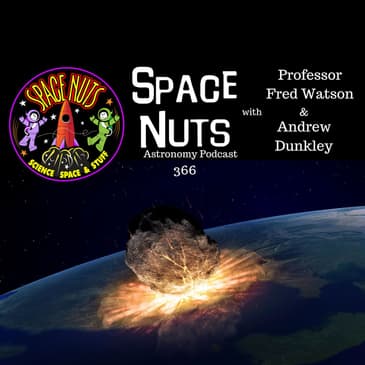


To delve into asteroid impact craters and their implications, we investigate the potential discovery of the largest impact crater. Located in Deniliquin region, New South Wales, Australia, its suspected existence highlights the phenomenal energy released during an asteroid impact. Profound understanding of these craters can provide insights into Earth's geological history and our planet's interaction with space bodies, enlightening us about potential threats and helping devise protective measures. The resources mentioned in this episode are: · Check out the article titled 'New Evidence Suggests the World's Largest Known Asteroid Impact Structure is Buried Deep in Southeast Australia' on The Conversation website for more information on the Deniliquin Impact Crater. · Visit the Australian Geographic website to read their article on the Deniliquin Impact Crater and learn more about this potential discovery. · Explore the Curiosity Rover's findings in Gale Crater on Mars, including the discovery of mud cracks and evidence of wet and dry cycles. · Stay updated on the latest news and discoveries from NASA's Mars missions, including the Perseverance Rover's exploration of the Jezero Crater. · Learn more about impact craters and their significance in understanding Earth's history and the formation of celestial bodies. · Consider supporting scientific research and exploration by donating to organizations like NASA or educational institutions involved in space studies. · Stay curious and engaged with the wonders of our universe by continuing to listen to Space Nuts for more fascinating discussions on space and astronomy.
Become a supporter of this podcast: https://www.spreaker.com/podcast/space-nuts-astronomy-insights-cosmic-discoveries--2631155/support.
[00:00:00] Hi there, thanks for joining us. This is Space Nuts. My name is Andrew Dunkley. Funnily enough, it's the same name I had last week. And this is the 366th episode of Space Nuts,
[00:00:13] believe it or not. Coming up this week, we're going to look at an asteroid impact crater that may be the biggest one ever to be discovered on Earth, and it is just down the road from where
[00:00:25] I am. In fact, I might be on the edge of it. Who knows? We'll also be looking at the mud cracks of Mars and we'll be answering audience questions about Fred's spectrometer. And Jared and Carlos
[00:00:38] are asking questions about sunlight and light in general. So we put them together, see if we can sort it all out for them. That's all coming up on this edition of Space Nuts. 15 seconds, guidance is internal. 10, 9, ignition sequence start. Space Nuts. 5, 4, 3, 2, 1.
[00:01:02] Space Nuts. Astronauts report it feels good. And joining me as he does, even though he can't avoid it, is Professor Fred Watson, astronomer at large. Hello, Fred. Andrew. Another episode. Yes. With all those... They're going thick and fast at the moment. With all those questions on light,
[00:01:21] this is bound to be an illuminating episode. Oh gosh, the dad jokes just keep on coming. Well, there's never a dull moment. That's right. Don't start. No, I won't. No, I won't.
[00:01:37] I used to play a game with a guy at the ABC once where we'd do that. We'd talk about something and we just kept coming up with puns and it'd just roll on and on and on. Gee, it was fun. I wish
[00:01:49] we'd done it on air. Oh, you didn't do it on air? No, we did it at production meetings. Oh, right. But we just, yeah, it'd just go on and on and on. We'd just keep coming up with them
[00:02:00] one after the other, just firing them back when you've got one. That's true. It's a skill. Real skill is that. Yeah, maybe. That's not what the other people thought. Man. Oh dear. Now, we should get down to business and this first story caught my eye over the
[00:02:19] weekend and I thought we really need to talk about this because we have talked about impact craters in the past and of course there are a couple of famous ones, the Chicxulub crater
[00:02:28] in what is now the Gulf of Mexico that they've been looking into and they've found the impact point where the rebound happened and they've taken samples and found some interesting stuff.
[00:02:37] There was also a story some time ago about a big one that they think was, I think it was in China, somewhere there that was hidden because the earth changes over time and these things disappear and
[00:02:48] that's why we can't find a lot of them. But now they're saying this is possibly the biggest one ever and it's around the southern parts of New South Wales, the state where we live. It's called
[00:03:03] the Deniliquin impact crater. Deniliquin being a town in southern inland New South Wales that I visited not so long ago. So, I've probably driven over this. You might have done. That explains the bumpiness of the trip. Not New South Wales roads or anything like that?
[00:03:23] That's probably more accurate. Yeah, it's lovely to see Deniliquin on the map, isn't it? In terms of the kinds of things that we talk about. Deniliquin, it's really only famous for the yearly get together of all the rev heads. What's it called? The Denny... The Dennybush. Dennybush.
[00:03:46] What's the Dennybush? Dennybush. Yeah. Get all their V8s and their Utes together and have a big weekend of rev heading it. Yeah. But it's a beautiful little town though. Pretty well on the border, isn't it? If I remember rightly.
[00:04:01] It's down there around the Griffith, the Murrumbidge irrigation area zone. Yeah. Down there where they grow all the rice and all that other stuff. Quite so. So, it's work that again, not only does this have an Australian flavour in that that's
[00:04:19] what we're talking about. It's also research that's being done in Australia. In fact, at the University of New South Wales, which I'm honoured to have an adjunct appointment at, but not in geophysics. So, the research that we're talking about was published in a journal
[00:04:39] that I've never heard of. Even though I ought to have done with a name like that. It's called Tectonophysics. I guess it is a sub branch of geophysics, I guess. Where I tend to think of
[00:04:52] geophysics as the science of the earth. But tectonophysics is even more specific. It's the science of kind of tectonic activity and things of that sort. So, it's actually two scientists who've led this work, Tony Yates and Andrew, I can't see that, Glixson. That's what it is.
[00:05:15] I thought it was Dantley. Well, it could have been. Andrew Dantley might be the sleeping partner in the trio. The silent partner twice removed probably. But these two scientists at University of New South Wales have basically had a notion for a
[00:05:35] long time that there was something going on in the magnetic field of the area around Daniloquin. It's hard to say, isn't it? Yeah. Say it 10 times fast. Daniloquin, Daniloquin, Daniloquin. That is a lot easier.
[00:05:54] Everyone says, yeah. A lot of Australian towns, they just stoop to that level of giving it a shortened name. What's another one? Gundawindi. Although you're supposed to pronounce it Gundawindi, but half the people say Gundawindi because it's spelt G-O-O-N, but people just call it Gundy.
[00:06:11] Yeah. Coona, where I used to. Coona, Thinnabarramri. Yeah. And Dubbo is Dubbo. Yeah. Although people have started calling it Dub Vegas. I don't know why, but it's become a thing around here. I have to say, we're way off track now. My very first visit to Australia in 1978
[00:06:36] was to use the Anglo-Australian telescope. And so my travel was fixed up by colleagues at the Royal Observatory in Edinburgh. And of course they're Scottish and they told me that I would
[00:06:46] have to fly via Dubbo. Dubbo. Yes. So I thought Dubbo sounds good. So yeah. Not quite how to pronounce. Anyway. And you know what you need a lot of out here? I'm not falling for that. I'm going to use another abbreviation, air con.
[00:07:06] Yes, that's right. You do need a lot of air con. Need a lot of air con. Indeed. So back to the- What are we talking about? Back to the Daniloquin structure.
[00:07:16] Which the work that has been done, and this, I guess the caveat is that this has not been confirmed by drilling, which is the gold standard in working out whether you've got an impact
[00:07:30] crater. Because if you drill, you can find shocked quartz and all these sorts of things that look, that tell you basically what's been happening. That there has been a high energy process of
[00:07:43] some sort and the highest energies come from impact. So the idea comes from, so it was just basically saying, it's the, and this is all nearly 30 years ago that Tony Yates suggested this, magnetic patterns beneath the Murray Basin, that great river system in New South Wales,
[00:08:08] may suggest that there is a huge buried impact structure. And I think a survey was done of the you know, the related geophysical data between 2015 and 2020, seemed to confirm the existence of a 520 kilometer diameter structure. This is an extraordinary size. It's massive.
[00:08:36] Compared with Chicxulub, the dinosaur killing impact crater, 170 kilometers wide, much, much smaller. And I think the one that's usually considered the world's largest is 300 kilometers wide. It's in South Africa and it's the Freedefort impact structure, which I think would be an
[00:09:02] Afrikaans name. And I think that's, I'm not sure whereabouts it is, but it is in South Africa, which in some ways has similar geology to what we have, a kind of ancient landscape. Yes. It's the kinds of things that lead to the suggestion that the magnetic information gives
[00:09:27] you leads to the suggestion that you've got a crater there is that the magnetic field lines, the local magnetic field lines form a ring pattern, which is centered sort of in the Deniliquin district. But there are also what are known as radial faults. So,
[00:09:49] basically these fault lines in the landscape caused by tectonic movement are essentially in a radial direction. And I guess they're perpendicular to the ring structure of the magnetic field. But the other thing that's basically being held up as really strong evidence for it being an impact
[00:10:12] crater is the central structure. There is a central core, which has kind of high density. And you and I have talked about this before. In fact, I think you mentioned it a few minutes ago,
[00:10:29] that when you get an impact, not only do you get a crater falling, but there is a central peak as well, which often disappears because an impact of big enough size, certainly like the 15 kilometer
[00:10:42] object that hit the Chicxulub area in the Gulf of Mexico, that one, the energies are so much that the rock surface basically turns into liquid. It behaves just like a liquid. So, you get this
[00:10:56] huge deep crater formed and then a rebound in the center. And then that collapses as well. And it's all in a matter of minutes actually, kind of 500 seconds or something, and it's all over. Yes. Extraordinary. So, there is evidence for this central structure, as well as the,
[00:11:19] what are being called magnetic anomalies, the things that give you the radial patterns and the circular patterns as well. So, that's the current theory. And I guess it's hard to date it without samples. I was about to ask you how long ago this might've happened, but yeah,
[00:11:44] I guess because it's just a theory based on, was it magnetic data? Hard to really pinpoint. It is, although these authors, and I should mention that this is very nicely written up
[00:11:57] in the conversation for anyone who wants to look at it. Actually, I've just come to the wrong conversation article there, but yeah, it's worth tracking down. The title is, new evidence suggests the world's largest known asteroid impact structure is buried deep in Southeast Australia.
[00:12:16] So, I think there is reason to believe that this event may have taken place in the region of half a billion years ago. And that links it to something already known, which is a mass extinction,
[00:12:36] which occurred somewhere between 455.2 and 443.8 million years ago. So, that kind of nearly half a billion. It's got a name actually, I'm not a geophysicist, so I'm not mispronouncing this, the Henantian glaciation stage. And it's sometimes defined as the Ordovician-Selurian
[00:12:59] extinction event, where something like 85% of the planet species were eliminated. Partly by a glaciation, it was basically an ice age, a gigantic ice age lasting for millions of years or yeah, in fact, millions of years, something like a million and a half years,
[00:13:22] that would essentially wipe out more than twice the number of species that the Chicxulub impact crater did. What kind of life are we talking about? Well, it would be primitive life, wouldn't it? You're talking about... That's a really good question. And I did a table for the
[00:13:47] book Space War that essentially mentioned what time in the past different sorts of life came into being. And I think we were talking really about plant life here, mostly. There's a number of extinction events that took place around that time, something called the early Cambrian
[00:14:10] extinction event, which was a bit more than half a billion years ago. We're talking about very primitive structure or very primitive living organisms on our planet surface. Really extraordinary stuff. I should try and check. Excuse me, I'll go back to Space War.
[00:14:29] I don't carry the whole book in my head. So I need to check the actual dates of when different species came into being. But I have a chance to do that report next week, Andrew.
[00:14:39] Yeah. Just as a matter of interest, we're talking about a potential impact site of 560 kilometers, was it? Yeah. 520, I think was the... 520. How big of rock would create that? Yeah. Well, we think that the 170 kilometer crater, the Chicxulub crater was caused by something maybe 15 kilometers across.
[00:15:05] This is going to be bigger. I don't know how much bigger, but you're certainly talking about an object in the tens of kilometers range. That is a species destroying impact. It doesn't sound
[00:15:20] big, does it? When you think how big the Earth is, 12 and a half thousand kilometers in diameter, and yet something that's only 15, 20, maybe 30 kilometers across can so disturb the atmosphere that you lose half the living organisms on the surface.
[00:15:39] Mind boggling stuff. I suppose it's coming in at such a rate, the impact is just... This is this thing that's coming in at thousands of kilometers an hour. Yes, certainly. It just suddenly stopped. Yes, that's right. Here's the surface,
[00:15:55] which is why the surface effectively behaves like a liquid because the amount of energy that comes from that explosion, typically 30 kilometers per second, something like that. And it's pretty fast. It would have hit the planet at a time where the land masses would have looked so different.
[00:16:13] Yes, that's right. It wouldn't have been Australia back then. I think it was one of those super continents. Possibly Gondwana, I think. Gondwana was the big one. The thinking is that it was in the northern part of Gondwana that this impact would have taken place. That's where Australia
[00:16:34] was at the time. Well, I suppose what happens next, we assume, is that somebody gets their Ryobi drill and starts digging down there to try and find some... Yes. And I've actually got spare Ryobi batteries if anybody needs... I've got one of those too.
[00:16:56] Yes. But you need to get one of those really big drill bits, like that's really about an inch thick. But I think it's even a bit thicker than that. Yeah. But what an interesting experiment to do.
[00:17:07] And I don't think it'll be long before we start seeing talk of expeditions mounted to take those core samples and find the smoking gun. Probably a lot easier than Chicxulub. Yes, that's right. You'd think so. Although I guess it's possible that the main mass
[00:17:22] might be buried deeper than Chicxulub because it came in at a high velocity. Yes, indeed. All right. We watch with interest. There's quite a few articles about this online, The Conversation. There's also a really good one on the Australian Geographic website if you want to
[00:17:38] check it out. This is Space Nuts. Andrew Dunkley here with professor, professor, profisher, professor Fred Watson. Okay, we checked all four systems and in with the go. Space Nuts. Put my teeth back in. That's the old radio saying, isn't it?
[00:17:57] Now from asteroids hitting Earth to water on Mars, which has been a regular topic of ours in recent times. But we're starting to continually find evidence of the activities that happened on Mars in its deep dark past. Obviously, river deltas and previous ocean sites. Now we're finding
[00:18:22] mud cracks, courtesy of Curiosity. That's right. Yes. You're absolutely right. Perseverance is investigating what is an ancient river delta, a Jezero crater. While Curiosity, plodding away since, was it 2012 when Curiosity landed, I think?
[00:18:42] Yeah. Sounds about right. Has been investigating Gale crater. Not that far from Perseverance on a global scale, but too far for them to meet and shake hands. Gale crater, once again, an impact
[00:18:57] crater, but one that was thought to have once harbored a lake. There's some evidence that Gale crater was once wet. But what we're now finding is evidence that not only was it wet, but there were
[00:19:12] wet and dry cycles. That comes from actually imagery of Curiosity from some of their cameras, which is the part of Gale crater where there is a large flat rock named Pontours. I'm not sure whether it's French or anyway, P-O-N-T-O-U-R-S. Even though actually this may be French because
[00:19:38] this research has been carried out by a team led at the University of Toulouse in France. An image of a patch of rock is not the sort of thing that you imagine would give you a really
[00:19:57] good clue about this sort of activity, but the imagery is easy to find on the web. This rock shows hexagonal patterns on it, which are a matter of just a few centimeters, four
[00:20:13] centimeters or so across. So these are quite small. They've been observed by, I think, the Mastcam on Curiosity. Curiosity's Mastcam, a camera that's been looking at the ground in front of it. What's interesting is their regularity. So these cracks are not just sort of straight lines in the
[00:20:34] mud. They're this whole pattern of hexagons, as I said, four or five centimeters across, looking a lot like a patch of crazy paving. Crazy paving was very popular where I grew up in the
[00:20:50] 40s and 50s, I think. You've got lots of slabs of rock which are different shapes and you put them down in a way that actually made sense, but it didn't have any symmetry to it. Like a kind of
[00:21:06] rather rugged jigsaw puzzle. But these ones do. They're all six sided. And the really interesting comment from, actually this is Sky and Telescope, their article on this by Colin Stewart. The comment is that when mud dries out, it shrinks and it fractures into T-shaped junctions. But if you
[00:21:36] get repeated wetting and drying, that apparently softens the junctions and these junctions become Y-shaped. And a Y-shaped junction is basically the origin of hexagonal cracks. Very, very distinctive pattern. And when you look at the pictures, you can see it there. It's extremely regular. As I said,
[00:22:02] like crazy paving, but very, very well-ordered crazy paving because these hexagons are quite marked. So that's the evidence. I think... I think I've had a question there, Andrew, did you? Did I interrupt you? Oh no, it just reminds me a little and I don't know if it's
[00:22:21] related anyway, but it reminds me of tessellated rocks which we have on Earth. Yes, yes, that's right. There's a famous outcrop of them in Tasmania, the tessellated pavement, I think they call it. Yeah. They have a different origin. I figured they might because they're a different
[00:22:38] shape. They're definitely igneous. They're rock that's effectively volcanic. And of course, you also get columnar basalt. Tessellated rocks are basically the tops of columns of these hexagonal columns. Have you been to Sorn Rocks near Narrabri, Andrew? Which is one of the
[00:23:00] finest... No, I don't think I've been to that one. I have been to the one in Tassie. Yeah, I know where you mean. I've been there too. But these are... Sorn Rocks are actually the basalt
[00:23:10] columns there, but some of them have fallen down and when you look at the end, what you've got there is a tessellated pavement, a tessellated rock. And you're absolutely right, these do look like that, but they have a different origin. This is definitely sedimentary rock rather than igneous
[00:23:28] rock. And so, this was mud at one time. And so, the interesting thing is that things like this, certainly in rock geologically, are pretty rare on Earth because they get eroded away.
[00:23:47] And also we get the effects of subduction that spoils a lot of the ancient landscape of the Earth. It means it's under a rock somewhere else that we can't see, or probably in the mantle and probably
[00:24:01] much more fluid. Whereas the ones on Mars are preserved. And just to kind of cut to the chase on this, the cracks can be dated because there is apparently a salty crust on their edges,
[00:24:19] which is known to have arisen something like 3.8 to 3.6 billion years ago. Now, that's the period, exactly the period when we think Mars was kind of drying out, that before that it was more wet.
[00:24:35] It's a period we call the Noatian-Hesperian transition, when you went from a wet Mars to a dry Mars. And that's the time you would expect to find this sort of pattern of wet and dry,
[00:24:48] maybe every day. That's the thing. And so, one of the authors of this paper, some lovely quotes here, which I'm just going to read out. This is the first tangible evidence we've seen that the ancient climate of Mars had such regular Earth-like wet-dry cycles.
[00:25:06] And so, it probably to do with Gale Crater either being flooded or just the groundwater sort of coming upwards through cracks or through basically the sorts of things like the geothermal wells that we've got in Northern New South Wales, where we're just talking about the impact.
[00:25:32] So, this author goes on to say that we know that wet-dry cycles, this is the interesting bit, Andrew, wet-dry cycles can drive chemical reactions to obtain the building blocks of life. Now, this is actually another author. In fact, it's actually somebody, this is Sidney Becker,
[00:25:55] who's at Max Planck Institute of Molecular Physiology in Germany, not involved with this research, but that's a natural consequence of these wet-dry cycles. So, as Sidney Becker goes on, finding these conditions on Mars is an exciting discovery. And I should attribute the
[00:26:17] comments from the University of Toulouse author of this, William Rapin, who has made those comments about the wet-dry cycles and the fact that we see these Earth-like phenomena on the planet Mars. I think that's very exciting. Although, we shouldn't be surprised that we're finding
[00:26:46] formations like this on other planets and other satellites, moons and things, because I don't know if it's mathematics or what, but if the conditions are right, it's going to follow a certain pattern regardless of where it's happening.
[00:27:04] Yeah, that's right. The trouble is we really don't know what actually triggers living organisms. And in fact, Dr. Becker, who we were just talking about, Sidney Becker from the Max Planck Institute in Germany, comments that it's not just this wet-dry cycling
[00:27:26] that you need to put together the building blocks of life. You'd need the right atmospheric composition, the right mineral compositions. And we don't know whether Mars had those, partly because we don't know what the chemistry exactly is. And Dr. Becker says the conditions
[00:27:46] needed for the origin of life might be different to the ones that actually create the needed building blocks. In other words, you get these building blocks of life being formed chemically, but there might be other conditions that you just don't have that would be what would trigger life.
[00:28:08] Sorry, go ahead Andrew. No, I was just going to say, I was probably alluding more to the way the rocks shape themselves and the way that the sediments fall. Yes, and yes. Well, that's true. That is true. That's correct. That's
[00:28:23] physics rather than biochemistry. That's the word I was looking for. Just to wrap up his comments, the conditions to sustain life over a long period of time, again, could be very different. Since the first life was likely very fragile,
[00:28:38] wet, dry cycling might have caused too much external disturbance. We just don't know. And once again, this is in that basket of many, many pieces of evidence that we've got that Mars
[00:28:54] was once wet and may have had exactly the right conditions or the same conditions that we had on Earth, which did generate life. Maybe it did on Mars, but we don't know. We don't know yet. We don't know yet. That's right.
[00:29:11] Yeah. I'm sure, well, I'm hopeful we'll figure it out. We were talking about it last week with the samples that Perseverance has been collecting and will be picked up one day and analyzed. And you never know, the answer might be in one of those little cubes.
[00:29:25] Exactly. Very possible. But yes, skyandtelescope.org is the place where you can read the article about that discovery of the mud tracks on Mars. This is Space Nuts, Andrew Duntley here with Professor Fred Watson. You're okay and I feel fine.
[00:29:46] Space Nuts. Okay, Fred, let's turn it over to the audience and see if we can solve some of the puzzles that riddled them. And the first one comes from Rusty. Hello, Fred and Andrew. It's Rusty. Hello from Donnybrook. A question for Fred. Fred,
[00:30:05] you built the world's first multi-object spectrometer. I think I'm getting it right. And that really makes you the inventor. So what has the science enabled in the field of astronomy so far and where do you see it leading in the foreseeable future? This is really interesting.
[00:30:32] Thank you. Cheers. Thank you, Rusty. Tell us about the spectrometer, Fred. Yeah, it actually wasn't the world's first multi-object spectrometer. It was the world's first wide field multi-object spectrograph. We used optical fibers to take the
[00:30:55] light from the UK Schmidt telescope, which has a huge field of view, six degrees on the side. So we could put fibers on selected targets in that field of view and take them to a spectrograph,
[00:31:10] which sat outside the telescope. It was also the world's first to use an off-telescope spectrograph. That's the instrument that records the spectra, the rainbow spectra in which are embedded all the signatures of the elements and the molecules and the velocities and everything
[00:31:27] that you want to know about. So what we did, and it was actually... There's a nice link here, Andrew. I worked very closely with a man called Dr. John Doe, who was actually my first boss in Australia.
[00:31:44] He was like me, a scientist at the Royal Observatory in Edinburgh, but on secondment to Australia. Strangely, at the end of his life, I was his boss. Because we worked together on a project, a different project. He sadly lost his battle
[00:32:01] with cancer in, I think about 2004. John's life, the last years of his life were in, guess where? Deniliquin. So John and I worked on the idea. What a hole that place is. I think he really liked it. He moved from Coonabarabran, by Coonamble to Deniliquin.
[00:32:28] And I think his daughter still lives there, one of his daughters. So John was a very fine scientist, very active mind. We worked together on the idea that this telescope, the Schmidt Telescope, the United Kingdom Schmidt Telescope, which by the way is 50 years old tomorrow.
[00:32:47] This is 50 years old tomorrow. No, really? The 17th of August, 1973 was when it was commissioned and opened. It was built as a wide angle photographic telescope. In other words, a wide angle camera.
[00:32:59] That was what it was built to do, to photograph the Southern sky on 365 millimeter square plates. That's 14 inches in the old measure. They were millimeter thick, so they were quite flexible, which they needed to be because the focus of the telescope was curved. And for the first
[00:33:17] 20 years of its life, that's what the telescope did. But when I arrived there in 1982, the telescope had been working for nine years by then. John and I could see another future for the telescope,
[00:33:34] which was to use this new trick of optical fibers, not invented in Australia, but definitely perfected here, both on the Anglo-Australian Telescope and the UK Schmidt, to record the light of objects
[00:33:48] spread over a very wide field of view. That was the new thing that we did and wrote papers about that, suggesting that this would be a way to do what we call spectroscopic surveys. That's to say
[00:34:02] that for each object you take a spectrum and get all these intimate details about its rotation, its speed, its chemistry and all that. To do that for many objects simultaneously and to do it over
[00:34:14] the whole sky, if you've got a wide field telescope, then you can cover the whole sky in a relatively short time. That's exactly what we did. By the early 2000s, we were engaged in something called
[00:34:26] the 60F Galaxy Survey, which surveyed galaxies over the whole sky, about 136,000 of them. Then we did half a million stars over the whole Southern sky with the RAVE survey. Just going to the last bit of Rusty's question there, that work, and I'm not claiming any great
[00:34:49] priority here, but it did really lay the groundwork for what is happening today, which are instruments that take that what we call the multiplex advantage. The fact that you can look at
[00:35:03] many objects at once, they take that to a completely new level. The best we did on the Schmidt telescope was to have 150 fibers. Each one could be put on a target object. Actually, you had to put some of them on the sky as well to record the background,
[00:35:19] but you get something like 130, 140 different objects in one hit. You might do, on a good night, you might do seven or eight of those. You're pulling in large numbers of targets. But now, the organization that we both work for, the former Australian Astronomical Observatory,
[00:35:39] which is now called Astralis, at least its instrument building section is, they just finished a device which is going out to a telescope in Chile, which has 2,400 fibers. So, nearly 20 times the number that we were dealing with. That's on a bigger telescope.
[00:36:01] You can go fainter, see more objects. So basically, where this is all leading to, Rusty, is to have a spectrum for every object in the sky down to a really faint level. The survey astronomy has been transformed by this fiber optic technique and has brought many
[00:36:21] discoveries in terms of our own galaxy and the wider universe and cosmology. It's by using this technique that we've learned about some of the aspects of the universe. We've confirmed dark energy, confirmed dark matter by looking at the way galaxies behave. And testing. Yeah,
[00:36:42] I don't often get the opportunity to say all that, but I'm quietly proud of what we did back in those days. We really laid the groundwork for what became a huge science. See, Rusty, it was worth the 20 bucks he slipped off.
[00:36:58] I've only got 10 of it, actually. I don't know where the rest has gone. Probably commissioned from Hugh, probably. That's probably it. Yes, very true. All right. Thank you, Rusty. Astute as always. Now we're
[00:37:13] going to focus our attention on sunlight, light in general, other stars. We've got a couple of questions about that. This first one comes from Carlos. Hello SpaceNets. This is Carlos from Austin,
[00:37:25] Texas. It's pretty hot here, so I have a couple of questions about the sun and more general star, like stars. How does a star turn on? What would the ignition look like? Is it like a log
[00:37:41] burning on and off in different areas? Is it more like a gas grill? You put a lighter to it and it's all on at once. Would it be more like a motor engine? And then the second question is,
[00:37:57] I know it takes thousands of years for photons to escape the center of the sun. Is this also the case of startup? Essentially, will the sun or will this star be on but not showing for a
[00:38:08] few thousand years? Thanks for taking my question. Keep up with the great work. Thanks. Thank you, Carlos. That's a good question. I've never really thought about how a star gets going. Is it like a log fire that slowly erupts into the inferno that keeps you warm or
[00:38:30] is it just boom? They do begin in gas clouds, don't they? These massive clouds. A lot of pressure brought to bear, I think, isn't it? To create the process, depending on what's in
[00:38:46] there. You tell me, Fred. You're absolutely right, Andrew. So, I've got a cloud of gas and dust which collapses under its own gravity. In fact, it might collapse in little pockets in different
[00:39:04] places. That's why we think stars are born in clusters. We can see these. The James Webb Telescope is great at penetrating these clouds of gas and dust where we can see the stars,
[00:39:16] actually the newborn stars, in the middle of them. But that process is a gravitational collapse. So, it's not sudden. I think we've been asked before how long does it take for this to switch on?
[00:39:33] I suspect it's still a relatively leisurely period as the star collapses. What you're going to get is at the very center where the pressure is highest, the temperature goes up highest. That's where the hydrogen fusion will kick off. That's what starts the star burning.
[00:39:56] I think that will spread as the collapse continues. That will basically spread. There'll be radiative heating from the central nucleus which will heat up the hydrogen around it. So, I think it'll be a process that is actually the idea of a log burning is probably not too
[00:40:14] far off the mark, except I think it would be more symmetrical than a log. I think it's going to have a spherical symmetry. It might take quite a long time. Then the newborn star goes through all kinds of phases where it's actually emitting, it's spewing off gas because
[00:40:32] there's surplus gas that it doesn't need that gets blown away. So, you get these stellar winds and things of that sort. It goes through something called a T Tauri phase where it's emitting light directly from glowing hydrogen rather than from a hot body, which is what the
[00:40:50] star eventually does. It's got a different sort of spectrum. I like the second part of Carlos' question as well. We know, I think it's about 170,000 years is the best estimate for how long
[00:41:06] it takes light to get from the central nucleus of the sun out to the photosphere where we actually see it. In which time it's bouncing off atoms all the way up so that they start off as gamma rays
[00:41:19] and wind up as they've lost energy on the way out when they come out as visible light. So, I guess that's true as well. A star when it's switching on is basically going to be just an
[00:41:33] infrared object because it's getting hot. Eventually, I'm not saying it's that length of time that it takes for the light to come from the center. I think it will be a much more gradual process than that. But you'll start to see it brightening up as the process continues.
[00:41:52] Okay. So, during its infrared phase, you wouldn't see it? You do in the infrared. That's why the Webb telescope is so important. With the naked eye. Not that you should be looking at the sun. No, no, that's right.
[00:42:05] Yeah. So, he's right. You wouldn't see it in its early life until it started emitting visible light and then way ago. Yeah, exactly. Fascinating. Great questions, Carlos. Thank you. We're going to continue our
[00:42:19] look at light. But as I said, don't look directly at the sun. This is Jared. Hi, Professor Fred and Dave. Our sun puts out radiation across a wide spectrum. Gamma rays, X-rays, UV, visible light, infrared, radio waves. Fred's previously mentioned that the
[00:42:38] light of the early universe is now stretched and red shifted into the cosmic microwave background. What should we expect from other early universe radiation? Will the sky light up one day with
[00:42:51] visible light that used to be X-rays 13 billion years ago? Keep up the good work. Love the show. Jared from Albania. Thank you, Jared. I think he's been listening to an old episode where I got called Dave quite a few times.
[00:43:06] Yeah, we did it. Of the Dave here for some reason or another and it's back. I don't know. It's a good name though, Dave. I quite like it. Man, my best mate's name is Dave. Mine, there are only two best mates who were called Dave. There you are.
[00:43:21] Very honest name. It's a good honest name. So, yes. In a way, that visible light is already there, but it's so weak that we don't see it. What we're talking about with the radiation of the early universe
[00:43:48] is what's called a black body spectrum. This is a humped curve. It's a bit like a camel's back. And you're looking with one end, you've got very short wavelength radiation. The other end, you've got long wave radiation. The two ends, they slope towards zero gently.
[00:44:12] I don't know whether I'm explaining this well. You really need to diagram. But this black body spectrum, which is well understood and the cosmic microwave background radiation follows that completely, has its peak in the microwave region of the spectrum, corresponding to a temperature
[00:44:28] of 2.3 degrees, I think is the correct one. So, it peaks in the microwave region, but on either side of that, it stretches downwards, approaching zero in the long wavelength region where you're talking about radio waves and in the short wavelength region. I don't know that anybody
[00:44:50] has ever detected the visible light component of the cosmic microwave background radiation. It's effectively gone to zero because that's the characteristic of a black body spectrum. But what it means is that those x-rays, which I'm sure would have been emitted in the early
[00:45:07] universe, I don't know the details of that, but I think that the short wavelength tail of the black body spectrum would reach down below x-radiation. But that's already been redshifted out to the short wavelength end of the existing microwave black body spectrum. If you think of this camel's
[00:45:27] hump shaped diagram and move it to the right in the long wavelength direction by the expansion of the universe, that's effectively what we're talking about. Okay. So, the sudden burst of light theory that Jared mentioned, not likely? It's happened already.
[00:45:47] So, it's all over. So, you would have seen that if you've been observing the universe at a much earlier phase than we are now. It's all been stretched. You missed it, Jared. You missed it.
[00:46:00] Not by much. Only about 13 and a half billion, maybe something, maybe 13 billion years, something. Yeah. Darn it. Oh, well. Good question. Better luck next time. Yes. But it is a great question. We'll check it out in the next universe. Yes. After the Gnab Gibb.
[00:46:20] Gnab Gibb, that's right. All right. Thanks, Jared. Thanks, everybody who sent in questions. Don't forget if you would like to send us some questions or just some comments or recipes, whatever you like, you can do that by going to our website, spacenutspodcast.com or spacenuts.io
[00:46:38] and click on the link. There's the AMA link at the top where you can send text and audio questions, or on the right-hand side, send us your audio question. I think it says. Just press that. As
[00:46:48] long as you've got a device with a microphone, you're all set. And don't forget to tell us who you are and where you're from so that we can laugh at you. No, so that we can identify you. We like
[00:46:58] to know who we're talking to. And while you're on our website, check it out. Have a look around. Check out the shop. If you're interested in becoming a patron, we have many of those and
[00:47:10] they are greatly appreciated. We would never force you to pay for the podcast, but people do it voluntarily. And we are so appreciative of that. And there are many options. If you want to just
[00:47:22] buy us a cup of coffee as a one-off, or if you want to make a regular monthly contribution, totally up to you. You can do that via our website. So, yeah, check out the supporter link or
[00:47:32] whatever the heck it's called. I can't remember now. And I was only there like two years ago, so I should remember. Dear, oh dear. Anyway, your support is greatly appreciated. Thank you. Fred, that wraps it up for another week. Thank you as always. It's a pleasure, Andrew. Just
[00:47:52] remember to watch out for those fish and chips as well. The fish and chips. Yes, they are. Once you eat one of those, you'll never eat again. Unless you're a radio-active alien. Well, that could help. All right. Thanks, Fred. We'll see
[00:48:09] you soon. Sounds great. Thanks, Andrew. Fred Watson, astronomer at large, part of the team here at Space Nuts. And Fred, Hugh couldn't join us to make everything work today, which is why everything worked. And from me, Andrew Dunkley, thanks for joining us. Look forward to your
[00:48:28] company on the next episode of Space Nuts. Bye-bye. Space Nuts. You'll be listening to the Space Nuts podcast. Available at Apple Podcasts, Google Podcasts, Spotify, iHeart Radio, or your favorite podcast player. You can also stream on demand at bytes.com.
[00:48:48] This has been another quality podcast production from bytes.com.