


This episode of Space Nuts is brought to you with the support of Antigravity A1. The Antigravity A1 is the world’s first 8K 360 drone, it’s genuinely a game-changer. You get full immersive flight with the goggles, insanely intuitive controls, and endless creative freedom in editing.
If you’re thinking about buying a drone, make it this one. Check out the link to learn more: AntigravityA1
And NordVPN. To get our special Space Nuts listener discounts and four months free bonus, all with a 30-day money-back guarantee, simply visit www.nordvpn.com/spacenuts or use the coupon code SPACENUTS at checkout.
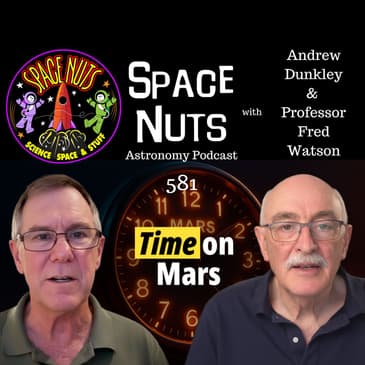
Cosmic Conversations: Time on Mars, Eccentric Orbits, and Space Gum
In this riveting episode of Space Nuts, hosts Andrew Dunkley and Professor Fred Watson embark on a fascinating journey through the cosmos, tackling the complexities of timekeeping on Mars, the peculiar orbit of exoplanet TOI 3884B, and a surprising discovery from asteroid Bennu.
Episode Highlights:
- Timekeeping on Mars: Andrew and Fred delve into the challenges of synchronizing time between Earth and Mars, highlighting the unique aspects of Martian days and the effects of relativity that complicate clock synchronization.
- TOI 3884B's Eccentric Orbit: The hosts explore the unusual orbit of TOI 3884B, a planet that orbits its star at a significant angle, raising questions about its formation and the dynamics at play in its solar system.
- Space Gum from Asteroid Bennu: A surprising find of nitrogen-rich polymeric sheets in the samples returned from asteroid Bennu leads to a discussion about the origins of this "space gum" and its implications for understanding asteroid composition and formation.
- Curiosities and Speculations: The episode wraps up with playful banter about the implications of these discoveries and the mysteries that continue to unfold in our universe.
For more Space Nuts, including our continuously updating newsfeed and to listen to all our episodes, visit our website. Follow us on social media at SpaceNutsPod on Facebook, X, YouTube Music Music, Tumblr, Instagram, and TikTok. We love engaging with our community, so be sure to drop us a message or comment on your favorite platform.
If you’d like to help support Space Nuts and join our growing family of insiders for commercial-free episodes and more, visit spacenutspodcast.com/about.
Stay curious, keep looking up, and join us next time for more stellar insights and cosmic wonders. Until then, clear skies and happy stargazing.
Become a supporter of this podcast: https://www.spreaker.com/podcast/space-nuts-astronomy-insights-cosmic-discoveries--2631155/support.
00:00:00 --> 00:00:02 Andrew Dunkley: Hello there. Thanks for joining us on Space
00:00:02 --> 00:00:05 Nuts, where we talk astronomy and space
00:00:05 --> 00:00:07 science and sometimes canines.
00:00:08 --> 00:00:11 And coming up in this
00:00:11 --> 00:00:14 episode, does anybody really know what time
00:00:14 --> 00:00:17 it is on Mars? Well,
00:00:17 --> 00:00:19 apparently they've worked out a way, and it's
00:00:19 --> 00:00:21 really fascinating. And there's a good reason
00:00:21 --> 00:00:23 for it, too. We're also going to talk about
00:00:23 --> 00:00:26 the weird orbit of TOI
00:00:26 --> 00:00:29 3884B. I
00:00:29 --> 00:00:31 was only there last week. And chewing gum on
00:00:31 --> 00:00:34 Asteroids. It's a thing. That's all coming
00:00:34 --> 00:00:37 up on this episode of space nuts.
00:00:37 --> 00:00:40 Voice Over Guy: 15 seconds. Guidance is internal.
00:00:40 --> 00:00:42 10, 9, ignition
00:00:42 --> 00:00:45 sequence. Star space nuts. 5, 4, 3,
00:00:45 --> 00:00:48 2, 1, 2, 3. 4, 5, 5, 4,
00:00:48 --> 00:00:51 3, 2', 1. Space nuts.
00:00:51 --> 00:00:52 Astronauts report it feels good.
00:00:53 --> 00:00:54 Andrew Dunkley: And he's back again.
00:00:54 --> 00:00:57 For more, here's Professor Fred Watson,
00:00:57 --> 00:00:58 astronomer at large. Hello, Fred.
00:00:59 --> 00:01:01 Professor Fred Watson: Hello, Andrew. Complete with the dog.
00:01:01 --> 00:01:03 Andrew Dunkley: Yes, yes. good old Jordy.
00:01:04 --> 00:01:07 He's great value. I still laugh at
00:01:07 --> 00:01:09 the way he greeted us when we went to your
00:01:09 --> 00:01:10 place a month or so back and
00:01:12 --> 00:01:13 came tearing down the stairs.
00:01:14 --> 00:01:17 Professor Fred Watson: That's right. That's it. But that's his,
00:01:17 --> 00:01:20 modus operandi. Yes, it is. And it's
00:01:20 --> 00:01:23 not aggressive. It's just, exciting.
00:01:23 --> 00:01:25 Hello, how are you? But it just goes beside
00:01:25 --> 00:01:26 himself when.
00:01:27 --> 00:01:28 Andrew Dunkley: Yeah.
00:01:28 --> 00:01:29 Professor Fred Watson: Anyway, he's already had a session this
00:01:29 --> 00:01:31 morning, standing at the bottom of our stairs
00:01:31 --> 00:01:33 yelling at something, and I have no idea what
00:01:33 --> 00:01:34 it was.
00:01:34 --> 00:01:36 Andrew Dunkley: Probably a blade of grass that got.
00:01:36 --> 00:01:38 Professor Fred Watson: Blown in the weed. Yeah, yeah. That's the
00:01:38 --> 00:01:41 level at which he gets excited. Absolutely.
00:01:41 --> 00:01:42 Oh, blade of grass.
00:01:43 --> 00:01:44 Andrew Dunkley: Yeah. I love it.
00:01:45 --> 00:01:48 Okay, we have got some really interesting
00:01:48 --> 00:01:50 topics today. We've always got interesting
00:01:50 --> 00:01:52 topics, but this is a really great
00:01:52 --> 00:01:54 combination. we're talking time, weird
00:01:54 --> 00:01:57 orbits, and chewing gum. let's start
00:01:57 --> 00:02:00 on mar. and to quote the famous
00:02:00 --> 00:02:02 song, does anybody really know what time it
00:02:02 --> 00:02:05 is? Mars is a
00:02:05 --> 00:02:07 bit of a problem when it comes to time. And
00:02:07 --> 00:02:10 so is the moon to a certain degree, because
00:02:10 --> 00:02:13 time doesn't run the same way in those places
00:02:13 --> 00:02:16 as it does on Earth. And going forward, that
00:02:16 --> 00:02:18 could become an issue because we're going to
00:02:18 --> 00:02:21 ultimately spend time on Mars,
00:02:22 --> 00:02:24 wandering around growing potatoes. But,
00:02:25 --> 00:02:27 we need to be able to get the time right.
00:02:29 --> 00:02:31 Professor Fred Watson: We do. and, I mean, there are some
00:02:32 --> 00:02:34 sort of basic facts before you get into the
00:02:34 --> 00:02:37 nitty gritty, which include the
00:02:37 --> 00:02:39 fact that a day on Mars is 40
00:02:39 --> 00:02:42 minutes longer than a day on Earth. So,
00:02:42 --> 00:02:45 about 24 hours and 40 minutes. And of course,
00:02:45 --> 00:02:48 a year on Mars is longer, too. It's, 600 and
00:02:48 --> 00:02:51 something days of our days. 687,
00:02:51 --> 00:02:54 is the length of time a Martian year.
00:02:55 --> 00:02:57 So they're the easy
00:02:57 --> 00:03:00 bits, they're the givens. But if
00:03:00 --> 00:03:03 you're trying to synchronize your
00:03:03 --> 00:03:05 clocks, between Earth and Mars,
00:03:06 --> 00:03:08 and this is kind of already happening, with
00:03:08 --> 00:03:11 the rovers, the fact that the rovers are
00:03:11 --> 00:03:13 actually controlled from Earth. But, because
00:03:13 --> 00:03:15 of the time delay for signals to get to Mars,
00:03:17 --> 00:03:19 there's a degree of autonomy in all the
00:03:19 --> 00:03:22 rovers that are roving on Mars. That's not
00:03:22 --> 00:03:24 the issue at the moment. The issue is how you
00:03:24 --> 00:03:27 make your clocks on Earth agree, with clocks
00:03:27 --> 00:03:29 on Mars. And there's two subtleties,
00:03:30 --> 00:03:32 that come into this. And I should, credit the
00:03:32 --> 00:03:34 organization that's done the work on this,
00:03:34 --> 00:03:37 which is the United States National Institute
00:03:37 --> 00:03:39 of Standards and Technology, or nist.
00:03:40 --> 00:03:43 they've actually done detailed calculations,
00:03:43 --> 00:03:46 about exactly how time
00:03:46 --> 00:03:49 varies on Mars. And so you've got two
00:03:49 --> 00:03:50 things, Andrew, when you're trying to
00:03:50 --> 00:03:52 synchronize with clocks on Earth, apart from
00:03:52 --> 00:03:55 the time, you know, the time
00:03:55 --> 00:03:57 delay with signals going to Mars,
00:03:58 --> 00:04:01 the two things that come into being both are,
00:04:01 --> 00:04:03 to do with Einstein's theories of
00:04:03 --> 00:04:06 relativity. and we've talked about these
00:04:06 --> 00:04:09 ad infinitum. We've gone on about them
00:04:09 --> 00:04:12 a lot for a long time. and you from that
00:04:12 --> 00:04:14 will know that, when you put a clock into a
00:04:14 --> 00:04:17 gravitational field, it runs slower. and
00:04:17 --> 00:04:19 that's the time dilation effect of general
00:04:20 --> 00:04:22 relativity. So we know that, clocks
00:04:22 --> 00:04:25 on the surface of the Earth run slightly
00:04:25 --> 00:04:28 slower than clocks either in space or even in
00:04:28 --> 00:04:30 the air. We've now got clocks that are so
00:04:30 --> 00:04:33 accurate you can tell the difference between
00:04:33 --> 00:04:36 time ticking away on a jet plane at 10 km
00:04:36 --> 00:04:38 high and time ticking away on the surface of
00:04:38 --> 00:04:41 the Earth. But Mars, of course, also has
00:04:41 --> 00:04:43 a gravitational field. It's got a
00:04:43 --> 00:04:46 gravitational pull, but it's only a sixth or
00:04:46 --> 00:04:49 thereabouts of what we have here on our
00:04:49 --> 00:04:51 planet. So that means because the
00:04:51 --> 00:04:54 gravity is lower, a clock runs
00:04:54 --> 00:04:57 faster on the surface of Mars.
00:04:57 --> 00:04:59 if you're on Mars, your clock is ticking away
00:04:59 --> 00:05:02 at the same rate, but to an outside observer
00:05:03 --> 00:05:06 it runs, slower. And to an observer on the
00:05:06 --> 00:05:08 Earth whose clocks are running even slower,
00:05:09 --> 00:05:11 it seems to be running faster. And the
00:05:11 --> 00:05:14 calculation has been that from the
00:05:14 --> 00:05:16 nist, the National Institute of Standards and
00:05:16 --> 00:05:18 Technology, a clock on Mars would run
00:05:19 --> 00:05:21 477 microseconds
00:05:22 --> 00:05:24 faster per day compared with a clock
00:05:24 --> 00:05:27 on the earth. So 477 millionths of a
00:05:27 --> 00:05:30 second doesn't actually sound much except
00:05:30 --> 00:05:32 that when you've got communications,
00:05:33 --> 00:05:36 like the 5G network you're working to,
00:05:36 --> 00:05:38 you know, the internal clocks work to better
00:05:38 --> 00:05:41 than a millionth of a second. and
00:05:41 --> 00:05:44 so 477 of those millionths of a second is
00:05:45 --> 00:05:48 yes, throwing messy M messy
00:05:48 --> 00:05:50 indeed. But it actually gets messier
00:05:51 --> 00:05:54 because as you know, we've talked
00:05:54 --> 00:05:56 about this too. the special theory of
00:05:56 --> 00:05:59 relativity says that if you have a clock
00:05:59 --> 00:06:02 on a moving object and you observe it from
00:06:02 --> 00:06:05 not a moving object, then you will
00:06:05 --> 00:06:07 also get time dilation. That clock will look
00:06:07 --> 00:06:09 as though it's going slower even though it's
00:06:09 --> 00:06:11 ticking away at the same rate to the person
00:06:11 --> 00:06:14 who's on the moving object. To an outside
00:06:14 --> 00:06:16 observer who's stationary, it looks as though
00:06:16 --> 00:06:19 it's going slower. And so we've got an
00:06:19 --> 00:06:22 effect because of the motion of Mars
00:06:22 --> 00:06:25 relative to the motion of Earth. Now Mars is
00:06:25 --> 00:06:27 in an orbit around the sun just like we are,
00:06:27 --> 00:06:30 but it's actually quite an eccentric orbit.
00:06:30 --> 00:06:32 In other words, it's rather elongated, more
00:06:32 --> 00:06:35 so than Earth's orbit is. And so that means
00:06:35 --> 00:06:38 it's always got a motion towards or away from
00:06:38 --> 00:06:40 the Earth. And that adds another
00:06:40 --> 00:06:43 uncertainty, which can go
00:06:43 --> 00:06:45 either way because if it's coming towards us
00:06:45 --> 00:06:47 then you get a different effect. it's
00:06:47 --> 00:06:50 226 microseconds,
00:06:50 --> 00:06:53 the daily offset, in the course
00:06:53 --> 00:06:56 of a Martian year the
00:06:56 --> 00:06:58 difference between us and there, and
00:06:59 --> 00:07:01 I just said something that I want to correct
00:07:01 --> 00:07:04 there because the thing is always the same
00:07:05 --> 00:07:06 sign, it doesn't matter of whether it's going
00:07:06 --> 00:07:09 towards us or away from us. you've still got
00:07:09 --> 00:07:12 the offset in terms of the
00:07:12 --> 00:07:15 relativistic time dilation, which is
00:07:15 --> 00:07:17 not what I said, so I'm correcting that now.
00:07:18 --> 00:07:20 but yeah, so you've got this additional 226
00:07:20 --> 00:07:23 microseconds, so 477
00:07:23 --> 00:07:25 microseconds, with up to
00:07:25 --> 00:07:28 226 microseconds added to that. It
00:07:28 --> 00:07:31 means you've got actually quite a messy
00:07:31 --> 00:07:33 difference in time. It's almost a thousandth
00:07:33 --> 00:07:34 of a second.
00:07:34 --> 00:07:37 Andrew Dunkley: Yeah, this relates to a
00:07:37 --> 00:07:40 time where we've got long term human
00:07:40 --> 00:07:43 presence on Mars and we need to,
00:07:43 --> 00:07:45 and the technology doesn't exist yet, but we
00:07:45 --> 00:07:48 need to be able to communicate with Earth
00:07:48 --> 00:07:51 in real time. Technically they're going
00:07:51 --> 00:07:54 to probably develop ways of setting up
00:07:54 --> 00:07:57 communication systems so that the
00:07:57 --> 00:07:59 radio signal issue doesn't
00:07:59 --> 00:08:01 impinge on that communication. Because at the
00:08:01 --> 00:08:04 moment it's like, what, 24 minutes
00:08:04 --> 00:08:05 to send in.
00:08:05 --> 00:08:07 Professor Fred Watson: I think at maximum, it can be. Yeah. And
00:08:08 --> 00:08:10 you're not going to be able to get away from
00:08:10 --> 00:08:12 that. But you can build that in because, you
00:08:12 --> 00:08:15 know, Mars is distance very precisely. Yeah.
00:08:15 --> 00:08:17 So you can build in a time delay.
00:08:17 --> 00:08:20 Andrew Dunkley: So this is more about working out
00:08:20 --> 00:08:22 a time system
00:08:23 --> 00:08:26 that is in sync with Earth. Does
00:08:26 --> 00:08:29 that mean we have to invent a new kind of
00:08:29 --> 00:08:31 clock to use on Mars? So that it's.
00:08:33 --> 00:08:35 Professor Fred Watson: I think, what it means, it's really about
00:08:36 --> 00:08:39 the internal consistency of time signals
00:08:39 --> 00:08:41 on Mars. So,
00:08:43 --> 00:08:45 you're absolutely right. The synchronization
00:08:45 --> 00:08:48 with Earth comes into play here.
00:08:48 --> 00:08:51 But you also want to make sure that
00:08:51 --> 00:08:54 your communication's actually on Mars, which
00:08:54 --> 00:08:57 would be vital. are. All right. And that's,
00:08:57 --> 00:09:00 in a way, okay. Because the
00:09:00 --> 00:09:03 relativistic effects don't come in there
00:09:03 --> 00:09:05 because you're all in the same gravity and
00:09:05 --> 00:09:08 you're all basically moving, on a planet at
00:09:08 --> 00:09:10 the same speed. It's like, we don't have to
00:09:10 --> 00:09:12 take these effects into consideration when
00:09:12 --> 00:09:15 we're talking between ourselves on the
00:09:15 --> 00:09:17 surface of the Earth. It's only when you're
00:09:17 --> 00:09:19 talking up to satellites above the Earth,
00:09:19 --> 00:09:21 which we do through GPS and through
00:09:21 --> 00:09:23 communications, then you need to take those
00:09:23 --> 00:09:26 minute differences into account. And
00:09:26 --> 00:09:29 in a sense, that's what this is all about.
00:09:29 --> 00:09:32 So, you know, you've got the basic property
00:09:32 --> 00:09:33 that you can't get away from the speed of
00:09:33 --> 00:09:35 light, 300 kilometers per second. That's,
00:09:35 --> 00:09:38 the speed at which radio signals go to and
00:09:38 --> 00:09:41 from Mars. that you can deal with because we
00:09:41 --> 00:09:43 know the distance. But then on top of that,
00:09:43 --> 00:09:46 you've got this added tweak in
00:09:46 --> 00:09:48 terms of synchronizing our clocks with the
00:09:48 --> 00:09:51 clocks on Mars, which makes for a very
00:09:51 --> 00:09:53 interesting, you know, a very interesting
00:09:53 --> 00:09:54 scenario. yeah.
00:09:54 --> 00:09:56 Andrew Dunkley: Well, here's a dumb question. Why can't we
00:09:56 --> 00:09:59 just do what we do on Earth across
00:10:00 --> 00:10:02 the entire solar system and use
00:10:02 --> 00:10:05 Zulu time? Would that not work?
00:10:11 --> 00:10:14 Andrew Dunkley: Just Zulu time on Earth basically means it's
00:10:14 --> 00:10:17 the same time everywhere on the planet.
00:10:17 --> 00:10:18 Professor Fred Watson: That's an expression I haven't heard before,
00:10:18 --> 00:10:19 actually.
00:10:19 --> 00:10:22 Andrew Dunkley: Oh, it's. It's a real thing. Is it Zulu time?
00:10:22 --> 00:10:24 Yeah, it's used by the military,
00:10:24 --> 00:10:24 specifically.
00:10:24 --> 00:10:26 Professor Fred Watson: But, yeah, that might be why, I heard of it.
00:10:26 --> 00:10:29 Andrew Dunkley: I'll look it up. because right now it's set
00:10:29 --> 00:10:31 on, Greenwich Mean Time. But, you know, Zulu
00:10:31 --> 00:10:34 time applies across the entire planet.
00:10:34 --> 00:10:36 Professor Fred Watson: So that's what we would call Universal
00:10:36 --> 00:10:37 time.
00:10:37 --> 00:10:38 Same thing in the world of astronomy.
00:10:38 --> 00:10:41 Andrew Dunkley: Yeah, yeah. Why can't we do that?
00:10:41 --> 00:10:44 Professor Fred Watson: well, we do. I mean, you know, we do in
00:10:44 --> 00:10:47 space, but that's fine. That
00:10:47 --> 00:10:49 gives you a time base, but
00:10:49 --> 00:10:51 you've got to tweak it for all these
00:10:52 --> 00:10:53 relativistic differences.
00:10:53 --> 00:10:55 Andrew Dunkley: So you've got the time slip problem
00:10:55 --> 00:10:56 regardless of how you run the clock.
00:10:56 --> 00:10:58 Professor Fred Watson: It doesn't matter how you run the clock.
00:10:58 --> 00:11:01 Yeah. So if you're on
00:11:01 --> 00:11:03 one of the moons of Uranus, then
00:11:04 --> 00:11:07 you'd probably still work on Universal time
00:11:07 --> 00:11:08 or Zulu time.
00:11:09 --> 00:11:11 But when you synchronize that with Earth,
00:11:11 --> 00:11:13 you've got to take all these things into
00:11:13 --> 00:11:15 consideration. And that's the bottom line.
00:11:15 --> 00:11:17 Andrew Dunkley: Okay, I get it. Gosh, it's so complicated
00:11:18 --> 00:11:20 and yet, you know, Mars is as close to Earth
00:11:20 --> 00:11:22 as you probably going to find in another
00:11:22 --> 00:11:25 planet. The daytime
00:11:25 --> 00:11:28 difference is only 40 minutes. But when
00:11:28 --> 00:11:30 we actually set up
00:11:31 --> 00:11:34 long term stays on Mars, that in
00:11:34 --> 00:11:36 itself is going to be a problem for humans
00:11:36 --> 00:11:39 because we are tuned to our own environment.
00:11:40 --> 00:11:42 Having an extra 40 minutes a day is going to
00:11:42 --> 00:11:45 throw everything into a, into a spear. And
00:11:45 --> 00:11:47 I think we talked about this some time ago
00:11:47 --> 00:11:49 and the only way around it would be,
00:11:50 --> 00:11:52 you have to have a daytime snooze.
00:11:53 --> 00:11:56 Professor Fred Watson: Well, we kind of know about this already
00:11:56 --> 00:11:58 because and again we've talked about this
00:11:58 --> 00:12:00 before that the people who actually operate,
00:12:00 --> 00:12:03 perseverance and curiosity and all the other
00:12:03 --> 00:12:06 rovers that are on Mars, the
00:12:06 --> 00:12:08 ones that, the only other one that's
00:12:08 --> 00:12:09 operational is the Chinese one.
00:12:11 --> 00:12:13 the people who operate those actually change
00:12:13 --> 00:12:15 onto a 24 hours and 40 minute
00:12:15 --> 00:12:18 schedule. So they're isolated
00:12:18 --> 00:12:21 in a sense from their
00:12:21 --> 00:12:23 community and I think they quite quickly
00:12:23 --> 00:12:25 adapt. I think it's a bit rough for the first
00:12:25 --> 00:12:28 few days. It's a bit like jet lag. but
00:12:28 --> 00:12:30 I think they quite quickly adapt to that
00:12:30 --> 00:12:31 longer day, a Martian day.
00:12:32 --> 00:12:34 Andrew Dunkley: So if you start work at 9:00 on a Monday, you
00:12:34 --> 00:12:36 start at 9:40 on Tuesdays.
00:12:37 --> 00:12:39 Professor Fred Watson: Yeah, that's right. Salami.
00:12:39 --> 00:12:41 Andrew Dunkley: By, by end of the week you've.
00:12:41 --> 00:12:43 Professor Fred Watson: Yeah. So, actually it's the other way around,
00:12:43 --> 00:12:45 isn't it? You'd. Yeah. Would it be. Yeah,
00:12:45 --> 00:12:47 you'd have to start earlier by the, by
00:12:47 --> 00:12:48 Monday.
00:12:48 --> 00:12:51 Andrew Dunkley: Well, it's the same as trying to figure out
00:12:51 --> 00:12:53 daylight saving, isn't it just, am I going to
00:12:53 --> 00:12:54 be early or late?
00:12:56 --> 00:12:58 Oh, imagine trying to do that every day.
00:12:58 --> 00:13:00 Gosh, no, it's fascinating. And so
00:13:00 --> 00:13:03 yeah, and the bottom line is that this, this
00:13:03 --> 00:13:06 team has has more or less figured it all
00:13:06 --> 00:13:08 out and worked out what we have to do to make
00:13:08 --> 00:13:10 the time right when we get to Mars.
00:13:11 --> 00:13:13 Professor Fred Watson: You're right. And you, you were right
00:13:13 --> 00:13:16 actually. You would start. So to everybody
00:13:16 --> 00:13:18 else, your day, you'd be starting 40
00:13:18 --> 00:13:21 minutes late Tuesday. but you're
00:13:21 --> 00:13:24 still starting at midnight or you know,
00:13:24 --> 00:13:27 whatever time you, you started. Nine o' clock
00:13:27 --> 00:13:29 in fact. Nine o' clock
00:13:29 --> 00:13:31 Martian time. Yeah, yeah.
00:13:31 --> 00:13:33 Andrew Dunkley: It's just a bit crazy isn't it? But yeah,
00:13:33 --> 00:13:35 it's a fascinating story. If you'd like to
00:13:35 --> 00:13:37 read about it, it's on the website scitech
00:13:37 --> 00:13:40 Daily or you can read the paper that's
00:13:40 --> 00:13:42 been published in the Astronomical Journal.
00:13:43 --> 00:13:45 This is Space Nuts with Andrew Dunkley and
00:13:45 --> 00:13:47 Professor Fred Watson.
00:13:52 --> 00:13:53 Space Nuts.
00:13:53 --> 00:13:56 All right, we're going to focus on a target
00:13:56 --> 00:13:58 of interest. Now I only just figured out what
00:13:58 --> 00:13:59 that means.
00:13:59 --> 00:14:02 TOI3884B.
00:14:02 --> 00:14:05 This is a planet orbiting a star. And
00:14:05 --> 00:14:07 at this point in time they've only found this
00:14:07 --> 00:14:10 one planet. But the weird thing is
00:14:10 --> 00:14:13 its orbit is just so out of kilter
00:14:13 --> 00:14:15 with what we would consider normal. And they
00:14:15 --> 00:14:16 don't know why.
00:14:17 --> 00:14:20 Professor Fred Watson: They don't. So you're absolutely right. We're
00:14:20 --> 00:14:23 talking about an object by the name of TOI
00:14:23 --> 00:14:24 3884B.
00:14:26 --> 00:14:28 I was just talking to a radio presenter,
00:14:29 --> 00:14:31 in actually in Coffs Harbour in
00:14:33 --> 00:14:34 northern what's it called? The Mid North
00:14:34 --> 00:14:37 Coast? Yeah, New South Wales.
00:14:37 --> 00:14:40 about this very topic, and he wants to
00:14:40 --> 00:14:43 rename it the Hula Hoop. That's a good idea.
00:14:43 --> 00:14:46 Yeah, because as he said, with Hula Hoops the
00:14:46 --> 00:14:49 problem is always keeping the Hula Hoop at
00:14:49 --> 00:14:52 the same angle to your waistline. he said it
00:14:52 --> 00:14:54 tends to wander off and that's exactly what's
00:14:54 --> 00:14:55 happened with this planet.
00:14:55 --> 00:14:57 So Luke Ryan, this is one for you.
00:14:58 --> 00:15:01 it's the Hula Hoop, the Hula Hoop planet. so
00:15:01 --> 00:15:03 what's the story? Well this is a, ah, planet
00:15:03 --> 00:15:06 going around a red dwarf star. it's one of
00:15:06 --> 00:15:08 the 7 odd now exoplanets
00:15:08 --> 00:15:11 that we know about. it's at a distance of
00:15:11 --> 00:15:14 something like 130 light years
00:15:15 --> 00:15:18 from Earth. This red
00:15:18 --> 00:15:20 dwarf is pretty you
00:15:20 --> 00:15:23 know, unspectacular
00:15:24 --> 00:15:26 in that it's just a typical red dwarf star.
00:15:27 --> 00:15:30 But it's got spots on it. Now a lot
00:15:30 --> 00:15:32 of stars we know have spots on it. And
00:15:32 --> 00:15:34 actually here in Australia we've got a group
00:15:34 --> 00:15:36 who I work with quite often up in the
00:15:36 --> 00:15:38 University of Southern Queensland whose
00:15:38 --> 00:15:41 speciality is star spots and understanding
00:15:41 --> 00:15:44 how we can learn about them. And they do,
00:15:44 --> 00:15:46 they. So, you know, I've seen some of the
00:15:46 --> 00:15:48 papers that they've written and sometimes
00:15:48 --> 00:15:50 these star spots, you know, they're almost,
00:15:50 --> 00:15:52 ah, a quarter of the size of the disk of the
00:15:52 --> 00:15:55 star itself. Unlike the sunspots that we see,
00:15:55 --> 00:15:57 which are yes, bigger than Earth, many of
00:15:57 --> 00:15:59 them, but the Earth's 100 times smaller than
00:15:59 --> 00:16:02 the sun. So, our sunspots are quite
00:16:02 --> 00:16:04 tiny compared with some of the star spots
00:16:04 --> 00:16:07 that we know exist on other stars. And this
00:16:07 --> 00:16:10 particular, red dwarf has at least one big
00:16:10 --> 00:16:13 spot, which they're cooler than,
00:16:13 --> 00:16:14 the rest of the atmosphere. They're cool
00:16:14 --> 00:16:17 spots and that's why they look darker. and
00:16:17 --> 00:16:20 it's because of that, even though you can't
00:16:20 --> 00:16:22 see the spot directly, what you can see is
00:16:22 --> 00:16:24 the way the light from that star
00:16:24 --> 00:16:27 changes as the star rotates,
00:16:28 --> 00:16:30 bringing the spot towards us. And then on the
00:16:30 --> 00:16:33 other side of the star, when the spot's
00:16:33 --> 00:16:35 towards us, it's a little bit dimmer. And so
00:16:35 --> 00:16:38 what they've done is, these scientists,
00:16:38 --> 00:16:40 and I should acknowledge, where they are.
00:16:40 --> 00:16:43 I'll come to that in a minute. they
00:16:43 --> 00:16:46 have, figured out, first of all
00:16:46 --> 00:16:48 from that spot rotation,
00:16:49 --> 00:16:52 they figured out that this planet, sorry,
00:16:52 --> 00:16:55 this star itself rotates every 11
00:16:55 --> 00:16:58 days, which is of course,
00:16:59 --> 00:17:01 shorter than the Sun. It's kind of half the
00:17:01 --> 00:17:04 Sun's rotation. But that 11 days is
00:17:04 --> 00:17:07 the key, to understanding how the
00:17:07 --> 00:17:10 star itself rotates. Now enter the planet
00:17:10 --> 00:17:12 into this. The planet itself
00:17:13 --> 00:17:15 goes around in something like four days.
00:17:16 --> 00:17:18 so it sort of whizzes around the parent star.
00:17:19 --> 00:17:22 but what the scientists have done
00:17:22 --> 00:17:25 is used some very, very careful
00:17:25 --> 00:17:28 measurements and a phenomenon which is
00:17:28 --> 00:17:30 called the Rossiter McLachlan effect,
00:17:31 --> 00:17:34 which is to do with the way,
00:17:34 --> 00:17:37 the appearance of a star's spectrum
00:17:37 --> 00:17:40 changes as a planet rotates around
00:17:40 --> 00:17:43 the star or revolves around the star.
00:17:43 --> 00:17:46 And using that effect, they have,
00:17:47 --> 00:17:50 basically discovered that this
00:17:51 --> 00:17:53 planet orbits the star at an
00:17:53 --> 00:17:56 angle of 62
00:17:56 --> 00:17:59 degrees to the star's equator.
00:18:00 --> 00:18:02 and contrast that with the solar system,
00:18:02 --> 00:18:04 where the planets all orbit more or less in
00:18:04 --> 00:18:07 the same plane. Mercury is the outlier in
00:18:07 --> 00:18:09 that it's tilted, but,
00:18:10 --> 00:18:12 that plane is more or less the same as
00:18:12 --> 00:18:14 the, as the equator of the sun.
00:18:14 --> 00:18:17 Andrew Dunkley: Yeah. If you compare it to Earth,
00:18:17 --> 00:18:20 that planet's 40 degrees off. We're
00:18:20 --> 00:18:23 23.44 and they're 60. Whatever you
00:18:23 --> 00:18:24 said. that's a heck of a tilt.
00:18:25 --> 00:18:26 Professor Fred Watson: No, it's a different tilt you're talking
00:18:26 --> 00:18:29 about there. Oh, that's the tilt of the
00:18:29 --> 00:18:31 Earth's. Oh, that's the axis rotation axis.
00:18:31 --> 00:18:32 Andrew Dunkley: Yeah. Right, right.
00:18:32 --> 00:18:34 Professor Fred Watson: But the tilt of the Earth's, orbit to the
00:18:34 --> 00:18:37 sun, to the sun's equator, is effectively
00:18:37 --> 00:18:38 zero.
00:18:38 --> 00:18:38 Andrew Dunkley: Right, Gotcha.
00:18:38 --> 00:18:40 Professor Fred Watson: as. As most of the planets are, with
00:18:40 --> 00:18:41 exception.
00:18:41 --> 00:18:43 Andrew Dunkley: So it's not the tilt. It's the actual orbit
00:18:43 --> 00:18:43 itself is.
00:18:43 --> 00:18:45 Professor Fred Watson: Yep, that's right. It's the orbit itself.
00:18:46 --> 00:18:48 Not. Not the rotation of the planet. That's
00:18:48 --> 00:18:50 right. Good. Good to clarify that.
00:18:50 --> 00:18:50 Andrew Dunkley: Yeah.
00:18:50 --> 00:18:53 Professor Fred Watson: Thanks, Andrew. so, yeah, and that's peculiar
00:18:53 --> 00:18:55 because, you know, we. We conventionally
00:18:55 --> 00:18:58 understand that the way planets form is,
00:18:58 --> 00:19:01 in a. In a, what we call a protoplanetary
00:19:01 --> 00:19:04 disk which surrounds the infant
00:19:04 --> 00:19:07 star. And because both
00:19:07 --> 00:19:09 the star and the planets have come from a
00:19:09 --> 00:19:11 collapsing cloud of dust and gas, which is
00:19:11 --> 00:19:13 itself rotating. And it's that sort of
00:19:13 --> 00:19:16 fossilized rotation, that we see in the
00:19:16 --> 00:19:19 rotation of the planets or the revolution of
00:19:19 --> 00:19:21 the planets around the sun and the rotation
00:19:21 --> 00:19:23 of the sun. And they're all in the same
00:19:23 --> 00:19:26 plane. This one's not. So how has
00:19:26 --> 00:19:29 that happened? And the
00:19:29 --> 00:19:30 suggestion is.
00:19:30 --> 00:19:33 Andrew Dunkley: Oh, I know, I know. Theo did
00:19:33 --> 00:19:33 it.
00:19:34 --> 00:19:37 Professor Fred Watson: Well, yeah, that's. It could be a Thea
00:19:37 --> 00:19:39 effect. Something that's. Something that's
00:19:39 --> 00:19:42 actually collided with this object.
00:19:42 --> 00:19:44 But this apparently, as you pointed out right
00:19:44 --> 00:19:47 at the beginning, there isn't another.
00:19:47 --> 00:19:50 There isn't another. There's no other
00:19:50 --> 00:19:53 objects known to be, in orbit around this
00:19:53 --> 00:19:55 star. It seems to be a single planet.
00:19:56 --> 00:19:57 That's not to say that there wasn't something
00:19:57 --> 00:20:00 that collided with it and moved its orbit.
00:20:00 --> 00:20:02 But even, you know, something like Theia
00:20:02 --> 00:20:04 hitting the Earth, which is how we think the
00:20:04 --> 00:20:06 Moon was formed, that didn't push the Earth
00:20:06 --> 00:20:08 out of its orbit until the orbit. It's a very
00:20:09 --> 00:20:11 peculiar effect. I mean, it may be
00:20:11 --> 00:20:14 that this star has had an interaction
00:20:14 --> 00:20:16 gravitationally at some time in the past and
00:20:17 --> 00:20:20 shifted the, orbit of the planet by
00:20:20 --> 00:20:23 the gravitational interference of something
00:20:23 --> 00:20:25 else going past. But that's,
00:20:26 --> 00:20:28 you know, that's just conjecture. and the
00:20:28 --> 00:20:31 bottom line is, for a single planet going
00:20:31 --> 00:20:33 around a star, this is the most peculiar one
00:20:33 --> 00:20:36 we've ever found. It's because of this tilt
00:20:36 --> 00:20:37 in its orbit.
00:20:37 --> 00:20:40 Andrew Dunkley: And that's what we keep seeing every time we
00:20:40 --> 00:20:42 find something new in another solar system,
00:20:43 --> 00:20:46 we Find. Not every time, but
00:20:46 --> 00:20:48 we are, ah, starting to find something new
00:20:48 --> 00:20:50 and different and unexplainable. And,
00:20:51 --> 00:20:53 nothing's normal really when it comes to all
00:20:53 --> 00:20:54 these new discoveries.
00:20:55 --> 00:20:56 Professor Fred Watson: That's correct. That's right.
00:21:00 --> 00:21:02 it's a universe out there that's full of
00:21:02 --> 00:21:04 diversity. That's probably the best way to
00:21:04 --> 00:21:05 put it.
00:21:05 --> 00:21:08 Andrew Dunkley: Yeah. and quite a strange
00:21:08 --> 00:21:11 place. Do we know what kind of planet it is?
00:21:11 --> 00:21:14 Professor Fred Watson: yeah, it's a super Earth, I think it's got a
00:21:14 --> 00:21:16 mass of 39 Earths. So it's, something less
00:21:16 --> 00:21:19 than Jupiter. but, but I think it's, not
00:21:19 --> 00:21:22 as big, not as big in diameter as Jupiter is.
00:21:22 --> 00:21:24 I think that's right. But you know, it
00:21:24 --> 00:21:26 probably means it's a hot Jupiter, basically,
00:21:26 --> 00:21:27 or a hot sub Jupiter perhaps.
00:21:27 --> 00:21:28 That's the best way to put it.
00:21:28 --> 00:21:31 Andrew Dunkley: Right. Okay. Well, it's another
00:21:31 --> 00:21:33 interesting find. I'm sure
00:21:33 --> 00:21:36 they'll keep looking at it to try and figure
00:21:36 --> 00:21:38 out how it ended up where it is and why. but
00:21:38 --> 00:21:41 yeah, it sounds. Now, logic, logic, if you
00:21:41 --> 00:21:43 tear it all down, you go with the most
00:21:43 --> 00:21:46 obvious answer. It's probably been hit
00:21:46 --> 00:21:49 by something. Probably Steve Smith's cricket
00:21:49 --> 00:21:50 bat would be my theory.
00:21:52 --> 00:21:54 Professor Fred Watson: I think you've probably just baffled, two
00:21:54 --> 00:21:55 thirds of our listeners.
00:21:55 --> 00:21:58 Andrew Dunkley: Probably look up Steve Smith, cricketer,
00:21:58 --> 00:21:59 and you'll know what I'm talking about.
00:22:01 --> 00:22:03 been having a great season, Absolutely
00:22:04 --> 00:22:06 wonderful season. But I won't gloat because I
00:22:06 --> 00:22:09 know we're heard in England and I, I don't
00:22:09 --> 00:22:10 want to, you know, it's not over yet.
00:22:12 --> 00:22:13 so if you would like to read up on that
00:22:13 --> 00:22:16 story, you can do so@the
00:22:16 --> 00:22:18 dailygalaxy.com website. Or you can read the
00:22:18 --> 00:22:20 paper in the
00:22:20 --> 00:22:23 Astronomical Journal. I think it is. Let me
00:22:23 --> 00:22:25 just double check that. Yes, the Astronomical
00:22:25 --> 00:22:28 Journal. This is Space Nuts with Andrew
00:22:28 --> 00:22:30 Dunkley and Professor Fred Watson.
00:22:33 --> 00:22:35 Roger, you're live right here. Also Space
00:22:35 --> 00:22:36 Nuts.
00:22:36 --> 00:22:39 Our last story is about
00:22:39 --> 00:22:41 one of my favorite things, and that is
00:22:41 --> 00:22:43 chewing gum. I grew up on that stuff. I
00:22:43 --> 00:22:45 didn't eat food. I just chewed gum
00:22:46 --> 00:22:48 ad infinitum. I, I used to
00:22:49 --> 00:22:51 stick it on the bedpost when I went to sleep
00:22:51 --> 00:22:54 and start again as soon as I woke up. I just
00:22:54 --> 00:22:56 was addicted to this stuff. Especially the
00:22:56 --> 00:22:58 stuff we had called Big Charlie. I don't know
00:22:58 --> 00:23:00 if anyone remembers Big Charlie, but it came
00:23:00 --> 00:23:02 in a stick about one foot long
00:23:04 --> 00:23:06 and good. Yeah, it was amazing.
00:23:06 --> 00:23:09 Anyway, I can't find that anymore. the
00:23:09 --> 00:23:11 point I'm trying to make is that this is all
00:23:11 --> 00:23:14 about a discovery that's been made on the
00:23:14 --> 00:23:16 samples of the Bennu
00:23:16 --> 00:23:19 asteroid that were returned to Earth in the
00:23:19 --> 00:23:21 deserts of Utah a couple of years ago. And
00:23:21 --> 00:23:23 they've been sort of looking at it ever since
00:23:23 --> 00:23:26 and they have found something
00:23:26 --> 00:23:29 unusual. It's not chewing gum, but it is like
00:23:29 --> 00:23:32 chewing gum because, it's
00:23:32 --> 00:23:32 a.
00:23:32 --> 00:23:33 Professor Fred Watson: Kind of a polymer.
00:23:35 --> 00:23:37 Yeah. I'm still grappling with you and
00:23:38 --> 00:23:41 your chewing gum on the BET post m.
00:23:41 --> 00:23:44 If I remember rightly, it was Lonnie Donegan
00:23:44 --> 00:23:47 who in the 1950s had a big hit
00:23:47 --> 00:23:49 with does your chewing gum lose its flavor in
00:23:49 --> 00:23:51 the bedpost overnight?
00:23:51 --> 00:23:52 Andrew Dunkley: The answer is yes.
00:23:54 --> 00:23:57 Professor Fred Watson: Yeah, so straight from there
00:23:57 --> 00:23:58 to Asteroid Bennu.
00:24:00 --> 00:24:02 I think it was Lonnie Donegan anyway.
00:24:02 --> 00:24:03 Andrew Dunkley: Yeah, I can't remember, but I know.
00:24:03 --> 00:24:06 Professor Fred Watson: The race skiffle artist of the
00:24:06 --> 00:24:07 1950s.
00:24:08 --> 00:24:11 Andrew Dunkley: there's a photo of Big Charlie. I don't know
00:24:11 --> 00:24:12 if you can see that now. You can't.
00:24:12 --> 00:24:14 Professor Fred Watson: I can't. No. It's just disappearing because
00:24:14 --> 00:24:16 you. All I can see now is the moon.
00:24:16 --> 00:24:18 Andrew Dunkley: Yeah. Anyway.
00:24:18 --> 00:24:20 Professor Fred Watson: A Big Charlie. We did Charlie.
00:24:21 --> 00:24:23 Ah, lucky one.
00:24:23 --> 00:24:26 Andrew Dunkley: Yeah, it was a monster packet. Like, you
00:24:26 --> 00:24:29 know, you couldn't put it in your pocket.
00:24:29 --> 00:24:30 You'd poke a m out.
00:24:34 --> 00:24:37 Professor Fred Watson: Well, I have to say, it's something
00:24:38 --> 00:24:40 not at all like that that we're talking about
00:24:40 --> 00:24:43 with asteroid Bennu because all these
00:24:43 --> 00:24:45 observations have made. Been made with an
00:24:45 --> 00:24:47 electron microscope, which you probably
00:24:47 --> 00:24:49 didn't need for a Big Charlie. but
00:24:50 --> 00:24:53 what's it all about? It's what's
00:24:53 --> 00:24:55 been found in the dust,
00:24:56 --> 00:24:59 which was returned by the Osiris Rex
00:24:59 --> 00:25:01 spacecraft, I think in
00:25:01 --> 00:25:04 2023, if I remember rightly. Samples from
00:25:04 --> 00:25:06 asteroid Bennu. It's a NASA project.
00:25:07 --> 00:25:09 what has been found in there is what the
00:25:09 --> 00:25:11 scientists call nitrogen rich
00:25:11 --> 00:25:13 polymeric sheets,
00:25:14 --> 00:25:17 which you and I would call gum. It's a
00:25:17 --> 00:25:19 polymer basically. and
00:25:19 --> 00:25:22 polymers, ah, are materials where you've got
00:25:22 --> 00:25:24 these long chains of molecules that
00:25:24 --> 00:25:27 give them that sort of flexible and sticky,
00:25:27 --> 00:25:30 sticky flavor. or not flavor, but,
00:25:30 --> 00:25:33 demeanor, let me put it that way. so
00:25:33 --> 00:25:35 it's. Yeah, it's got it's got
00:25:36 --> 00:25:39 these long chain molecules on it. And so the
00:25:39 --> 00:25:42 scientists are calling it space gum. it's
00:25:42 --> 00:25:44 not gum as we would know it. But what they've
00:25:44 --> 00:25:47 done is, they've found, sort of
00:25:47 --> 00:25:50 almost like shards of this stuff within the
00:25:50 --> 00:25:52 dust samples from
00:25:52 --> 00:25:55 Bennu. And in order to analyze it,
00:25:55 --> 00:25:57 they've actually had to coat it with a
00:25:58 --> 00:26:00 layer of I think it's
00:26:00 --> 00:26:03 platinum. Yeah. That
00:26:03 --> 00:26:06 they've. They've reinforced it with so that
00:26:06 --> 00:26:09 they can take samples from it, with a
00:26:09 --> 00:26:11 tungsten micro needle. and you see
00:26:11 --> 00:26:13 pictures of all this stuff going on on the
00:26:13 --> 00:26:15 Web. The Universe Today's got a nice story
00:26:15 --> 00:26:17 about it. and,
00:26:18 --> 00:26:21 then with the microneedle, then you can
00:26:21 --> 00:26:23 take the samples and, you know, analyze them.
00:26:23 --> 00:26:25 With all the various pieces of kit that
00:26:25 --> 00:26:28 we use to make these analyses.
00:26:29 --> 00:26:31 And it turns out, yep, there's, There's gum
00:26:31 --> 00:26:34 there. I think the puzzle is
00:26:34 --> 00:26:36 how it got there. because.
00:26:37 --> 00:26:40 Well, let me just, since we're mentioning
00:26:40 --> 00:26:43 Universe Today and the lovely article,
00:26:43 --> 00:26:46 by Andy Thomas Twick, I think is his name,
00:26:46 --> 00:26:48 might not be how you pronounce it. But,
00:26:48 --> 00:26:51 what, he says is. One question remains.
00:26:51 --> 00:26:53 One question remains. How exactly did the
00:26:53 --> 00:26:56 space Gump survive on Bennu for so long? We
00:26:56 --> 00:26:58 know that Bennu was part of a larger asteroid
00:26:58 --> 00:27:00 that had hydrothermal vents.
00:27:01 --> 00:27:03 Meaning the asteroid itself was subjected to
00:27:03 --> 00:27:06 water. Complex organic molecules like the
00:27:06 --> 00:27:09 space gum. Usually either dissolve or
00:27:09 --> 00:27:11 break up when subjected to hot water.
00:27:12 --> 00:27:14 So how had this particular sample,
00:27:14 --> 00:27:17 avoided that fate? And what
00:27:17 --> 00:27:20 they're saying then is that perhaps the
00:27:20 --> 00:27:22 sample might have formed, basically
00:27:23 --> 00:27:26 during a phase when Bennu was
00:27:26 --> 00:27:29 cold. Before it actually got hot enough for
00:27:29 --> 00:27:31 nuclear processes to heat it up.
00:27:32 --> 00:27:34 and they're saying that these samples
00:27:34 --> 00:27:36 actually date from that time. and that
00:27:36 --> 00:27:39 basically, what they say
00:27:39 --> 00:27:42 is, By the time radioactive elements inside
00:27:42 --> 00:27:45 the asteroid. And this again is quoted from
00:27:45 --> 00:27:47 Universe, today, by the time the radioactive
00:27:47 --> 00:27:49 elements inside the asteroid had heated up
00:27:49 --> 00:27:51 enough to create the water, the plastic in
00:27:51 --> 00:27:54 inverted commas, sheets of polymer were
00:27:54 --> 00:27:56 already formed and were, in fact, water
00:27:56 --> 00:27:58 resistant, thereby getting trapped by the
00:27:58 --> 00:28:01 rocks on the asteroid surface. Where they
00:28:01 --> 00:28:03 were eventually picked up by an intrepid
00:28:03 --> 00:28:05 space probe, namely Osiris,
00:28:06 --> 00:28:08 Rex. So, yeah, and here's the really
00:28:08 --> 00:28:11 interesting bit. we've got other
00:28:11 --> 00:28:14 asteroid samples, as you know, Andrew,
00:28:14 --> 00:28:17 from, the two Japanese spacecraft that have
00:28:17 --> 00:28:19 brought back asteroid samples. and
00:28:19 --> 00:28:22 neither of those have polymers in them.
00:28:22 --> 00:28:24 so, Bennu is different. It's a different,
00:28:25 --> 00:28:28 body. It's still a rubble pile asteroid, as
00:28:28 --> 00:28:30 far as we know, but different in its chemical
00:28:30 --> 00:28:31 makeup.
00:28:31 --> 00:28:33 Andrew Dunkley: So I suppose that throws up questions about,
00:28:33 --> 00:28:36 asteroid formation and why this
00:28:36 --> 00:28:39 is different. Or is it. Is it normal and the
00:28:39 --> 00:28:41 other two were different? You don't know, do
00:28:41 --> 00:28:41 you?
00:28:41 --> 00:28:42 Professor Fred Watson: Yeah, that's right. That's the thing. Yes.
00:28:43 --> 00:28:43 Yeah.
00:28:43 --> 00:28:45 Andrew Dunkley: Very interesting indeed. If, you'd like to
00:28:45 --> 00:28:48 read about it. Universetoday.com has
00:28:48 --> 00:28:50 that great article that, Fred was talking
00:28:50 --> 00:28:53 about. And, yeah, we'll probably learn more
00:28:53 --> 00:28:55 and more as they keep going through those
00:28:55 --> 00:28:56 samples from Bennu.
00:28:58 --> 00:29:00 Fred, we're, we're all done. Thank you so
00:29:00 --> 00:29:01 much. That was quick.
00:29:01 --> 00:29:04 Professor Fred Watson: It was, wasn't it? M. And they were. They
00:29:04 --> 00:29:07 were quite complex stories as well. Yeah.
00:29:07 --> 00:29:09 Andrew Dunkley: Probably why we didn't spend much time on
00:29:09 --> 00:29:11 them. Brains.
00:29:11 --> 00:29:12 Professor Fred Watson: Neither of us understands them either.
00:29:14 --> 00:29:14 Yeah.
00:29:15 --> 00:29:16 Andrew Dunkley: All right, thanks, Fred. We'll, catch you
00:29:16 --> 00:29:19 shortly, for our final
00:29:19 --> 00:29:22 program of the year officially. So we'll see
00:29:22 --> 00:29:23 you then. Thanks, Fred.
00:29:23 --> 00:29:24 Professor Fred Watson: Sounds great.
00:29:24 --> 00:29:25 Well done, Andrew.
00:29:25 --> 00:29:28 Andrew Dunkley: And, thanks to Huw in the studio who couldn't
00:29:28 --> 00:29:30 be with us today because of a weird, object
00:29:30 --> 00:29:33 that, he's gone to see the Doctor about. and
00:29:33 --> 00:29:35 don't forget to visit us online. And, you can
00:29:35 --> 00:29:38 do that@spacenutspodcast.com or
00:29:38 --> 00:29:41 spacenuts.com and,
00:29:41 --> 00:29:44 check it all out there. You can, go to our
00:29:44 --> 00:29:46 supporters page if you would like to learn
00:29:46 --> 00:29:48 more about how to support us in whatever way
00:29:48 --> 00:29:50 you feel fit. You don't have to. It's not
00:29:50 --> 00:29:52 mandatory. Or you can send questions in via
00:29:52 --> 00:29:55 the AMA link. Sign up for the Astronomy Daily
00:29:55 --> 00:29:57 Newsfeed. But Christmas is coming up. Don't
00:29:57 --> 00:30:00 forget to visit the Space Nuts shop. it's all
00:30:00 --> 00:30:03 atspace nuts podcast.com and for me,
00:30:03 --> 00:30:05 Andrew Dunkley. Thanks for your company. We
00:30:05 --> 00:30:08 will see you again on the next episode. Real
00:30:08 --> 00:30:08 soon,
00:30:08 --> 00:30:09 Voice Over Guy: You've been listening to the Space Nuts
00:30:09 --> 00:30:12 podcast, available at
00:30:12 --> 00:30:14 Apple Podcasts, Spotify,
00:30:14 --> 00:30:17 iHeartRadio or your favorite podcast
00:30:17 --> 00:30:20 player. You can also stream on demand at
00:30:20 --> 00:30:22 bitesz.com this has been another quality
00:30:22 --> 00:30:24 podcast production from bitesz.com