
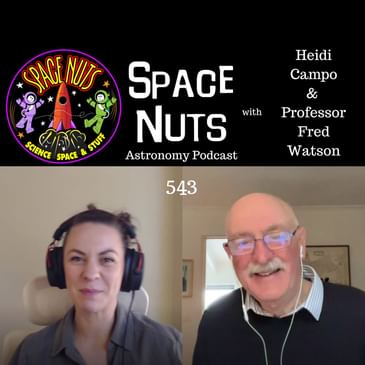

In this captivating episode of Space Nuts, hosts Heidi Campo and Professor Fred Watson explore the latest cosmic curiosities and fascinating astronomical phenomena. From the intriguing interstellar object 3I Atlas to the unexpected influences of space weather on ancient civilizations, this episode is filled with insights that will expand your understanding of the universe.
Episode Highlights:
- The Mystery of 3I Atlas: The episode kicks off with a discussion about the interstellar object 3I Atlas, which is hurtling through our solar system. Fred explains its origins, orbit, and the speculation surrounding its potential extraterrestrial origins, sparked by Harvard physicist Avi Loeb.
- Space Weather and Human History: The conversation then shifts to how space weather impacts life on Earth. Fred shares insights from a recent interdisciplinary study that connects changes in the Earth's magnetic field with increased use of ochre by ancient peoples, suggesting a fascinating link between cosmic events and human behavior.
- The Dramatic Fate of TOI 2108B: The hosts then discuss the dramatic fate of the exoplanet TOI 2108B, which is spiraling towards its parent star. Fred outlines the potential scenarios for its demise, including tidal disruption and atmospheric loss, highlighting the ongoing research surrounding this extreme world.
- Interdisciplinary Connections: Throughout the episode, Heidi and Fred emphasize the importance of interdisciplinary research in understanding the cosmos and our place within it, showcasing how different fields of study can illuminate one another.
For more Space Nuts, including our continuously updating newsfeed and to listen to all our episodes, visit our website. Follow us on social media at SpaceNutsPod on Facebook, X, YouTube Music Music, Tumblr, Instagram, and TikTok. We love engaging with our community, so be sure to drop us a message or comment on your favorite platform.
If you’d like to help support Space Nuts and join our growing family of insiders for commercial-free episodes and more, visit spacenutspodcast.com/about
Stay curious, keep looking up, and join us next time for more stellar insights and cosmic wonders. Until then, clear skies and happy stargazing.
Got a question for our Q&A episode? https://spacenutspodcast.com/ama
Become a supporter of this podcast: https://www.spreaker.com/podcast/space-nuts-astronomy-insights-cosmic-discoveries--2631155/support.
00:00:00 --> 00:00:03 Heidi Campo: Welcome back to another fun and exciting
00:00:03 --> 00:00:05 episode of Space Nuts, the
00:00:05 --> 00:00:07 podcast that is out of this world.
00:00:08 --> 00:00:10 Generic: 15 seconds. Guidance is internal.
00:00:11 --> 00:00:13 10, 9. Ignition
00:00:13 --> 00:00:16 sequence start. Space nuts. 5, 4, 3,
00:00:16 --> 00:00:19 2. 1. 2, 3, 4, 5, 5, 4,
00:00:19 --> 00:00:22 3, 2, 1. Space nuts astronauts
00:00:22 --> 00:00:23 report it feels good.
00:00:24 --> 00:00:26 Heidi Campo: And I'm your host for this, uh, American
00:00:26 --> 00:00:29 summer and Australian winter. My
00:00:29 --> 00:00:32 name is Heidi Campo, filling in for Andrew
00:00:32 --> 00:00:35 Dunkley. And joining us is the wonderful
00:00:35 --> 00:00:38 Professor Fred Watson, astronomer at
00:00:38 --> 00:00:40 large. How are you doing, Fred?
00:00:41 --> 00:00:43 Professor Fred Watson: Very well, thank you, Heidi. I've been m
00:00:44 --> 00:00:45 traveling since we last spoke and have
00:00:45 --> 00:00:47 explored the great state of Western
00:00:47 --> 00:00:50 Australia, uh, in great detail. If
00:00:50 --> 00:00:52 I remember rightly, Western Australia would
00:00:52 --> 00:00:55 encompass Texas three times. I think that's
00:00:55 --> 00:00:58 the figure. Uh, it's very large. And
00:00:58 --> 00:01:01 so we spent a lot of time,
00:01:01 --> 00:01:03 uh, in coaches, but saw some incredible
00:01:03 --> 00:01:05 sites, including, um, the Carnarvon
00:01:06 --> 00:01:08 space ah, facility, which
00:01:09 --> 00:01:11 was, uh, one of the places where radio, um,
00:01:11 --> 00:01:14 signals were picked up and uh, beamed out
00:01:14 --> 00:01:17 to the world during the Apollo era.
00:01:17 --> 00:01:20 So lovely to visit some of the places
00:01:20 --> 00:01:22 where history was made at a time when
00:01:22 --> 00:01:25 I was, you know, um,
00:01:26 --> 00:01:28 a young budding astronomer and very excited
00:01:28 --> 00:01:30 by the whole thing. So it's great to see all
00:01:30 --> 00:01:31 that old technology again.
00:01:32 --> 00:01:33 Heidi Campo: Yeah, there's just something special about
00:01:33 --> 00:01:36 the old technology. The way it looked and
00:01:36 --> 00:01:38 felt and was packaged. And the new, sleek,
00:01:38 --> 00:01:41 modern stuff is cool and great, but it just
00:01:41 --> 00:01:42 doesn't feel the same.
00:01:43 --> 00:01:45 Professor Fred Watson: That's right. Well, when they get fashion
00:01:45 --> 00:01:47 designers to design their spacesuits, you
00:01:47 --> 00:01:48 know that things have moved on quite a long
00:01:48 --> 00:01:50 way since the Apollo era.
00:01:50 --> 00:01:53 Heidi Campo: It really has changed. But one thing
00:01:53 --> 00:01:56 that will never change until it does
00:01:56 --> 00:01:59 is our fascination with extraterrestrials.
00:02:00 --> 00:02:02 Which leads us into our first story
00:02:03 --> 00:02:03 today.
00:02:04 --> 00:02:07 So the three. I don't know if this is the
00:02:07 --> 00:02:09 three I or the three lowercase l. Atlas.
00:02:10 --> 00:02:13 Um, Harvard's thinking
00:02:13 --> 00:02:16 maybe alien probe. What's going on
00:02:16 --> 00:02:18 here, Fred? Give us some sanity.
00:02:19 --> 00:02:21 Professor Fred Watson: Yeah, so 3i.
00:02:22 --> 00:02:23 It is 3i because it's the third
00:02:24 --> 00:02:26 interstellar, um, visitor,
00:02:27 --> 00:02:28 uh, that has been recorded. There are
00:02:28 --> 00:02:31 probably many more that we haven't detected.
00:02:31 --> 00:02:33 Uh, but this is an object which is flying
00:02:33 --> 00:02:35 through the solar system. We have talked
00:02:35 --> 00:02:37 about it before. Uh, we're going to talk
00:02:37 --> 00:02:40 about it again just because of a couple of
00:02:40 --> 00:02:43 things that have come up. Um, so
00:02:43 --> 00:02:46 the bottom line, 3i. Atlas. Atlas was the
00:02:46 --> 00:02:48 facility that discovered it. Uh, it's,
00:02:49 --> 00:02:51 uh, an object which is whizzing through the
00:02:51 --> 00:02:54 solar system at about 60 km per second
00:02:54 --> 00:02:57 in an orbit that tells you immediately
00:02:57 --> 00:02:59 that it has come from outside the solar
00:02:59 --> 00:03:01 system. It's not, uh, in any sense
00:03:01 --> 00:03:04 gravitationally bound to the Sun. So it's not
00:03:04 --> 00:03:06 part of the Sun's family of planets. It's
00:03:06 --> 00:03:08 from somewhere else. We don't know where it
00:03:08 --> 00:03:10 came from. And, uh, is whizzing through the
00:03:10 --> 00:03:12 solar system. If I remember rightly, it
00:03:12 --> 00:03:15 passes closest to the Sun. I think it is
00:03:15 --> 00:03:18 October. Uh, it's, um,
00:03:18 --> 00:03:21 certainly, um, uh, down the track. Uh, yes,
00:03:21 --> 00:03:24 it's the closest approach in October. Um,
00:03:24 --> 00:03:27 so, uh, it's probably a comet.
00:03:27 --> 00:03:30 Um, a comet is an object made
00:03:30 --> 00:03:33 of ice, uh, with dust embedded in
00:03:33 --> 00:03:35 it. Uh, it's, uh, it's
00:03:35 --> 00:03:38 um. You know, the thing about comets is when
00:03:38 --> 00:03:40 they get near the sun, the ice turns into a
00:03:40 --> 00:03:43 gas. And we see the uh, result of
00:03:43 --> 00:03:46 that, um, often stretched in a tail
00:03:46 --> 00:03:48 across the sky, which makes them very bright
00:03:49 --> 00:03:52 occasionally and also occasionally quite,
00:03:52 --> 00:03:55 um, you know, quite, um, inspiring to
00:03:55 --> 00:03:56 people who don't know what they're looking
00:03:56 --> 00:03:58 at, which is why they were often regarded as
00:03:58 --> 00:04:01 portents of doom, uh, down, uh,
00:04:01 --> 00:04:03 uh, in historical times. So this one
00:04:04 --> 00:04:06 however, is probably not going to do that. It
00:04:06 --> 00:04:08 may be a comet. It's thought to be about 20
00:04:08 --> 00:04:11 km across, which is actually quite large for
00:04:11 --> 00:04:14 the nucleus of a comet. But the reason why
00:04:14 --> 00:04:16 I wanted to bring it up again is
00:04:17 --> 00:04:19 it's the headline that I almost could have
00:04:19 --> 00:04:22 predicted. Uh, is Interstellar
00:04:22 --> 00:04:25 Object 3I Atlas an alien probe.
00:04:25 --> 00:04:27 Harvard Physicist sparks debate.
00:04:28 --> 00:04:30 Uh, and that Harvard physicist is a very
00:04:30 --> 00:04:33 eminent, uh, uh, astrophysicist.
00:04:33 --> 00:04:35 Uh, I think he's still the director of the
00:04:35 --> 00:04:38 Harvard Smithsonian Institute for Astronomy.
00:04:38 --> 00:04:41 His name is Avi Loeb, and he
00:04:41 --> 00:04:43 is famous for always putting,
00:04:44 --> 00:04:46 uh, a slant which
00:04:47 --> 00:04:50 could be interpreted as
00:04:50 --> 00:04:53 uh, suggesting I'm, um, going a long way
00:04:53 --> 00:04:54 around this because I want to be careful with
00:04:54 --> 00:04:57 my words, uh, that things like this
00:04:57 --> 00:05:00 could have an intelligent origin. Uh, we
00:05:00 --> 00:05:03 had the same when the first of these
00:05:03 --> 00:05:05 interstellar visitors came by back in
00:05:05 --> 00:05:08 2017. Um, an object called
00:05:08 --> 00:05:11 Oumuamua, named after, uh.
00:05:11 --> 00:05:14 Uh, it's a Hawaiian name meaning first
00:05:14 --> 00:05:16 visitor from afar, which is a lovely name. An
00:05:16 --> 00:05:18 interesting object, only 100 meters or so
00:05:18 --> 00:05:21 across. We didn't discover it until it was on
00:05:21 --> 00:05:23 its way out of the solar system. It's
00:05:23 --> 00:05:25 probably shaped a bit like a pancake from the
00:05:25 --> 00:05:27 light curve, the way the light was reflected
00:05:27 --> 00:05:30 off it. Uh, but I think Avi, um,
00:05:30 --> 00:05:33 very quickly, uh, found what he thought was
00:05:33 --> 00:05:36 evidence that this thing perhaps had an
00:05:36 --> 00:05:39 extraterrestrial intelligence origin.
00:05:39 --> 00:05:42 And exactly the same thing has happened, uh,
00:05:42 --> 00:05:45 with the uh, three I atlas his
00:05:45 --> 00:05:47 reasoning though I think is really
00:05:48 --> 00:05:50 interesting, uh, and that is,
00:05:51 --> 00:05:53 uh, the curious couple of
00:05:53 --> 00:05:56 curious coincidences, uh, in
00:05:56 --> 00:05:59 regard to the orbit of 3i
00:05:59 --> 00:06:01 ATLAS. And remember, this is an open orbit.
00:06:01 --> 00:06:03 It's just a pathway through the solar system.
00:06:03 --> 00:06:06 It's not like an ellipse or a circle.
00:06:06 --> 00:06:08 It's going almost in a straight line. In
00:06:08 --> 00:06:10 fact, it's going so fast. But
00:06:10 --> 00:06:13 uh, what Aviloeb has noted
00:06:13 --> 00:06:16 is that, uh,
00:06:16 --> 00:06:19 this object will actually pass close
00:06:20 --> 00:06:22 to Mars, Venus and
00:06:23 --> 00:06:25 Jupiter. Uh, and
00:06:26 --> 00:06:28 so, uh, what Avi has done is a
00:06:28 --> 00:06:31 statistical test on the likelihood of
00:06:31 --> 00:06:34 that. And he estimates that the chance of
00:06:34 --> 00:06:37 this path occurring naturally by chance
00:06:37 --> 00:06:40 is 0%.
00:06:41 --> 00:06:44 Uh, and another little feature of this,
00:06:44 --> 00:06:46 as uh, I mentioned, uh, the object
00:06:47 --> 00:06:48 actually passes closest to the sun in
00:06:48 --> 00:06:51 October. It's actually the 29th of October.
00:06:51 --> 00:06:54 And it turns out that when that is the case,
00:06:54 --> 00:06:57 it will be, uh, on the other side of
00:06:57 --> 00:06:59 the sun from the Earth. It'll be hidden from
00:06:59 --> 00:07:02 the Earth. And so AVI goes
00:07:02 --> 00:07:04 as far as to suggest that that is perhaps
00:07:05 --> 00:07:08 so that it does not get detected to avoid
00:07:08 --> 00:07:10 detection. Now I think that one's stretching
00:07:10 --> 00:07:12 it a little bit too far. But I do think it's
00:07:12 --> 00:07:15 interesting, uh, that the
00:07:15 --> 00:07:17 interstellar comet, if that's what it is,
00:07:17 --> 00:07:20 passes close by, uh, those three planets that
00:07:20 --> 00:07:23 I just mentioned. Whether it is proof that
00:07:23 --> 00:07:26 it's an alien visitor is another
00:07:26 --> 00:07:26 story.
00:07:28 --> 00:07:29 Heidi Campo: Well, I guess we'll find out.
00:07:30 --> 00:07:32 Professor Fred Watson: Well, we might not. Although, um,
00:07:33 --> 00:07:35 uh, so you know, what happens
00:07:35 --> 00:07:38 when something like this goes by is that all
00:07:38 --> 00:07:41 the world's telescopes concentrate uh, on
00:07:41 --> 00:07:42 it because it's something that you've only
00:07:42 --> 00:07:45 got a limited time frame to do. So
00:07:45 --> 00:07:48 there's a big, um, interest
00:07:48 --> 00:07:50 in bringing together lots of telescopes that
00:07:50 --> 00:07:52 can observe this object,
00:07:53 --> 00:07:56 uh, and uh, look at it in great detail,
00:07:56 --> 00:07:59 uh, with our uh, spectrographs and things of
00:07:59 --> 00:08:02 that sort, which analyze any gases that are
00:08:02 --> 00:08:04 coming from it, perhaps give us an idea of
00:08:04 --> 00:08:06 the sort of surface that it has. So those
00:08:06 --> 00:08:09 things will be,
00:08:09 --> 00:08:12 um, being looked at over the next month or
00:08:12 --> 00:08:15 so, couple of months. Um, but whether we
00:08:15 --> 00:08:17 will find enough evidence to demonstrate that
00:08:17 --> 00:08:20 it has an intelligent origin
00:08:20 --> 00:08:22 is a different story. Uh, because we could
00:08:22 --> 00:08:24 learn all sorts of things about it and still
00:08:24 --> 00:08:27 not have that answer. So, um, I think it's
00:08:27 --> 00:08:29 one that Space Nuts will keep an eye on over
00:08:29 --> 00:08:32 the next few months. Uh, and yes, if it
00:08:32 --> 00:08:35 turns out to have windows or spikes, ah,
00:08:35 --> 00:08:37 coming out of it or things like that, um, our
00:08:37 --> 00:08:39 uh, Space Nuts audience will be the first to
00:08:39 --> 00:08:39 know about it.
00:08:40 --> 00:08:43 Heidi Campo: Absolutely. You'll you. You'll always hear it
00:08:43 --> 00:08:44 here first.
00:08:47 --> 00:08:49 Generic: Okay, we checked all four systems and.
00:08:49 --> 00:08:51 Professor Fred Watson: Being with a go space nuts.
00:08:52 --> 00:08:55 Heidi Campo: Um, well, our next story is I guess
00:08:55 --> 00:08:58 a little bit less fringe alien
00:08:58 --> 00:09:01 stuff, but still odd and still
00:09:02 --> 00:09:04 so relevant to, you know, everything that
00:09:04 --> 00:09:06 we're looking at with space. But we're
00:09:06 --> 00:09:09 talking about how space
00:09:09 --> 00:09:12 weather, like,
00:09:12 --> 00:09:14 affects scientists here on Earth. So this is,
00:09:14 --> 00:09:17 uh, the article is saying, um,
00:09:17 --> 00:09:19 the weather has been influencing human
00:09:19 --> 00:09:22 behavior on Earth since years and years and
00:09:22 --> 00:09:25 years ago. But this one's a little bit
00:09:26 --> 00:09:27 interesting.
00:09:29 --> 00:09:31 Professor Fred Watson: It is. I think this is a lovely story.
00:09:33 --> 00:09:36 I always relish stories that bring
00:09:36 --> 00:09:38 together quite unrelated disciplines in
00:09:38 --> 00:09:41 science, which this one certainly does, uh,
00:09:41 --> 00:09:43 because it brings together, um,
00:09:43 --> 00:09:46 geophysicists, people who study space
00:09:46 --> 00:09:48 weather, um, uh, and uh,
00:09:49 --> 00:09:51 also archaeologists, people who study
00:09:51 --> 00:09:54 the uh, ancient history, uh, of our species.
00:09:55 --> 00:09:58 Uh, and it's um, actually a conversation
00:09:58 --> 00:10:00 article that sparked my interest on this, uh,
00:10:00 --> 00:10:03 which is written by three authors from, uh,
00:10:03 --> 00:10:05 um, the United States, two from the
00:10:05 --> 00:10:08 University of Michigan, uh, one from the
00:10:08 --> 00:10:09 Helmholtz center for
00:10:10 --> 00:10:13 Geosciences that might actually be not in the
00:10:13 --> 00:10:15 United States. But anyway, that's another
00:10:15 --> 00:10:18 story. Um, so we've got, uh,
00:10:18 --> 00:10:20 these, uh, scientists
00:10:20 --> 00:10:23 who have looked at, um, the
00:10:23 --> 00:10:26 evidence for the behavior of
00:10:26 --> 00:10:28 the Earth's magnetic field, uh, in
00:10:29 --> 00:10:32 geological time. Uh, now we know,
00:10:32 --> 00:10:34 uh, from quite
00:10:34 --> 00:10:37 reliable sources, namely,
00:10:38 --> 00:10:41 uh, basically the magnetic
00:10:41 --> 00:10:43 details of ancient rocks on the
00:10:43 --> 00:10:46 ocean bed. We know that the Earth's magnetic
00:10:46 --> 00:10:48 history has been very varied. And about three
00:10:48 --> 00:10:51 or four times every million years, the
00:10:51 --> 00:10:53 Earth's poles flip. And these are the
00:10:53 --> 00:10:56 magnetic poles, not the rotation poles. The
00:10:56 --> 00:10:59 Earth still rotates in the same axis, but
00:10:59 --> 00:11:01 the magnetic poles flip. And we think that's
00:11:01 --> 00:11:04 to do with the relationship between
00:11:04 --> 00:11:07 the, uh, solid core of the Earth and its
00:11:07 --> 00:11:09 liquid core. These two things mix together,
00:11:10 --> 00:11:13 uh, and they produce, uh, a magnetic field
00:11:13 --> 00:11:16 which, uh, occasionally basically
00:11:16 --> 00:11:18 declines. Uh, and then when it returns
00:11:18 --> 00:11:20 its pointing the other way, it's a different
00:11:20 --> 00:11:23 magnetic, uh, pole. And it's been known,
00:11:24 --> 00:11:26 uh, because of evidence like that from seabed
00:11:26 --> 00:11:29 rocks, uh, and things of that sort, uh, that
00:11:29 --> 00:11:32 there was a time about 41 years ago,
00:11:34 --> 00:11:36 uh, when the magnetism of the
00:11:36 --> 00:11:39 Earth basically dwindled
00:11:39 --> 00:11:42 away to something like 10% of its
00:11:42 --> 00:11:45 current, uh, intensity. Uh,
00:11:45 --> 00:11:48 and um, so, you know,
00:11:48 --> 00:11:50 we've got a magnetic field that is not
00:11:50 --> 00:11:53 offering the same protection, uh, from the
00:11:53 --> 00:11:56 solar wind as it does today. Uh,
00:11:56 --> 00:11:59 and that would lead to a number of
00:11:59 --> 00:12:01 things, one of which would be, um,
00:12:02 --> 00:12:04 the occurrence of
00:12:04 --> 00:12:07 aurorae, the northern and southern lights
00:12:07 --> 00:12:10 a long way from the poles. Because
00:12:10 --> 00:12:13 as the magnetic field dwindles, um,
00:12:13 --> 00:12:15 you can, you know, these subatomic particles
00:12:15 --> 00:12:17 are not funneled into the polar regions of
00:12:17 --> 00:12:20 the Earth as they are now, but they go to
00:12:20 --> 00:12:22 much lower latitudes. And so,
00:12:23 --> 00:12:25 uh, I think they've asked the question,
00:12:26 --> 00:12:29 what would that do to, uh, our
00:12:30 --> 00:12:32 distant forebears? Um, if they are watching
00:12:32 --> 00:12:35 the sky, um, they might
00:12:35 --> 00:12:38 well see, uh, aurorae, northern and southern
00:12:38 --> 00:12:41 lights, which, uh, had never been seen
00:12:41 --> 00:12:43 before, uh, at their latitudes.
00:12:44 --> 00:12:47 And so archaeologists have now looked at
00:12:47 --> 00:12:48 this, uh, and
00:12:49 --> 00:12:51 basically, uh,
00:12:53 --> 00:12:56 they imagine, uh, people seeing a green
00:12:56 --> 00:12:59 sky, a sky that's got really
00:12:59 --> 00:13:02 bright aurora. Now, uh, in
00:13:02 --> 00:13:05 archeology, um, a sort of response
00:13:05 --> 00:13:07 to something like that is really
00:13:08 --> 00:13:10 not easy to capture because there's nobody
00:13:10 --> 00:13:13 writing and saying, oh, we saw a green sky
00:13:14 --> 00:13:17 that we can still read today. It's not
00:13:17 --> 00:13:19 that sort of, you know, not at that sort of
00:13:19 --> 00:13:22 level. So you've got to look for, um,
00:13:22 --> 00:13:25 perhaps, uh, more
00:13:25 --> 00:13:27 circumstantial, uh, evidence for
00:13:27 --> 00:13:30 the fact that the space weather was causing a
00:13:30 --> 00:13:33 different sky from what they had before.
00:13:33 --> 00:13:36 And the paper that's been written on this,
00:13:37 --> 00:13:39 uh, is actually, um.
00:13:40 --> 00:13:43 It pinpoints something that perhaps
00:13:43 --> 00:13:46 otherwise would not be understood. And that
00:13:46 --> 00:13:49 is that, um, the use
00:13:49 --> 00:13:52 of ochre, uh, which is
00:13:52 --> 00:13:55 a sort of powdery rock, um, very, very
00:13:55 --> 00:13:57 well known in Australia. It's, uh, a reddish
00:13:57 --> 00:13:59 rock because, um, our first nations people
00:14:00 --> 00:14:02 used it and still do use ochre, uh, for
00:14:03 --> 00:14:05 body markings. It washes off, of course, but
00:14:05 --> 00:14:08 it's a way of decorating your body. Uh, and
00:14:08 --> 00:14:11 it turns out that that period, 41 years
00:14:11 --> 00:14:14 ago, coincides with an increased use
00:14:14 --> 00:14:17 of ochre, uh, by the people who lived
00:14:17 --> 00:14:19 at that time. And, um,
00:14:21 --> 00:14:24 the way they interpret this is that
00:14:24 --> 00:14:27 ochre actually is a kind
00:14:27 --> 00:14:30 of natural sunscreen. It's.
00:14:30 --> 00:14:32 I don't know what it's. You know, its SPF
00:14:32 --> 00:14:34 factor is, but if you put ochre on,
00:14:35 --> 00:14:37 you've got a sunscreen that will protect you
00:14:37 --> 00:14:40 a little bit from the increased
00:14:40 --> 00:14:43 ultraviolet radiation, which we would expect
00:14:43 --> 00:14:45 to find hitting the Earth at a time when the
00:14:45 --> 00:14:48 magnetic field was weak. Uh, so what they're
00:14:48 --> 00:14:51 suggesting is that, um,
00:14:52 --> 00:14:55 the risk of sunburnt, uh, eye
00:14:55 --> 00:14:58 damage and other health issues, uh,
00:14:58 --> 00:15:01 may have been mitigated by
00:15:01 --> 00:15:04 people discovering that if you rub more
00:15:04 --> 00:15:07 ochre on, you're actually more likely to be
00:15:07 --> 00:15:10 protected from these phenomena. And
00:15:10 --> 00:15:13 so it is interesting that at
00:15:13 --> 00:15:15 the time when we know the magnetic field was
00:15:15 --> 00:15:17 letting through much more radiation from the
00:15:17 --> 00:15:20 sun, we see people using more
00:15:20 --> 00:15:23 ochre on their Bodies perhaps for
00:15:23 --> 00:15:25 protection. A, uh, really interesting,
00:15:25 --> 00:15:28 you know, piece of research that brings
00:15:28 --> 00:15:31 together two apparently completely unrelated
00:15:31 --> 00:15:31 fields.
00:15:32 --> 00:15:34 Heidi Campo: Well, that's why, you know, a word that I
00:15:34 --> 00:15:36 throw around so often is interdisciplinary.
00:15:36 --> 00:15:38 And I think it's so, so, so important
00:15:39 --> 00:15:42 because, you know, nobody lives in a
00:15:42 --> 00:15:45 vacuum. Even, you know, even something as
00:15:46 --> 00:15:48 simple as mathematics
00:15:48 --> 00:15:50 touches everything. Well, I guess math wasn't
00:15:50 --> 00:15:52 a, ah, very good because it does touch
00:15:52 --> 00:15:55 everything. But any, any field is going to be
00:15:55 --> 00:15:58 related to every other field. And I was on
00:15:58 --> 00:16:00 a call, I joined a, um, bioastronautics
00:16:00 --> 00:16:03 journal club recently and we were talking
00:16:03 --> 00:16:06 about um, some research
00:16:06 --> 00:16:08 that had come out and it was brought up that
00:16:09 --> 00:16:11 um, extreme conditions has
00:16:11 --> 00:16:13 already been kind of defined and there's
00:16:13 --> 00:16:15 already protocols in place with submarine
00:16:15 --> 00:16:18 usage and people who summit high
00:16:18 --> 00:16:20 mountains and that there's already so much
00:16:20 --> 00:16:23 that we can learn from things that we already
00:16:23 --> 00:16:25 do here on Earth. So it's just, it is
00:16:25 --> 00:16:27 interesting and I think it is important for
00:16:27 --> 00:16:29 us to not live in our little bubbles and our
00:16:29 --> 00:16:31 little boxes, but we still have to go outside
00:16:31 --> 00:16:34 and talk to other people. Funny, uh,
00:16:34 --> 00:16:36 little, just anecdote, side tangent and then
00:16:36 --> 00:16:37 we'll move on is there was
00:16:38 --> 00:16:41 um, an ancient statue that
00:16:41 --> 00:16:43 people couldn't. Archeologists couldn't
00:16:43 --> 00:16:45 figure out what was going on with the hair.
00:16:45 --> 00:16:48 It was of a woman and they're like, well, was
00:16:48 --> 00:16:50 it artistic? Why does the hair look this way?
00:16:50 --> 00:16:52 You know, they couldn't figure it out. And
00:16:52 --> 00:16:55 then a modern day hairdresser was like, oh,
00:16:55 --> 00:16:58 it was, it was sewn in the, it was
00:16:58 --> 00:16:59 like, it was hair extensions that were sewn
00:16:59 --> 00:17:02 in. You're seeing a marble statue of somebody
00:17:02 --> 00:17:05 who had sewn hair extensions on. But
00:17:05 --> 00:17:07 the archaeologist couldn't figure it out. But
00:17:07 --> 00:17:09 the hairdresser looked at that immediately
00:17:09 --> 00:17:10 and was like, well, of course, that's what
00:17:10 --> 00:17:12 that is. So I just think that was kind of a
00:17:13 --> 00:17:14 funny little example.
00:17:15 --> 00:17:18 Professor Fred Watson: Um, that's a really interesting one
00:17:18 --> 00:17:21 actually. Makes you wonder, um,
00:17:21 --> 00:17:22 what, you know, what the person
00:17:24 --> 00:17:27 of whom the statue was made was. Uh, like
00:17:27 --> 00:17:29 whether they were somebody who was ah, vain
00:17:29 --> 00:17:32 about their hairstyle or um,
00:17:32 --> 00:17:34 whether it was something necessary because,
00:17:34 --> 00:17:37 uh, other, you know, other, um, reasons would
00:17:37 --> 00:17:39 make you keep your hair short. For example,
00:17:39 --> 00:17:42 if you were doing military things and stuff
00:17:42 --> 00:17:44 like that. Interesting stuff. Yeah, but
00:17:44 --> 00:17:45 again, you're quite right. Uh,
00:17:45 --> 00:17:48 interdisciplinary. It's a great word.
00:17:51 --> 00:17:53 Generic: 0G. And I feel fine.
00:17:53 --> 00:17:56 Heidi Campo: Space nuts. Well, speaking of. Well, I guess
00:17:56 --> 00:17:57 this last one's not really so
00:17:57 --> 00:18:00 interdisciplinary. It's dramatic and it is
00:18:00 --> 00:18:03 very in its own little niche field. But
00:18:03 --> 00:18:06 the title is A Cosmic Death Spiral.
00:18:06 --> 00:18:09 Astronomers catch planet in its final
00:18:09 --> 00:18:12 orbit before destruction. This is a
00:18:12 --> 00:18:15 very dramatic story. But Fred, I know
00:18:15 --> 00:18:17 that you always bring reason and
00:18:18 --> 00:18:21 logic and peace to all of
00:18:21 --> 00:18:23 these stories. So what's going on with this
00:18:23 --> 00:18:25 dramatic death spiral?
00:18:25 --> 00:18:27 Professor Fred Watson: Well, it's a death spiral. That's right.
00:18:28 --> 00:18:31 Um, and I like this story because it's, um,
00:18:31 --> 00:18:34 research that's been done by astronomers
00:18:34 --> 00:18:36 in the university that I'm associated with
00:18:36 --> 00:18:38 here in Australia, Macquarie University in
00:18:38 --> 00:18:41 Sydney. Uh, and so what they've done is
00:18:41 --> 00:18:43 looked at. It's actually a very well studied,
00:18:43 --> 00:18:46 uh, exoplanet, uh, with the marvelous
00:18:46 --> 00:18:48 name of Toi, uh,
00:18:48 --> 00:18:51 2108B. It's
00:18:51 --> 00:18:53 about 900 light years away.
00:18:54 --> 00:18:57 Uh, it's, uh, extreme in the
00:18:57 --> 00:18:59 sense that it is, um, an
00:18:59 --> 00:19:01 object that orbits its parent star,
00:19:02 --> 00:19:05 uh, closer than any other known
00:19:05 --> 00:19:08 planet. Um, its year.
00:19:09 --> 00:19:11 Uh, that is the time it takes to go around
00:19:11 --> 00:19:13 its star is 16 hours.
00:19:14 --> 00:19:17 So it whizzes around its parent star. It's
00:19:17 --> 00:19:20 very close to it. So, um,
00:19:20 --> 00:19:23 it's bathed in radiation, uh, from the
00:19:23 --> 00:19:25 star. It's what we call a hot Jupiter. It's,
00:19:25 --> 00:19:28 it's, um, actually bigger than Jupiter, uh,
00:19:28 --> 00:19:31 and is, um, essentially,
00:19:32 --> 00:19:34 um, you know, as I said, bathed in the
00:19:34 --> 00:19:36 radiation of its parent star. It's very, very
00:19:36 --> 00:19:39 hot. Um, so, um,
00:19:39 --> 00:19:42 that situation
00:19:42 --> 00:19:44 that you've got this object going around its
00:19:44 --> 00:19:47 parent star once every 16 hours, uh,
00:19:47 --> 00:19:50 is telling you that
00:19:50 --> 00:19:53 that orbit is untenable in the long term.
00:19:53 --> 00:19:56 Uh, the orbit is going to decay. Uh,
00:19:56 --> 00:19:59 and what the scientists have studied is
00:20:00 --> 00:20:03 basically the mechanics of that. How will the
00:20:03 --> 00:20:04 orbit decay? Uh,
00:20:06 --> 00:20:08 will this planet just get gobbled up by its
00:20:08 --> 00:20:11 star? Will it get flung away in a
00:20:11 --> 00:20:14 random direction? Uh, how's it going to
00:20:14 --> 00:20:17 work? Uh, and so, um, what they've done
00:20:17 --> 00:20:19 is they've looked at, uh, data that goes
00:20:19 --> 00:20:22 back to 2010, um, to look for
00:20:22 --> 00:20:25 changes in the orbit of this planet.
00:20:25 --> 00:20:28 Uh, and there's um,
00:20:28 --> 00:20:31 details that they've found
00:20:31 --> 00:20:33 that can suggest that there might be three
00:20:33 --> 00:20:36 different ways that it could, uh, reach the
00:20:36 --> 00:20:38 end of its life. Uh, either,
00:20:39 --> 00:20:42 number one, uh, it gets torn apart,
00:20:42 --> 00:20:44 uh, as it gets closer to the star. Because,
00:20:45 --> 00:20:48 um, what you have is this phenomenon called,
00:20:48 --> 00:20:50 um, tidal disruption. It's where
00:20:51 --> 00:20:53 part of the planet that's nearer to the star
00:20:53 --> 00:20:55 feels a much bigger gravitational force on
00:20:55 --> 00:20:57 the other side. And that tends to pull the
00:20:57 --> 00:21:00 planet to pieces. So that's one scenario.
00:21:01 --> 00:21:03 Uh, the other one is that it might just
00:21:03 --> 00:21:06 disappear into the star. In other
00:21:06 --> 00:21:09 words, just get sucked into the star. And we
00:21:09 --> 00:21:11 know that happens because we've seen evidence
00:21:11 --> 00:21:13 of it, uh, uh, in other
00:21:13 --> 00:21:16 solar systems. We've seen brightening of a
00:21:16 --> 00:21:19 star that seems to be caused by a
00:21:19 --> 00:21:22 planet basically impacting on it.
00:21:22 --> 00:21:24 And we can also find evidence in the
00:21:24 --> 00:21:27 atmospheres of stars, uh, for the
00:21:27 --> 00:21:29 sorts of chemicals that you would only find
00:21:29 --> 00:21:31 in a planet, but not in the star itself. So
00:21:31 --> 00:21:33 we know that happens. Uh, but the other one
00:21:33 --> 00:21:35 is perhaps the most interesting one. The
00:21:35 --> 00:21:38 third of their, um, uh, possible end
00:21:38 --> 00:21:40 games for Toi, uh,
00:21:40 --> 00:21:43 2109B, that it's
00:21:43 --> 00:21:46 a gas giant like Jupiter and Saturn are.
00:21:46 --> 00:21:49 Uh, and what they're suggesting is that
00:21:49 --> 00:21:52 perhaps its gaseous envelope, its
00:21:52 --> 00:21:54 atmosphere might just be blown
00:21:54 --> 00:21:57 away by the radiation coming from the star
00:21:57 --> 00:21:59 and just essentially leave a planet that's
00:21:59 --> 00:22:02 still going around that parent star, but is
00:22:02 --> 00:22:04 now just a rocky remnant.
00:22:04 --> 00:22:07 Um, it's not, uh, a gas giant
00:22:07 --> 00:22:10 anymore. So what, um,
00:22:10 --> 00:22:13 people are going to look for, uh,
00:22:13 --> 00:22:16 is to see exactly how this
00:22:16 --> 00:22:19 behavior continues. The prediction
00:22:19 --> 00:22:22 is that, um, the orbit of this
00:22:22 --> 00:22:25 planet is shortening by, I think it's 10
00:22:25 --> 00:22:28 seconds per year, the amount of orbital
00:22:28 --> 00:22:30 shortening that's going on at the moment. As
00:22:30 --> 00:22:33 time goes on, we will see the planet
00:22:33 --> 00:22:35 pass some kind of, um, some kind of
00:22:35 --> 00:22:38 trigger point, uh, you know, a tipping point,
00:22:39 --> 00:22:41 uh, where one of these three scenarios might
00:22:41 --> 00:22:43 become more obvious as to what's going to
00:22:43 --> 00:22:45 happen to it. Once again, we'll keep an eye
00:22:45 --> 00:22:48 on that with the space nuts. Eagle, uh, eye
00:22:48 --> 00:22:50 on astrophysics and what's going on in the
00:22:50 --> 00:22:51 universe.
00:22:51 --> 00:22:54 Heidi Campo: That planet sounds like your average grad
00:22:54 --> 00:22:56 student just circling in chaos and they're
00:22:56 --> 00:22:59 either going to get flung out, never to enter
00:22:59 --> 00:23:00 that field again, or they're just going to
00:23:00 --> 00:23:03 get absorbed by it and become whatever
00:23:03 --> 00:23:05 it is that they're studying.
00:23:05 --> 00:23:07 Professor Fred Watson: Yep, that's right. That's what you do. You
00:23:07 --> 00:23:09 become what you study.
00:23:10 --> 00:23:13 Heidi Campo: Yeah. So I am, um, nicknaming this
00:23:13 --> 00:23:15 planet the grad student.
00:23:16 --> 00:23:18 Professor Fred Watson: I think it's a better name than toi, whatever
00:23:18 --> 00:23:18 it was.
00:23:21 --> 00:23:24 Toi, by the way, stands for, um, tess,
00:23:24 --> 00:23:26 Object of Interest. TESS was a planet finding
00:23:26 --> 00:23:29 satellite that was active a few years.
00:23:29 --> 00:23:31 Heidi Campo: And if it gets flung out into the universe,
00:23:31 --> 00:23:34 this could be our next alien, uh, spaceship.
00:23:34 --> 00:23:36 Professor Fred Watson: Yes, that's right. Who knows?
00:23:36 --> 00:23:39 Heidi Campo: What is this thing? It's just a planet that
00:23:39 --> 00:23:41 got flung out of its orbit.
00:23:42 --> 00:23:44 Well Fred, that uh, that uh, wraps up this
00:23:44 --> 00:23:46 episode. That was kind of a fun, eclectic
00:23:46 --> 00:23:48 group of articles. Thank you so much for
00:23:48 --> 00:23:50 finding those and disseminating all of that
00:23:50 --> 00:23:53 information for us. We definitely
00:23:53 --> 00:23:56 appreciate you and thank you. This is,
00:23:56 --> 00:23:59 uh, I guess that's uh, that's the end of
00:23:59 --> 00:23:59 our tale today.
00:24:00 --> 00:24:02 Professor Fred Watson: It's uh, a tale that's never ending really,
00:24:02 --> 00:24:04 because there'll be other things to talk
00:24:04 --> 00:24:06 about. But yes, I look forward to next time.
00:24:06 --> 00:24:08 Heidi, thanks very much.
00:24:08 --> 00:24:11 Heidi Campo: All right, catch you next time on our Q and A
00:24:11 --> 00:24:12 episode. That's all for now.
00:24:12 --> 00:24:15 Andrew Dunkley: Hi Fred. Hi Heidi. Hi Huw. In the studio.
00:24:15 --> 00:24:18 Andrew again with another update on our world
00:24:18 --> 00:24:21 tour. And we've uh, done a heck of a
00:24:21 --> 00:24:23 lot since I spoke to you last year. Uh, we
00:24:24 --> 00:24:26 went to uh, this was an amazing place,
00:24:26 --> 00:24:29 but then again it wasn't and I'll tell you
00:24:29 --> 00:24:32 why. But we were back in Morocco and
00:24:32 --> 00:24:35 we docked in Tangier and then we did a couple
00:24:35 --> 00:24:37 of hours drive to a place called the Blue
00:24:37 --> 00:24:39 City where all the buildings are blue and
00:24:39 --> 00:24:41 there's all sorts of reasons why they're blue
00:24:41 --> 00:24:43 that come up when you do a Google search. But
00:24:43 --> 00:24:45 the main reason that we were told was that
00:24:45 --> 00:24:48 one day somebody painted his house blue and
00:24:48 --> 00:24:50 everyone went, well, that's a good idea. And
00:24:50 --> 00:24:52 so everyone else did. So that's why it's a
00:24:52 --> 00:24:54 blue city and everything's blue. Blue doors,
00:24:54 --> 00:24:56 blue buildings, blue fences, blue lights,
00:24:56 --> 00:24:59 blue everything. Um, not those kinds of blue
00:24:59 --> 00:25:01 lights, but uh, yeah, interesting place.
00:25:01 --> 00:25:04 Downside over saturated with
00:25:04 --> 00:25:07 hawkers and salespeople and high pressure
00:25:07 --> 00:25:10 tactics. Uh, and, and it's a
00:25:10 --> 00:25:13 pretty smelly place. Lots of mangy cats and
00:25:13 --> 00:25:15 dog poo everywhere. Yeah,
00:25:15 --> 00:25:17 um, nice place to visit. Wouldn't want to
00:25:17 --> 00:25:20 live there. But uh, and then we got caught up
00:25:20 --> 00:25:22 in a Palestinian protest that they were
00:25:22 --> 00:25:25 having. So that was a bit um, intimidating, I
00:25:25 --> 00:25:28 must say. Uh, then we moved on to our
00:25:28 --> 00:25:30 next stop which was, um,
00:25:31 --> 00:25:34 Seville. Uh, Seville, uh, was really
00:25:34 --> 00:25:37 fantastic. We actually got to walk on a, um,
00:25:37 --> 00:25:40 ah, a bullring where they still
00:25:40 --> 00:25:43 have bull fighting today. Mixed, um,
00:25:43 --> 00:25:45 opinions about the ethics of that. But uh,
00:25:45 --> 00:25:48 getting to actually see it and stand on the
00:25:48 --> 00:25:50 ground where they do that was, was
00:25:50 --> 00:25:53 incredible. And uh, yeah, quite
00:25:53 --> 00:25:55 a beautiful city. Really, uh, really
00:25:55 --> 00:25:58 loved Seville. Uh, most enjoyable.
00:25:58 --> 00:26:00 Our next stop took us to
00:26:01 --> 00:26:03 um, a really amazing place, uh,
00:26:03 --> 00:26:06 Lisbon in Portugal, where we
00:26:06 --> 00:26:09 saw the monument to the explorers, uh, the
00:26:09 --> 00:26:12 great names like Magellan and so on,
00:26:12 --> 00:26:14 uh, and Henry the Explorer.
00:26:15 --> 00:26:18 And uh, of course, uh, they've got a
00:26:18 --> 00:26:21 bridge there that looks uncannily like the
00:26:21 --> 00:26:23 Golden Gate Bridge in San Francisco. And
00:26:23 --> 00:26:25 going under that on the ship as we left was
00:26:25 --> 00:26:28 quite awe inspiring because you look like
00:26:28 --> 00:26:29 you're going to hit it. Uh, not much
00:26:29 --> 00:26:31 clearance between the Top of the ship. Ship
00:26:31 --> 00:26:33 and the bottom of the bridge. Uh, they've got
00:26:33 --> 00:26:35 a, um, a giant statue, uh,
00:26:36 --> 00:26:38 of Jesus Christ there as well. Like the one
00:26:38 --> 00:26:41 in, uh, Brazil. So we went up and
00:26:41 --> 00:26:43 had a look at that and went around the city
00:26:43 --> 00:26:45 and uh, enjoyed Portuguese tarts, which
00:26:46 --> 00:26:48 are, uh, just so delectable. But we went to
00:26:48 --> 00:26:50 the original place where they were first made
00:26:50 --> 00:26:53 by the monks in 1837 or
00:26:53 --> 00:26:56 something. Oh my gosh. And, and it's like
00:26:57 --> 00:26:59 KFC. There's. They don't tell you what's in
00:26:59 --> 00:27:02 them. Uh, uh, and uh, our next
00:27:02 --> 00:27:04 stop, I mean we've done a lot of stops, was
00:27:04 --> 00:27:07 uh, um, uh, the place,
00:27:08 --> 00:27:10 uh, where they um,
00:27:11 --> 00:27:14 found the location for uh, one of the. One
00:27:14 --> 00:27:17 of the great scenes in Game, um, of
00:27:17 --> 00:27:19 Thrones. Remember the castle Dragonstone?
00:27:20 --> 00:27:23 Well, we, we saw it, but there's no
00:27:23 --> 00:27:24 castle on top of the island. It's just a
00:27:24 --> 00:27:27 church. But that windy little passage, uh,
00:27:27 --> 00:27:30 up the stairs to the top, uh, is real.
00:27:30 --> 00:27:33 And uh, I can't remember where,
00:27:34 --> 00:27:36 where it was now that we've been to so many
00:27:36 --> 00:27:39 places. Um, Jude, can you
00:27:39 --> 00:27:40 remember where that was?
00:27:43 --> 00:27:43 Professor Fred Watson: Bilbao.
00:27:43 --> 00:27:46 Andrew Dunkley: Bilbao in Spain. That's right, yeah. Um,
00:27:46 --> 00:27:49 lovely place as well. Really great city. And
00:27:50 --> 00:27:51 they have the Guggenheim museum there as
00:27:51 --> 00:27:54 well, which we visited. That's right. And
00:27:54 --> 00:27:57 since then we've been to France and we did a
00:27:57 --> 00:27:59 day trip in a Volkswagen, uh, Combi to a
00:27:59 --> 00:28:02 vineyard. And uh, that was our
00:28:03 --> 00:28:06 last stop. Uh, and just now, as
00:28:06 --> 00:28:08 I speak, we've parked the boat,
00:28:09 --> 00:28:11 uh, in Cork in Ireland. So we're going to
00:28:11 --> 00:28:13 spend the day there. We're going to do the
00:28:13 --> 00:28:16 Titanic museum and have a look around town.
00:28:16 --> 00:28:17 We're here till 10 o' clock tonight, so we're
00:28:17 --> 00:28:20 going to probably do a bit of a, uh, visit to
00:28:20 --> 00:28:22 some Irish pubs and just sort of get into
00:28:22 --> 00:28:25 the, uh, atmosphere of the Irish. So
00:28:25 --> 00:28:26 we're looking forward to that. Should be
00:28:26 --> 00:28:29 great fun. Hope all is well back home. Uh,
00:28:29 --> 00:28:32 we've still got one third of our trip to go.
00:28:33 --> 00:28:35 Uh, looking forward to getting home, but, uh,
00:28:35 --> 00:28:37 having such a great time. We're not in a
00:28:37 --> 00:28:40 hurry. All right, catch you soon. Take care.
00:28:40 --> 00:28:40 Bye. Bye.
00:28:42 --> 00:28:44 Generic: You've been listening to the Space Nuts
00:28:44 --> 00:28:47 podcast, available at
00:28:47 --> 00:28:49 Apple Podcasts, Spotify,
00:28:49 --> 00:28:52 iHeartRadio or your favorite podcast
00:28:52 --> 00:28:54 player. You can also stream on Demand at
00:28:54 --> 00:28:56 bitesz.com This has been another quality
00:28:56 --> 00:28:59 podcast production from Bytes. Com.