
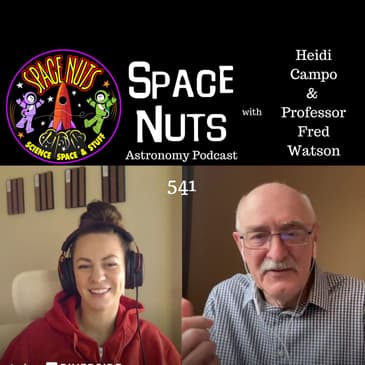


In this exciting episode of Space Nuts, hosts Heidi Campo and Professor Fred Watson delve into the latest astronomical discoveries and cosmic curiosities. From the enigmatic Fermi bubbles in our Milky Way to a potential impact event on Saturn, this episode is brimming with fascinating insights that will leave you pondering the wonders of the universe.
Episode Highlights:
- Understanding Fermi Bubbles: The episode opens with a discussion about the newly observed Fermi bubbles, massive structures in the Milky Way. Fred explains their origins, linked to explosive activity from the supermassive black hole at the galaxy's center, and shares intriguing details about the hot gas and cooler gas clouds found within these bubbles.
- The Mystery of Saturn's Flash: The hosts then explore a recently captured flash on Saturn, potentially indicating an impact event. Heidi and Fred discuss the implications of this discovery and the importance of citizen science in verifying the occurrence of such events.
- Astrobiology: In a thought-provoking segment, the conversation shifts to the intersection of high energy astronomy and the search for extraterrestrial life. Fred highlights a new initiative that seeks to explore signals from advanced civilizations using high-energy emissions, challenging traditional notions of where life might thrive.
- Reflections on Cosmic Discoveries: The episode wraps up with a recap of the discussions, emphasizing the ongoing quest for knowledge in astronomy and the importance of community engagement in scientific discovery.
For more Space Nuts, including our continuously updating newsfeed and to listen to all our episodes, visit our website. Follow us on social media at SpaceNutsPod on Facebook, X, YouTube Music Music, Tumblr, Instagram, and TikTok. We love engaging with our community, so be sure to drop us a message or comment on your favorite platform.
If you’d like to help support Space Nuts and join our growing family of insiders for commercial-free episodes and more, visit spacenutspodcast.com/about
Stay curious, keep looking up, and join us next time for more stellar insights and cosmic wonders. Until then, clear skies and happy stargazing.
Got a question for our Q&A episode? https://spacenutspodcast.com/ama
Become a supporter of this podcast: https://www.spreaker.com/podcast/space-nuts-astronomy-insights-cosmic-discoveries--2631155/support.
00:00:00 --> 00:00:02 Heidi Campo: Welcome back to another episode of
00:00:02 --> 00:00:03 Space Nuts.
00:00:03 --> 00:00:06 Generic: 15 seconds. Guidance is internal.
00:00:06 --> 00:00:09 10, 9. Ignition
00:00:09 --> 00:00:12 sequence. Star space nuts. 5, 4, 3,
00:00:12 --> 00:00:15 2. 1, 2, 3, 4, 5, 5, 4,
00:00:15 --> 00:00:17 3, 2, 1. Space nuts.
00:00:17 --> 00:00:19 Astronauts report it feels good.
00:00:20 --> 00:00:23 Heidi Campo: I am your host, filling in for the beloved
00:00:23 --> 00:00:25 Andrew Dunkley. And my name is Heidi Campo.
00:00:26 --> 00:00:28 Joining us today is Professor Fred Watson,
00:00:28 --> 00:00:31 astronomer at large. And you are at
00:00:31 --> 00:00:33 large. You're still at your conference?
00:00:34 --> 00:00:36 Professor Fred Watson: Uh, that's correct, yes. Um, still in. It's
00:00:36 --> 00:00:38 actually turning out to be rainy Adelaide
00:00:38 --> 00:00:40 today. There's, uh, quite heavy showers going
00:00:40 --> 00:00:41 through, which I can see out of the window.
00:00:42 --> 00:00:45 Um, and, um, hopefully, uh, I'll get a
00:00:45 --> 00:00:47 dry spell to walk up to the university to
00:00:48 --> 00:00:50 connect with my colleagues on the conference.
00:00:50 --> 00:00:52 Uh, I do have an umbrella, so that's all
00:00:52 --> 00:00:55 right. Being
00:00:55 --> 00:00:57 British, you always carry an umbrella.
00:00:57 --> 00:00:58 That's.
00:00:58 --> 00:01:00 Heidi Campo: I was gonna say you're good at astronomy and
00:01:00 --> 00:01:03 planetary science, bringing an umbrella.
00:01:03 --> 00:01:05 Professor Fred Watson: Yeah. I should show you my umbrella.
00:01:05 --> 00:01:07 Actually, I can't do it now. But, um, it's
00:01:07 --> 00:01:09 got all the northern constellations on it.
00:01:09 --> 00:01:12 It's lovely. You flick it open and
00:01:12 --> 00:01:15 suddenly there's the sky in front of you, uh,
00:01:15 --> 00:01:17 all marked out, which came from
00:01:17 --> 00:01:20 Jodrell bank in Northern England, which is
00:01:20 --> 00:01:22 the home of the Lovell Radio telescope, which
00:01:22 --> 00:01:25 was the biggest, uh, radio. It was telescope
00:01:25 --> 00:01:28 in the world and it was built in 1957. So,
00:01:28 --> 00:01:28 yeah.
00:01:28 --> 00:01:31 Heidi Campo: Wow. Well, that's a fun, fun fact to start
00:01:31 --> 00:01:32 off the episode.
00:01:32 --> 00:01:35 And I guess speaking of radio, I will brag
00:01:35 --> 00:01:38 for us. Before we started recording, Fred
00:01:38 --> 00:01:40 had mentioned to me that a story that we just
00:01:41 --> 00:01:43 covered on the last episode is hitting the
00:01:43 --> 00:01:46 radio with, uh, quite a lot of
00:01:46 --> 00:01:49 popularity. But you guys heard it here first.
00:01:49 --> 00:01:52 And, um, if you missed our last episode,
00:01:52 --> 00:01:55 you should go, uh, check that out. But just
00:01:55 --> 00:01:58 talking about the Big Crunch, and, um,
00:01:58 --> 00:02:00 we covered it thoroughly on the last episode,
00:02:00 --> 00:02:03 and it's the hot news in astronomy now, so
00:02:03 --> 00:02:06 you can go back and listen to that one. But
00:02:06 --> 00:02:09 we do have a lot of great stories in the
00:02:09 --> 00:02:11 queue for today as well that you're also
00:02:11 --> 00:02:13 going to want to hear. And, you know, this is
00:02:13 --> 00:02:16 funny because it's like, this is a science
00:02:16 --> 00:02:18 podcast, but I feel like the articles today
00:02:18 --> 00:02:21 are particularly Science Science rich.
00:02:21 --> 00:02:24 There's a lot of, um, and.
00:02:24 --> 00:02:26 And great variety too, Fred. These are going
00:02:26 --> 00:02:27 to be some really fun articles.
00:02:27 --> 00:02:30 So today, I don't even know I understand the
00:02:30 --> 00:02:33 word bubbles and I understand Milky Way,
00:02:33 --> 00:02:36 but I don't know what a Fermi bubble is
00:02:36 --> 00:02:39 that we have discovered in the Milky Way. And
00:02:39 --> 00:02:41 can you just tell Us Why they named it the
00:02:41 --> 00:02:41 Milky Way?
00:02:42 --> 00:02:43 Professor Fred Watson: Oh, um, you know, I.
00:02:44 --> 00:02:46 Heidi Campo: There's a meme on the Internet where it's
00:02:46 --> 00:02:47 like, who just looked up at that and thought,
00:02:48 --> 00:02:49 mmm, milky.
00:02:50 --> 00:02:53 Professor Fred Watson: The Greeks, I think, um, uh, um, and
00:02:53 --> 00:02:55 the Romans. It goes back. It's probably, you
00:02:55 --> 00:02:58 know, it's lost in time because it's got
00:02:58 --> 00:03:01 this milky appearance. Via lacta, it's called
00:03:01 --> 00:03:04 in Latin, uh, Milky Way. Uh, and,
00:03:04 --> 00:03:07 um, uh. So ancient people looked
00:03:07 --> 00:03:09 at it, thought it looked milky, called it the
00:03:09 --> 00:03:12 Milky Way, telling it like it is. And
00:03:12 --> 00:03:14 it's. And it's been known as that,
00:03:15 --> 00:03:18 um, ever since. And I think it's
00:03:18 --> 00:03:19 delightful that we still call it that. I
00:03:19 --> 00:03:22 mean, we technically we see it as. It's the
00:03:22 --> 00:03:24 edge, you know, the thickness of our galaxy
00:03:24 --> 00:03:26 that we're looking through when we see the
00:03:26 --> 00:03:29 Milky Way. It was Galileo who first saw that
00:03:29 --> 00:03:31 it was made of stars and not congealed milk
00:03:31 --> 00:03:34 or something like that. Uh, when he, when he
00:03:34 --> 00:03:36 perfected the telescope or perfected his
00:03:36 --> 00:03:38 telescope in 16, 1609, uh,
00:03:39 --> 00:03:41 towards the end of 1609, early 1610, he
00:03:41 --> 00:03:43 saw it was made of stars.
00:03:44 --> 00:03:47 And that was, um, the first time anybody knew
00:03:47 --> 00:03:49 really what it was made of. And that was, um,
00:03:49 --> 00:03:52 you know, only, excuse me, 400
00:03:52 --> 00:03:55 years or so ago. So it's quite a recent
00:03:55 --> 00:03:57 discovery that it's actually, uh, made of
00:03:57 --> 00:04:00 celestial objects rather than something,
00:04:00 --> 00:04:03 um, almost supernatural, which I'm sure
00:04:03 --> 00:04:05 was very much on the minds of people before
00:04:05 --> 00:04:08 that. Supernatural milk from supernatural
00:04:08 --> 00:04:10 cows, probably. Excuse me.
00:04:10 --> 00:04:12 Heidi Campo: Yeah, I've always thought. I mean, it does. I
00:04:12 --> 00:04:14 guess I don't look at it and think milky. I
00:04:14 --> 00:04:16 think maybe Sparkle Way or something. But now
00:04:16 --> 00:04:18 that, uh, you know, thinking of it through
00:04:18 --> 00:04:20 the lens of ancient people, that makes sense.
00:04:22 --> 00:04:24 Professor Fred Watson: A lot of, um, you know, what you might call
00:04:24 --> 00:04:26 first nations cultures throughout the world
00:04:26 --> 00:04:28 see it differently. Here in, uh, Australia,
00:04:29 --> 00:04:32 a lot of the Aboriginal people. And
00:04:32 --> 00:04:35 there are something like 400 different groups
00:04:35 --> 00:04:37 of Aboriginal people within Australia. It's a
00:04:37 --> 00:04:39 very. Because the. A big continent and these
00:04:39 --> 00:04:42 are small nations dotted throughout. But
00:04:42 --> 00:04:45 many of them saw it as a celestial river. Uh,
00:04:45 --> 00:04:46 oh, that's beautiful. You know, so. And that.
00:04:46 --> 00:04:49 And you can kind of get that because often
00:04:50 --> 00:04:52 rivers in Australia, uh, uh, are milky and
00:04:52 --> 00:04:54 the water's sometimes quite milky in
00:04:54 --> 00:04:56 appearance. So it sort of all makes sense.
00:04:57 --> 00:04:58 Heidi Campo: Hmm.
00:04:58 --> 00:05:00 Well, I guess today we're starting off by,
00:05:00 --> 00:05:02 uh, talking about milk bubbles.
00:05:03 --> 00:05:05 Professor Fred Watson: Well, that's, you know, the froth on your
00:05:05 --> 00:05:08 milk, um, which is very nice on a coffee or
00:05:08 --> 00:05:09 something like that. Anyway, that's a
00:05:09 --> 00:05:11 different story. So what are these things?
00:05:11 --> 00:05:14 Fermi bubbles. You mentioned them. Um, they,
00:05:14 --> 00:05:16 uh, and I'm not actually sure. I thought you
00:05:16 --> 00:05:17 were going to ask me who named them and I
00:05:17 --> 00:05:19 don't know the answer to that, so I'm very
00:05:19 --> 00:05:22 glad you didn't. Um, the um,
00:05:22 --> 00:05:25 Fermi bubbles are their structures
00:05:25 --> 00:05:28 which are uh, thousands of light
00:05:28 --> 00:05:30 years across, um,
00:05:30 --> 00:05:33 and they, they, we see them in, in
00:05:33 --> 00:05:36 radio telescopes. They're bubbles of hot
00:05:36 --> 00:05:39 gas. And um, and we think they're
00:05:39 --> 00:05:42 caused by sort of explosive activity
00:05:42 --> 00:05:45 in the center of our galaxy because we
00:05:45 --> 00:05:48 know that the center of our galaxy hosts uh,
00:05:48 --> 00:05:50 a 4 million solar mass black hole,
00:05:51 --> 00:05:54 um, which occasionally gobbles up material,
00:05:54 --> 00:05:57 um, uh, you know, approaches it and
00:05:57 --> 00:05:59 gets sucked into the accretion disk and
00:05:59 --> 00:06:01 whizzes around at high speeds radiating X
00:06:01 --> 00:06:03 rays and things of that sort and then get
00:06:03 --> 00:06:06 sucked uh, into the black hole. What doesn't
00:06:06 --> 00:06:08 get sucked in squirts upwards, uh, and
00:06:08 --> 00:06:11 downwards, uh, at the poles of rotation of
00:06:11 --> 00:06:14 the black hole, uh, to form jets. That's the
00:06:14 --> 00:06:16 way black holes behave when they're active,
00:06:16 --> 00:06:17 when they're gobbling stuff up. They form
00:06:17 --> 00:06:19 these jets which come about because of
00:06:19 --> 00:06:21 magnetic fields. So we think that the Fermi
00:06:21 --> 00:06:24 bubbles are the result of uh, previous
00:06:24 --> 00:06:27 outbursts in the galaxy's history. They've
00:06:27 --> 00:06:30 only been known for 15 years. Heidi
00:06:31 --> 00:06:34 20, uh, 10 I think. They were first
00:06:34 --> 00:06:36 picked up by uh, gamma ray telescopes. So
00:06:36 --> 00:06:39 gamma rays are very short wa wavelength
00:06:39 --> 00:06:41 radiation at the opposite end of the spectrum
00:06:41 --> 00:06:43 from radio waves, uh, but they are
00:06:43 --> 00:06:46 symptomatic of high energy processes. So
00:06:46 --> 00:06:48 things that are very hot, uh, or you know,
00:06:48 --> 00:06:51 very active, like center of a
00:06:51 --> 00:06:53 galaxy with an active black hole in it,
00:06:53 --> 00:06:55 they're going to produce gamma rays as well.
00:06:55 --> 00:06:57 Um, so, um, violent events.
00:06:58 --> 00:07:01 They've been likened to volcanic eruptions
00:07:01 --> 00:07:03 from the center of uh, our galaxy forming
00:07:03 --> 00:07:05 these bubbles of material moving away
00:07:06 --> 00:07:09 from uh, the galactic center. They're both
00:07:09 --> 00:07:12 north and south of the center of the
00:07:12 --> 00:07:15 galaxy. Um, but some new
00:07:15 --> 00:07:18 observations using uh, the Green
00:07:18 --> 00:07:20 bank telescope, uh, National Science
00:07:20 --> 00:07:23 foundation over there in your country, uh, is
00:07:23 --> 00:07:26 a team, uh, from um, I can't
00:07:26 --> 00:07:28 remember which university. They're from North
00:07:28 --> 00:07:31 Carolina State University and some other
00:07:31 --> 00:07:34 institutions. What they've done is
00:07:34 --> 00:07:36 they've used uh, the Green bank radio
00:07:36 --> 00:07:39 telescope to get basically really
00:07:39 --> 00:07:41 high, uh, fidelity, uh,
00:07:41 --> 00:07:44 images and data on
00:07:45 --> 00:07:48 the composition of the gases within
00:07:48 --> 00:07:50 them, the speed that they're moving, things
00:07:50 --> 00:07:53 of that sort. Uh, um, so
00:07:53 --> 00:07:54 they've done what we would call a survey of
00:07:54 --> 00:07:57 the Fermi bubbles. Ah, and that lets
00:07:57 --> 00:08:00 them pick out fine details um, now
00:08:00 --> 00:08:02 the thing about the Fermi bubbles, as I said,
00:08:02 --> 00:08:03 they're very high energy. Their temperature,
00:08:04 --> 00:08:07 uh, within them is roughly a
00:08:07 --> 00:08:09 million degrees or so.
00:08:10 --> 00:08:13 Uh, 1 million degrees Celsius or Kelvin.
00:08:13 --> 00:08:15 Uh, it's a lot more in Fahrenheit, but it's
00:08:15 --> 00:08:18 about a million degrees. But
00:08:18 --> 00:08:21 there are clouds of gas within those
00:08:21 --> 00:08:23 bubbles, um, which are
00:08:25 --> 00:08:28 significant. You know, they're big clouds of
00:08:28 --> 00:08:31 gas. They weigh um, thousands of times
00:08:31 --> 00:08:33 the mass of the Sun. They're within the
00:08:33 --> 00:08:36 bubbles, uh, roughly. The uh, ones they've
00:08:36 --> 00:08:38 been identified are about 12 light years
00:08:38 --> 00:08:40 from the center of the Milky Way.
00:08:40 --> 00:08:43 And it's amazing thing, given that the
00:08:43 --> 00:08:45 temperature of the Fermi bubbles is a million
00:08:45 --> 00:08:48 degrees, these things are cold.
00:08:49 --> 00:08:52 They're uh, uh, well, cold in comparison, let
00:08:52 --> 00:08:54 me put it that way. They're only about 10
00:08:54 --> 00:08:57 degrees. If you can describe 10
00:08:57 --> 00:08:59 degrees as cold. Well it is compared with the
00:08:59 --> 00:09:01 million degrees that's, you know, that's
00:09:01 --> 00:09:04 surrounding them. And um, in fact there's a
00:09:04 --> 00:09:06 lovely quote from uh, uh,
00:09:07 --> 00:09:09 one of the um, uh, authors, the co author of
00:09:09 --> 00:09:11 the paper is actually at the Space Telescope
00:09:11 --> 00:09:13 Science Institute, STScI, which is in
00:09:13 --> 00:09:16 Baltimore. Um, somebody uh, called Andrew
00:09:16 --> 00:09:19 Fox. Uh, he um,
00:09:19 --> 00:09:21 has this lovely quote. Uh, he says they're
00:09:21 --> 00:09:24 around 10 degrees Kelvin, so cooler than
00:09:24 --> 00:09:26 their surroundings by at least a factor of
00:09:26 --> 00:09:29 100. Finding these clouds within the Fermi
00:09:29 --> 00:09:31 bubble is like finding ice cubes in a
00:09:31 --> 00:09:33 volcano. And you know, that's really
00:09:33 --> 00:09:36 nice, a nice uh, summary. Um,
00:09:36 --> 00:09:39 and it's hard to
00:09:39 --> 00:09:42 understand m, why they're
00:09:42 --> 00:09:45 there. And one of the other astronomers
00:09:45 --> 00:09:46 involved with this says computer models of
00:09:46 --> 00:09:49 cool gas interacting with hot outflowing
00:09:49 --> 00:09:51 gas in extreme environments like the Fermi
00:09:51 --> 00:09:54 bubbles show that cool clouds should be
00:09:54 --> 00:09:56 rapidly destroyed, usually within a few
00:09:56 --> 00:09:58 million years. Uh, a timescale that
00:09:58 --> 00:10:01 aligns with independent estimates of the
00:10:01 --> 00:10:04 Fermi bubbles age. Um, and
00:10:04 --> 00:10:07 it wouldn't be possible for the clouds to be
00:10:07 --> 00:10:10 present, to be present at all if
00:10:10 --> 00:10:12 the bubbles were 10 million years or older.
00:10:12 --> 00:10:14 So that's what they're saying is, you know,
00:10:14 --> 00:10:17 you've got a scale of a few million years for
00:10:17 --> 00:10:19 these things to evaporate to become at the
00:10:19 --> 00:10:22 same temperature as the bubbles. But uh, uh,
00:10:22 --> 00:10:25 they haven't done that yet. Um,
00:10:26 --> 00:10:28 and one other quote if I may. Uh, because
00:10:28 --> 00:10:30 this is full of great quotes and there's my
00:10:30 --> 00:10:33 phone ringing and I don't know why,
00:10:33 --> 00:10:36 uh, I'm going to ignore it.
00:10:36 --> 00:10:37 They might be trying to get me out of the
00:10:37 --> 00:10:40 room. Do you mind if I take this? Heidi,
00:10:40 --> 00:10:42 let's Pause it. Let's pause it. We'll just.
00:10:43 --> 00:10:44 Actually, they've gone. All right.
00:10:45 --> 00:10:46 Heidi Campo: They'll be back. Don't worry.
00:10:48 --> 00:10:48 Professor Fred Watson: They'll be back.
00:10:48 --> 00:10:49 Heidi Campo: Probably.
00:10:49 --> 00:10:51 Professor Fred Watson: They will be back. Yes, I'm sure that's
00:10:51 --> 00:10:54 right. Uh, unless the place is
00:10:54 --> 00:10:55 on fire or something like that. Doesn't look
00:10:55 --> 00:10:58 to be. Um, so
00:10:58 --> 00:11:00 another quote, uh, ah,
00:11:02 --> 00:11:04 uh, uh, from one of the scientists involved
00:11:04 --> 00:11:06 with this. What makes this discovery even
00:11:06 --> 00:11:09 more remarkable is its synergy with
00:11:09 --> 00:11:11 ultraviolet observations from the Hubble
00:11:11 --> 00:11:13 Space Telescope. The clouds lie along a
00:11:13 --> 00:11:16 sight line previously observed with the
00:11:16 --> 00:11:18 Hubble Space Telescope, which detected
00:11:18 --> 00:11:21 highly ionized multiphase gas.
00:11:21 --> 00:11:24 Uh, that's just saying it's very excited. Uh,
00:11:24 --> 00:11:26 ranging in temperatures from a million to
00:11:26 --> 00:11:27 100 degrees, which is what you would
00:11:27 --> 00:11:30 expect to see if cold gas is getting
00:11:30 --> 00:11:32 evaporated. In other words, there is evidence
00:11:33 --> 00:11:36 that these cold gas clouds are, uh, actually
00:11:36 --> 00:11:38 dissipating, that they're warming up. Uh, and
00:11:39 --> 00:11:42 basically, uh, they're going to disappear,
00:11:42 --> 00:11:44 you know, within a million years or so. Uh,
00:11:45 --> 00:11:47 so a really interesting story with a lot of
00:11:47 --> 00:11:49 loose ends tied up very nicely by the
00:11:49 --> 00:11:50 observations made by these scientists.
00:11:52 --> 00:11:53 Heidi Campo: Wow, that's a.
00:11:55 --> 00:11:56 I just. I'm still wrapping my head around
00:11:56 --> 00:11:59 that metaphor of the ice cube in a lava
00:11:59 --> 00:12:02 volcano or in a volcano. What an
00:12:02 --> 00:12:04 incredible discovery. That's one I'm
00:12:04 --> 00:12:07 definitely going to keep my eye on for
00:12:07 --> 00:12:09 further, um, research and
00:12:10 --> 00:12:12 seeing what we figure out. This is a really
00:12:12 --> 00:12:15 interesting phenomenon.
00:12:16 --> 00:12:18 Professor Fred Watson: Yeah, it's pretty amazing.
00:12:19 --> 00:12:22 Uh, and, um, uh, Fermi bubbles.
00:12:22 --> 00:12:23 We've talked about them a little bit in the
00:12:23 --> 00:12:26 past on Spacenuts, uh, when the, uh,
00:12:26 --> 00:12:29 beloved Andrew Dunkley was there, uh, and
00:12:29 --> 00:12:32 he'll be back, I'm sure. Uh, um, the,
00:12:33 --> 00:12:35 uh, bottom line is though, that, um, they're
00:12:35 --> 00:12:37 still a bit mysterious. You know,
00:12:38 --> 00:12:40 clearly they are. They're sort of spherical
00:12:40 --> 00:12:42 in shape. You can see when you look at, um,
00:12:42 --> 00:12:45 images taken with, um,
00:12:45 --> 00:12:47 principally radio telescopes, but also Gamma
00:12:47 --> 00:12:49 Ray Telescope. Uh, it's that they're, they're
00:12:49 --> 00:12:52 quite spherical. That a bubble is a good name
00:12:52 --> 00:12:54 for it because they seem to be hollow. Uh,
00:12:54 --> 00:12:57 but how they actually are,
00:12:58 --> 00:13:01 how they arise, probably because the hot gas
00:13:01 --> 00:13:04 shooting up from the black hole, uh, might
00:13:04 --> 00:13:07 excavate a sort of spherical cavern in the
00:13:07 --> 00:13:09 surrounding gas. It's still a bit mysterious
00:13:09 --> 00:13:10 though.
00:13:13 --> 00:13:15 Generic: Three, two, one.
00:13:15 --> 00:13:17 Space nuts.
00:13:17 --> 00:13:17 Heidi Campo: Yeah.
00:13:17 --> 00:13:20 Speaking of mysteries, our next story
00:13:20 --> 00:13:23 is also quite mysterious
00:13:23 --> 00:13:26 and it seems like the race is on to figure
00:13:26 --> 00:13:28 out what the answer is. And we are trying to
00:13:28 --> 00:13:29 figure out. Did something just happen to
00:13:29 --> 00:13:32 Saturn? Saturn? Did it just get Hit what is
00:13:32 --> 00:13:35 going on? The headlines here is astronomers
00:13:35 --> 00:13:38 are racing to find out. So it sounds like
00:13:38 --> 00:13:40 this is also kind of a hot discovery that
00:13:40 --> 00:13:43 everybody wants to know the answer to
00:13:43 --> 00:13:45 is what's going on with Saturn?
00:13:46 --> 00:13:49 Professor Fred Watson: Uh, yeah, so, um, Saturn, I
00:13:49 --> 00:13:52 guess everybody's favorite planet, um, with
00:13:52 --> 00:13:54 its rings, wonderful uh, place to
00:13:54 --> 00:13:57 study and a great place to start with if
00:13:57 --> 00:13:59 you've got a small telescope because you. The
00:13:59 --> 00:14:02 rings are always quite breathtaking. Um,
00:14:03 --> 00:14:04 so uh,
00:14:05 --> 00:14:08 we know that um, planets, particularly in the
00:14:08 --> 00:14:10 outer parts of. Well we know planets
00:14:10 --> 00:14:12 everywhere are subject to bombardment by
00:14:12 --> 00:14:15 asteroids at a relatively low rate. Um,
00:14:15 --> 00:14:18 this is part of uh, the process of
00:14:18 --> 00:14:20 planet building, uh most of which took place
00:14:20 --> 00:14:22 four billion years ago, four and a half
00:14:22 --> 00:14:23 billion years ago. But there are still
00:14:24 --> 00:14:27 asteroids bombarding planets that, you know,
00:14:27 --> 00:14:29 m missed the boat really. Uh, and we know
00:14:29 --> 00:14:31 about asteroids that have hit the Earth in
00:14:31 --> 00:14:33 particular the dinosaur killer back in
00:14:33 --> 00:14:35 66 million years ago.
00:14:36 --> 00:14:39 Um, so it's expected that you would see from
00:14:39 --> 00:14:41 time to time small uh, asteroids, meteorites,
00:14:41 --> 00:14:44 effectively hitting other planets. Uh, and
00:14:44 --> 00:14:47 the most well known one for the outer planets
00:14:47 --> 00:14:50 is a comet, uh, which uh,
00:14:50 --> 00:14:53 impacted um, the planet Jupiter
00:14:53 --> 00:14:55 back in, I think it was
00:14:55 --> 00:14:57 1994 or
00:14:57 --> 00:15:00 thereabouts. Um, uh, which
00:15:00 --> 00:15:03 uh, basically, uh,
00:15:03 --> 00:15:06 yes, it was 1994. I've just checked it up. A
00:15:06 --> 00:15:08 uh, comet called Shoemaker Levy nine,
00:15:09 --> 00:15:11 uh, which broke up actually because of
00:15:11 --> 00:15:13 Jupiter's intense gravitational field. It
00:15:13 --> 00:15:16 broke up before it hit the planet. Uh, but it
00:15:16 --> 00:15:19 did hit the planet and because people had
00:15:19 --> 00:15:22 observed the comet, uh, there were many
00:15:22 --> 00:15:24 observations made including by our Anglo
00:15:24 --> 00:15:26 Australian telescope here in Australia. Um,
00:15:27 --> 00:15:29 they managed to observe the impact of
00:15:29 --> 00:15:31 Shoemaker Levy nine fragments with the
00:15:31 --> 00:15:34 atmosphere of Jupiter. Um, and so we'd expect
00:15:34 --> 00:15:36 to see the same sort of thing with the other
00:15:36 --> 00:15:38 gas giants out there.
00:15:38 --> 00:15:41 And um, so with that as the
00:15:41 --> 00:15:43 background, what's hit the headlines
00:15:43 --> 00:15:46 uh at the moment is a
00:15:46 --> 00:15:49 flash that has been recorded. It's actually
00:15:49 --> 00:15:51 right on the limb of the planet Saturn,
00:15:52 --> 00:15:54 uh, by an amateur astronomer who was
00:15:55 --> 00:15:58 m taking video footage of the planet
00:15:58 --> 00:16:01 itself. Um, now it's
00:16:01 --> 00:16:04 an astronomer, uh, by the name of Mario
00:16:04 --> 00:16:07 Rana, who is a NASA employee
00:16:08 --> 00:16:11 and um, has. So as well
00:16:11 --> 00:16:13 as working for NASA, he's also an amateur
00:16:13 --> 00:16:15 astronomer. Uh, and he
00:16:16 --> 00:16:19 basically um, caught this
00:16:19 --> 00:16:22 image which you can find on the web. There's
00:16:22 --> 00:16:24 a few websites that have got a picture of it.
00:16:24 --> 00:16:26 It's a very blurry image of Saturn, which is
00:16:26 --> 00:16:28 kind of what you'd expect from a short
00:16:28 --> 00:16:31 exposure video image, uh, with a
00:16:31 --> 00:16:33 flash at one side. Now the question
00:16:34 --> 00:16:36 that everybody's asking, and this is what you
00:16:36 --> 00:16:38 were alluding to right at the beginning is
00:16:39 --> 00:16:41 uh, what is the flash? Is it something
00:16:41 --> 00:16:44 impacting the atmosphere of Saturn or
00:16:44 --> 00:16:47 is it perhaps a glitch in the data which are
00:16:47 --> 00:16:50 uh, not unknown at all. Uh, when you're doing
00:16:50 --> 00:16:52 astronomical imaging uh, with any kind of
00:16:52 --> 00:16:54 equipment there are often, there's often the
00:16:54 --> 00:16:57 possibility of a glitch. Uh so
00:16:57 --> 00:17:00 um, that is a ah question
00:17:01 --> 00:17:03 that can really only be resolved if
00:17:04 --> 00:17:06 somebody else was also observing
00:17:07 --> 00:17:09 plateau, not platurn Saturn.
00:17:10 --> 00:17:12 If somebody else was also observing the
00:17:12 --> 00:17:15 planet Saturn, sometimes abbreviated to
00:17:15 --> 00:17:18 platen, um, uh, then um,
00:17:19 --> 00:17:21 basically uh, and they found
00:17:22 --> 00:17:25 the same flash in their data. Um
00:17:25 --> 00:17:27 then that would prove that this was not a
00:17:27 --> 00:17:30 glitch in the data, that it's actually ah,
00:17:30 --> 00:17:33 um, something that's real, a real
00:17:33 --> 00:17:36 event. Uh and so uh, the search
00:17:36 --> 00:17:39 is on for somebody who was observing the
00:17:39 --> 00:17:41 planet Saturn on the 5th of July
00:17:42 --> 00:17:44 between 9am and 9:15am
00:17:45 --> 00:17:47 UTC. That's Universal Coordinated universal
00:17:47 --> 00:17:50 Time. That's the sort of standard time that
00:17:50 --> 00:17:52 used to be called Greenwich Mean Time but is
00:17:52 --> 00:17:54 now much more sophisticated uh 9:00am and
00:17:54 --> 00:17:57 9:15 if any. Um, SpaceNots listeners
00:17:57 --> 00:17:59 have got footage of Saturn taken at that
00:17:59 --> 00:18:02 time, 5th of July, not very long ago between
00:18:02 --> 00:18:05 9am and 9:15am M UTC. We want
00:18:05 --> 00:18:08 to see your data uh, because there
00:18:08 --> 00:18:10 could be evidence that this was a real event
00:18:11 --> 00:18:13 rather than a hot pixel or some sort of
00:18:13 --> 00:18:16 glitch in the data. So um, that's a story
00:18:16 --> 00:18:18 that I think is going to develop again, one
00:18:18 --> 00:18:20 we should keep an eye on Heidi, because
00:18:21 --> 00:18:23 hopefully maybe within the next couple of
00:18:23 --> 00:18:25 weeks we might find that somebody has
00:18:25 --> 00:18:27 recorded the planet Saturn at that time,
00:18:28 --> 00:18:31 uh, and that there is confirmation that it
00:18:31 --> 00:18:33 was actually an impacting object. Then we've
00:18:33 --> 00:18:34 got to think about what it might have been.
00:18:34 --> 00:18:37 Possibly a comet, possibly an asteroid,
00:18:37 --> 00:18:40 but something um, big enough to make
00:18:40 --> 00:18:43 a significant um, flash when it
00:18:43 --> 00:18:45 actually burned up or
00:18:46 --> 00:18:47 interacted with the atmosphere of Saturn.
00:18:48 --> 00:18:51 Heidi Campo: Yeah, yeah. This is just another reminder of
00:18:51 --> 00:18:54 how important citizen science is because this
00:18:54 --> 00:18:57 is a great example of you don't need to
00:18:57 --> 00:18:59 be a Fred Watson to make these discoveries.
00:18:59 --> 00:19:02 You could be, you know, any of our
00:19:02 --> 00:19:04 regular listeners, you could be a Heidi Campo
00:19:04 --> 00:19:07 and still do cool things and uh,
00:19:07 --> 00:19:09 uh, that's really exciting. So I guess we
00:19:09 --> 00:19:12 will find out. Uh, right now I guess it is
00:19:12 --> 00:19:14 just a big hands in the air. I don't know.
00:19:15 --> 00:19:18 We need more data to figure that out.
00:19:20 --> 00:19:22 Voice Over Guy: Okay, we checked all four systems and. Team
00:19:22 --> 00:19:24 with a go space nuts.
00:19:24 --> 00:19:27 Heidi Campo: But unlike our last Story where there is
00:19:27 --> 00:19:30 just so much conversation, lots of
00:19:30 --> 00:19:33 talk, lots of mystery, lots of data, lots of
00:19:33 --> 00:19:35 not data. We are talking about,
00:19:36 --> 00:19:38 I think it's, we're going to be split down
00:19:38 --> 00:19:40 the middle. It's either something you love to
00:19:40 --> 00:19:43 talk about or it's oh man, this again. But we
00:19:43 --> 00:19:45 are talking about the search for
00:19:45 --> 00:19:47 extraterrestrials.
00:19:48 --> 00:19:48 Professor Fred Watson: Yes.
00:19:48 --> 00:19:51 Heidi Campo: And uh, for, I think for those of you who
00:19:51 --> 00:19:54 are in the camp of you've watched the movie
00:19:54 --> 00:19:56 Contact and you loved it, then this will be
00:19:56 --> 00:19:57 the story for you.
00:19:58 --> 00:20:00 Professor Fred Watson: It's a really interesting story. The reason I
00:20:00 --> 00:20:03 put it in today Heidi, was that one of
00:20:03 --> 00:20:06 my colleagues at the conference actually
00:20:06 --> 00:20:09 mentioned this idea in his
00:20:09 --> 00:20:12 talk, uh, for about a fifth of a
00:20:12 --> 00:20:14 second. He didn't dwell on it. It was
00:20:14 --> 00:20:17 flashed up on the screen. High, uh, energy
00:20:17 --> 00:20:19 astrobiology was the term he used. And then
00:20:19 --> 00:20:22 he moved on to something else. And I thought
00:20:22 --> 00:20:25 those two words, oh, uh, three words I guess,
00:20:25 --> 00:20:28 high energy with uh, a hyphen in between.
00:20:28 --> 00:20:31 High energy and astrobiology.
00:20:31 --> 00:20:34 Astrobiology is the uh, study
00:20:34 --> 00:20:36 of the origin of life, how life evolved, how
00:20:36 --> 00:20:39 it became, uh, where it is throughout the
00:20:39 --> 00:20:42 universe. High uh, energy astronomy
00:20:42 --> 00:20:44 is at the opposite end. It's the stuff we've
00:20:44 --> 00:20:45 been talking about with the Fermi bubbles.
00:20:45 --> 00:20:48 It's uh, things that are very hot or very
00:20:48 --> 00:20:50 active or you know, full of radiation.
00:20:51 --> 00:20:52 Uh, the kinds of things that you don't
00:20:52 --> 00:20:55 associate with the origin of life.
00:20:55 --> 00:20:58 Uh, that you might um, you know, think
00:20:58 --> 00:21:01 that these high energy radiations would just
00:21:01 --> 00:21:04 destroy any sort of molecules that
00:21:04 --> 00:21:06 are trying to evolve into living
00:21:06 --> 00:21:09 organisms. Uh, and uh, that's
00:21:09 --> 00:21:12 why it seemed like um.
00:21:12 --> 00:21:15 Yes, it seemed like the word is an oxymoron,
00:21:15 --> 00:21:17 isn't it? An oxymoron's two things that go
00:21:17 --> 00:21:20 together that mean opposite things. That's
00:21:20 --> 00:21:22 what it seemed like. And then here I found
00:21:22 --> 00:21:25 ah, an article which is on the phys.org
00:21:26 --> 00:21:28 website, phys.org Ah,
00:21:28 --> 00:21:31 reviving search for Extraterrestrial
00:21:31 --> 00:21:34 Intelligence with High Energy Astronomy.
00:21:34 --> 00:21:37 And so it's really um,
00:21:37 --> 00:21:39 it's a white paper actually that's gone to
00:21:39 --> 00:21:42 the NASA Decadal Astrobiology Research
00:21:42 --> 00:21:45 and Exploration Strategy. Uh, and
00:21:45 --> 00:21:47 they uh, have a request for information and
00:21:47 --> 00:21:49 this white paper has uh, come in as a
00:21:49 --> 00:21:52 submission. Um, and it's got at
00:21:52 --> 00:21:55 uh, least two researchers involved with this.
00:21:55 --> 00:21:57 Uh, they're involved with a project called
00:21:57 --> 00:21:59 Breakthrough Listen, which we've certainly
00:21:59 --> 00:22:02 talked about before on uh, Space Nuts.
00:22:02 --> 00:22:05 Breakthrough Listen is a privately funded uh,
00:22:05 --> 00:22:07 venture to devote some of the time
00:22:07 --> 00:22:10 on two big radio telescopes, one of which is
00:22:10 --> 00:22:12 here in Australia, the Parkes radiodish to
00:22:12 --> 00:22:15 listening for uh, SETI signals. In
00:22:15 --> 00:22:17 other words, the search for extraterrestrial
00:22:17 --> 00:22:20 intelligence. Listening for signals that
00:22:20 --> 00:22:22 might actually be
00:22:22 --> 00:22:25 um, somebody's communication signals,
00:22:25 --> 00:22:28 uh, in a different star system. Uh,
00:22:28 --> 00:22:31 so these people are already tuned into that
00:22:31 --> 00:22:33 idea. Now the breakthrough listen has been
00:22:33 --> 00:22:35 going for some years, maybe 15,
00:22:35 --> 00:22:38 10, 15 years. It's funded by a Russian
00:22:38 --> 00:22:40 billionaire called Yuri Milner.
00:22:41 --> 00:22:43 Uh, and they haven't found anything.
00:22:43 --> 00:22:46 Basically, uh, no signals have been detected
00:22:46 --> 00:22:48 that could be artificial in origin.
00:22:49 --> 00:22:52 And I think, um, maybe in a little bit of
00:22:52 --> 00:22:54 frustration around that, because
00:22:54 --> 00:22:57 radio is what you think of at first as
00:22:58 --> 00:23:00 extraterrestrial civilizations trying to
00:23:00 --> 00:23:02 communicate with one another. It's what we
00:23:02 --> 00:23:05 use in our civilization and uh, it leaks out
00:23:05 --> 00:23:07 into space. We know that the Earth is quite
00:23:07 --> 00:23:10 bright in the radio spectrum because of all
00:23:10 --> 00:23:13 our radio signals as we communicate with each
00:23:13 --> 00:23:15 other. Uh, so perhaps frustrated at
00:23:15 --> 00:23:18 the lack of any response on that, these
00:23:18 --> 00:23:21 scientists have posed the
00:23:21 --> 00:23:24 idea how could high energy astronomy be used
00:23:24 --> 00:23:26 to find radio signals from
00:23:26 --> 00:23:28 technological civilizations?
00:23:29 --> 00:23:32 And so it dwells on things
00:23:32 --> 00:23:34 like objects that emit M, cosmic rays,
00:23:34 --> 00:23:36 gamma rays, X rays,
00:23:37 --> 00:23:40 uh, all these things which are uh, come
00:23:40 --> 00:23:43 from sources of high energy emissions. Uh,
00:23:43 --> 00:23:45 they list a whole lot of them. Neutrinos, X
00:23:45 --> 00:23:48 rays, cosmic rays, gamma rays, pulsar
00:23:48 --> 00:23:51 wind, nebulae, neutron stars, black holes,
00:23:51 --> 00:23:53 solar flares and gamma ray bursts. Um,
00:23:53 --> 00:23:56 but how do you uh, associate that with
00:23:57 --> 00:23:59 uh, technological civilizations? Well, what
00:23:59 --> 00:24:02 you've got to do is think completely out of
00:24:02 --> 00:24:05 the box. Uh, and one of the boxes
00:24:05 --> 00:24:08 that they think out of is, you know,
00:24:08 --> 00:24:11 we uh, regard our environment here
00:24:11 --> 00:24:13 on Earth at a comfortable temperature of
00:24:13 --> 00:24:15 about 15 degrees Celsius on average for the
00:24:15 --> 00:24:18 whole planet, uh, as being where
00:24:19 --> 00:24:21 life has evolved, where we have evolved. But
00:24:21 --> 00:24:23 they are thinking way outside and they're
00:24:23 --> 00:24:26 saying, okay, uh, think of the surface of a
00:24:26 --> 00:24:29 neutron star. Now uh, I meant to look up what
00:24:29 --> 00:24:30 the average temperature of the surface of a
00:24:30 --> 00:24:33 neutron star is and I forgot to, but it is
00:24:33 --> 00:24:35 very, very hot. It's, you know, we're talking
00:24:35 --> 00:24:38 thousands of degrees. Um, and
00:24:38 --> 00:24:41 imagine uh, that ah,
00:24:43 --> 00:24:46 a life form could exist on such a
00:24:46 --> 00:24:48 surface that lives on nuclear energy
00:24:49 --> 00:24:51 and all that radiation that comes from the
00:24:51 --> 00:24:54 neutron stars. So how do
00:24:54 --> 00:24:57 you search the signals we get from neutron
00:24:57 --> 00:24:59 stars to look for artificial signals? And
00:24:59 --> 00:25:02 they're suggesting AI for that machine
00:25:02 --> 00:25:04 learning, uh, searching X ray images,
00:25:05 --> 00:25:07 neutrino bursts, gamma ray observations.
00:25:08 --> 00:25:11 Um, there is a quote, if I may, uh,
00:25:11 --> 00:25:13 read it from the study that says high energy
00:25:13 --> 00:25:16 seti, by and large Must be a
00:25:16 --> 00:25:18 commensal effort for the foreseeable future.
00:25:18 --> 00:25:21 That's one that everybody joins in. Dedicated
00:25:21 --> 00:25:23 programs will only be feasible after much
00:25:23 --> 00:25:25 further investigation. At, uh, this stage,
00:25:25 --> 00:25:27 our efforts will be like those of early radio
00:25:27 --> 00:25:29 and optical SETI pioneers who developed
00:25:29 --> 00:25:32 methods and infrastructure that took
00:25:32 --> 00:25:35 decades to grow into the robust subfield
00:25:35 --> 00:25:38 it is today. So, yeah,
00:25:38 --> 00:25:41 it's really interesting. I like the other
00:25:41 --> 00:25:42 comment as well. An even more basic reason
00:25:42 --> 00:25:44 for these studies is the difficulty in
00:25:44 --> 00:25:46 building optics for some kinds of radiation
00:25:47 --> 00:25:49 because we cannot make neutrino lenses. Every
00:25:49 --> 00:25:52 neutrino detector is sensitive to large
00:25:52 --> 00:25:55 areas of sky, making it a good
00:25:55 --> 00:25:57 SETI facility if you're looking at the whole
00:25:57 --> 00:26:00 sky. But what you find might not mean very
00:26:00 --> 00:26:02 much to us. So I'm not quite sure where this
00:26:02 --> 00:26:05 study is going. Um, I have to admit
00:26:05 --> 00:26:08 a little bit of skepticism as to whether we
00:26:08 --> 00:26:11 would ever find a technosignature from the,
00:26:11 --> 00:26:13 uh, X rays coming from a neutron star.
00:26:13 --> 00:26:16 Um, it would be very mysterious. So the first
00:26:16 --> 00:26:18 thing I would think of would be, uh, well,
00:26:18 --> 00:26:19 maybe there's a planet going around it that's
00:26:19 --> 00:26:21 got a rather more benign environment to it.
00:26:21 --> 00:26:23 But, you know, we're always looking for
00:26:23 --> 00:26:25 planets in the Goldilocks zone, that zone
00:26:25 --> 00:26:27 where it's not too hot and not too cold for
00:26:27 --> 00:26:29 liquid water to exist, because that's the
00:26:29 --> 00:26:31 only form of. Of life we know, one that's
00:26:31 --> 00:26:33 based on liquid water. But, yes, there may be
00:26:33 --> 00:26:35 other forms of life. Who knows?
00:26:35 --> 00:26:38 Heidi Campo: We. I, I certainly don't. No, some
00:26:38 --> 00:26:41 of our listeners do. Maybe. Maybe, uh,
00:26:41 --> 00:26:43 Henrique will be the one to find them.
00:26:43 --> 00:26:43 Professor Fred Watson: Ah, yes.
00:26:43 --> 00:26:45 Heidi Campo: This, uh, this really does kind of sound like
00:26:45 --> 00:26:48 the plot line to contact
00:26:48 --> 00:26:51 some billionaire funding some young ambitious
00:26:51 --> 00:26:53 scientist. And I've always laughed because
00:26:53 --> 00:26:55 it's like, that's every scientist dream. If
00:26:55 --> 00:26:56 someone shows up with a blank check, and it's
00:26:56 --> 00:26:58 like, all right, how much money do you need?
00:26:58 --> 00:26:59 I will fund everything. And you're just like,
00:27:00 --> 00:27:01 thank you so much.
00:27:01 --> 00:27:03 Professor Fred Watson: Thank you. Yeah, I don't know, what do you
00:27:03 --> 00:27:04 say, but thank you.
00:27:05 --> 00:27:08 Heidi Campo: That'd be pretty cool. Um, my friend, um,
00:27:08 --> 00:27:10 Dr. Allison McGraw, she's a planetary
00:27:10 --> 00:27:12 scientist at the Lunar and Planetary
00:27:12 --> 00:27:15 Institute. She looks through
00:27:15 --> 00:27:17 telescopes, and she's sure her background's
00:27:17 --> 00:27:19 in, um, geology. And she's always thought
00:27:19 --> 00:27:21 that for extraterrestrial life, that we
00:27:21 --> 00:27:24 should look for planets with
00:27:24 --> 00:27:25 plastic signatures.
00:27:26 --> 00:27:27 Professor Fred Watson: Yeah. Yep.
00:27:27 --> 00:27:29 Heidi Campo: And that's always been. Her philosophy, is
00:27:29 --> 00:27:31 just looking for those kinds of materials
00:27:31 --> 00:27:34 or things that are not going to be
00:27:34 --> 00:27:36 organically made. I mean, she's like, we need
00:27:36 --> 00:27:38 planets that have garbage on them. Yeah,
00:27:39 --> 00:27:41 that's going to tell us there's life there.
00:27:42 --> 00:27:44 Professor Fred Watson: Exactly. And it's uh, another way that
00:27:44 --> 00:27:47 uh, people are already looking uh, for is,
00:27:47 --> 00:27:49 you know, gases in the atmospheres of
00:27:50 --> 00:27:52 exoplanets that can only be formed by
00:27:52 --> 00:27:54 industrial processes, which might be easier
00:27:54 --> 00:27:56 to find than plastic signatures. Some of the
00:27:56 --> 00:27:59 gases like fluorocarbons, things of that
00:27:59 --> 00:28:01 sort that only come out of
00:28:01 --> 00:28:04 smokestacks, uh, in industrial, you know,
00:28:04 --> 00:28:06 industrial machinery.
00:28:06 --> 00:28:08 Heidi Campo: Um, uh, so we found that and it was
00:28:08 --> 00:28:11 KB18B.
00:28:11 --> 00:28:13 Professor Fred Watson: Yeah. K2.18B. That's right.
00:28:13 --> 00:28:14 Heidi Campo: K2.18B.
00:28:16 --> 00:28:18 Professor Fred Watson: Those are um, the signatures that
00:28:19 --> 00:28:21 are reputed to have been found, they still
00:28:21 --> 00:28:23 haven't been confirmed, are ah, chemicals
00:28:23 --> 00:28:25 that are only emitted by microbes on Earth.
00:28:25 --> 00:28:27 So they're not technosignatures, but they are
00:28:27 --> 00:28:29 bio, uh, signatures, what we might call
00:28:29 --> 00:28:31 biomarkers, if they are real.
00:28:32 --> 00:28:34 Heidi Campo: And that is an episode from a few weeks ago
00:28:34 --> 00:28:37 that we go in depth on if you were interested
00:28:37 --> 00:28:40 in ah, that particular planet.
00:28:41 --> 00:28:43 Professor Fred Watson: That's the one, um, which your husband likes,
00:28:43 --> 00:28:43 I believe.
00:28:44 --> 00:28:47 Heidi Campo: Yeah. Uh, I think he saw that on Instagram
00:28:47 --> 00:28:49 and he was fascinated because it was one of
00:28:49 --> 00:28:52 those clickbait type articles that has some
00:28:52 --> 00:28:55 headline. It's like, we found aliens. NASA
00:28:55 --> 00:28:56 confirms that we have found aliens. It's
00:28:56 --> 00:28:59 like, okay, we're alive.
00:29:00 --> 00:29:03 And then you read the study and you find out
00:29:03 --> 00:29:06 that they're just finding um, gas bubbles
00:29:06 --> 00:29:07 that might be something. That might be
00:29:07 --> 00:29:09 something. And it's, they're just looking at
00:29:09 --> 00:29:11 it through a few pixels on one telescope. So
00:29:11 --> 00:29:14 it's like, okay, we're not quite there yet. I
00:29:14 --> 00:29:17 think when we, if, if, if or when we do
00:29:17 --> 00:29:19 find something, it'll be more than one
00:29:19 --> 00:29:22 article from one random Instagram page.
00:29:23 --> 00:29:25 Professor Fred Watson: I think you're right there, everybody talking
00:29:25 --> 00:29:26 about it.
00:29:26 --> 00:29:29 Heidi Campo: Well, Fred, this has been a really fun, uh,
00:29:29 --> 00:29:32 conversation and I know that you're eager to
00:29:32 --> 00:29:34 get back to the rest of your conference where
00:29:34 --> 00:29:37 you can learn more and share more with us. So
00:29:37 --> 00:29:39 we're going to let you uh, get going. But
00:29:39 --> 00:29:42 thank you so much for joining me today.
00:29:42 --> 00:29:45 This has been really fun, talking about milky
00:29:45 --> 00:29:48 coffee bubbles and uh,
00:29:48 --> 00:29:51 Saturn and ETs and all the fun stuff.
00:29:51 --> 00:29:54 Professor Fred Watson: A high energy episode of, uh, um,
00:29:54 --> 00:29:56 Space Nuts. That's what we call it, don't we?
00:29:56 --> 00:29:57 Space Nuts. That's it.
00:29:59 --> 00:30:01 Yeah. No, it's great. Thank you, thank you
00:30:01 --> 00:30:03 very much, Heidi. Thanks as always for your
00:30:03 --> 00:30:06 time and enthusiasm and we'll talk again
00:30:06 --> 00:30:06 soon.
00:30:06 --> 00:30:09 Andrew Dunkley: Hi Fred. Hello, Heidi. Hello, Huw in the
00:30:09 --> 00:30:09 studio.
00:30:09 --> 00:30:12 Andrew again from somewhere in
00:30:12 --> 00:30:14 the Mediterranean and where We've spent, uh,
00:30:15 --> 00:30:17 a fair bit of time since I last spoke to you
00:30:17 --> 00:30:19 after our visit to Tenerife. What have we
00:30:19 --> 00:30:22 been doing since? Blimey. Uh, we've been
00:30:22 --> 00:30:25 everywhere. Uh, mainly in Spain, but also
00:30:25 --> 00:30:28 Morocco. We docked
00:30:28 --> 00:30:31 at Casablanca and then took a,
00:30:31 --> 00:30:34 A trip for a few hours to Marrakech. Now, we
00:30:34 --> 00:30:36 didn't catch the Marrakech Express,
00:30:37 --> 00:30:40 um, which is made famous by the Crosby,
00:30:40 --> 00:30:42 Stills Nash and Young song, but, uh, we did
00:30:42 --> 00:30:45 see it, actually. Uh, no, we went to
00:30:45 --> 00:30:48 Marrakech and, uh, we. We sat down to a
00:30:48 --> 00:30:50 traditional Moroccan lunch and, and looked at
00:30:50 --> 00:30:53 the countryside. Uh, it's a strange,
00:30:53 --> 00:30:56 strange change of terrain when
00:30:56 --> 00:30:59 you're driving from Casablanca to
00:30:59 --> 00:31:01 Marrakech, when you're heading south because
00:31:01 --> 00:31:04 it turns into desert very rapidly. But
00:31:04 --> 00:31:07 beautiful country. Quite, uh, quite
00:31:07 --> 00:31:10 different to what I expected. Uh, then we
00:31:10 --> 00:31:12 sailed through the Strait of Gibraltar and
00:31:12 --> 00:31:14 saw the Rock. We were supposed to stop there,
00:31:14 --> 00:31:17 but delays have, uh, forced us to
00:31:17 --> 00:31:20 skip the, uh, UK territory.
00:31:20 --> 00:31:22 And then it was on to,
00:31:23 --> 00:31:26 uh, Valencia. And we did a
00:31:26 --> 00:31:28 cooking class, believe it or not, uh, and
00:31:28 --> 00:31:31 learned how to make paella or. Paella
00:31:31 --> 00:31:34 or whatever is the local pronunciation. And
00:31:34 --> 00:31:36 we got to eat it later. Fantastic.
00:31:37 --> 00:31:40 And then we moved even further to
00:31:41 --> 00:31:44 Barcelona. And, uh, we. We
00:31:44 --> 00:31:47 discovered, um, things about Barcelona we
00:31:47 --> 00:31:50 didn't know. Like the hidden city that was,
00:31:50 --> 00:31:53 uh, dug up fairly recently, they
00:31:53 --> 00:31:55 didn't know was there, but it was, uh, a
00:31:55 --> 00:31:58 city underneath the city of Barcelona.
00:31:58 --> 00:32:01 Uh, so, uh, they've renovated that and uh,
00:32:01 --> 00:32:03 excavated it. I mean. And, uh, you know, you
00:32:03 --> 00:32:05 can see the streets and the. And the shops.
00:32:05 --> 00:32:08 They think it was a market called Elborn.
00:32:09 --> 00:32:10 Uh, worth looking up if you want to check it
00:32:10 --> 00:32:13 out. And we saw the cathedral there. I mean,
00:32:13 --> 00:32:15 you go to a European city, there's a
00:32:15 --> 00:32:18 cathedral, and of course, the famous Columbus
00:32:18 --> 00:32:20 statue where he's pointing out to sea.
00:32:21 --> 00:32:24 Uh, then we moved on again and dropped
00:32:24 --> 00:32:27 in yesterday to Majorca and did a
00:32:27 --> 00:32:30 bit of a cross country trip to see the caves
00:32:30 --> 00:32:32 of Drac. And they are, uh,
00:32:32 --> 00:32:35 spectacular. We even got treated to a
00:32:35 --> 00:32:38 wonderful little classical concert, uh, with
00:32:38 --> 00:32:41 people in boats on a lake in, in the
00:32:41 --> 00:32:44 depths of these caves. And there
00:32:44 --> 00:32:47 was an, uh, an organ, two violinists,
00:32:47 --> 00:32:49 a cello and a rower in one boat
00:32:50 --> 00:32:52 who did the concert for us was fantastic.
00:32:52 --> 00:32:55 Uh, and then we, um, looked around
00:32:55 --> 00:32:57 at, uh, many other places. One of the
00:32:57 --> 00:33:00 interesting things about Mallorca is in the
00:33:00 --> 00:33:02 farming district that we, we drove across.
00:33:03 --> 00:33:05 Uh, it used to have a problem with, um,
00:33:06 --> 00:33:08 groundwater. It was the. The ground was
00:33:08 --> 00:33:10 completely soaked and they wanted to use it
00:33:11 --> 00:33:13 and they couldn't figure out how to get the
00:33:13 --> 00:33:16 water out, so they contacted it. A Dutch
00:33:16 --> 00:33:18 engineer who came over and said, oh, I've got
00:33:18 --> 00:33:20 the solution for you, and put up about
00:33:21 --> 00:33:23 2 of these
00:33:23 --> 00:33:26 windmills and dried the whole thing out by
00:33:26 --> 00:33:27 draining off the water through windmills.
00:33:27 --> 00:33:29 Well, the windmills are still there, but they
00:33:29 --> 00:33:32 don't use them anymore. Uh, they use electric
00:33:32 --> 00:33:34 pumps instead. And
00:33:34 --> 00:33:37 then, uh, we moved on today
00:33:37 --> 00:33:40 to Cartagena, the one in
00:33:40 --> 00:33:42 Spain, not the one in Colombia, although we.
00:33:42 --> 00:33:45 We've now been to both. And we, uh, did
00:33:45 --> 00:33:47 a little bit of a walking tour around
00:33:47 --> 00:33:49 Cartagena, Saw the Roman ruins, the,
00:33:50 --> 00:33:53 uh, Roman streets that they dug up, uh,
00:33:53 --> 00:33:56 recently, and some of the other architecture.
00:33:56 --> 00:33:58 But mainly we were there to try the food, the
00:33:58 --> 00:34:01 tapas and the amazing,
00:34:01 --> 00:34:04 uh, sangria and that incredible
00:34:04 --> 00:34:07 coffee that they produce with, um, Liquor
00:34:07 --> 00:34:10 43 and, oh, gosh, it's
00:34:10 --> 00:34:13 so nice. Probably terrible for my heart, but,
00:34:13 --> 00:34:15 um, we'll get over it, I'm sure. So that's
00:34:15 --> 00:34:17 where we're up to. Our next stop takes us
00:34:17 --> 00:34:20 back to Morocco, where we'll be getting off
00:34:20 --> 00:34:23 in Tangier, and then we'll be doing a coach
00:34:23 --> 00:34:25 trip to the Blue City. So I'll, uh,
00:34:26 --> 00:34:27 report on that and more. By the time I talk
00:34:27 --> 00:34:29 to you next, we'll have made several more
00:34:29 --> 00:34:31 stops, but, uh, it's really exciting. We're
00:34:31 --> 00:34:34 having a great time. Hope all is well in
00:34:34 --> 00:34:37 Houston and Sydney and everywhere else,
00:34:37 --> 00:34:40 uh, where Space Nuts people live. Talk
00:34:40 --> 00:34:42 to you soon. Bye for now.
00:34:42 --> 00:34:45 Voice Over Guy: You've been listening to the Space Nuts
00:34:45 --> 00:34:48 podcast, available at
00:34:48 --> 00:34:50 Apple Podcasts, Spotify,
00:34:50 --> 00:34:52 iHeartRadio or your favorite podcast
00:34:52 --> 00:34:54 player. You can also stream on
00:34:54 --> 00:34:57 demand at bitesz.com This has been another
00:34:57 --> 00:34:59 quality podcast production from
00:34:59 --> 00:35:00 bitesz.com