
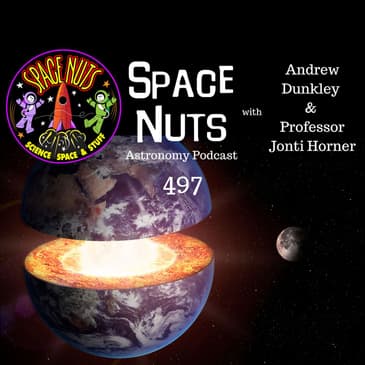


Space Nuts Episode 497: Earth's Core Dynamics, Hypervelocity Stars, and Cosmic Dust
Join Andrew Dunkley and Professor Jonti Horner in this captivating episode of Space Nuts as they delve into the intriguing dynamics of our planet's core, the discovery of a hyperactive star with a planet, and the fascinating phenomenon of cosmic dust. From the slowing of Earth's inner core to the implications of interstellar objects entering our solar system, this episode is filled with insights that will ignite your curiosity about the universe.
Episode Highlights:
- Earth's Core Dynamics: Andrew and Jonti discuss the recent findings regarding the Earth's inner core, revealing that it has been slowing down. They explore how researchers used data from repeating earthquakes to uncover the complexities of the core's rotation and its implications for our understanding of Earth's geology.
- Hypervelocity Stars: The duo introduces the concept of hypervelocity stars and highlights a newly discovered star that is moving at an astonishing speed of nearly 2 million kilometers per hour. They discuss the significance of this find and its connection to the planet orbiting this remarkable star.
- Cosmic Dust from Neighboring Systems: Andrew and Jonti explore the idea of "space dandruff," where neighboring solar systems contribute to the influx of cosmic dust in our own. They discuss simulations that suggest a million objects from the Alpha Centauri system are currently passing through our solar system, and the potential for detecting these interstellar visitors.
- Debate on Planetary Classification: The episode wraps up with a discussion on a newly discovered object that challenges the boundaries between planets and brown dwarfs. Jonti explains the ongoing debate regarding the definitions of these celestial bodies and how new discoveries are prompting scientists to reconsider traditional classifications.
For more Space Nuts, including our continually updating newsfeed and to listen to all our episodes, visit our website. Follow us on social media at SpaceNutsPod on Facebook, X, YouTube Music Music, Tumblr, Instagram, and TikTok. We love engaging with our community, so be sure to drop us a message or comment on your favorite platform.
If you'd like to help support Space Nuts and join our growing family of insiders for commercial-free episodes and more, visit spacenutspodcast.com/about
Stay curious, keep looking up, and join us next time for more stellar insights and cosmic wonders. Until then, clear skies and happy stargazing.
00:00 - Introduction to the episode and topics
02:15 - Discussion on Earth's core dynamics and slowing rotation
10:30 - Exploration of hypervelocity stars and their implications
18:00 - The phenomenon of cosmic dust from neighboring systems
26:45 - Debate on planetary classification and the discovery of Gaia 4B
30:00 - Closing thoughts and listener engagement
✍️ Episode References
Earth's Inner Core Research
https://www.nature.com/articles
Hypervelocity Stars and Planet Discovery
https://www.space.com/hypervelocity-stars
Cosmic Dust Studies
https://www.sciencedirect.com/science/article/pii/S0019103519302003
Become a supporter of this podcast: https://www.spreaker.com/podcast/space-nuts-astronomy-insights-cosmic-discoveries--2631155/support.
Hi there, thanks for joining us. This is Space Nuts. My name is Andrew Dunkley, your hosts. Great to have your company. Coming up on this episode, we are going to look at Earth's core and it's sort of hit the news lately, but this is not a news story, but we thought we'd better talk about it just in case you're wondering Earth's core is slowing down or not doing what you'd think it would normally do. So we'll talk about that. There's a hyperactive star out there and it's got a planet. What does that mean? It means it's pretty darn quick. We're going to talk space dandruff. Yes, it's true, and a new planet that's sparking a bit of debate on its status. If we've got time. If we've got time, we'll do that one. That's all coming up on this episode of Space Nuts Channel ten nine Ignition Space Nuts or three two Space Nussen actually bought it real good. Respect for more. Professor John D. Horner, Professor of vestrophysics at the University of Selling Queensland. Hi, Johnny, Hey, how are you going? I am well, how are you? I'm getting them I'm not a morning person, as I was saying I got woken up earlier than I was planning this morning by phone call that said, can you go on live on the radio for five minutes? So I got to be a zombie on live radio, which all was good fun. There's PESTI journalists, yeah, grade ever since. Yeah, I have great sympathy for anybody who works the morning show. And we I think we're talking about this last week, but it must be had. But I'm not at my best at twenty to seven in the morning. This is a more reasonable time, but this is still morning. It's twenty to twelve. At the minute. I used to work Rapy the Deeping Conscience. I used to work with the journalists who used to have to do the police rounds first thing in the morning to get any news from around the various police districts in car crashes, all that horrible stuff. Fires, et cetera. And after a council meeting, they used to have to ring the mayor at sparrows in the morning. We had one particular mayor who was always nearly asleep when they called, and they could never get a good quote from him because he was just non compassmentus, not of the day. It was a frustration to the journalist. I can tell you I'm going to do something at five am. I'd rather have said. Up all night to do it than sat my a larm oler. Yes, yes, well I never had a choice for thirty odd years, but anyway, that was that was my choice, even though I didn't. Have a choice. I know you have your freedom, so I do. Now, let's get down to business. Earth's core, the rotation thereof This is a story that's been around a little while, but it keeps popping up. It popped up again on the weekend and I thought, well, let's talk about it. We may have talked about it with Fred. I've got an inkling that when it first came up we went there. But yes, it's something that the press is certainly honing in on. Yeah. Well, there's a few little fact words about this that really caught my arch. So when you sent me the link through, I've managed to miss this one. These are researchers at the University of Southern California so USC, and they've been looking at earthquake data. So if we want to study the interior of the Earth with the best wall in the world, we can't drill down there. You know. The deepest hole ever drilled was less than ten kilometers I believe, and the earth is frustrating the opaque. We can't see the interiors grounds in the way. So we've learned everything that we know about. The interior structure of the Earth. The call the mantle, how they all behave through earthquakes. So you get an earthquake and seismic wave travel outwards in all directions. There are two different types of seismic waves in a very rough sense, and when they go from one medium to another, their speed changes and they're refract in just the same way, likeness when it enters a swimming pool, same kind of idea. So if you're measuring these earthquakes using seismic grass from all around the world, you can back out what the interior of the Earth looks like and its properties by the time it takes the different tax seismic waves to reach you, essentially, and by doing that over an incredible long time, we've got a very detailed picture of the Earth's interior even now to you know the temperatures, the pressures, the compositions, and people are monitoring this all the time. But the finer the detail you want, the more challenging it is to disentangle the information about the earthquake itself from the information you're learning about the interior. And this is something we see a lot with finding X up on. It says a perverse analogy here that we're looking at the light from stars, and to get a really good idea of what the planet's like, you've got to understand the star first, because that is overlaid on the data and you've got to disentangle them so to get a real handle on the fine details of what's going in in terms of the Earth. Your ideal situation will be to have every earthquake be identical to the last, so that all the earthquakes were the same, and you could take that out of your analysis. You could essentially account for that. And that was the first thing I say this that I thought was really interesting. I mean, obviously the results are cool, but it's the way they got them. They looked at this sample of what are described as repeating earthquakes. They got data from these earthquakes near the South Sandwich Islands, one hundred and twenty one of these that occurred between nineteen ninety one and twenty twenty three, and it says, repeating earthquakes as seismic events that occur at the same location and produce identical seismogrants. So rather than using all the earthquakes from all around the world, they use this one subset that gave them very controlled data and that lets you get very fine resolution on the things you're looking at because you're not adding extra noise essentially, and by doing all this they'll learned a couple of new things about the Earth in a core. So we've known for a while that while the Earth has a call, the core actually has two layers. It's got a molten outer core, which the iron and the nickel are essentially liquid. They're moving while they're molten, so they're a fluid. They move around, and that movement is tied to the formation of the earth magnet field. You get the induced magnetism that gives us a magnetic field interior to that why the pressures hing. Even though the temperature is so high, the pressure is such that the inner core has been thought to be solid, and so you've got a solid with a liquid layer outside, and then the multen layer of the mantle, then the solid layer of the crust. As a rough kind of structure. What these new results have shown is the headline act is that that inner core doesn't spin perfectly constantly. It had apparently from a long period of time which I wasn't aware of, people were are that the spin speed of that inner care was gradually increasing. It was speeding up a little bit, almost imperceptibly. But what this research has shown is that more recently it has now started to slow down again. So that's a headline act. The inner core has slowed down a little bit. And they're talking about here on a scale of about one thousandth of a second for the rotation period, so it's a tiny effect, but they can measure it thanks to these repeating earthquakes that have the same signature. That allows them to get and much better resolution on the data. The other thing. Which I think is very interesting that isn't in the main pressure is but is in a couple of the other articles, is that the same data suggests that the inner core is not totally solid but actually has molten areas within it. So this is a bit of a change to the paradigm we had of this very simple model of a solid inner core than a molten outer core that there's actually a bit of moltenness to the inner core as well, which probably makes a bit of sense in the context of this thing's rotation changing over time. If you've got bits that are melting, bits that are moving around a little bit, you're moveing angular momentum around. So therefore you'll change the rotation period in just the same way that the rotation period of the Earth as a whole will change if the ice caps melt, will change in a measurable way because you're moving mass from. The poles to the equator. Redistributing that mass will mean that the spin will slow a little bit to conserve angular momenta. So it's a fascinating story, and I think, yes, the head line side of it, the inner core has slowed down. That's interesting. That's the headline story. But to me, the really interesting stuff was how of how they figured that out, and those subtleties of the choice of earthquakes to use and the additional things they can figure out. It really shows the benefit of continuing to get longer data sets in reanalyzing what you thought you knew when you've got better data and better instruments. So it's a very cool story and do encourage people to have a look around. There's a few different versions of the story out there on the web. Even CNN covered. It at one point, so it's a good one. Interesting. By reading a variety of stories, you can get some of the different cool facts that maybe the main pressure release didn't pick up on. Yeah, they figured this out by studying what is one hundred and twenty one earthquakes between nineteen ninety one and twenty twenty four. Yes, help accurate. Do you perceive their data to be well? I trust at the end of the day, it's peer reviewed and published, so there's a and confidence of fidelity there. That's good. And I find their data selection really interesting. There the fact that you've got thousands of earthquakes happening all the time. You know, we see what's happening in Santaurini at the minute with what is probably a very large motion of magma underneath that ancient volcano that suggests it may well erupt again at some point, seeing similarly under aples. So earthquakes are happening all the time all around the world. And what I loved about this was finding this subset of earthquakes that are happening recurrently at the same place that are giving them the same signal, which makes a data analysis much much much better. I just really like that, and it's why, in exactly the same way that we can find planets using our radial. Velocity of the wobble method much. More easily around quiet stars and active starts because active stars are roiling and bubbling and boiling, so the lines of the spectrum of the star are moving around because of the properties of the star. That introduces a lot of noise. When you've got a quiet SAA South that isn't very active a bit like the Sun, is that noise is much less, which means that you can resolve much smaller motions thanks to the planets, and so you can detect smaller planets around stars that are less active. And it's a. Direct parallel here. By getting a much simpler set of earthquakes that all behave the same way, you reduce the noise and therefore you can get a much more accurate pressure of what's going on in the interior. So I guess if you want to look at timescale changes in the mantle and stuff like that, you can use all the data set and map it that way. But for something like this way, you need that really fine tooth comb. It's a beautiful way of doing it. Yeah. Yeah, it's fascinating story. It's you know, we're so close to it compared to everything else we study, but it's it's. Invisible to us to Yeah, we have to dig deep instead of getting developed from this then applying astronomy and in planet for science. You know, we talked previously about Insight, which sat on Mars and recorded Mars quakes and that much just single station. I would love at some point in the future, perhaps when Syrielon decides that he's finally going to move to Mars, if he could text some seismometers with him and drop them in a variety of positions, that'll give us a lot more information on Mars's interior. Similar with these kind of techniques are very similar to what my colleagues at the University of Southern Queensland and elsewhere around the sphere of academia used to study the interiors of starsks. You've got the same problem. You look at the Sun and it's our near as star, but always see it's a surface. You can't see inside it because the surfaces in the way now, how do we know about the structure of the interior. It's exactly the same kind of thing they're doing here, but using star quakes and star wobbles rather than earthquakes. Yeah, really interesting stuff. And if you'd like to read more about the core of our own planet slowing down, just do a. Search for that. It's everywhere. You can find it on Discover magazine and a few other sites. Let's take a little break from the show to tell you about our sponsor, Nord VPN. Now, I've been using NordVPN for almost two years. And without a word of a lie, I. Have been very impressed not only with their VPN but all their other products. I've used VPN overseas, yes, but also I use it in my day to day activities. I've set it up on my smartphone and it's always on and it keeps me protected twenty four hours a day, and no, I do not notice any difference in the performance of my phone when browsing the internet on Wi Fi or mobile or cell towers. It's seamless, it's simple to use, and you can load it onto ten devices including your smart TV, your tablet, your PC, your MacBook whatever. As a space Nuts listener, Nord has a special birthday offer with big savings for you, and I'll give you that URL shortly so you can take advantage. First of all, there's an extra four months available for free if you sign on for their two year plan. But right now they're offering a Nord coupon as a part of the deal, which offers six months of NordVPN. That you can use yourself or share with someone else. You can check out all their deals and services at nord vpn dot com slash space nuts. For their exclusive deal for space nuts listeners. That's Nord vpn dot com slash space nuts and they back their gear. They have a thirty day money back guarantee. Don't forget about that Nord vpn dot com slash space nuts. Check it out today. Now back to the show three Space Nuts. Now, let's go to this story that is talking about a star that's been described as hyperactives. This is a star that's moving well. It's probably one of the. Fastest, if not the fastest, ever discovered. This story is quite amazing. So this is what's called a hypervelost is Sara, and we do know a few of these in the Milky Way. These are stars that are traveling at such a high speed that they're traveling faster than the local escape velosity for the galaxy at their location. So we're on the surface of the Earth, and if I throw a tennis ball up in the air, it will fall back down. I'll catch it, or I'll fail to catch it. Bex and English and the English cricket team is doing terribly at them, and it's I'll probably fail to catch it because that's where I'm from. Originally, if I threw it hard enough, the Earth's gravity wouldn't be able to hold on twit and it would escape. And for the Earth, that's about eleven kilometers a second. The more massive you are, the higher that veloci is, but the further you are from the. Mass, the lower that veloci is. I mean, it's the kind of thing we teach in first year astrophysics as an equation for the escape velocity where you can work it out, and I think it's a square of two gm over r now sounds about right though. That's basically it's related to the mass of the thing you're going around that and it's investly proportional to the distance that you are away from that thing with a square rout there. What that means is that anything that has mass has an escape velocity. So technically I have an escape velosity. If you put me in the vacuum of space far away from any star and give me that tennis ball, I could, in theory nudge it gently and make it orbit me. But if I knowdge too hard, it would escape. But even though I'm far too heavy, my gravitational pull is incredibly weak because I'm only one hundred and thirty kilos, not the mass of the Earth. What that means from the point of view of our galaxy is that our galaxy has an escape velosity that varies depending on where you are in the galaxy mayor you are to the middle. The higher the speed you need to be traveling is to escape. Just as in the Solar System, it's harder to escape from the Sun when your name Mercury is orbit than it is when you're. Know Neptron's orbit. So that's how stars move, and a small fraction of the stars in our galaxy, because they're constantly moving around all the other stars because of things going on, a small number of those stars will eventually get ejected from the galaxy entirely. Now. Quite a few of these actually that are previously known are linked to stars that were in a binary star system that was quite close and then one of the components went super and over and suddenly like the lead was cut, so suddenly they're rejected at very high speed. Right, But that's not the only way you can form that hypervelocity stars. And are these stars whose speed is so high that they will probably escape and never return, that will wonder the void between the galaxies in a very lonely life forevermore. The other side of this story is planet detection. We've talked before about how the two most successful methods for finding planets are the transit method and the radio lossy method, essentially seeing stars warbble and wink. There is a method of technique called gravitational microlensing that if you went back to the Latin nineties, people were really hoping it would find gazillions of planets, that it would be really successful, and it's never quite found as many as people expected because it's fundamentally hard to do. It's not that these events aren't happening, it's just that they're very hard to observe. But going back to twenty eleven, a team of scientists that were looking towards the galactic core, where you've got the most stars on the sky in the smallest area, observed a gravitational micro lensing event. They saw a background star brightened and then faded away again, but it had a double peak in the brightness, so there were two peaks as it went up, and then it went up further and then it fell away again, and that was indicating that in the foreground between us and that star, something had passed in front that had mass. That mass curving space time acted as a lens bent a little bit more of the light from the background star towards us, and that's why we saw the star brighton. And then as the thing in the foreground moved away again, the lens went away and it faded away again. And when these events happened quite a lot from studying the degree to which the thing brightened and faded and also the timescale over which it happened, and the team at the time announce the results. This is really exciting, but there's a little bit of what we call a degeneracy. There are two different models that can equally well explain what we've observed. The first is that you've got a star that's about a fifth of the mass of the Sun with a planet that is about twenty nine times the mass of the Earth. That's scenario one, so you've got a star with a planet. The other scenario is that you had a planet the mass of Jupiter with a tiny little moon, and in either case, the ratio of the mass between the big thing and the little things about twenty three hundred times. Either of these scenarios could explain perfectly well what was seen. So how do we differentiate between them. Well, one thing we can do now that we've got better telescopes and better technology, is to use the Keck telescopes, which are among the biggest in the world. There are incredible instruments in South America, and also the Geyer spacecraft, which has been should finish its mission, but it spent twelve years in orbit mapping the positions of the motions of up to two billion stars with unprecedented mind boggling accuracy. So the team that found this object in twenty eleven saw this signal in the gravitational micro lensing said, one way that we could distinguish between those two different models. Is to look for the thing that caused the lensing. If it's a star, in theory, there'll be a point of light there that's moving that we can see that we can track back and say it was in the right place at the right time. We'll be able to see it, and that shows that the thing that did the lensing was a star. So it's a star and a planet. If we see nothing, then the star doesn't work because if there was a star there, we'd see it, so it must be the other scenario. So they went away and dug through that data, and it took them a bit longer than expected, but they finally found a star that is moving ridiculously quickly but was in exactly the right place at the right time caused a micro lensing event. And that star is also quite near the middle of the galaxy, so it's quite it was quite far from us, quite near the thing it was lensing at the time. They've tracked it back and it turns out that the movement of this star just at right angle to all ainosites, so the movement across the sky gives it a speed that is almost two million kilometers per hour five hundred and forty kilometers. Per second glimy. That is ridiculous. You know, stars nearby near the some moving around. We typically talk of speeds of tens of kilometers a second, maybe a bit more than one hundred, So five hundred and forty is ridiculously extreme and is already almost the escape lossary of the galaxy at that point. Now, the unknown here is that there could be some movement towards are away from us as well, So we only see the movement on the sky, and essentially any movement that is radial towards are away from us would be enough to mean that this thing is unbound by the galaxy, that it will eventually escape. It is therefore a hyper velocity star, and this is the very first time a planet has been confirmed around the hypervelosity stat. Now, planets will form around the stats, that's fine. But to get the very first one, that's kind of cool, and that's the planet that is signific cooking massive than the Earth. That's our probably has other planets. Where you find one planet, there will be more. So this is a planetary system that is on a one way ticket out of our galaxy, never to return. Wow. Yeah, that's quite a fine isn't it, And such an incredible speed. Have they worked out how long it will take to exit the galaxy? Probably a long time even at that speed. Very very long time, even at that speed. So we can probably try and back of the envelope mental arithmetically. So I'll get everybody on line to forgive me. But speed of light is three hundred thousand kilometers a second. I'm going to say that this is six hundred klometers a second because that just keeps the mouths easier, right, six hundred over three hundred thousand is six hundred, which is two percent thereabouts. So this thing's traveling at two percent of the speed of light. That's fairly significant. Now the galaxy is going to be pointing back as long down as it goes. But if you think about the diameter of the milky ways, about one hundred thousand light years, so that means the radius of the milky way's about fifty thousand light years. If you're traveling at two percent of the speed of light, that means it will take you fifty years to travel one light year, right, right, So fifty years per light year for fifty thousand light years is two point five million years. Now, that is a long time for us. But where compuere it to the fact that it takes to some two hundred and fifty million years or so to go around the middle of the galaxy. That gives you a sense of how quickness is actually moving. Fascinating. All right, Yeah, so far the fastest found, but maybe others will probably find another one that's faster at some stage. Yes, you can read about that. It's based dot com. If you want to read the actual paper. It was published this month in the Astronomical Journal. There's a space nuts with Andrew Dunkley and Professor John T. Horner. Okay, we take a space nuts now. Johnny, let's move on to this problem with. Dandriff in space that's what it's described as. It's not really Dandriff. It's just neighboring solar systems dumping their stuff on us. So I didn't know. I didn't know that. Was a thing Amber's doing exactly the same back at the BIT. Should have said no, only. Ask one of those things that I talk about a lot. In the context of our solar system, we have comets and asteroids, and the main where that comets get removed from the Solar System to no longer pose a threat to the Earth. Is that many of the mess get the Solar System never to return, usually flung out by one of the giant planets or by subtle gravitational perturbations like that. So you can look back over the edge of the Cellar System and it has continually been shedding comets and asteroids into the void of space, creating these interstellar wonderers essentially, And that will have been particularly strongly the case, incidentally, when the Solar System was still forming, because big part of the formation of the planets and the cleanup afterwards was getting rid of most of the stuff that was left over. So the Solar System over it some will have shed uncountered objects into space, and it continues to do so today. And I've often said, in those socks, it's almost certain that every other star will be doing the same thing. Any star that has a planetary system, those planets will be staring things up and throwing things out. So it's one of those things that I've just taken for granted. But it's only recently that we've actually been able to detect the products of this from other stars. Like I said, for decades people have talked about the possibility of us finding interstellar objects in the Solar System. So seeing comets or asteroids coming through that could be absolutely indefinitively shown not to have an origin in it our source system, how do we do that while we look at how quick they're moving. It's just like what we were talking about a minute ago with the escape velocity. Objects moving around the Sun are gravitationally bound. If they get a nudge and they're going to escape, they will be traveling a bit too quick to be gravitationally bound, but only just by a tiny amount. So when we find an object that comes in, we can work out what speed it would travel at if it was infinitely far from the Sun. Top call this the velocity of infinity. So and once the Sun has slowed it down as much as it can, how much speed has it got left? And two objects that were found in the last decade met this criteria have been interstellar. There were Umau Mau which came through in twenty seventeen. And despite what a certain eminent person at Harvard, and I'm trying to choose my words carefully here because I have a certain opinion, despite what he keeps trying to tell you to sell his books and make a lot of money. That was not an alien spaceship. It never would be an alien spaceship. It absolutely was not aliens. That was just a lump of rock and debris. We then had commit Borisov back in twenty nineteen, which was our second interstellar object. Yeah, we found two of them. Now the odds are that in the coming decade we will find hundreds because the Vera Ruben Observatory is going to come online. Vera Ruben Observatory, of course, named for one of the grade astronomers of twentieth century who was a woman in astronomy, And that's a challenging thing to discuss at the moment with what's going on in the US. I will just mention in passing that that is itself a controversy this week because with the new government in the US, they've been forced to change the biography of Vera Rubin on the website because one of the things that she was very active on was advocating for women in science and you know, setting up schemes to try and help women get more involved in astronomy. Now you can't talk about that anyway, that's an aside, but it's a bit of a frustration of the human element of this. Yeah, vera Rubin Observatory named after this incredible astronomer. It's going to come online in the next year or two, and it's for has to find tens or hundreds of these objects, because we'll just be much better at spotting them. What the new research is is some computer modeling. A group has had the same idea that we're just talking about and said, let's model this. Let's try and get a handle on just how much stuff nearby star systems are throwing our way to fill the space around us. And they're looked at our nearest companions. The Alpha Centauri system, which is the binary star of Alpha Centauri AMB, and then the red dwarf Proximma, which is currently a bit closer to us, are the two biggest starts. They ransom simulations very much of the ILK. That I do in my day job running on the supercomputing cluster here saying if this star system has the kind of objects in it we'd expect for system of that age, how many getting ejected in our general direction? And what they have found is that their simulation suggests there could be as many as a million objects bigger than one hundred meters across passing through our Solar system out of the current time that departed from the Alpha Centaurus system. Now the circulty here is a lot of the time when we talk about passing through the Solar system, we think of our local part of the Solar system, the orbits of the planets, But in reality, the volume of space we're considering to be the Solar system here is the entirety of the Oat cloud. So this is a volume of space something like two light years in every direction from us. It's an unimaginably vast sphere of space that has these objects passing through it. So the likelihood of one getting closer for us to detective the near future is pretty low, but it's not being the bounds of possibility. And again, when Vera Rubin comes online, if any of these are in the domain of the planets, they're coming close enough to the sum that they are detectable, Vera Rubin will find them. Now a million objects spread over the Oat Cloud, to be honest, means that it's very unlikely one of them will be close enough to see. But these things are going to be traveling faster than the escape loss the Sun, so they'll come through fairly quickly, and that means if they're moving through, just because we don't see them now doesn't mean if we look again in five years time, there wouldn't be one that's appeared. The other thing that. Came out of this is that they talked about the smaller particles more common, and it's quite likely that there may be as many as ten meteas per year on the Earth that are bits of dust from the off Centaurus system hitting our planet. Now ten per year across the entire surface of the Earth means that you're very unlikely to find them, but it reminded me of stories that go back much further, because we have these wonderful networks of cameras across the Earth that look up at shooting stav and try and get multi session observations so you can do trigonometry and figure out what their orbit was, how they were moving, and they've detected over the years a very small number of definitively interstellar meteors, so Metea's coming into the Earth's atmosphere with a speed significantly higher than seventy two kilometers a second, which means that they can't have been bound to the Solar system. One of the things that those papers discussed for a long time is that there is one dominant source of dust through our Solar system that gives us more than all of the sources combined. A famous star called Beta Pictoris, which back in nineteen eighty three was one of three stars the Infrared Astronomical Satellite was confused about because it found an infrared excess around that star. It is three light years away, It's more massive than the Sun and hotter, but it's very young, and it's still got a disc of debris around it forming planets. It's got planets in that disk that we've discovered. But then incredibly active stellar wind that that massive star has is blowing lots of the dust into space, streaming off in all directions, and the enough of that dust is traveling to reach us sixty three light years away that we can detect that as a distinct source of debris crashing into the s atmosphere. That really boggles my mind that a star that far away can be putting dust into our atmosphere at a subfigent level that people have detected that dustry. It is it's amazing, and this must be happening just about everywhere. We've probably got systems exchanging junk constantly. Yeah. Absolutely, And it ties into the panspermia idea that we've talked about before as well. If you are constantly ejecting dust and debris from every planetary system, if you have somewhere with life in that system, eventually that life has the potential to travel. And you know, yeah, most of it will. Most of the debris ejected from the Earth will never land on any other world. It will just float in space for forever more. But enough has been ejected that eventually something ejected from the Earth will land on a planet around another SAR, or will be incorporated in a planet forming region around a SATH that's just been borught. You put enough material out there, with enough bacteria buried in it, it's very reasonable to imagine that you could get a situation where, at some point in the distant future, there is a planet that has life on it, and that life is having a discussion of how did life get started, and someone suggests, well, Medley, life came from the stars, and everybody says, well, that's a lot of rubbis. Stop watching star trek and after it was the case because it's earthlife. Yes, indeed, And this story also proves that you shouldn't get upset with your neighbors for throwing the grass clippings over your fence because it happens right through the. Cosmos absolutely, I mean times into the other space sand rough thing. Actually. So the whole Nambrup connection here, of course, is the stars shaking their head and comets flying through space, essentially the beautiful analogy there. But every time you're walking around outside or anytime you're doing the dust thing in your house, a certain amount of the dust that is falling on your shoulders or that is a crewing in your house is dust from outer space. We have these tiny little particles of dust, which are sometimes called brownly particles. They are small enough that they are slowed down by the very tenuous sout atmosphere before they get into a thick enough flare of atmosphere that they get ablated that before they burn up. So there's this steady little sleeked of micro micro microscopic particles from space running down on the Earth all the time. So when you do the best thing, or when you go outside on a day and you're getting dusts on you. A total fraction of one is space that you've got spast under running down on you at old times. Yeah, it is fascinating to think about. I think we have touched on that story once before a while ago, but yeah, fascinating. I think if we're quick, we can squeeze in one more little story, or if you want to chase up the space Dandriff story, Life science dot Com carries that one one last yarn and this one is something we I think we touched on in the last couple of weeks about you know, where does a planet store start and a brown dwarf begin? And we talked about thirteen jupiter masses. Well, now our new planet has popped up in a study that has sparked debate on that very issue. Yes, so what we to do as humans in all walks of life is trying to understand the universe. That's just very fundamentally human thing to do. And to do that, we break things that are continue up into discrete packets, into discrete fractions. And we do this with a human lifetime. You know, you grow up and then suddenly one magical morning you wake up and you're legally able to drive. Are you'llegally able to drink so long as you're not driving. You know, you have these magical thresholds where we've said one day you're an adult, the day before you were a child. You're not fundamentally any different across that barrier, but we're grouping like with like and keeping different things separated. That's what's happened with definitions of planets. You know, this was all the age, all the controversy two decades ago with the emotion of Pluto. It was the same thing. It was trying to group objects that are similar with each other in groups so that you can study that. And one of the great areas where this has happened is you've got planets, you've got stars, and in between them, you've got these curious objects that people call brown dwarfs, which are things that they viewed as been too big and too massive to be considered a typical planet, but they're not massive enough to have hydrogen fusion and to shine and become a star. So the boundary to be a star is fairly clear. Cup If you get hydrogen fusion going, you're a star, which leads to the slightly quirky thing that white dwarfs and neutron stars are not stars. They's cellar remnant, so they're dead stars, which is a turtle a site. But between a planet and a star, there's this domain where you are not massive enough to burn hydrogen, but the temperature in your core will get high enough that you will temporarily be able to burn the uterium, which. Is heavy hydrogen. There's not much of that, so you'll get a very short period of uterium burning and then you'll just fizzle out and be a little glowing ember. Now where that boundaries with a star is very clear cup it's a hydrogen fusion and it's a very observable thing. But the boundary at the lower end, where you no longer have enough mass to burn the uterium, is much woolier. And if people do modeling, it depends on the composition of the object and how much solid material it's got and how much deuterium it's got, and all sorts of things going on. So what's happened historically, because we didn't really have the capacity to find low mass objects is people just put this arbitrary boundary of thirteen jupiter masses there to say anything more massive than that is a brown dwarf. Anything less massive as a planet. So that is setting this boundary purely on the physical mass is taking no account of the composition of the object or how it formed, And as we finally got the ability to find objects of this mass, people have started to question that because the formation mechanism of the composition matters. A planet like Jupiter has about thirty Earth masters of solid material as a core because of the way it formed. A star doesn't have that same kind of structure. So there's a growing argument that maybe we should divide it by formation mechanism, and something that formed like a planet is a planet, even if it's more massive than this limit, and it probably wouldn't undergo due TOI infusion because a lot of the masses solid material, so it's got less utarium. Alternatively, if it formed like a star, even if it's less massive than thirteen juke to masses, maybe it should be considered a brand war rather than a planet because of the formation mechanism. And it's a debate that. So we're just starting to kick off because we're only really able to find these objects now. It's been fired up here by the discovery of what's known as GAYA four B. So the guy in spacecraft we talked about earlier is this incredible mission that was measuring the positions of the motions of a billion stars with incredible precision. Two billion stars, absolutely ridiculous. And what Gaya has promised for a long time is that it would find one hundred thousand to one million planets around other stars. That was part of the marketing. So far it has found four or five. More will come. Because they're still doing their big data really says, so it will give us a deluge of planets at some point. But the reason it can do this is that it measures the positions of the stars in the sky so accurately that it can see than wabbling as they move as a result of the planets pulling them around. So this is a counterpart to our radial loss in effort. The radio lossy sees a movement back and forth on a line of sight, guyas sees a movement at right angles to that. So it's been looking at this star. This star is less massive than the Sun, about two thirds of the mass of the Sun, and this starts moving across the night sky. Because it's moving through the galaxy separately towards it's not what we call proper mation, and Guy has identified that instead of that proper motion ministrat line, it's following a corks grow path across the sky, zigzagging, and that's a telltale sign it's got a planet going around it. Now, because this sounds a bit like the Sun, it's a bit cooler. You can do radio lossity observations, which means you can measure the line of sight wobble as well, which means you can perfectly constrain what's going around it. And the evidence here is that this is an object eleven point eight times a mass of Jupiter, so it's just underneath that threshold to be a brown dwarf. We would traditionally call it a planet. And job done. The complexity comes out that this star is less massive than the Sun and it's got a roughly similar composition to the Sun. What that means is a material the planets around it would have formed from would have been similar to that around the Sun. It's not particularly metal rich, so it wouldn't have had far more solid material around it than the Sun did, which means is a really difficult question to answer which is, how can a star less massive than the Sun, which presumably formed from a less massive cloud of material than the Sun, how can it form a planet twelve times more massive than the biggest planet we have in our system. That just doesn't make much sense. It's really counter to our planet formation models, which is more massive stars formed more massive planets. So that then brings up the suggestion that maybe this thing didn't form as a planet at all. Maybe instead what we're seeing as a failed binary star system. And this eleven point eight dupe to mass object formed in the same way that binary stars would form, and it. Wasn't core recretion. You didn't get a load of solid material grow to thirty times a mass of the Earth or ten times a mass of the Earth and then sat gathering gas because of the gravitational pull that instead it formed through gravitational and instability in the cloud like another star would fall. And therefore this could be considered a failed star, in which case. It should be called a brown dwarf. Even though it's not massive enough because it didn't fall as a planet. It may even be because it's so class of the threshold that it could have almost got to the deuterium Beurn, England. It could have had that happen. Now we don't really know if we could go there, If we could borrow Captain Kirk's spaceship and engage what Brave and go there, we'd be able to answer this after a little while. We'd put a mission up like Juno that's going around Jupiter, that would allow you to map the interior of the objective bit like the earthquakes we were talking about the first topic, and figure out if it had a core or not, and that would tell you about its formation. But we can't do that. We just can't get there. So we at the minute it's purely in the domain of speculation, but it's efficiently odd discovery that it is just restarting that old discussion about at what point do we need. To look at this again? I guess at. What point do we need to discuss whether we get a more physically motivated difference between brand walls and planets, or whether we're happy to sticking with this arbitrary mass limit. And as the years go on, Geyer is going to discover far more objects. We continue to find planets using all the other methods, there will be more objects that straddle that boundary. Because nature forms things of all sizes, it doesn't say I'm going to leave a gap here to make it massive. There'll be things of all masses, and there will be things of identical masses that formed in different ways, and so it's going to be an ongoing question. I'm sure we could have a chat in a couple of years time and they'd still be having the same debates. But it's great when you get to the point where our ability to find things is such that it pushes the boundaries of how we define things and we have to revisit them. That's how signs works, and I. Really love it, even if it means you get cranky people all waving plugs and go Blueto should still be a planet. Yes, yes, and that's still happening two years indeed. Yeah, all right, if you would like to look into Guaya four B and five B. They've posted a report in the Astronomical Journal. Yes, a fascinating discovery. And I imagine the more we look, the more unusual things we'll find. And yes, we probably will have to redefine where a Brown law starts and a planet finishes. In the future, it might come down to that. At the moment, we just go with what we know until proof sends us in a different direction. We are just about done. Johnny, thank you so much. That's absolute pleasure. If I keep having me, always a pleasure. And we'll see you real soon. Professor John T. Horner from the University of Southern Queensland. And thanks to Hugh in the studio, who couldn't be with us today. It's very embarrassed. He's got a severe case of space Dandriff. Don't forget to visit. Us online as well Space Nuts podcast dot com or space Nuts dot io. And from me Andrew Uncley, thanks for joining us. We'll see on the very next episode of Space space Nuts come exert. Until then, Bye bye to the Space Nuts podcast. Available at Apple Podcasts, Spotify, iHeart Radio, or your favorite podcast player. You can also stream on demand at guides dot com. This has been another quality podcast production from nights dot com.