
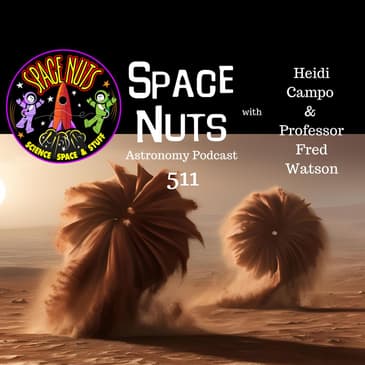


In this captivating episode of Space Nuts, host Heidi Campo fills in for Andrew Dunkley, joining astronomer Professor Fred Watson to explore some of the most intriguing cosmic topics. From the fascinating dust devils observed on Mars to innovative solutions for space debris and the surprising behavior of distant galaxies, this episode is packed with insights that will leave you pondering the mysteries of the universe.
Episode Highlights:
- Dust Devils on Mars: Heidi and Fred delve into the unique phenomenon of Martian dust devils, discussing how they differ from those on Earth and their significant impact on Mars' surface, including the surprising discovery of lightning within these swirling dust columns.
- Space Junk Solutions: The duo examines the growing problem of space debris and introduces a groundbreaking technology from Perseus Space that utilizes electrodynamic tethers to help clean up our orbits, offering a sustainable approach to managing space junk.
- Galaxy Growth Conundrums: Fred shares insights from the latest findings of the James Webb Space Telescope, revealing unexpected results about the growth of early galaxies and the implications for our understanding of cosmic evolution.
- Multiverse Theories: The conversation takes a speculative turn as Heidi and Fred discuss the intriguing concept of the multiverse and how it challenges our understanding of the cosmos and the laws of physics.
For more Space Nuts, including our continually updating newsfeed and to listen to all our episodes, visit our website. Follow us on social media at SpaceNutsPod on Facebook, X, YouTube Music Music, Tumblr, Instagram, and TikTok. We love engaging with our community, so be sure to drop us a message or comment on your favorite platform.
If you’d like to help support Space Nuts and join our growing family of insiders for commercial-free episodes and more, visit spacenutspodcast.com/about
Stay curious, keep looking up, and join us next time for more stellar insights and cosmic wonders. Until then, clear skies and happy stargazing.
(00:00) Professor Fred Watson joins us to discuss the latest Space Nuts podcast
(00:40) It's been quite windy here, but the weather's been nice
(01:04) The Spaceflight Human Optimization and Performance Summit is happening this month
(02:18) Fred Seibert talks about light pollution in Arizona
(03:41) People may not be as familiar with some of the dust storms on Mars
(11:47) Mars has such a thin atmosphere that it's not a place to colonize
(13:23) New technology could help us deal with space debris and junk in orbit
(15:52) Perseus Space is developing a new weapon against space junk
(20:46) The James Webb Space Telescope is looking very much at very distant galaxies
(26:44) Astronomers and cosmologists talk about the multiverse theory
(34:35) Fred: We have very exciting time at the moment in human space flight
For commercial free editions, become a supporter of this podcast: https://www.spreaker.com/podcast/space-nuts-exploring-the-cosmos--2631155/support.
Welcome back to another exciting episode of Space Nuts, the podcast that is absolutely out of this world. I am your host today, Heidi Compo, filling in for the regular Andrew Dunkley. And here we have with us Professor Fred Watson, astronomer at Large. Fifteen shack and guide the Channel ten nine ignition. Space Nuts SHY four three two one, space Nurse at the NAT recorded fels good. Hi Fred, how are you doing today? I'm well, thanks handy and lovely to see you again. And we have a beautiful sunny morning here in Sydney where I'm recording at the moment, you're at the other end of the world, at the other end. Of the day, Space Center Houston. It's evening. It's been quite windy here, but the weather's been nice. It's been warm, but not too warm. And this is going to be this is going to be an I think springtime in Houston is always just really fantastic. And speaking of this month, I wanted to share with you and our other listeners an exciting event that is happening here in Space Center Houston. Well, yeah, sorry, it will be at Space Center Houston, but it's happening in Houston in general. Is the Spaceflight Human Optimization and Performance Summit, so that will be happening at the end of the month, and they are going to have all kinds of fantastic speakers from NASA and other private organizations. They're giving educational talks on the effects of spaceflight on the human body. And it is such a fantastic opportunity to network, to hear from people who are really at the cutting edge of science, and to just kind of collaborate with some really brilliant people. It's fun to sometimes be in those places where you are pretty confident that you're not the smartest person in the room. I've spent my whole life feeling that, honestly, Well. I feel like that sometimes when I'm looking at your books and whatnot. So we've got some pretty fun articles we're looking at today. We've got some things about stuff going on on Mars. There's articles about space junk and galaxy models. And I wanted to start this off by asking you, Fred, have you ever been to Arizona. Oh, yes, quite often, because for a long time the center of the world's astronomy instrument development. What's the word for it, frost, That's a good word. The center of the world's Astronomy Instrument Development THRUST was in Tucson, and of course the Kitpeak National Observatory is not very far from Tucson, so I spent many many weeks there on and off. And the other thing that Tucson's famous for in that sense of the two of course are absolutely interlieved, is that's where the basically the dark Sky movement started, the idea that we can do something about light pollution, because it was at that time the impact was mostly on astronomers. But we now know that it's not just astronomers who were impacted by bad light and light pollution, it's the whole natural world and indeed ourselves. So that has moved on since the early nineteen eighties when it all got going in Tucson, Arizona. And yes, while I was in TUCSONA I explored most of the rest of Arizona's squat excellent. Well, yeah, that's good. We're kind of building on what we talked about last week with the pollution. But I was going to say, if you've been to Arizona, well, I guess in Sydney, Australia too. You've definitely seen some dust storms. Right, yeah, yeah, that's right, and absolutely I know where this is going. Do you get haboobs in Australia at all? You know? Is that the name for what we call dust devils? Oh, so the haboobs are the really really big ones. I was living in Arizona. If you guys want to google the twenty ten haboob in Arizona haboob. It's very phonetic huboob. I believe or ha that it is a Middle Eastern word because these normally happen in the Middle East and with things like you've seen the movie Hill Dalgo with the horse horses running things like that. So if you see the twenty ten haboo Arizona pictures you'll see what I'm talking about. Quite crazy, but yeah, dust is something that you're going to be familiar with in places like Australia and Arizona, but people may not be as familiar with some of the dust storms on Mars, which you're so smart. That's exactly where we were going is they did see some dust devil activity on Mars, and I think that's kind of cool and exciting. Can you tell us a little bit about going out of that? And it's for the this is a a topic I really love, and it's because you've put your finger on it. This is something we're familiar with here, not in Sydney certainly, but in the western plains of New South Wales, and I lived in that region for twenty five years. It was very common to see these pillars of dust. Is that what you mean by a haboob? Is it very much? You know? How does it relate to a tornado? Bubes are much more extreme. It's an extreme dust storm that's more like a wall of sand or by area. So if you think of interstellar with the wave of water, it's like that, but with sand. We get that in Australia too, whether you know, the top soil will blow off in one region and you will literally get a wall of dust, brown dust, which sometimes gives rise to the most spect tacular photographs. And if the dust, you know, penetrates far enough, it does actually reach the coast. There have been occasions of that sort of dust storm in Sydney. The the whole color of the landscape changes, not just because it's covered in dust, but because the atmosphere filters out you know, all the all the the blue light and you get this reddish ethereal glow, which is in many ways etherea is probably the wrong word. It's it's actually almost apocalyptic. It feels, you know, that that you've got this wall of dust and the colors afterwards, the cover of the peculiar colors. But what I was going to talk about today though, what are usually known as dust devils, which are quite small areas of dust, and it's where you get a little whirlwind that picks up a column of dust and moves along the landscape. So you see these moving columns of basically dust. Sometimes there's bits of debris being circulated around. It's not a tornado, but it's you know, the sort of perhaps the poor relative of a tornado. We do get them in western New South Wales, and I've seen a lot there, but I was surprised. It goes back actually this story to probably about two thousand and three or four, in the early days of the new generation of Mars rovers. Spirit and Opportunity were the two that really sort of put Mars rovers on the map. There were other ones before that, but Spirit and Opportunity gave us some stunning images of the planet's surface, and among them were images from Spirit I think taken from the top of a mountain range which was basically on the edge of a crater. Actually it might have been Curiosity, and I should have checked that. No, I think it's Spirit Crater. I think it was its name if I remember rightly, lovely images across the crater with a little movie clips of these dust devils going across it, which are relatively common on Mars, it turns out, and in fact they were observed actually by the Viking orbiter back in nineteen seventy six, so the spacecraft happened to be looking down at a region where one of these was happening. They're different from earthly ones in first of all, in the sense that because the atmosphere on Mars is so dry, it's virtually zero humidity, that means that static electricity can build up, and so you often get flashes of lightning in the base of Martian dust devils, and yeah, little sparks of lightning caused by the static electricity build up. And the other thing is they're much taller than the ones we find here on Earth. The biggest one I ever saw in South Wales here in Australia probably had a height of about five hundred meters half a kilometer, so what's that sort of you know, about about the third of a mile basically, and that's you know, that was pretty significant. On Mars they get up to eight kilometers, which is like five miles, and I guess that's partly due to the fact that the dust is very, very fine, and also the fact that Mars of course only has a third of the gravity that we have here on planet Earth and just a quicker side. They're technically known as dust devils. I think that's the correct term. It's different from a haboob. A harboob's a wall of dust, and that's something we also get. But in most of Australia they have a first nation's name and aboriginal name. They're called willy willies, and a willy Willie is a little dust storm that going past on the horizon. One of the little factoid about the Martian ones in particular is that with both spirit and opportunity, which relied for their power on solar panels, unlike curiosity and perseverance, which have got thermoelectric nuclear generators, the dust panel, sorry, the solar panels tended to get just covered by dust that is, you know, present on Mars. Mars is a very very dusty planet. So as you as you roam around the surface, you're kicking up dust with the space with the rovers wheels, and that dust eventually lands on the solar panels. I'm going to have to clear my throat. Excuse me one minute, Yeah, yeah, there we go. I hope that. Oh, I don't think. I don't think I muted that. That's okay, we can edit that out. That was meant to be muted out, and I'm sorry I did. Sorry, Hugh, that probably went right in your ears, as I can see from Heidie's face it went in hers as well. Just to mention though, that the solar panels themselves were cleared unlike my throat by dust devils. They were actually cleared when these things passed over and swept the dust off the solar panels. So Curiosity in particular, which was in a sorry opportunity, was in a dusty place that kept you know, the power kept dropping and kept reappearing again because of these dust devils. Quite quite extraordinary, and that's definitely going to be a concern when we're trying to, you know, get humanity to set up a colony on this planet. I'm just thinking of the movie The Martian, as cliche as it is, that was the big problem that got him stuck there to begin with, was that big dust storm. So I guess that was a bit scientifically accurate when they put that into that movie. And that's right, the dust storm was we now know Martian dust is. It's toxic as well, in the sense that it gets into your lungs. It does quite a lot of damage. So in my view, not a place to colonize, but that's my view. Is the dust similar to the moon regolith, where it's also kind of sticky? Yeah, I think it's a bit like that, and probably for the same sort of reason. Mars has such a thin atmosphere that the erosion processes. Originally, erosion took place with wind and water like like it did here on Earth because of the fact that Mars had a warm and wet climate. The thinness of the atmosphere means that you've got a much higher level of bombardment by subatomic particles from the Sun, and that's what gives you the sharp, pointy edges of dust particles on the Moon. Now the Moon's nearer to the Sun than Mars is, but I think still the mechanism occurs that you've got bombardment, which which actually further further breaks down the further breaks down the dust. Well, if if we do end up going to Mars and we are successful with our endeavors there, we can fill Twister three with Glenn Powell doing some twisters on Mars. Space nuts to. Get through the atmosphere. It seems like there is just more and more issues with their atmosphere and all the space trunk that's up there. And I even just saw on I don't know if it was Prime or Netflix, whatever streaming service I was on the other night, there's a movie. There's a there's a movie out about space junk, and in this sci fi movie they have people who work in orbit constantly clearing space debris. But that might not be something that's even a worry because it looks like there's a new technology that can help us with some of the space debris and junk. Can our orbit. Absolutely, I mean, this is one of the major problems of our era, the potential for space chunk. It's the space junk already exists. There's a lot of stuff up there that is now redundant and quite harmful, given that the minimal orbital speed that you're going at is about eight kilometers per second, about five miles per second, So everything is charging around at very high speeds, and as you will well know, even a fleck of paint can take a chip out of the window of a space shuttle. That very well known phenomenon from a few decades ago. Actually so at the moment there are just over eleven thousand active spacecraft in orbit around the Earth. Most of them are Starlink satellites. But when you look at the debris that is actually tracked, stuff that is redundant, I don't have the exact figure out, but it's well over thirty thousand items bigger than four inches sorry for it, yes, four inches, one hundred millimeters, ten centimeters. And then when you look at smaller stuff, you're in the millions. You're really in the millions of bits of debris, and it's all damaging. And that the main problem is that as soon as you get a collision between two bits of this stuff, especially if it's sizable in any way, then you will get more debris being created, and that increases the risk and that can lead to what's called the Kessler syndrome, where everything's crashing into everything else and you suddenly lose access to space. So it's a real problem and one that needs attention, and indeed is getting attention from the world's technologists. I just saw a tail walk through the picture there behind. You, little dog speaking of little problems. Yes, always on the parral. But yeah, I mean this is super interesting because it's like every i mean almost every something going wrong in space movie starts with this. So it's well mel from the scientists down to the creatives. And so it looks like this this this what do they call them, the bold new weapon against space junk. It looks like Percy p e r Sei Space Yep, that's right, is a startup that's helping with these issues. Yes, that's right. So that there is a backstory to this in that there's been several experiments carried out by both private companies and things, you know, body bodies like the European Space Agency to try and see how you could clean up space, and mostly it involves something like well, one of them is sending up a spacecraft that centrally rendevus with a satellite that's now redundant, whether it's a rocket body or you know, a communication satellite, something that switched off and is now dead. But he's a risk because it's up there. And if you can then put it through a grappling iron at it, you know, going back to the technology that was used in the Middle Ages, catch hold of it with your hydraulically propelled grappling iron or whatever it is, you then can capture it. And if you have a satellite that now has hold of this Maverick object, you can basically apply braking rockets and make it re enter so that it burns up and is no longer a problem for collisions. But that's a difficult that's quite a tricky problem and it needs, you know, spacecraft equipped with quite large amounts of fuel to do that. And so this new idea, the one that you've highlighted from perse Iied Space, it's going to be tested actually early next year. It's quite counterintuitive and takes it will to get your head around how it works. It's called an electrodynamic tether. It's a ribbon of aluminium maybe more than that one hundreds of meters i e. Hundreds of yards long and only a few inches or centimeters wide. And what happens is that this thing gets a current running up and down it from the plasma in the ionosphere. And by that we mean charged particles charge sub atomic particles, in other words, sub atomic particles that carry an electric charge, so excuse me. So you get an electric current set up in the tether, but that then interacts with the asthmagnetic field. This is the really cunning bit and puts a drag on the tether. It slows it down, it starts breaking it. So if the tether is attached to in fact, it can be attached to a cube sat. They're small enough that you can do that. This is the thing of size of a loaf of bread. But you then have to attach the cube sat to whatever spacecraft you want to whose orbit you want to change. You can actually set things up so that you slow down the Maverick spacecraft and essentially make it slow enough that it will start to re enter the atmosphere and be burned up and again got out of the way. But this is the really coming bit. If you do it in a slightly different way, you can also actually push it into a higher orbit so that you can refurbish a spacecraft one that has run out of its maneuvering fuel, so it can't save itself from being swallowed up by the atmosphere anymore. You can shove it up to a higher orbits with the same electrodynamic tether and give it a new lease of life. It's quite an amazing promise. And this is the best bit. All of this is free. It comes with no fuel expenditure. It's because you're relying on the natural forces that' surround the earth in order to do this. It's a very very clever argument. The question is will it work. Yeah, what you're sounding, what you're saying sounds truly just like magic. And I think about that all the time. If you were to tell ancient people about even just the Internet or a phone, it would have founded like magic for them. And oh, I'm talking to somebody around the world. They would have thought I was a sorceress. And this to me sounds just amazing. It's so cool what humans have truly come up with. I mean, humanity, I'm so proud of us. Sometimes sometimes I'm not so. Sometimes Sometimes I look at what humanity is collectively doing and it's just so awe inspiring and I just love being around these people who are doing incredible things or space nuts. But sometimes we mess it up, and sometimes our models and predictions get it wrong, which looks like that was the case with some models that they created with these galaxies. There are models. Either the models got it wrong or the galaxies got it wrong. But our predictions is that they were going to continue growing, but in reality the galaxies stopped growing sooner than the models predicted. That's right. A fascinating story once again comes from I guess the post a child of spacecraft at the moment, at least for astronomers, the James Webspace Telescope, which has, as you know, I think we talked about this a week or so ago, has been concentrating on as well as many other objects in space, but looking very much at very distant galaxies, because that is our probe to the early universe. Whenever we look into space, we're always looking back in time. We are looking back, in this case many many billions of years. We think the universe is thirteen point eight billion years old, so nothing can look back further than that. We do see something at that age, but it's the flash of the Big Bang. But those galaxies which came into being we think within the first few hundred million years of the Big Bang. The Big Bang generated hydrogen. Hydrogen form stars, stars form galaxies, and so we basically have been looking for galaxies in the early history of the universe kind of to try and understand when these first stars occurred and when they switched on. And the basically what's happened is we've uncovered one after another puzzles, really quite serious puzzles for our understanding of how galaxies work. And this new one, it's another conundrum comes about because we see galaxies when the universe was less than a billion years old, but we see galaxies that look as though they should be several billion years old, and that's because they've used up all their hydrogen in forming forming the stars. Staff galaxies do form stars because the hydrogen is the raw material of the stars, and certainly our galaxy is actually still forming stars. But some we know formed stars used up all their hydrogen and became effectively dead galaxies. Now, we thought those had to be going for billions of years in order to get like that, but several have been found now in the early universe, which looks as though they're much older than they can be because they've you know, they've only existed for a few hundred million few, yes, a few hundred million years. There's some really nice nomenclature with this, Heidi, because like you know, astronomers tend to light forming nice acronyms. And there is a survey called which is called Red Unknowns Bright Infrared Extra Galactic Survey, which abbreviates to RUBIES, and I quite like that abbreviation. So one of these galaxies is called Rubies udsqg Z seven. That's you know, a nice yeah, just encapsulates everything about it. I guess the Rubies is echoing what these galaxies look like. Galaxies look like. They're redder than the star forming galaxies which tendency who have the tendency to be blue. So another puzzle in the early universe which we have to get our heads around in order to understand really what's going on in that distant era of our past. Do you think and I almost like, you know, it's almost scary to think this, but do you think that we could discover so much in space with James Web and looking deeper and deeper that it challenges everything that we already know about the Solar System and sorry, the universe. It's almost like that already. It's the Web telescope has really caused a lot of heads scratching in terms of how you make these observations fit with our models of what the early universe was like. Some people and a few of our question you know, when we've had Q and A sessions in Space Notes, we occasionally get questions from listeners who've heard this sort of thing and say, well, there's something wrong here because some of these galaxies must have been formed before the Big Bang, and that can't happen because there was nothing before the Big Bang, not even space probably, And so what we're talking about is not a conundrum that says, yes, we're seeing galaxies that are too old for the universe. The conundrum is galaxies evolved much more quickly than we expected them to. They come into being, and as we've seen here, some of them are almost enter old age when they're only a few one hundred million years old, and that flies in the face of conventional wisdom. It means that our models of galaxy, for which we thought we had sort of fairly well neat and tidied up or neatly and tidied up. That didn't make sense either anyway. You know what I'm trying to say. We thought we'd we thought we'd understood them, and clearly we don't. There are gaps in our knowledge that the James Webb Telescope is uncovering almost every day, and it's a very stimulating time for astronomy and particularly those theoretical astronomers who've got to get their head around why it's like this and how this all works. Ask me. Every semester of grad school, I finish up the semester, I'm like, okay, finals, Well, I feel like I know what I'm doing. Next semester should be a cakewalk. And then I walk into next semester and I was like, oh this is I feel completely inadequate again. And I don't understand any of this, but I do. Astronomers and cosmologists ever talk about the multiverse theory and how I don't know if there could be you know, galaxies clashing and colliding from other universes and the big bang of our universe is timed differently than others. Is that something that's been tossed around. Yeah, there's a huge amount of activity in the what you might call the the speculative sphere about the multiverse, if I remember rightly, the term was coined by Martin Reece, now Lord Reece, who's the astronomer oroyl in Britain, the Astronomer Royal, I think, was the first person to point out that the universe that we see around us is very well tuned for things like stars and planets to form, for galaxies to form, and for life to form, and that you only have to change the fundamental consonants of the universe a tiny bit either way and none of that happens. And I think that was what led to the idea that maybe our universe is just one of many which have different physical constants, and we happen to be the one that has the physical constants that allow life to happen, which is, you know, it's kind of self fulfilling almost. We're not in one of the other ones because life wouldn't happen there. So that was the start of it. There's been other ideas that speculate about multiple universes, one of them and really neat one. Actually, you may know, there's four fundamental forces in nature. There strong and weak nuclear forces, the electromagnetic force, which is light and radio and gravity. But gravity is hundreds of it's actually billions upon billions upon billions upon billions of times fainter, sorry, weaker than the other ones. It's not fainter, it's weaker. So gravity is very very weak, even though we feel it quite you know, noticeably if we fall over and get pulled out to Earth with the bang. But so gravity is very weak, and some people have speculated that that might be because gravity leaks out into other universes if we've got a multiverse. The problem is, I mean, the word universe itself means all that we can ever see or detect or measure, and as soon as you start talking about other universes, you've thrown that definition away, and it's hard to see where they would exist unless there are higher dimensions that we do not yet understand, and we might have, you know, a fifth or a sixth or a twentieth dimension which contains other universes, and then you have the idea of a multiverse. What's difficult to see is how a galaxy from one of those could stray into our universe, because otherwise it becomes part of the universe and probably would have formed with you know, with our universe and our galaxies. The one thing that people point to as an observational tool is this my co wave background, this background of radiation that we see and understand as being the flash of the Big Bang, that we're seeing so far in look back time that we can still see it because that has a pattern imprinted on it, which are hot, slightly warmer, and cooler zones of temperature. And some people think they can see patterns in that that they think might have come from a different universe. But that is very very speculative, very speculative. Indeed, that's more of the mathematicians' realm is to go in to find some of these things mathematically before we can even really define it theoretically, and then you know, maybe a thousand years from now will have the technology to better understand this. But in the meantime, I guess the only way that I think this could theoretically make sense, and this is just fun little brain candy, is you know my pencil leaves behind it's in three D. My three dimensional pencil leaves behind its mark on a piece of paper. That's only because the lead is that crossover and so there could be I don't know, crossover bits of matter that can bleed in two different dimensions. Yeah. The nice thing about your analogy is that you're quite right. Your pencil is it's not a pencil, but it looks a bit like that. It's a three dimensional object. You're right on paper, which is a two dimensional object. And so you've got a three dimensional object interacting with a two dimensional object. And that could be a nice model for what the you know, what the multiverse is like. And in fact, it's not too far out. We can sort of almost extend it as well, because excuse me, we have a piece of paper. Oh fantastic, now I'm in the demos. Yeah, so I don't know whether anybody else can see this. If you're listening, I'm sorry about this, but I'm holding up a sheet of paper. We can all envision a piece of it actually turns out to be two pieces of paper. And that's the idea of something called M theory. M theory is membrane, and so we think one sheet of paper is a membrane on which our universe is imprinted, and another sheet of paper might be a membrane with another universe on it, and the idea is that it's collisions between these membranes that cause big bangs. This is known as the ech pyrotic theory of the universe, to give it a name. What's freaky about that is, if it's true these membranes are only a few millimeters apart, and. So things happening all then. Maybe there are yes. Yes, that's right. So take that one away and think about it. But what a good analogy? Though? You did? You did? You hit on the right. I watch a lot of sci fi. They drain and dumb it down for their their watchers, their viewers. You know, I've always thought of this ever since I was a little kid with the Men in Black the original movie, the very end scene where they zoom all the way out of our Earth and our gay and our soul system and galaxy and universe, and it keeps zooming out, and it keeps zooming out, and it keeps zooming out, and then eventually everything that we could conceptualize in our known universe was just a marble in an alien's hand and they were just playing with marvels. And it's just, you know, the idea that it just continually exponentially if you just could open up the aperture infinitely, there would always be something bigger and bigger and bigger. And I think that mathematically, they've I've just heard this. I have no idea, but I think mathematically, some of the formulas to look at some of the smallest known things and the biggest things are similar. And I think that falls into quantum theory. Yeah, that's why. Well, yes, that's correct quantum. I mean, when you look at the mathematics of relative quantum theory, which are the two sort of theories that you know, one governs are very small, one governs are very large, some of those equations do look similar. They're all horrendous. Mathematics was not my strong point at university. I'm afraid, oh me neither. But now, oh but what if? And you know, I don't think these are the questions will ever answer. But what if it was just a big circle? How craazy would that be? Those are the things we may never find out though, but we will continue to explore and answer those questions every week here on Space Nuts. Fred, did you have anything else you wanted to add to our conversation today. Not only that we have a very exciting time at the moment in human space flight. We've just seen the orbital flight, sorry orbital flight of the FRAM two mission, the privately operated space mission that took humans into a polar orbit for the first time, one that is both the north and the South pole. Those astronauts returned a few days ago with lots of tales to tell. We might cover that in a future is edition of Space Nuts. It's very exciting. Thank you so much, Fred, It was great talking to you today. Always a pleasure, Hidi, thank you very much for your time to space to the Space Nuts podcast available at Apple Podcasts, Spotify, iHeart Radio, or your favorite podcast player. You can also stream on demand at bides dot com. This has been another quality podcast production from nights dot com.