


This episode is brought to with the support of Incogni....when your online privacy and security becomes important, you need Incogni.To check our special discount deal, visit www.incogni.com/spacenuts
If you'd like to check out our special offer from NordVPN, our official VPN provider, just visit www.nordvpn.com/spacenuts or use the coupon code SPACENUTS at checkout.
Both offers come with a 30-day money back guarantee.
Galactic Discoveries: Unraveling the Milky Way and Mysterious Signals
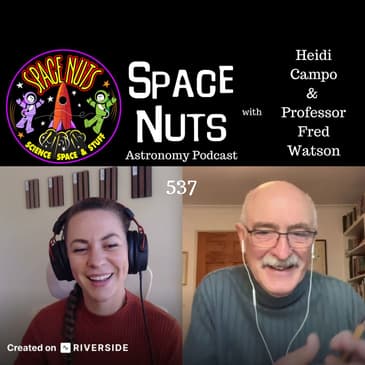
In this intriguing episode of Space Nuts, hosts Heidi Campo and Professor Fred Watson dive deep into the latest astronomical findings and cosmic mysteries. From the formation of our galaxy to puzzling signals from space, this episode offers a rich tapestry of insights that will leave you pondering the vastness of the universe.
Episode Highlights:
- World UFO Day and Cosmic Curiosities: The episode kicks off with a lighthearted banter about World UFO Day, featuring a classic dad joke that sets the tone for a fun exploration of space phenomena. Fred shares his excitement about the ongoing discoveries in astronomy and how they continue to shape our understanding of the cosmos.
- Milky Way's Formation Insights: The discussion transitions to groundbreaking research from the James Webb Telescope, focusing on the concept of galactic archaeology. Fred explains how astronomers are investigating the evolutionary history of the Milky Way, revealing the dual structure of its disk and the implications for understanding other galaxies.
- A Mysterious FRB from a Defunct Satellite: The hosts delve into an astonishing discovery of a brief but intense radio signal linked to the old Relay 2 satellite. Fred elaborates on the possible explanations for this enigmatic burst, from electrostatic discharges to micrometeoroid strikes, leaving listeners captivated by the unknown.
- Innovative Alloy for Exoplanet Research: The episode wraps up with a fascinating exploration of a newly discovered alloy that could revolutionize the search for exoplanets. Fred discusses how this alloy's unique properties could enhance the stability of instruments used in detecting and characterizing distant worlds, highlighting the intersection of materials science and astronomy.
For more Space Nuts, including our continuously updating newsfeed and to listen to all our episodes, visit our website. Follow us on social media at SpaceNutsPod on Facebook, X, YouTube Music Music, Tumblr, Instagram, and TikTok. We love engaging with our community, so be sure to drop us a message or comment on your favorite platform.
If you’d like to help support Space Nuts and join our growing family of insiders for commercial-free episodes and more, visit spacenutspodcast.com/about
Stay curious, keep looking up, and join us next time for more stellar insights and cosmic
Become a supporter of this podcast: https://www.spreaker.com/podcast/space-nuts-astronomy-insights-cosmic-discoveries--2631155/support.
00:00:00 --> 00:00:03 Heidi Campo: Welcome back to another episode of Space
00:00:03 --> 00:00:05 Nut. I am your host for this season,
00:00:05 --> 00:00:08 Heidi Campo. And joining us is
00:00:08 --> 00:00:11 professor Fred Watson, astronomer at large.
00:00:11 --> 00:00:14 Generic: 15 seconds. Guidance is internal.
00:00:14 --> 00:00:17 10, 9. Ignition
00:00:17 --> 00:00:20 sequence. Star space nuts. 5, 4, 3,
00:00:20 --> 00:00:22 2. 1. 2, 3, 4, 5, 5, 4,
00:00:22 --> 00:00:25 3, 2, 1. Space nuts.
00:00:25 --> 00:00:27 Astronauts report. It feels good.
00:00:28 --> 00:00:31 Heidi Campo: Fred, did you know that today
00:00:31 --> 00:00:33 is world UFO Day?
00:00:33 --> 00:00:35 Professor Fred Watson: Oh, um, no, I didn't.
00:00:37 --> 00:00:39 I've got a feeling I saw something about that
00:00:39 --> 00:00:41 and then, um, it moved on.
00:00:42 --> 00:00:45 Heidi Campo: Um, how do you know? So I'm trying to fill in
00:00:45 --> 00:00:48 for our normal host, Andrew Dunkley. And
00:00:48 --> 00:00:50 he loves his dad joke, so I figured I'd need
00:00:50 --> 00:00:53 to bump up the dad joke. So, Fred, how do you
00:00:53 --> 00:00:55 know if you are talking to an
00:00:55 --> 00:00:56 extraterrestrial?
00:00:58 --> 00:01:01 Professor Fred Watson: Um, because their lips
00:01:01 --> 00:01:02 don't move.
00:01:03 --> 00:01:05 Heidi Campo: Well, you need to ask them probing questions.
00:01:08 --> 00:01:10 Professor Fred Watson: I love that. Yes, I like that very much.
00:01:11 --> 00:01:13 Heidi Campo: It was not original. My Alex Zaharov-Reutt
00:01:13 --> 00:01:15 told me that whole spiel this morning.
00:01:15 --> 00:01:17 I thought that was too good not to share with
00:01:17 --> 00:01:17 you guys.
00:01:17 --> 00:01:20 Professor Fred Watson: Yeah, it's a good one. Um,
00:01:20 --> 00:01:22 a very probing answer as well.
00:01:24 --> 00:01:26 Heidi Campo: Well, how are you today? Are you excited?
00:01:26 --> 00:01:29 Professor Fred Watson: Um, well, look, I go through my life in a
00:01:29 --> 00:01:31 state of permanent excitement. Um, Heidi.
00:01:32 --> 00:01:34 And who, who wouldn't be? When we're mixed up
00:01:34 --> 00:01:36 with all this fabulous news coming from
00:01:36 --> 00:01:38 space. Astronomy, physics, biology,
00:01:39 --> 00:01:41 it's. We're being bombarded by all these
00:01:41 --> 00:01:43 marvelous discoveries. And, um, that, uh,
00:01:43 --> 00:01:46 certainly for me is very exciting.
00:01:46 --> 00:01:49 And, um, the annoying thing for me
00:01:49 --> 00:01:52 is that I'm at the sort of end of my
00:01:52 --> 00:01:55 career. That means that a lot
00:01:55 --> 00:01:58 of the things I want to know the answers to
00:01:59 --> 00:02:01 may be beyond my horizon.
00:02:03 --> 00:02:05 And that's really, uh, irritating. Um,
00:02:06 --> 00:02:08 but that's okay. I mean, I'm thinking of
00:02:08 --> 00:02:10 things like. And this might be beyond many
00:02:10 --> 00:02:13 people's horizon. For example, um, the plans
00:02:13 --> 00:02:16 to build a new, uh, future circular
00:02:16 --> 00:02:19 collider, as it's called, uh, by the
00:02:19 --> 00:02:21 cern. The, um, nuclear research
00:02:22 --> 00:02:24 center, uh, on the French Swiss border.
00:02:24 --> 00:02:26 They're planning this machine which will
00:02:26 --> 00:02:29 switch on in 2070.
00:02:29 --> 00:02:32 And, um, you know, we're going to discover
00:02:32 --> 00:02:35 wonderful things from it. 2070 is above
00:02:35 --> 00:02:37 many people, beyond many people's horizon.
00:02:38 --> 00:02:39 Certainly beyond mine.
00:02:40 --> 00:02:42 Heidi Campo: Yeah, there's some existentialism in the
00:02:42 --> 00:02:43 first three minutes of the episode today.
00:02:44 --> 00:02:46 Professor Fred Watson: Yeah, there you go. So. Yes, that's right.
00:02:46 --> 00:02:49 Um, um, so for all you
00:02:49 --> 00:02:51 space nuts out there, don't worry, you'll
00:02:51 --> 00:02:54 all. You'll all hear the answers to many of
00:02:54 --> 00:02:56 the questions that you want to know about,
00:02:56 --> 00:02:59 like dark matter, dark energy, is
00:02:59 --> 00:03:01 there life elsewhere? All these Questions are
00:03:01 --> 00:03:03 probably within your horizon, but maybe not
00:03:03 --> 00:03:04 mine.
00:03:05 --> 00:03:07 Heidi Campo: Maybe one, uh, of these days, I know we had,
00:03:07 --> 00:03:10 uh, some, some kids, um, come in with some
00:03:10 --> 00:03:12 questions on some of the Q and A episodes.
00:03:12 --> 00:03:14 Maybe one day, when they're the hosts, these
00:03:14 --> 00:03:15 things will be discovered.
00:03:16 --> 00:03:18 Professor Fred Watson: Exactly. That's right. That's the thing to
00:03:18 --> 00:03:20 look forward to. It's not, it's, it's
00:03:20 --> 00:03:23 existential stuff, but it's good new stuff as
00:03:23 --> 00:03:25 well. Because, you know, science is one of
00:03:25 --> 00:03:27 those things that just keeps on moving and we
00:03:27 --> 00:03:29 keep on learning new things and who knows
00:03:29 --> 00:03:31 what we might discover that will transform
00:03:31 --> 00:03:34 our understanding, uh, of the universe. I
00:03:34 --> 00:03:35 think that's the end of the show, isn't it
00:03:35 --> 00:03:37 today, Heidi? I think we've covered
00:03:37 --> 00:03:37 everything there.
00:03:39 --> 00:03:41 Heidi Campo: Oh, well, today is a great one and here's my
00:03:41 --> 00:03:41 segue.
00:03:41 --> 00:03:42 We're going to just jump right into
00:03:42 --> 00:03:45 introducing all of our articles. We have
00:03:45 --> 00:03:48 history, we have mystery, and
00:03:48 --> 00:03:50 we have discovery. We are really
00:03:51 --> 00:03:53 covering the full spectrum of
00:03:53 --> 00:03:56 space science today. And our history
00:03:56 --> 00:03:59 article today is touching on
00:03:59 --> 00:04:02 a, basically a James Webb
00:04:02 --> 00:04:05 discovery of how the
00:04:05 --> 00:04:08 Milky Way, um, was kind
00:04:08 --> 00:04:10 of formed. Is that about right, Fred?
00:04:10 --> 00:04:12 Professor Fred Watson: Yep, right on the money there, Heidi. Uh,
00:04:13 --> 00:04:16 and it's, this is actually a topic
00:04:16 --> 00:04:18 that's close to my heart because
00:04:18 --> 00:04:21 I've been involved with research very like
00:04:21 --> 00:04:23 this. Um, so
00:04:23 --> 00:04:26 what uh, the Webb Telescope is doing is
00:04:26 --> 00:04:28 looking at what we call cosmic archaeology,
00:04:29 --> 00:04:32 which uh, is trying to understand basically
00:04:33 --> 00:04:36 the evolution of galaxies, the detailed
00:04:36 --> 00:04:39 evolution of galaxies. Uh, but it relates
00:04:39 --> 00:04:42 to um, something that has been very
00:04:42 --> 00:04:44 actively pursued in the last 20 years
00:04:44 --> 00:04:47 or so. A topic that we call galactic
00:04:47 --> 00:04:50 archaeology. And that's understanding how
00:04:50 --> 00:04:52 our own galaxy came to be put together.
00:04:53 --> 00:04:56 Uh, and uh, that topic has
00:04:56 --> 00:04:58 led to some quite significant discoveries.
00:04:58 --> 00:04:59 The people I've worked with have made some of
00:04:59 --> 00:05:02 these discoveries. Uh, uh, we've
00:05:02 --> 00:05:05 been working on a project called galah. Galah
00:05:05 --> 00:05:08 is, uh, an Australian bird, a very
00:05:08 --> 00:05:11 well known, um, species of Australian bird.
00:05:11 --> 00:05:14 G A L A H. Galah stands for
00:05:14 --> 00:05:17 galactic archeology with Hermes. Hermes
00:05:17 --> 00:05:19 being the instrument that we used to do this.
00:05:20 --> 00:05:22 Uh, so I was um, very much on the
00:05:22 --> 00:05:24 observational side of this project, but
00:05:24 --> 00:05:26 worked with people who discovered some of the
00:05:26 --> 00:05:29 fundamental properties of our galaxy. And
00:05:29 --> 00:05:32 that relates directly to the story that we've
00:05:32 --> 00:05:34 got coming from the James Webb Telescope.
00:05:34 --> 00:05:35 Because one of the discoveries that my
00:05:35 --> 00:05:38 colleagues made was that the disk of our
00:05:38 --> 00:05:41 galaxy, uh, ah, and remember our
00:05:41 --> 00:05:44 galaxy is this flattened spiral of stars and
00:05:44 --> 00:05:47 gas and dust and dark matter, um, which
00:05:47 --> 00:05:50 ah, basically is disk shaped. And we
00:05:50 --> 00:05:51 see that when we See the Milky Way, we're
00:05:51 --> 00:05:53 looking the thickness of the disk. We've
00:05:53 --> 00:05:56 known for a long time, more than 100 years,
00:05:56 --> 00:05:58 that there is another component to the
00:05:58 --> 00:06:01 galaxy, and that's what we call the halo. Uh,
00:06:01 --> 00:06:02 this is a spherical region of,
00:06:03 --> 00:06:06 um, stars and what we
00:06:06 --> 00:06:08 call globular clusters. These, uh,
00:06:09 --> 00:06:11 very dense clusters of stars that surrounds
00:06:11 --> 00:06:14 the disk of the galaxy. But the people I
00:06:14 --> 00:06:16 worked with made a discovery that there is
00:06:16 --> 00:06:19 another component, and that is that the disk
00:06:19 --> 00:06:22 is not just a single item. It has
00:06:22 --> 00:06:24 two parts to it, which maybe not
00:06:24 --> 00:06:27 surprisingly, are called the thin disk and
00:06:27 --> 00:06:30 the thick disk, um, because one's
00:06:30 --> 00:06:32 thin and one's thick, and they're two
00:06:32 --> 00:06:35 different sort of populations, uh, of stars.
00:06:35 --> 00:06:37 So the thin disk really is what we see when
00:06:37 --> 00:06:40 we look at the Milky Way. But there is a
00:06:40 --> 00:06:42 more rarefied population of stars that make
00:06:42 --> 00:06:44 up a thicker disk. And they've got different
00:06:45 --> 00:06:47 dynamical characteristics. That's to say they
00:06:47 --> 00:06:50 move in different ways. So that's the
00:06:50 --> 00:06:52 segue to this story from the James Webb
00:06:52 --> 00:06:54 Telescope, because people are now looking at,
00:06:54 --> 00:06:57 uh, other galaxies beyond our own to see
00:06:57 --> 00:07:00 if the thin and thick disks can be detected.
00:07:01 --> 00:07:03 Uh, I mean, it's taken us, you know,
00:07:03 --> 00:07:06 centuries, I guess, to work out that the disk
00:07:06 --> 00:07:09 of our galaxy was in two components.
00:07:10 --> 00:07:13 Let's now move outwards and look at other
00:07:13 --> 00:07:15 galaxies to see whether they are the same
00:07:16 --> 00:07:18 and to see how that informs our own
00:07:18 --> 00:07:21 understanding of the evol of our own
00:07:21 --> 00:07:24 galaxy. So, um, the team of astronomers,
00:07:24 --> 00:07:26 uh, one of whom was based here in Australia,
00:07:26 --> 00:07:28 I'm glad to say, and that's actually the team
00:07:28 --> 00:07:31 leader, uh, that's, um, again carrying on
00:07:31 --> 00:07:34 this tradition of, uh, Australian involvement
00:07:34 --> 00:07:36 with the idea of thin and thick disks. So
00:07:36 --> 00:07:39 they've looked at, um, 100 galaxies,
00:07:39 --> 00:07:42 uh, up to 11 billion
00:07:42 --> 00:07:45 years ago. So we're talking now about very
00:07:45 --> 00:07:48 distant galaxies, uh, in the early universe.
00:07:48 --> 00:07:51 Uh, and basically look to see how
00:07:51 --> 00:07:54 the thin and thick disks, uh,
00:07:55 --> 00:07:57 appear in those galaxies. Um,
00:07:58 --> 00:08:01 in particular, uh, the question they want to
00:08:01 --> 00:08:04 ask is when you've got a galaxy forming and
00:08:04 --> 00:08:06 evolving, uh,
00:08:07 --> 00:08:09 what is the point at which that
00:08:09 --> 00:08:11 structure that we have in our own galaxy,
00:08:11 --> 00:08:14 that dual disk structure, what's the point
00:08:14 --> 00:08:17 at which that forms? And so what they've done
00:08:17 --> 00:08:20 is they've chosen galaxies. And this
00:08:20 --> 00:08:22 is kind of what you'd expect them to do.
00:08:22 --> 00:08:25 They've chosen galaxies that we see edge on.
00:08:25 --> 00:08:28 Um, and so that means that you're looking
00:08:28 --> 00:08:31 directly at the disk itself. It's
00:08:31 --> 00:08:33 edge onto you, uh, rather than face on.
00:08:34 --> 00:08:36 And that means that you've got a good chance
00:08:36 --> 00:08:38 of seeing the stars in the thick disk and the
00:08:38 --> 00:08:41 thin disk separated. And indeed
00:08:41 --> 00:08:44 that's what they have found. Um, and
00:08:44 --> 00:08:47 this is actually world leading research. It's
00:08:47 --> 00:08:49 the first time that astronomers have
00:08:49 --> 00:08:52 studied um, these two
00:08:52 --> 00:08:55 populations of stars in galaxies in the
00:08:55 --> 00:08:57 early universe. So the bottom line
00:08:58 --> 00:09:01 uh, of this story is that uh,
00:09:01 --> 00:09:03 it looks as though from the observations that
00:09:03 --> 00:09:05 have now been made of these hundred galaxies,
00:09:06 --> 00:09:08 uh, it looks as though the thick disk
00:09:08 --> 00:09:11 forms first. So what you get is
00:09:11 --> 00:09:14 initially is the thick disk, uh, and then the
00:09:14 --> 00:09:17 thin disk within it forms later on.
00:09:18 --> 00:09:20 Uh, and so that's new knowledge.
00:09:20 --> 00:09:23 That's something that we, we didn't um, you
00:09:23 --> 00:09:26 know, we didn't appreciate before. It's
00:09:26 --> 00:09:29 actually a very, very fine piece of research
00:09:29 --> 00:09:32 that feeds directly into our understanding of
00:09:32 --> 00:09:34 our own galaxy. Taking information from
00:09:34 --> 00:09:37 distant galaxies, uh, in the early universe.
00:09:37 --> 00:09:39 I was full of admiration for it.
00:09:40 --> 00:09:42 Heidi Campo: That's, that's amazing. So why do they think
00:09:42 --> 00:09:45 that is with the, with the thicker disc
00:09:45 --> 00:09:47 that they think is the more mature one, Are
00:09:47 --> 00:09:50 they seeing the, the clusters
00:09:50 --> 00:09:52 in a more um, un.
00:09:52 --> 00:09:55 Uniform spin then? So it seems like as,
00:09:55 --> 00:09:58 as they, as the, I don't know what the,
00:09:58 --> 00:10:00 as the discs get more mature, the
00:10:01 --> 00:10:03 clusters get more sporadic.
00:10:04 --> 00:10:06 Professor Fred Watson: Yeah, that's right. It's the stars themselves
00:10:07 --> 00:10:10 that um, m. Define how these disks
00:10:10 --> 00:10:12 appear. And I think your point is right
00:10:12 --> 00:10:15 though because what we call the
00:10:15 --> 00:10:17 kinematics of the thick disk in our own
00:10:17 --> 00:10:18 galaxy, that's the way stars move in it. It's
00:10:18 --> 00:10:21 a lot more um, disorganized than
00:10:22 --> 00:10:24 the kinematics of the thin disk. The thin
00:10:24 --> 00:10:27 disk has very, very well behaved star motions
00:10:27 --> 00:10:29 in it. For example, the sun is in orbit
00:10:29 --> 00:10:32 around the galactic center. It's a very neat
00:10:32 --> 00:10:33 and tidy orbit. Takes about
00:10:35 --> 00:10:38 uh, 200 million years to go around once. Uh,
00:10:38 --> 00:10:41 so, uh, and all the stars in our
00:10:41 --> 00:10:42 neighborhood are doing the same sort of
00:10:42 --> 00:10:45 thing. But the thin disk is less well
00:10:45 --> 00:10:48 organized. It's got much higher uh,
00:10:48 --> 00:10:50 velocities outside the plane of the disk.
00:10:50 --> 00:10:53 So there's a sort of vertical component of
00:10:53 --> 00:10:55 the velocity of stars in the thick disks as
00:10:55 --> 00:10:57 well. And so you're right. It looks as though
00:10:57 --> 00:10:59 that older disk, um,
00:11:00 --> 00:11:03 uh, the thick disk being
00:11:03 --> 00:11:05 the first thing to form, uh, stars in
00:11:05 --> 00:11:08 it, eventually collapse towards a thin
00:11:08 --> 00:11:11 disk, um, uh,
00:11:11 --> 00:11:14 in response to the galactic pull of the
00:11:14 --> 00:11:17 whole galaxy. And perhaps uh, an analog with
00:11:17 --> 00:11:20 this is the rings of Saturn, which
00:11:20 --> 00:11:22 are a uh, very, very thin disk of
00:11:22 --> 00:11:25 material. Um, you probably know that rings of
00:11:25 --> 00:11:27 Saturn are about 250 kilometers in
00:11:27 --> 00:11:30 diameter and less than 100 meters thick.
00:11:30 --> 00:11:33 100 meters thick. So it's
00:11:33 --> 00:11:36 a blade of material in space. Um,
00:11:36 --> 00:11:38 and that is because of the gravitational
00:11:39 --> 00:11:41 forces that act on it from the planet Saturn
00:11:41 --> 00:11:44 itself. And so it looks as though something
00:11:44 --> 00:11:46 perhaps analogous to that happens in our
00:11:46 --> 00:11:49 galaxy that you eventually get the,
00:11:49 --> 00:11:51 um, stars in the disk shepherded into this
00:11:51 --> 00:11:54 quite thin region, uh, leaving behind
00:11:54 --> 00:11:56 remnants of perhaps an earlier phase, which
00:11:56 --> 00:11:58 is what we see as the thick disk.
00:11:59 --> 00:12:01 Heidi Campo: So the opposite of most people. When we age,
00:12:01 --> 00:12:03 we tend to get, uh, a little bit thicker.
00:12:05 --> 00:12:07 Professor Fred Watson: Nicely done. Very nicely done.
00:12:07 --> 00:12:08 Heidi Campo: Especially around the middle.
00:12:09 --> 00:12:10 Professor Fred Watson: Well, yes, that's right.
00:12:11 --> 00:12:13 Heidi Campo: Well, you know, we can't all be as beautiful
00:12:13 --> 00:12:16 as, um, Saturn with its
00:12:16 --> 00:12:17 beautiful, uh, discs.
00:12:22 --> 00:12:23 Space nuts.
00:12:23 --> 00:12:25 Um, but this next story
00:12:27 --> 00:12:29 is a mystery and that's kind of fun and
00:12:29 --> 00:12:31 exciting. So, you know, we just talked about
00:12:32 --> 00:12:35 our galaxy forming, but this next one is
00:12:36 --> 00:12:39 a little bit less straightforward than what
00:12:39 --> 00:12:41 you just explained. And I'm really excited to
00:12:41 --> 00:12:43 hear what you have to say because you have
00:12:43 --> 00:12:44 such a great way of taking something
00:12:44 --> 00:12:47 complicated and making it make sense to us.
00:12:47 --> 00:12:50 But tell us about this. Ah, the surprise in
00:12:50 --> 00:12:51 the desert.
00:12:51 --> 00:12:54 Professor Fred Watson: Yeah, so. And it's, um. Again, this is
00:12:54 --> 00:12:56 relatively close to home. This is research
00:12:56 --> 00:12:59 that's being done here in Australia. Uh, and
00:12:59 --> 00:13:01 I think we've talked about it before, Heidi.
00:13:01 --> 00:13:04 Um, uh, a facility called the Square
00:13:04 --> 00:13:06 Kilometer Array Observatory.
00:13:07 --> 00:13:09 Skao, uh, uh, is,
00:13:09 --> 00:13:12 um, an international project. I think it's
00:13:12 --> 00:13:15 got seven, maybe eight nations involved in it
00:13:15 --> 00:13:18 now, uh, uh, with
00:13:18 --> 00:13:21 facilities in Australia, in South
00:13:21 --> 00:13:24 Africa and in the UK and the UK is just
00:13:24 --> 00:13:26 where the headquarters is. So our telescopes
00:13:26 --> 00:13:29 here in Australia. Um, there is. The
00:13:29 --> 00:13:32 Square Kilometer Array itself is being
00:13:32 --> 00:13:35 built. It will probably see fully, uh,
00:13:35 --> 00:13:38 first light, first radio signals,
00:13:38 --> 00:13:41 uh, in, um, something like five.
00:13:41 --> 00:13:43 Sorry, three to four years. Uh, but there is
00:13:43 --> 00:13:46 what's called a pathfinder, uh, um, and it
00:13:46 --> 00:13:49 rejoices in this marvelous name of ascap,
00:13:49 --> 00:13:51 uh, the Australian Square Kilometer Array
00:13:51 --> 00:13:53 Pathfinder. And that's, uh,
00:13:54 --> 00:13:56 used, um, very effectively
00:13:57 --> 00:14:00 for, um, finding many
00:14:00 --> 00:14:02 different sorts of objects in space. It has
00:14:02 --> 00:14:04 about 30 dishes, uh, in the
00:14:05 --> 00:14:08 Western Desert of Australia. Um, and in
00:14:08 --> 00:14:11 particular it's been really good, ah, finding
00:14:11 --> 00:14:14 these things called fast radio bursts,
00:14:15 --> 00:14:17 um, which my colleagues in the
00:14:17 --> 00:14:19 radio broadcasting business tell me should be
00:14:19 --> 00:14:22 pronounced fast radio burst because they're
00:14:22 --> 00:14:23 very fast.
00:14:23 --> 00:14:24 Heidi Campo: I don't know why that was so.
00:14:24 --> 00:14:27 Professor Fred Watson: Funny to me, anyway. Well,
00:14:27 --> 00:14:29 it's a bad name because really they're short
00:14:29 --> 00:14:32 radio bursts. Excuse me. They're,
00:14:32 --> 00:14:34 um, something like a millisecond long. And
00:14:34 --> 00:14:37 they're flashes of radio radiation
00:14:38 --> 00:14:40 which have now been recorded, uh, for
00:14:40 --> 00:14:42 something like a couple of decades. And so
00:14:42 --> 00:14:45 they've been very well studied. Um, and,
00:14:45 --> 00:14:48 um, we think they come from what are called
00:14:48 --> 00:14:50 magnetars. Uh, these are, uh,
00:14:50 --> 00:14:52 neutron stars, highly collapsed.
00:14:53 --> 00:14:56 Excuse me, highly collapsed stars which have
00:14:56 --> 00:14:58 very strong magnetic fields. And you get
00:14:58 --> 00:15:01 flares on these stars. Um,
00:15:01 --> 00:15:03 that's what we think fast radio bursts are
00:15:03 --> 00:15:06 caused by. But in making those
00:15:06 --> 00:15:08 measurements, this team of astronomers
00:15:09 --> 00:15:12 actually came across something that was a
00:15:12 --> 00:15:14 burst of radiation, uh, very bright,
00:15:14 --> 00:15:17 a bit like a fast radio burst. But
00:15:17 --> 00:15:20 rather than being, uh, you know, a
00:15:20 --> 00:15:23 thousandth of a second long or thereabouts,
00:15:23 --> 00:15:26 this was a few billionths of a
00:15:26 --> 00:15:28 second long. It was incredibly
00:15:28 --> 00:15:31 brief. Uh, so it actually, the
00:15:31 --> 00:15:34 pulse that they measured lasted for 30Ns,
00:15:34 --> 00:15:37 30 billionths of a second. And
00:15:37 --> 00:15:40 that's a mystery. Um, we have never seen
00:15:40 --> 00:15:42 anything like this before. So they were
00:15:42 --> 00:15:45 puzzled. Uh, it took them a year to
00:15:45 --> 00:15:48 try and work out what it is that we think
00:15:48 --> 00:15:50 we're seeing. Uh, and
00:15:51 --> 00:15:53 first of all, they had some hints, um,
00:15:54 --> 00:15:56 that it might be quite close by. Because
00:15:57 --> 00:16:00 in the radio telescope world, there's a
00:16:00 --> 00:16:01 phenomenon called dispersion. If you have a
00:16:01 --> 00:16:04 pulse of radiation, um, the higher
00:16:04 --> 00:16:06 frequencies get to you before the lower
00:16:06 --> 00:16:08 frequencies. That's the phenomenon of
00:16:08 --> 00:16:11 dispersion. And so, uh, that,
00:16:12 --> 00:16:14 um, uh, is something that you
00:16:14 --> 00:16:17 look for as a kind of indicator of distance.
00:16:17 --> 00:16:20 Now, this particular 10, uh, sorry, 30
00:16:21 --> 00:16:23 nanosecond pulse didn't show
00:16:24 --> 00:16:27 that dispersion phenomenon. And that tells
00:16:27 --> 00:16:29 you that it's coming from relatively
00:16:29 --> 00:16:32 nearby rather than deep in the universe,
00:16:32 --> 00:16:35 unlike the other things. And in fact, they
00:16:35 --> 00:16:38 could also see that it was out of focus.
00:16:38 --> 00:16:41 It had blurriness in the image. And so
00:16:41 --> 00:16:44 that let them put a, an estimate of distance
00:16:44 --> 00:16:46 on it. And rather than it being several
00:16:46 --> 00:16:48 billion light years away, like most of the
00:16:48 --> 00:16:51 fast radio bursts are, the distance they got
00:16:51 --> 00:16:53 for this was 4 kilometers.
00:16:54 --> 00:16:56 Uh, what's that? That's about 3 miles.
00:16:57 --> 00:16:59 Um, so that's, uh, rather
00:16:59 --> 00:17:02 nearby, which tells you, uh, it is
00:17:02 --> 00:17:05 probably, uh, coming from a satellite. And so
00:17:05 --> 00:17:07 they worked out from the direction that
00:17:07 --> 00:17:10 they'd seen it in, uh, what
00:17:10 --> 00:17:12 satellite it might be. And they identified
00:17:12 --> 00:17:14 one. And it's a satellite called
00:17:15 --> 00:17:17 Relay 2 that was launched
00:17:17 --> 00:17:20 in 1964, and it was one
00:17:20 --> 00:17:23 of the first telecommunications
00:17:23 --> 00:17:26 satellites. Now, by 1967, the
00:17:26 --> 00:17:28 whole thing had switched off. It was just a
00:17:28 --> 00:17:31 defunct piece of space junk. Um, so this
00:17:31 --> 00:17:33 satellite, Relay 2, has not done
00:17:33 --> 00:17:36 anything for, um, well, 60
00:17:36 --> 00:17:39 years, nearly 60 years.
00:17:39 --> 00:17:42 Uh, and so it's a real puzzle
00:17:42 --> 00:17:45 as to why a dead satellite
00:17:45 --> 00:17:48 should suddenly produce a
00:17:48 --> 00:17:51 flash of radiation that's a billionth of a
00:17:51 --> 00:17:54 second or 30 billionths of a second long, um,
00:17:54 --> 00:17:57 and be incredibly bright. And I think the
00:17:57 --> 00:17:59 only thing that the team has been able to
00:18:00 --> 00:18:02 come up with, uh, and they're saying they
00:18:02 --> 00:18:05 think this is the most likely cause, uh,
00:18:05 --> 00:18:08 is an electrostatic discharge.
00:18:08 --> 00:18:11 Um, and we're all familiar with those. When
00:18:11 --> 00:18:13 you've got very dry weather, uh, sometimes
00:18:13 --> 00:18:16 your clothes, as you take them off, if you've
00:18:16 --> 00:18:19 got synthetic fabrics in your clothes,
00:18:19 --> 00:18:21 they rub against your skin, they cause a
00:18:21 --> 00:18:24 buildup of static electricity, and you get a
00:18:24 --> 00:18:26 little spark once in a while. You can
00:18:26 --> 00:18:28 actually see those. If you're in a dark room,
00:18:28 --> 00:18:30 take. Take your jacket off, your shirt off,
00:18:30 --> 00:18:32 and you suddenly see flashes all around you.
00:18:32 --> 00:18:34 Heidi Campo: Here's a. Here's a cute little story about
00:18:34 --> 00:18:37 static electricity. Every morning my dog. My
00:18:37 --> 00:18:39 dog sleeps in the bed with me. And every
00:18:39 --> 00:18:40 morning he sleeps down by my feet. Every
00:18:40 --> 00:18:43 morning he kind of scoots slowly across the
00:18:43 --> 00:18:45 bed. And he doesn't understand physics.
00:18:46 --> 00:18:49 He doesn't understand that it's the slow
00:18:49 --> 00:18:51 scoot towards me that's building up that
00:18:51 --> 00:18:54 static electricity. And he, he goes and he
00:18:54 --> 00:18:55 gives you a little kiss on the cheek every
00:18:55 --> 00:18:57 morning. And he always gets that shock right
00:18:57 --> 00:19:00 on his nose. And so he's developed the ha.
00:19:00 --> 00:19:02 Of scooting slower and slower.
00:19:03 --> 00:19:05 The poor little guy just keeps building up
00:19:05 --> 00:19:07 more static electricity,
00:19:07 --> 00:19:08 everybody.
00:19:09 --> 00:19:11 So I try and touch him on his shoulder or
00:19:11 --> 00:19:12 something before he gets to me. So it doesn't
00:19:12 --> 00:19:14 get him on his nose. But, yeah, that's, uh,
00:19:14 --> 00:19:17 that's a. So they're calling us the zombie.
00:19:17 --> 00:19:20 Zombie craft. And it was a United States.
00:19:21 --> 00:19:23 Professor Fred Watson: Uh, it was satellite. Yeah, that's
00:19:23 --> 00:19:26 right. And so, um, the,
00:19:27 --> 00:19:30 the. Basically the. The
00:19:30 --> 00:19:32 thing they think is the most likely is one of
00:19:32 --> 00:19:34 these, Ah, an electrostatic
00:19:34 --> 00:19:37 discharge just like your dog's nose, um,
00:19:38 --> 00:19:40 uh, but causing a flash of radio radiation.
00:19:40 --> 00:19:43 But they say the problem at that, uh, with
00:19:43 --> 00:19:45 that idea is that usually electrostatic
00:19:45 --> 00:19:48 discharges relative to this one are quite
00:19:48 --> 00:19:50 slow. They last thousands of times longer
00:19:50 --> 00:19:53 than the 30 nanoseconds of this signal.
00:19:53 --> 00:19:56 Um, so they postulate a second
00:19:57 --> 00:20:00 hypothesis, which is a strike by a
00:20:00 --> 00:20:02 micrometeoroid, a tiny piece of something.
00:20:02 --> 00:20:03 Generic: Wow.
00:20:03 --> 00:20:06 Professor Fred Watson: Um, which, uh, could produce
00:20:06 --> 00:20:09 a flash of radio waves, but they
00:20:09 --> 00:20:12 say that's got very low probability. So the
00:20:12 --> 00:20:14 bottom line is we don't actually know, um,
00:20:15 --> 00:20:17 that, uh, we simply don't know what this, you
00:20:17 --> 00:20:19 know, what this, uh, signal Is
00:20:20 --> 00:20:23 maybe, uh, we will find
00:20:23 --> 00:20:25 a few more insights. But
00:20:26 --> 00:20:29 um, that's uh, the, the story
00:20:29 --> 00:20:30 from this team that's hit the news. Even
00:20:30 --> 00:20:33 though they're doing fabulous work on fast
00:20:33 --> 00:20:34 radio bursts. The thing that hits the
00:20:34 --> 00:20:37 headlines is the mystery, the mystery
00:20:37 --> 00:20:38 signal.
00:20:38 --> 00:20:41 Heidi Campo: It is quite the mystery. And that, that was
00:20:41 --> 00:20:44 a, that is an interesting one. I'm going to
00:20:44 --> 00:20:45 be scratching my head about that for a little
00:20:45 --> 00:20:46 while.
00:20:49 --> 00:20:50 Professor Fred Watson: 0G.
00:20:50 --> 00:20:51 Generic: And I feel fine.
00:20:51 --> 00:20:52 Heidi Campo: Space nuts.
00:20:52 --> 00:20:55 I'm glad that, um, our last story gives us a
00:20:55 --> 00:20:57 little bit of closure with a new
00:20:58 --> 00:21:01 alloy that was discovered. A
00:21:01 --> 00:21:01 new alloy, um,
00:21:04 --> 00:21:06 it's needed for an exoplanet discovery.
00:21:07 --> 00:21:09 Professor Fred Watson: This is a really. Yeah, it's a really
00:21:09 --> 00:21:12 interesting story because, um, you know, why
00:21:12 --> 00:21:14 should something, uh, that seems to be
00:21:14 --> 00:21:17 metallurgy find its way into space
00:21:17 --> 00:21:20 and astronomy news headlines? Uh,
00:21:20 --> 00:21:22 uh, and the answer is that it's got
00:21:22 --> 00:21:25 um, a definite uh,
00:21:25 --> 00:21:28 application in our, uh, hunt for
00:21:28 --> 00:21:30 exoplanets for planets around other stars.
00:21:30 --> 00:21:32 And not just hunting for them, but to try and
00:21:32 --> 00:21:34 characterize them, to try and learn more
00:21:34 --> 00:21:37 about them. Um, so the
00:21:37 --> 00:21:40 curious thing about this alloy, uh,
00:21:40 --> 00:21:43 is that it has a negative
00:21:43 --> 00:21:46 coefficient of thermal expansion. Uh,
00:21:46 --> 00:21:49 and so what that means is, uh, as we know,
00:21:49 --> 00:21:51 when things get hot, they tend to get bigger.
00:21:51 --> 00:21:54 It's just like when they age. Uh,
00:21:54 --> 00:21:57 so, um, a piece of metal, uh, if you
00:21:57 --> 00:22:00 heat it up, it gets bigger. And the rate
00:22:00 --> 00:22:02 at which it gets bigger with temperature is
00:22:02 --> 00:22:04 something we call the expansion coefficient,
00:22:04 --> 00:22:06 the thermal expansion coefficients. Basic,
00:22:06 --> 00:22:09 basic physics. Um, there are a
00:22:09 --> 00:22:12 few materials and one of them
00:22:12 --> 00:22:15 is very well known to astronomers. Uh, a
00:22:15 --> 00:22:18 few materials that don't expand or contract
00:22:18 --> 00:22:21 with temperature, they don't do anything. Uh,
00:22:21 --> 00:22:24 and uh, one of them is um, a glass
00:22:24 --> 00:22:26 ceramic material which was developed in the
00:22:26 --> 00:22:29 1970s. There are two versions of it. One
00:22:29 --> 00:22:32 is called Servet, uh, that was made by Owens,
00:22:32 --> 00:22:35 Illinois in the United States. Uh, and the
00:22:35 --> 00:22:37 other, um, I can't remember its name, but
00:22:37 --> 00:22:39 it's made by the Schott Glass Company in
00:22:39 --> 00:22:42 Europe. Uh, these are ah, effectively
00:22:42 --> 00:22:45 what looks like a piece of brown glass,
00:22:45 --> 00:22:47 but it's a mixture. Uh, it's got the
00:22:47 --> 00:22:49 properties of both glass and a ceramic and it
00:22:49 --> 00:22:52 has a zero expansion coefficient. So as the
00:22:52 --> 00:22:54 temperature changes, if you make a telescope
00:22:54 --> 00:22:56 mirror out of this, which has a surface
00:22:56 --> 00:22:59 accurate to a few billionths of a meter,
00:23:00 --> 00:23:02 uh, uh, if you make a mirror out of this, as
00:23:02 --> 00:23:05 the temperature changes, uh, it doesn't alter
00:23:05 --> 00:23:08 its shape. And that is why most of the
00:23:08 --> 00:23:10 mirrors, big telescopes in the world today
00:23:10 --> 00:23:12 are made from this material. Including the
00:23:12 --> 00:23:14 one I used to be, uh, a astronomer in charge
00:23:14 --> 00:23:17 of at uh, Siding Spring Observatory. But this
00:23:17 --> 00:23:20 new material, this new alloy has the opposite
00:23:20 --> 00:23:22 characteristic. When you heat it up, it
00:23:22 --> 00:23:25 contracts. Uh, and that's very
00:23:25 --> 00:23:27 much, uh. Uh, you know, it's very different
00:23:28 --> 00:23:30 from uh, what we expect to find with
00:23:30 --> 00:23:33 metals. But what it does is
00:23:33 --> 00:23:36 because it's so different from normal metals.
00:23:37 --> 00:23:39 It gives you the possibility of building
00:23:39 --> 00:23:41 structures that have
00:23:42 --> 00:23:45 uh, some of this new alloy, uh, in
00:23:45 --> 00:23:47 them, uh, which will contract with
00:23:47 --> 00:23:50 temperature. It's called Alvar Alloy 30,
00:23:50 --> 00:23:52 by the way, to give it a name. Um,
00:23:53 --> 00:23:56 uh, if you can combine
00:23:56 --> 00:23:59 that with metals that have
00:23:59 --> 00:24:01 the normal thermal expansion characteristic.
00:24:02 --> 00:24:04 Then one can compensate for the other. And
00:24:04 --> 00:24:07 they can essentially cancel out any
00:24:08 --> 00:24:10 form of temperature, uh, distortion,
00:24:11 --> 00:24:13 uh, that you might get as the temperature
00:24:13 --> 00:24:16 changes. Your structure is built in such a
00:24:16 --> 00:24:19 way that it doesn't change its shape because,
00:24:20 --> 00:24:23 uh, the two different uh, coefficients cancel
00:24:23 --> 00:24:26 out. And that's important in one
00:24:26 --> 00:24:29 specific field which has been identified. And
00:24:29 --> 00:24:32 this actually is appropriate for both space
00:24:32 --> 00:24:35 telescopes and ground based telescopes. Uh,
00:24:35 --> 00:24:37 when you're looking for, um,
00:24:38 --> 00:24:40 for planets around other stars,
00:24:41 --> 00:24:43 uh, what you need, uh, is
00:24:44 --> 00:24:46 absolute stability in the instrument.
00:24:47 --> 00:24:49 Uh, because the measurements you're trying to
00:24:49 --> 00:24:51 make, whether they're what we call the
00:24:51 --> 00:24:54 Doppler wobble technique, which is where the
00:24:54 --> 00:24:56 motion of a planet around the star pulls the
00:24:56 --> 00:24:58 star slightly one way and then the other as
00:24:58 --> 00:25:01 it goes round. And we see the star exhibiting
00:25:01 --> 00:25:03 that backwards and forwards motion which can
00:25:03 --> 00:25:05 be measured. Whether it's that or whether
00:25:05 --> 00:25:08 you're looking for a direct image of
00:25:08 --> 00:25:11 a planet going around its parent star. All of
00:25:11 --> 00:25:13 these need instruments that are utterly
00:25:13 --> 00:25:16 stable over long periods of time.
00:25:16 --> 00:25:19 Um, the way you normally compensate for this,
00:25:19 --> 00:25:21 the way we've done this in the past. Is to
00:25:21 --> 00:25:24 have very sensitive calibration mechanisms.
00:25:24 --> 00:25:26 So that you can, as you take your
00:25:26 --> 00:25:28 observations, you also take calibration
00:25:28 --> 00:25:30 measurements that tell you whether that your
00:25:30 --> 00:25:32 instrument is changing its shape. And that
00:25:32 --> 00:25:35 lets you then compensate for it. But with
00:25:35 --> 00:25:38 this new alloy, you wouldn't need to do that.
00:25:38 --> 00:25:40 Uh, if you built your structures with normal
00:25:40 --> 00:25:43 metal and this alloy 30. Then
00:25:43 --> 00:25:45 you could make structures that really need
00:25:45 --> 00:25:48 very little calibration. Uh, and that means
00:25:48 --> 00:25:51 that you can make these high precision
00:25:51 --> 00:25:54 measurements, uh, with the minimum of fuss.
00:25:54 --> 00:25:56 Uh, and in particular, if you're talking
00:25:56 --> 00:25:58 about a space telescope which is not
00:25:58 --> 00:26:00 particularly hands on because it's up there
00:26:00 --> 00:26:03 in orbit. Then you've got a
00:26:03 --> 00:26:04 system that will withstand, understand the
00:26:04 --> 00:26:07 temperature variations that you experience in
00:26:07 --> 00:26:09 space as you go in and out of the Earth's.
00:26:09 --> 00:26:11 Shadow, uh, and remain stable. Uh,
00:26:12 --> 00:26:14 so I think this is quite an interesting
00:26:15 --> 00:26:18 discovery just for its own
00:26:18 --> 00:26:20 sake. Um, who ever would have thought of a
00:26:20 --> 00:26:23 metal that shrinks as it gets hotter? I
00:26:23 --> 00:26:26 certainly wouldn't. Um, and then,
00:26:26 --> 00:26:28 you know. But it gives a really interesting
00:26:28 --> 00:26:29 astronomical application.
00:26:30 --> 00:26:33 Heidi Campo: Yeah, um, I was just looking here too.
00:26:33 --> 00:26:36 It sounds very similar to another metal that
00:26:36 --> 00:26:39 I've been researching a lot lately. Um,
00:26:39 --> 00:26:42 and I don't know if we're talking about the
00:26:42 --> 00:26:43 same thing, but a smart,
00:26:44 --> 00:26:47 sorry, shape memory alloy. Are you familiar
00:26:47 --> 00:26:48 with shape memory alloy?
00:26:48 --> 00:26:48 Professor Fred Watson: Yeah.
00:26:48 --> 00:26:49 Heidi Campo: So these are different then?
00:26:50 --> 00:26:52 Professor Fred Watson: They are, yes. Uh, but the shape memory
00:26:52 --> 00:26:54 alloys, uh, yeah, that's a really interesting
00:26:54 --> 00:26:57 thing too because it remembers, you know, you
00:26:57 --> 00:26:59 deflect it and it has memory of how it's been
00:26:59 --> 00:27:02 deflected. There may be, they may be made of
00:27:02 --> 00:27:05 similar materials. You know, some of these
00:27:05 --> 00:27:07 alloys are quite complex chemical,
00:27:08 --> 00:27:10 uh, um, chemical uh,
00:27:10 --> 00:27:12 entities. They've got unusual chemical
00:27:12 --> 00:27:15 reactions to make them. Uh, and maybe the,
00:27:15 --> 00:27:18 you know, there might well be uh, connections
00:27:18 --> 00:27:19 between the shape memory alloy and the
00:27:20 --> 00:27:22 negative expansion alloy. Probably all made
00:27:22 --> 00:27:24 by the same company somewhere down the track.
00:27:24 --> 00:27:24 Yeah.
00:27:24 --> 00:27:26 Heidi Campo: Well it's so interesting because it's like
00:27:26 --> 00:27:28 the shape memory alloys are.
00:27:28 --> 00:27:31 SMAs are also really being used a lot in some
00:27:31 --> 00:27:34 space with um. Well they're not being used in
00:27:34 --> 00:27:36 space yet, but there's hopes um, to have
00:27:37 --> 00:27:39 kind ah, of smart textile spacesuit design.
00:27:40 --> 00:27:42 And I know that MIT's been working on those
00:27:42 --> 00:27:45 uh, spacesuit fabrics a lot, but they've kind
00:27:45 --> 00:27:48 of hit a little bit of a roadblock because of
00:27:48 --> 00:27:51 the amps required to make it work
00:27:51 --> 00:27:53 is unsafe to have around humans.
00:27:53 --> 00:27:56 It's um, the amps would be too high
00:27:56 --> 00:27:59 and let's stop a human heart. So they're um,
00:27:59 --> 00:28:02 they're still looking at it and maybe we're
00:28:02 --> 00:28:04 on the cusp of having something really cool I
00:28:04 --> 00:28:07 think of ah, Back to the Future where he, I
00:28:07 --> 00:28:09 think is back to the future too where he has
00:28:09 --> 00:28:11 the, the shirt and the boots that
00:28:12 --> 00:28:14 ah, the fabric absorbs up to be the right
00:28:14 --> 00:28:15 size for him.
00:28:17 --> 00:28:18 Professor Fred Watson: That's, that's exactly what these things are
00:28:18 --> 00:28:20 going to do as far as I understand it. The
00:28:20 --> 00:28:23 shape shaped memory, uh, fabrics, um,
00:28:23 --> 00:28:26 and uh, yeah, I didn't know that they uh,
00:28:26 --> 00:28:29 they were currently too dangerous to wear.
00:28:29 --> 00:28:32 Uh, that's um, that's a bit, a bit of
00:28:32 --> 00:28:35 a um, you know, perhaps
00:28:35 --> 00:28:38 undesirable aspect of these fabrics that if
00:28:38 --> 00:28:40 they have currents that are too high for the
00:28:40 --> 00:28:43 human heart to withstand. Uh, but yeah,
00:28:43 --> 00:28:44 obviously the research is going in the right
00:28:44 --> 00:28:46 direction with that. Yeah, it's really
00:28:46 --> 00:28:46 interesting stuff.
00:28:46 --> 00:28:48 Heidi Campo: And as you said, it really is exciting.
00:28:48 --> 00:28:49 Professor Fred Watson: Yeah.
00:28:49 --> 00:28:52 Heidi Campo: And you know, baby, I always say this, I say
00:28:52 --> 00:28:54 this. I think maybe every episode or every
00:28:54 --> 00:28:56 other episode, it could be the people
00:28:56 --> 00:28:58 listening who are the ones working on this
00:28:58 --> 00:29:01 stuff and making those breakthroughs. So uh,
00:29:01 --> 00:29:03 you know, and maybe this is the episode that
00:29:03 --> 00:29:06 connected those two dots for some, someone
00:29:06 --> 00:29:08 out there to be the one who makes that
00:29:08 --> 00:29:10 discovery. You heard it here folks, on Space
00:29:10 --> 00:29:11 Nuts.
00:29:11 --> 00:29:13 Professor Fred Watson: That's one of the reasons why we do it. Who
00:29:13 --> 00:29:16 knows who's listening and might make a
00:29:16 --> 00:29:19 brilliant discovery. Space Nuts is to
00:29:19 --> 00:29:19 blame.
00:29:20 --> 00:29:22 Heidi Campo: Space Nuts, Yeah. Uh, you can give us a
00:29:23 --> 00:29:24 little note on the acknowledgement
00:29:24 --> 00:29:25 acknowledgments on your manuscript.
00:29:25 --> 00:29:27 Professor Fred Watson: That's right, yeah, absolutely.
00:29:27 --> 00:29:30 Heidi Campo: Well, thank you so much, Fred. This has been
00:29:30 --> 00:29:32 a lovely conversation. I really enjoyed
00:29:32 --> 00:29:35 chatting with you today and I will look
00:29:35 --> 00:29:38 forward to talking to you again in our
00:29:38 --> 00:29:39 Q and A episode. Uh, next.
00:29:40 --> 00:29:41 Professor Fred Watson: Sounds great. Thanks Heidi.
00:29:42 --> 00:29:45 Andrew Dunkley: Hello Heidi. Hello Fred. And hello Huw
00:29:45 --> 00:29:45 in the studio.
00:29:45 --> 00:29:47 Andrew here from the Crown Princess. Uh,
00:29:47 --> 00:29:50 we're a month, over a month now into
00:29:50 --> 00:29:53 our world cruise and since I spoke to you
00:29:53 --> 00:29:56 last, uh, we have been super busy. We
00:29:56 --> 00:29:59 got around the Horn of Africa eventually and
00:29:59 --> 00:30:02 we stopped in Cape Town. Weather wasn't
00:30:02 --> 00:30:05 great, but uh, it did clear up. And
00:30:05 --> 00:30:07 uh, we had a fabulous two days there.
00:30:08 --> 00:30:11 And we went out on a um, a ah,
00:30:11 --> 00:30:13 safari which was a couple of hours drive out
00:30:13 --> 00:30:16 of Cape Town. And uh, saw some fabulous
00:30:16 --> 00:30:18 uh, scenes. Beautiful uh,
00:30:19 --> 00:30:21 animals. Giraffes. We saw a baby
00:30:21 --> 00:30:24 rhino that was apparently born that day
00:30:24 --> 00:30:27 trailing along behind its mum. So it got its
00:30:27 --> 00:30:30 legs sorted out. And we
00:30:30 --> 00:30:33 saw buffalo, uh, we saw lions.
00:30:33 --> 00:30:36 And we got up close with them. They, they
00:30:36 --> 00:30:38 actually came up to our vehicle. Beautiful
00:30:38 --> 00:30:41 uh, creatures. Um, didn't
00:30:41 --> 00:30:43 feel too apprehensive about them being, you
00:30:43 --> 00:30:45 know, face to face. But uh, it was, it was
00:30:45 --> 00:30:48 terrific and uh, plenty of other
00:30:48 --> 00:30:51 things. And then the next day we went
00:30:51 --> 00:30:54 to um, a colony of
00:30:54 --> 00:30:56 penguins at a place called Boulders Beach.
00:30:56 --> 00:30:59 They're the African penguins. They're highly
00:30:59 --> 00:31:01 endangered and they were so cute.
00:31:01 --> 00:31:04 And uh, a lot of uh, babies. Uh,
00:31:04 --> 00:31:05 there as well.
00:31:05 --> 00:31:08 Andrew Dunkley: So got to see all that. And Cape Town was
00:31:08 --> 00:31:10 fabulous. And by the time we were leaving and
00:31:10 --> 00:31:12 the ship was pulling out, the skies cleared
00:31:13 --> 00:31:15 and we got to see the famous Table Mountain.
00:31:15 --> 00:31:18 So, uh, yeah, just a terrific time.
00:31:18 --> 00:31:21 And then two days sail later, we were in
00:31:21 --> 00:31:23 Namibia. Now we were told, uh,
00:31:23 --> 00:31:26 by uh, the people on the ship not to expect
00:31:26 --> 00:31:29 much, that um, Namibia, Walvis
00:31:29 --> 00:31:31 Bay, particularly Was a bit of a backwater
00:31:31 --> 00:31:34 and uh, it wouldn't be, uh, the
00:31:34 --> 00:31:37 greatest stop, uh, to
00:31:37 --> 00:31:40 make. But, uh, we would
00:31:40 --> 00:31:42 like to disagree with the cruise staff
00:31:42 --> 00:31:45 because we had a fabulous time. We went out
00:31:45 --> 00:31:47 four, uh, wheel driving on the, on the sand
00:31:47 --> 00:31:50 dunes that Namibia is famous for. We went
00:31:50 --> 00:31:53 out on Walvis Bay and saw more,
00:31:53 --> 00:31:56 um, living creatures than we've
00:31:56 --> 00:31:59 seen anywhere. Colonies of thousands of
00:31:59 --> 00:32:01 seals, fur seals who came swimming up to the
00:32:01 --> 00:32:04 boat to say hello. What's all this then?
00:32:05 --> 00:32:07 Ah, Fred would understand that accent. And
00:32:07 --> 00:32:10 one of them actually jumped in the boat and
00:32:10 --> 00:32:12 obviously was used to being around people.
00:32:13 --> 00:32:15 We, uh, got visited by a pelican who jumped
00:32:15 --> 00:32:17 on board. We got visited by a seagull who
00:32:17 --> 00:32:20 jumped on board. Uh, we visited the, the salt
00:32:20 --> 00:32:23 pans. Salt is a major export of Namibia. Ah.
00:32:23 --> 00:32:26 Andrew Dunkley: And you know, we were driving along with
00:32:26 --> 00:32:29 sand dunes on the left and the Atlantic Ocean
00:32:29 --> 00:32:32 on the right and only a track to,
00:32:32 --> 00:32:35 um, separate them. And uh, it was just
00:32:35 --> 00:32:37 amazing. Just an incredible country. Such
00:32:37 --> 00:32:40 lovely people. And I would highly
00:32:40 --> 00:32:43 recommend, uh, Walvis Bay and Namibia to
00:32:43 --> 00:32:44 everybody. They're just about to make an
00:32:44 --> 00:32:46 announcement, so that'll probably interrupt
00:32:46 --> 00:32:48 me, but I won't stop because I'm nearly
00:32:48 --> 00:32:50 finished. We are now heading
00:32:50 --> 00:32:53 northwest. Our next stop, uh, is Tenerife
00:32:54 --> 00:32:57 and I, uh, believe. I believe we
00:32:57 --> 00:33:00 just, um, uh, passed
00:33:00 --> 00:33:03 the day that is where, uh, the
00:33:03 --> 00:33:05 Earth is the furthest from the sun. So that's
00:33:05 --> 00:33:08 my little astronomical analogy for you today.
00:33:09 --> 00:33:12 And I'm uh, a fellow aphelion. Is that
00:33:12 --> 00:33:13 what it's called? I think I'm right. Fred,
00:33:13 --> 00:33:16 uh, will correct me. But anyway, that's where
00:33:16 --> 00:33:18 we're up to. Tenerife, next stop. And I'll
00:33:18 --> 00:33:21 report in again real soon. Hope everyone's
00:33:21 --> 00:33:22 doing well. I'll try and see. Post some
00:33:22 --> 00:33:24 pictures on the Facebook page. I just keep
00:33:24 --> 00:33:27 forgetting. And the Internet here is, um,
00:33:27 --> 00:33:30 clunky at best, but we're managing. All
00:33:30 --> 00:33:31 right, talk to you all soon. Bye bye.
00:33:32 --> 00:33:35 Generic: You've been listening to the Space. Nuts
00:33:35 --> 00:33:37 podcast available
00:33:37 --> 00:33:40 at Apple Podcasts, Spotify,
00:33:40 --> 00:33:42 iHeartRadio or your favorite podcast
00:33:42 --> 00:33:44 player. You can also stream on
00:33:44 --> 00:33:47 demand at bitesz.com This has been another
00:33:47 --> 00:33:49 quality podcast production from
00:33:49 --> 00:33:50 bitesz.com