
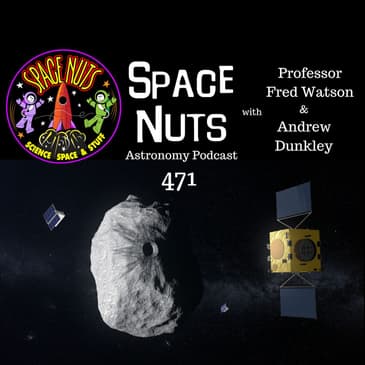
Join Andrew Dunkley and Professor Fred Watson in this enlightening episode of Space Nuts, where they explore the latest developments in Space exploration and the fascinating role of light in both astronomy and human healing.
Episode Highlights:
- HERA Mission Milestones: Discover the latest updates on the HERA mission, including critical trajectory corrections and its upcoming Mars gravity assist. Learn about its objectives, including a close encounter with Mars' moon Deimos, and its ultimate goal of orbiting the asteroid Didymos.
- Black Hole Light Echoes: Delve into the intriguing concept of black hole light echoes and how light can be bent by gravity to create multiple observations of the same event. Understand the potential of using Very Long Baseline Interferometry to study these phenomena and what it could reveal about accretion discs.
- Healing with Light: Explore the historical and modern uses of light in medicine, from ancient sun worship to contemporary phototherapy treatments. Hear Andrew's personal experience with radiation therapy and the importance of regular health checks.
For more Space Nuts, including our continually updating newsfeed and to listen to all our episodes, visit our website. Follow us on social media at SpaceNutsPod on facebook, X, YouTube, Tumblr, Instagram, and TikTok. We love engaging with our community, so be sure to drop us a message or comment on your favourite platform.
For more Space and Astronomy News Podcasts, visit our HQ at www.bitesz.com.
Become a supporter of this podcast: https://www.spreaker.com/podcast/space-nuts/support.
Stay curious, keep looking up, and join us next time for more stellar insights and cosmic wonders. Until then, clear skies and happy stargazing.
00:00 - Andrew Dunkley: Coming up on Space Nuts is the HERA mission
02:11 - I'm interested in two different stories about light about the hero mission
02:59 - ESA's HERA mission will make a close approach to Mars next year
11:07 - Andrew Dunkley and Fred Watson discuss light echoes in Space Nuts
13:17 - Measuring Black Hole Light Echoes with Very Long Baseline Interferometry
21:42 - Measuring black hole light echoes with very long baseline interferometry
22:39 - Even since ancient times, we've used light for medical purposes
27:55 - Fred has been receiving radiation therapy for prostate cancer for five weeks now
34:16 - Professor Fred Watson: Believe me, I'll be around for next episode
✍️ Episode References
European Space Agency
https://www.esa.int
Phys.org
https://www.phys.org
Universe Today
https://www.universetoday.com
Astrophysical Journal Letters
https://iopscience.iop.org/journal/
8205
5--- The Conversation
https://theconversation.com
Cancer Council New South Wales
https://www.cancercouncil.com.au
Hi there, thanks for joining us. This is Space Nuts. My name is Andrew Dunkley. Lovely to have your company again. Coming up in this episode, we're going to look at the Hero mission, which was launched not so long ago, but now they've reached some critical points in the mission, even though it won't reach its destination for quite some time, they've done some critical burns to get the thing moving in a more expedient fashion. Let's say, we're also going to look at black holes, well not specifically, but black hole echoes and how they might be able to be found using light. And speaking of light, this is a really interesting story about the human history of using light to treat people's ailments. That's all coming up on this episode of Space. Nuts fifteen in Channel ten nine. Ignition Space Nuts NI or three more Radio one spaces and I reported Neils. Good and here again see what I did there is Professor Fred. What's a hello? Fred? Oh? You should be on radio? You know there such good stuff that you do know. I think forty years on radio was enough. Although you know what, I'd go back tomorrow if anyone asked, Suh, I tell Judy, I teld Judy, Well, I would get there. It's just good fun. I just I loved being on the air and telling silly stories and got a big kick out of breaking news if something big happened and no one else knew about it. Yeah. I know that sounds pretty more because sometimes it wasn't good news. But break breaking a story is as a journalist is always a big Yeah, it makes you feel good. Sometimes I better qualify that, do's not always? I know what you mean. Yes, yes, we have plenty. This is a really fascinating episode, Fred, because we're talking about, firstly the hero mission, but I'm really interested in the two different stories about light and because we know we couldn't do without light for many, many reasons. So we'll get into that. But the Here emission, we didn't really talk about it when it first started because I mean, it started as a rocket launch and what can you say, it launched. Okay, we got that done, But now Here has reached a critical point and they've done a fairly significant burn to get it into an accelerated approach to Mars where it will do a gravity assist and then that'll pick it up even more. But I think they've got to do another burn before that because they've got to adjust its course to get on target. We might start though, by talking about what the Hero mission is all about. It's got two sort of objectives. One's a minor objective taking advantage of the of the Mars visit. Indeed, that's right, so it's in fact it will be really interesting. And that that flyby that we're about to talk about is March next year. It's not very far down the track, so we've got a close approach to Mars. And it's a gravitationally assist that's why it's basically happening. But it comes, it will come within three hundred kilometers of the surface of Demos, which is Mars's smaller moon. If I remember right, this is about fourteen kilometers across. It's a tiny world. And this will give us some really good close up images of the surface of Demos, which has been explored already by the you know, some of the orbiters that are around Mars. But that is here is going to give us another look and just to tight the details. You've sort of mentioned this already, but the fly But the reason why we're talking about this and why it's sort of in the news is because of this trajectory correction, so it's an eesumission. I didn't mention that at the beginning. European Space Agency launched the seventh of October, so very recently, but towards the end of October, on the twenty third, as you said, it underwent course correction, and the details are that it fired all three of its orbital control thrusters for one hundred minutes. That's how long we're earn It changed the velocity by one hundred and forty six meters per second, and then there was another one carried out just a few days, few days ago, I'm not sure. Yes, from where we are now, it's four days ago. It was on the sixth of November. That lasted thirteen minutes and put in an additional twenty meters per second. And now we've got it absolutely on track for the gravity assist at Mars in March twenty twenty five. So something to look forward to that we will almost certainly talk about next year. Yes, indeed, I'm just trying to look up what its actual speed is total, but I'm having trouble finding it a bit. It's going hellful leather. Let's just yes, yes, so there is a there's a further burn coming up a little bit later this month, Andrew on twenty first of November, which the mission scientists say will be a few It will be another correction of just a few tens of centimeters per second, so. It's less than a Yeah, it's. Just incredible what these guys can do. I read. I think that the telemetry that they're gathering so that they can make the adjustments includes three locations on the surface of the Earth, and one of those is in Australia. Is that right? Yes, that's right, said does have a it's got a tracking station in Australia. I think it's the new Nausea one. That might be wrong with that, but there is an ISSA tracking station here. Now. You know, it's going to take a closer look at Demos, which is of great interest given that you know, it could it could become crucial in terms of future visits to Mars. It might, it might provide some kind of Is it the one that's going to actually fall back into Mars at some stage in terms of the otherwise that's Phobos. Yeah, Phobos is kind of spiraling slowly downwards towards the surface of Mars. I think Demos is going the other way. Actually right, oh okay, And is the thinking that they used to be like they're captured asteroids. Yes, probably it's that there odd world's Phobos is it's got the density of a piece of pummus. It's you know, it's most probably fifty percent of it is empty space, which is really interesting, so that Phobos will be an interesting world to visit. And you might remember it's probably now at least a decade ago, there was a mission to Phobos which was launched by the Russian Space Agency ross Cosmos. It was called Phobos Grunt and Grant was the work ground because it was going to land on Phobos. But it didn't make it. The launch vehicle didn't give it in a forbital velocity, and sadly it burned up in the atmosphere, in the atmosphere, not marsers. So yes, you're you're right, there's all that happening. And then there is the mission. The mission's real you know, its real goal, which is to go into orbit around Didimos, so it will actually orbit it's target when it gets there. And by the way, the target date, the date for orbit insertion around Didimos is the fourteenth of December twenty twenty sixth. That's my birthday, so that'll be a good meet to celebrate. So and what you know, the questions that it will will really be interested in are not so much to do with Didimos the asteroid, but it's Moon Dimorphous, which is, if I remember rightly, aboute hundred and seventy meters across, and that's the one that the Dark Mission impacted in twenty twenty two. So the questions that Hero will be asking are things like did it leave a crater or did it just sort of rebuild the whole asteroid because we think Didimos is a rubble pile. Sorry, we think, well, Didimos is probably a rubble pile as well, but we think Dimorphois is a rubble pile, and a little bit more about its internal structure, which you'd be able to get from the details of the orbit that here finally goes into. So I think it's going to be a very interesting mission. That will be a really neat follow up for the Dart mission, and we'll give us more information again on you know, the relative all relevant stuff. If ever, we are under threat from an asteroid impact because this knowledge that we really need. Yes, absolutely, absolutely, And the good news about this mission is that it's not going to be that long down the track. Some of the missions that are headed out at the moment are just going to take so long. But this one, Yeah, we're looking at just a bit over two years before we reach the destination, which in astronomical terms is a pretty quick trip. Yes, it's my calculations are correct. It's less than two years. Less than oh yeah, hang on a big time. I know you're right now, sorry, you're quite right. Yes, it's a bit over two years, exactly, Sorry, I'm miscalculating there and putting my March is where my December should be. And I believe I would think that Marie Claire, won of our most dedicated listeners who went to NASA for that particular impact event of the Dart mission, should be pretty keen on what happens next. So yeah, and I've got all my Dart memorabilia here, I've got my Dart T shirt, my Dart stickers are over there, and thanks to Mary Claire, and hello to you, thanks for your support, and yeah, it would be a pretty exciting mission for all those involved, even those that were invited just to watch. Yeah, terrific. So yeah, we will definitely be updating that when the time comes. And if you want to read the story about the course adjustment and the mission, the Hero mission, it's at the fizz dot org website. Phys Now you're with Andrew Duncle and Fred Watson. This is space Nuts. Space Nuts. Now. We've got a couple of light stories. They're either light stories or light stories, depending on which way you want to look at it. This first story, Fred brings us back to our old favorite topic black holes. But I found this story interesting because it really explains well how light is affected by gravity, particularly the gravitational effect of black holes in space, and how we can witness events more than once because of this. We've talked about that before and they refer to them as light echoes. Do they not? Y if they do? And later light echoes are sort of a broad topic. In astronomy, we've got a situation where because of the finite speed of light, you can sometimes see the same event twice. Perhaps the classic one is and the one that's easiest to get your head around. If you have a super and over explosion, a star explodes and you get the direct beam of light that comes to us that tells the story of the explosion. But sometimes you get reflections off dust clouds, which is quite often a long way away from the super and over explosion, so that the light takes a dog leg path and eventually we see it again. And that's actually one of the ways why we can see sometimes see super and Ova, which exploded in historic historical times. The one that I like is Kepler super and Ova, which took place in sixteen hundred and four, and we can still see it because of a light echo. So you can analyze body equipment to analyze the lights. This is something a little bit different. I'm going to pour from min Andrew because there's a gentleman with a what I would call a strummer and you'd call something else, is doing the grass out the back of our house. Are you getting any noise interference there? Just a little bit. It's not too bad. Okay, I'll keep going, then I keep doing so. With the black hole story, it's not about reflections from dust clouds. It's about refraction, about the light being bent by gravity around the black hole. So the intense gravitational field of a black hole pull's light around it. And you know it will either deflect it slightly or depending on where the light is emitted, or it can be something that goes all the way round, and in fact, you can go all the way round more than once. And so the paper that we're talking about, which is I'm looking at the original paper here in Astrophysical Journal Letters, is called Measuring black Hole Light Echoes with very long Baseline into Ferometry, and it's by a group of scientists who are all in the US at institutions with very very prestigious names, like the Institute for Advanced Study in Princeton, which I think was where Einstein worked, at the Los Alamos National Laboratory in New Mexico, all of these places, and so this is something you know, it's work of a very high quality. What these authors are suggesting is that if you have so think of a black hole around it, it's got the accretion disc, the disc of material that is swirling around the black hole, some of which is actually going to disappear inside it, and some of it will be squirted upwards along the relativistic jets. Think of that accretion disc that's got stuff in it that's swirling to together, and you know just basically the energies that are involved as such that you get X rays and radio waves coming from that accretion disc. Now, if you imagine, you know, a particularly big lump of something in there, that it's another particularly big lump in that disc, you're going to get a flash, basically, an explosive event, which will release radiation. And the point that these authors make is that that radiation, yes, may take a direct path towards the Earth, but it could also go around the black hole, and it could go around multiple times. So you might get an explosion that we see and then a number of light echoes that follow it at sort of pretty regular intervals as the light travels around the black hole. And so what they've suggested is that if you can analyze that and look at it in detail with radio telescopes we're talking about here, because that's the wavebandits of interest in this, then that might tell you something about the details of the accretion disc and the events that are taking place inside it. If you could see, you know, whereabouts these light echoes seem to come from, and things of that sort. And what they're suggesting is that you could do it with this technique called very long baseline interferometry or VLBI, which is beloved of radio astronomers. And what you do is you have dishes separate, separated by large distances, and you can sort of correlate the signals that each gets because they're slightly different, you know, because of the separation of them, and that lets you essentially see very very fine details. It's actually how the event horizon telescope works, the thing that has indeed mapped the event horizon of several super massive black holes. So so the bottom line is you can't actually do it with very long baseline into geometry on Earth. You need to put one of your one of your You can do it with one telescope on Earth, but you need to put one of them in orbit around around the Earth, or at least into space. You need the distances that you know that you get from putting putting the antennas that are going to provide the baseline. You need to put them very very far apart. And so it's the paper that suggests how you might do that. I've just got the abstract from the paper in front of me. What they say is our results suggest that detecting echoes may be achievable through interferometric observations with a modest space based, very long baseline into ferrometory mission. The modest is a word that you can put numbers on, and I think the numbers are later in the article. Haven't actually read the paper itself, but in the abstract they certainly talk about the kinds of the kinds of effects that you might see and what you might need to build in order to do that. Now, interferometer is interferometers in space and not a new suggestion. So it may well some of our audience have suggested it. They have, indeed, that's right, they have. Indeed, so we might we might find that this is something that almost that the the you know, the hardware already exists because there are radio telescopes in space already. But anyway they're suggesting, they're not they're not really going into detail of how you might do it, but they're suggesting that it will in fact be possible. Okay, so we are not there yet, but they've certainly looked at ways that they might be able to do this by through publishing this paper. They've they've gone public on it. That's exactly right. Yeah, what they've what they concentrate on in the detail in the paper is the details of this, you know, this multiple apparition of flashes of light and the actual how how the gravity of the black hole actually steers the light around, and just the details of what the black hole might do to the to the light and by light, I'm talking really here about radio radiation, uh, and suggesting that you might need bigger tackle than we've got already in order to in order to measure it. Yeah. What fascinated me in the story is how you talk about an event collision that creates a flash, and that light comes straight towards us, and we see that event, But the light can also be disrupted by the gravity of the black hole and do a few laps around the black hole before it gets headed in our direction. So what sort of a time difference would it make between us seeing the real event and then the echo. Well, they'd be very small, wouldn't they dis going to depend on the size of the black hole. You know, some I think they're talking about super massive black holes, And in fact the article talks about we explore the viability of our method using I love this using numerical general relativistic magneto hydrodynamic simulations. There you are of a near face on decretion system scale to M eighty seven like Parameises et seven being the galaxy of which we've imaged the super massive black hole center. And so you're talking there about an event horizon that is solar system sized or much bigger than the solar system. So you're talking about possibly hours to days of delay in the efforts. Still, that's a short time frame in terms of being able to collect data. So that's you know, it makes it even more Gee, they're doing a good job in your backyard. By the end, I'm wondering what I'm going to have to move for Andrew to find quite a place to do this. So let's let's let's move house and we'll keep going. We'll keep talking, but I'm going to take you with me and I quiet a part perhaps to do this. This doesn't happen often, but that's. All about Yeah, that's right. I'm going to wander around this way because I think it will be quiet right at the other end of the house. Right, just depends whether or not you lose your your Wi Fi connection in the process. Should hopefully, hopefully it should be all right. So I mean, I'm knowing Marni's study with Currently we're taking service as a bedroom because we've got lots of visitors coming. So here we are, Oh very nice, oh nice view, beautiful mm hmm, excellent, Ah, very. Good, Thailand, complete silent until they come around the corner and do that bit that. Yes, but I think we've pretty well wrapped up that story. So if you are interested in reading it, it's in Universe today dot com, or you can read the whole thing Measuring black hole light echoes with very long baseline interferometry in the Astrophysical Journal Letters. This is space nuts Andrew Dunkley with Professor Fred Watson piece nuts. Finally, Fred, we continue our look at light, but this is light of a very different ilk, I suppose you could say, because it looks at the relationship between light and humans and how even since ancient times we've used light for medical purposes, which is FASCT and this dates back a long long time. It does. Indeed, that's right, and you know, I guess we are. We're I think, as you said, you've you've almost experienced this yourself. We all know that the Sun is the principal source of heat and light, for the planetics what allows life to evolve, it's where the energy comes from. And so it's not really surprising that our forebears of various different ILKs should have had a special place for lights in their understanding. And you've only to think of some of the civilizations in South America which you know, which were based on sun worship, and talked about some of those. The reason why we're talking about this is a very very nice conversation article that has recently been issued the seventh of November, just a few days ago, written by Philippa Martyr who is a lecture lecturer in Pharmacology Women's Health at the School of Biomedical Sciences in the University of Western Australia. And philipp has written a lovely a lovely kind of overview of the part of light in making us better and her article is part science, part magic and illuminating history of feeling with lights. A very nice title there, and it you know it goes. It starts off with some of the most ancient religions on the planet, which involves some worship and takes it from there because often these early religions were tied up with healing and just reading from Philippa's article earlier. While sorry sick people would turn to the shaman or priest or priestess for help and that's you know, so it's a natural thing to do when you kind of feel better when you're in sunlight. And so the article traces, you know, traces that history right through to more modern times. And you know the fact that we still use phototherapy with blue lights used to treat newborn babies with jaundice in hospital. That sort of thing really interesting and a really interesting story with a very comprehensive look at sunlight and its place and you know, well. Being yes, and when you talk about the ancient cultures that used to use it and papers were actually written about it dating back to fifteen hundred BCE in Egypt. Egyptian medical scrolls have been discovered that talk about using sunlight mixed with other things to try and overcome certain, i don't know, frailties, illnesses, afflictions, whatever you want to call them. But even as simple as the warmth of the sun being used to heal just simply getting warmer. And you probably could read some of this stuff and say, oh, look, you know it's all hogwash. They were obviously, just you know, they didn't know much about medicine, so they came up with these lame brain ideas. But even today light is used in medicine and there are great examples of it. It doesn't so much happen in Australia, but there are parts of the world that get very dark and dreary in winter, and you can overcome that with certain forms of light. You can cure jet lag with light. You can different kinds of light for different kinds of circumstances, white or blue light. When you expose people to that, it can over forms of depression in some cases, and you can use ultraviolet light to treat skin conditions. The article refers to that it is quite a natural thing because we've grown up and adapted to sunlight as a species on this planet over tens of thousands of years. So it makes sense. And some of the interesting people that have talked about light have been brought up in this article. One of them was Florence Nightingale, who actually wrote a I think did she write a book about it. She wrote a book called Notes on Nursing and was a strong believer in the power of sunlight. This is quite incredible stuff and sorry, go on, no, go. Ahead, go ahead, Andrew's find Well, I. Was going to just sort of put myself out there because even though it's not directly sunlight related, we still use things that are created in the light spectrum to treat serious illnesses. And you look at radiation therapy for cancer, Well, the rays that are produced by radiation therapy type machines are in the light spectrum. So you could argue that we're still to this day in modern medicine using light. And you said earlier Fred that I have some experience with that, and a few people that listen to the show already know this. But I have been for the last two and a bit years been dealing with a cancer diagnosis, and over the last five weeks, I've been receiving radiation therapy for remnant cells caused by prostate cancer, and hopefully the therapy will be successful and eradicate them. So that's my personal experience with if you want to call it light therapy, it's not use of sunlight. These in my case would I've done some research because I need to know these things for it, but it's in my case the form of therapy I'm receiving is actually using X rays to attack the postak cancer cells. And according to bioncologist, I'm a very very good candidate for this kind of therapy. And it started off with an injection in the bum which was a hormone suppressant to stop testosterone, which is what prostate cancer feeds on. And then that was three months ago, and then I started my radiotherapy five weeks ago, once just after we got back from Turkey, and that finishes at the time of this recording tomorrow. It was my last dose. And then on Thursday I get another hormone shot to stop the testosterone from recharging so that the radiation therapy has got the best possible chance of killing off the cancer cells. So yeah, that's been my life for the last five weeks or so. And basically I've been dealing with this for a bit over two years. So at the beginning of last year, I had the prostate removed, but the pathology showed that the cancer had broken through the prostate cell prostate wall and got into a thing called the seminal vesicle. And this was probably the unlucky bit. When they took the prostate out, they severed the seminal vesicle, So two millimeters of cancer cells were retained in my body and that's where it's all sort of come from. So yeah, that sounds shocking, It sounds horrible, it sounds scary, and I suppose it is to a certain degree, but I'm dealing with it and my prognosis is very good. Obviously they can't give me absolute guarantees, but this therapy is the most successful available today, So fingers crossed. Yeah, light therapy is a thing, is a thing. So you're right. The X rays that you use are part of the electromagnetic spectrum and so it's just light radiation with very short wavelength. And you know, I think it's all credits you, Andrew, for what you're going through at the moment, and for opening up to all of us space not cases, who are all very much interested in your well being. And yeah, I've received some nice messages. I went public through the can the Council New South Wales because I get a regular newsletter from them, and they put an appeel out for anyone who might be willing to tell their story in the hope that it will help others. So I know, with my radio background, felt that was probably something appropriate, and I will give the same message right now. If you're a man fifty or over, you need to go to the doctor and have a PSA check and get them to check your heart, your diabetes or bloodshoo levels and your cholesterol or at the same time to make sure you're okay, particularly PSA levels, because if they start to climb, they can look innocent enough and then all of a sudden they will balloon. And that's what happened to me. I went from a two point one ps A level to a seven point eight in twenty two months, and that's when they knew something was dreadfully wrong. So all it. Takes is an annual checkup at your local doctor just to see if everything's okay. And if you do that and you do develop prostate cancer, chances are they'll catch it super early and you won't end up where I am. So don't Dealey Deli. It's not going to hurt you. Just to go and get a quick blood test and sort it all out. That's my message to any man or someone you know of the male persuading fifty or over, and I would take that back to forty plus. If there's a family history there, you go all right, I've done my job. Well done. Yeah, it's very good to hear. Yes, I think it's an important message. Indeed, did this. Yeah, and it's all about light, as you say, it's all about light, yes it is. Yeah, and it's a great story. Read it. It's at the Conversation dot com. And it's. A really interesting story, part science, past magic, past, part magic and illuminating history of healing with light. It's a terrific story while we're well worth reading. And we might just end it there, Fred, Thank you so much. It's a it's a pleasure, Andrew. It's a temporary ending, of course, because we'll be coming back again. Yeah. I'm not dropping off there. I'm not dropping out of the Twigans. Hurry. Believe me when you said I end it there. It did sound a bit final. But sorry about that. No, it's all good. Yeah, Sorry, I see you next time. Indeed. Yes, we've got some questions to sort out in our next episode, so I do want to be around for that. Thank you, Fred, so soon. Professor Fred Watson, Astronomer at Large. And thanks to Hugh in the studio for not sending me any sick jokes this week. He does it all the time and some of them horrible. And from me Andrew, Uncle you thanks for your company. Catch you on the very next episode guaranteed on Space Nuts. Bye bye to the Space nutsdcast. Available at Apple Podcasts, Spotify, iHeartRadio, or your favorite podcast player. You can also stream on demand at fights dot com. This has been another quality podcast production from fights dot com.