
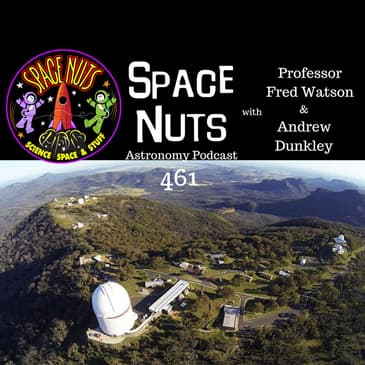

Join Andrew Dunkley and Professor Fred Watson in this engaging episode of Space Nuts, where they explore the latest advancements and historical milestones in space exploration. From the 50th anniversary of the Anglo-Australian Telescope to the groundbreaking Starship 5 test flight, this episode is brimming with fascinating insights and cosmic discoveries.
Episode Highlights:
- Anglo-Australian Telescope at 50: Celebrate the half-century milestone of the largest optical telescope on Australian soil. Fred Watson Watson shares his personal connection and the telescope's impact on astronomy, from its iconic images to its world-first discoveries.
- Starship 5's Spectacular Test Flight: Discover the audacious success of SpaceX's Starship 5, where the booster was caught mid-air by giant clamps. A game-changer in Space flight efficiency and technology.
- Deep Space Laser Communication: Explore NASA's successful tests of laser data systems, achieving communication over distances equivalent to Earth-Mars separation. Learn how this technology could revolutionise Space communication.
- Europa Clipper's Journey Begins: The mission to explore Jupiter's icy moon is underway. With its massive solar panels and advanced instruments, Europa Clipper promises to uncover the mysteries beneath Europa's surface.
For more Space Nuts, including our continually updating newsfeed and to listen to all our episodes, visit our website. Follow us on social media at SpaceNutsPod on Facebook, X, YouTube Music, Instagram, and TikTok. We love engaging with our community, so be sure to drop us a message or comment on your favourite platform.
For more Space and Astronomy News Podcasts, visit our HQ at www.bitesz.com.
Become a supporter of this podcast: https://www.spreaker.com/podcast/space-nuts/support.
Stay curious, keep looking up, and join us next time for more stellar insights and cosmic wonders. Until then, clear skies and happy stargazing.
Hello again, Thank you for joining us. This is Space Nuts. My name is Andrew Dunkley. I know it doesn't sound like me, but I have a cold, so that's my excuse and I'm sticking to it. Coming up on this episode it is all about space launchers and telescopes and communications. We got a look at the Anglo Australian telescope fifty years on Starship five's test flight, the deep space laser communication system that NAS has been testing, and Europa Clipper is off the ground. That's all coming up on this episode of Space Nuts fifteen seconds. Guidance is Internal ten nine ignition sigunch, Space Nuts four three. Two Space Nuts as when I reported Neil's good. And joining us to unravel all the ravelment of space science is Professor. I've read Wat's a Hello Fred, Hello, Hell, They're good to see you again, Andrew gotcha. Yes, indeed, I've been overseas. I know that people probably don't realize that, but I think we alluded to it in the last few episodes that we were doing catch ups to try and maintain the momentum, so we didn't miss any many weeks. But I've been to Turkey, which is what we call it, but it's Turkey in that particular country. And well you can say Europe or Asia, which one do you choose? I mean that the country spans both continents, So yeah, it's fascinating country. Fred I loved it there, loved it. I haven't. Yeah. Look, I chose that holiday because I wanted to go to the Gallipoli Peninsula. Now that'll be familiar to Australians, New Zealanders, British and a few other contingents who did fight on the peninsula in World War One in nineteen fifteen. But to people from the United States, they might go Galie, what Gallipoli? Gallipoli, the data and els. It was a plan to take Constantinople from the Ottoman Empire in World War One and it was an utter disaster, but it was written into Australian folklore, so sort of a mecha for Australians and New Zealanders to go there because it was essentially Australia's first war as a federated nation. And so I walked the beaches of Vanzac Cove and visited the battlefields of Lone Pine. I wanted to see the Neck. The Battle of the Neck was one of the most tragic advances I think the Australians fought in in the entire First World War many but it was a hiding to nothing. They just did not have to stand a chance because they were running across ground that had cliffs on both sides as wide as three tennis courts, and they were up against machine guns and they just didn't have a hope. And now that I've seen it, I can see the problem. I didn't really you know, you've heard the stories, but yeah, quite incredible. I went to. Chunnick Bear right up the top, which is where the New Zealand has got, and that's as far as the Allies ever got in the Callipoli campaign. They could see the dataels which was the target, but they never got near them. Yeah. And then we visited all sorts of other places, some incredible ruins, including the famous city of Troy. Yeah. And then we spent seven days out on a boat on the Mediterranean, just flitting around from port to port or cove to cove, swimming and relaxing and telling silly stories to each other and eating up a dorms. Great fabulous country. Loved it. Istanbul is just amazing, but so as some of the other places you've probably never heard of, like Fettia and Cash and places like that, well. Worth a visit. I would go back tomorrow. Yeah, So what have you been up to while I've been away? You've been busy, You've been busy. Yeah, just a few minor you know, plans shaping my entire future, which we won't go into at the moment, but there might be news down the track, but more especially it will lead into our first item. I think we've recently had a symposium to celebrate the fiftieth anniversary of the Anglo Australian Telescope, the largest optical telescope on Australian soil, together with the annual Siding Spring Starfest, which is the open weekend that always happens at the beginning of October. Yeah, which I went to a couple of time times over the years, but I was away for this one. And look, fifty years is an incredible achievement. But for twenty of those years you were in charge of that place. That's correct, and actually. And that's how we met. It is how we met, that's right when there was astronomer in charge there. So yes, it's as I said, the biggest telescope on Australian soil, mirror three point nine meters in diameter and sits on the mountain in the Warren Bungle Mountain range. Warren Bungle is a go millar Ray word. It means crooked mountains that's not very far from where you are now, and yeah, they are very crooked. So we had a lot to do with each other. But what a lot of people in the astronomical community don't realize because they have no idea that I am actually one hundred and ninety years old, but I was involved with the Anglo Australian Telescope before it was even built because my first job in astronomy and the only time I've ever worked for a private company other than with casual student jobs, I was an optical physicist fresh out of university at a company by the name of Sir Howard Grubb, Parsons and Company Limited, which was founded back in the eighteen thirties or its original version was, and that was the company that got the contract to build the telescope itself. That's what we call the tube, even though it's more like a you know, it's an open framework and the optics they had the contract to do that. The mounting of the telescope, a bit that pointed around the sky, was built by the Mitsubishi Corporation in Japan, who you may have heard of. And my job, this is back in nineteen sixty nine, was just after the sting for the mirror. So the mirror is made of not glass quite, it's a glass ceramic material called serve It, which has which has zero expansion coefficient, which means that as the temperature changes, it doesn't change its shape. Quite a revolution at the time, because you know, as the temperature warmed. With old fashioned telescopes, she had to refocus them and do all sorts of things, but Servit changed all that. So this twenty ton casting three point nine meter diameter casting of Servit material was cast in Ohio, which is where O AND's Illinois, despite their name, where they had their glass factory. My boss at the time went to inspect this glass blank in nineteen sixty nine and came back saying it's all good. There is no there are no flaws with it that will compromise its you know, it's becoming a perfect mirror and it's coming back to the United Kingdom where I was working. What we need is we need a proper mat for it to sit on while the optical polishing is taking place. But it's more than a matt. It was an air bag. So this was two thick pieces of polyethylene welded together around the edge three point nine meters in diameter, to be filled with air under high pressure when the mirror arrived, so it could sit on that for the optical surfacing, which actually took about four years and removed something like four tons of material. The finished mirror was sixteen tons, delivered in nineteen seventy three to the observatory. I didn't actually make the air bag, but I did start the work on the air bag. Remember these huge pieces of black polyethylene. That was my part in the origins of the Anglo Australian Telescope. As you said, it very quickly became an icon in its own right. It was commissioned, well, it was actually opened in fact, as we are recording this on the sixteenth of October twenty twenty four. It was opened fifty years ago today by a gentleman who simply signed his name Charles in the visitors book and has now been promoted is his Majesty the King he opened it, and that's what we're celebrating with that anniversary. It went into service in nineteen seventy five immediately became one of the leading telescopes in the world because it was the first telescope of its size to be completely computer controlled, and that meant it was could work very efficiently. And another thing that put it very quickly on the map was the photographic work of my friend and colleague David Malin lives not very far from where I'm sitting now in retirement, although he's still active. He perfected the art and science of making true color images of the sky, which had never been done before. He used a combination of three photographic plates and in red light, one in blue light, one in green light, combined them together to make true color images, and they became world famous. There were books and albums and all sorts of things, but that, plus the scientific ability of the telescope is what really put it on the map, and so for fifty years it's been one of the leading instruments in the world's arsenal of great telescopes. We nearly lost it, though, didn't we At Big Fire. Yes, that's correct. Twenty thirteen, the thirteenth of January was the date the womble On fire swept across the top of siding Spring Mountain and nearly took out everything. The reason why it didn't one of the reasons why it was that exactly a decade earlier, almost to the day, not quite, but almost to the day, a similar fire had swept across the Mount Stromlow Observatory in Canberra, which was the parent body of the Siding Spring Observatory, and that did take out pretty well everything. And the bottom line was lessons were learned from that that were applied at Siding Springs, so we had amber screens on all the windows. One of the problems with the bush fire is that the ambers, the burning embers get through the windows, they smash the glass and before you know where you are, you've got a fire inside the building. Doesn't matter how you know how good it is on the outside, the fires burning inside. And that's what happened Stromlo. We were saved from that by the lessons learned, plus the aerial water bombing of the Rural Fire Service as well. So yeah, they were infrastructed. They were fabulous. Of course, you and I spent a lot of time on here over those twenty years talking astronomy and some of the things achieved by the Anglo Australian Telescope. And our transmitters were on the neighboring mountain, yes, zen Kruek, and our transmitters were under threat from that same fire, and the Royal Fire Service saved our transmitters by bombing it with retardant, and the whole top of the mountain was pink. I got some photos of it, and it saved the transmitters. And I actually got into trouble from the ABC because I didn't tell anyone in Sydney that our transmitters were under threat, simply because nobody told me. But that was no excuse apparently. But yeah, but andrew you any harrowing time. You were always in trouble with the ABC. Now if I was over, yes, I pretty well defied political correctness on a few occasions and got me into some boiling water. But great time spread, great time. There were just very briefly, just to give you a flavor of our listeners, of a flavor of what the telescope did. It you know, had some world first It was the first telescope to see down to the surface of Venus with infrarend like penetrating the clouds. It was one of the first telescopes to discover the optical flashes of light from these rapidly spinning neutron stars that we call pulsars. In later years, it made and still does actually made huge surveys of the environment of our galaxy in the universe. So we've got, you know, surveys out to several billion light years. I think it's about five billion light years now, the originally it was two and a half billion light years. Where you map all the galaxies and from that you can deduce the structure. You find. There's this kind of honeycomb structure of galaxies which we relate to the Big Bang, and it lets us learn more about dark matter and dark energy. The actual structure that's imprinted on the universe as a whole is still doing that, and the other thing it's doing is investigating galaxies themselves in detail and discovering and characterizing the planets and of the stars. So it's right across all these hot topics in contemporary astrophysics. Fifty years after it was built, it's pretty good. It's remarkable and hopefully it will keep on keeping on. My first and last sojourn into television was with you at the observatory. So long ago. Yeah, they were testing whether or not regional stations, regional radio stations could become kind of television bureaus. It was somewhat successful. I think they've reignited that policy now. But yeah, we did a story about the two d AP wasn't it the two degree field Yes, I think yes, which was installed there. Yeah. Great, it's a great facility. After that fire, you could drive towards Kunebarrabrin from Dubbo and you could see this white pimple on the side of the mountain because none of the trees were there, so the observatory stood out like a literal sourcear. Yes, it's a remarkable site driving towards the Warren Bungles, but even more spectacular with all the trees burned away. It has changed the whole landscape. But yeah, congratulations for your part of it, because you were there for quite a significant part of those fifty years. Well done to you and everybody. Fred let us on if you want to read about it. Fred's written a terrific article about the telescope in the Australian Geographic magazine online at Australian Geographic dot com dot au. Fred, let's have a quick chat about SpaceX and their test launch the other day. The Starship rocket last weekend, as we speak, got off the ground. This was a really interesting launch, not only forgetting it off the ground but getting it back in a way I've never seen before. And when I watched the video, I went, this has got to be science fiction. That's not real. Yeah, it's computer generated. But no. In fact, they did catch the rocket in like clamps back on the platform. Amazing, a pair of giant chopsticks. Yes, so what they described them as. So, I mean we you know, I've been keeping an eye on this for a long time and because this has been planned for a long time. The idea of capturing the booster, the Falcon super heavy seventy one meters high. I don't know what that is in feet, but it's a lot. It is the basically the first stage of Elon Musk Starship project, and that idea of capturing the booster by this extraordinary mechanism of a couple of clamps that grab it as it falls back down to the to the launch pad where it left from seemed like a crazy idea. We've been talking they've been talking about it for years, but then this week we actually watched it happen on TV and it was truly amazing. So just quickly about the rationale for this, Andrew, I think most of the people who catch our podcasts will be aware that the Falcon Falcon nine boosters, which are really the workhourse of Star Sorry SpaceX's fleet. They routinely land on bar drone barges and they touched down on a flat surface, but they've got landing legs which fold outwards. I've stood underneath them actually in Houston and at Cape Canaveral, they they've got ones that have actually flown there. Those landing legs fold out and the rocket touch down and of course doesn't fall over because you've deployed the landing legs and they hold it up. But for the Falcon super heavy, it is so super heavy that landing legs strong enough to keep it upright just couldn't be made, at least with the weight penalty that you'd have to take with you up to deliver whatever payload it is you're delivering into orbit. So this really audacious idea of capturing it with these two chopsticks on this structure that they call mecha Zilla is amazing. And you know, I don't even think Elon thought it would work first time, but it damn well has done. So that start that flight. It's called Starship five. It launched from Bocachica in Texas, Orange Site with the starship itself, which is the payload. The pair of them what is it, one hundred and twenty one meters tall, incredible went up as planned. The starship itself was injected into orbit. It only made half an orbit, but it was actually an orbital velocity that dropped under control. Actually it was a soft landing, but not on land. It was in the ocean. I think it was the Indian Ocean, if I remember rightly. While seven minutes after the launch, the super heavy launch, the booster itself came back down to Earth where it set off from, was grabbed by these two clamps and is now sitting there ready to be used again where it needs to be. You don't have to go out to the Atlantic to get it, bring it back or whatever. It's where it needs to be used again. Achievement almost a game changer I think in spaceflight. Oh for sure, it'll save them a lot of time and probably a little bit of money in the process too, because the recovery process must be very costly and time consuming. Yeah, they can make this work time and time again. It'll it'll just. Just increases the efficiency of the process. So well done to everybody at SpaceX with that Starship launch test launch that was so successful and so spectactic. If you haven't watched it the X, just do a search online and find the Starship five test flight and watch the video of the landing. That thing just drops like a rock and just to watch it adjust its trajectory and balance and flight path and just sort of coming back to Earth. It's like you're watching a film in reverse. That's what it loves like. Yeah, it's quite incredible. This is space nuts. Andrew Unkley here with Professor Fred Watson. Space buds. That was Fred sniffing, not me. Oh did I sniff? Actually I did sniff. I do apologize. It could have been me. It could easily have been me. I'm usually careful with that sort of thing, but my god. Do I know that's can we get in the when the jingles are on it just sort of yeah, you think, yeah, embarrassing. It's all good for it, it's all good. Just o't cat No. I'll try to avoid that by being three killings. Probably not far enough. One of the most important things in space flight and space travel and putting bases on moons and planets, which will probably ultimately happen, probably sooner than we think, is communications and NASA. NASA has been looking at methods of communication that you know, through through a series of tests, and they've been very successful with this particular process, which I am still trying to get my head around. But it's it's a laser data system. And am I right in saying that they've actually successfully sent signals to Mars. It's it's it's the distance that Mars is out that it's not true that they've sent signals to Mars. Well, they might, they might have done, but they're not have come back because there's nothing on Mars to send them back. But the reason why Mars is mentioned in this story is that the distance that have these signals have been successfully received and transmitted four hundred and sixty million kilometers or two hundred and ninety miles two hundred ninety million miles of make apart. It's the same distance as separates Mars and the Earth when they too at their furthest apart. To Mars, but to a distance equivalent itchroxtremity. Yes, it's almost half a billion kilometers. It's wow, an amazing distance, and it's part of a project that is really all about something completely different. This is the Psyche spacecraft, which is on its way to an asteroid called Psyche, which, like so many other things in astronomy, is very close to my heart because Psyche was one of the asteroids that I tested my brand new software on that I wrote for my master's degree back in the eighteen fifties or whatever it wants it was. So Psyche is an asteroid that I've known about for a long time. It's of great interest today. Can you remember why it's exciting as an asteroid? Andrew, Yes, good, well, I'll tell you it's a metal asteroid. That's what I was going to say that I should trust myself, trust yourself. That's right. Should put your money where your mouth is, or your mouth where your money is. That must might be the right one or the other. It's it's it may be the sort of denuded core of a protoplanet that never formed. So it's thought to be mostly made of II. That may be other stuff mixed with it, but it's it's got that density that suggests it is the actual core of a of a of a planet that never made it. So Psyche the asteroid is being visited by Psyche the spacecraft, but en route the spacecraft has been testing out this new technology of optical communications. So what you do is to use a laser rather than a radio transmitter, and beam your signals which are modulated with the information that you want to carry in just the same way as you do with the radio signal, and you pick it up at the other end, and you look at what you've got. Now, this is not it's not sort of insignificant technology. The transmitter on the Earth is a laboratory. It is actually near right Wood in California, and it's run by the Jet Propulsion Laboratory. They have a facility at a place called Table Mountain which is near right Wood, and that's got the terrestrial laser transmitter on board which beams out wait for it, seven killer watts of laser power up towards Psyche. So you've got to have because Psyche itself has only got a small telescope. To receive these signals, you need to beam them out with a huge power, which is why it's a seven killerwa laser. Remember that you're even a strong laser pointer will be about three milliwatts or something like that, two to three milliwatts, So seven killer whats is a lot. The spacecraft receives those with its little optical dish and could then beam signals back. Now, because the spacecraft doesn't have a seven killer what laser on board, it means that at this end, if you're trying to get the signals back from the spacecraft, you've got to have a big telescope. And in fact what they've been using is an instrument that for many years was the biggest optical telescope in the world, the Hail Telescope at Mount Palomar, not far from San Diego in California. It's a five meter telescope two hundred inch. When I was a lad, it was my father the biggest telescope in the world. There were pictures of it everywhere, prominent in history, and now it's still a fully used optical astronomy telescope. But it's also being borrowed to be used as a ground station for this experiment. What is the point of it, Well, if you can use optical communications from space or even on the ground, you've got data rates that are up to one hundred times more than you can with radio frequencies. You can pack much much more data into your signals, and so it is particularly for space communications, is being seen as a really interesting way forward for our future in communications in deep space using lasers. These are in forra read lasers. Then they're not visible light wavelengths, but they're still much much more capable in terms of their data content. The radio signals are lasers amazing what they can do with them, and they use them in medicine and radio radiation oncology, they use them in day to day life. They use them, as you said, with pointers, just little things like that, and idiots use them in their backyards to try and infew with aircraft. I mean, there's it's all sorts of that've become such a very. I don't know, pliable tool in so many ways. Yeah. Another tool that astronomers use them for is to create artificial stars that their adaptive optic systems can lock onto. So some of the biggest telescopes in the world in Hawaii in Chile have these laser systems that what they do is they shoot out light of wavelength the same wavelength that sodium atoms a bit. And you'll all remember the yellowish color of sodium lamps, sodium vapor lamps, which that's the characteristic color of glowing sodium. But if you beam a laser up to the upper atmosphere at about ninety kilometers above the Earth, there is a layer of sodium and you can excite it to glow like an artificial star if you pump it up with a laser, and then you can lock onto that with your adaptive optic system to remove the twinkling effect of the atmosphere. So that's one of the new technologies that astronomers use using laser. Not to mention also military applications, but we it's a very sensitive subject. So well there's all that too, Yes, that's right, say nothing more about that at the moment. Yeah, that's a great story. If you'd like to read read all about it, you can do that at Sidetechdaily dot com. And being an ASSA project, you probably find it on their website as well. Okay, we take all for space nuts, from one mission to another, from Psyche to europea clipper. We could not finish the show without mentioning that it is now up and running. Europa Clipper is a go and was launched this week our time. Indeed it was, and so far everything's functioning perfectly. It has already unfurled its solar panels, which I think I'm right in saying are the biggest in the biggest solar panels that have been used for an interplanetary mission. They're thirty one meters long, which is a lass. What's that one hundred feet are there about it? That's about the size of your average caravan. No, once you get around, yeah, what did you get stuck behind? Exactly? So it's yeah, So it's on its way. It's going to enter orbit around Jupiter, even though it's looking at Europa, one of Jupiter's moons. It will be in orbit around Jupiter from Is twenty thirty is when it will arrive. It will make. It has a four year lifetime and during that time we'll make forty nine flybys of Europa. The water world, the ice world that we know is orbiting Jupiter, a rocky body with all a global ocean over the top of it and a layer of ice over the top of that. So every three weeks or so it will sail past Europa, which is why it's called the Europa Clipper, because that's what it's going to do, ye past Europa and it's it will you know, it's festooned with things like ice penetrating radar and all of that sort of stuff that will allow us to detect what sort of content the water beneath the ocean might have. It will also we think, like Saturn's moon Enceladus, Europa has plumes of ice coming from its polar regions and so Europa Clipper will fly through those and it's got equipment on board that will say whether there are any perhaps suggestions of prebiotic molecules in the water or even biomarkers. Maybe we might discover that there's something in that water ice that tells you that there is life beneath the icy surface of Europa. That would be the discovery of the sension still bedding on krill. I've got very very long odds on a detecting whale song. But well that's right. Well, so might be there. Wouldn't that be the extraordinary? Yeah? Probably, it'll probably be squid. Science fiction always seems to go to the squid, like yes, discoveries on these kinds of world. Yeah, it could be, could be. Yes, Ut least I have something to eat when we finally go there. But it's very exciting. It's a long mission. If you've got a job on this mission, you could be pretty happy because you've probably been involved long enough to get long service leave. So it's a big mibb. Yes, that's right, And it'll probably. Lasts longer than the four years that they've given it, because that seems to be the norm these days with some of these spacecraft. They just keep going. I mean, look at the Voyagers and all those things that are still trundling around on Mars that we thought would be forever gone long ago, and they're still working. Everything seems to work well past it's use by date these days, which is a good thing. We'll probably possibly get more out of it, unless they're planning to crash it into something for it. Are they? I don't know. I don't know what the mission is, but you're right, that was exactly what I was thinking, because in some ways, it's a kin to Cassini, which was in orbit to satur And the reason why it was crashed into Saturn's atmosphere to melt basically by friction, is in order to avoid any suspicion of contamination by some of the moons of Saturn that may contain living organisms. So maybe a similar fate, It's bless you, maybe a similar fate away. It's Europa Clipper at the end of its life. That was my wife. It's become part of the program that she has to sneeze at least once during a recording section. I'm just grateful that it wasn't me sniffing. Yeah, the thing is she'd probably do about twenty five more before she's finished. She only sneezes once a week, but she does them all at once. Oh gosh. Yeah, that's a great story, and europea clipper on its way. So sit back, relax, get yourself hurt, spin a collad and we'll get back to you in twenty thirty. So yeah, we probably Well that's the tough part about you. You've got to be patient. You've got to be patient. You can find that story on the NASA dot Gov website. We're just about done. Don't forget to visit our website. As well while you're online Space Nuts podcast dot comspacenuts dot io and have a look around. Don't forget. We've got the Astronomy Daily news feed there that you can subscribe to. You can communicate with us via the am a link up the top. There. You can visit the shop if you've got the old Christmas is coming up. You know, if you've got Astronomy nuts in the family, you might find something really juicy there that you can get somebody for Christmas. Whether it's a T shirt or a cap or a book or there's all sorts of stuff. Space Nuts podcast dot Com is the site and we are done. Fred, thank you so much. It's a pleasure. Thank you for having me and great to see you again. Andrew. Always good to have you along, Fred, Otherwise I'd be sitting here just doing that getting RSI of the thumbs. Yes, thanks Red, Fred, Wat's an astronomer at large. And thanks to here in the studio for being so very patient and sitting back for four weeks waiting for me to get back from Turkey and from me Andrew uncle you thanks for your company. Catch you on the very next episode of Space Nuts. Bye bye, Thanks. You'll be listening to the Space Nuts podcast. Available at Apple Podcasts, Spotify, iHeartRadio, or your favorite podcast player. You can also stream on demand at bites dot com. This has been another quality podcast production from nights dot com.