
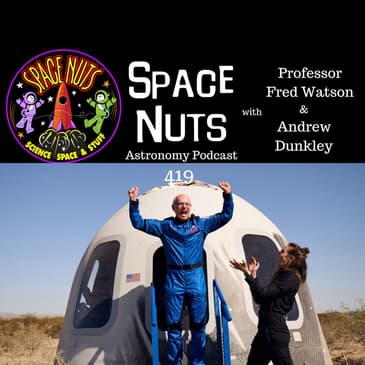


00:01:12 Professor Fred Watson discusses eating fairy floss with a moustache
00:02:10 Bright flash in the sky over Europe turned out to be comet
00:05:55 Ed Dwight was the first astronaut of colour to be selected by NASA
00:10:10 This is a newly discovered planet, or newly identified planet
00:17:14 Planet in orbit around red dwarf star 1200 light years away
00:21:06 Fred: Some work is being done on background gravitational waves
00:28:17 Fred Watson: People are fascinated by gravitational waves because of mystery
Support Space Nuts and join us on this interstellar voyage by visiting our support page. Your contributions help us continue our mission to explore the wonders of the universe. Clear skies and boundless exploration await on Space Nuts, where we make the cosmos your backyard.
Become a supporter of this podcast: https://www.spreaker.com/podcast/space-nuts--2631155/support.
www.spacenuts.io
www.bitesz.com
https://www.bitesz.com/show/space-nuts/support/
Sponsor:
www.bitesz.com/nordpass
Hi there, thanks for joining us. This is Space Nuts where we talk astronomy and space science. My name is Andrew Dunkley, your host. It's good to have your company. Coming up on this episode, we are going to be looking at the latest launch from Blue Origin. It's been a while they've had some technical issues, but they've now had a successful launch and some interesting side stories In this one as well, we're going to look at a planet that's well, not made of but has the consistency of fairy floss. That's what we call it in Australia. You might call it cotton candy or candy floss depending on where you're from. And gravitational wave background in the universe more evidence of that. I guess you could compare it to what we refer to as cosmic microwave background radiation, but this is in gravitational wave form. I think I got that right. That's all coming up on this episode of Space Nuts. In Channel ten nine ignition Space Nuts or three two and I reported real good and once again he did grace us with his presence is Professor Fred Watson, Astronomer at Large. You got you got some fairy floss on your face? Oh sorry, but that I must have a show. Could be could be a mustache. Have you have you died a pink or something? Actually, eating fairy floss is lethal with a mustache, and it's uh yeah. Yeah. The other thing that's really hard to do is scones with jam and cream on because you end up cream everywhere. Yes, I remember my days of being a bearded fellow, And yeah there was something she just didn't especially especially if you get like source or ketchup in it and you don't know and it dries out, and yeah, it's horrible, it's disgusting. Actually, we've got a lot to talk about, Fred and I did. I did want to sort of bring up a topic without notice, But I don't know if you saw the story over the weekend of the bright flash in the sky that was seen in Europe, Spain and Portugal. What fascinated me about this story is it turned out to be a piece of comet after they did a bit of analysis. Now how do they know that compared to it being a meteor or a meteorite? Yeah, so I died looked a enough story as well. It was scene of a Portugal and other European countries very very bright something like forty four kilometers per second fly through speed. I checked all that. So because there was so much imagery of it, Andrew, you can essentially trace back its orbit orbit that it was on when it collided with this atmosphere, and it's that that gives you the clue as to where it comes from. I assume. I don't know. I didn't follow up on the on the story. I did see that people were quoting that it might be a broken off bit of comet. If you've got a very elongated orbit, one that you know will be typical of what a comet might look like, that would be a clue to that. Mmmm. Well, yeah, would the color be effected, because that's correct. There can be different colors depending on the composition, can't they. That's right, that's correct, And yes, indeed, I think it was magnesium that was quite strong in the coloring, or hypothesized to be quite strong in the coloring in terms of the material that was contained there, And I think magnesium was another pointer to it being of cometary rather than asteroidal origin. Most most metals are just dust left over debris from the version of the Solar system, so they more related to asteroids than comments, but this might be quite an unusual one. Indeed, some of the footage was extraordinary. I remember one particular video I saw of a young woman who was being filmed, I assumed by her boyfriend, and she was just talking. I think she was in Portugal, and the sky just lit up bright green, and she just looked up and it was sort of this silence for a while. It's just beautiful piece of video. I've got an amazing shot of it just streaking over her head basically and then disappearing beyond the horizon. But it just turned night into day very briefly. A Green Day, which is also a great band. But it was quite extraordinary. Yeah, worth looking up. There's plenty of footage of it, lots I saw it now, going from green to blue? Now, Fred, did you like that segue? It's pretty good. Yeah, you should be more. Yeah. Well, I think I'm just about to retire. Now. Blue Origin has been back up for the first time in a couple of years. They've had some setbacks, but this is actually, I suppose, not only a great return to space for them, but a couple of well at least one major record set in the process. Yeah, and a really nice story too. So this is Blue Origins NS twenty five mission again, as these flights are as sub orbital flights, and you're quite right they had issues with an uncrude flight a couple of years ago which grounded them for a while, but they're back in business now. The flight was uneventful. I think one of the return parachutes was not fully opened when they landed. But Blue Origin can land with only two parachutes. It usually has three, and I think they're clearly looking at all that. But the thing that you alluded to, fabulous story. A gentleman by the name of Ed Dwight, who is I think I'm writing saying ninety years old. He was selected back in nineteen sixty one by the President John F. Kennedy as an astronaut candidate to trained at the US Air Force's Aerospace Research Pilot schools. Was a conduit basically into the Astronaut Corps. At the time, NASA was very young then, NASA was only formed in nineteen fifty eight. So yeah, so what it meant was that he was the first astronaut candidate of color, and so that would have been a record breaking status for him if he'd been the first astronaut of color to fly, and he actually wasn't selected though, so he completed his training. He was recommended by the Air Force for the Astronaut Core, but he wasn't selected. In those days, it was the look of the draw. There were many people available. I think there was a whole cohort of female astronauts. I never got selected either in the very early days. But this time he made it. So he flew into space with the Blue Origin New Shepherd mission and his twenty five A lovely quote from him, I thought I didn't need this in my life, but I lied. I really did need it. It was the first real deal that I got involved with in that I wasn't successful at, he added, referring to his non selection by and so this is I'm quoting here on space dot com. So he said, I wish I'd gotten it then, But it's great, That's all I can say. Good on him, Good on your head. And what a wonderful you know, what a wonderful thing to happen. Yeah. Holy. He got into space at the age of ninety years, eight months and tender, which is the oldest person ever to go into space, which is extraordinary in terms of his early selection for potential astronaut candidacy, that it was the subject of a lot of controversy at the time, because, as you said, he didn't get selected. He was quoted in nineteen sixty six as saying that racial politics had forced him out of NASA and into the regular officer Corps. So it doesn't sound like he had a smooth run in the situation that he faced, and probably was a bit resentful by the sound of it. But he went on. This is what I found amazing. He went on to work as an engineer and then into real estate, but he became a sculptor, yes, which I find amazing. Is I'm not aware of his work, but he's done some amazing sculptures. Apparently he was commissioned by the Colorado Colorado Centennial Commission to create a series of bronze sculptures entitled Black Frontier in the American West. Now, he must have been a talented guy. I'm still alive. I'm not know. He's obviously a talented guy and has had quite an extraordinary career, not involving space by the sound of it. But he finally got there, which is fantastic. Yeah, that's what a brilliant thing. Yeah, it's a really nice story. And just to mention that he was one of six passengers on board S twenty five and I think all the great time. Yes, And I think he also was in twenty twenty inducted into now what was it, I can't remember, but yeah, he was recognized for his candidacy Hall of Fame. I can't remember something like that. Yeah, it's probably right in front of me and I cannot see it. Don't you hate that? Yes? I do. Perhaps to be all the tribals PA's nuts. Yeah, never mind, but yeah, a great achievement by him, and of course Blue Origin back in action after a couple of years off. Fred, let's keep moving. We're going through lickety split today. But this one, I particularly, this caught my attention on the weekend. I'm glad you picked up on it to talk about. This is a newly discovered planet or newly identified planet. I don't know which way you go, because sometimes they find these things and you don't hear about them for years. But this is a gas giant. It's huge, but it's also not very dense. It's got sort of opposing factors that come into play. Here and it's being described as a cotton candy or candy floss or fairy floss planet. Let's talk about this. It's one of the WASP discoveries. That's correct, it is. It is WASP one. Where I've lost the number one nine to three B. What's one nine three B? What's if I remember rightly stands for Wide Angle Search for Planets. It's actually an old colleague of mine who started that program back in the day, somebody I worked within the nineteen nineties that ling Each observatory, so a great program and has done very well. It's a program that looks for planets by the occultation method. That means as the planet passes in front of its parents, start the light of the parents start dimm slightly, and you you recognize the dimming as being due to the obscuration by a planet. And then it goes around. It's all bit comes back and does it again. And when it does it again, then you know you've got a planet and you can work out you know, it's always all characteristics and things of that sort. But what you need to do for more details is to look at the spectrum of the object, in particularly the spectrum of the star to do what we call the Doppler wobble technique, where you look at the wobble in the star's motion which is detected is this is its motion along the line of sight what we call the radial velocity that can be detected. That excuse me, wobble caused by the planet pulling the star slightly out of place as it goes around. That basically essentially resulted in scientists knowing the mass of one nine three B And it turns out that it's paradoxical. It is paradoxical, as the headline in sitech Daily says, a baffling cosmic mystery, A giant planet as fluffy as cotton candy. And so what we have here is a planet about twelve hundred light years away. It's fifty percent bigger in diameter than Jupiter, but only one seventh of the mass, and that means it's density is very low. There's a dog barking outside. Probably it's the dog star. For read, Yeah, that could be it. Yes, well, the dog star is called Jordian in box. At any time a leaf moves outside or anything like that, it's very sensitive. I think his mummy has probably just come back. That's probably what it is anyway, so that the statistics themselves are quite interesting. So it's it's got a density and I'm working in the old units here of grams per cubic centimeter. Remember, water has a denity of one gram per cubic centimeter. Our rocky Earth has a higher density five point five one grams per cubic centimeter. Jupiter, being a gas giant, is lowering density on average. It probably has a rocky core. We don't really know too much about the core of Jupiter, but it's one point three three grams percubic centimeter. So that's the density of Jupiter. And then move to WASP one nine three B, and its density is zero point zero five nine grabs per cubic centimeter, which is about the same as cotton candy. It's about the same now cotton candies light, or candy floss or fairy floss. Because it's mostly air, you know, it's it's essentially an open structure which has air air in it. Now, clearly WASP one nine three B doesn't have air because it's it's in space, but it may well have some sort of structure that is that is similar to cotton candy. We really don't know. It's that. The reason why it's hitting the headlines is that the scientists have made this discovery, and mostly in the US. Massachusetts Institute of Technology is one of the one of the institutions there. The question now is how did planets get like this? How can you form a planet that's like that? It's no, that's just that. That's the question I actually wrote down on my piece of paper. How does a planet become so fluffy? For one of a better term, and you know, what could it possibly be made of? Exactly so. So there's a few comments from some of the researchers. One some of them were in Spain. By the way, I did mention m I T. But let me just quote from some of the authors. On quotes from some of the authors, here's one. The planet is so light that it's difficult to think of an analog solid state material. The reason why it's close to cotton candy is because both are pretty much air. The planet is basically super fluffy. And then from one of the Spanish show collaborators on this, we don't know where to put this planet in all the formation theories we have right now, because it's an outlier of all of them. We cannot explain how this planet was formed. Looking more closely at its atmosphere will allow us to constrain an evolutionary path of this planet, in other words, looking at how something like this might have come about if you can see chemicals in its atmosphere or something of that sort. And then just one other quote, what's one ninety three B is a cosmic mystery. Solving it will require some more observational and theoretical work, notably to measure its atmospheric properties with the James Webspace Telescope and to confront them to different theoretical mechanisms that could possibly result in such an extreme inflation. It is inflated, that's the way. It's kind of puffed out. And yeah, what causes that? Is there an energy was in it that's blowing stuff outwards? I don't know. I don't know the answer to that. Yeah, it makes you wonder why you'd call it a planet if if it's just inconsistent, it's just just a well, so you've got to call it. I don't know, it's a blob blob that's more. Yes, let's see, that would seem more consistent with its, with its, with its ure, and yet its characteristics are very much those of a planet's in orbit around a star. It's quite a short orbit, if I remember, it's just a few days so, and I think it's probably a red dwarf. I can't remember the the star itself, the characteristic of its, of its Yeah, I think they said it was actually a young sun like star. And the orbit is six and a quarter days a quarter days, that's correct. Yes, how's that for a memory. I only read that a minute ago. I've got in front of me, which is even better. Yeah, it is a mystery. And this is like, we don't know so much about Jupiter and Saturn and the ice giants further out, but here's one that's twelve hundred odd light years away that we've we've discovered that it's just so very different to what we think of in terms of the place giants. And now it's possible it was just made up of leftover stuff and there wasn't much left and it's yeah, but the trouble is that's how planets form anyway, It's left over stuff, and so there must be something else going on. I think this is when we should keep an eye on though, so there'll no doubt be more research coming on. Is it actually pink? Do we know what color it is? That's done? We don't actually we yeah, we don't know, and that's because all we can see at the moment is the obscuration of the planet of the star by the planet and the radial velosity changes in the star itself. So that's not much information to tell you what color it is. But if the James Webb telescope gets onto it, there's every likelihood that when the planet passes in front of its Parents style, some of that light from the Parents star goes through the atmosphere of the planet, and you can actually detect from that what's what the constituents of the atmosphere are, and that might tell us first of all, what it's made of, what the atmosphere is made of white, so different from all the others, And whether it has a color, whether it's pink or blue. Yeah, it's probably yellow or reddish in color, I would imagine, But who knows two of ours are blue or no? One's blue ones green? Yeah, actually, yes, they're both looking more similar colors. Now, there's been some work done on this which that the difference in coloring has kind of been exaggerated over the years. Right, Yeah, I actually I know you mentioned that. I do remember reading about it and they they were basically saying, the similarities between Neptune and uranus are quite extraordinary. They're almost identical twins. Ye. Yes, But you keep an eye out for this one. This is this is just if you if you want to try and spy it in the night sky. It's right next to the big Ferris wheel, so it shouldn't be hard to fight. But just watch out for the cosmic roller coaster, which is probably as well. Yeah, and there's terrible showbags, full of junk, terrible to you. Maybe that's what it is. Maybe it's made of show bags, written showbags. Yeah. No. A great story though, and well worth looking into. And you can find that on SI Tech Daily. This is Space Nuts. Andrew Dunkley here with Professor Fred Watson. Three Space Nuts. Now, Fred to one of the most popular topics on Space Nuts and certainly one that draws a lot of questions from the audience, and that is gravitational waves. What we are talking about today is not quite that. This is some work that's being done on background gravitational waves. Now, I said at the beginning that this was I would describe this like the cosmic microwave background radiation the remnants of the Big Bang. Well, this is the remnants of gravitational wave activity, and they're calling it gravitational wave background in the universe? Am I right? Or have I just completely decimated this entire story? You're right? Is rightish? Is good enough for me? You know, the gravity wave background is called the background because it's in the background of everything. Sorry, sorry, The cosmic microwave background is in the background of everything. We can see. It's the flash of the Big Bang. It's something that originated in the Big Bang, and so it is a It provides a backdrop to all our observations. It's there in the background. If you've got the microwave telescope, you can see it, and indeed you can map it. We have the best map we have today of the microwave background comes from the Plank spacecraft of European spacecraft that mapped in great detail. And it's because of that mapping that we can, excuse me, that we can see you know, structure, structure in the cosmic microwave background radiation. That tells us about conditions in the Big Bang. The background that we're talking about here is slightly different. Whilst it is true that the Big Bang would have caused gravitational waves, there is something else going on that's sort of spread throughout the whole universe, and that is a background of you could call it interference. It's a little bit like you know, if you're broadcasting, as you often do, and your listeners are hearing you over the airwaves, there might be a bit of a background hiss or something that comes from from interference. And I think that's the way in which this term is being used for this, because what has been detected and the evidence that you know, the headline with this story was that the evidence is growing for this is a sort of background heres if I put it that way, of gravitational waves that come from many many phenomena going on in space, mostly mergers, mostly neutron star black cole collisions or black hole black coal collisions, or neutron style neutron style collisions. All that sort of constantly going on, which gives you a background level of gravitational radiations, of gravitational waves slashing around through the whole universe. That can't be pinned down to come from a specific source, which is what the LIGO detector does, and it's you know, it's comparable instruments throughout the world. LIGO Large Interferometric Gravitational Wave Observatory picks up signals that the ripples in space that come from identifiable phenomena, but there is also a kind of background swill or swell of gravitational waves which are detectable in a different way. That's why this story is an interesting one that does include Australian science as well. So it turns out that binary pulsars, which are essentially the a big part that there are some binary pulsars involved with this. But pulsars, let me just explain what pulsars are. Pulsating radio sources that basically are there. They're rapidly rotating neutron stars which are beaming out radiation in a lighthouse like fashion, and the essentially the beams of radiation they're radio waves. Principally, sometimes they're seen invisible optical pulsars. They they if they flash across the direction of Earth, then we see a pulse. And it turns out that that rotation of those neutron stars is very, very constant. It's a constant almost better than atomic clocks. They are timing devices better than our best atomic clocks. They're so irregular, but because they're part of the fabric of space, they are sort of being moved around by gravitational waves and that changes the frequency of the pulsation. And so if you can set up what it called pulsar timing networks or pulsar timing arrays, then and if you can do that from many places on Earth, so you're kind of effectively looking in different directions at different pulsars, you can see the effect of gravitational waves. And so the timing arrays that are mentioned in this paper European Pulsar Timing Array, the Indian Pulsar Timing Array, the North American nanots Observatory, and the Parks Pulsar Timing Array, these are basically arrays that are looking at the timing of these pulsars and measuring how they're changing slightly due to this ground swell of gravity waves that's sort of bucketing through the universe in general, and he's thought to come from you know, it's it's superimposed gravitational ways from lots and lots of things going on in the universe. Black hole, black black old binaries, always seeing one another, collisions. They are more specific events, but the smaller ones at great distances would contribute to this background. So what we're talking about, just to clear it in my head, you've got a pond, you're chucking a hundred pebbles in all the waves just criss cross and criss cross backwards and forwards constantly. That's that's the gravitational wave background. The absolutely the Ano Logue equivalent and very nicely put, if I may say so, Andrew, that's exactly right. If you've got this, you've got to dam it down for me. Well, no, it's not dumbing down. I think that's a very good analogue. But you get what I meaning. It is a sort of background. And then if somebody throws a rock in, there's a big, you know, big spreading out of ripples, which you can then detect with a gravitational wave detector. But you've still got this unevenness in the in the surface of the water. So yeah, great, and the wow, Okay, I'm sure we'll get a lot of questions about this, but it's yeah, it's a I'd never thought of gravitational waves as being just bouncing around constantly and interrupting things that we can observe, so that we can, you know, we can piece together what's happening to a certain degree. But I'm sure we'll get questions about it. Fred, Absolutely, people are fascinated by these kinds of things, and I think it's because of the mystery that surrounds them that gets people wondering and coming up with their own ideas. And I love that. I love it when people come up with their own ideas of what might be happening, because that's how you figure things out in the end. It is indeed, that's right. Oh and you mentioned that background hissed when I'm on the radio. That's just too many eggs for breakfast, So yeah, I did much about that. Yeah, yeah, well that's right. You should move you should move your mic away from your digestive processes. That's something I've loved, you know. I've got to tell you though, I was I was on air once and I did feel a sort of movement and I thought, just quietly, nah, didn't quite and it actually happened between words, so it wasn't a his Yeah, great moments in radio. Yeah, well quite so. Yes, we should find the table. I'm pretty sure it's long gone. Yes, thank you, Thank goodness, too many other embarrassing moments that I've managed to keep there. Now. If you want to chase up that story about the gravitational wave background, it's on universetoday dot com for it. That just about wraps it up for us for another week. Thank you so much. It's a pleasure, and I hope we'll do it again sometime soon. Possibly so maybe in a few minutes. You never know. Time is a relative, it is until relative. That's rightly thanks. Fred, will catch you soon. Fred Watson, Astronomer at large, and who isn't with us today? How everything went well? And from me Andrew Uncley, thanks for your company. Catch you on the next episode of Space Nuts. Bye bye, Spacenuts. You'll be listening to the Space Nuts podcast available at Apple Podcasts, Spotify, iHeartRadio, or your favorite podcast player. You can also stream on demand at bites dot com. This has been another quality podcast production from Sites dot com.