


Then, take a volcanic voyage to Jupiter's moon Io with Juno's latest flybys, revealing a lava lake in Loki Patera so vast and smooth it mirrors the gas giant itself. Marvel at the newly dubbed Steeple Mountain, a geological spire that evokes Earth's own gothic cathedrals, and ponder the mysterious forces sculpting Io's tumultuous terrain.
The episode continues to probe the secrets of the Solar System as Juno also sheds light on Jupiter's elusive water content, challenging previous theories about the giant planet's formation. And finally, the duo turns their gaze to Mars, where a new theory suggests that humans may inadvertently be unearthing the Red Planet's methane mysteries with the tread of rovers.
From celebrating trailblazing astronauts to unraveling the enigmas of alien worlds, this episode of Space Nuts is a cosmic journey not to be missed. Tune in for these interstellar stories, and remember to bring your curiosity as we explore the wonders of our universe.
Support the podcast and unlock a universe of knowledge by visiting https://www.spreaker.com/podcast/space-nuts--2631155/support. Don't forget to subscribe for more deep space discoveries and celestial insights with Space Nuts, where the cosmos is just a play button away. Until our next cosmic rendezvous, keep your eyes to the skies and your questions at the ready.
And for your daily space news fix, check out the team at our sister podcast 'Astronomy Daily the Podcast. Available wherever you get podcasts or stream from the website at www.astronomydaily.io
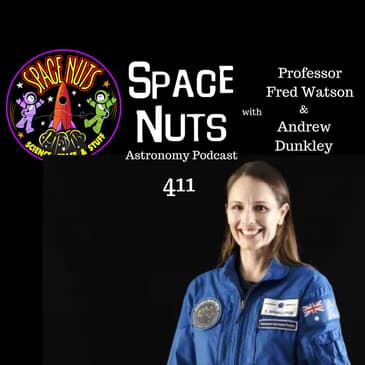
Hi there, Thanks for joining us on this episode of Space Nuts. I'm your host Andrew Dunkley. Glad you could join us once again. Coming up on this particular episode, we'll be looking at Australia's first female astronaut, announced this week. Her name is Katherine Vannell Peg. We'll tell you a little bit about her. She had to go through quite a process to get there, but it's all good news. We'll also be inspecting things within our solar system, a lava lake on EO. We'll be looking at Jupiter's water or lack of as the case may be, and a new theory as to why methane is being found on Mars. And it's a strange theory. Indeed, indeed we'll tell you all about it on this episode of Space Nuts. Fifteen seconds. Guidance is in chantal ten nine ignition Squench Space nuts UI or three two more space notes. As when I reported Bills Goods joining us to take a dip in the legs of EO is Professor Fred what's an astronomer at large? Hello Fred? Yeah, you'd want to have your steel chip boots on. I think if you did that, But yes, it's very good to be here, Andrew. I'm delighted to be back on Space Nuts once again. I'm glad to have you. Otherwise I'd be sitting here making a complete fool of myself, which happens lightly, rather than me making it complete with myself, which is also what happens anyway. It's all about Yes, it is. Otherwise we'd have to call it space normals. Yeah, yeah, properly, yes, and it doesn't have a ring to it at all. Now we might as well get stuck straight in and first cab off the rank is this announcement that we have now and Australian female astronaut, first one ever. We've had a couple of blokes, but this is our first female astronaut and she had to really work hard to get there. She did, Yes, she saw the blokes. Just to get that out of the way. Paul Scully Power and Andrew Thomas, Thomas, Andy Thomas, both of them my actually had quite a lot to do with. In fact, Paul Scully Power wants led me completely astray after an episode of the Prime Minister Science Prizes when I shared a cab with him. We ended up I didn't end up at my hotel going to bed, which is what I expected. We ended up in a bar, so that was interesting. But to come back to reality, I've also I actually have met Catherine Bennell Peg and I can't remember the I can't remember the occasion on which it was. It was down in Adelaide. I think it was at the Space Agency because that's where she worked. Day job is the Space Agencies, and this is the Australian Space Agency, of course it's she is the space as Director of Space Technology and there must have been an event on I think it was Anrico Palermo, who's the head of the Space Agency, who introduced me to Catherine, but I can't remember what the event was. I do play fairly regular trips down to Adelaide, where the Space Agency has its headquarters. Anyway, enough of that. What is she She's what? She's now a fully trained astronaut. She's just finished a formal astronaut training in Germany. She is basically somebody who's always wanted to be an astronaut. Let me quote what she says in the news release. When I dreamed of becoming an astronaut as a child, I never thought it possible to do so, representing Australia. It's an honor to be granuating as an astronaut with the Australian flag on my shoulder. And actually the reason why she's saying that is that I think both Andy Thomas and Paul Scully Power had the US flag on their shoulder because I think they were whilst they were Australian citizens, are born Australian. I think they had US citizenship as well, So Catherine doesn't. She's actually got UK citizenship as well. But like me, and that I mean, but she will represent Australia. She goes on to say, representing Australia is filled with opportunities to propel our nation science and technology forward in the global space arena and to raise the level of aspiration for the next generation. I hope my training and whatever comes next unlocks the path for more Australians to become involved in human spaceflight. So she's now, she's now fully qualified. Will it remains to be seen as to when she will get a flight. I hope she will, and I hope we'll talk about it on Space Notes. We might in build an interviewer one day, wouldn't that be lovely? Yes? Yes, I believe She's one of six graduates out of an original pool of twenty two and a half thousand. There you go. It's incredible. It's pretty pretty tight. Back in the seventies there was there was an invitation for US citizens to apply for astronaut training. Now looked at the advert But I didn't qualify because I'm too tall. Really yeah, five foot eleven was the limit. I'm six foot four, so no chance, no chance. Just how tall I am for it? Five foot eleven, five eleven. Yeah, you could go. It's not too late, Andrew, Oh, I think it probably is. Probably, although although you know, if I took a leaf out of John Glenn's book, I could probably get up there. Yeah, well that's right when he last went. Yes, yes, a bit young boy. Yeah, it's anticipated that all six of these graduates should get into space before twenty thirty. That's your plan. I think, great, it's excellent. So yeah, we've got to keep going until twenty thirty so we can talk to Catherine. There's a nice there's a nice comment by the person I just mentioned in Rico, the head of the Australian Space Agency. He says, we're proud of Catherine. She will return to Australia, a qualified astronaut brimming with knowledge, insights and connections that will help generate global opportunities for our industry. And that's good news. It is. And to wrap it up, she's thirty nine and a mother of two and that's good too. I mean, mums in space would be rare, wouldn't they. I don't know the statistics on that, but it's something we could look at. Yes, yeah, I'll write that down. Mun's in space? How many mums in space? That's a good idea. And yes, well done and congratulations, we wish her well, Katherine Bearnell pig. Now, Fred, let's move on to Juno, do you know, which is just a little bit further out than the Moon and other places where astronauts are headed soon. But this is part of the Sorry we're going to Eo, but jo is the mission. It is the closest moon to Jupiter and they've been taking a very close look at it and they're making some amazing discoveries on this mission. Absolutely, it's so you know, I can't remember when Juno was went into a bit around Jupiter. It's been quite a while, I reckon it's been four or five years. We've had extraordinary images of of the you know, the cloud tops on Jupiter, stuff that we never really imagine because there's so much going on, as we'll talk about in a minute, there's so much going on around Jupiter's polls that you never actually see from from ground based observations. You know, even the Hubble telescope or the James Webb telescope, which has taken some very fine image of Jupiter, it doesn't see that structure around the north pole, which is a south pools of Jupiter. But also what has happened is within the last actually the last six months, back in December and again in February, JUNO made close flybys of EO, the innermost of the moons that were discovered by Galileo, what were called the Galilean moons. In fact, a minimum distance was fifteen hundred kilometers from the surface of EO. And so lots of data taking, lots of image taking, and that's basically what we're talking about, because there's been some really quite striking imagery that's been produced. And one of the one of the areas that was flown basically at a low altitude and by that I mean hundred kilometers was around what I think is the biggest of the of the volcanoes on sorry on Eo. EO is riddled with volcano it's the most volcanically active body in the Solar System. It gets its its heat for the activity from the fact that it's in a resonance resonant orbits with some of the other Galilean moons, in fact, principally Europa and Ganymede. Those resonances basically squash and squeeze Eo along with the gravity of Jupiter itself to warm up the center by friction. Basically you've got you know, this squeezing and squashing and so that's why it's so volcanically active. And I think the most active or the biggest of these volcanoes is Lucky and it sits in the middle of a lava lake which has been observed actually from the Earth surface. And I think we might have talked a few years ago about observations which were made from Earth of the lava lake it's called Lucky Paterra, that showed that its surface kind of dried up from time to time and then turned over that you've got these kind of lava lake icebergs that actually turned over, and you might remember because you've increased the amount of infrareend radiation that's coming from it, which is how you know it's turned over. Do you remember that? Yeah? Yes, I do, yes, Yeah. And it's quite a blake too, isn't it. Yeah? Two hundred kilometers long, one hundred and twenty seven miles it's not a small lake. We'd call that an inland sea here, I think nearly. Yeah, and it's lava. You know. One of the observations that Juno has made is that there is a very strong specular reflection that comes off it, which means you're dealing with a very smooth surface. Indeed, and just to point out that, there are available on the web some YouTube basically reconstructions of the imagery that make it look like a flyby, and they are very nicely done. They are artists impressions, but they're made on the basis of the real imagery that Juno has taken, and certainly in one of them, you've got a nice reflection of the planet itself in the lava lake, which gives you an idea of just how smooth that surface is. And can we just move on as well to one of the other regions that was imaged. This is amazing, isn't it astonishing? There is there is because EO is so volcanically active, it's got mountains on it, and one of them is quite extraordinary. It's called Steeple Mountain. Once again, it's an artist's impression that we're seeing, which might mean that the elevation has been extended. But it's based on Juno imagery and it looks like a cathedral with you know, a medieval cathedral with with with towers on it. So yes, that's probably, you know, a result of the tectonic activity on EO. So we've got really quite remarkable structures on the surface that were I think are a bit unexpected. I don't think we we found too much evidence of really sharp mountains, but they're being shut by this by this flyby. Yeah, they've named this one's Steeple Mountain, haven't they. That's exactly what it looks like. It's very reminiscent actually of the imagery anyway of of Mont Sale Michelle. I don't know whether you've ever visited there when you've been sojourning in France, but it's off the coast of northern France, and it's a volcanic plug. It's offshore. It sits in the middle of the ocean, but it's got buildings all the way up. It's basically a monastery, and it's got this extraordinary cathedral on top with sepels that look a lot like Steeple Mountain here on the on EO. So that was, well, that was the lightness that didn't work in my mind when I looked at this in imagery. It's quite extraordinary. EO is just a bit bigger than our moon. And yeah, it's sort of suffering the effect of a tugger war between other moons and Jupiter itself resulting in all of its volcanic activity. A pretty volatile kind of place. And JUNO started orbiting EO or Jupiter, I should say, on the fourth of July twenty sixteen. So it's nearly eight years ten years. Wow, what did I say? Four or five years? I was, yeah, it's austral sixteen. While we're talking about the JUNO mission, it's also been looking at Jupiter itself and taking some scientific readings. And one of the things that scientists seem to be interested in is Jupiter's water what have they found out there? Well, I think this comes from analysis of the polar cyclones on Jupiter, which we're really only seeing close up as Juno gets closer and closer to the surface. And you might remember that Saturn has a polar hexagon, which is this hexagonal structure that comes from cyclonic activity. He basically sets up a wave in it's a wave akin to the jet stream on Earth around the pole. Jupiter's got something similar with the sort of symmetry that we've seen on Saturn, only this is actually eight sided symmetry rather than six sided symmetry, and it's this set of cyclones around the polar are eight of them, but they're also surround a central you know, a kind of mother cyclone, if I can put it that way, which is even more prominent. But what has been discovered is that the microwave radiation from that central cyclone right at Jupiter's north pole, and we are talking about the northern polar region. Now, that central cyclone has a low level of microwave signature. It's much less strong than the other storms that are going around it. And so what's being inferred from this is that the structure underneath that cloud surface is very different from the other cyclones, and in fact, they're expecting as we get more data from JUNO, to be able to build what you might call a three dimensional map of these polar storms so you can see how they stretch down into the atmosphere of Jupiter. And that comes from a quote by JUNO project scientists whose name is Steve Levin. He's at NASA's Jet Propulsion Laboratory. So that's again related to how they are looking for the molecular structure of Jupiter's atmosphere, and it turns out that there isn't as much water on Jupiter as they expected to find what we call water abundance. So it's suggesting and this is by looking at molecules like oxygen and hydrogen TO and H two, and they of course are the constituents of water. That is suggesting that there is a deficiency of water on the planet Jupiter, which is unexpected, and so you know, it feeds into our understanding of how Jupiter formed. There's a quote which is on the NASA Spaceflight website which perhaps I can I can just read this because it's certainly puts it more cogently than I will juno's new results on Jovian water abundance suggest very low water abundance, an unexpected results that scientists are still trying to understand. However, these results do support scientists theories that during the Solar System's formation, water lice material was lightly a driving force between heavy element en Richmond, the process by which chemical elements heavier than hydrogen and helium were recreted or collected by Jupiter during its formation. And they're going to basically keep looking with JUNO to try and work out what the distribution of water abundance is comparing pullar and equatorial regions, And no doubt we might talk about that down the trap. We may well do. There's just so much going on that mission is quite incredible. The fact that it's done, I don't know, getting close to sixty maybe more flybys of Jupiter and it's done. And while it's doing that, they've been able to coordinate flybys of the near moons, which in an engineering sense is just an extraordinary mission. And well you probably historically going in it's one of one of the great feats of modern space engineering. I would imagine absolutely and remember you know when this was being planned and I think back in twenty sixteenth space nuts that already started. We were talking about it then. Nobody knew whether it would survive radiation bells. That was always one of the big questions, is he going to make it? And well, it certainly has, and it's doing a fine job, as we've been discussing, and it sure has. And if you want to chase up information about that Juno mission and the water on Jupiter and those incredible geological features on EO, it's on the NASAs spaceflight dot Com web website. Even this is space Nuts Andrew Dunkley here, we're Professor Fred Watson space Nuts. Now, Fred, let's move on to Mars, a little bit closer to Earth sort of. And they have. We've we've discussed this a few times and there's been all sorts of theories put up about why they've been detecting methane on Mars. One of the theories is it may still have some sort of tectonic activity below the surface, or it may have some you know, primordial life that's that's leaking this stuff out. Because most of the methane on Earth is created by living creatures. We know there aren't living creatures on Mars to this point in time. So you're thinking maybe there's something you know, microbial below the surface that might be doing this, But a new theory has been put forward and the cause might be us human Yes, well partly us, that's right, partly, which is not directly indirectly caused by us. Yeah, yeah, some of this anyway, because this the puzzle of methane puzzle is and it's one that goes back before we started sending the you know, curiosity and perseverance to Mars, because you can observe this in the atmosphere from Earth. You can detect that there is methane in Mars' atmosphere, So we knew about this long time ago. And yes, exactly as you've said, is it residial volcanism or is it methanogenic micros, both of which are interesting ideas, but it's behaved in a very odd way. For example, there is one spacecraft which is a European Space Agency spacecraft. It's called the EXO Mar Exo Mars Trace Gas Orbiter. It's in orbit lower orbit around Mars. It's never detected methane, and that is bizarre because that's why it was said there because we see Mars, we do see myth. Then in the atmosphere of Mars, I think it probably means that you don't get any methane at high altitudes, and then we've got you know, Curiosity had a device known as SAM Sample Analysis at Mars which keeps on detecting traces of methane around the surface of the location where it is, which is Gale Crater, named after an Australian amateur astronomer in the early twentieth century. So Gale Crater is a place where methn's detected on the surface, but in fact it's the only one so far because none of the Perseverance doesn't have anything to detect Mars. Perseverance, of course is in a different place, it's Jesuit Crater, so it doesn't have the ability to detect meThe But the story gets more complicated because quite often methane is detected at night by Curiosity, but then it vanishes during the day. It varies with the seasons. As you know, Mars of course has seasons. It's got a similar orbital inclination to the Earth about twenty five degrees if I remember rightly, and sometimes it goes you know way way up spikes to levels around forty times greater than we normally see. So what's the story why do some This is a question that's on a lovely article on this on fits dot org, the fis dot org website. They oppose the question why does some science instruments detect methane on the Red planet while others don't? And what they are coming to the conclusion The new idea in this is, and it comes from NASA, it's, you know, something that's been basically studied for quite a while. In fact, it's a scientists at they got old to Space Flight Center, green Belt, Maryland where this work is coming from. What they are suggesting is that the soil of Mars, which is kind of different from the soil on the Earth. We know that there's very fine grain sand there, but also that you get if there's a high level of salt concentration within that soil, it gets crusty. So you've got a crust that covers the lower levels. And they're suggesting that underneath that crust, and they're not suggesting how the methane is produced, but what they're suggesting is that the methane rises up and it is locked in by this crust of soil making up you know, making up the surface of Mars. And so they suggest that during summer, when it's a bit warmer, that weakens the crust and you get methane seeping out, and that's why we see the seasonal variations in methane. But also that if you've got a rover which weighs about the same as a car, you know, driving over this crust, it could break the crust as you drive over it and let the methane out. So that that's why you're seeing it in Gale Krater because this is where this crust is. That the rovers driving over that every time you know, it goes forward, it's going to stress the surface, maybe it release puffs of methane. It's a really interesting idea, and as you say, it means that humans are intervening in this process of Martian methane more than we perhaps thought thought there was. Well, it sort of brings into the into the arena the Ockham's razor theory. The most obvious answer is probably the right one. And you can see the tracks that these rovers leave behind, and they do dig little holes and grooves, and it stands to reason that if you're driving over pockets of methane and you're cracking the surface, it's going to come up and you're going to detect it. If the rover's got that kind of equipment on board, it could well be the reason, but it still doesn't answer the question as to how it got there in the first place. That's quite right. That remains a mystery. Yes, but some of its escaping is seasonal and possibly interventional. Yes, interventional. I like that. It's a good word. Yeah, I love making up words that it could be an intervenualist, interventionistic. Yeah, well that's even better. Yeah, I like that. Yes, Yeah, it's it's an interesting theory and one that you could hold water or me. Yeah. I don't know how you you know, I don't know how you investigate this further way, putting methane detectors on the spacecraft. There is a comment from another scientist that got up spaceflights to which is, methane experiments are resource intensive, so we have to be very strategic when we decided to do them. So, you know what, it sounds like they're half hearted about it. I'm not going to touch that one. Andrew. Yeah, anyway, two. You know, yes, it's hard to know how you how you pursue that to prove them that's the case. But maybe future surface spacecraft the way to go. They might be more focused on answering these significant specific questions. Yes, especially especially the question of where it all came from in the first place. Is it still being produced somewhere down deep inside big questions? All right, very good, and yes, as Fritz said, you can chase that story up on the fizz dot org website. That's p h y. Yes, and don't forget to visit our website while you're online listening to us. So you can do that by going to space nuts podcast dot com or space nuts dot io and have a look around while you're there, and you can listen to back episodes. You can subscribe to that thing that we have on there that I've forgotten the name of. I'm doing a Fred freend Ye. Yes, isn't it becoming a supporter. Becoming a supporter is what I'm talking about. So you can do that, check out the space nut Shop all that sort of stuff. Fred. That's where we're going to wrap it up for this episode, reminding people of our next episodes coming up. In the not too distant future a Q and A episode looking at all sorts of interesting stuff as requested by the audience. But until then, Fred, thank you very much. We'll see you soon. Sounds great. Thank you, Andrew. Talk to Sir Fred Watson, Astronomer at large, and thanks to here in the studio. Let me just check and see how he's going. Popped out for a cup of tea. So we'll just sit here and twiddle our thumbs for a while, and so we can come back and stop everything. No we won't, but thanks for your company. Catch you on the next episode of Space Notts from me Andrew Duncley. Bye bye. You'll be listening to the Space Nuts podcast available at Apple Podcasts, Spotify, iHeart Radio, or your favorite podcast player. You can also stream on demand at bites dot com. This has been another quality podcast production from nights dot com.