
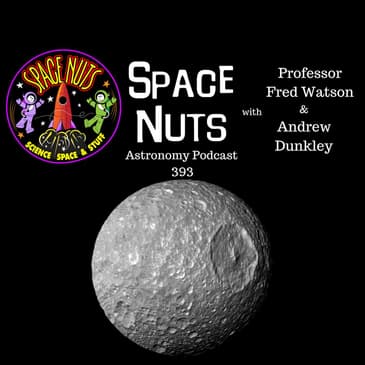


But that's not all that's brewing in the interstellar pot. We're also venturing to the red plains of Mars, confronting the possibility that bacteria might not just survive but thrive under the harsh Martian conditions. What does this mean for future human missions to the Red Planet? Could these microscopic stowaways pose a threat to astronauts, or might they hold the key to unlocking the secrets of life beyond Earth?
With a blend of intrigue and expertise, Andrew and Fred navigate through these cosmic questions, offering insights that will leave you pondering long after the episode ends. So buckle up, space enthusiasts, as we embark on another adventure that's sure to expand your universe.
For those hungry for more interstellar knowledge, be sure to subscribe to Space Nuts on your favorite podcast platform and join our growing community of astronomy aficionados. With new episodes filled with astronomical wonders and answers to your burning space queries, Space Nuts is your gateway to the cosmos. Until next time, keep gazing upward and let your curiosity lead the way!
Become a supporter of this podcast: https://www.spreaker.com/podcast/space-nuts--2631155/support.
Show notes created by https://headliner.app
---
📋 Episode Chapters
(00:00) This is space nuts. Coming up, we're looking at the Death Star
(03:05) It might be opportunist bacteria that follows the bite that could cause Alzheimer's
(04:39) Fred says moon Mimus actually librates around planet Earth
(12:16) Andrew Ker: Mimas and Enceladus are totally different moons
(18:56) NASA to try flutter test on its ingenuity helicopter on Mars
(19:52) Scientists have tested four human infectious bacteria to survive harsh Martian environments
(26:37) Fred Watson says bacteria could pose a risk to astronauts on Mars
Become a supporter of this podcast: https://www.spreaker.com/podcast/space-nuts--2631155/support.
[00:00:00] Hello again, thanks for joining us. This is Space Nuts. My name is Andrew Duncley. Coming up, we're going to look at the Death Star.
[00:00:06] Yes, we've gone from science to science fiction. No, not really.
[00:00:10] But there is a moon that looks like the Death Star from Star Wars and
[00:00:14] it's now in the news for a very different reason because it's not blowing up planets, but it's blowing up scientific minds.
[00:00:23] We'll also be looking at the potential for bacteria to have survived the rigors of
[00:01:25] insects that have left an impact. But yours is worse than mine. Yours sounds nasty.
[00:01:30] It may take me to hospital today to get intravenous antibiotics, which... Wow.
[00:01:31] Yeah, that's big time stuff, isn't it? Yeah, yeah.
[00:01:35] I get the pills I've been taking.
[00:01:38] A lot of people ask me about Australia and how dangerous it is because of all the snakes
[00:01:44] and the spiders and the box jellyfish and the drop bears and all those things.
[00:02:42] Yeah. And to keep them away.
[00:02:44] And that's right. Yeah.
[00:02:50] Yes, we use those if we've got dinner party outside or something like that.
[00:02:52] That away.
[00:02:57] It wasn't the greatest idea in the world to have this little thing smoldering away
[00:03:00] in a bedroom, but anyway, no,
[00:03:02] it's just passive smoking.
[00:03:03] That's what it is. I thought it was.
[00:03:05] Yeah.
[00:03:07] Yeah. I mean body is sort of elongated. They're not they're traditionally round spiders. They're more that shape. Long and thin. Yeah. But yeah, you don't really want to tangle with one of those. I can if that's what I had, I can vouch for that.
[00:05:42] You know, I got I got bitten, I got bitten on as you said, and unfortunately, I can't remember what it's called, but I'm sure you'll find it very quickly on the interweb. The story, though, is a surprise and it comes from some work. I think if I remember right, at least by French scientists,
[00:05:47] can't find the reference at the Okay, but this this liberation if you study it carefully will tell you things about the internal makeup of Of whatever moon it is you're talking about Because and this is particularly the case. This is how the oceans of of Titan of
[00:07:04] Enceladus of
[00:07:06] Europa
[00:07:07] and of effect. Yes, that's right. So when you look at the surface, you know what the liberation should be, but you don't see it on the surface. You see something different. It's a wobble that is different from what you know that moon itself is doing. And that reveals that you've got this thing, you know, the icy surface is floating on top of a liquid ocean. It is a month. I can't remember. Anyway, somebody will tell us. So that's what betrays. It's a smoking gun for an ocean. And sure enough, that has been discovered on Mimas. Now, it turns out that the measurements that were made of Mimas's rotation,
[00:10:45] due to an elongated core or due to an ocean. And what they did was looked at other irregularities in the orbit.
[00:10:52] I've got the wrong page open at the moment because there's quite a lot on the web about this.
[00:10:56] Let me just...
[00:10:58] I did some research on that impact point. I think it's called Herschel.
[00:11:02] It is. It's Herschel. That's correct.
[00:11:04] Yeah. kilometers, Mimas is nearly 400. So it's not that much smaller than Enceladus, which we know of course has a sub ice ocean because we've seen the geysers that come through the ice with Cassini. Cassini has actually flown through them so we know what they're made of as well. orbital resonances, if I can put it that way, things where one planet goes around in the same time't locate the age that they think the ocean is, but it is just a few, I think just a few million years, maybe less than two million years. It's a very, very recent one, geologically of course.
[00:15:01] Yeah, I suppose if it's only a be very tempting for scientists to send more and more missions
[00:16:21] out there to see if they can find life. I know that you wrote the clip is heading out
[00:17:27] It's phenomenal stuff. Such a different picture of the solar system from what we had back in the day when I first started learning about astronomy. It's incredible stuff.
[00:17:32] Well, I remember the books we used to read at school and they were very, it was very basic.
[00:17:37] They didn't talk about the moons of the planet so much beyond Earth because it just wasn't
[00:17:42] considered. There were just dots of light in the telescopes of the time, certainly in the books I Whatever search engine you use. This is Space Nuts, Andrew Dunkley here with Professor Fred Watson Let's take a short break from the show to tell you about our sponsor NordVPN And I've spoken to you many times about a virtual private network and the benefits that it gives and I do
[00:19:06] Personally use NordVPN and yes, I did pay for on Windows, works on Mac, it works on Linux, it works on Android and Apple devices, it works on Windows, it works on Firefox, basically any browser system you've got.
[00:20:20] You can load the NordVPN system into the browser proper and so it's always working away in
[00:20:28] the translation. The URL you need for this
[00:21:40] and don't forget their 30-day money back guarantee is nordvpn.com slash space the bits to their limits and see what it can cope with in terms of the physical structure of it, just to do tests that will reveal a bit more about how ingenuity has coped on Mars. I mean, there's a lot of fantastic stories in there.
[00:23:02] Even in death, it continues to do it.
[00:23:06] Yeah, absolutely. So what this team has done, and there's quite a long list of authors, they're described in our good old phys.org website as, "...an international team of radiation specialists, biologists and infectious disease experts have found four types of bacteria that are capable of surviving exposure to the hostile
[00:24:23] Mars environment." of surviving in really, really difficult environments. The things we call extremophiles, they love extremes. And they've, especially ones that, you know, they're fine with high amounts of radiation or salt, poisons. There's one lot of bacteria that live cheerfully in this toxic
[00:25:40] lake, I can't remember, I think it's a similar situation, I suppose. You're touching what concerns me today with that infected... Incea, sorry. Because no, that's all right. It's just such a classic example of
[00:27:00] survivable bacteria because the antibiotics are taken so far don't seem to have had any
[00:27:04] effect whatsoever. these myself, yes, because I enjoy drawing. Well, I do want to eat at the time. I never seen you at the time these days. Where is it? Come on, come on. You're around here somewhere, I know, because I wrote the damn book. Here we Three survived for 21 days and one seemed to multiply and thrive. And so the conclusion of the team is that bacteria carried inadvertently to Mars could pose a health risk to astronauts, particularly if the bacteria mutated to
[00:29:44] help them better survive the harsh everything. That writes Mars off for me because I can't stand the smell of Glen 20 and for you know having to suck that stuff up through my nose for three months no chance. I'm done. Well like 18 months Andrew. You know see I was just assuming I'd be on the fast track but anyway.