
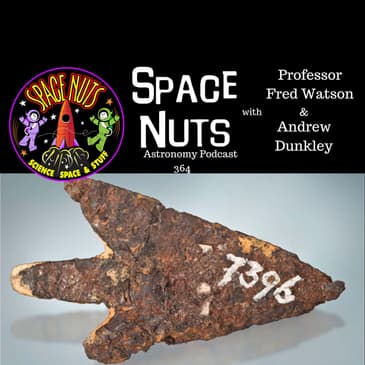


The episode also discusses NASA's InSight mission to Mars, which utilized a seismometer and a special tool, RISE, to study the planet's interior structure. These tools detected Mars quakes and measured the planet's rotation, adding to our understanding of Mars' internal mechanics. It depicts Mars' unique features such as the acceleration of its rotation and the potential non-spherical core, which prompts further investigation and discovery. The resources mentioned in this episode are: · Visit the bitesz.com website to read the full article about the Bronze Age arrowhead made of meteoritic iron. · Explore the Insight mission's findings and discoveries about the rotation of Mars on the NASA website. · Check out the NASA InSight Twitter account for updates and images from the mission. · Learn more about the Twunberg iron meteorite and its composition by conducting a search online. · Stay informed about the latest space news and discoveries by subscribing to the Space Nuts podcast on your favorite podcast platform. · Support the Space Nuts podcast by leaving a positive review and rating on Apple Podcasts or other podcast platforms. · Join the Space Nuts community by following the Space Nuts Facebook page and engaging in discussions with fellow space enthusiasts. · Consider making a donation to NASA or other space organizations to support future missions and research. · Share the Space Nuts podcast with friends and family who have an interest in astronomy and space science.
Become a supporter of this podcast: https://www.spreaker.com/podcast/space-nuts-astronomy-insights-cosmic-discoveries--2631155/support.
[00:00:00] Hi there, thanks for joining us. My name is Andrew Dunkley and this is Space Nuts, where we talk astronomy and space science. Coming up today, we're going to look at a fascinating story about an ancient arrowhead that was created by an ancient person. And what's
[00:00:20] interesting is the material. Horseshoe. We'll also be looking back at a story we did last week about that African meteorite that was found in the desert. Well, now a question has been asked as to whether or not there's another piece of iron floating around in space
[00:00:38] that was put there by an impact or an explosion of some kind. There's also news about how Mars is spinning and there's been a bit of a discovery by the InSight rover or the InSight
[00:00:54] mission. And we'll do a whole bunch of other stuff as well, including audience questions coming up on this episode of Space Nuts. 15 seconds, guidance is internal. 10, 9, ignition sequence start. Space Nuts. 5, 4, 3, 2, 1. 1, 2, 3, 4, 5, 5, 4, 3, 2, 1. Space Nuts. Astronauts report it feels good.
[00:01:20] Joining us as always is his good self, Professor Fred Watson, astronomer at large. Hi, Fred. Hello, Andrew. How are you doing today? I am well, sir. How are you? Yeah, all right. Thanks. As you can see, the cupboards are bare at my place.
[00:01:33] Yes, it's looking very, very bleak at your place. Yes, we're packing. We're getting ready for the big move. I mean, we don't have to move for another few weeks, but my lovely wife, Judy, loves to be organized.
[00:01:48] Well, look, when it comes to a house move, it's the only way. Because if you leave everything to the last minute, it's total chaos and you don't know what you're doing. It always is. And you end up very grumpy. Well, we've already done that.
[00:02:05] Well, you started grumpy. You might not be grumpy by the end of it. That's a good sign. I think it'll just be standard level of grumpiness until it's all over. Well, maybe that's right.
[00:02:17] Yes, I think that'll be the way to go. Now, we've got a fair bit to talk about today. I love this story about the Bronze Age arrowhead, which was not made of bronze, by the way.
[00:02:30] But it's what they've discovered about it that I find fascinating. Now, do we know when this arrowhead was found originally? We'll say a while ago. It was, yes. Yes. No, we probably do know, but I don't. So that wasn't the question that
[00:02:54] I was expecting you to ask me. The question that I thought you were going to ask me was, when was it made? And the answer is probably about 3,000 years ago. But 3,000 years ago is not when it was found. So that's the wrong answer.
[00:03:13] Right. Okay. But 3,000 years ago, somebody found a rock and went, oh, this looks good for making arrowheads. And they said it with that accent too. And then they did make one and who knows where it ended up, but they've found it and analyzed it and gone, hang on
[00:03:30] a minute, something's different here. So what's the story? It's a really interesting one that casts light on the way metals were used back in those early times. And we know, for example, we know that in Egyptian times, when we're
[00:03:55] talking now 4,000 years ago when the pyramids were being built and things of that sort, iron was actually more precious than gold. And the reason was that nobody had worked out how to turn iron ore into iron at that time. But gold could be dug out as lumps of
[00:04:15] gold as we know, gold nuggets are still occasionally found. They are metallic gold. So to find a lump of iron on the surface of the earth was a huge thing in ancient times, because
[00:04:32] here was a metal that nobody knew how to make, but you could find lumps of it and you could by hacking away at it, cut it up and fabricate it into useful things. And one of the reasons
[00:04:48] why I mentioned Egypt is that one of the very, very ornate daggers that was buried with Tutankhamun has a blade made of meteoritic iron. So this is iron that has fallen from
[00:05:00] the sky. And I think in some ways to make something like that for a king out of a lump of iron that you think has fallen from the sky, that makes perfect sense because it's
[00:05:14] blessed by the gods and all the rest of it. So a meteoritic iron was extremely precious and was used quite widely in the Middle East for things like tools, for weapons, things
[00:05:32] of that sort. Now, the reason why this bronze arrowhead is worthy of note is that most of those artifacts have been found principally in the Middle East and actually in Asia as
[00:05:49] well. Whereas this object was dug up in Switzerland. 19th century it was found. Thank you, I should have read that because it was right in front of me. Oh dear me. How do we get away with
[00:06:09] this Andrew? I don't know. But just blunder through, make it up as we go along. I think so, except I'm not. But yeah, thank you very much. So it's one that's been in a, probably
[00:06:20] in a museum or something like that. So this has been analyzed and it has been determined because you can do this with isotope ratios, that this is meteoritic iron. And Switzerland is a place where I don't think anything like this has ever been found before. Arrowheads
[00:06:44] and dwellings have been found dating back, this is going back to somewhere between 900 and 800 before the common era. So getting on for 3000 years ago. These artifacts that have been found don't normally include something that's got meteoritic origin. That's what
[00:07:07] I'm trying to say. And this one, so that's why it's a rarity. In fact, I've got a note here that says the sort of meteoritic objects in Europe have really only been noted in Poland.
[00:07:28] There's been things found there in Poland. So this is moving slightly further to the West and one in Switzerland. Now, what gets interesting is when you look at the metal that this is made of, because today people can actually associate metal objects like this one, like
[00:07:51] this arrowhead, with meteorites, with particular meteorites. If you've got samples of that particular meteorite, you can actually link one with the other. And so there's basically lots of technology that's used to make these identifications. They're using, I quite like
[00:08:15] this, NDT, which is something I hadn't come across before as an acronym or as a set of initials, non-destructive testing. I am certainly familiar with the idea because that's what
[00:08:27] you want to do to a painting if you want to find out who made the paint, what it's made of. They do that with humans too. Yeah, sometimes they do. Yeah. I seem to remember the tests,
[00:08:40] the mathematics tests that I had when I was at university were certainly not non-destructive. They almost ruined my life. Yeah, mine too. Yeah. Anyway, so non-destructive testing is being used and it means things like, well, very clever stuff using muons, subatomic particles
[00:09:00] to induce X-ray emission. And that kind of technology is something that would certainly not have been available to the 19th century scientists and archaeologists who found this metal arrowhead. Now, the interesting thing though was that the one meteorite that seems
[00:09:27] to have the same metallic composition, is known as the Thornburg Iron Meteorite, which has got lumps all over the place. It obviously broke up when it came through the atmosphere. That's the nearest meteorite. So- They've found a couple of thousand pieces of it.
[00:10:03] They have and none of them match this arrowhead. So, whoever made the arrowhead found a different rock. A different rock. And they've instead linked it with pieces from a meteorite that fell in Estonia, not Australia, Estonia, lovely
[00:10:25] country on the Baltic, which is quite a long way from Switzerland. That's the bottom line. And that was probably about three and a half thousand years ago when that meteorite fell. That's the Korlyev Meteorite. And it's got the same chemical signature and physical signature
[00:10:46] as this arrowhead. But you're talking about something that's a thousand miles away, 1600 kilometers or thereabouts. So, the question arises, how on earth did it end up in Switzerland? My guess is one hell of a bow. Probably not. But obviously
[00:11:07] somebody created this thing and it's found its way a long way from where it originated. Yeah. I mean, it may well have been traded. I think that was the way these things worked. Certainly from an area of expertise that I'm supposed to know something about, things like
[00:11:30] telescopes were traded. That was, of course, that was much, much later. That was in the 17th century. But even so, they still had pretty rudimentary means of getting around, mostly walking or horseback. So, I suspect that, yes, it was probably trading that brought
[00:11:52] that arrowhead to where it was found in Switzerland. Or it might have been another similar rock. Yeah. That's another possible explanation. That's a boring answer. We don't like that answer. Yeah. And it would be one that hasn't been found yet. And well, yeah, it might still remain
[00:12:12] to be found. There might be a meteorite remnant somewhere in Switzerland that matches the arrowhead. So, either way, it's a great story and I'm so sorry to have completely fumbled it while you're telling.
[00:12:25] It's all good. So, I'm guessing it's a simple case of somebody found this rock, saw its potential and created the arrowhead and probably created other things as well if there was enough material. Yes, that's right. So, there's a good chance that you might find other stuff there, which
[00:12:50] to the best of my knowledge hasn't been found yet. But again, that tallies with the idea that this was traded from a long way away because all the other ones were probably in that region of Estonia where that meteorite landed.
[00:13:05] Or they were in something like an animal or another human. That's what arrowheads were for. Well, yes. Yes, that's right. Yeah, that's a possibility as well. You knew it was going down that road.
[00:13:20] Yeah. So, somewhere there might be bones that might be found with an arrowhead in the middle of them that tells you that that was what it was used for. Well, wasn't there that famous case of the frozen man, I think his name was Otzi or something,
[00:13:34] that found the Alps. Italian Alps. And they actually, he was so well preserved, they did a post-mortem and the first team of scientists couldn't figure out what killed him. The second team of scientists did an X-ray and went, oh yeah, there's an arrow in him. That's what
[00:13:51] killed him, which was embarrassing for the first team. Well, yes. Oh, we didn't notice that. Yeah, I didn't see that. Whoops, sorry. The universe is beige. No, it stands to reason that there are probably several other arrowheads around somewhere that were made from whatever rock this person found.
[00:14:16] Maybe. But not necessarily in Switzerland. Not necessarily. It's a great story. It is. And it leaves so many unanswered questions. It's a really lovely thing to conjecture on, but there's probably not that much more that we can do unless something turns up that matches
[00:14:35] this arrowhead perfectly in terms of its composition, its physical composition. Actually, hang on a sec, Fred. Got an idea. Be right back. Oh, for the benefit of those without YouTube, he's gone. I've got a prop. Here he comes. Ah, it's a lump. I found a rock.
[00:14:56] It's a lump of rock, not shaped like an arrow. It's got writing on it. And the writing says- Made in Mars. Now, that's a rock from Cameron Corner, which is a particularly popular tourist destination in this part of the world where three states meet.
[00:15:16] One of my children thought it'd be great to steal a rock from there and bring it home. I don't know what sort of rock. It's rusty looking, so it's probably got a bit of iron in it. But maybe it's something special. And see the rare blue fleck there?
[00:15:33] Yeah. That's why they call it that. No, that's blue tack. You have to talk to your children, Andrew. When you're on tour, leave only footprints, take only memories. Yes. Well, don't take bits of rock. I'll try to remember that. Well, I took-
[00:15:55] I'm in trouble for this one too. I took a piece of the Grand Canyon, but I figured it's making it bigger. So that's a positive. Oh dear. And where were we? We were somewhere.
[00:16:09] I can't remember, but there was stuff lying around and they said, yeah, take as much as you like. Really? I can't remember. What was it? A volcano, I think. At any rate, we want to- You'd think the Grand Canyon people would be telling you that, wouldn't they?
[00:16:24] Maybe just make it even grander. Well, that was my whole plan. I made it bigger by that part. All right. Fascinating story. And hopefully we will find other relics and be able to connect them to this particular piece of arrowhead. And maybe one day someone will stumble across
[00:16:44] the exact rock it came from. Who knows? Yeah. Yeah. It's a really interesting mystery one. And if you want to read about it, it's on the universetoday.com website. This is Space Nuts with Andrew Dunkley and Professor Fred Watson. Space Nuts.
[00:17:05] Let us move on and have a chat about this discovery by Insight about the rotation or the spin of Mars. What's going on there? It's, again, a really intriguing story. So, Insight is no longer with us. It's no longer in sight.
[00:17:29] It's no longer in sight. It is with us. It's just been shut down. It ran out of power, I think, last December. So, it's not that long ago since it switched off. Four-year mission,
[00:17:44] though, and as you mentioned earlier, not a rover. It's actually a lander, which was based on the same chassis or bus, as they call it in the space industry, as Phoenix, which you might remember landed in Mars's northern Arctic. And essentially realized or didn't realize, but discovered by
[00:18:09] digging down into the sand that there's permafrost ice underneath the sandy surface in that region where Phoenix landed. So, Phoenix was a great mission. Insight followed up with the idea of probing the planet's interior, principally with a thermometer that was supposed to be dug into the
[00:18:29] ground that never made it. It got blocked by rocks and things like that. But the real success of the mission was its seismometer because it detected many Mars quakes, including one just before it
[00:18:41] shut down that was really quite a big one. That's given people a lot of insight into the internal structure of Mars. You use seismic measurements to determine, for example, how big the
[00:18:54] metal core of a planet is like the Earth. That's how we know what it's like. Same with Mars. So, but it also carried on board a piece of equipment called RISE, R-I-S-E, which is an acronym for
[00:19:20] maybe radio. I can't find what it's an acronym for. I'm having a bad day today. You're having a rip. A rip of a day. Anyway, RISE is a radio- Rotation and Interior Structure Experiment. Well done. Thank you very much. I just made it up.
[00:19:39] Really glad you're here, Andrew, today because if I was on my own, I'd just be waffling complete garbage. Actually, RISE has a principal investigator who's at the Royal Observatory in Belgium, a place that we don't often talk about on Space Notes, but hello to anybody in Brussels.
[00:20:04] The principal investigator was from the Royal Observatory. What they've done is they've studied data from RISE, which has been collected over 900 Martian days, which is significant because a Martian day is a little bit longer than an Earth day. So, this is roughly a thousand Earth
[00:20:25] days. Just remind me again, Andrew, what it stands for? I can't remember. It stands for Rotation and Interior Structure Experiment. Yeah, that's right. Which basically is the answer that we're getting, that it's all about
[00:20:42] the rotation of Mars and about its interior structure. You might guess from its name. How does that work, though? Apparently, the RISE experiment has, as I said, I was about to say, it's basically a very clever radio transponder. What happens is you beam a radio signal from Earth
[00:21:11] to the lander via NASA's Deep Space Network, which of course has one of its antennas here in Australia at Tidbinbilla near Canberra. So, you beam a blip out and then this RISE device essentially reflects the signal back or transponds it back. What you're doing at the receiving end
[00:21:34] is looking for the change in frequency, which is caused by the Doppler effect. The fact that Mars is not only rotating, but it's moving in its orbit with respect to the Earth. So, there is a shift in the frequency of these signals and that shift can be measured
[00:21:55] with incredible precision. Certainly, for optical astronomy, you can measure these Doppler shifts down to centimetres per second, which is really quite extraordinary. I think it's even more sensitive in radio astronomy. So, you've got that shift in frequency. That tells you,
[00:22:19] first of all, about the planet's motion in its orbit, which is well understood, well known. But by analysing over time, you can also look at any changes that might have happened in Mars's rotation period. And there are changes which are in the region of four milliseconds
[00:22:45] per year, which is sort of significant. Our day is slowing by something like, what is it, two milliseconds per day per century. That's the slowdown of the Earth's rotation. What they found on Mars, though, is it's accelerating. It's accelerating by about four milliarcseconds
[00:23:13] per year. So, days are getting shorter? They are at the moment. Now, with the Earth, we know that the underlying increase in the length of the day is due to the fact that the Moon is taking energy
[00:23:30] from the Earth's rotation. And that energy is being essentially transferred into pushing the Moon away. So, the Earth's rotation is... It's called the Sod-Off effect. As in sod off, you do gloves. Well, yes. I thought there was going to be a clever acronym there, but... No.
[00:23:51] This is just a dad joke. Yeah. Yeah. Here we go. Yes. Move away from the cake. Isn't that... Move along. Move along. Nothing to see here. Nothing to see here. Yeah. So, yeah, that's right. But so, the Moon's gravity is essentially slowing
[00:24:10] down the Earth's rotation. And as a result, the Moon's being pushed out to a more distant orbit. But the opposite is happening on Mars. Now, Mars doesn't have a massive Moon like we have.
[00:24:21] So, it can't be anything to do with its Moon. Its two Moons are tiny. The bigger of them, Phobos, is 23 kilometers across. The other one's about 14, I think, if I remember rightly.
[00:24:32] These are not objects that are going to affect the rotation of Mars in any way because they're too small. Even though Mars is only half the diameter of the Earth, it's still a planetary body.
[00:24:42] And so, well, there's various ideas that are being thrown around as to what's happening here. One is... Sorry, go ahead. I was going to say, essentially, they don't know why, do they? No, that's right. So, it's speeding up.
[00:25:00] They don't. But there are some pretty convincing suggestions. And we know that these sorts of things happen on Earth and change the rotation of the Earth. I mean, one of the things that changes it is the movement of ocean currents. They don't have ocean currents anymore on Mars.
[00:25:22] They might have had four billion years ago, but they don't now. But one of them is the way ice is accumulating. This is on the polar ice caps. Where does it come from? Well, there is
[00:25:38] small amounts of water vapor in the atmosphere. There's also carbon dioxide in the atmosphere, which contributes to the Martian ice caps, solid carbon dioxide because the temperature is cold enough to allow that to happen. Another suggestion, which is something we think is
[00:25:54] happening in Greenland here on Earth, what's called post-glacial rebound where ice melts, but that means that the mass of ice on top of a landmass is reducing. So, the landmass is rising. Bouncing back. Yeah, bouncing back.
[00:26:10] I've seen that effect when we were in New Zealand in January around the southern area of New Zealand where all those areas were forged out by glaciers. You still see the rebound effect happening. Because you can see the fact that the sea level is changing, I guess.
[00:26:31] Yes, the emergence of the bedrock, I suppose. Yes, that's right. Yeah. So, that's the bottom line. It's a discovery that's waiting to be made in terms of what it's all about. The interesting thing will be, and unfortunately this
[00:26:56] won't be able to happen because RISE is no longer operational, but in another 900 days you might find it's going the other way, which would be interesting because that would knock on the head
[00:27:09] the idea of it being post-glacial land rise or things of that sort, which tends to take place over very long periods of time. Anyway, that's all conjecture that is probably of no value whatsoever.
[00:27:23] But the bottom line is, yes, the Martian day is getting shorter. Now, there is another thing that RISE has been able to use to measure, and that's something we call nutation.
[00:27:37] Well known in worlds of astronomy, it's a sort of wandering of the pole of a planet. The Earth nutates as well, it has nutation. By measuring the nutation on Mars, what the scientists have done
[00:27:53] is actually use it to determine the size of Mars' iron core. Because it's thought that nutation is due to the sloshing around of the liquid in its core. It turns out from these data that the core has probably got a radius of about 1800 kilometers.
[00:28:20] So, yeah, something like 3,600 kilometers in diameter, which I believe was a lot bigger than I expected. Is that right? Yes, but it tallies also with the seismic measurements which have been made. Because the seismic measurements let you look at the diameter too of the core of Mars.
[00:28:52] It turns out that these measurements are actually in reasonably good agreement in the region of 1800 kilometers radius. But it is actually quite big compared with Mars itself. So, it is a big core
[00:29:12] in comparison with the Earth's core. So, yeah, one final thing is that they actually find the core is not... We think of the core of a planet as being perfectly spherical, but it's not. It's slightly different. Not by much, but it's slightly different and the RISE data
[00:29:29] actually let you see the difference from a sphere that the core shape has. What they're suggesting here is that for this to be the case, there must be slightly higher or lower density regions. Maybe not in the core itself, but in the mantle, that's the rocky covering of
[00:29:53] the Martian core, which of course has a crust on top of that. So, look, it's a really interesting story. There's things about your favorite planet Mars that we're still learning about, Andrew.
[00:30:05] Yes, indeed. You can read all about it on the phys.org website. That's phys.org. I have another theory as to why Mars might be spinning faster. All the junk we're landing on here. No, no, no. And knock it out of kilter.
[00:30:20] It could knock it out of kilter, but I would have thought that would have made it spin slower. Because it's got more mass on the surface. It depends on the impact angle. Oh, it depends on the impact angle. That's as well, yes.
[00:30:33] All right. Yes, another fascinating discovery about Mars and we keep on making them. We haven't found the life yet, but we're still working on that one. This is Space Nuts. Andrew Dunkley here with Professor Fred Watson. Okay, we checked all four systems and in with the girls.
[00:30:50] Space Nuts. Now, Fred, before we go to questions, a little bit of homework from last week. We talked about that meteorite found somewhere in Africa that they discovered was originally from Earth.
[00:31:04] So somehow, maybe, it got blown off the planet, hung around for a while and then came back and landed in the desert. That's prompted a question from David in Queensland. What about the 1957
[00:31:18] manhole cover? Did it come back? Now, the story behind this is it was blasted into space by a nuclear test. Now, I didn't know whether to believe this really happened or if it was an old wife's tale. What do you know about it, Fred?
[00:31:33] I had heard it before, Andrew, but didn't know any details. So yes, I checked back and there is certainly pretty recent publicity given to the fact that it was one of the scientists, a man
[00:31:52] called Robert Brownlee, who worked on these nuclear tests back in the 1950s, who actually related the story before his death a few years ago. In an interview, he died at the age of 94 in 2018. It was an interview with the Insider website. So, the details of that
[00:32:23] interview are actually on the Insider website. It's easy to find. It's a great story. But the suggestion is, yes, that this manhole cover, which was placed over basically a deep hole, not that deep actually, only a matter of feet rather than miles, in which the nuclear weapon
[00:32:50] was placed to make it an underground test. Actually, there were two of these tests, Andrew. They were called PASCAL A and B. PASCAL A was placed in a very deep hole, 485 feet,
[00:33:11] with an iron cap on it. But the second one was more shallow, I beg your pardon, was deeper still, 500 feet. They recorded the explosion with a camera that was looking in the direction of the
[00:33:27] hole with its manhole cover on top. So, there is one frame in the high-speed camera that shows this cap flying off the column because of the nuclear explosion. It was literally launched. It was launched. The calculation is something like 50, 60 kilometers per second.
[00:33:50] Wow. That was its speed. Now, at that speed, going through the atmosphere, the atmospheric friction would be colossal and it would be heated to something that is like a meteorite or a meteor which melts in the upper atmosphere because
[00:34:07] of its speed. This thing is going through the lower atmosphere which is much more dense. I wouldn't mind betting that it just vaporized. So, for it to be... I mean, that 50 or 60 kilometers
[00:34:20] per second is five times the escape velocity. So, if it made it to the top of the atmosphere intact, it wouldn't be coming back. No. It could still be hurtling out in... It knows where.
[00:34:33] Yes. So, it could be the first human-made object into space because, of course, that was in August 1957 and Sputnik 1 was launched in October 1957. So, maybe it's just a conspiracy so that the Americans say, hey, we were first. We were first. Well, there's always a possibility.
[00:34:55] It's a great story. I did a quiz question about it once years and years ago and I just found the whole story quite fascinating. I'd like to think it's out there somewhere, but it'll probably swirl around for a while and then go into someone else's atmosphere and plop
[00:35:09] someone on the head. Yeah. And they'll say, where'd that come from? What the hell is it? Yeah. Oh, it's radioactive. Well, there's another problem. This means war. Yes. Well, it could be, yeah. Declaration of war.
[00:35:25] The simple answer to David's question is it probably didn't come back if it got out, but it may well have been vaporized in the process. Yeah. It's a fascinating story. I'd like to find more about that and I'll do my...
[00:35:40] I love the story. I think that's really, really interesting. Thanks, David. Let's move on to a question now from Andrew who's asking a question that I predicted a couple of weeks ago. Hello, Fred and Andrew. This is Andrew from Melbourne again. I've just been thinking about
[00:35:58] this new or fairly recent paper about the age of the universe potentially being twice as long as we thought it was. And from what I've read, it seems to be depending on a thing called tired light.
[00:36:14] And as I understand it, that's related to light losing energy because it interacts with particles along the way, along the path of travel. But that interaction, I think, should be actually scattering the light, shouldn't it? Or is it when light gets absorbed and loses a
[00:36:38] bit of energy, does it go off in the same direction? Really curious about that one. Hopefully you can get to it soon. Love your program. Been listening since the very first episode.
[00:36:48] Bye now. Wow. You must have a lot of spare time. Thanks, Andrew. The answer is we don't know. Very patient man. We don't know at all. Can't do anything. Next question. Tired light.
[00:37:01] Yeah. Look, tired light, it's a bit vague about exactly the mechanism because it was never really accepted. There were a few scientists who thought that the redshift could be interpreted as being a tired light phenomenon rather than due to the expansion of the universe stretching the light
[00:37:22] waves. I have to say that things I've read in the wake of that paper about the universe perhaps being twice as old as we thought it was because the scientists who worked it out did it by means
[00:37:42] of a combination of tired light and the expansion of the universe. I think it's been regarded as not essentially prima facie evidence that the universe is twice as old as we thought it was
[00:37:57] as just one possible interpretation of the data, but one that's got no more value than any other random interpretation. Whereas the simplest explanation is that the universe is 30.8 million years old because of the fact that the Earth's space is expanding and stretching
[00:38:17] the light and radio waves, which is the origin of the cosmological redshift. But Andrew's right in terms of scattering. Scattering phenomena are very well understood. They're used in many, many instances of our investigation ranging from sensing what rocks
[00:38:45] are made of on the planet Mars by scattering of radiation to just the fact that the sky is blue, which is a scattering phenomenon. It's caused by light being scattered by something called Rayleigh
[00:39:00] scattering, which is a mechanism that scatters blue light preferentially. I think the sky being blue actually answers the second part of Andrew's question. Certainly in terms of Rayleigh scattering, which is perhaps the one that we are most familiar with, the light is not scattered in
[00:39:18] the same direction as it was originally traveling in. It's scattered in random directions. There are preferential directions that you get, but generally it's random. There are two preferred directions, what are called forward scattering, where things are generally going in the same direction as the
[00:39:38] photons were originally traveling. The scattered photons roughly go in the same direction, forward scattering. But they can also be backscattered, which means they're going the opposite direction from where they were traveling. It's a random stochastic process. But the fact
[00:39:55] that the sky is blue is what tells you that it's scattered in all directions. Because wherever we look in the sky, we see blue and that's coming from light being scattered somewhere else, except
[00:40:06] if you live in England. Yes, okay. If you live in England, there is blue sky. I'll have to explain that, won't I? Yeah, I do remember many, many weeks of grayness in the sky where I grew up and it was blue occasionally.
[00:40:28] Once in a blue moon. Boom, boom. Okay. Confused, Andrew? I am. But yeah, hopefully you understood the answer. Hopefully I understood the questions. Thanks, Andrew. Good question. Let's move on to a question now from Fenton. Yeah. Hello, Fred and Andrew. This is Fenton speaking to you from
[00:40:52] St. Paul, Minnesota. I have two questions for you. They're interrelated. Those are how time dilation and spaghettification seem to have escaped science and ended up in popular media. Now, is there a relationship between these two phenomena? Time dilation and spaghettification?
[00:41:18] Is it a rigorous relationship? Do we know what it is? How many years of time dilation can a union hold out before they're spaghettified? And finally, is there going to be a difference in time between the center of our galaxy and our location in the Milky Way?
[00:41:44] Thank you very much. I look forward to your broadcast. Goodbye now. Thank you, Fenton. I think the last part of his question we did get recently, and the answer was yes,
[00:41:56] about the difference in time related on where you sit in the galaxy. But let's go to the first bit first. Time dilation, spaghettification, are they related? If so, in what way and what happens? Yeah. So they're both relativistic phenomena, but they are different in the sense that
[00:42:19] spaghettification is something that definitely happens to you when you fall into a black hole. Time dilation depends on your frame of reference. So as you're being spaghettified, you don't notice time changing at all. Your clock ticks at the same rate as you go through that
[00:42:42] spaghettification process. But to an observer outside that gravitational well, you would see the time slowing down as the person is spaghettified. That's because you're in an external reference frame. So you're not seeing. You're working by your own clock,
[00:43:01] not the clock of the person who's in that huge gravitational potential. So yes, there's a relationship between them, but it's not quite as straightforward as you might think, particularly from the science fiction world. Yes, you're right as well, Andrew, in that we can observe
[00:43:23] time dilation. It was actually, if I remember rightly, this was this work that we reported on recently where, I think it was Geraint Lewis was one of the authors, a friend of mine from
[00:43:36] Sydney University. If I remember rightly, it was, I know he's from Sydney University, but if I remember rightly, he was one of the authors. It was actually in distant galaxies that the time dilation was observed because of the behavior of quasars, if I'm remembering the right
[00:43:57] piece of information. Is that what Tal is with your memory in? I think so. Yeah. Good. So yes, the answer is it is observed in distant objects, probably not the center of the galaxy, but certainly in the center of other galaxies. Okay. And what was the last part
[00:44:21] of his question? That was it. That was it. Yes, exactly. And that's what we talked about. There was a middle bit, which was how long could you hold out in time dilation? But you're talking
[00:44:34] about two different things there. The time dilation is something you observe from the outside. Spaghettification is something that happens to you on the inside. Gotcha. Yeah. All right. I knew there was something else. I didn't write that bit down.
[00:44:48] I'm glad it's you this morning as well as me, Andrew. Yeah. I think we're both in the same boat, paddling upstream without pedal. Yeah. With a bit of luck, people will stop listening to us and we'll both stop doing this.
[00:45:03] Yes, we'll be sad. It might be a rebellion. Thank you, Fenton. I hope we adequately answered your question. Finally, we go to Rennie on one of our favorite topics. Hi, this is Rennie Traub from West Hills, California. My question today is concerning
[00:45:21] black holes. Is there any evidence that a black hole has consumed so much matter that it has reached the ultimate singularity and has exploded outwards spewing its contents either in our universe or going out the other end, creating a new universe?
[00:45:46] Rennie, that's a fascinating question. Has there been any evidence of a black hole overeating and exploding like a Monty Python movie? No, no evidence. But people have hypothesized that that's how big bangs occur. Most notably,
[00:46:09] Roger Penrose. I think that's close to his idea that big bangs come from indigestion in supermassive black holes. Yeah, that's... As long as they're not diarrhea, then we're all in trouble. We're really spagging the barrel now, aren't we?
[00:46:31] Yeah, it's good. We might not have to do this anymore when people are just... Right, they've lost the plot. Yeah, both of them. They've just got too old and seen off. So black holes do lose mass,
[00:46:46] which is the Hawking radiation. That's been demonstrated to be correct, but it's a very, very slow process. Basically, they're losing mass by losing energy with the equivalent of mass and energy. You're losing it through electromagnetic radiation, broadband
[00:47:03] electromagnetic radiation at a very, very slow level. We think that of all the black holes that have ever been created in the universe, none of them have evaporated yet simply because it takes
[00:47:16] too long. Wow. But that's not quite the same sort of thing that Renny's asking about. I think it might be worth Renny having a look online to check out what Roger Penrose has done on this
[00:47:33] sort of work because he is certainly one of the proponents of this kind of idea. Yeah. So the idea has substance. Yes, but not evidence. Well, like many things, isn't it? When you talk astronomy, lots of great ideas, but we can't prove it. Yeah, that's right.
[00:47:53] All right. Thanks Renny. Lovely to hear from you. Thanks to everybody who contributed to this week's program and please keep the questions coming in. Next week will be an all question episode. So if you've got something on your mind, jump on our website, spacenutspodcast.com
[00:48:09] or spacenuts.io, click on the AMA link and send us an audio question or a text question or on the right hand side where it says, hang on, I'm just going to get the right wording,
[00:48:18] send us your voice message. Got a device with a microphone, sweet. Just tell us who you are, where you're from and ask your question and we'll get to it next decade file. While you're on the website, have a look at all the other stuff that's there too.
[00:48:36] The Astronomy Daily newsletter, the shop, what's in the shop? I'll have a look. Somebody asked me about SpaceNuts memorabilia the other day. Look, you can get a cat and a hat
[00:48:48] and a beanie so that you got your head covered. Get them all at the same time. Notebooks, socks. In fact, I think if you bought every piece of apparel that you can wear, you would be fully
[00:49:00] clothed except for underpants. So check it all out at our website spacenutspodcast.com. I think that'll do us, Fred. We're done for another week. Thank you so much. Thank you, Andrew. Maybe we're done for good. I was going to say, we might be done for good.
[00:49:19] Oh, well, there you go. That's why they call us SpaceNuts. Yes, that's exactly right. All right. We'll see you soon, Fred. Thank you. Sounds great. Take care, Andrew. Cheers. Fred Watson, astronomer at large, part of the team here at SpaceNuts and
[00:49:32] on his best behavior this week for a change, you in the studio. And from me, Andrew Dunkley, thanks for joining us. Looking forward to your company on the next episode of SpaceNuts. Bye-bye.