


Go to https://curiositystream.com/SPACENUTS and use code SPACENUTS to save 25% off today. Visit www.nordvpn.com/spacenuts for our special security deal designed for you.
Space Nuts #352
In this episode of Space Nuts, we explore a groundbreaking discovery about how Earth cleans up its own atmosphere, and how it could change the game in mitigating air pollution. But when our host jumps to the wrong planet, we discover stunning new images of Uranus taken by the James Webb Space Telescope and reveal some incredible insights about this mysterious planet. However, our excitement is cut short with a shocking revelation that leaves us wondering, will we ever go back?
Become a supporter of this podcast: https://www.spreaker.com/podcast/space-nuts-astronomy-insights-cosmic-discoveries--2631155/support.
[00:00:00] Hi there, thanks for joining us. This is the latest episode of Space Nuts. My name is Andrew Dunkley, your host. It's so good to have you accompany. Today we are going to look pretty close to home at our own atmosphere because they've made a fascinating discovery. It looks
[00:00:15] like Earth cleans up its act, which is good, but they've found a mechanism that wasn't previously known, which is really quite fascinating. And we're going to look at Neptune because the James Webb Space Telescope recently took some happy snaps of Neptune and it is quite
[00:00:34] astounding. On top of all that, we're going to answer questions we've never had asked before. You don't believe me? Somebody wants to rewrite Big Bang Theory. There's also a question about the expansion of the universe and dark matter. Never done that before. That's all coming up
[00:00:53] on this edition of Space Nuts. And joining me to get down and dirty with Uranus and clean it all up with Earth's atmosphere is Professor Fred Watson, astronomer at large. Hello Fred. We've been doing this too long, Andrew.
[00:01:28] Oh dear. Anyway, yes, it's great to be here. Good to have you here. Good to have you here. Yes, we will probably just plow straight into it today because there's plenty to talk about. And I'm really fascinated by this first story about how Earth's atmosphere cleans itself because
[00:01:49] we've been talking for decades now about how filthy our atmosphere is and how much dirtier it's getting and what that means for global warming and climate change and the melting of the ice caps and dogs and cats living together. But this discovery could change the game.
[00:02:06] Yeah, that's right. It certainly changes the game in terms of our understanding of what's happening in the Earth's atmosphere. And what's that got to do with astronomy? Well, first of all,
[00:02:17] the Earth is a planet and we learn things about planets by looking at the way things happen on Earth. But the other thing, of course, is that astronomers, these ground-based astronomers, are always looking through the atmosphere. So it's quite important to us. And that's why I
[00:02:32] thought this story was one that was worthy of a Space Nuts feature. And it comes from research that has been published in the United States, in the Proceedings of the National Academy of Sciences. The researchers are essentially chemists at University of California, Irving. So what's
[00:02:57] the story? Okay, it's about hydroxide, which is a sort of two-atom molecule related to water, but it isn't water. It's O and H stuck together. And of course, water's H2 and O stuck together.
[00:03:14] But this OH is a molecule that in some senses is unstable, but it binds with other molecules. That's its great thing. It's very, very gregarious. It likes to be with other compounds.
[00:03:28] And that's why it has a role in cleaning up the atmosphere because a lot of hydrocarbons in particular actually react with OH and basically turn into stuff that's okay, like water. And you know, one of the authors of this paper says, you need OH to oxidize hydrocarbons,
[00:03:53] otherwise they will build up in the atmosphere indefinitely. And that would not be a good thing. Definitely not. That'd be runaway greenhouse, wouldn't it? Yes. In the end, it would lead to an increase in greenhouse gases. So actually another of
[00:04:11] the scientists, and forgive me, I didn't mention that Christian Georges is from the University of Lyon en France. And I think he's the lead author of the study. Christian goes on to say, OH,
[00:04:29] that's this strange little molecule, OH is a key player in the story of atmospheric chemistry. It initiates the reactions that break down airborne pollutants and helps to remove noxious chemicals such as sulfur dioxide and nitric oxide, which are poisonous gases from the atmosphere.
[00:04:50] Thus having a full understanding of its sources and sinks is a key to understanding and mitigating air pollution. So that's the link with why we're able to clean up the planet's atmosphere. So the way we've always thought OH was formed in the atmosphere was by sunlight,
[00:05:12] by ultraviolet radiation from the sun triggering a reaction that forms OH. And so it's always been thought that you've got to have sunlight to make this stuff. But it turns out that there is another
[00:05:30] way, which may actually be in many ways the principle way. It might actually be sunlight as the main mechanism for creating OH. Excuse me one moment. It's the frog in the throat syndrome. Here we are. Sorry, the OH molecule in the throat syndrome. There probably is one somewhere.
[00:05:54] So it builds on earlier work. Another group, in fact at Stanford University in the USA, they discovered that if you've got water droplets just sort of hanging around in a lab, you can get hydrogen peroxide, which is another molecule forming on these water droplets. It's
[00:06:20] formed spontaneously. And that was the work that triggered the research that we're reporting now, because it's not hydrogen peroxide that these scientists are looking at. It's OH, hydroxide. So what they did was they got a lot of different containers, some which contain droplets of water
[00:06:44] with air, and some that contain water without any air. So it's vaporized water effectively. And they looked at the production of the hydroxide molecule. And what they saw was that in the ones in darkness, in fact they're all in darkness actually. They're not illuminated. These
[00:07:13] are all in darkness, some with water and some without. The ones with the air and water surfaces actually generate the hydroxide at the same rate or even faster than sunlight does. And so one of the authors says enough of the hydroxide will be created to compete with other
[00:07:36] known hydroxide sources. And at night when, this is a comment by one of the authors, at night when there is no photochemistry, OH is still produced and is produced at a higher rate than would
[00:07:48] otherwise happen. So it's just finding a completely new mechanism for where this stuff comes from. And a surprising one. And I think the thinking is that the mechanism involves electrostatic forces, that it's kind of static electricity that actually generates it because apparently there is a strong
[00:08:18] electric field at the surface of water droplets in air. Now that is something that I think has probably been known but not recognized as being strong enough to sort of mimic in a way the
[00:08:32] ultraviolet light that comes down from the sun and kick these hydroxide molecules into existence. I'm fascinated because on one hand I'm thinking, okay, they've discovered this, but obviously it's been a process that's existed for a very, very long time. And yet we're still
[00:08:51] struggling with melting ice caps and sea level rises, global warming, climate change. So discovering this hasn't really changed anything. But then on the other hand, I wonder if the discovery enables us to come up with perhaps an artificial process going forward that might help
[00:09:10] us clean up our act? Yeah. I think that's sort of the thinking behind this. If you can understand where this stuff comes from and you can perhaps generate more than nature does, then without
[00:09:25] poisoning the rest of us in the process. That's the other thing, isn't it? Yeah. You can clean up the atmosphere. So I think it's quite a significant finding. There's a hint that this work will
[00:09:44] actually lead other scientists to try and recreate this result. So there's a comment by one of the authors, the next step is to perform carefully designed experiments in the real atmosphere in different parts of the world. Because at the moment this is all happening in the lab.
[00:10:04] But yeah, the atmospheric research community is definitely being shaken up. And one of the researchers comments, a lot of people will read this but will not initially believe it. Will either try to reproduce it or try to do experiments to prove it wrong. There will be many
[00:10:19] lab experiments following up on this for sure. And so yeah, watch this space story. But maybe the key thing is going to be to do, as they said, real atmosphere experiments on this OH production.
[00:10:35] Well, that's science, isn't it? I've made a discovery. No, you haven't. Well, yes, I have. Check again. Well, I did check again and you're not quite right, but that's generally how it goes.
[00:10:46] How much OH is too much for us? Well, that's a good point. I guess there is an amount that's too much for us. I'm not sure of the physiology of that, but yes. Yes, all these things come
[00:11:02] with caveats. You don't want to suddenly build OH production factories that give the atmosphere a bad smell, for example. Oh yeah. Or that you'd get used to it. You might get used to it. Eventually. Your comment about the experiments being announced and then proving people wrong
[00:11:23] reminds me, and it goes back to the 1980s of two researchers called Fleischmann and Pons. I don't know whether those names mean anything to you, but they wrote papers. They thought they had demonstrated cold fusion, the idea that you can fuse atoms together at room temperatures rather
[00:11:42] than needing something like the ITER machine that's been built in Southern France to fuse atoms to make essentially free electricity, the nuclear fusion process. That caused a lot of excitement at the time. I remember it very well, but nobody could reproduce their results.
[00:12:03] So it's been put back in the cupboard as something that maybe just some sort of unexpected glitch in the experiment, but nobody can reproduce their results. So cold fusion got knocked on the head
[00:12:15] with that. Yeah. I read about that fusion reactor in France. Yeah, ITER. At the moment, it's actually requiring more fuel to produce the electricity than it's actually producing. So they haven't achieved equilibrium there yet, but that's the goal, isn't it? It is. Yeah. And I don't
[00:12:36] think the main machine's finished yet. I think they're still building it. I've read reports recently of all sorts of strange large pieces of scientific stuff wending its way through the back roads of Provence in France, because that's where it is at night so that you don't block up
[00:12:53] the roads for all the traffic. Yeah. Still on the atmosphere, we have talked about in the past, and I know it's something that's been toyed with to try and clean up the atmosphere, the creation
[00:13:06] of artificial carbon scrubbers and placing them around the world to try and clean things up. I don't know if that's ever gotten off the experiment page, but that could be an option
[00:13:22] if the OH concept is going to cause us too much trouble. But it's too early to say, isn't it? With OH, it's a lab experiment. That's right. And it may not necessarily be... The pollutants that they're talking about are the nasties, not particularly the greenhouse
[00:13:41] gases. So carbon scrubbing might be an option. Yeah. Well, carbon sequestering, that's been talked about as well, putting the carbon back in the earth under high pressure. There's a lot of ideas. Well, one of the things they do out here is they pay farmers to grow trees,
[00:13:59] which holds the carbon, which is okay until you have a massive fire and then it's all gone again. It goes back again. Yeah, that's right. We've got massive farms even in this district,
[00:14:12] which are designed primarily just to grow timber to hold carbon. And they get paid for it. And they get paid rather well as it turns out. But this is a really interesting discovery about how
[00:14:27] earth cleans itself up and tries to maintain equilibrium in the atmosphere. There's just one little wrinkle in that process and it's called humans. That's right. Which are kind of sort of pendulum swung too far. And yet there are still those that are debunking it saying,
[00:14:45] it's not real. No such thing. I know. I know. Anyway, we'll watch with interest. Hopefully that will develop into something going forward and you can read all about it at the scitechdaily.com
[00:14:58] website or go direct to the source of the paper, which will be referenced in that story. It is. Yeah. This is Space Nuts. Andrew Dunkley here with Professor Fred Watson. Let's take a short break from the show to talk about our sponsor NordVPN. Now, Nord is the best
[00:15:18] in the business when it comes to virtual private networks. And I've used it a few times now in my overseas travels. I'm using it right at this minute as a part of recording Space Nuts.
[00:15:30] And it shows you how you're connected. It's a high speed system. I could do a speed test right now on my... In fact, I think I will. How about that? Speed test. And it is a reasonably fast
[00:15:46] plan. It's not the fastest, but it's good enough for our purposes. But often when you connect to a VPN, you get downgraded a bit in terms of speed because you're going through all those extra
[00:15:57] servers. So I'll hit go and away it fires. Now it's connecting to a server from Dubbo to Sydney and I'm getting speeds around 45 megabits per second download, which isn't bad at all considering
[00:16:15] the traffic on the network. You know, just sort of tipped up towards 26. So yeah, 46, I should say. 46 download and about 18 upload on a 50-20 plan. So that's pretty darn good with a VPN connected.
[00:16:30] And yeah, you don't lose much. And sometimes it's even faster. I've done this test before and found that I'm getting 52-53 megabits per second download on a 50-20 plan, which is rather
[00:16:42] extraordinary. Now, if I also sort of have a look at what's on offer, I click on this next bit. I've got my threat protection all connected, which provides me protection through the web.
[00:16:57] I get file protection, all those other bits and bobs that are clicked in. And I've got MeshNet, which means I can share files, I can route traffic, I can link other devices through my system. They're
[00:17:10] all protected. And there's a dark web monitor, which will advise me if anything, anything at all that isn't kosher or savvy or right will pop up as a threat so I can deal with it. Now, I'd strongly
[00:17:27] suggest you go through nordvpn.com space nuts and look at what's on offer. That's the special URL, nordvpn.com space nuts. There's a 30-day money back guarantee as always. And depending on what
[00:17:45] you sign up for, it gets cheaper for the longer you sign up. You can go with a standard monthly plan or you can sign up on a year's plan or a two-year plan. Whichever one you choose, you get an
[00:17:57] extra four months at the moment as a space nuts listener. So check it out today nordvpn.com space nuts, click on get the deal and pick the plan that works for you. I bought the whole damn lot.
[00:18:11] It's not an expensive thing to do and you can look at it like insurance. It just covers you just in case. Maybe you'll never need it, but you don't want to find out that you did and it's too late. nordvpn.com space nuts. Now back to the show.
[00:18:31] Space nuts. Now we're going to stick to our solar system. We're just going to go from the third rock from the sun to the one that's furthest from the sun, technically speaking.
[00:18:42] And some new images of... No we're not. We're not going to what? Talk about... We're going to Neptune. We're going to Uranus which isn't the furthest from the south. Oh hang on. Which one are we
[00:18:52] looking at? The planet Uranus. Ah, see I wrote Neptune down. I'm a buff head. Yeah. Oh, that's all right. We're going to Uranus. It sounds disgraceful. Never mind. Never mind. Yeah, that's okay. Now some new images from the James Webb Space Telescope of Uranus have been published
[00:19:15] and they are stunning and they're revealing some quite amazing things about the planet that we've only visited what once in our history? Yeah, yeah, that's right. Flyby of Voyager 1 I
[00:19:30] think it was. Yes. So it's a place we... And I think we had a question a few weeks ago asking why haven't we been back? When are we going back? Yeah. And there's certainly a lot of
[00:19:43] enthusiasm within the space community and the planetary science community for going back to Uranus, possibly Neptune as well. These are missions that I think still probably decades away even and of course they'll take decades to get there as well a long time because we don't have
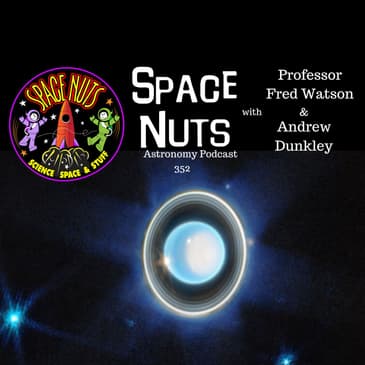
[00:20:03] the luxury that we had in the 70s of neat planetary alignments that let you catapult spacecraft using the gravity assist method. So, but what's lovely about this story and probably many of our listeners will have seen images that were made with the Hubble Space
[00:20:25] Telescope of the planet Uranus decades ago showing the planet with its ring looking like a halo around it because of course the planet sits more or less edgeways on in its orbit. Its pole is
[00:20:41] pointed slightly below the plane of its orbit. So we tend to see the rings sort of full on whenever you see them. Quite mystifying when you see it at first because it look a bit like Saturn,
[00:20:54] a depleted Saturn but tipped on its side. So as you'd expect once it became possible for the James Webb Telescope to image Uranus because the James Webb as we've discussed before can only point in
[00:21:09] certain directions. It can cover the whole sky in a year but it can't sort of cover the whole sky at any one time. So I think what's happened is Uranus has now come into view and we've got some, as you
[00:21:21] said, some really stunning observations of the planet. What really blew me away Andrew is that these observations took 12 minutes of James Webb Telescope time. Which is fantastic. Of course it's a bright object. And it's reasonably close. It's nearby compared with some of the things that
[00:21:46] the web looks at. But yeah, fabulous stuff. Short exposures. They're near infrared images. I think most of them were obtained with the NIRCAM, which is the near infrared imager that the web carries.
[00:22:04] And these images of course show not just the planet and its rings but also many of its moons. Is it 27 moons that Uranus has? I lose count with these things because it used to be when I think
[00:22:19] they could have been two. They could too when I started this talk. They might be confused. They mightn't be moons. They could be polyps. Okay. Well, one good thing about that Andrew is that
[00:22:33] you could have said something worse. Yes, it is 27 known moons and many of them have been captured. You might remember that the moons of Uranus are named after all Shakespearean characters, mostly from Midsummer Night's Dream. So notwithstanding all that, what we have is
[00:22:53] images that show first of all, I think everybody is captivated by the rings in much finer detail than we've seen. The Hubble images gave you an impression that there was one thin ring around Uranus with maybe some inner ones. But this shows beautifully the structure of ringlets
[00:23:16] within the Uranus ring system, very like what we see in the Saturnian ring system where we've got lots and lots of what are called ringlets that together make up the main rings as we see them.
[00:23:32] This is, yeah, it's stunning. I urge all our listeners to go and hunt these images out. They're very easy to find. I found them on the Science Alert website. But the rings, and of course,
[00:23:48] because these cameras on the Webb telescope have got pretty neat filters on them that let you sift through the light, there's probably more coming out of those images than just looking at them and
[00:24:05] saying, aren't they pretty? The structure of the rings, of course, is shown clearly in the images, but there'll be more details that we will find out from perhaps some more detailed information that's been secured in those 12 minutes. The other thing that's notable is Uranus shows up clouds
[00:24:26] occasionally in its atmosphere. And indeed, there are clouds visible, but there is also the North Polar Cap, which is huge. It's an area of the planet from the visible disk, it covers
[00:24:44] almost half the visible disk that you can see. And that polar cap, of course, it's not ice like it is on Mars and the Earth, because Uranus is a gas giant. So it's something in the gassy atmosphere
[00:25:00] of Uranus. And its source is unknown. But what has been spotted from this that hasn't been discovered before is that in the middle of that polar cap, it's actually brighter. That's something
[00:25:16] that hasn't been seen before. So the origin of this polar cap is something that's going to be observed probably more with the web, if not more details coming from these present observations.
[00:25:33] The polar cap brightens up actually as it faces the sun. In other words, it goes into summer because Uranus has seasons, but they're very peculiar ones because it's tilted so far on its
[00:25:45] side. I'm trying to understand why the polar cap hasn't migrated to the top of the planet, because that's generally the colder part. Yeah, but that's absolutely right. But there may be,
[00:25:59] if you think about the rotation of Uranus, a polar cap on the top of the planet will be going around what is it? It's once every, it's a matter of a few hours, I think the rotation of Uranus,
[00:26:13] it wouldn't stay put. It would just keep on going around. And it's possible as well that the dynamics of the atmosphere, the movement of gas within the atmosphere is what actually, when you relate that to the rotation of the planet, that's what causes the polar cap.
[00:26:29] So it's not really climatic as such as it is rotational? Yeah, that's right. Probably both though. But remember, it may be, we think of a polar cap as being something cold, but this one only appears when it's in full sunlight. So it's something
[00:26:49] different from that. So my guess would be hazes in the upper atmosphere because you see that sort of thing in the atmospheres of Jupiter and Saturn. But as I said, it's not really fully understood.
[00:27:03] The chemistry of it's not understood properly. So it is, yes, it is really a stunning image, really stunning science that's coming from it. The clouds themselves speak of storms actually taking place in the atmosphere of Uranus. And there are, the scientists who've made these images are just
[00:27:31] thrilled at the extent, particularly of the rings, how many of the rings it shows. Apparently it's 11 of the 13 known rings. Of course, the rings were imaged more clearly and I got it wrong. I said Voyager 1, but it was actually Voyager 2 that flew by Uranus in 1986. And that discovered
[00:27:53] more rings, I think the 13. Fred, you wouldn't have made that mistake had you read this book. Which book am I looking at? Oh yes, that's the one. Why is Uranus Upside Down by Fred Watson.
[00:28:08] Well, you're doing it for me. I don't need to mention my own books now. You called it a gas giant in the article. It refers to it as an ice giant and I've heard that many times. Why do we sometimes call Uranus and Neptune ice giants?
[00:28:27] Because there's ice in the atmosphere. That's right. Is that all? Yes, that's right. They're icier than Jupiter and Saturn. They are gas giants, but they've got a high proportion of ice in the atmosphere. And again, that might be something that relates to that polar brightening
[00:28:47] as well that we were talking about. So these images, stunning and pretty as they are, will be used to do quite a bit of science and to try and learn as much about this
[00:28:57] planet as we can. It is a really odd place. I mean, you've got to admit. It's strange, isn't it? And we do need to learn more about it because something happened in its deep dark past that caused it to flip. To fall over. Yeah.
[00:29:12] That's right. And that's one of the great... We don't know exactly what happened, do we? No. The thinking is something the size of the Earth, perhaps, clouded it in the formation of the solar system. Planet nine.
[00:29:27] Knocked it over. Maybe planet nine. Yeah. And actually that's a good suggestion because it may be that whatever hit it in that collision was given sufficient impetus to actually escape the solar system. So it might be a planet that we don't have any... Yeah. Could be.
[00:29:42] Or indeed the mysterious planet nine, which we still don't know whether it exists or not. That's it. Would be in such a peculiar orbit, we think, that maybe that was the result of the collision
[00:29:53] too. Planetary dynamicists can do amazing things by tracking back the history of the solar system and looking for evidence of that kind of thing. But I don't think there's any compelling evidence. I just like the color of Uranus. It is lovely, isn't it? Beautiful turquoise color. Yeah.
[00:30:10] Yeah. Definitely go and have a look at those images. I might get Hugh to make that our cover image on this episode because it's absolutely stunning. Well, it certainly beats a photo of OH. Yes, it does. Yeah. You're right.
[00:30:28] But if you do want to find out more about these amazing photos, you'll find them all over the web, but the sciencealert.com website is a pretty good destination you will find. Michelle Starr is the author with a name like that. You couldn't, you can't go wrong
[00:30:43] making mistakes. She could be. She writes a lot of stuff. Yeah, she's good. Yeah. This is Space Nuts. Andrew Dunkley here with Professor Fred Watson. Hi there, Steve here again. Today's episode of Space Nuts is brought to you by CuriosityStream.
[00:31:00] It's the best place to find and watch documentaries about science, history, technology, nature, travel, and so much more. With exclusive award-winning films and shows that you can't watch anywhere else, CuriosityStream offers the deepest collection of the best documentaries from
[00:31:17] around the world, deeper than any other streaming service out there. And the best part, they add new shows every week. So there's always something new to watch. Do you want to know more? Curiosity Stream is the perfect entertainment brand for people with inquiring minds who want to find
[00:31:34] out more about the universe we live in. With content spanning science, nature, history, technology, tech, military history, music, and so much more. There's really something for everyone on this service and it's available worldwide. So no matter where you are, you can enjoy all
[00:31:51] the amazing documentaries and nonfiction series CuriosityStream has to offer. So head over to our special URL, curiositystream.com forward slash space nuts to get unlimited access to the world's top documentaries and for our Space Nuts listeners, use the promo code space nuts to save a
[00:32:11] massive 25% off your subscription. What an amazing bargain for access to the brilliant Curiosity Stream collections. Don't miss out on this incredible opportunity to watch the best documentaries and nonfiction series from around the world. Click the link in the show notes or go to curiositystream.com
[00:32:29] forward slash space nuts and save 25% right now and you can start exploring more of our universe with CuriosityStream. And now it's back to your hosts, Andrew Dunkley and Professor Fred Watson on Space Nuts. Space Nuts. Yes, indeed. Now, Fred, we've got some questions to deal with.
[00:32:50] Most of these are Australian, which is interesting. We usually get people from all over the world, but they're all text questions as well. This first one comes from Mario, who is in Melbourne.
[00:33:04] Do we need a Big Bang rewrite based on the fact that the James Webb Space Telescope has shown multiple early universe galaxies that are as large as the Milky Way and have red stars in them? A totally unexpected finding and contradictory to Hubble observations and current universe
[00:33:22] development theories. What does this finding imply or is this finding somehow inaccurate? Keep up the great show. I've been listening since the start. By the way, we need more of Fred's dad jokes. Thanks. No, we don't. Yeah, mine are granddad jokes.
[00:33:46] Look, Mario's right. The web has certainly uncovered some things that stretch the theories that we have developed for how galaxies evolve and how they appear. The red objects, I think, are red galaxies. The red stars are probably beyond the reach even of Webb. But
[00:34:13] certainly galaxies that are, what you might say, perhaps you could say more evolved than we would expect for such an early phase in the universe. This is good. Nobody's at the moment talking
[00:34:29] about rewriting the Big Bang because it has so much utterly compelling evidence in support of it. Yeah. The fact that you can see it for a start in the cosmic microwave background radiation,
[00:34:44] that is exactly what was predicted that we will be able to see the Big Bang if it happened because we can look back so far in time that we can see it. And yes, not only have we seen it,
[00:34:54] but we've measured it and measured the fluctuations in it, the temperature fluctuations that tell you a lot about the early history. So in that regard, that plus the expansion of the universe, plus the relative abundance of hydrogen, helium, things like lithium in the
[00:35:13] early universe, which we can observe, they are exactly what you get from the Big Bang, from looking at the physical models for the Big Bang. I think what might be at fault here is our
[00:35:25] understanding of how rapidly galaxies evolve, how quickly the process takes place of clouds of hydrogen in a cold, dark universe collapsing to form stars and then galaxies. And of course, many of the big telescope projects currently underway, most notably the Square Kilometer Array
[00:35:47] are aimed at exactly that issue. What did the first stars and galaxies look like? What did the universe look like before the first stars and galaxies switched on? And in fact, the Square
[00:36:00] Kilometer Array, one of its tasks will be to map the cold hydrogen throughout the universe in the aftermath of the Big Bang. And that would certainly add insights to this exact issue. Because if you could see the hydrogen collapsing into proto-galaxies early enough, then you do solve
[00:36:20] the problems that James Webb has uncovered. Didn't we recently talk about a discovery or an observation dating back to about 3 billion years after the Big Bang that showed massive galaxies and they were trying to figure out why? Was that what? Yeah. Yeah. That's right. So
[00:36:43] galaxies were more massive than you might expect at that early period. Yeah. Okay. So no rewriting of the Big Bang, Mario. Too much evidence to suggest that it is what it is and it
[00:36:56] was what it was and still is. But yes, there are still some mysteries to unravel. That's part of the problem, I suppose. Not really a problem, but an effect of getting bigger and better tools to do
[00:37:11] observations, you start finding things and go, well, okay, we've now got to figure out why that is. And that's what's happening with James Webb. Well, it's what happens with all big telescope projects. What happens when you build something like that or something like the Extremely Large
[00:37:27] Telescope or the SKA, the Square Kilometer Array? You write a case to convince the funding agencies that you're going to discover great things. And so you have specific questions that you answered, specific things that you really want to look at, like the distribution of hydrogen in the
[00:37:45] early universe. But what actually happens is you build the thing and yes, it does all that, but it uncovers something that was totally unexpected. And that's this rewriting the textbook stuff because that's when you find things that you thought you had right, but were wrong.
[00:38:05] What's the most unexpected thing you've come across in your career? Oh, gosh. That's a good question. It is. Yeah. There are probably lots of candidates for that. And some of the things we've talked about have blown me away because they've been
[00:38:23] completely unexpected. I'm trying to grapple with them. I mean, I do remember back, this is going back decades, when we realized that gravity can actually magnify distant objects behind galaxies, gravitational lensing. That was something, I mean, Einstein
[00:38:45] predicted it decades before I got to know about it, but that was very unexpected to me. Things like, I'll tell you the other sorts of things as well, evidence for tsunamis on Mars,
[00:38:56] which we talked about some years ago, debris that suggests that at one stage there were tsunamis on Mars. The ones that I guess are most intriguing and perhaps that's one of them, the tsunamis on Mars
[00:39:10] is something that you didn't expect, but when you learn about it, you think, why didn't I think of that? That's so obvious that something like that should happen. Well, yeah, you would think so because it used to have water on the surface. Yeah.
[00:39:25] In many ways, very similar to Earth on a completely different- Early Mars, that's right. Early Mars was- So it makes sense that that would happen and it's probably happened on other planets as well. If the conditions are right and the circumstances are right.
[00:39:40] Thank you, Mario. We're going to go to Mario's neighbor, Kevin, who's also in Melbourne. I'm sure they live next door to each other. It's only a small place. Kevin writes, hi guys, love the show and look forward to it every week. I have a question about the
[00:39:52] expansion rate of the universe. If the further away we look, the faster things are moving away from us, doesn't that imply that the further back in time we look, the faster things are moving away
[00:40:02] from us? And if that's the case, doesn't that imply the expansion of the universe is slowing down? Thanks and keep up the good work, Kev. Yeah. So let me just think. We're always looking further back in time. Yes.
[00:40:20] So yes, the trick is that basically that's what we always thought until the 1970s, 1980s actually, during the 70s. We thought that the expansion is slowing down. It's not. So you've got to separate
[00:40:42] the two things here. We can look in the local universe and see galaxies receding from ourselves, all disappearing. And the further you look, further away you look, the faster that they're receding. And that's a geometrical thing. But when you start looking at greater distances, and I'm now talking
[00:41:07] about perhaps five, six billion light years, then the effect that Kevin mentions exactly comes into play. And so what you have to do is you've got to use a different yardstick other than the redshift expansion. And that's what Brian Schmidt and his colleagues and his colleagues over in
[00:41:31] the United States, two different teams working together on the same problem. That is what they did to discover the accelerated expansion of the universe. They had a different yardstick from just the expansion. And it was supernovae. It was standard candles of type 1a supernovae, which
[00:41:50] explode, we think always with the same brightness, intrinsic brightness. And so you can use that. You look at how bright it appears and you can do that. And it turned out that these things,
[00:42:04] if I get this the right way around, they were further away than expected. And that implies that the expansion of the universe has accelerated. So Kevin's thinking is correct, but the measurements, you've got to have another external source rather than just looking at the,
[00:42:26] sorry, another external yardstick rather than just the expansion of the universe, which is what we normally use as the yardstick for measuring distances. Okay. There you go, Kevin. Just pop next door to Mario and compare notes.
[00:42:41] You can solve everything for us. Now we'll move on to another Australian location, not quite near Melbourne. It's Toowoomba, Queensland. And this one comes from Nick. He said, my question is regarding dark matter. I was watching a show about tornadoes and was
[00:42:58] thinking, how does the twister stay together and not get flung apart from centrifugal force? I then started thinking about the galaxy and how it does not get flung apart, which we presume is because of dark matter. Could the millions of stars inside the galaxy be causing a disruption
[00:43:16] in space time inside the galaxy versus space time outside the galaxy? Kind of like a low versus a high pressure system, which assists in the stars not being flung out of the galaxy. Kind regards,
[00:43:28] Nick. Geez, thought about this. This is lovely thinking. Yeah. I like that very much. So I guess what holds a twister together is the intense low pressure at its center because there must be a
[00:43:42] balance. I'm really getting much thought to that, but yeah, there must be a balance between the outward acceleration caused by the rotation and the inward pull caused by the low pressure.
[00:44:00] So I think the answer is that when you look at the galaxy, you take these things into account. So just remind me, Andrew, was Nick postulating gravitational distortion of space time? Put the millions of stars inside the galaxy be causing a disruption in space time versus
[00:44:27] inside the galaxy versus space time outside the galaxy. Yeah. So that would be something that the scientists who do this work would have in mind. But even taking that into account, there's still not enough mass there to hold it together.
[00:44:46] So it's a nice analog actually, the idea of the low pressure in the middle of a tornado being what holds it together, maybe distorted space time in the middle of a galaxy, but there's
[00:45:00] still not enough in the stars that we can see. And throwing the black hole as well, you might as well, you get a few million solar masses or brilliant solar masses there. It's still not enough to hold
[00:45:10] it together. So there's got to be something else, which is why dark matter was invoked. Okay. There you go, Nick. So yes and no, but more no because of dark matter. Dark matter matters in the scheme of things. Does, it matters a lot.
[00:45:27] It does. It's a big matter. All right. Wraps up our questions. Although I've got one more little comment here from Todd in Utah. You're going to love this, Fred. Okay. Because we got a comment asking for more dad jokes from you. I like this.
[00:45:45] Todd says, I'm a new listener. I just wanted to say that I love the show. Also, I learned for myself that space and time are relative as the more time I spend with my relatives, the more space I need. Very nice one. I like that.
[00:46:02] That's pretty good. That is pretty good. Yeah. I think you should steal that one for your relatives. I could do that. Yeah. Because it's dad joke Friday tomorrow. Yeah. There you go.
[00:46:12] Okay. Thank you all. Please keep those cards and letters coming in. You can go to our website and send us your text or audio questions through the AMA link or rather the tab on the right-hand side
[00:46:25] of the homepage if you've got a device with a microphone. It's pretty simple. Mobile phones these days, cell phones for those who don't live in Australia or text it. We'll accept them all.
[00:46:36] Just tell us who you are and where you're from. We love that. And while you're there, have a look around at the shop where you might be able to find this book that I just picked up
[00:46:46] by somebody I know. Did he autograph this one for me? No, he didn't. It must've come from your publicist. But anyway. Maybe. Must've. And yeah, there's plenty of other things to see and do on our website as well.
[00:47:01] So check it out. Spacenutspodcast.com or spacenuts.io. Oh, and don't forget our social media platforms. There's the official Spacenuts Facebook page. We've also got an Instagram page. We're on TikTok. We're on Twitter. And there's the Spacenuts podcast group on Facebook where you can
[00:47:18] all get together and chat to each other and share your astronomical photos. And yeah, it's a fun site. Yeah. We've got quite a few thousand people that are signed up to that page these days. Fred, that brings us to the end. Thank you so much.
[00:47:38] Pleasure, Andrew. And well, I look forward to the next one. Yes, there'll be a next one. Don't know when. Maybe in a week. Don't know when. Could be. Thanks, Fred. Talk to you soon. Sounds great. Take care.
[00:47:50] Fred Watts, an astronomer, a large part of the team here at Spacenuts. And I'd say thanks to Hugh, but he took a sickie today. I want your note. Don't forget your note, Hugh. Gotta have a note or you don't get paid. That's it from me. Thanks for listening.
[00:48:06] We'll catch you on the very next episode of Spacenuts. Bye-bye.