
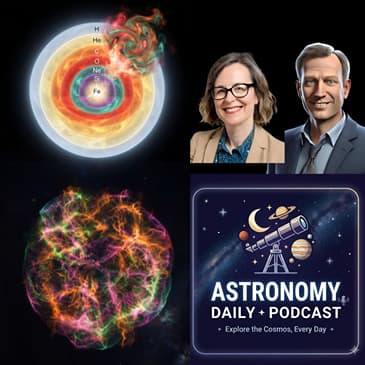

Webb has read the dust of Cassiopeia A clump by clump, and the chemistry points to the star's inner burning shells merging in its final hours. Plus the week that was, the week ahead, and Venus at its most brilliant. The Star That Rearranged Itself Webb's Mid-Infrared Instrument has resolved the dust in individual, solar-system-sized clumps of Cassiopeia A. Argon-rich debris holds silica; neon- and carbon-monoxide-rich debris holds carbon grains; the 'Green Monster' is magnesium silicate the star shed before it exploded. Only models in which the star's oxygen-burning shell merged with the carbon–neon shell above it reproduce both dust types — independent support for Chandra's 2025 evidence that the star's interior was churned up less than about three hours before collapse. Caveats: dust carries no clock, the models are one-dimensional, an alternative exists, and dust masses are lower limits. Temim, Arendt, Milisavljevic et al., ApJL 1012, published 23 Nov 2026. The Week That Was BepiColombo captured at Mercury with about 77% of the planned burn and a 75-hour orbit, plus MIXS first light; the case for Planet X2 (Lykawka & Horner); Euclid's quasar at z = 8.13 and Shenzhou-24's first foreign visitor; Hera's first detailed look at Dimorphos; the FCC's Starmind approval and ESO's 26 November statement; the faintest supernova ever recorded and galaxies light on central dark matter. The Week Ahead Cygnus XL (named for Jim Lovell) launches Sun 29 Nov 10:47 am EST (02:47 AEDT Mon); Gaia DR4 Wed 2 Dec 14:45 CET (00:45 AEDT Thu); Europa Clipper Earth flyby closest approach 3:14 pm EST Thu 3 Dec (07:14 AEDT Fri); Mio separation ~9–10 Dec; Roman first images 3:30 pm EST Mon 7 Dec (07:30 AEDT Tue 8 Dec). Skywatch Venus at greatest brilliancy (a flat peak — magnitude −4.45 all week); the Moon past Regulus, Mars and Jupiter (Mon 30 Nov in the north, Tue 1 Dec in Australia); last quarter 06:08 UTC 1 Dec; Saturn high from the south; the Large Magellanic Cloud for southern observers; Cassiopeia for the north. Sources · [Lead] ESA/Webb — weic2624, Webb shows how supernova dust chronicles star evolution (23 Nov 2026) — https://esawebb.org/news/weic2624/ · [Lead] Temim, Arendt, Milisavljevic et al., 'JWST Resolves Dust Emission from Individual Ejecta Clumps in Cassiopeia A: Dominant Grain Compositions Point to a Shell Merger in the Progenitor', ApJL 1012 (2), 23 Nov 2026, DOI 10.3847/2041-8213/aea901 · [Lead background] Sato et al., 'Inhomogeneous stellar mixing in the final hours before the Cassiopeia A supernova', arXiv 2507.07563 (Jul 2025); Chandra release Aug 2025 — https://chandra.si.edu/photo/2025/casa/ · [Lead background] De Looze et al. 2024, The Green Monster hiding in front of Cas A, ApJL 976 L4, DOI 10.3847/2041-8213/ad855d · [Week] ESA — BepiColombo safely in Mercury orbit despite unexpected challenge (23 Nov 2026) · [Week] Lykawka & Horner, MNRAS (Planet X2), Nov 2026 · [Week] Wolf, Belladitta et al., A&A 715, A356 (Euclid quasar z = 8.13), 24 Nov 2026 · [Week] ESA — Hera's first detailed images of Dimorphos (25 Nov 2026) · [Week] ESO — eso2614, ESO statement on approval of one million space data centres (26 Nov 2026) — https://www.eso.org/public/news/eso2614/ · [Week] Zimmerman, Gal-Yam et al., Nature Astronomy, DOI 10.1038/s41550-026-03024-z (26 Nov 2026); Lei, Zhu et al., Nature Astronomy (26 Nov 2026) · [Ahead] Northrop Grumman — NASA Commercial Resupply Mission NG-25 — https://www.northropgrumman.com/what-we-do/space/missions/nasa-commercial-resupply-mission-ng-25 · [Ahead] ESA — Watch live: Gaia releases its largest-ever goldmine of cosmic data (26 Nov 2026); NASA JPL — Europa Clipper Earth flyby (25 Nov 2026) · [Skywatch] Ephemerides computed in-session with PyEphem for Sydney, Los Angeles, New York and London.
Become a supporter of this podcast: https://www.spreaker.com/podcast/astronomy-daily-latest-space-news--5648921/support.
Sponsor Details:
Ensure your online privacy by using NordVPN. To get our special listener deal and save a lot of money, visit www.astronomydaily.io/nordvpn. You'll be glad you did!
Get the best secure and private email on the planet. Stop your Government, google and who knows who else spying on every email you write. Do what we did and use ProtonMail. They beleive in privacy and there are no ads in their business model...yet they still provide a free forever service. Check them out and get out special deal at www.astronomydaily.io/protonmail
Become a supporter of Astronomy Daily by joining our Supporters Club. Commercial free episodes daily are only a click way... Click Here
This episode includes AI-generated content.
00:00:00 --> 00:00:02 Anna: Hello, everyone, and welcome. About
00:00:02 --> 00:00:05 340 years ago, light from an
00:00:05 --> 00:00:08 exploding star in Cassiopeia reached
00:00:08 --> 00:00:10 Earth. Now, the James Webb Space
00:00:10 --> 00:00:13 Telescope has read the dust that star left
00:00:13 --> 00:00:16 behind, and it seems to say the star's
00:00:16 --> 00:00:18 insides were tearing themselves apart in the
00:00:18 --> 00:00:20 last few hours before it died.
00:00:20 --> 00:00:22 Avery: That's our big news story for the weekend
00:00:22 --> 00:00:24 wrap. Then we look back at a week that put a
00:00:24 --> 00:00:27 spacecraft in orbit around Mercury, found the
00:00:27 --> 00:00:30 most distant quasar yet, got a close look at
00:00:30 --> 00:00:32 an asteroid we hit on purpose and caught the
00:00:32 --> 00:00:34 faintest supernova ever recorded.
00:00:35 --> 00:00:37 Anna: Plus the week ahead and a morning
00:00:37 --> 00:00:40 sky worth getting up for. It's Saturday
00:00:40 --> 00:00:42 28th November 2026.
00:00:43 --> 00:00:44 I'm Anna.
00:00:44 --> 00:00:46 Avery: And I'm Avery. This is Astronomy
00:00:46 --> 00:00:48 AstroDailyPod, the weekend wrap.
00:00:49 --> 00:00:50 Anna: Would you like to do the honours and kick
00:00:50 --> 00:00:51 things off, Avery?
00:00:51 --> 00:00:52 Avery: I would love to.
00:00:53 --> 00:00:56 Cassiopeia A is the wreckage of a massive
00:00:56 --> 00:00:58 star about 11 light years away.
00:00:59 --> 00:01:01 Its light first reached Earth around
00:01:01 --> 00:01:04 340 years ago, which makes it the youngest
00:01:04 --> 00:01:06 known remnant of a collapsed star in our
00:01:06 --> 00:01:09 galaxy. It's been studied by almost every
00:01:09 --> 00:01:11 major telescope there is. On Monday, a team
00:01:11 --> 00:01:13 led by Thea Temim of Columbia University
00:01:14 --> 00:01:15 published a paper in the Astrophysical
00:01:15 --> 00:01:17 Journal Letters that tries to answer a
00:01:17 --> 00:01:20 question you'd think was impossible. What was
00:01:20 --> 00:01:22 happening inside that star in its final
00:01:22 --> 00:01:22 hours?
00:01:23 --> 00:01:25 Anna: How can you possibly see inside a star that
00:01:25 --> 00:01:27 blew up centuries ago?
00:01:27 --> 00:01:30 Avery: You read what it threw out. A massive star
00:01:30 --> 00:01:31 near the end of its life is built like an
00:01:31 --> 00:01:34 onion. Hydrogen on the outside, then helium,
00:01:34 --> 00:01:37 then carbon, oxygen, neon,
00:01:37 --> 00:01:40 silicon, and an iron core at the centre.
00:01:40 --> 00:01:42 Each layer is a shell where a different
00:01:42 --> 00:01:44 element is being burned. When the core
00:01:44 --> 00:01:46 collapses and the star explodes, the those
00:01:46 --> 00:01:48 layers are flung out into space and the
00:01:48 --> 00:01:50 debris remembers, at least partly, where it
00:01:50 --> 00:01:51 came from.
00:01:51 --> 00:01:54 Anna: And something can go wrong with the onion.
00:01:55 --> 00:01:57 Avery: Theory says it can. Computer models of
00:01:57 --> 00:01:59 massive stars predict that close to the end,
00:01:59 --> 00:02:02 an intensely burning oxygen shell can break
00:02:02 --> 00:02:04 through into the carbon and neon shell above
00:02:04 --> 00:02:06 it. The two merge into one huge
00:02:06 --> 00:02:09 churning layer. Neon gets dragged down and
00:02:09 --> 00:02:12 burned. Silicon made deeper in gets carried
00:02:12 --> 00:02:15 up. That's called a shell merger. And it's
00:02:15 --> 00:02:17 very hard to catch because by definition, it
00:02:17 --> 00:02:19 happens just before the star destroys the
00:02:19 --> 00:02:22 evidence. The first observational hint came
00:02:22 --> 00:02:24 last year from NASA's Chandra X Ray
00:02:24 --> 00:02:27 Observatory. A team led by Toshiki Sato of
00:02:27 --> 00:02:30 Meiji University in Japan found patches in
00:02:30 --> 00:02:32 Casciopeia, uh, a rich in silicon but poor in
00:02:32 --> 00:02:35 neon, sitting right beside patches that were
00:02:35 --> 00:02:38 the opposite. Their reading was the fossil of
00:02:38 --> 00:02:40 exactly that up and down Churning from how
00:02:40 --> 00:02:42 unevenly the material was mixed, they
00:02:42 --> 00:02:44 estimated the merger began less than about
00:02:44 --> 00:02:47 three hours before the core collapsed. X
00:02:47 --> 00:02:49 ray data from Chandra and the Japanese led x
00:02:49 --> 00:02:52 rays emission had also turned up phosphorus,
00:02:52 --> 00:02:55 chlorine and potassium, odd numbered elements
00:02:55 --> 00:02:56 of mergers expected to produce.
00:02:57 --> 00:02:59 Anna: So why wasn't that the end of it?
00:03:00 --> 00:03:02 Avery: Because X rays only see gas. Some of the most
00:03:02 --> 00:03:05 important elements, silicon and magnesium in
00:03:05 --> 00:03:08 particular, don't stay as gas. They condense
00:03:08 --> 00:03:10 into dust grains. And dust doesn't glow in X
00:03:10 --> 00:03:13 rays. So the gas only numbers can be skewed.
00:03:14 --> 00:03:16 To check the story, you have to look at the
00:03:16 --> 00:03:18 dust. And that means the mid infrared, which
00:03:18 --> 00:03:21 is where Webb comes in. The team used Webb's
00:03:21 --> 00:03:23 mid infrared instrument in spectrometer mode
00:03:23 --> 00:03:26 with data taken in November 2022 for a
00:03:26 --> 00:03:29 programme led by co author Dan Milosavlik of
00:03:29 --> 00:03:31 Purdue University. They picked three patches
00:03:31 --> 00:03:33 that NASA's retired Spitzer telescope had
00:03:33 --> 00:03:36 flagged. Each about 8 arcseconds across.
00:03:36 --> 00:03:38 Spitzer could map the dust, but each of its
00:03:38 --> 00:03:41 spectra blended several clumps together. Webb
00:03:41 --> 00:03:43 is sharp enough to separate individual
00:03:43 --> 00:03:45 clumps, and at Cassiopeia A's distance, each
00:03:45 --> 00:03:47 of those clumps is roughly the size of our
00:03:47 --> 00:03:48 solar system.
00:03:49 --> 00:03:51 Anna: And the dust in different clumps
00:03:51 --> 00:03:52 turned out to be different,
00:03:53 --> 00:03:56 Avery: very different. In argon rich debris, Webb
00:03:56 --> 00:03:58 saw a broad feature at 21 microns that the
00:03:58 --> 00:04:01 team traces to silica, the compound that
00:04:01 --> 00:04:03 makes quartz. In debris rich in neon and
00:04:03 --> 00:04:05 carbon monoxide, there's no feature at all,
00:04:06 --> 00:04:08 just a smooth glow, best explained by carbon
00:04:08 --> 00:04:10 grains. The team ruled out iron dust for that
00:04:10 --> 00:04:12 one because matching the glow would need
00:04:12 --> 00:04:14 about a third of the sun's mass in iron, more
00:04:14 --> 00:04:17 than the whole remnant contains. The third
00:04:17 --> 00:04:19 patch sits inside a structure Webb found in
00:04:19 --> 00:04:21 2023. Nicknamed the Green Monster.
00:04:21 --> 00:04:24 Its dust is magnesium rich silicate. And it
00:04:24 --> 00:04:26 isn't debris from the explosion at all. It's
00:04:26 --> 00:04:29 material the star shed before it died, which
00:04:29 --> 00:04:31 the blast wave has since run into.
00:04:31 --> 00:04:34 Anna: Walk me through why silica and carbon point
00:04:34 --> 00:04:34 to a merger.
00:04:35 --> 00:04:38 Avery: It's chemistry. Silica forms when there's
00:04:38 --> 00:04:40 more silicon than magnesium around. If
00:04:40 --> 00:04:43 magnesium were plentiful, you'd get magnesium
00:04:43 --> 00:04:45 silicates instead. And carbon dust only
00:04:45 --> 00:04:47 survives where there's more carbon than
00:04:47 --> 00:04:50 oxygen, because oxygen grabs carbon to make
00:04:50 --> 00:04:53 carbon monoxide first. So one set of
00:04:53 --> 00:04:55 clumps is telling you silicon was pushed up
00:04:55 --> 00:04:58 into the oxygen rich zone. And another is
00:04:58 --> 00:05:00 telling you about neon rich carbon rich
00:05:00 --> 00:05:02 material that a merger would leave behind.
00:05:03 --> 00:05:05 Carbon dust turns up concentrated in two
00:05:05 --> 00:05:07 crescent shaped neon rich Regions that
00:05:07 --> 00:05:10 earlier work estimated hold up to about a
00:05:10 --> 00:05:12 fifth of all the remnants neon.
00:05:12 --> 00:05:14 Anna: And they tested that against models
00:05:14 --> 00:05:17 Avery: Anna against three versions of the same kind
00:05:17 --> 00:05:20 of star, a rotating star of about 13 times
00:05:20 --> 00:05:22 the Sun's mass that had lost its outer
00:05:22 --> 00:05:25 hydrogen. One with no merger, one
00:05:25 --> 00:05:28 with a partial merger, one with a complete
00:05:28 --> 00:05:30 merger. Only the merger models
00:05:30 --> 00:05:33 reproduce both dust types. Tamim
00:05:33 --> 00:05:35 describes the shells as churning and
00:05:35 --> 00:05:38 circulating enough to merge shortly before
00:05:38 --> 00:05:41 the explosion. Milosoviewich's view is that
00:05:41 --> 00:05:43 Webb is now showing what was happening, as he
00:05:43 --> 00:05:45 puts it, in the hours leading up to core
00:05:45 --> 00:05:46 collapse.
00:05:46 --> 00:05:48 Anna: Which is where we slow down.
00:05:48 --> 00:05:51 Avery: It is. And there are four things to keep in
00:05:51 --> 00:05:54 mind. First, dust carries no
00:05:54 --> 00:05:56 clock. The hours figure comes from last
00:05:56 --> 00:05:59 year's Chandra analysis, not from Webb. What
00:05:59 --> 00:06:01 Webb adds is an independent line of evidence
00:06:01 --> 00:06:04 that a, uh, merger happened. Second, the
00:06:04 --> 00:06:06 star models are one dimensional nested
00:06:06 --> 00:06:08 spheres and weren't built for Cassiopeia A in
00:06:08 --> 00:06:11 particular. The authors say themselves that
00:06:11 --> 00:06:13 real three dimensional mixing and a lopsided
00:06:13 --> 00:06:16 explosion would reshape both the star and its
00:06:16 --> 00:06:18 debris. Third, there's an
00:06:18 --> 00:06:21 alternative. Silico rich conditions can form
00:06:21 --> 00:06:23 in the deepest layers of an ordinary star
00:06:23 --> 00:06:26 with no merger. Though those layers probably
00:06:26 --> 00:06:28 sit in material the inward moving shock
00:06:28 --> 00:06:31 hasn't reached yet. And fourth, the dust
00:06:31 --> 00:06:33 amounts are lower limits about a ten
00:06:33 --> 00:06:35 thousandth of the sun's mass each for silica
00:06:35 --> 00:06:38 and magnesium silicate. Because Webb misses
00:06:38 --> 00:06:40 the coldest grains, some faint regions don't
00:06:40 --> 00:06:42 match any of the three templates at all.
00:06:43 --> 00:06:46 Anna: So strong supporting evidence. Not a closed
00:06:46 --> 00:06:46 case.
00:06:47 --> 00:06:49 Avery: That's the right way to say it. And as far as
00:06:49 --> 00:06:51 we could find, this went straight to the
00:06:51 --> 00:06:53 Journal with no earlier preprint. So it
00:06:53 --> 00:06:54 really is new this week.
00:06:55 --> 00:06:58 Anna: Why should anyone care what a star did in
00:06:58 --> 00:06:59 its last three hours?
00:06:59 --> 00:07:01 Avery: Because those hours may decide how it
00:07:01 --> 00:07:04 explodes. Earlier X ray work argued that the
00:07:04 --> 00:07:06 lopsidedness a merger creates could help a
00:07:06 --> 00:07:09 supernova succeed and could shape the kick
00:07:09 --> 00:07:11 and spin of the neutron star left behind.
00:07:11 --> 00:07:13 Back in September, we covered work suggesting
00:07:13 --> 00:07:16 a surprising number of massive stars fail to
00:07:16 --> 00:07:18 explode at all. Whatever tips a star one way
00:07:18 --> 00:07:21 or the other happens deep inside in exactly
00:07:21 --> 00:07:22 the window nobody can watch directly.
00:07:23 --> 00:07:25 Supernova remnants are the only place to read
00:07:25 --> 00:07:27 it after the fact. The team's next steps are
00:07:27 --> 00:07:29 spectra from more positions across the
00:07:29 --> 00:07:31 remnants and comparisons with three
00:07:31 --> 00:07:32 dimensional explosion models that include a
00:07:32 --> 00:07:33 merger.
00:07:33 --> 00:07:36 Anna: And for our southern listeners,
00:07:36 --> 00:07:38 Avery: honestly, we this one belongs to the north.
00:07:38 --> 00:07:41 Cassiopeia a is almost 59 degrees north.
00:07:41 --> 00:07:44 It reaches 72 degrees up from New York
00:07:44 --> 00:07:46 65 from Los Angeles and 83 from
00:07:46 --> 00:07:49 London. But from Sydney it never rises.
00:07:49 --> 00:07:52 It peaks nearly 3 degrees below the horizon.
00:07:52 --> 00:07:54 There's no Southern team on the paper either.
00:07:54 --> 00:07:57 The South's own supernova laboratory is SN
00:07:57 --> 00:08:00 1987A in the large Magellanic
00:08:00 --> 00:08:02 Cloud, the only one we watched from the first
00:08:02 --> 00:08:05 burst of neutrinos onward. And where ALMA in
00:08:05 --> 00:08:07 Chile measured a large mass of fresh dust in
00:08:07 --> 00:08:10 the debris back in 2014, it's about 50
00:08:10 --> 00:08:12 degrees up from Sydney a few hours after
00:08:12 --> 00:08:14 dark. Put that beside yesterday's faint
00:08:14 --> 00:08:17 supernova in NGC 6744 and
00:08:17 --> 00:08:19 it's been quite a week for dying stars.
00:08:20 --> 00:08:22 Anna: Now let's get on with the weekend wrap and
00:08:22 --> 00:08:23 look back at the week in the order it
00:08:23 --> 00:08:24 happened.
00:08:24 --> 00:08:27 Monday and Tuesday belong to BepiColombo.
00:08:27 --> 00:08:29 Avery: The European Japanese mission was captured
00:08:29 --> 00:08:32 into orbit around Mercury on the 21st, but
00:08:32 --> 00:08:34 the braking burn was cut short by a software
00:08:34 --> 00:08:37 issue on Monday. We said only that the burn
00:08:37 --> 00:08:39 ended early on Tuesday. ESA gave the full
00:08:39 --> 00:08:42 picture. The Spacecraft got about 77%
00:08:42 --> 00:08:45 of the planned push, which left it in a 75
00:08:45 --> 00:08:48 hour orbit instead of the planned 58.
00:08:48 --> 00:08:50 ESA says no extra burns are needed and the
00:08:50 --> 00:08:52 separation of Japan's Mio orbiter is still
00:08:52 --> 00:08:55 set for the 9th 10th of December. The first
00:08:55 --> 00:08:57 signal after the burn came home through ESA's
00:08:57 --> 00:09:00 new Norcia station in Western Australia and
00:09:00 --> 00:09:03 the British built Mixs X ray telescope
00:09:03 --> 00:09:05 delivered its first light a picture of the
00:09:05 --> 00:09:06 Crab Nebula.
00:09:06 --> 00:09:09 Anna: Also on Monday a UH Sydney LED result.
00:09:09 --> 00:09:11 Closer to home, a UH University of Sydney
00:09:11 --> 00:09:14 team led by Davis and Blant Hawthorne
00:09:14 --> 00:09:17 argued that masers long assigned to the Milky
00:09:17 --> 00:09:20 Way's normal arm actually trace a shock
00:09:20 --> 00:09:22 front along our galaxy's central bar.
00:09:23 --> 00:09:25 That makes the bar long, about 4.3
00:09:25 --> 00:09:28 kiloparsecs from centre to end, slow
00:09:28 --> 00:09:30 turning and still forming stars.
00:09:31 --> 00:09:34 Also on Tuesday, a new candidate for a
00:09:34 --> 00:09:37 hidden planet Patrick Lakofka and
00:09:37 --> 00:09:39 Jonty Horner, a frequent guest on our sister
00:09:39 --> 00:09:42 show Space Nuts, made the case in the monthly
00:09:42 --> 00:09:45 notices of the Royal Astronomical Society
00:09:45 --> 00:09:47 for Planet X2 a world of
00:09:47 --> 00:09:50 1 1/2 to 2 Earth masses orbiting
00:09:50 --> 00:09:53 350 to 500 times farther from the
00:09:53 --> 00:09:56 sun than Earth to explain odd orbits in the
00:09:56 --> 00:09:59 distant Kuiper Belt. It's a prediction, not a
00:09:59 --> 00:10:02 detection. No one has seen it, and the
00:10:02 --> 00:10:04 Rubin Observatory is the telescope that could
00:10:04 --> 00:10:05 test it.
00:10:05 --> 00:10:08 Avery: And Japan's Hayabusa2, with its ion engines
00:10:08 --> 00:10:10 failing, has given up its planned 2031
00:10:10 --> 00:10:13 rendezvous with asteroid 1998
00:10:13 --> 00:10:16 KY26 JAXA is retargeting it
00:10:16 --> 00:10:18 to a fast flyby of a small asteroid
00:10:18 --> 00:10:21 2015 BM510 in April
00:10:21 --> 00:10:24 2028, which needs only 24 metres per second
00:10:24 --> 00:10:25 of extra speed.
00:10:26 --> 00:10:28 Wednesday brought a record. Essa's Euclid
00:10:28 --> 00:10:30 found the most distant quasar yet,
00:10:30 --> 00:10:32 J1504 6252,
00:10:32 --> 00:10:35 nicknamed Dun Anilar, at a redshift of
00:10:35 --> 00:10:37 8.13. We're seeing it about
00:10:37 --> 00:10:40 630 million years after the Big Bang, and
00:10:40 --> 00:10:42 it's the first quasar ever confirmed beyond
00:10:42 --> 00:10:44 redshift 8. Its black hole weighs about
00:10:45 --> 00:10:48 360 million suns but is feeding at
00:10:48 --> 00:10:51 only 12 to 44% of its maximum rate, so
00:10:51 --> 00:10:53 it must have grown faster earlier or started
00:10:53 --> 00:10:54 out heavy.
00:10:54 --> 00:10:57 Anna: Same day, China's Shenzhou 24
00:10:57 --> 00:11:00 docked with the Tiangong Station carrying
00:11:00 --> 00:11:03 Mohammed Zeeshan Ali of Pakistan,
00:11:03 --> 00:11:05 the station's first foreign visitor.
00:11:05 --> 00:11:08 Avery: Thursday was the payoff for a three year
00:11:08 --> 00:11:10 wait. ESA's HERA spacecraft showed us
00:11:10 --> 00:11:13 Dimorphos, the moonlit NASA's dart mission
00:11:13 --> 00:11:16 hit in 2022. There's a stadium sized
00:11:16 --> 00:11:19 crater across one whole face. The moonlet
00:11:19 --> 00:11:21 is tumbling and hundreds of boulders are
00:11:21 --> 00:11:23 orbiting with it all three outcomes the
00:11:23 --> 00:11:25 scientists had argued about at once.
00:11:26 --> 00:11:28 HERA's measurements of the crater's size and
00:11:28 --> 00:11:29 the asteroid's mass are still to come.
00:11:29 --> 00:11:32 Anna: Thursday also brought the week's big policy
00:11:32 --> 00:11:34 story. America's Federal Communications
00:11:34 --> 00:11:37 Commission approved SpaceX's StarMind
00:11:37 --> 00:11:40 network of up to a million satellites to
00:11:40 --> 00:11:42 serve as data centres in orbit over
00:11:42 --> 00:11:45 objections from the American Astronomical
00:11:45 --> 00:11:47 Society. There's been a new development since
00:11:47 --> 00:11:50 we reported it on Thursday, the European
00:11:50 --> 00:11:52 Southern Observatory, which runs the Very
00:11:52 --> 00:11:55 Large Telescope and is a partner in alma,
00:11:55 --> 00:11:58 issued a formal statement. ESO says the
00:11:58 --> 00:12:01 approval would have profound consequences for
00:12:01 --> 00:12:04 astronomy with streaks beyond what mitigation
00:12:04 --> 00:12:06 can handleradio noise pollution from
00:12:06 --> 00:12:09 launches and RE entries and the risk of chain
00:12:09 --> 00:12:11 reaction collisions. Its director general
00:12:12 --> 00:12:14 Andreas Coffer, called for international
00:12:14 --> 00:12:17 mechanisms to assess activities whose
00:12:17 --> 00:12:19 impacts reach far beyond national borders.
00:12:20 --> 00:12:22 ESO had already filed a response to the FCC
00:12:23 --> 00:12:26 with Britain's Royal Astronomical Society and
00:12:26 --> 00:12:28 the International Astronomical Union.
00:12:28 --> 00:12:30 Avery: And yesterday, the faintest supernova ever
00:12:30 --> 00:12:33 recorded, SN2024VJM
00:12:33 --> 00:12:36 M, caught by the Black Gem telescopes at La
00:12:36 --> 00:12:38 Silla in The southern spiral NGC
00:12:38 --> 00:12:40 6744 was 100 to 300
00:12:40 --> 00:12:42 times dimmer than an ordinary supernova of
00:12:42 --> 00:12:45 its kind. Faint ones are supposed to fade
00:12:45 --> 00:12:47 fast. This one glowed for months because its
00:12:47 --> 00:12:49 slow moving debris stayed thick enough to
00:12:49 --> 00:12:51 trap the light for more than 70 days and a
00:12:51 --> 00:12:54 Euclid image taken 11 months earlier shows no
00:12:54 --> 00:12:56 star at the spot pointing to a very faint
00:12:56 --> 00:12:57 white dwarf system.
00:12:58 --> 00:13:01 Anna: Also yesterday, across 136
00:13:01 --> 00:13:03 nearby galaxies, the biggest ones have less
00:13:03 --> 00:13:05 dark matter in their centres than our leading
00:13:05 --> 00:13:08 simulations predict, and nobody yet knows
00:13:08 --> 00:13:08 why.
00:13:09 --> 00:13:11 Avery: Now, looking forward, a busy week ahead.
00:13:11 --> 00:13:14 Tomorrow, Sunday Northrop Grumman's Cygnus XL
00:13:14 --> 00:13:16 cargo ship, named for Apollo astronaut Jim
00:13:16 --> 00:13:18 Lovell, is due to launch to the space station
00:13:18 --> 00:13:21 on a Falcon 9 at 10:47am Eastern
00:13:21 --> 00:13:24 at 7:47 Pacific and quarter to 3
00:13:24 --> 00:13:27 on Monday morning in Sydney. It carries about
00:13:27 --> 00:13:30 11 pounds, or 5 tons of supplies
00:13:30 --> 00:13:31 and science.
00:13:31 --> 00:13:34 Anna: On Wednesday, ESA releases Gaia's
00:13:34 --> 00:13:37 fourth data release from quarter to 3 in the
00:13:37 --> 00:13:39 afternoon, Central European Time. That's
00:13:39 --> 00:13:42 8:45am Eastern, 5:45
00:13:42 --> 00:13:45 Pacific and quarter to 1 on Thursday morning
00:13:45 --> 00:13:46 in Sydney.
00:13:46 --> 00:13:49 Avery: Then NASA's Europa Clipper swings past Earth
00:13:49 --> 00:13:52 on its way to Jupiter with closest approach
00:13:52 --> 00:13:54 at 3:14pm Eastern on Thursday
00:13:54 --> 00:13:57 the 3rd. That's 12:14 Pacific
00:13:57 --> 00:14:00 and 14 minutes past 7 on Friday morning in
00:14:00 --> 00:14:03 Sydney. BepiColombo's due to release
00:14:03 --> 00:14:06 MIO around the 9th or 10th of December
00:14:06 --> 00:14:09 and the Monday after next. NASA unveils the
00:14:09 --> 00:14:11 Roman Space Telescope's first images at Ah,
00:14:11 --> 00:14:14 3:30pm Eastern on the 7th. That's
00:14:14 --> 00:14:17 half past seven on Tuesday morning, the 8th
00:14:17 --> 00:14:17 in Cygni
00:14:17 --> 00:14:20 Anna: through the sky and the morning is where the
00:14:20 --> 00:14:21 action is.
00:14:22 --> 00:14:24 Venus is at its most brilliant for this
00:14:24 --> 00:14:27 apparition right about now. Listings put
00:14:27 --> 00:14:30 the peak on Sunday the 29th, but the peak
00:14:30 --> 00:14:32 is genuinely flat. Our own calculation
00:14:32 --> 00:14:34 has Venus at magnitude
00:14:34 --> 00:14:37 -4.45 every morning
00:14:37 --> 00:14:40 this week because as it pulls away from the
00:14:40 --> 00:14:42 sun, the lit part of its disc grows from
00:14:42 --> 00:14:45 about 22 to 29%, while
00:14:45 --> 00:14:48 the disc itself shrinks. The M2
00:14:48 --> 00:14:50 changes cancel out. So whichever morning you
00:14:50 --> 00:14:52 pick, you're seeing it at its best
00:14:53 --> 00:14:56 east before dawn, about
00:14:56 --> 00:14:59 45 minutes before sunrise. Venus is around
00:14:59 --> 00:15:02 28 degrees up from Los Angeles, 27 from
00:15:02 --> 00:15:05 New York and 23 from London. From
00:15:05 --> 00:15:08 Sydney it's lower, about 16 degrees, so
00:15:08 --> 00:15:10 you'll want a clear eastern horizon
00:15:10 --> 00:15:13 higher up. A reminder from earlier in the
00:15:13 --> 00:15:16 week. Mars, Jupiter and the bright star
00:15:16 --> 00:15:19 Regulus are close together. Mars about 2
00:15:19 --> 00:15:21 degrees from Regulus and about 5 from
00:15:21 --> 00:15:23 Jupiter. And the waning moon passes through
00:15:24 --> 00:15:26 northern. Listeners get the closest pass on
00:15:26 --> 00:15:29 Monday morning, 45 minutes before sunrise
00:15:29 --> 00:15:32 in Los Angeles, the moon sits about 1 1/2
00:15:32 --> 00:15:35 degrees from Regulus, and in New York it's
00:15:35 --> 00:15:37 about 2 degrees from both Regulus and
00:15:37 --> 00:15:39 Jupiter, all around 60 degrees up
00:15:40 --> 00:15:43 in Sydney. The best morning is Tuesday, with
00:15:43 --> 00:15:45 the moon about 2 degrees from Regulus and
00:15:45 --> 00:15:48 Mars about 40 degrees up in the northeast.
00:15:48 --> 00:15:50 The Moon reaches last quarter at 6:08
00:15:50 --> 00:15:53 universal time on Tuesday. That's eight
00:15:53 --> 00:15:55 minutes past five on Tuesday afternoon in
00:15:55 --> 00:15:57 Sydney and late Monday evening in the
00:15:57 --> 00:15:58 Americas.
00:15:58 --> 00:15:59 Avery: And the evening
00:16:00 --> 00:16:03 Anna: Saturn, which favours the south at the end
00:16:03 --> 00:16:05 of evening twilight. Tonight, it's about 54
00:16:05 --> 00:16:08 degrees up from Sydney against 39 from
00:16:08 --> 00:16:11 Los Angeles, 33 from New York and 23 from
00:16:11 --> 00:16:14 London. Its rings are still narrow, so in a
00:16:14 --> 00:16:16 small telescope, they look like a thin line
00:16:16 --> 00:16:18 through the planet. And for southern
00:16:18 --> 00:16:20 observers, the Large Magellanic Cloud, home
00:16:20 --> 00:16:23 of SN1987A, is well up
00:16:23 --> 00:16:25 in the southeast a few hours after dark,
00:16:26 --> 00:16:29 about 50 degrees from Sydney. It never rises
00:16:29 --> 00:16:31 from the three northern cities. Northern
00:16:31 --> 00:16:34 listeners can find Cassiopeia, today's lead
00:16:34 --> 00:16:36 constellation, high in the north in the
00:16:36 --> 00:16:39 evening. The remnant itself is a radio and X
00:16:39 --> 00:16:41 ray object, though not something you can see
00:16:41 --> 00:16:41 with your eyes.
00:16:42 --> 00:16:45 Avery: And as always, never look at the sun without
00:16:45 --> 00:16:47 proper protection. If you're observing a
00:16:47 --> 00:16:50 solar eclipse or the sun itself, use only
00:16:50 --> 00:16:52 eclipse glasses or solar filters certified to
00:16:52 --> 00:16:55 the ISO 123122
00:16:55 --> 00:16:57 international safety standard, and never
00:16:57 --> 00:17:00 through binoculars or a telescope unless it
00:17:00 --> 00:17:02 has a proper solar filter fitted to the
00:17:02 --> 00:17:02 front.
00:17:03 --> 00:17:05 Anna: I know we mentioned that safety message a
00:17:05 --> 00:17:08 lot. Well, every day. But it is very
00:17:08 --> 00:17:08 important.
00:17:09 --> 00:17:12 Avery: Indeed it is. And, um, that's the
00:17:12 --> 00:17:15 weekend wrap. A star whose insides
00:17:15 --> 00:17:17 merged in its final hours, red from the dust
00:17:17 --> 00:17:20 it left behind. Plus a week of Mercury, a
00:17:20 --> 00:17:23 record quasar, a battered asteroid, and the
00:17:23 --> 00:17:24 faintest supernova yet.
00:17:25 --> 00:17:28 Anna: We're back on Monday. Show notes and sources
00:17:28 --> 00:17:31 are at astronomydaily IO and you can
00:17:31 --> 00:17:34 find us everywhere. Astrodaily
00:17:34 --> 00:17:34 pod
00:17:34 --> 00:17:36 Avery: Astronomy AstroDailyPod is part of the
00:17:36 --> 00:17:39 bytes.com podcast network. I'm, um,
00:17:39 --> 00:17:39 Avery.
00:17:40 --> 00:17:42 Anna: And I'm Anna. Clear Skies, everyone.
00:17:43 --> 00:17:44
00:17:46 --> 00:17:47 stories we told.