

**Full show notes:**
Today's episode — S05E166, Thursday August 13, 2026:
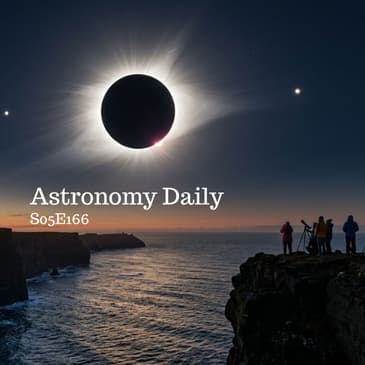
**Main story: The August 12 total solar eclipse.** The Moon's shadow crossed the Arctic Ocean, eastern Greenland, western Iceland, northern Spain, the Balearic Islands and out into the Mediterranean. Longest totality on land: 2 minutes 18 seconds at Látrabjarg, Iceland. Millions gathered across northern Spain, with the path also crossing A Coruña, Bilbao, Zaragoza, Valencia and Palma (Madrid and Barcelona were just outside the path). Observers reported seeing the solar corona, a prominence, and Jupiter, Mercury and Venus during totality. Spain gets another total eclipse on August 2, 2027.
**Three supermassive black holes, one galaxy.** Astronomers led by Hannah Übler (Max Planck Institute for Extraterrestrial Physics) used JWST to confirm three actively feeding supermassive black holes in galaxy J0148-4214, 12.5 billion light-years away — the first such triple system ever confirmed. Two of the three are on course to merge.
**Virgin Galactic delays commercial flights to 2027.** The company's upgraded Delta-class spaceplane will now begin commercial service in February 2027, pushed back from Q4 2026, to complete avionics and systems installation. Shares fell 12% after-hours. $750,000 seat packages were oversubscribed.
**Rocket Lab's Neutron: delay and deal.** Rocket Lab is hedging on a 2026 debut for its Neutron rocket, with the window potentially slipping into 2027 — even as the company signs a new five-launch deal with Kepler Communications.
**Links & sources:**
- [Space.com — Total solar eclipse live updates](https://www.space.com/news/live/total-solar-eclipse-today-aug-12-2026-live-updates)
- [Space.com — Total solar eclipse 2026 thrills millions (photos, video)](https://www.space.com/stargazing/solar-eclipses/total-solar-eclipse-2026-thrills-millions-with-a-stunning-cosmic-spectacle-photos-video)
- [CNN — Photos: Total solar eclipse 2026](https://www.cnn.com/2026/08/12/science/gallery/photos-total-solar-eclipse)
- [Wikipedia — Solar eclipse of August 12, 2026](https://en.wikipedia.org/wiki/Solar_eclipse_of_August_12,_2026)
- [Max Planck Institute — Three supermassive black holes discovered in a single galaxy](https://www.mpg.de/26904239/three-black-holes-discovered-in-a-young-galaxy)
- [SpaceNews — Virgin Galactic delays resumption of commercial flights to 2027](https://spacenews.com/virgin-galactic-delays-resumption-of-commercial-flights-to-2027/)
- [Spaceflight Now — Window for 2026 Neutron debut is narrowing](https://spaceflightnow.com/2026/08/10/window-for-2026-launch-debut-of-rocket-labs-neutron-rocket-is-narrowing-as-development-continues/)
- [Rocket Lab — Neutron launch deal with Kepler Communications](https://rocketlabcorp.com/updates/rocket-lab-inks-neutron-launch-deal-with-kepler-communications/)
Follow us: @AstronomyDailyPod
Become a supporter of this podcast: https://www.spreaker.com/podcast/astronomy-daily-latest-space-news--5648921/support.
Sponsor Details:
Ensure your online privacy by using NordVPN. To get our special listener deal and save a lot of money, visit www.astronomydaily.io/nordvpn. You'll be glad you did!
Get the best secure and private email on the planet. Stop your Government, google and who knows who else spying on every email you write. Do what we did and use ProtonMail. They beleive in privacy and there are no ads in their business model...yet they still provide a free forever service. Check them out and get out special deal at www.astronomydaily.io/protonmail
Become a supporter of Astronomy Daily by joining our Supporters Club. Commercial free episodes daily are only a click way... Click Here
This episode includes AI-generated content.
00:00:00 --> 00:00:03 Anna: Hey, everyone. Welcome back to Astronomy
00:00:03 --> 00:00:04 AstroDailyPod. I'm Anna.
00:00:04 --> 00:00:07 Avery: And I'm Avery. And Anna, uh, I don't think
00:00:07 --> 00:00:09 I've slept properly since Wednesday.
00:00:10 --> 00:00:11 Anna: Because of the eclipse.
00:00:11 --> 00:00:14 Avery: Because of the Eclipse. It's Thursday,
00:00:14 --> 00:00:17 August 13th. This is series five, episode
00:00:17 --> 00:00:20 166. And yesterday, half our
00:00:20 --> 00:00:22 listeners were either standing on a beach in
00:00:22 --> 00:00:24 Spain or on a boat in Greenland watching the
00:00:24 --> 00:00:27 moon eat the sun. So, yeah, today's a
00:00:27 --> 00:00:27 big one.
00:00:28 --> 00:00:31 Anna: It really is. We've got the eclipse as
00:00:31 --> 00:00:33 our main storey today, properly deep dive.
00:00:33 --> 00:00:35 We're going to spend some real time on it.
00:00:35 --> 00:00:37 And then three more news storeys to get
00:00:37 --> 00:00:39 through. Astronomers have found three
00:00:40 --> 00:00:42 supermassive black holes hanging out in one
00:00:42 --> 00:00:45 single galaxy, which rude
00:00:45 --> 00:00:48 Virgin Galactic just pushed its comeback
00:00:48 --> 00:00:50 flight back again. And Rocket Lab's
00:00:50 --> 00:00:53 neutron rocket is doing that thing where the
00:00:53 --> 00:00:55 deadline keeps sliding, but they're also
00:00:55 --> 00:00:58 signing new customers, so make it make sense.
00:00:58 --> 00:01:00 Avery: Lots to get through. Let's get into it.
00:01:00 --> 00:01:03 Anna: Okay, so let's set the scene. Yesterday,
00:01:03 --> 00:01:05 August 12th, the moon's shadow, and this
00:01:05 --> 00:01:08 shadow is about 182 miles wide,
00:01:08 --> 00:01:11 swept across the planet, starting up near
00:01:11 --> 00:01:14 Siberia, across the Arctic Ocean, down
00:01:14 --> 00:01:16 through eastern Greenland, western Iceland,
00:01:17 --> 00:01:20 northern Spain, over the Balearic Islands,
00:01:20 --> 00:01:22 and finally out into the Mediterranean, which
00:01:22 --> 00:01:24 is such a wild path.
00:01:24 --> 00:01:27 Avery: Like, you don't usually get Arctic Ocean in
00:01:27 --> 00:01:29 northern Spain in the same sentence for
00:01:29 --> 00:01:31 anything, let alone the same eclipse.
00:01:31 --> 00:01:33 Anna: Right. And this is one of the reasons this
00:01:33 --> 00:01:36 one had people so excited, because it hit
00:01:36 --> 00:01:38 two totally different kinds of eclipse
00:01:38 --> 00:01:41 chasing experiences. You had people up in
00:01:41 --> 00:01:44 Greenland and Iceland, where it's this stark,
00:01:44 --> 00:01:46 icy, end of the world kind of landscape.
00:01:47 --> 00:01:49 And then a few hours of shadow travel later,
00:01:49 --> 00:01:51 it's crossing sunbathers in Spain.
00:01:52 --> 00:01:54 Avery: Tell me about the Iceland leg, because I
00:01:54 --> 00:01:55 heard that's where you got the longest
00:01:55 --> 00:01:56 totality.
00:01:56 --> 00:01:59 Anna: Yeah, so the single longest point of totality
00:01:59 --> 00:02:01 on land was at a place called La Tr,
00:02:02 --> 00:02:04 which is this dramatic bird cliff on
00:02:04 --> 00:02:07 Iceland's westernmost tip. And totality there
00:02:07 --> 00:02:10 ran about 2 minutes and 18 seconds.
00:02:10 --> 00:02:13 The actual maximum point of the whole eclipse
00:02:13 --> 00:02:16 was just off the coast, about 45 kilometres
00:02:16 --> 00:02:17 out over the water.
00:02:17 --> 00:02:20 Avery: 2 minutes 18. Doesn't sound like much, but
00:02:20 --> 00:02:20 when you're
00:02:20 --> 00:02:23 Anna: standing there, it's an eternity. And
00:02:23 --> 00:02:26 this is the bit I love. One of the Space.com
00:02:26 --> 00:02:28 editors on the ground, Daisy Dobrievic,
00:02:28 --> 00:02:31 said something like, I knew what to expect.
00:02:31 --> 00:02:34 I've seen thousands of photos, but nothing
00:02:34 --> 00:02:36 compares to that feeling you get when you
00:02:36 --> 00:02:38 watch the sun transform before your very
00:02:38 --> 00:02:39 eyes.
00:02:39 --> 00:02:42 Avery: That's a thing every eclipse chaser tries to
00:02:42 --> 00:02:44 explain to people who haven't seen one, and
00:02:44 --> 00:02:45 you just can't really.
00:02:46 --> 00:02:47 Anna: There was another quote I liked from a guy
00:02:47 --> 00:02:50 watching in Spain, Anthony Wood. He said it
00:02:50 --> 00:02:52 strikes the lizard part of your brain that
00:02:52 --> 00:02:54 just tells you this shouldn't be real.
00:02:56 --> 00:02:58 Avery: The lizard brain thing. Yeah, that tracks.
00:02:58 --> 00:03:00 There's something about totality that's
00:03:00 --> 00:03:02 almost primal. Day turning to night in a
00:03:02 --> 00:03:05 couple of minutes, temperature dropping,
00:03:05 --> 00:03:06 animals going quiet.
00:03:06 --> 00:03:09 Anna: And in Iceland, because it happened mid
00:03:09 --> 00:03:11 afternoon, only about four hours before
00:03:11 --> 00:03:14 sunset, and up that far north, you got some
00:03:14 --> 00:03:17 extra atmospheric effects that this eclipse
00:03:17 --> 00:03:19 gamma geometry meant people could actually
00:03:19 --> 00:03:21 see the moon shadow moving through the high
00:03:21 --> 00:03:24 atmosphere and had this weirdly extended
00:03:24 --> 00:03:26 twilight window either side of totality.
00:03:27 --> 00:03:29 Avery: That's very niche and, uh, very cool.
00:03:29 --> 00:03:31 Anna: There was even a chance of aurora showing up
00:03:31 --> 00:03:33 in northern Russia if the geomagnetic
00:03:33 --> 00:03:36 activity cooperated. Which total eclipse and
00:03:36 --> 00:03:39 aurora at once, that's the dream combo for a
00:03:39 --> 00:03:40 lot of skywatchers.
00:03:41 --> 00:03:43 Avery: Okay, let's talk Spain, because that's where
00:03:43 --> 00:03:45 the crowd numbers really show up.
00:03:45 --> 00:03:48 Anna: So the path crossed Ocaruna, Bilbao,
00:03:48 --> 00:03:50 Zaragoza, Valencia and Palma,
00:03:50 --> 00:03:53 notably Madrid and Barcelona, were both
00:03:53 --> 00:03:56 just outside the path of totality. So a
00:03:56 --> 00:03:57 lot of people had to
00:03:57 --> 00:03:59 Avery: travel for it, which, if you live in Madrid,
00:03:59 --> 00:04:02 that's a rough one. So close. And yet,
00:04:02 --> 00:04:03 nope, you get the partial.
00:04:04 --> 00:04:06 Anna: Millions of people gathered across small
00:04:06 --> 00:04:09 towns in northern Spain. Places like
00:04:09 --> 00:04:12 Valoria, La Buena, and Segur de Calafel
00:04:12 --> 00:04:15 were absolutely packed. And because it
00:04:15 --> 00:04:17 happened about an hour before sunset there,
00:04:17 --> 00:04:20 you got totality low on the horizon
00:04:20 --> 00:04:23 with this golden, dramatic lighting.
00:04:23 --> 00:04:25 Avery: And it wasn't just a look up and go home
00:04:25 --> 00:04:28 event either. There was real science
00:04:28 --> 00:04:29 happening during totality.
00:04:30 --> 00:04:32 Anna: Yeah, this is the bit that matters. Beyond
00:04:32 --> 00:04:35 the spectacle during totality, the
00:04:35 --> 00:04:38 sun's corona, its outer atmosphere, which
00:04:38 --> 00:04:40 you basically never get to see because the
00:04:40 --> 00:04:43 sun's surface is so blindingly bright, still
00:04:43 --> 00:04:45 streams out visibly into space.
00:04:46 --> 00:04:49 Observers also picked out a solar prominence,
00:04:49 --> 00:04:51 and you could see Jupiter, Mercury, and
00:04:51 --> 00:04:54 Venus all pop into the darkened sky.
00:04:55 --> 00:04:57 Avery: Four minutes, well, two and a bit minutes
00:04:57 --> 00:05:00 of what does a solar system actually look
00:05:00 --> 00:05:01 like right now?
00:05:02 --> 00:05:04 Anna: Exactly. And coronal science is
00:05:04 --> 00:05:07 genuinely useful. It helps researchers study
00:05:07 --> 00:05:10 the sun's magnetic structure and the
00:05:10 --> 00:05:13 processes that drive space weather, which is
00:05:13 --> 00:05:15 obviously very relevant right now, given how
00:05:15 --> 00:05:17 active this solar cycle's
00:05:17 --> 00:05:19 Avery: been for anyone gutted, they missed it.
00:05:19 --> 00:05:22 Partial phases were visible from a huge chunk
00:05:22 --> 00:05:25 of the world, too. Some are set in England,
00:05:25 --> 00:05:28 the northeastern U.S. michigan, Canada,
00:05:28 --> 00:05:31 even Alaska. All got a partial bite taken out
00:05:31 --> 00:05:31 of the sun.
00:05:32 --> 00:05:35 Anna: And if you're already eclipse hungry again,
00:05:35 --> 00:05:37 Spain gets another one relatively soon.
00:05:38 --> 00:05:40 Less than a year from now, on August 2,
00:05:41 --> 00:05:43 2027, there's another total solar
00:05:43 --> 00:05:45 eclipse crossing Spain.
00:05:45 --> 00:05:48 Avery: Two total eclipses in Spain within 12 months.
00:05:48 --> 00:05:50 Eclipse chasers are going to have a
00:05:50 --> 00:05:53 Anna: very good year, they really are.
00:05:53 --> 00:05:56 So that's our deep dive. The August 12th
00:05:56 --> 00:05:57 total solar eclipse. A, uh,
00:05:58 --> 00:06:00 182 mile wide shadow,
00:06:00 --> 00:06:03 Arctic ice to Spanish coastline. 2
00:06:03 --> 00:06:06 minutes 18 seconds of totality at its
00:06:06 --> 00:06:09 longest and a genuine I can't believe what
00:06:09 --> 00:06:11 I just saw moment for millions of people.
00:06:12 --> 00:06:14 Avery: Can we talk logistics for a second? Because I
00:06:14 --> 00:06:16 know a chunk of our listeners are already
00:06:16 --> 00:06:19 plotting the 2027 one. If you've never
00:06:19 --> 00:06:22 chased totality before, what's actually
00:06:22 --> 00:06:22 involved?
00:06:23 --> 00:06:25 Anna: Honestly, the biggest thing is just being
00:06:25 --> 00:06:27 inside the path. Even
00:06:27 --> 00:06:30 99% partial is nothing like
00:06:30 --> 00:06:32 totality. It's a completely different
00:06:32 --> 00:06:35 experience. So it's worth the travel. After
00:06:35 --> 00:06:38 that, it's the usual stuff. Proper eclipse
00:06:38 --> 00:06:40 glasses for every phase, except totality
00:06:40 --> 00:06:43 itself. A spot with a clear horizon if you
00:06:43 --> 00:06:46 can one, and a uh, backup location in case of
00:06:46 --> 00:06:49 cloud because you cannot control the weather
00:06:49 --> 00:06:49 on the day.
00:06:50 --> 00:06:52 Avery: And don't try to photograph the whole thing
00:06:52 --> 00:06:54 on your phone and forget to actually look up.
00:06:55 --> 00:06:57 Anna: That is the classic mistake. Half the
00:06:57 --> 00:07:00 eclipse chaser community has a rule now. Get
00:07:00 --> 00:07:03 one or two shots set up on a tripod and
00:07:03 --> 00:07:05 then just put the phone down and watch it
00:07:05 --> 00:07:08 with your own eyes. Because you only get 2
00:07:08 --> 00:07:11 minutes and 18 seconds and you don't get them
00:07:11 --> 00:07:11 back.
00:07:12 --> 00:07:14 Avery: I did see the livestreams were huge for this
00:07:14 --> 00:07:17 one too. Between the Greenland boat
00:07:17 --> 00:07:19 expeditions and the Spanish coverage, they
00:07:19 --> 00:07:21 were millions of people watching online who
00:07:21 --> 00:07:22 couldn't be there in person.
00:07:23 --> 00:07:25 Anna: Which is honestly one of the nicer things
00:07:25 --> 00:07:28 about how big eclipse broadcasting has
00:07:28 --> 00:07:30 gotten. You don't have to be a hardcore
00:07:30 --> 00:07:33 chaser with a passport full of stamps to get
00:07:33 --> 00:07:36 at least some of the I can't believe what I
00:07:36 --> 00:07:37 just saw feeling.
00:07:38 --> 00:07:40 Avery: Still not the same as the lizard brain moment
00:07:40 --> 00:07:40 though.
00:07:41 --> 00:07:44 Anna: No, nothing beats being there. But August
00:07:44 --> 00:07:46 2, 2027 in Spain is looking
00:07:46 --> 00:07:49 very tempting for a lot of people right now.
00:07:49 --> 00:07:52 Avery: Alright, from one sun to three black holes,
00:07:52 --> 00:07:55 astronomers have confirmed for the first time
00:07:55 --> 00:07:58 three actively feeding supermassive black
00:07:58 --> 00:07:58 holes
00:07:58 --> 00:08:01 Anna: sitting inside a single galaxy, which is
00:08:01 --> 00:08:02 just greedy.
00:08:04 --> 00:08:05 Avery: The galaxy's called
00:08:05 --> 00:08:08 J014-84214
00:08:08 --> 00:08:11 and it's about 12.5 billion light
00:08:11 --> 00:08:13 years away. So we're seeing it as it looked
00:08:13 --> 00:08:16 roughly 1.2 billion years after the
00:08:16 --> 00:08:17 big bang.
00:08:17 --> 00:08:20 Anna: So this is baby picture of the universe
00:08:20 --> 00:08:20 stuff.
00:08:21 --> 00:08:23 Avery: Exactly. And that's what Makes it such a big
00:08:23 --> 00:08:26 deal. The team led by Hannah Hubler at the
00:08:26 --> 00:08:28 Max Planck Institute for Extraterrestrial
00:08:28 --> 00:08:30 Physics used the James Webb Telescope's
00:08:30 --> 00:08:32 NIRSP instrument to find them.
00:08:33 --> 00:08:34 Specifically, a technique called
00:08:34 --> 00:08:37 spectroastrometry, which measures tiny
00:08:37 --> 00:08:39 spatial shifts in the light coming from
00:08:39 --> 00:08:42 hydrogen emission to pin down exactly where
00:08:42 --> 00:08:44 each black hole is sitting, even though
00:08:44 --> 00:08:45 they're really close together on the sky.
00:08:45 --> 00:08:47 Anna: And these aren't small either?
00:08:47 --> 00:08:50 Avery: No, roughly 80 million, 2 million
00:08:50 --> 00:08:53 and 0.6 million solar masses. And
00:08:53 --> 00:08:55 here's the two of the three are on a
00:08:55 --> 00:08:57 collision course. They're heading for a
00:08:57 --> 00:08:58 merger.
00:08:58 --> 00:09:01 Anna: So why does finding three in one galaxy
00:09:01 --> 00:09:03 actually matter scientifically beyond just
00:09:04 --> 00:09:04 wow three?
00:09:05 --> 00:09:07 Avery: Because it's evidence for how supermassive
00:09:07 --> 00:09:10 black holes get so big so fast in the early
00:09:10 --> 00:09:12 universe, which has honestly been a bit of a
00:09:12 --> 00:09:14 puzzle. If black holes can merge with each
00:09:14 --> 00:09:16 other, not just grow by slowly swallowing
00:09:16 --> 00:09:19 gas, that gives them a much faster route to
00:09:19 --> 00:09:22 becoming supermassive. Hubler's team is
00:09:22 --> 00:09:24 essentially saying mergers might be doing a
00:09:24 --> 00:09:26 lot more of the heavy lifting early on than
00:09:26 --> 00:09:27 we thought.
00:09:27 --> 00:09:29 Anna: It's basically a black hole growth hack,
00:09:30 --> 00:09:32 cosmic speedrunning to supermassive status.
00:09:33 --> 00:09:35 But it does reshape how we think about galaxy
00:09:35 --> 00:09:38 assembly in the early universe. If triple
00:09:38 --> 00:09:40 black hole systems like this aren't a total
00:09:40 --> 00:09:42 fluke, there could be a lot more of these
00:09:42 --> 00:09:45 hiding out there, waiting for JWST to spot
00:09:45 --> 00:09:46 them for scale.
00:09:46 --> 00:09:49 Avery: Sagittarius A, our own galaxy's black
00:09:49 --> 00:09:52 hole, is about 4 million solar masses. So
00:09:52 --> 00:09:55 the biggest of these three, at 80 million, is
00:09:55 --> 00:09:57 20 times heavier than the black hole sitting
00:09:57 --> 00:09:58 at the centre of the Milky Way.
00:09:58 --> 00:10:00 Anna: And that's just one of three in the same
00:10:00 --> 00:10:01 galaxy.
00:10:01 --> 00:10:03 Avery: Right. Which tells you this galaxy was doing
00:10:03 --> 00:10:06 some serious growing up fast. It's another
00:10:06 --> 00:10:09 one of those results where JWST just keeps
00:10:09 --> 00:10:11 outperforming what Hubble could ever have
00:10:11 --> 00:10:13 shown us at these distances. This is a level
00:10:13 --> 00:10:16 of detail on a 12.5 billion year old
00:10:16 --> 00:10:18 galaxy that simply wasn't accessible a few
00:10:18 --> 00:10:18 years ago.
00:10:18 --> 00:10:21 Anna: JWST really is the gift that keeps on
00:10:21 --> 00:10:24 giving. We'll be watching to see if Uber's
00:10:24 --> 00:10:26 team or anyone else turns up more of these
00:10:26 --> 00:10:28 triple systems now that people know what to
00:10:28 --> 00:10:28 look for.
00:10:29 --> 00:10:31 Sticking with things that are taking longer
00:10:31 --> 00:10:33 than planned, Virgin Galactic has delayed its
00:10:33 --> 00:10:36 return to commercial spaceflight again.
00:10:36 --> 00:10:37 Avery: Again being the key word.
00:10:38 --> 00:10:40 Anna: Right. So the new spacecraft, this is their
00:10:40 --> 00:10:43 upgraded Delta class vehicle, was supposed to
00:10:43 --> 00:10:45 start flying paying customers in the fourth
00:10:45 --> 00:10:47 quarter of this year. That's now been pushed
00:10:47 --> 00:10:49 to February 2027.
00:10:49 --> 00:10:51 Avery: What's the hold at this time? According to
00:10:51 --> 00:10:53 the company, it's avionics and systems
00:10:53 --> 00:10:55 installation on the first operational
00:10:55 --> 00:10:57 spacecraft. They say they need more time to
00:10:57 --> 00:10:59 get it right before putting people on board,
00:10:59 --> 00:11:01 which. Fair enough. I'd rather they take the
00:11:01 --> 00:11:03 extra months than rush it.
00:11:03 --> 00:11:05 Anna: Always the right call with anything crude.
00:11:05 --> 00:11:06 How did the market react?
00:11:06 --> 00:11:09 Avery: Not well. Shares dropped about 12% in after
00:11:09 --> 00:11:11 hours trading on the news.
00:11:11 --> 00:11:14 Anna: Ouch. But there's a more interesting storey
00:11:14 --> 00:11:16 buried in the same. Their
00:11:16 --> 00:11:18 $750 a seat flight packages
00:11:18 --> 00:11:21 were over subscribed and CEO Michael
00:11:21 --> 00:11:24 Coglazier said they'll be offering higher
00:11:24 --> 00:11:26 price points when ticket sales reopen this
00:11:26 --> 00:11:26 autumn.
00:11:26 --> 00:11:28 Avery: So even with the delay, demand isn't the
00:11:28 --> 00:11:31 problem. If anything, they could be
00:11:31 --> 00:11:32 underpricing seats.
00:11:32 --> 00:11:34 Anna: Seems that way. Financially, the picture is
00:11:34 --> 00:11:37 actually improving too. Net loss narrowed to
00:11:37 --> 00:11:39 about $56 million, down from
00:11:39 --> 00:11:42 $67 million a year ago. And they've still got
00:11:42 --> 00:11:45 $286 million in cash and
00:11:45 --> 00:11:46 securities on hand.
00:11:46 --> 00:11:48 Avery: So they can absorb another delay. They've
00:11:48 --> 00:11:50 just got to actually get the Delta ships
00:11:50 --> 00:11:51 flying at some point.
00:11:51 --> 00:11:53 Anna: That's the whole storey with Virgin Galactic
00:11:53 --> 00:11:55 at this point, isn't it? The money and the
00:11:55 --> 00:11:57 demand are there. It's the hardware timeline
00:11:57 --> 00:11:58 that keeps slipping.
00:11:58 --> 00:12:01 Avery: It's a very different position than where
00:12:01 --> 00:12:03 they were even five years ago. Right back
00:12:03 --> 00:12:05 when this was Richard Branson's company
00:12:05 --> 00:12:08 flying the original SpaceShipTwo on short
00:12:08 --> 00:12:10 hops. And everyone was comparing them
00:12:10 --> 00:12:12 directly to Blue Origin's New Shepard.
00:12:13 --> 00:12:15 Anna: Right. And that comparison's aged in an
00:12:15 --> 00:12:18 interesting way. Blue Origins had its own
00:12:18 --> 00:12:20 well documented hardware problems this year
00:12:20 --> 00:12:23 too. So it's not like Virgin Galactic's the
00:12:23 --> 00:12:25 only one whose timeline keeps slipping.
00:12:25 --> 00:12:28 Suborbital space tourism as a whole seems to
00:12:28 --> 00:12:30 be harder than everyone hoped across the
00:12:30 --> 00:12:31 board.
00:12:31 --> 00:12:34 Avery: Which? Building crewed spacecraft's always
00:12:34 --> 00:12:37 harder than everyone hoped. We'll cheque back
00:12:37 --> 00:12:39 in as February 2027 gets closer.
00:12:39 --> 00:12:42 Last one, Rocket Lab. Their new medium
00:12:42 --> 00:12:45 lift rocket, Neutron, is looking less and
00:12:45 --> 00:12:47 less likely to make its planned debut before
00:12:47 --> 00:12:48 the end of this year.
00:12:49 --> 00:12:50 Anna: How much of a slip are we talking?
00:12:51 --> 00:12:54 Avery: The company's now hedging pretty openly. This
00:12:54 --> 00:12:56 could push out of 2026 and into
00:12:56 --> 00:12:59 2027. It's the kind of narrowing
00:12:59 --> 00:13:02 window language that usually means don't hold
00:13:02 --> 00:13:03 your breath for December.
00:13:03 --> 00:13:06 Anna: Rocket development timelines name a more
00:13:06 --> 00:13:08 consistent disappointment, honestly.
00:13:08 --> 00:13:11 Avery: But and this is the fun contrast, in the same
00:13:11 --> 00:13:14 window, they announced a brand new 5 launch
00:13:14 --> 00:13:16 deal with Kepler Communications, who'll be
00:13:16 --> 00:13:18 flying payloads on Neutron once It does get
00:13:18 --> 00:13:19 off the ground,
00:13:20 --> 00:13:22 Anna: so customers are still betting on it even as
00:13:22 --> 00:13:24 the debut date wobbles.
00:13:24 --> 00:13:27 Avery: Exactly. And Rocket Lab's actually coming off
00:13:27 --> 00:13:29 a record revenue quarter, so the business
00:13:29 --> 00:13:31 overall is healthy. It's specifically
00:13:31 --> 00:13:33 Neutron's first flight that keeps sliding,
00:13:33 --> 00:13:34 right?
00:13:34 --> 00:13:37 Anna: Which to be fair, is basically the storey of
00:13:37 --> 00:13:39 every new orbital rocket ever built. Starship
00:13:39 --> 00:13:41 slipped for years, New Glenn slipped for
00:13:41 --> 00:13:42 years.
00:13:42 --> 00:13:44 Avery: Ariane 6 slipped for years,
00:13:45 --> 00:13:45 right?
00:13:45 --> 00:13:48 Anna: It's basically tradition at this point. We'll
00:13:48 --> 00:13:50 keep you posted on Neutron as we get closer
00:13:50 --> 00:13:51 to an actual launch date.
00:13:52 --> 00:13:55 Avery: For anyone not fully across it, Neutron's the
00:13:55 --> 00:13:57 reusable medium lift rocket Rocket Lab's been
00:13:57 --> 00:14:00 building to sit between their small electron
00:14:00 --> 00:14:02 rocket and the big players. Basically going
00:14:02 --> 00:14:04 head to head with Falcon 9 for the medium
00:14:04 --> 00:14:06 payload market, which
00:14:06 --> 00:14:08 Anna: is a pretty crowded lane to be entering late.
00:14:09 --> 00:14:11 Falcon 9's flying constantly and everyone
00:14:11 --> 00:14:13 from Blue Origin to the Chinese commercial
00:14:13 --> 00:14:15 players wants a piece of that market too.
00:14:16 --> 00:14:18 Avery: Exactly why deals like the Kepler
00:14:18 --> 00:14:20 communications one matter so much right now.
00:14:21 --> 00:14:23 Signing customers ahead of your first flight
00:14:23 --> 00:14:26 is basically a vote of confidence that Rocket
00:14:26 --> 00:14:28 Lab's execution track record with electron is
00:14:28 --> 00:14:31 enough to earn trust, even with Neutron
00:14:31 --> 00:14:33 itself still on the ground reputation
00:14:33 --> 00:14:35 Anna: doing some of the heavy lifting while the
00:14:35 --> 00:14:36 hardware catches up.
00:14:36 --> 00:14:39 Okay, that's our storeys for today. Quick
00:14:39 --> 00:14:41 recap the total solar eclipse over Greenland,
00:14:41 --> 00:14:44 Iceland and Spain gave millions of people a
00:14:44 --> 00:14:46 lizard brain moment on August 12.
00:14:47 --> 00:14:49 Astronomers found three supermassive black
00:14:49 --> 00:14:52 holes cozying up in one distant galaxy, two
00:14:52 --> 00:14:54 of them headed for a merger. Virgin
00:14:54 --> 00:14:56 Galactic's Delta class comeback flight has
00:14:56 --> 00:14:59 slipped to February 2027, and Rocket
00:14:59 --> 00:15:01 Lab's neutron rocket is picking up customers
00:15:01 --> 00:15:03 faster than it's picking up a launch date.
00:15:03 --> 00:15:05 Avery: If you enjoyed today's episode, the best
00:15:05 --> 00:15:08 thing you can do for us is leave a rating or
00:15:08 --> 00:15:10 review wherever you're listening and share
00:15:10 --> 00:15:12 the episode with a fellow space nerd. You can
00:15:12 --> 00:15:15 find full show notes, sources and links for
00:15:15 --> 00:15:17 every storey we cover today at astronomydaily
00:15:17 --> 00:15:20 IO and find us on social media. We're
00:15:20 --> 00:15:23 astronomydailypod pretty much everywhere.
00:15:23 --> 00:15:25 Anna: We'll be back tomorrow with another episode.
00:15:25 --> 00:15:27 Until then, keep looking up.
00:15:27 --> 00:15:28 Avery: See you next time.