

Become a supporter of this podcast: https://www.spreaker.com/podcast/astronomy-daily-latest-space-news--5648921/support.
Sponsor Details:
Ensure your online privacy by using NordVPN. To get our special listener deal and save a lot of money, visit www.astronomydaily.io/nordvpn. You'll be glad you did!
Get the best secure and private email on the planet. Stop your Government, google and who knows who else spying on every email you write. Do what we did and use ProtonMail. They beleive in privacy and there are no ads in their business model...yet they still provide a free forever service. Check them out and get out special deal at www.astronomydaily.io/protonmail
Become a supporter of Astronomy Daily by joining our Supporters Club. Commercial free episodes daily are only a click way... Click Here
This episode includes AI-generated content.
00:00:01 --> 00:00:03 Anna: Picture an asteroid. You're probably
00:00:03 --> 00:00:06 imagining a potato, one lump of
00:00:06 --> 00:00:09 rock tumbling through the dark. Now
00:00:09 --> 00:00:12 imagine three lumps joined at the neck
00:00:12 --> 00:00:15 like a cosmic string of pearls and
00:00:15 --> 00:00:18 a tiny moon keeping pace alongside.
00:00:18 --> 00:00:21 Avery: That's a real object out in the main belt.
00:00:21 --> 00:00:24 And until this week, nobody knew it looked
00:00:24 --> 00:00:26 like that. We'll take you there first, and
00:00:26 --> 00:00:27 then
00:00:27 --> 00:00:30 Anna: we'll chase a wind. One that lights up
00:00:30 --> 00:00:32 our own sky and the same kind of
00:00:32 --> 00:00:35 wind that's slowly stripping a planet
00:00:35 --> 00:00:36 bare.
00:00:36 --> 00:00:39 Avery: G' day and welcome to Astronomy Daily. It's
00:00:39 --> 00:00:42 Friday 31st July, 2026.
00:00:42 --> 00:00:43 I'm Avery.
00:00:43 --> 00:00:46 Anna: And I'm Anna. Four stories today,
00:00:46 --> 00:00:48 a skywatch that spans both
00:00:48 --> 00:00:51 hemispheres and a thread running right
00:00:51 --> 00:00:54 through the back half of the show. Avery,
00:00:54 --> 00:00:55 where do we start?
00:00:55 --> 00:00:58 Avery: Where else? With the three faced asteroid.
00:00:59 --> 00:01:01 Anna: So, asteroid 44
00:01:01 --> 00:01:04 NISA. The number tells you it was one of
00:01:04 --> 00:01:07 the early finds. Discovered back in
00:01:07 --> 00:01:09 1857. One of the
00:01:09 --> 00:01:12 brightest asteroids in the whole main
00:01:12 --> 00:01:15 belt. That broad river of rubble between
00:01:15 --> 00:01:17 Mars and Jupiter. It's about
00:01:17 --> 00:01:20 75 kilometers across at its widest.
00:01:21 --> 00:01:24 So a serious chunk of rock, one of the
00:01:24 --> 00:01:26 largest of its particular type.
00:01:26 --> 00:01:29 Its type matters here. NISA is
00:01:29 --> 00:01:32 what astronomers call an E type. Its
00:01:32 --> 00:01:35 surface is rich in a pale mineral called
00:01:35 --> 00:01:38 instatite, which makes it unusually
00:01:38 --> 00:01:41 bright and reflective. There aren't many
00:01:41 --> 00:01:43 big E types, so NYSSA has always
00:01:43 --> 00:01:46 been a bit of a favorite. But its shape
00:01:46 --> 00:01:49 has been a nagging mystery for years.
00:01:49 --> 00:01:52 Earlier observations hinted it might be
00:01:52 --> 00:01:55 what's called a contact binary. Two
00:01:55 --> 00:01:58 lobes stuck together, a bit like a
00:01:58 --> 00:02:00 peanut or a snowman. We've seen
00:02:00 --> 00:02:03 plenty of those. Comet 67P
00:02:03 --> 00:02:06 that Rosetta visited, the little asteroid
00:02:06 --> 00:02:09 Dimorphos that the NASA Dart mission crashed
00:02:09 --> 00:02:12 into last year. Donald Johansen that
00:02:12 --> 00:02:15 the Lucy spacecraft flew past last year.
00:02:15 --> 00:02:17 Two lobes is almost normal.
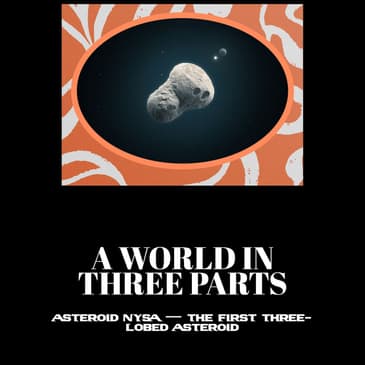
00:02:18 --> 00:02:20 BISA isn't normal. A team
00:02:21 --> 00:02:23 led by Kate Minker at, uh, Lowell Observatory
00:02:24 --> 00:02:26 has just announced in a study with the
00:02:26 --> 00:02:29 wonderful title Unmasking 44
00:02:29 --> 00:02:32 Nysa, that Nyssa appears to have
00:02:32 --> 00:02:35 three lobes. Three joined by
00:02:35 --> 00:02:38 two narrow necks, like, uh, a figure carved
00:02:38 --> 00:02:40 with two deep waists around it.
00:02:41 --> 00:02:43 If it holds up, it's the first tri
00:02:43 --> 00:02:45 lobed asteroid ever seen.
00:02:46 --> 00:02:49 Avery: Three lobes? How do you even see that? These
00:02:49 --> 00:02:52 things are tiny dots, even in big telescopes.
00:02:52 --> 00:02:55 Anna: That's the clever part. They used two of
00:02:55 --> 00:02:58 the sharpest eyes on Earth. The Large
00:02:58 --> 00:03:00 Binocular Telescope in Arizona. Its
00:03:00 --> 00:03:03 main mirror is about eight meters, roughly
00:03:03 --> 00:03:06 three times the size of Hubble's, running an
00:03:06 --> 00:03:09 instrument called sharkvis, plus
00:03:09 --> 00:03:11 the Very Large Telescope down in Chile.
00:03:12 --> 00:03:15 And they used adaptive optics, a mirror
00:03:15 --> 00:03:17 that flexes hundreds of times a second,
00:03:18 --> 00:03:20 nearly 600 tiny actuators
00:03:20 --> 00:03:23 pushing on it to cancel out the blurring of
00:03:23 --> 00:03:26 our atmosphere in real time. The
00:03:26 --> 00:03:29 result is sharper than Hubble. They imaged
00:03:29 --> 00:03:31 NISA on two nights, 15
00:03:31 --> 00:03:34 February and 21 March this year.
00:03:35 --> 00:03:37 And both times the same strange
00:03:37 --> 00:03:39 three part silhouette turned up.
00:03:40 --> 00:03:42 Which brings us to the second surprise.
00:03:42 --> 00:03:45 NISA has a moon, a little one,
00:03:45 --> 00:03:48 about a kilometer across, orbiting at
00:03:48 --> 00:03:50 least 170 kilometers out.
00:03:51 --> 00:03:53 It's been given the placeholder name
00:03:53 --> 00:03:55 S202644
00:03:55 --> 00:03:58 1, and it
00:03:58 --> 00:04:01 was hiding in plain sight, drowned out by
00:04:01 --> 00:04:03 the glare of the much brighter asteroid next
00:04:03 --> 00:04:06 to it. To dig it out, the team borrowed a
00:04:06 --> 00:04:09 trick from a completely different corner of
00:04:10 --> 00:04:13 high contrast imaging, the same family
00:04:13 --> 00:04:15 of techniques we used to pull a faint
00:04:15 --> 00:04:18 planet out of the glare of its star.
00:04:18 --> 00:04:20 As one of the sharkvis scientists,
00:04:21 --> 00:04:23 Gianluca Lee Cauce, put it, they used
00:04:23 --> 00:04:26 that technique to catch a faint companion
00:04:26 --> 00:04:29 whose light was being swamped by the primary.
00:04:29 --> 00:04:32 And because they caught it moving across two
00:04:32 --> 00:04:35 separate observing runs, they know it's
00:04:35 --> 00:04:38 genuinely in orbit, not a background star.
00:04:38 --> 00:04:41 Avery: Photobombing the shot and a, uh, moon is
00:04:41 --> 00:04:41 useful, right?
00:04:42 --> 00:04:44 Anna: Not just a bonus, it's enormously
00:04:44 --> 00:04:47 useful. This is the thing I love about it.
00:04:47 --> 00:04:50 Watch how fast the moon goes round and how
00:04:50 --> 00:04:53 far out it sits and you can weigh the
00:04:53 --> 00:04:55 asteroid. You get nice's mass.
00:04:56 --> 00:04:58 Combine the mass with the size and you get
00:04:58 --> 00:05:01 its density. And density is the whole
00:05:01 --> 00:05:03 ball game here, because there are two
00:05:03 --> 00:05:06 competing stories for what NYSA actually
00:05:06 --> 00:05:09 is. Story one, it's a
00:05:09 --> 00:05:11 genuine three part body, maybe a
00:05:11 --> 00:05:14 contact trinary. Three chunks that
00:05:14 --> 00:05:17 drifted together and gently stuck.
00:05:18 --> 00:05:21 It's one solid, deeply dented lump
00:05:21 --> 00:05:24 that only looks three lobed from our angle.
00:05:25 --> 00:05:27 Density can help tell those apart. A loose
00:05:27 --> 00:05:30 rubble pile reads light and fluffy. A
00:05:30 --> 00:05:33 solid coherent rock reads dense.
00:05:34 --> 00:05:36 So that little moon is going to help settle
00:05:36 --> 00:05:39 what kind of world this is and how it got
00:05:39 --> 00:05:40 so weird.
00:05:40 --> 00:05:42 Avery: Any theories on the how?
00:05:42 --> 00:05:45 Anna: Nothing locked in. And that honesty is
00:05:45 --> 00:05:48 the fun of it. It could be a record of
00:05:48 --> 00:05:51 gentle slow motion collisions in the belt,
00:05:51 --> 00:05:54 bodies bumping and merging over billions of
00:05:54 --> 00:05:57 years. It could be the aftermath of a
00:05:57 --> 00:05:59 bigger smash that left a battered
00:05:59 --> 00:06:02 survivor. Or observations of that
00:06:02 --> 00:06:05 moon will narrow it down. For now, we've got
00:06:05 --> 00:06:08 a brand new kind of object, a triple
00:06:08 --> 00:06:11 lobed asteroid with its own satellite
00:06:11 --> 00:06:13 sitting in a part of the sky we thought we
00:06:13 --> 00:06:16 understood. And that's the quiet lesson of
00:06:16 --> 00:06:18 NISA. It was found in
00:06:18 --> 00:06:21 1857. It's one of the best
00:06:21 --> 00:06:24 studied bright asteroids we have. And in
00:06:24 --> 00:06:27 2026, it still had two secrets
00:06:27 --> 00:06:30 left. A shape nobody expected and a
00:06:30 --> 00:06:33 moon nobody had seen. The solar system
00:06:33 --> 00:06:34 is not done surprising
00:06:34 --> 00:06:37 Avery: us from a world we can nearly
00:06:37 --> 00:06:39 touch to one we may never reach,
00:06:40 --> 00:06:42 but might one day actually see.
00:06:43 --> 00:06:45 NASA has just backed a genuinely audacious
00:06:45 --> 00:06:48 idea. A plan to photograph the surface of a
00:06:48 --> 00:06:51 planet around another star. Not detect
00:06:51 --> 00:06:53 it, not measure it, see it.
00:06:53 --> 00:06:56 Continents, oceans, weather.
00:06:56 --> 00:06:59 Anna: Hang on, we can't do that. I feel
00:06:59 --> 00:07:01 like we have pictures of exoplanets.
00:07:02 --> 00:07:05 Avery: We have dots. Every exoplanet we've
00:07:05 --> 00:07:07 ever found is, in a sense, invisible. We
00:07:07 --> 00:07:10 infer it from a star's tiny wobble or a faint
00:07:10 --> 00:07:12 dip dip in brightness as the planet crosses
00:07:12 --> 00:07:15 in front. In the very best cases, we've
00:07:15 --> 00:07:18 captured a single pixel of light. Nobody
00:07:18 --> 00:07:20 has ever resolved a surface. The problem is
00:07:20 --> 00:07:23 brutal. A star can be around 10 billion times
00:07:23 --> 00:07:25 brighter than the little Earth sized planet
00:07:25 --> 00:07:28 beside it. And the two sit almost on top of
00:07:28 --> 00:07:31 each other in the sky. The new concept comes
00:07:31 --> 00:07:33 from physicist Paul Stankis at Brookhaven,
00:07:33 --> 00:07:36 and it's one of 18 early stage ideas NASA
00:07:36 --> 00:07:38 just funded through its innovative Advanced
00:07:38 --> 00:07:41 Concepts Program. Nyack. These are
00:07:41 --> 00:07:43 seed grants, small money, nine months,
00:07:43 --> 00:07:46 permission to chase something wild. His is
00:07:46 --> 00:07:49 called Mapping Alien Continents. It works in
00:07:49 --> 00:07:52 two moves. First, a new kind of light
00:07:52 --> 00:07:54 canceling instrument, another that blots out
00:07:54 --> 00:07:57 the star's glare while keeping the planet's
00:07:57 --> 00:07:59 light at a contrast of 10 billion to one or
00:07:59 --> 00:08:02 better. Then the really bold bit. You fly
00:08:02 --> 00:08:05 two of these on separate spacecraft about a
00:08:05 --> 00:08:07 hundred kilometers apart and combine their
00:08:07 --> 00:08:09 beams till they act as one enormous
00:08:09 --> 00:08:12 telescope, big enough in principle to resolve
00:08:12 --> 00:08:14 features on the planet's face.
00:08:14 --> 00:08:17 Anna: A telescope a hundred kilometers wide
00:08:17 --> 00:08:20 made of two spacecraft flying in formation.
00:08:20 --> 00:08:22 Avery: That's a dream. And I want to be honest about
00:08:22 --> 00:08:25 where this sits. It's a concept study, not a
00:08:25 --> 00:08:28 mission on a launch pad. It may never fly in
00:08:28 --> 00:08:30 this form, but this is exactly how the big
00:08:30 --> 00:08:33 leaps begin. Someone asks what if we could
00:08:33 --> 00:08:36 actually look? And NASA hands him a little
00:08:36 --> 00:08:37 funding to find out whether the physics
00:08:37 --> 00:08:40 holds. If it ever came together, it would
00:08:40 --> 00:08:42 turn exoplanets from statistics into
00:08:42 --> 00:08:43 places.
00:08:44 --> 00:08:45 Now, Anna, speaking of things, we can
00:08:45 --> 00:08:48 Anna: see from right here, we've got weather coming
00:08:48 --> 00:08:51 in space. Weather forecasters at
00:08:51 --> 00:08:53 noaa, uh, are tracking a couple of clouds of
00:08:53 --> 00:08:56 solar material heading our way. Coronal
00:08:56 --> 00:08:59 mass ejections, big blobs of charged
00:08:59 --> 00:09:02 gas flung off the sun. These two
00:09:02 --> 00:09:04 are faint and they're only likely to give
00:09:04 --> 00:09:07 Earth a glancing blow over the next day or
00:09:07 --> 00:09:07 so.
00:09:08 --> 00:09:09 Avery: Glancing, but not nothing.
00:09:10 --> 00:09:13 Anna: Not Nothing. Layer those CMEs
00:09:13 --> 00:09:16 on top of a fast stream already flowing from
00:09:16 --> 00:09:18 a coronal hole, a gap in the Sun's
00:09:18 --> 00:09:21 outer atmosphere, and the models suggest we
00:09:21 --> 00:09:24 could tip into a G1 storm. That's
00:09:24 --> 00:09:27 the mildest rung on the scale. No drama for
00:09:27 --> 00:09:29 the power grid, but enough to nudge the
00:09:29 --> 00:09:32 aurora to slightly lower latitudes than
00:09:32 --> 00:09:35 usual. The so over the coming nights. It's
00:09:35 --> 00:09:37 worth a look if you're up high, and I'll give
00:09:37 --> 00:09:39 you the where and when in the skywatch.
00:09:40 --> 00:09:43 Here's the thread, though. That same solar
00:09:43 --> 00:09:45 wind, the constant outflow from the sun
00:09:46 --> 00:09:48 is gentle at Earth because we've got a strong
00:09:48 --> 00:09:51 magnetic field and a thick atmosphere
00:09:51 --> 00:09:54 shrugging it off. Auroras are the pretty
00:09:54 --> 00:09:57 side of that shrug. But not every world
00:09:57 --> 00:09:59 is so lucky. Some planets have been
00:09:59 --> 00:10:02 standing in that wind for billions of years
00:10:02 --> 00:10:04 with no shield at all.
00:10:04 --> 00:10:07 Avery: Which is the perfect cue for my next 1mi
00:10:07 --> 00:10:10 escapade, a pair of NASA's craft
00:10:10 --> 00:10:12 nicknamed Blue and Gold after the University
00:10:12 --> 00:10:15 of California, Berkeley colors, built by
00:10:15 --> 00:10:17 Rocket Lab and launched last November on a
00:10:17 --> 00:10:20 blue origin. New Glenn. They're Mars bound.
00:10:20 --> 00:10:23 And right now they're loitering out near a
00:10:23 --> 00:10:25 spot called L2, about a million miles
00:10:25 --> 00:10:28 beyond Earth, waiting for the road to Mars to
00:10:28 --> 00:10:31 open. While they wait, one of them turned its
00:10:31 --> 00:10:34 cameras back toward home and snapped a family
00:10:34 --> 00:10:37 portrait. Earth and the Moon together as
00:10:37 --> 00:10:39 two slim crescents. In ordinary
00:10:39 --> 00:10:41 visible light, they look exactly as you'd
00:10:41 --> 00:10:44 hope, two bright sunlit sickles against the
00:10:44 --> 00:10:47 black. But these cameras also see in thermal
00:10:47 --> 00:10:50 infrared heat, and that view is stranger
00:10:50 --> 00:10:53 and honestly, a bit beautiful. The night
00:10:53 --> 00:10:55 side of Earth glows softly with its own
00:10:55 --> 00:10:58 warmth, while the Moon's dark half sits
00:10:58 --> 00:11:01 far, far colder. A portrait in
00:11:01 --> 00:11:03 light and a portrait in heat of the same two
00:11:03 --> 00:11:04 worlds.
00:11:04 --> 00:11:07 Anna: Gorgeous. But that's not why they built it,
00:11:07 --> 00:11:08 is it?
00:11:08 --> 00:11:10 Avery: It's not. And here's where our, uh, thread
00:11:10 --> 00:11:13 lands. Escapade exists to study exactly what
00:11:13 --> 00:11:15 we were just talking about. Its whole job,
00:11:15 --> 00:11:18 once it reaches Mars in 2027, is to measure
00:11:18 --> 00:11:20 how the solar wind strips away the Martian
00:11:20 --> 00:11:23 atmosphere. Mars doesn't have a global
00:11:23 --> 00:11:26 magnetic shield like ours, so the same wind
00:11:26 --> 00:11:28 that just gives us auroras has, over billions
00:11:28 --> 00:11:31 of years, helped peel Mars from a warmer,
00:11:31 --> 00:11:33 wetter world. The thin, cold desert we see
00:11:33 --> 00:11:36 today. Two spacecraft taking readings from
00:11:36 --> 00:11:39 two vantage points at once, watching a planet
00:11:39 --> 00:11:42 lose its air in real time. That Earth and
00:11:42 --> 00:11:44 Moon portrait was really a calibration check,
00:11:44 --> 00:11:46 a chance to point the cameras at uh, familiar
00:11:46 --> 00:11:49 targets before the main event, but it doubles
00:11:49 --> 00:11:52 as a quiet reminder. A shielded world
00:11:52 --> 00:11:55 and an unshielded one are separated by
00:11:55 --> 00:11:56 not very much at
00:11:56 --> 00:11:59 Anna: all the wind that paints our sky
00:11:59 --> 00:12:02 and the wind that scours Mars. The same
00:12:02 --> 00:12:04 sun. Lovely thread Avery
00:12:04 --> 00:12:06 right out under the sky.
00:12:07 --> 00:12:09 First the moon. We've just come off the full
00:12:09 --> 00:12:12 buck moon on the 29th, so we're in a
00:12:12 --> 00:12:15 bright waning gibbous stretch. M beautiful
00:12:15 --> 00:12:17 to look at, but that glare will wash out
00:12:17 --> 00:12:20 anything faint for the next several nights.
00:12:20 --> 00:12:23 Worth knowing before you plan meteors.
00:12:23 --> 00:12:26 The southern Delta Aquariids and the Alpha
00:12:26 --> 00:12:29 Capricornids have just passed their peak on
00:12:29 --> 00:12:32 the 30th in into the 31st. From here
00:12:32 --> 00:12:34 in the southern hemisphere, the Delta
00:12:34 --> 00:12:37 Aquarids still favor us. But with the moon
00:12:37 --> 00:12:39 this bright, keep expectations modest
00:12:39 --> 00:12:42 and watch for the occasional slow bright
00:12:42 --> 00:12:45 Capricornid fireball which both
00:12:45 --> 00:12:48 hemispheres can catch. The better news is
00:12:48 --> 00:12:50 what's coming. The Perseids build to
00:12:50 --> 00:12:53 their peak on the night of the 12th into the
00:12:53 --> 00:12:56 13th of August, and this year the Moon is
00:12:56 --> 00:12:59 nearly new, so it's a genuinely dark
00:12:59 --> 00:13:01 generous window. For North America,
00:13:01 --> 00:13:04 that's prime. Find a dark spot, look
00:13:04 --> 00:13:07 up after midnight and the northern sky can
00:13:07 --> 00:13:09 deliver a meteor a minute at its best.
00:13:10 --> 00:13:12 From the southern hemisphere, the Perseids
00:13:12 --> 00:13:15 sit low in the north so you'll see fewer.
00:13:15 --> 00:13:18 But a clear northern horizon is worth a try.
00:13:18 --> 00:13:21 Mark the 12th. Also on the 12th of
00:13:21 --> 00:13:24 August, a uh, total solar eclipse. The
00:13:24 --> 00:13:26 path of totality runs across Greenland,
00:13:26 --> 00:13:29 Iceland and a slice of Spain, with
00:13:29 --> 00:13:32 partial phases for parts of northern North
00:13:32 --> 00:13:34 America and Europe. If you're anywhere near
00:13:34 --> 00:13:37 it, never look at the partial sun without
00:13:37 --> 00:13:40 certified eclipse glasses that meet the
00:13:40 --> 00:13:41 ISO
00:13:41 --> 00:13:43
00:13:43 --> 00:13:46 standard. Ordinary sunglasses will not
00:13:46 --> 00:13:49 protect your eyes. Totality only is
00:13:49 --> 00:13:51 safe to view with the naked eye and only for
00:13:51 --> 00:13:54 those precious seconds it lasts. Planets
00:13:54 --> 00:13:57 quickly, both hemispheres. The pre dawn
00:13:57 --> 00:14:00 sky is the place to be with the brighter
00:14:00 --> 00:14:02 planets gathering low in the east before
00:14:02 --> 00:14:05 sunrise. From Sydney, look to the eastern
00:14:05 --> 00:14:08 horizon in the hour before dawn. From
00:14:08 --> 00:14:11 North America, the same window an hour or
00:14:11 --> 00:14:14 so before your local sunrise. One
00:14:14 --> 00:14:16 quick diary item and this one's for our
00:14:16 --> 00:14:19 telescope owners. On the 5th of August, a uh,
00:14:19 --> 00:14:22 dead SpaceX Falcon 9 upper stage
00:14:22 --> 00:14:24 space junk we tracked since it launched
00:14:24 --> 00:14:27 Firefly's Blue Ghost lander back in January
00:14:27 --> 00:14:30 of last year is expected to smack
00:14:30 --> 00:14:33 into the moon near Einstein Crater at
00:14:33 --> 00:14:36 about half past six Universal Time.
00:14:36 --> 00:14:39 For North America, that's the small hours of
00:14:39 --> 00:14:42 the 5th and you're the best placed to try for
00:14:42 --> 00:14:44 it. Aim for the faint dust plume near the
00:14:44 --> 00:14:47 Moon's eastern edge. Not a naked eye
00:14:47 --> 00:14:50 flash. You'll want a decent telescope from
00:14:50 --> 00:14:53 Sydney. The Moon isn't up at impact, so down
00:14:53 --> 00:14:56 here we'll be leaning on the afterimages from
00:14:56 --> 00:14:59 orbiters like NASA's Lunar Reconnaissance
00:14:59 --> 00:15:01 Orbiter. And to close our thread, the
00:15:01 --> 00:15:04 aurora. If those solar storms land
00:15:04 --> 00:15:07 as forecast, watch the high latitudes over
00:15:07 --> 00:15:10 the coming nights across the northern tier of
00:15:10 --> 00:15:13 the United States and up into Canada in the
00:15:13 --> 00:15:15 north and down towards Tasmania,
00:15:15 --> 00:15:18 southern New Zealand and southern Victoria in
00:15:18 --> 00:15:21 the south. Same sun, same wind,
00:15:21 --> 00:15:23 both ends of the Earth. And if you catch a
00:15:23 --> 00:15:26 glow, you'll know exactly what you're looking
00:15:26 --> 00:15:26 at.
00:15:26 --> 00:15:29 Avery: Everything we talked about today, the links,
00:15:29 --> 00:15:31 the images of NISA and that Earth and moon
00:15:31 --> 00:15:32 portrait is at
00:15:32 --> 00:15:35 astronomydaily.IO, along with the
00:15:35 --> 00:15:38 daily newsfeed and the newsletter signup.
00:15:38 --> 00:15:40 Anna: And if you spotted an aurora or bagged a
00:15:40 --> 00:15:43 Perseid, tell us. There's a listener contact
00:15:43 --> 00:15:45 form on the site. And we love hearing what
00:15:45 --> 00:15:46 you've seen.
00:15:46 --> 00:15:49 Avery: That's Astronomy daily for Friday 31st
00:15:49 --> 00:15:51 July. I'm Avery.
00:15:51 --> 00:15:53 Anna: And I'm Anna. Until next time. Click. Clear
00:15:53 --> 00:15:54 Skies.