

When your ready to upgrade your digital security online, do what we did and get the best - NordVPN. And right now you can save a heap of money and help support the show. For details on the full deal CLICK HERE
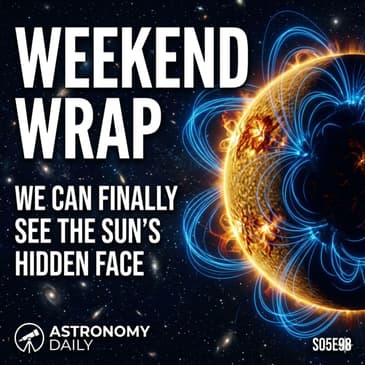
Astronomy Daily — S05E98 | Weekend Wrap | May 9, 2026 Welcome to the Astronomy Daily Weekend Space & Astronomy News Wrap! Every Saturday, Anna and Avery bring you a roundup of the biggest stories from the past week in space and astronomy — plus two fresh stories to open the show. Here's what we covered this week: Fresh Stories 🌞 The Sun's Hidden Face Finally Gets a Full Read-Out For 25 years, helioseismology has let scientists detect sunspot groups forming on the Sun's far side — but not their magnetic polarity, the key factor in forecasting how dangerous an eruption might be. A new technique developed by the National Solar Observatory's GONG network changes that, enabling polarity-resolved magnetic maps of the Sun's hidden hemisphere for the first time. With a significant far-side flare firing just days ago, the real-world stakes couldn't be clearer. Published in Scientific Reports. 🌀 Webb Finds an Ancient Galaxy That Simply Refuses to Spin James Webb has spotted XMM-VID1-2075, a massive galaxy formed less than 2 billion years after the Big Bang that shows no rotation — a trait normally reserved for much older, evolved systems. Current theory says young galaxies should still be spinning. This one isn't. The UC Davis-led team is now searching for similar objects to understand how rare this truly is. Published in Nature Astronomy. Weekly Wrap — The Four Biggest Stories 🪐 The Planetary Odd Couple That Defies the Rules 190 light-years away, a hot Jupiter and a mini-Neptune are orbiting the same star — an arrangement once thought nearly impossible, since hot Jupiters typically scatter anything in their neighbourhood. Using JWST, MIT researchers have now read the mini-Neptune's atmosphere for the first time, finding a heavy mix of water vapour, CO₂, SO₂ and methane that points to formation far beyond the frost line. Both planets likely migrated inward together. Published in Astrophysical Journal Letters. 🟤 200,000 Volunteers Double the Known Brown Dwarf Population NASA's citizen science project Backyard Worlds: Planet 9 has announced the discovery of more than 3,000 brown dwarfs over 10 years — essentially doubling the known count. The 75-author paper in The Astronomical Journal includes 61 volunteer co-authors. New finds include extreme T subdwarfs, ultra-cool objects, and a brown dwarf that may have aurorae. The search continues through more than 2 billion WISE sources. 🍩 NASA Launches Space Doughnut Mission Tuesday SpaceX CRS-34 launches May 12 carrying STORIE (Storm Time O+ Ring Current Imaging Evolution), a joint NASA/U.S. Space Force instrument to be mounted outside the ISS. STORIE will study Earth's ring current — a doughnut-shaped region of trapped charged particles that can surge during solar storms, disrupting satellites and power grids — from the inside out. Six-month mission duration. 🪨 Webb Directly Reads an Exoplanet's Surface for the First Time JWST has achieved a planetary science first — directly characterising the surface of a super-Earth 48 light-years away. The findings reveal a dark, airless, Mercury-like world with no atmosphere. The technique marks a significant shift from atmospheric to direct surface analysis, opening new possibilities for characterising rocky planets in and near habitable zones.
Become a supporter of this podcast: https://www.spreaker.com/podcast/astronomy-daily-latest-space-news--5648921/support.
Sponsor Details:
Ensure your online privacy by using NordVPN. To get our special listener deal and save a lot of money, visit www.astronomydaily.io/nordvpn. You'll be glad you did!
Get the best secure and private email on the planet. Stop your Government, google and who knows who else spying on every email you write. Do what we did and use ProtonMail. They beleive in privacy and there are no ads in their business model...yet they still provide a free forever service. Check them out and get out special deal at www.astronomydaily.io/protonmail
Become a supporter of Astronomy Daily by joining our Supporters Club. Commercial free episodes daily are only a click way... Click Here
This episode includes AI-generated content.
00:00:00 --> 00:00:02 Anna: Hello, space fans. You're tuned in to
00:00:02 --> 00:00:05 Astronomy Daily, your weekend home, for the
00:00:05 --> 00:00:08 biggest stories from the cosmos. I'm Anna.
00:00:08 --> 00:00:10 Avery: And, um, I'm Avery. And what a week it has
00:00:10 --> 00:00:11 been.
00:00:11 --> 00:00:13 Anna: We've got two fresh stories to kick things
00:00:13 --> 00:00:16 off, and then, as always on a Saturday, we're
00:00:16 --> 00:00:19 bringing you our weekend wrap. The four
00:00:19 --> 00:00:21 biggest space and astronomy stories from the
00:00:21 --> 00:00:22 past seven days.
00:00:22 --> 00:00:25 Avery: So let's not waste a second. Let's get into
00:00:25 --> 00:00:25 it.
00:00:25 --> 00:00:28 Anna: So this first story is about something that
00:00:28 --> 00:00:30 has frustrated solar scientists for decades.
00:00:31 --> 00:00:33 And honestly, it's about time it got sorted.
00:00:34 --> 00:00:35 Avery: Oh, uh, I know what you're gonna say. The far
00:00:35 --> 00:00:36 side.
00:00:36 --> 00:00:39 Anna: The far side. Every 28 days, the
00:00:39 --> 00:00:42 sun rotates all the way around, which means
00:00:42 --> 00:00:44 anything happening on the side we can't see
00:00:44 --> 00:00:47 from Earth. Sunspots, flares,
00:00:47 --> 00:00:50 eruptionshas historically been a mystery
00:00:50 --> 00:00:51 until it swings into view.
00:00:52 --> 00:00:53 Avery: Um, and by that point, you might only have
00:00:53 --> 00:00:55 days of warning before whatever's brewing
00:00:55 --> 00:00:57 rotates directly toward Earth.
00:00:57 --> 00:01:00 Anna: Exactly. Now, scientists have had a
00:01:00 --> 00:01:03 technique called helioseismology for about
00:01:03 --> 00:01:06 25 years, basically using sound waves
00:01:06 --> 00:01:09 reverberating inside the sun to locate
00:01:09 --> 00:01:11 where large active regions are forming on
00:01:11 --> 00:01:12 that hidden side.
00:01:12 --> 00:01:15 Avery: So a bit like using sonar to look for things
00:01:15 --> 00:01:16 you can't directly see.
00:01:16 --> 00:01:19 Anna: Great analogy. But here's the thing.
00:01:19 --> 00:01:21 That technique could tell you that something
00:01:21 --> 00:01:24 was there. What it could not tell you was the
00:01:24 --> 00:01:26 polarity of those active regions.
00:01:26 --> 00:01:28 Avery: So polarity matters because.
00:01:29 --> 00:01:31 Anna: Because the polarity of a sunspot group,
00:01:31 --> 00:01:34 which way the magnetic field is pointing, is
00:01:34 --> 00:01:36 one of the most important factors in how
00:01:36 --> 00:01:39 powerful an eruption might be. Get the
00:01:39 --> 00:01:41 polarity wrong, and your forecast is
00:01:41 --> 00:01:42 basically useless.
00:01:42 --> 00:01:43 Avery: So what's changed?
00:01:43 --> 00:01:46 Anna: A team led by solar physicist Almer Hamada
00:01:46 --> 00:01:49 at the National Solar Observatory have
00:01:49 --> 00:01:52 developed a new method using data NOAA's
00:01:52 --> 00:01:54 Global Oscillation Network Group Gong A Ah,
00:01:54 --> 00:01:57 network of robotic telescopes stationed
00:01:57 --> 00:01:59 around the world that continuously records
00:01:59 --> 00:02:02 the Sun's surface oscillations. They've found
00:02:02 --> 00:02:04 a way to analyze phase shifts in the
00:02:04 --> 00:02:07 helioseismic maps and assign actual
00:02:07 --> 00:02:09 magnetic polarities to far side sunspot
00:02:09 --> 00:02:10 regions.
00:02:10 --> 00:02:12 Avery: So we're not just seeing where the sunspot
00:02:12 --> 00:02:14 is. We're now getting information about how
00:02:14 --> 00:02:16 dangerous it might be before it's even
00:02:16 --> 00:02:16 visible.
00:02:17 --> 00:02:20 Anna: And to put a very real world spin on this,
00:02:20 --> 00:02:23 just two days ago, on May 7, a significant
00:02:23 --> 00:02:26 solar flare erupted from the Sun's far side.
00:02:26 --> 00:02:28 The event was partially blocked by the solar
00:02:28 --> 00:02:31 horizon, so we don't even know how large it
00:02:31 --> 00:02:33 really was. The question already being asked
00:02:33 --> 00:02:34 is, what's
00:02:34 --> 00:02:37 Avery: coming back around that's genuinely
00:02:37 --> 00:02:38 exciting and a little unnerving.
00:02:38 --> 00:02:41 Anna: Uh, the team's results have been published in
00:02:41 --> 00:02:43 scientific reports and the findings are being
00:02:43 --> 00:02:46 hailed as a breakthrough for full sun
00:02:46 --> 00:02:48 magnetic mapping. The more we can see the
00:02:48 --> 00:02:51 whole sun at once, the better we can protect
00:02:51 --> 00:02:53 the satellites, power grids and astronauts
00:02:53 --> 00:02:56 that rely on space weather forecasting.
00:02:56 --> 00:02:58 Avery: Massive step forward. Love it.
00:02:58 --> 00:03:01 Anna: Okay, story two comes from the James Webb
00:03:01 --> 00:03:04 Space Telescope. And I have to be honest, I
00:03:04 --> 00:03:06 feel like almost every week JWST
00:03:07 --> 00:03:08 is breaking something. We thought we
00:03:08 --> 00:03:11 understood this point. It's basically its
00:03:11 --> 00:03:13 personality, right?
00:03:14 --> 00:03:16 Avery: So this week, a team led by researchers at
00:03:16 --> 00:03:19 the University of California, Davis, has
00:03:19 --> 00:03:22 published findings in Nature Astronomy about
00:03:22 --> 00:03:24 a galaxy called XMMVidon M
00:03:24 --> 00:03:28 M2075.
00:03:28 --> 00:03:31 And before you zone out at the name, here's
00:03:31 --> 00:03:33 why it matters. This galaxy formed less
00:03:33 --> 00:03:36 than 2 billion years after the Big Bang,
00:03:36 --> 00:03:37 which in
00:03:37 --> 00:03:39 Anna: cosmic terms is extremely young.
00:03:40 --> 00:03:43 Avery: Extremely young. Now, according to everything
00:03:43 --> 00:03:45 we understand about how galaxies form, young
00:03:45 --> 00:03:48 galaxies should be spinning. Angular
00:03:48 --> 00:03:50 momentum from inflowing gas, the influence of
00:03:50 --> 00:03:53 gravity during formation. It all sets them
00:03:53 --> 00:03:56 rotating over billions of years through
00:03:56 --> 00:03:58 mergers and other processes. Some of them
00:03:58 --> 00:04:00 eventually slow down and become these large
00:04:00 --> 00:04:02 settled non rotating systems.
00:04:03 --> 00:04:05 Anna: But that takes a very long time.
00:04:05 --> 00:04:07 Avery: A, ah, very long time. And yet
00:04:08 --> 00:04:09 XMMVID M M
00:04:10 --> 00:04:13 2075 shows essentially
00:04:13 --> 00:04:16 zero rotation. None. It has
00:04:16 --> 00:04:18 already settled into that mature non
00:04:18 --> 00:04:21 spinning state at an age when it should still
00:04:21 --> 00:04:24 be churning away like a cosmic washing
00:04:24 --> 00:04:24 machine.
00:04:24 --> 00:04:26 Anna: So how is that even possible?
00:04:26 --> 00:04:29 Avery: That's the big question. Some simulations do
00:04:29 --> 00:04:31 allow for a very small number of these
00:04:31 --> 00:04:33 objects in the early universe, but they're
00:04:33 --> 00:04:36 predicted to be incredibly rare. Finding one
00:04:36 --> 00:04:38 is already significant. The team is now
00:04:38 --> 00:04:41 actively searching for more to understand
00:04:41 --> 00:04:44 just how common or uncommon they might be.
00:04:44 --> 00:04:46 Anna: And I understand this galaxy was already on
00:04:46 --> 00:04:48 the radar as one of the most massive in the
00:04:48 --> 00:04:49 early universe.
00:04:49 --> 00:04:52 Avery: It was. Previous observations confirmed it
00:04:52 --> 00:04:54 already had several times as many stars as
00:04:54 --> 00:04:57 our entire Milky Way and had stopped forming
00:04:57 --> 00:05:00 new stars. Both traits of a much older
00:05:00 --> 00:05:03 evolved system. JWST was then
00:05:03 --> 00:05:05 used to measure how material was actually
00:05:05 --> 00:05:07 moving inside it. And the result was
00:05:08 --> 00:05:09 it basically wasn't,
00:05:09 --> 00:05:12 Anna: shouldn't exist, but it does. That's
00:05:12 --> 00:05:13 JWST in a nutshell.
00:05:13 --> 00:05:15 Avery: Every week. Every single week.
00:05:15 --> 00:05:18 Anna: Alright, time for our weekend wrap. Four
00:05:18 --> 00:05:20 stories. The biggest space in astronomy news
00:05:20 --> 00:05:23 from the past seven days. Avery, set it up.
00:05:23 --> 00:05:26 Avery: Let's do it. This week we have a cosmic odd
00:05:26 --> 00:05:28 couple that shouldn't be together. A quarter
00:05:28 --> 00:05:31 million citizen scientists who've quietly
00:05:31 --> 00:05:33 doubled the book of brown dwarfs. A NASA
00:05:33 --> 00:05:35 mission that's about to launch inside a space
00:05:35 --> 00:05:38 donut. And the Webb first that nobody has
00:05:38 --> 00:05:39 done before. Big week.
00:05:40 --> 00:05:42 Anna: A space donut. We'll get to that.
00:05:42 --> 00:05:44 Let's start with rap story number one. A
00:05:44 --> 00:05:47 planetary pairing that MIT scientists are
00:05:47 --> 00:05:49 calling one of the rarest architectures
00:05:49 --> 00:05:52 astronomers have ever found. It involves a
00:05:52 --> 00:05:54 hot Jupiter and a mini Neptune,
00:05:54 --> 00:05:57 190 light years from Earth, orbiting the same
00:05:57 --> 00:05:59 star. And according to everything we know,
00:06:00 --> 00:06:02 one of them should not still be there.
00:06:02 --> 00:06:04 Avery: Hot Jupiters are legendary bullies.
00:06:04 --> 00:06:07 Anna: They really are. They're massive gas giants
00:06:07 --> 00:06:09 that orbit very close to their star. And
00:06:09 --> 00:06:12 their gravity is so intense that any planet
00:06:12 --> 00:06:14 daring to share the neighborhood normally
00:06:14 --> 00:06:17 gets flung away into deep space. Hot
00:06:17 --> 00:06:19 Jupiters are almost always found alone,
00:06:19 --> 00:06:22 Avery: except in this system toi 1130,
00:06:23 --> 00:06:24 where a, uh, mini Neptune is not only
00:06:24 --> 00:06:27 surviving, but orb even closer to the star
00:06:27 --> 00:06:29 than the hot Jupiter, which has
00:06:29 --> 00:06:31 Anna: been puzzling scientists since the system was
00:06:31 --> 00:06:34 first discovered in 2020. Now a team at
00:06:34 --> 00:06:37 MIT has used James Webb to actually read the
00:06:37 --> 00:06:39 atmosphere of the mini Neptune for the first
00:06:39 --> 00:06:41 time. And what they've found is a heavy
00:06:42 --> 00:06:45 water vapor, carbon dioxide, sulfur
00:06:45 --> 00:06:47 dioxide, and hints of methane.
00:06:47 --> 00:06:49 Avery: And that heavy atmospheric chemistry is the
00:06:49 --> 00:06:50 clue.
00:06:50 --> 00:06:52 Anna: Exactly. If this planet had formed where it
00:06:52 --> 00:06:55 currently sits close to its star, it would
00:06:55 --> 00:06:57 have a light atmosphere dominated by hydrogen
00:06:57 --> 00:07:00 and helium. Instead, it's dense with
00:07:00 --> 00:07:02 molecules that point to formation in the
00:07:02 --> 00:07:05 cold, icy outer reaches of the protoplanetary
00:07:05 --> 00:07:08 disk, what astronomers call beyond the frost
00:07:08 --> 00:07:09 line, which suggests
00:07:09 --> 00:07:12 Avery: both planets formed far out and then migrated
00:07:12 --> 00:07:14 inward together, maintaining their
00:07:14 --> 00:07:15 atmospheres as they went.
00:07:15 --> 00:07:18 Anna: This is actually the first measurement ever
00:07:18 --> 00:07:20 made of the atmosphere of a mini Neptune
00:07:20 --> 00:07:22 sitting inside a hot Jupiter's orbit.
00:07:23 --> 00:07:25 Genuinely unprecedented. Published this week
00:07:25 --> 00:07:27 in the Astrophysical Journal Letters.
00:07:27 --> 00:07:30 Avery: Two planets that shouldn't coexist. And yet
00:07:30 --> 00:07:33 they do, in perfect, if bewildering,
00:07:33 --> 00:07:33 harmony.
00:07:34 --> 00:07:36 Anna: Rap Story 2, and I love this one because it's
00:07:36 --> 00:07:38 a reminder that some of the most significant
00:07:39 --> 00:07:41 contributions to astronomy right now are
00:07:41 --> 00:07:43 being made by ordinary people sitting at home
00:07:43 --> 00:07:44 with a laptop.
00:07:44 --> 00:07:47 Avery: NASA's Backyard World's Planet Nine project?
00:07:47 --> 00:07:50 Anna: The very same. So for those who haven't heard
00:07:50 --> 00:07:52 of it, this is a citizen science program
00:07:52 --> 00:07:54 where volunteers sift through infrared data
00:07:54 --> 00:07:57 from NASA's retired WISE satellite, looking
00:07:57 --> 00:07:59 for objects that move. Stars move slightly
00:07:59 --> 00:08:02 against the background. Over time. Brown
00:08:02 --> 00:08:05 dwarfs move. Planet nine, if it exists, would
00:08:05 --> 00:08:05 too.
00:08:05 --> 00:08:07 Avery: And along the way, the volunteers have been
00:08:07 --> 00:08:10 finding brown dwarfs in remarkable numbers.
00:08:10 --> 00:08:13 Anna: Remarkable doesn't cover it. A new
00:08:13 --> 00:08:16 paper published this week in the astronomical
00:08:16 --> 00:08:18 journal with 75 authors,
00:08:18 --> 00:08:21 61 of whom are volunte announces
00:08:21 --> 00:08:23 that the project has discovered more than
00:08:23 --> 00:08:26 3 brown dwarfs over its first 10
00:08:26 --> 00:08:28 years, essentially doubling the known
00:08:28 --> 00:08:29 population.
00:08:30 --> 00:08:32 Avery: For listeners unfamiliar with brown dwarfs,
00:08:32 --> 00:08:35 they're often called failed stars. Too
00:08:35 --> 00:08:37 massive to be a planet, not massive enough to
00:08:37 --> 00:08:39 ignite nuclear fusion like a true star.
00:08:40 --> 00:08:42 They're about the size of Jupiter, they glow
00:08:42 --> 00:08:45 faintly in infrared, and they're surprisingly
00:08:45 --> 00:08:48 common. About one for every three or four
00:08:48 --> 00:08:49 stars near our Sun.
00:08:49 --> 00:08:52 Anna: But because they're so dim, they've always
00:08:52 --> 00:08:54 been hard to find. Until now.
00:08:54 --> 00:08:57 Avery: The discoveries include objects never seen
00:08:57 --> 00:08:59 before, extreme T subdwarfs,
00:08:59 --> 00:09:02 ultra cool objects, and apparently one brown
00:09:02 --> 00:09:05 dwarf that may even have aurorae
00:09:05 --> 00:09:07 orrore on a brown dwarf
00:09:08 --> 00:09:10 Anna: a million times brighter than the northern
00:09:10 --> 00:09:13 lights on Earth, if you could see them. The
00:09:13 --> 00:09:15 project is still working through more than 2
00:09:15 --> 00:09:18 billion sources in the WISE data, so there
00:09:18 --> 00:09:20 are almost certainly more finds to come.
00:09:21 --> 00:09:24 Avery: Science powered by people. I'll never stop
00:09:24 --> 00:09:26 finding that inspiring before
00:09:26 --> 00:09:28 Anna: we head into our next story, the donut I
00:09:28 --> 00:09:31 mentioned earlier, I'd like to take a moment
00:09:31 --> 00:09:34 to remind you about our sponsor, NordVPN.
00:09:34 --> 00:09:36 As I keep saying, when you're ready to secure
00:09:36 --> 00:09:39 your online life, get the best and help
00:09:39 --> 00:09:41 support the show while saving a heap of
00:09:41 --> 00:09:44 money. We use NORDVPN and reckon you
00:09:44 --> 00:09:47 should too. To get our special no Risk deal,
00:09:47 --> 00:09:49 just click on the link in the show notes.
00:09:49 --> 00:09:50 Thank you.
00:09:50 --> 00:09:51 Avery: Amen to uh, that.
00:09:51 --> 00:09:54 Anna: Okay, wrap story three and this one
00:09:54 --> 00:09:57 is timely because it's happening in three
00:09:57 --> 00:09:59 days. On Tuesday, May 12,
00:09:59 --> 00:10:02 SpaceX launches the 34th cargo
00:10:02 --> 00:10:04 resupply mission to the International Space
00:10:04 --> 00:10:07 Station. And among the 6
00:10:07 --> 00:10:09 pounds of cargo heading to orbit is something
00:10:09 --> 00:10:11 rather unusual.
00:10:11 --> 00:10:13 Avery: Tell em about the donut.
00:10:13 --> 00:10:16 Anna: The donut so surrounding
00:10:16 --> 00:10:19 our planet within Earth's magnetic field is
00:10:19 --> 00:10:22 a structure called the ring current. It's an
00:10:22 --> 00:10:24 invisible donut shaped region where charged
00:10:24 --> 00:10:27 particles from space get trapped and flow in
00:10:27 --> 00:10:30 opposite directions. Positive particles one
00:10:30 --> 00:10:33 way, negative the other, creating actual
00:10:33 --> 00:10:34 electrical currents.
00:10:34 --> 00:10:37 Avery: And this ring current matters because during
00:10:37 --> 00:10:40 solar storms it can intensify dramatically.
00:10:41 --> 00:10:43 Anna: When that happens, those electrical currents
00:10:43 --> 00:10:46 can induce magnetic fluctuations that
00:10:46 --> 00:10:48 ripple down to the ground, disrupting power
00:10:48 --> 00:10:51 lines, pipelines, satellite signals and
00:10:51 --> 00:10:54 GPS systems. We've always known the ring
00:10:54 --> 00:10:56 current matters for space weather. What we've
00:10:56 --> 00:10:59 never had is a proper inside out view of it
00:10:59 --> 00:11:02 until storey storey
00:11:02 --> 00:11:05 storm time O Ring Current
00:11:05 --> 00:11:08 Imaging Evolution, a joint NASA and
00:11:08 --> 00:11:10 U.S. space Force mission that will be
00:11:10 --> 00:11:12 robotically mounted on the outside of the ISS
00:11:13 --> 00:11:15 after Tuesday's launch. Rather than looking
00:11:15 --> 00:11:17 at the ring current from a distance, story
00:11:17 --> 00:11:20 sits within it and images outward,
00:11:20 --> 00:11:21 capturing One slice at
00:11:21 --> 00:11:24 Avery: a time, every 90 minutes as a station
00:11:24 --> 00:11:27 orbits, building up a complete picture of the
00:11:27 --> 00:11:29 full ring current over its
00:11:29 --> 00:11:32 Anna: six month mission, it will track how the ring
00:11:32 --> 00:11:34 current grows and shrinks during solar storms
00:11:34 --> 00:11:37 versus quiet periods. And try to answer a,
00:11:37 --> 00:11:39 uh, question scientists have long
00:11:40 --> 00:11:43 where exactly do these trapped particles come
00:11:43 --> 00:11:45 from? The solar wind or from Earth itself?
00:11:46 --> 00:11:49 Avery: The answer has real world implications for
00:11:49 --> 00:11:51 how we predict and prepare for space weather
00:11:51 --> 00:11:52 events.
00:11:52 --> 00:11:54 Anna: Keep an eye on the skies and the news on
00:11:54 --> 00:11:55 Tuesday night.
00:11:56 --> 00:11:58 Avery: And our final wrap story for the week,
00:11:58 --> 00:12:00 another JWST milestone and
00:12:00 --> 00:12:03 genuinely a, uh, planetary science first.
00:12:03 --> 00:12:04 Anna: Go on.
00:12:04 --> 00:12:07 Avery: So up until now, when we studied exoplanets
00:12:07 --> 00:12:09 with James Webb, we've been studying their
00:12:09 --> 00:12:12 atmospheres the way starlight filters through
00:12:12 --> 00:12:14 a planet's air as it passes in front of its
00:12:14 --> 00:12:17 star. That's transmission spectroscopy,
00:12:17 --> 00:12:19 and it's transformed what we know about
00:12:19 --> 00:12:21 worlds beyond our solar system.
00:12:21 --> 00:12:24 Anna: But this week, the telescope went a step
00:12:24 --> 00:12:24 further.
00:12:25 --> 00:12:28 Avery: For the first time, JWST has
00:12:28 --> 00:12:30 directly analyzed the surface of an
00:12:30 --> 00:12:32 exoplanet. The target is a super
00:12:32 --> 00:12:35 Earth, just 48 light years away,
00:12:35 --> 00:12:38 relatively close by by cosmic standards. And
00:12:38 --> 00:12:41 what the telescope found is a dark, airless
00:12:41 --> 00:12:44 world, no atmosphere, geologically
00:12:44 --> 00:12:47 ancient. The researchers are describing it as
00:12:47 --> 00:12:47 a
00:12:47 --> 00:12:49 Anna: Mercury like rock, which is actually
00:12:49 --> 00:12:52 fascinating in its own right. A scorching,
00:12:52 --> 00:12:55 barren super Earth with a surface you could
00:12:55 --> 00:12:57 in theory, characterize directly.
00:12:57 --> 00:13:00 Avery: The significance here is the technique. We've
00:13:00 --> 00:13:03 gone from studying what surrounds a planet to
00:13:03 --> 00:13:06 studying the planet itself directly reading
00:13:06 --> 00:13:08 the surface chemistry from light alone.
00:13:08 --> 00:13:11 Anna: That opens a completely new chapter in how we
00:13:11 --> 00:13:13 investigate rocky worlds. The next step,
00:13:13 --> 00:13:16 presumably, is applying this to planets in
00:13:16 --> 00:13:18 habitable zones, worlds where you might
00:13:18 --> 00:13:20 expect the surface to be far more
00:13:20 --> 00:13:20 interesting.
00:13:21 --> 00:13:23 Avery: One more extraordinary week for the most
00:13:23 --> 00:13:25 extraordinary telescope ever built.
00:13:26 --> 00:13:28 Anna: And that is your Astronomy Daily weekend wrap
00:13:28 --> 00:13:31 for Saturday. May 9th. The Sun's Hidden
00:13:31 --> 00:13:34 face finally mapped a galaxy from the dawn
00:13:34 --> 00:13:37 of time that forgot how to spin a planetary
00:13:37 --> 00:13:39 odd couple. Defying the rules,
00:13:39 --> 00:13:42 200 volunteers who doubled the
00:13:42 --> 00:13:45 cosmic catalog, a mission launching Tuesday
00:13:45 --> 00:13:47 to study our planet's space weather. Donut
00:13:48 --> 00:13:50 and Webb, once again doing something
00:13:50 --> 00:13:52 nobody has ever done before.
00:13:53 --> 00:13:55 Avery: Not a bad week for a universe that's just
00:13:55 --> 00:13:56 sitting there doing its thing.
00:13:57 --> 00:14:00 Anna: On behalf of Avery and the whole Astronomy
00:14:00 --> 00:14:02 Daily team, thanks so much for spending part
00:14:02 --> 00:14:04 of your weekend with us. We'll be back Monday
00:14:04 --> 00:14:07 with the Daily Edition. Until then, keep
00:14:07 --> 00:14:09 looking up and stay curious. Everyone.