

Become a supporter of this podcast: https://www.spreaker.com/podcast/astronomy-daily-latest-space-news--5648921/support.
Sponsor Details:
Ensure your online privacy by using NordVPN. To get our special listener deal and save a lot of money, visit www.astronomydaily.io/nordvpn. You'll be glad you did!
Get the best secure and private email on the planet. Stop your Government, google and who knows who else spying on every email you write. Do what we did and use ProtonMail. They beleive in privacy and there are no ads in their business model...yet they still provide a free forever service. Check them out and get out special deal at www.astronomydaily.io/protonmail
Become a supporter of Astronomy Daily by joining our Supporters Club. Commercial free episodes daily are only a click way... Click Here
This episode includes AI-generated content.
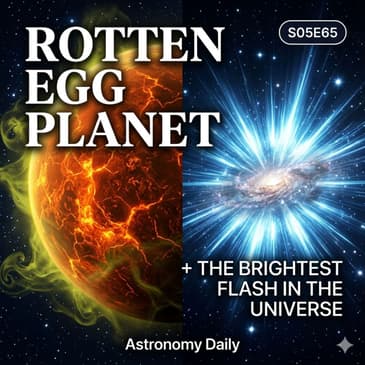
Hello, and welcome to Astronomy Daily. I'm Anna and I'm Avery. It's Tuesday, the seventeenth of March twenty twenty six, and we are back with your daily dose of everything happening in space and astronomy. Another big show today, Avery, New planets that would knock you off your feet with the stench, a cosmic radio flash breaking every record in the books, and a mystery that's been sitting unsolved for one hundred years. Exactly one hundred years. You love an anniversary. Let's get straight into it. Our first story is one that is genuinely extraordinary and slightly revolting. Astronomers using the James Webb Space Telescope have identified a planet that doesn't fit into any category we've had before, and if you could somehow smell its atmosphere, you'd wish you hadn't. That is a sentence I was not expecting to say today. Tell me everything. So the planet is called L ninety eight fifty nine D. It orbits as small red dwarf star about thirty five light years from Earth, which in astronomical terms, is genuinely close to us. It's about one point six times the size of Earth on the surface. It sounds fairly ordinary. But it's not ordinary at all? Is it? Not? At all? When researchers from the University of Oxford looked at the data from JWST alongside ground based telescopes, they found two extremely strange things. First, the planet has an astonishingly low density for its size. Second, its atmosphere is loaded with hydrogen sulfide, which, for anyone who needs a reminder, is the compound responsible for the smell of rotten eggs. Soh, the whole place stinks, got it? Well? The whole place is also a magma ocean. Their models suggest L ninety eight fifty nine D has a permanent global ocean of molten rock on its surface, and that magma ocean acts as a massive reservoir, soaking up and slowly releasing sulfur cons into the atmosphere over billions of years. Okay, so when you say ocean, you don't mean. Water, absolutely not molten rock. Imagine standing on a world where the sea is lava and the air smells like a volcanic vent. That's this planet. Hard pass But scientifically this is. Huge, right, It really is, Because this planet doesn't fit into either of the two boxes. Astronomers have used for small worlds. It's not a gas dwarf with a hydrogen heavy atmosphere, and it's not a water world covered in oceans and ice. It's something else entirely weed researcher doctor Harrison Nichols from Oxford said, and I love this quote that it makes us ask what other types of planets are waving to be uncovered. The universe just keeps surprising us. Every single week. The paper was published on the sixteenth of March in the journal Nature Astronomy, so literally yesterday, Science will have the link in the show notes. Story two. And this one's a genuine radio astronomy landmark. Scientists have identified the brightest fast radio burst ever recorded, and for the first time they've pinpointed exactly where it came from. And they gave it a brilliant name. They called it RB float Radio brightest flash of all time, which is simultaneously very science y and very. Extra Love the confidence of that name. So what is a fast radio burst? For anyone who needs a refresher. A fast radio burst or FRB is a flash of radio energy that lasts just milliseconds a thousandth of a second, but in that blink, it can briefly outshine every single radio source in its entire galaxy. They've been baffling astronomers since the first one was spotted in two thousand and seven. Nobody knows for certain what causes them, and until recently, pinpointing their exact origin in space has been essentially impossible. So what changed. An upgraded version of the Chime telescope in British Columbia, which now has what they call outriggers, smaller companion telescopes placed at different sites across North America and California and West Virginia. Together they act like a continent sized telescope with extraordinary precision. And that's how they caught RB float exactly. The burts came from a spiral galaxy called NGC forty one forty one, just one hundred and thirty million light years away, which for an FRB is essentially our cosmic backyard. The team at McGill University described the localization precision as being equivalent to spotting a coin from one hundred kilometers away. They trace it to a region just forty five light years across, smaller than an average star cluster on the outer edge of a star forming region in that galaxy, and then JWST got involved. It did because having the precise location meant they could point JWST at that exact spot when they found something unexpected, a faint infrared signal right where RB float came from. Scientists are still working out what it is, possibly a red giant star, possibly a fading light echo from the burst itself. The mystery within the mystery. And here's the other thing that's got researchers thinking RB float hasn't repeated. Most well studied FRBs do repeat. This one fired off and went silent, which challenges the idea that all fast radio bursts come from the same type of source. This really does feel like a new era for FRB science. That's exactly what the team said. The full papers are in the Astrophysical Journal Letters. Link is in the notes. Story three and this is perfectly timed because it's happening tomorrow and you can watch it live. Two NASA astronauts are stepping outside the International Space Station for the first spacewalk of twenty twenty six. I love a spacewalk story. Who's going out? NASA astronaut Jessica Meir, who is on her second spaceflight and her fourth EVA, and alongside her Chris Williams, who is heading outside for the very first time. This will be his debut spacewalk. That is such a special moment, your first time in the vacuum of space with nothing between you and the universe but a suit. They exit the Quest airlock at around eight in the morning Eastern Time on Wednesday the eighteenth, so tomorrow morning, and they're expected to be outside for around six and a half hours. And what's the job. They're installing a modification kit and rooting cables on the port side of the station to prepare the two to a power channel for a future upgrade. The station is getting additional rollout solar arrays the i rosas, which will boost its power generation capacity tomorrow. Spacewalk is the preparation work that makes that future installation possible. So this is kind of like doing the electrical rough end before you can install the solar panels on your house roof. That's actually a perfect analogy. And this is historically significant too. It's the two hundred and seventy eighth spacewalk in support of station assembly, maintenance and upgrades. A number that really puts into perspective just how much human labor has gone into building and running the ISS over the decades. How can people watch? DASA is carrying live coverage from six point thirty in the morning Eastern on Nasaplus, Amazon Prime Video, and the NASA YouTube channel. We'll have the direct link in the show notes. Thirty four, and we're heading to Mars. New research is suggesting that Mars was habitable for much longer than scientists had previously thought, and the Curiosity rover is right now investigating some strange features that could tell us a lot more about the planet's watery past. Mars keeps giving us surprises. It really does, so there are two threads to this. The first is new research published this week suggesting that hidden water may have persisted beneath the Martian surface far later in the planet's history than current models suggest. Scientists studying ancient sand dunes in Gale Crater, which is where Curiosity has been operating for years, have found evidence that liquid water was present and active much more recently than the standard timeline. Which extends the window during which life could potentially have existed on Mars exactly. And then separately curiosity has been investigating something that looks genuinely strange on the surface. These formations that scientists are describing as spiderweb ridges, their box work structures, intricate networks of raised lines that likely formed when minerals crystallize inside cracks in ancient rock that was once saturated with groundwater. So they're essentially fossilized water works. That's a beautiful way of putting it. The boxwork ridges are fascinating because they preserve a record of where water was moving through the rock, which could tell us about the chemistry of that ancient water, how long it was there, and whether the conditions were right for microbial life. And curiosity still going strong after all these years. Bill exploring, still sciencing. The links to both the water research and the box work story are in the show notes. Story five, and this one has a wonderful anniversary angle plus a genuine unsolved mystery that has been sitting there for exactly one hundred years. Tell me the mystery first. Yesterday, the sixteenth of March twenty twenty six, marked exactly one hundred years since Robert Goddard launched the world's first liquid fueled rocket. He did it in a snowy field on a farm in Auburn, Massachusetts, owned by his aunt. The rocket flew for two and a half seconds. It reached an altitude of forty one feet and traveled one hundred and eighty four feet sideways before coming back to earth. Not impressive by modern standards. But absolutely revolutionary. The rocket was fueled by liquid oxygen and gasoline. Goddard had proved that liquid propulsion worked, and that was the essential breakthrough that would eventually lead to the V two, the Saturn five, and the In nine rockets launching from Cape Canaveral today. So what's the mystery. The rocket's name was Nell, and nobody knows where Nell is today. The original rocket, the actual hardware that flew on March sixteenth, nineteen twenty six, was gathered up from the snow by Goddard, put back in his vehicle, and taken to his laboratory. He didn't preserve it as a historic artifact. He didn't have much money at the time, and he simply reused what he could. He didn't know he just changed history. Well, he knew he'd done something important, but he was also incredibly secretive. He didn't even tell people publicly about the flight for ten years. This Smithsonian has what is believed to be Nell's nozzle. It was incorporated into the successor rocket, the May nineteen twenty six version, which survives at the National Air and Space Museum, but the rest of Nell scattered, reused, or lost. So the rocket that launched the space Age is just gone. It's one of space history's great missing artifact. Celebrations took place at Goddard's original launch site, which is now the ninth hole of a golf course by the way, with one hundred scale model rockets launched in his honor. NASA, AIAA, Blue Origin, and a whole host of organizations have been marking the centennial. Robert Goddard's wife, Esther, also deserves a mention here. She absolutely does. She was there that day, she operated the camera that took the only photographs of the launch, and she was instrumental in documenting and preserving Goddard's work throughout his life. The anniversary coverage has rightly been celebrating both of them. Happy hundred now wherever you. Are, Indeed, happy one hundred. And our final story today is one of those technical breakthroughs that sounds technical but has some genuinely exciting implications for the future of space exploration. Researchers from MIT, Miterer Corporation and Sandia National Laboratories have published the paper in Nature describing a new kind of chip that could fundamentally change how spacecraft communicate and navigate. This is the photonic chip story, right. I've been looking forward to this one. It is so here's the context. One of the heaviest and most power hungry components on any spacecraft has traditionally been its optical and communications hardware, specifically the bulky mechanical mirror systems used for light ar and free space laser communications. Every gram matters when you're launching something into space. The whole size, weight and power problem exactly. Engineers call it swap, and what this team has done is replace those heavy mechanical mirrors with an optical phase array on a single chip. It's essentially a silicon photonics device that can steer laser beams electronically with no moving parts at all. No moving parts. That's significant in a spacecraft context. Hugely significant moving parts wear out, moving parts fail in the cold and radiation of space. A chip with no moving parts that can do the same job, is lighter, more reliable, and uses far less power. The implications for lightar, which is used for things like landing on other worlds, mapping terrain, and docking, are substantial, and for laser communications between spacecraft and back to Earth. This could enable much faster data transfer on much smaller platforms. So future missions, including small satellites, lunar landers, maybe even Mars missions could carry this technology. That's exactly the vision. The paper was published in Nature, and the team describes it as a potentially fundamental shift in spacecraft optical design. We'll have the full link in the show notes. That is everything for today's Astronomy Daily six stories covering everything from magma oceans and missing rockets to record breaking radio bursts and spacewalks. Happening tomorrow morning. If you want to watch Jessica Meyer and Chris Williams step Outside the ISS, set your alarm. Coverage starts at six point thirty Eastern on NASA Plus and YouTube. We'll have the link waiting for you in the show notes. And if today's episode got you excited about space, please do subscribe, leave us a review, and share us with someone who loves this stuff. As much as we do, it genuinely makes a difference. You can find this at Astronomy Daily dot io and across all the socials at astro Daily Pod. We're on x, Instagram, TikTok, YouTube and Tumblr. I'm Ada, I'm avery, keep looking up everyone. Sunnyday Star, Stito Star, Szo