

Become a supporter of this podcast: https://www.spreaker.com/podcast/astronomy-daily-latest-space-news--5648921/support.
Sponsor Details:
Ensure your online privacy by using NordVPN. To get our special listener deal and save a lot of money, visit www.astronomydaily.io/nordvpn. You'll be glad you did!
Get the best secure and private email on the planet. Stop your Government, google and who knows who else spying on every email you write. Do what we did and use ProtonMail. They beleive in privacy and there are no ads in their business model...yet they still provide a free forever service. Check them out and get out special deal at www.astronomydaily.io/protonmail
Become a supporter of Astronomy Daily by joining our Supporters Club. Commercial free episodes daily are only a click way... Click Here
This episode includes AI-generated content.
00:00:00 --> 00:00:02 Anna: Hello and welcome to Astronomy daily for
00:00:02 --> 00:00:04 Tuesday the 14th of July
00:00:05 --> 00:00:06 2026. I'm Anna.
00:00:07 --> 00:00:09 Avery: And I'm, um, Avery. Episode 140
00:00:09 --> 00:00:12 of season five. And honestly, today's rundown
00:00:12 --> 00:00:14 reads like someone dared us to pick the most
00:00:14 --> 00:00:16 argument starting stories we could find.
00:00:17 --> 00:00:19 Anna: It really does. Coming up, American
00:00:19 --> 00:00:22 regulators have just approved the launch of
00:00:22 --> 00:00:25 the first commercial space mirror, a
00:00:25 --> 00:00:27 spacecraft designed to beam sunlight down to
00:00:27 --> 00:00:30 Earth at night. And astronomers are,
00:00:30 --> 00:00:32 let's say, not thrilled.
00:00:32 --> 00:00:35 Avery: We've also got a newly revealed minefield of
00:00:35 --> 00:00:37 invisible space junk in one of the most
00:00:37 --> 00:00:39 valuable orbits around Earth with an
00:00:39 --> 00:00:41 Australian telescope right in the middle of
00:00:41 --> 00:00:44 the detective work. Plus, physicists and
00:00:44 --> 00:00:46 Manhattan have recreated black hole energy
00:00:46 --> 00:00:49 extraction in a lab. The biggest telescope
00:00:49 --> 00:00:52 ever built just moved for the very first
00:00:52 --> 00:00:54 time. And a new paper explains how the Square
00:00:54 --> 00:00:57 Kilometer Array is about to turn cosmic
00:00:57 --> 00:00:59 lightning flashes into a map of the invisible
00:00:59 --> 00:01:00 universe.
00:01:01 --> 00:01:03 Anna: And later, a quick update on Starship
00:01:03 --> 00:01:06 Flight 13 and the story of the Harvard
00:01:06 --> 00:01:09 astronomer who's just been handed the keys to
00:01:09 --> 00:01:11 the White House's new UFO
00:01:11 --> 00:01:14 Avery: Science Council told you argument
00:01:14 --> 00:01:15 starting. Let's get into it.
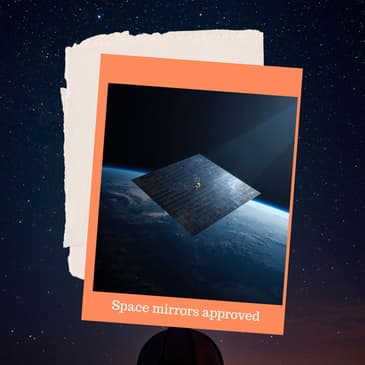
00:01:16 --> 00:01:18 Anna: Our lead story today. On 9 July,
00:01:18 --> 00:01:21 the US Federal Communications Commission
00:01:21 --> 00:01:24 formally authorized the launch of Earendil
00:01:24 --> 00:01:27 1, a demonstration satellite from
00:01:27 --> 00:01:29 California startup Reflect Orbital.
00:01:30 --> 00:01:32 Once in orbit around 600 kilometers up,
00:01:32 --> 00:01:35 it will unfurl a thin film reflector
00:01:35 --> 00:01:38 18 meters on a side that's roughly
00:01:38 --> 00:01:41 60ft and use it to bounce sunlight
00:01:41 --> 00:01:44 down to specific spots on the ground for
00:01:44 --> 00:01:45 several minutes at a time.
00:01:45 --> 00:01:48 Avery: So to be clear for everyone, a giant
00:01:48 --> 00:01:51 steerable mirror in space whose entire
00:01:51 --> 00:01:53 job is to shine daylight onto the night side
00:01:53 --> 00:01:54 of Earth.
00:01:54 --> 00:01:57 Anna: That's exactly it. The company calls itself
00:01:57 --> 00:01:59 the Sunlight Company and the pitch is
00:01:59 --> 00:02:02 sunlight on demand. Lighting construction
00:02:02 --> 00:02:04 sites so crews can work through the night,
00:02:05 --> 00:02:07 illuminating search and rescue operations,
00:02:07 --> 00:02:10 and boosting solar farms by extending their
00:02:10 --> 00:02:12 generating hours past sunset.
00:02:12 --> 00:02:14 Avery: The demonstration satellite weighs about
00:02:14 --> 00:02:17 142kg and is due to launch
00:02:17 --> 00:02:19 later this year. And here's the number that
00:02:19 --> 00:02:21 makes this a much bigger story than one test
00:02:21 --> 00:02:24 satellite. ReflectorBital has talked about
00:02:24 --> 00:02:27 operating 50 or more of these
00:02:27 --> 00:02:30 mirror craft in low Earth orbit by 2035,
00:02:30 --> 00:02:31 which is why
00:02:31 --> 00:02:34 Anna: the astronomy community has reacted the way
00:02:34 --> 00:02:36 it has. The FCC application drew
00:02:36 --> 00:02:39 nearly 1900 public comments, the
00:02:39 --> 00:02:42 overwhelming majority critical. For
00:02:42 --> 00:02:45 comparison, SpaceX's application for up to
00:02:45 --> 00:02:48 a million orbital data center satellites drew
00:02:48 --> 00:02:51 about 1500. The European southern
00:02:51 --> 00:02:53 Observatory has described plans like these as
00:02:53 --> 00:02:56 an existential threat to optical astronomy.
00:02:56 --> 00:02:58 Avery: And it's not just professional observatories.
00:02:58 --> 00:03:01 The American Astronomical Society Raised the
00:03:01 --> 00:03:03 prospect of eye damage for amateur
00:03:03 --> 00:03:05 astronomers. The company itself has
00:03:05 --> 00:03:07 acknowledged there's a risk if someone
00:03:07 --> 00:03:09 happened to catch the reflected beam through
00:03:09 --> 00:03:12 a telescope with a large enough aperture.
00:03:12 --> 00:03:14 Plus concerns about momentarily dazzling
00:03:14 --> 00:03:17 pilots and about what artificial daylight
00:03:17 --> 00:03:20 does to wildlife. Circadian rhythms are not
00:03:20 --> 00:03:22 optional extras for most living things.
00:03:22 --> 00:03:25 Anna: The FCC's answer to all of that was
00:03:25 --> 00:03:28 essentially not our department. The
00:03:28 --> 00:03:30 commission said concerns about optical
00:03:30 --> 00:03:32 astronomy and the environment fall outside
00:03:32 --> 00:03:35 its review, which is limited to radio
00:03:35 --> 00:03:37 spectrum. It found the risks with a single
00:03:37 --> 00:03:40 satellite unlikely to materialize, and said
00:03:40 --> 00:03:43 testing novel technology is in the public
00:03:43 --> 00:03:43 interest.
00:03:44 --> 00:03:46 Avery: Which might be true for one satellite. One
00:03:46 --> 00:03:48 mirror tested carefully with the light
00:03:48 --> 00:03:51 contained, switchable and steered away from
00:03:51 --> 00:03:53 observatories. That's a technology
00:03:53 --> 00:03:56 demonstration. 50 of them is a
00:03:56 --> 00:03:58 different planet to live on. And the
00:03:58 --> 00:04:01 regulatory gap is the real story here. If the
00:04:01 --> 00:04:03 agency licensing these satellites says
00:04:03 --> 00:04:06 impacts on the sky aren't their job, then,
00:04:06 --> 00:04:07 uh, whose job are they?
00:04:07 --> 00:04:10 Anna: To be fair to the company, they say they're
00:04:10 --> 00:04:13 trying to earn trust. The light is
00:04:13 --> 00:04:15 contained within the target spot. It can be
00:04:15 --> 00:04:18 switched off at any moment. And they'll avoid
00:04:18 --> 00:04:21 sensitive areas like research
00:04:21 --> 00:04:24 observatories and protected habitats.
00:04:24 --> 00:04:27 Their co founders said this license is the
00:04:27 --> 00:04:30 first step toward rigorously testing
00:04:30 --> 00:04:32 both the technology and the safeguards.
00:04:33 --> 00:04:36 Avery: And that test data, uh, will matter. But I
00:04:36 --> 00:04:38 suspect this is one we'll be covering again
00:04:38 --> 00:04:39 and again.
00:04:40 --> 00:04:42 Anna: The satellites, named Earendil, by the way.
00:04:43 --> 00:04:46 Tulkin fans, will recognize the mariner, who
00:04:46 --> 00:04:48 sails the sky with a shining star on his
00:04:48 --> 00:04:49 brow.
00:04:49 --> 00:04:51 Avery: At least they've got good taste in names.
00:04:51 --> 00:04:53 Whether the night sky agrees is another
00:04:53 --> 00:04:54 matter. Okay.
00:04:54 --> 00:04:57 From mirrors we can see, to junk
00:04:57 --> 00:05:00 we can't. A new study led by the
00:05:00 --> 00:05:02 University of Warwick has uncovered some of
00:05:02 --> 00:05:05 the faintest space debris ever detected in
00:05:05 --> 00:05:08 geosynchronous orbit. Fragments down to
00:05:08 --> 00:05:11 about five centimeters across. That's
00:05:11 --> 00:05:13 two inches. And here's the kicker.
00:05:14 --> 00:05:17 Nearly 80% of the faint objects
00:05:17 --> 00:05:19 they found don't appear in any publicly
00:05:19 --> 00:05:20 available catalog.
00:05:20 --> 00:05:23 Anna: Let's set the scene for anyone new to this
00:05:23 --> 00:05:26 geosynchronous orbit is that special
00:05:26 --> 00:05:27 band about
00:05:27 --> 00:05:30 36km up where a
00:05:30 --> 00:05:33 satellite circles the Earth, exactly in
00:05:33 --> 00:05:36 step with our planet's rotation so it
00:05:36 --> 00:05:39 hangs over the same spot. It's home
00:05:39 --> 00:05:41 to the big, expensive workhorses.
00:05:41 --> 00:05:44 Communications, broadcasting, weather,
00:05:44 --> 00:05:47 monitoring, some of the most valuable real
00:05:47 --> 00:05:48 estate in space.
00:05:49 --> 00:05:51 Avery: And unlike low Earth orbit, there's no
00:05:51 --> 00:05:54 cleanup service. Down low, the wisps of
00:05:54 --> 00:05:57 atmosphere gradually drag debris down until
00:05:57 --> 00:06:00 it burns up. At, uh, geo altitude, there
00:06:00 --> 00:06:02 is essentially nothing. Whatever ends up
00:06:02 --> 00:06:05 there, a dead satellite, a, uh, fragment from
00:06:05 --> 00:06:08 a breakup stays there effectively
00:06:08 --> 00:06:08 forever.
00:06:09 --> 00:06:12 Anna: So how did they find pieces this small
00:06:12 --> 00:06:13 at that distance?
00:06:13 --> 00:06:16 Avery: Clever image processing rather than new
00:06:16 --> 00:06:18 hardware. The team went back to archival
00:06:18 --> 00:06:20 survey data from the Isaacman Newton
00:06:20 --> 00:06:23 Telescope in the Canary Islands and applied a
00:06:23 --> 00:06:25 technique called blind stacking, layering
00:06:25 --> 00:06:27 many images along different possible
00:06:28 --> 00:06:30 trajectories so that incredibly faint moving
00:06:30 --> 00:06:33 objects rise up out of the noise. That
00:06:33 --> 00:06:36 reprocessing revealed 25 debris track
00:06:36 --> 00:06:39 lips the original analysis had completely
00:06:39 --> 00:06:41 missed. And the brightness flickering of many
00:06:41 --> 00:06:44 of these fragments shows their tumbling as a
00:06:44 --> 00:06:45 drift.
00:06:45 --> 00:06:47 Anna: And um, there's a lovely local connection in
00:06:47 --> 00:06:50 this one. The follow up observing campaign
00:06:50 --> 00:06:53 extended the survey to Siding Spring
00:06:53 --> 00:06:55 Observatory here in Australia. Working with
00:06:55 --> 00:06:58 the Australian National University plus
00:06:58 --> 00:07:01 Japan's Bisei Space Guard center with
00:07:01 --> 00:07:03 jaxa. Genuinely international
00:07:04 --> 00:07:07 detective work, which makes sense because the
00:07:07 --> 00:07:09 Geo Belt is a shared resource.
00:07:10 --> 00:07:12 Avery: The study's lead author, Dr. James Blake,
00:07:13 --> 00:07:15 pointed out that pieces of junk up there can
00:07:15 --> 00:07:18 be moving at kilometers per second relative
00:07:18 --> 00:07:20 to each other. So even a 5 centimeter
00:07:20 --> 00:07:23 fragment carries enough energy to do serious
00:07:23 --> 00:07:26 damage to a very expensive satellite. And
00:07:26 --> 00:07:29 his co author, Dr. Stuart Eaves had the line
00:07:29 --> 00:07:32 of the week. The debris in geosynchronous
00:07:32 --> 00:07:35 orbit is a potential minefield. And
00:07:35 --> 00:07:37 nobody in their right mind walks into a
00:07:37 --> 00:07:39 minefield without a mine detector.
00:07:39 --> 00:07:42 Anna: The constructive takeaway being we now
00:07:42 --> 00:07:45 have the detection techniques. Beeper's
00:07:45 --> 00:07:48 systematic surveys of the Geo Belt need
00:07:48 --> 00:07:51 to become routine because there are
00:07:51 --> 00:07:54 only so many orbital slots up there and
00:07:54 --> 00:07:57 one bad debris event could poison a
00:07:57 --> 00:07:59 chunk of that belt for generations.
00:08:00 --> 00:08:02 M Now to a story that's been making headlines
00:08:02 --> 00:08:05 this week, and it's a proper piece of physics
00:08:05 --> 00:08:08 history. Researchers at the Advanced
00:08:08 --> 00:08:10 Science Research center at the City
00:08:10 --> 00:08:13 University of New York have recreated in
00:08:13 --> 00:08:16 a laboratory the mechanism by which energy
00:08:16 --> 00:08:18 can be extracted from a spinning black hole.
00:08:19 --> 00:08:20 The papers in Nature.
00:08:20 --> 00:08:23 Avery: Okay, walk me through the black hole part
00:08:23 --> 00:08:25 first, because it's one of the great ideas of
00:08:25 --> 00:08:26 20th century physics.
00:08:27 --> 00:08:29 Anna: It goes back more than half a century. To Sir
00:08:29 --> 00:08:32 Roger Penrose, A, uh, spinning black hole
00:08:32 --> 00:08:35 drags the very fabric of space around with it
00:08:35 --> 00:08:38 in a region called the Ergosphere.
00:08:38 --> 00:08:41 Penrose realized that if a particle ventured
00:08:41 --> 00:08:43 in there and split in two, one piece could
00:08:43 --> 00:08:46 fall in while the other escaped, carrying
00:08:46 --> 00:08:49 more energy than the original particle
00:08:49 --> 00:08:51 arrived with energy stolen from the black
00:08:51 --> 00:08:54 hole's rotation. The physicist
00:08:54 --> 00:08:57 Yakov Zeldowicz then extended the
00:08:57 --> 00:09:00 idea to bounce a wave off a, uh,
00:09:00 --> 00:09:02 sufficiently fast rotating object and the
00:09:02 --> 00:09:05 wave can come away amplified. That effect
00:09:05 --> 00:09:07 is called super radiance.
00:09:08 --> 00:09:10 Avery: And the problem for 50 odd years has been the
00:09:10 --> 00:09:13 words sufficiently fast. You can't
00:09:13 --> 00:09:15 mechanically spin anything quickly enough.
00:09:15 --> 00:09:17 There were beautiful experiments with water
00:09:17 --> 00:09:20 vortices in 2017 and a rotating
00:09:20 --> 00:09:23 acoustic disc in 2020. But physically
00:09:23 --> 00:09:24 spinning objects hit a heart
00:09:24 --> 00:09:27 Anna: ceiling, which is where the New York team's
00:09:27 --> 00:09:30 trick comes in. They call it synthetic
00:09:30 --> 00:09:33 rotation. Instead of spinning anything at
00:09:33 --> 00:09:35 all, they built a ring of electronic
00:09:35 --> 00:09:38 resonators and rapidly modulated their
00:09:38 --> 00:09:40 electrical properties in a timed sequence
00:09:40 --> 00:09:43 running around the ring to an incoming
00:09:43 --> 00:09:46 radio wave. The stationary device is
00:09:46 --> 00:09:48 indistinguishable from something rotating
00:09:48 --> 00:09:51 impossibly fast. The synthetic rotation
00:09:51 --> 00:09:54 can even mimic motion faster than light,
00:09:54 --> 00:09:57 which no physical object could ever achieve.
00:09:57 --> 00:10:00 Avery: And it worked. The waves actually came out
00:10:00 --> 00:10:00 stronger.
00:10:01 --> 00:10:03 Anna: They did. The team measured genuine
00:10:03 --> 00:10:06 amplification with waves extracting energy
00:10:06 --> 00:10:08 from the synthetic rotation, exactly as
00:10:08 --> 00:10:11 Penrose and Zeldewicz predicted. Nothing
00:10:11 --> 00:10:14 moves. Yet the wave leaves with more energy
00:10:14 --> 00:10:15 than it arrived with.
00:10:16 --> 00:10:18 Avery: What I love about this one is that it cuts
00:10:18 --> 00:10:20 both ways. It's a fundamental physics
00:10:20 --> 00:10:22 validation, a 50 year old prediction about
00:10:22 --> 00:10:24 black holes confirmed on a benchtop in
00:10:24 --> 00:10:27 Manhattan. But it's also a brand new kind of
00:10:27 --> 00:10:29 amplifier. With a team talking about
00:10:29 --> 00:10:31 applications in wireless communications,
00:10:31 --> 00:10:33 optics and quantum technologies.
00:10:34 --> 00:10:36 Astrophysics as an engineering department.
00:10:36 --> 00:10:39 Anna: Black holes inspiring better radios since
00:10:39 --> 00:10:41 1969, who knew?
00:10:42 --> 00:10:44 Avery: Next to a mountaintop in Chile's Atacama
00:10:44 --> 00:10:46 Desert, where the biggest optical telescope
00:10:46 --> 00:10:49 humanity has ever attempted just did
00:10:49 --> 00:10:52 something for the very first time, it moved.
00:10:52 --> 00:10:55 Anna: This is the European Southern Observatory's
00:10:55 --> 00:10:57 Extremely Large Telescope, the
00:10:57 --> 00:11:00 elt, under construction on Cerro
00:11:00 --> 00:11:02 Armazonis. Crews rotated the
00:11:02 --> 00:11:05 telescope's entire structure around its
00:11:05 --> 00:11:08 vertical axis for the first time. And in the
00:11:08 --> 00:11:10 most charming detail of the week, they
00:11:10 --> 00:11:12 started by pushing it by hand a few
00:11:12 --> 00:11:15 centimeters before completing a full
00:11:15 --> 00:11:18 rotation with auxiliary motors. Eso
00:11:18 --> 00:11:21 captioned the release. And yet it moves,
00:11:21 --> 00:11:23 which Galileo would surely have appreciated.
00:11:24 --> 00:11:26 Avery: Now, let's put numbers on why hand pushing
00:11:26 --> 00:11:29 this thing is remarkable. The structure
00:11:29 --> 00:11:30 currently weighs about three and a half
00:11:30 --> 00:11:33 thousand tons. Once the mirrors and
00:11:33 --> 00:11:35 instruments go in, it climbs to around 4
00:11:36 --> 00:11:38 tons. And the whole assembly floats on a film
00:11:38 --> 00:11:41 of oil just 80 microns thin,
00:11:41 --> 00:11:44 roughly the width of a human hair. That's how
00:11:44 --> 00:11:46 a handful of people can start 10 million
00:11:46 --> 00:11:48 pounds of telescope turning.
00:11:48 --> 00:11:51 Anna: And this wasn't ceremony. It was a critical
00:11:51 --> 00:11:54 engineering test. That rotation is how the
00:11:54 --> 00:11:57 ELT will point anywhere in the southern
00:11:57 --> 00:12:00 sky. So proving the motion is smooth is a
00:12:00 --> 00:12:02 genuine milestone on the road to first light.
00:12:03 --> 00:12:05 When it's complete, the ELT's segmented
00:12:05 --> 00:12:08 primary mirror will stretch 39 meters
00:12:08 --> 00:12:11 across, built from 798
00:12:11 --> 00:12:14 hexagonal segments. Working as one,
00:12:14 --> 00:12:17 it'll gather more light than any optical
00:12:17 --> 00:12:18 telescope in history.
00:12:18 --> 00:12:21 Avery: ESO's program manager, Roberto Damai, said
00:12:21 --> 00:12:23 it beautifully that it's a reminder of what
00:12:23 --> 00:12:25 can be achieved when people push in the same
00:12:25 --> 00:12:28 direction, literally and figuratively.
00:12:28 --> 00:12:31 Anna: And for our listeners. Remember, this giant
00:12:31 --> 00:12:34 lives under southern skies, the Magellanic
00:12:34 --> 00:12:37 Clouds, the galactic center overhead. The
00:12:37 --> 00:12:40 ELT will see the same sky you do from
00:12:40 --> 00:12:42 your backyard, just 40 million times
00:12:42 --> 00:12:43 better.
00:12:43 --> 00:12:45 Avery: Rude, frankly, but we'll allow it.
00:12:45 --> 00:12:48 Anna: Sticking with giant instruments and southern
00:12:48 --> 00:12:51 skies. A new paper doing the rounds this
00:12:51 --> 00:12:54 week lays out how the Square Kilometer
00:12:54 --> 00:12:56 Array is going to use one of the most
00:12:57 --> 00:12:59 violent phenomena in the cosmos to
00:12:59 --> 00:13:02 map things, things no telescope can see.
00:13:02 --> 00:13:05 And the lead author is Dr. Manisha Caleb
00:13:05 --> 00:13:08 of the University of Sydney Home, UM team.
00:13:08 --> 00:13:11 Avery: All right. The violent phenomenon in
00:13:11 --> 00:13:14 question being fast radio bursts.
00:13:14 --> 00:13:17 Anna: Fast radio bursts. Flashes of radio
00:13:17 --> 00:13:20 energy from other galaxies that last about
00:13:20 --> 00:13:23 a millisecond, a hundred times quicker than a
00:13:23 --> 00:13:25 blink, yet carry enormous energy.
00:13:26 --> 00:13:28 And they're useful precisely because of what
00:13:28 --> 00:13:31 happens to them on the way here. As a
00:13:31 --> 00:13:34 burst crosses billions of light years, the
00:13:34 --> 00:13:37 plasma it passes through disperses it,
00:13:37 --> 00:13:40 stretching the signal out by frequency. And
00:13:40 --> 00:13:42 magnetic fields twist its polarization
00:13:43 --> 00:13:45 through an effect called Faraday rotation.
00:13:46 --> 00:13:49 Every burst arrives carrying a record of
00:13:49 --> 00:13:50 everything it traveled through.
00:13:51 --> 00:13:53 Avery: So each one is like a core sample drilled
00:13:53 --> 00:13:55 through the universe. The gas between
00:13:55 --> 00:13:58 galaxies barely emits any light, and
00:13:58 --> 00:14:01 magnetic fields emit none at all. But you can
00:14:01 --> 00:14:03 read both from what they've done to the burst
00:14:03 --> 00:14:03 along the way.
00:14:04 --> 00:14:07 Anna: Exactly. And the paper's argument is
00:14:07 --> 00:14:10 about scale. We've caught FRBs by
00:14:10 --> 00:14:12 the hundreds so far. The SKA, with
00:14:12 --> 00:14:15 SKA low being commissioned right now
00:14:15 --> 00:14:18 in Western Australia alongside the Dish
00:14:18 --> 00:14:21 Array in South Africa, is expected to
00:14:21 --> 00:14:24 detect them in the thousands upon thousands.
00:14:24 --> 00:14:27 At those numbers, the team argues, frbs
00:14:27 --> 00:14:30 graduate from curiosities into a
00:14:30 --> 00:14:32 genuine cosmological survey tool,
00:14:32 --> 00:14:35 tracing where the universe's missing ordinary
00:14:35 --> 00:14:38 matter is hiding, mapping cosmic
00:14:38 --> 00:14:40 magnetic fields, probing the universe's
00:14:40 --> 00:14:43 expansion, even testing fundamental
00:14:43 --> 00:14:46 physics, like whether photons have any
00:14:46 --> 00:14:47 mass at all.
00:14:47 --> 00:14:50 Avery: And the poetry of it is that we still don't
00:14:50 --> 00:14:52 fully know what makes a fast radio burst.
00:14:53 --> 00:14:55 Magnetars are the leading suspects, but the
00:14:55 --> 00:14:58 case is enclosed. So the SKA
00:14:58 --> 00:15:01 gets to work the mystery from both ends,
00:15:01 --> 00:15:03 using the bursts as tools while
00:15:03 --> 00:15:06 simultaneously figuring out what they are.
00:15:06 --> 00:15:08 Anna: A telescope, partly in our own backyard,
00:15:09 --> 00:15:11 using millisecond flashes from across the
00:15:11 --> 00:15:14 universe to weigh the invisible. The next
00:15:14 --> 00:15:17 few years of this are going to be something
00:15:17 --> 00:15:18 special Next up
00:15:18 --> 00:15:21 Avery: a, uh, quick update on Starship Flight 13. We
00:15:21 --> 00:15:23 gave you the full preview in yesterday's
00:15:23 --> 00:15:26 episode. So just the new developments today.
00:15:26 --> 00:15:29 First, the launch date has slipped. SpaceX
00:15:29 --> 00:15:31 is now targeting no earlier than Thursday
00:15:31 --> 00:15:34 16th July at 6:45
00:15:34 --> 00:15:37 in the evening US Eastern Time. That's
00:15:37 --> 00:15:40 8:45 Friday morning for those of us on
00:15:40 --> 00:15:41 Australia's east coast.
00:15:41 --> 00:15:44 Anna: And second, the good news that came with the
00:15:44 --> 00:15:47 slip. Basex has completed a, uh, full
00:15:47 --> 00:15:49 static fire of the super heavy Booster,
00:15:49 --> 00:15:52 lighting all 33 Raptor engines on the
00:15:52 --> 00:15:55 pad. That's the final major test before
00:15:55 --> 00:15:56 flight.
00:15:56 --> 00:15:58 Avery: The mission itself is unchanged from what we
00:15:58 --> 00:16:00 covered yesterday. The second flight of the
00:16:00 --> 00:16:03 version 3 vehicle carrying the first
00:16:03 --> 00:16:05 genuinely functional Starlink V3
00:16:05 --> 00:16:08 satellites rather than mass simulators.
00:16:08 --> 00:16:10 If the schedule holds, we'll have the full
00:16:10 --> 00:16:11 story in Friday's episode.
00:16:12 --> 00:16:14 Anna: Set those alarms, Australia. A Friday
00:16:14 --> 00:16:17 breakfast launch is the civilized way to
00:16:17 --> 00:16:18 watch Starship fly.
00:16:19 --> 00:16:21 Now, in case you missed it over the past
00:16:21 --> 00:16:23 couple of weeks, and because it's simply too
00:16:23 --> 00:16:26 interesting to leave on the shelf, Harvard
00:16:26 --> 00:16:29 astrophysicist Avi Loeb has been
00:16:29 --> 00:16:31 appointed to chair a brand new White House
00:16:31 --> 00:16:34 UAP Science Advisory Council, a
00:16:34 --> 00:16:37 scientific panel tasked with investigating
00:16:37 --> 00:16:39 unidentified anomalous phenomena.
00:16:40 --> 00:16:42 That's the current official term for what
00:16:42 --> 00:16:45 everyone still calls UFOs, covering
00:16:45 --> 00:16:48 objects in the air, in space or even
00:16:48 --> 00:16:49 underwater.
00:16:49 --> 00:16:52 Avery: And for listeners who know the name, yes,
00:16:52 --> 00:16:55 that Avi Loeb, former chair of
00:16:55 --> 00:16:57 Harvard's Astronomy Department, hundreds of
00:16:57 --> 00:16:59 papers on black holes and the early universe,
00:17:00 --> 00:17:02 and in recent years, the most famous or
00:17:02 --> 00:17:05 infamous advocate for taking the possibility
00:17:05 --> 00:17:08 of alien technology seriously. He's the one
00:17:08 --> 00:17:10 who suggested the interstellar object
00:17:10 --> 00:17:13 Oumuamua might have been an artificial light
00:17:13 --> 00:17:15 sail back in 2017.
00:17:15 --> 00:17:18 Anna: The setup the council was established under
00:17:18 --> 00:17:21 the Trump administration's transparency push
00:17:21 --> 00:17:23 on uap alongside agencies
00:17:23 --> 00:17:26 including the Pentagon's Anomaly Resolution
00:17:26 --> 00:17:29 Office, Office of the Director of National
00:17:29 --> 00:17:31 Intelligence and the FBI.
00:17:31 --> 00:17:34 Loeb's team reports to a new UAP
00:17:34 --> 00:17:37 governance board overseen by the intelligence
00:17:37 --> 00:17:39 community. And after its first meeting, the
00:17:39 --> 00:17:42 council requested more than 50 videos,
00:17:42 --> 00:17:45 images and documents from the Pentagon tied
00:17:45 --> 00:17:48 to known incidents, including the so called
00:17:48 --> 00:17:51 orb sightings reported by military personnel.
00:17:52 --> 00:17:54 Avery: Now the scientific community's reaction has
00:17:54 --> 00:17:57 been divided is the polite word.
00:17:57 --> 00:18:00 John Kirkpatrick, who used to run the
00:18:00 --> 00:18:02 Pentagon's own UAP investigations, said
00:18:02 --> 00:18:05 Loeb is not viewed favorably by much of the
00:18:05 --> 00:18:07 scientific community and lacks national
00:18:07 --> 00:18:10 security experience. Critics point to his
00:18:10 --> 00:18:12 hand picked counsel, including not just data
00:18:12 --> 00:18:15 scientists and oceanographers, but also
00:18:15 --> 00:18:18 figures who've openly claimed the US has
00:18:18 --> 00:18:20 recovered non human craft and
00:18:20 --> 00:18:22 Anna: in fairness, here's the other side of the
00:18:22 --> 00:18:25 ledger. Loeb himself says he's starting from
00:18:25 --> 00:18:28 the assumption these objects are human made
00:18:28 --> 00:18:30 and treating it as a national security
00:18:30 --> 00:18:33 question. He says the government is genuinely
00:18:33 --> 00:18:36 baffled by some of what it's seen, and his
00:18:36 --> 00:18:38 argument is that the fact these cases are
00:18:38 --> 00:18:41 being open to scientists at all suggests
00:18:41 --> 00:18:43 officials aren't confident they're
00:18:43 --> 00:18:45 conventional. His stated focus is
00:18:45 --> 00:18:48 instrumentation, data standards and
00:18:48 --> 00:18:51 rigorous collection. In his words, better
00:18:51 --> 00:18:54 data could settle the alien debate once and
00:18:54 --> 00:18:54 for all.
00:18:55 --> 00:18:57 Avery: And that's the version of this I can
00:18:57 --> 00:19:00 genuinely get behind. The worst outcome for a
00:19:00 --> 00:19:01 question like this is that it stays in the
00:19:01 --> 00:19:04 realm of blurry footage and anecdote forever.
00:19:04 --> 00:19:06 If this council produces calibrated
00:19:06 --> 00:19:09 instruments and open data, that's a win,
00:19:09 --> 00:19:11 regardless of what the answer turns out to
00:19:11 --> 00:19:14 be. If it produces headlines instead of data,
00:19:14 --> 00:19:16 well, we'll report that too.
00:19:16 --> 00:19:19 Anna: His own line on it Keep our eyes on the
00:19:19 --> 00:19:21 orbs, not the social media.
00:19:21 --> 00:19:24 Avery: On, um, this show, we keep our eyes on both
00:19:24 --> 00:19:26 strictly professionally Time for
00:19:26 --> 00:19:29 Anna: your skywatch, and Tonight is genuinely one
00:19:29 --> 00:19:32 to circle. 14 July brings a
00:19:32 --> 00:19:35 super new moon, which means the darkest
00:19:35 --> 00:19:37 skies of the entire month. And for those of
00:19:37 --> 00:19:40 us in Australia and New Zealand, that's a
00:19:40 --> 00:19:43 standing invitation. The Milky Way's core
00:19:43 --> 00:19:45 is riding high through the evening, with
00:19:45 --> 00:19:47 Scorpius and Sagittarius nearly
00:19:47 --> 00:19:50 overhead. If you've been meaning to get
00:19:50 --> 00:19:52 somewhere dark and see our galaxy properly
00:19:53 --> 00:19:55 tonight and the next few nights are the
00:19:55 --> 00:19:58 Avery: time while you're out there, look west after
00:19:58 --> 00:20:00 sunset for Venus, absolutely blazing at
00:20:00 --> 00:20:03 around magnitude -4 in LEO. You
00:20:03 --> 00:20:06 can't miss it. And here's one for your diary.
00:20:06 --> 00:20:09 On Thursday and Friday evening, the 16th
00:20:09 --> 00:20:11 and 17th, a slender young crescent
00:20:11 --> 00:20:14 moon slides up past Regulus and then Venus,
00:20:14 --> 00:20:16 low in the western twilight.
00:20:16 --> 00:20:19 Anna: A beautiful photo opportunity for the early
00:20:19 --> 00:20:21 risers. The pre dawn east is where the
00:20:21 --> 00:20:24 planets are congregating. Saturn is up after
00:20:24 --> 00:20:27 midnight and high before dawn with its rings
00:20:27 --> 00:20:30 tilted nicely for small telescopes. And
00:20:30 --> 00:20:32 Mars is gliding right past Aldebaran in
00:20:32 --> 00:20:35 Taurus this very morning. Two reddish
00:20:35 --> 00:20:38 points of similar brightness about 5 degrees
00:20:38 --> 00:20:41 apart. A lovely color comparison with just
00:20:41 --> 00:20:42 your eyes.
00:20:42 --> 00:20:45 Avery: Dark skies, a brilliant evening star, and
00:20:45 --> 00:20:48 a red planet racing a red star. Not a
00:20:48 --> 00:20:50 bad week's programming from the universe.
00:20:50 --> 00:20:52 Anna: And that's Astronomy daily for Tuesday
00:20:53 --> 00:20:55 14th July. All our episodes,
00:20:55 --> 00:20:57 show notes and the newsletter are
00:20:57 --> 00:21:00 @astronomydaily IO and you'll
00:21:00 --> 00:21:02 find us across social media.
00:21:02 --> 00:21:05 Avery: Astrodaily pod if
00:21:05 --> 00:21:07 today's episode sparked an opinion and let's
00:21:07 --> 00:21:10 face it space mirrors and UFO councils will
00:21:10 --> 00:21:12 do that. Come tell us about it. We read
00:21:12 --> 00:21:14 everything. I'm Avery.
00:21:14 --> 00:21:16 Anna: And I'm Anna. Thanks for spending part of
00:21:16 --> 00:21:18 your day with us. Until tomorrow.
00:21:18 --> 00:21:19 Avery: Clear skies.