

Become a supporter of this podcast: https://www.spreaker.com/podcast/astronomy-daily-latest-space-news--5648921/support.
Sponsor Details:
Ensure your online privacy by using NordVPN. To get our special listener deal and save a lot of money, visit www.astronomydaily.io/nordvpn. You'll be glad you did!
Get the best secure and private email on the planet. Stop your Government, google and who knows who else spying on every email you write. Do what we did and use ProtonMail. They beleive in privacy and there are no ads in their business model...yet they still provide a free forever service. Check them out and get out special deal at www.astronomydaily.io/protonmail
Become a supporter of Astronomy Daily by joining our Supporters Club. Commercial free episodes daily are only a click way... Click Here
This episode includes AI-generated content.
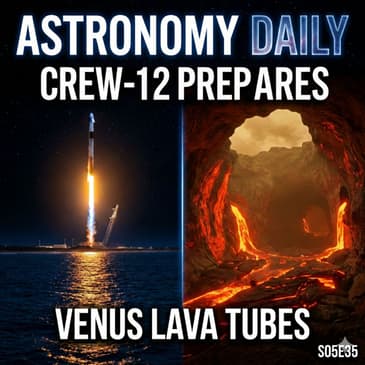
Four astronauts are sitting in quarantine right now at Kennedy's Space Center in Florida, bags packed suits ready, waiting for the weather to cooperate. SpaceX Crew twelve is almost go and the countdown is very much on. Meanwhile, our sun is doing what it does best, putting on a show plus a lava tunnel. The size of a city has just been confirmed under the clouds of Venus, and the tiny teethpoon of asteroid dust has just rewritten the story of how life's ingredients form in space. Good morning, good evening wherever you are in the world, and welcome to Astronomy Daily. I'm anna and I'm avery. Let's get into it. Let's kick things off with our lead story because the ISS is shorthanded right now and NASA wants to fix that as soon as possible. The SpaceX Crew twelve mission has been pushed back once again, this time to know earlier than Thursday, February twelfth, at fight in the morning Eastern Time. The culprit weather along the crew Dragon's flight path. Yeah, mission teams did a weather review and decided to wave off the Wednesday window entirely. Conditions are expected to improve Thursday but Friday the thirteenth is also being kept as a backup, so we're in a holding pattern, but a short one hopefully. And while we're waiting, let's talk about the crew, because this is a really international team. Commanding the mission is NASA astronaut Jack Hathaway, his first spaceflight command pilot seat goes to the brilliant Jessica Meyer, who's no stranger to the ISS. Then you've got Sophie at a Knot representing the European Space Agency this is her first spaceflight, and Ross Cosmos cosmonaut Andre Fejev completing the quartet. They'll be writing aboard Crewe Dragon Freedom, which is itself a fascinating spacecraft. This will be Freedom's fifth flight, returning after a whopping five hundred and one day turnaround since crew nine. And here's something they'll watch for at launch. This mission will mark the very first use of Landing Zone forty, a brand new landing pad built right inside the SLC forty complex itself. So the booster is going to launch and then come back and land right next door. That's wild. It is wild now. One thing that makes this particular rotation different from the usual six months is the expected duration. Because of Crew eleven's early medical evacuation back in January, Crew twelve is expected to stay for eight to nine months, longer than a typical stay. The ISS needs the staffing, and this crew is ready, and. It's a big week for launches Beyond just Crew twelve. The launch manifest is absolutely stacked. Right now. We have ULA's Vulcan rocket going up with USSF eighty seven, a pair of satellite surveillance for the US Space Force. Then there's the first Arion six four launch, which will carry thirty two Amazon Kuiper Internet satellites that's Starling's main competitor, by the way, plus a Russian Proton m and surprise, surprise, multiple Starlink missions. It is genuinely one of the busiest launch weeks we've seen in a while. So if you're a launch watcher, clear your Thursday calendar. Live streams will be available online for most, if not all, of these launches. Okay, story two, And we keep an eye on our star because right now, as we reported a few days ago, it is being very talkative. Sunspot region AR four three six six has been one of the most active regions of solar cycle twenty five and overnight if fired off four M class flares. The biggest was an M two point eight that's a moderate flare for context, at around two fourteen UTC this morning, which triggered a minor R one class radio blackout over the seas between Australia and Papa New Guinea. Just to give people a quick refresher on the scale here, solar flares are classified by their peak X ray intensity. C class are minor, M class are moderates and can cause brief radio blackouts at high latitudes, and X class are the big ones, the kind that can knock out power grids and satellite communications. So four M class flares in a day is definitely worth paying attention to. RC four three sixty six has actually been the source of some spectacular X class activity over the past couple of weeks. Two it's been a busy region. Now it's rotating out of the Earth facing part of the Sun, so today the forecast is quiet to unsettled as the Corona whole stream influence gradually weakens, but forecasters will be watching it closely. If we get any significant CMEs thrown our way, that could mean Aurora's pushing further from the poles than usual, which is always exciting news for skywatchers. We're still in an active phase of solar cycle twenty five, which is tracking hotter than predicted. I don't put the Aurora alert apps away just yet. We'll keep monitoring. We certainly will. This is exciting stuff. Okay. Moving on. Story three takes us to one of the most exciting ongoing areas of science, the BENU samples from NASA's Osyrius rex mission. We've talked about BENU a lot, and each new study seems to shift our thinking a little more. This week's paper, published in the Proceedings of the National Academy of Sciences might be the biggest shift yet. So what's the finding. For decades, sciences thought amino acids and asteroids formed through what's called Strecher synthesis, a process that requires warm liquid water. The classic picture was something like a wet, warm asteroid interior chemistry bubbling along. But the Penn State team, led by Alison Basinski looked at the isotopic signatures of amino acids in the BENU samples, specifically glycine, which is the simplest amino acid, and found that the story is much more complicated. The data suggests these amino acids formed under harsh, cold, icy radiation rich environments, the kind of environment we'd associate more with the outer Solar System than a warm, watery asteroid. Basinski described it as their results flipping the script on how amino acids form. It's not just one pathway anymore. It looks like there are many conditions under which life's building blocks can emerge. And why does that matter? Because if amino acids can form in extreme icy environments, not just warm watery ones, the range of places in the cosmos where life's precursors might exist just got dramatically wider. We're talking about icy moons, comet nuclei, the outer reaches of the Solar System, places we might not have been prioritizing in the search for life's ingredients. What's remarkable is that all of this came from a sample smaller than a tea spoon. That speck of four point six billion year old asteroid dust is genuinely changing our understanding of how life may have gotten started. The Osiris REX mission just keeps on giving. Story four today, and I genuinely love this one. We found lava tubes on the Moon, we found them on Mars, and now, for the first time, scientists have confirmed one on Venus. A team from the University of Trento in Italy has published the paper in Nature Communications this week revealing the existence of a massive underground lava tunnel on our closest planetary neighbor. And the really clever part of this story is how they found it. Venus is famously difficult to observe. It's permanently wrapped in thick sulfuric acid clouds that block direct photography of the surface. So the team went back to radar data collected by NASA's Magellan spacecraft between nineteen ninety and nineteen ninety two, data that's over thirty years old. They developed a new imaging technique specifically designed to detect underground conduits near surface collapse features called skylights, and when they applied it to the nix Mons region, named for the Greek goddess of the night, they found it. Now let's talk size for a moment, because, because this thing is enormous, the lava tube is estimated to be around one kilometer wide. That's wider than any lava tube found on Earth, the Moon, or Mars. The roof is at least one hundred and fifty meters thick, the empty void below is at least three hundred and seventy five meters deep, and based on the surrounding terrain analysis, the whole conduit could extend for at least forty five kilometers underground. Forty five kilometers. That's a subterranean highway. And there's an interesting reason it's so big. Venus has lower gravity than Earth and a denser atmosphere, which actually favors the rapid formation of a thick insulating crust on top of lava flows, so the tubes can grow larger and last longer on Venus than elsewhere. The planet with the worst surface conditions in the Solar System might have some remarkably stable real estate underground. This also has really important implications for future Venus missions. Issa's Envisions based craft and NASA's Veritas are both being developed for Venus, and both will carry advanced radar systems capable of doing this kind of subsurface analysis in far greater detail. The team describes this discovery as only the beginning of what could be a long and fascinating research program into Venus's Hidden Geology. And our final story Today takes a delightfully unexpected angle on the search for extraterrestrial intelligence. A new paper in the International Journal of Astrobiology by plant biologist Lincoln Ties at UC Santa Cruz argues that if we want to find advanced alien civilizations, we should be looking for exoplanets with large, accessible deposits of coal. Coal, not radio signals, not Dyson spheres. Coal. I genuinely love this, So what's the argument? Tye traces the chain of development that led to us being able to communicate across interstellar distances. On Earth. None of our advanced technology, no steel, no deep fossil fuel extraction, no electricity, no radio telescopes would have been possible without first being able to forge steel, and steel required coal, specifically huge amounts of shallow energy dense coal, like the deposits laid down during the Carboniferous and Permian periods roughly three hundred and thirty to two hundred and sixty million years ago. The paper argues that the same logic should apply to any technological civilization anywhere in the universe. Intelligence isn't enough. Biology isn't enough. You need the geology to match a planet that happened to grow the right kinds of forests at the right time in its history, under the right conditions to bury them and compress them into energy dense coal seams that a curious civilization could then dig up and use to bootstrap and industrial revolution. And the implication for SETI are fascinating. The paper suggests planets in the so called photosynthetic habitable zone, where both liquid water and oxygen producing photosynthesis are possible, might be relatively rare. Even rarer are the planets where all the conditions align. The right star, the right orbit, the right biology, the right geology, and the right timing. Cole doesn't just appear. It requires a very specific sequence of events across hundreds of millions of years. There is also a potential detection angle. An alien industrial revolution would produce atmospheric signatures elevated carbon dioxide, sulfur dioxide, nitrogen oxides, so these are theoretically detectable with sufficiently powerful telescopes. The catch, as the paper acknowledges, is that the coal burning phase of any civilization would be relatively brief. We certainly hope it is so. The detection window would be narrow, but it it adds a whole new layer to what we're looking for when we study exoplanet atmospheres. It's also a slightly humbling thought. The reason we can have this conversation, the reason we built the telescopes and the rockets and the radio transmitters, might ultimately come down to a lucky geological accident three hundred million years ago. We happen to live on a planet with a lot of coal in the right places at the right time. Not every world will be so fortunate. And that is your Astronomy Daily for Tuesday, the tenth of February twenty twenty six. From Solar Fireworks and a count down to Launch to Lava Tunnels on Venus, Rewritten Science from Benu and a genuinely thought provoking new take on the search for extraterrestrial life. It's been quite the episode. If you enjoy today's show, please take a moment to leave us a review wherever you listen. It genuinely helps more people find us, and if you want to go deeper on any of today's stories, we have links to all the source articles waiting for you in the show notes at Astronomy Daily dot io. Find us on social media at Astro Daily Pod, and if you've got a question, a story tip, or just want to tell us what you think, we'd love to hear from you. Thanks for listening and we'll see you again tomorrow. I'm Anna and I'm Avery. Keep looking up Sunday, star st star St