

Become a supporter of this podcast: https://www.spreaker.com/podcast/astronomy-daily-latest-space-news--5648921/support.
Sponsor Details:
Ensure your online privacy by using NordVPN. To get our special listener deal and save a lot of money, visit www.astronomydaily.io/nordvpn. You'll be glad you did!
Get the best secure and private email on the planet. Stop your Government, google and who knows who else spying on every email you write. Do what we did and use ProtonMail. They beleive in privacy and there are no ads in their business model...yet they still provide a free forever service. Check them out and get out special deal at www.astronomydaily.io/protonmail
Become a supporter of Astronomy Daily by joining our Supporters Club. Commercial free episodes daily are only a click way... Click Here
This episode includes AI-generated content.
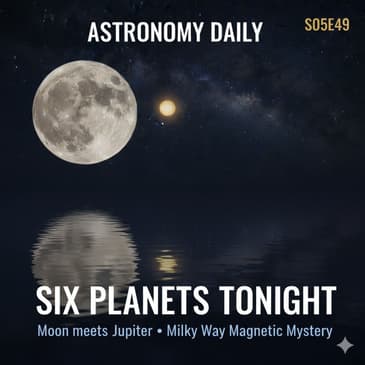
Tonight, the night sky puts on a show. The Moon has a date with Jupiter, and six planets are lined up for your viewing pleasure. This is Astronomy Daily. I'm Avery and I'm Anna, Season five, episode forty nine, Thursday, the twenty sixth of February twenty twenty six. Lots to get through today, so let's go. If you've been watching the western sky after sunset this week, you may have noticed something spectacular building. Six of the Solar System's planets are above the horizon simultaneously right now, and tonight is the visual highlight. We've also got a deep dive into some extraordinary new findings about our galaxy's magnetic field, a quick update on Artemis two, the identity of the astronaut at the center of last month's historic ISS medical story, and a brief heads up on a scrubbed military hypersonic launch that we'd been previewing earlier in the week. Big show, let's get into it. So, Avery, I know you've been watching this planet parade build all week, and tonight is the moment we've been waiting for. It really is. As darkness falls this evening, if you head outside and look west, you'll see the Moon sitting right next to Jupiter. It's a stunning pairing, and it's the centerpiece of a six planet alignment that's been building throughout February. Let's break this down. Fix planets above the horizon at once, Mercury, Venus, Jupiter, Saturn, Uranus, and Neptune. How does that work? Exactly? The planets orbit the Sun and roughly the same flat plane, the Ecliptic, so from Earth they always appear in a band across the sky. When they spread out enough that several are visible simultaneously, we get what astronomers call a planet parade or alignment. Right now, they're nicely spaced across that band. Now, I want to be honest with listeners here, because not all six planets are easy to spot. Some are quite the challenge. Absolutely right, Jupiter is by far the star of the show tonight, pun intended. It's high in the western sky after sunset, unmistakably bright and sitting just below the waxing, gibbous Moon. If you only look once this week, look tonight, look for the Moon, and that blazing point of light right beside it is Jupiter. What about the others? Saturn, and Mercury are visible, but low on the western horizon. And I mean low, they said, not long after the sun, so you've got a fairly tight window. Venus is actually dimmer than you'd expect right now because it's also sitting low in the twilight glare. Urinus needs binoculars, and Neptune really requires a telescope, and you'll need to wait until the Sun is fully below the horizon before even attempting that one. So Jupiter and the Moon for casual observers, extra kit for the dedicated stargazer, exactly. And here's something that keeping your diary. We're one week away from the full moon on March third, and this isn't just any full moon. It's a total lunaric LIL, which means we're heading into a blood moon. We'll have full coverage of that next. Week, something to really look forward to. So tonight, get outside, find the Moon and say hello to Jupiter right beside it. Beautiful. Now to the heart of our galaxy. Astronomers using the world's largest radio telescope array have peered deeper into the Milky Way's central molecular zone than ever before, and what they found is extraordinary. The region around Sagittarius, a star. Our galaxy's super massive black hole at the very center is a violent, turbulent environment, and new observations have revealed hidden chemistry swirling through that chaos. What the researchers have done is essentially map the complex molecules in the cloud of gas and dust that surround Sagittarius astar at a level of detail that wasn't previously possible. They're finding chemical signatures that challenge how we've thought about that region of the galaxy. When the lead researchers describe this as just the beginning, that's telling, isn't it. That phrase usually means they've opened a door rather than closed one. Precisely, this is a proof of concept for a new era of galactic center observations. As the arraysed capabilities continue to improve, the resolution and sensitivity will only get better. We're talking about unlocking processes at the very engine room of our galaxy, how molecules form in extreme environments, how the black holes, radiation and gravity shape the surrounding chemistry. And it all feeds into the bigger question of how galaxies like ours evolve over cosmic time. Exactly right, it's one of those stories where the science is genuinely exciting right now, but the best discoveries are still ahead of us. As we've been reporting throughout the week, NASA's Artemis two Space launch System rocket has now been rolled back from launch Pad thirty nine B to the Vehicle assembly building. The Crawler transporter made the journey on Tuesday, a spectacle haular but somewhat sobering sight that six point six million pound vehicle hauling a rocket that was supposed to be heading for the Moon. The issue is with the upper stage, and engineers now need to diagnose and repair whatever's causing the problem in the controlled environment of the VAB rather than on the pad. The current expectation is that the earliest realistic launch opportunity is now early April. Interestingly, President Trump gave a State of the Union address on Monday and gave a shout out to the Space Force, calling it and I quote, my baby, but notably didn't mention the Artemis two crew by name. Make of that what you will. We'll continue to follow this as it develops, but for now, no moonshot in March. Now to a story that first broke last month and which has just had a significant new development. NASA has now identified the astronaut at the center of the first ever medical evacuation from the International Space Station. To recap for anyone who missed the original story, in January, Space Excess Crew eleven mission returned to Earth early. One member of that crew had experienced a medical issue serious enough to warrant cutting the mission short and bringing the entire crew home. That was unprecedented in the entire history of the ISS. We'd never had a medical evacuation at that level before. NASA has now shed more light on what happened, specifically at the request of the astronaut involved, who wanted their identity made public. The crew of Crew eleven included NASA astronauts Mike Fink and Xena Cardman, Jackson astronaut Kmiya Yui, and Ross Cosmos cosmonaut Oleg Platinoff. It turns out it was Mike Fink who needed the medical help. It was explained that he needed some more imaging scans performed, which just couldn't be done with the equipment on board the ISS SO home they came, However, the nature of his ailment still hasn't been revealed. The details emerging give the medical community and space agencies important data for future long duration mission planning. It raises real questions about how we handle health crises in orbit, what protocols are in place, and how they might need to evolve, especially as missions eventually go beyond Low Earth orbit. A deeply human story alongside all the engineering and science. Will link to the full NASA disclosure in the show notes. Right and now for what might be my favorite story of the episode, And honestly, it's one of those pieces of research that just makes you stop and think about how strange and wonderful our galaxy is. Tell me everything. So, a team led by doctor joe Anne Brown at the University of Calgary has produced the most detailed map yet of the Milky Ways magnetic field, and what they found has fundamentally surprised them. Let's back up a second. How do you even map a magnetic field across a galaxy? Great question. The technique is called Faraday rotation. When radio waves travel through space, they interact with electrons and magnetic fields, and that interaction causes them to shift slightly. They rotate. Doctor Brown student Rebecca Booth described it brilliantly. Think of a straw in a glass of water looking bent because of refraction. Faraday rotation is the same concept, but it's electrons and magnetic fields benting radio waves instead of light through water. That's a genuinely beautiful analogy. Isn't it. And by carefully measuring how much those radio waves shift, the team can trace the invisible magnetic lines flowing through the galaxy. Now here's the astonishing finding. If you could look at the Milky Way from above, the overall magnetic field runs clockwise, but in the Sagittarius arm, one of our galaxy spiral arms, it runs counterclockwise, a complete reversal. They must have known about that reversal before, though. Right, they knew about the reversal, Yes, what they didn't understand was how the transition happened, how the field switches direction. And this is where the new data delivered a genuine moment of discovery. Doctor Brown describes it perfectly. She says, one day her student Anna brought in the new data, and Brown's reaction was, and I'm quoting here, OMG, the reversal's diagonal. I love that and OMG moment in astrophysics. It's wonderful. The reversal doesn't happen in a flat, clean plane as previously assumed. It runs diagonally through the galaxy in three dimensions. That changes everything about how we model the magnetic structure. The team has now built a new three D model to explain it. And why does it matter? Why does the galaxy's magnetic field matter at all? Well, as doctor Brown puts it, without a magnetic field, the galaxy would collapse in on itself due to gravity. The magnetic field is essentially one of the forces holding the whole structure and balance. Understanding how it's shaped and how it's evolved over billions of years tells us something profound about how galaxies like ours come to exist and persist. Absolutely mind expanding. We'll have the research details and links in the show notes. And finally, a quick update on a launch we'd been previewing earlier in the week. Rocket Lab's Haste suborbital rocket was due to lift off from Wallops Island, Virginia on Tuesday, but the mission was scrubbed due to out of bounds launch commit criteria. No new launch date has been announced yet, but just to give listeners the full picture on what this mission actually is, because it's genuinely fascinating. It really is. The mission is called That's not a knife, and yes, that is a deliberate crocodile done d reference and it's carrying a scramjet powered hypersonic demonstrator called dart AE, built by the Australian company Hypersonics. A scramjet being the key technology here. Exactly a scramjet supersonic combustion ramjet ingests air flowing through it faster than the speed of sound and burns fuel in that airstream. What makes hypersonics version particularly interesting is that it runs on hydrogen rather than kerosene, making it essentially zero carbon dioxide emissions at hypersonic speeds. The dart AE is designed to validate advanced propulsion materials and guidance systems for the US Defense Innovation. Unit, and HASTE itself is Rocket Labs workhorse electron rocket adapted for suborbital hypersonic testing. Correct, this would have been the seventh HASTE flight. The mission will fly, just not this week. We'll update you when a new data is confirmed. That's everything for Series five, episode forty nine. An enormous thank you for joining us today. Lots to look at both in the sky and in the science. Don't forget Moon and Jupiter tonight, get outside if you can. You enjoyed today's episode, please do subscribe, leave us a review, and share us with a friend who loves space. We are Astronomy Daily, part of the Bytes dot com podcast network. Find us on all major podcast platforms at Astronomy Daily and on social media at astro Daily Pod. We'll be back tomorrow with more from the universe. Until then, keep looking up blear skies everyone, Sunny Day, star Starz