
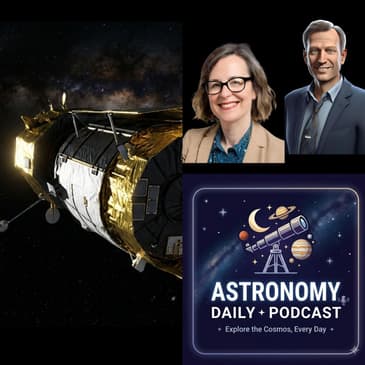

Links & sources: Space.com — Liftoff! NASA's Roman Space Telescope soars to the stars on a SpaceX Falcon Heavy rocket in spectacular launch (video) NASA Science (Roman blog) — NASA's Roman Space Telescope Launches NASA Science (Roman blog) — NASA Concludes Roman Space Telescope Launch Coverage Space.com — What time will SpaceX launch NASA's Roman Space Telescope? (Full mission timeline) Space.com — Goodbye, Falcon 9: SpaceX planning to retire workhorse launcher when Starship is up and running Teslarati — Elon Musk just set a condition that could end Falcon 9 as we know it ScienceDaily — The universe is still speeding up, but nobody knows why University of Bern (media relations) — Asteroid impact shaped the appearance of Mars' moon Deimos Nature Astronomy — Raducan, Agrusa, Asphaug et al. (2026), DOI 10.1038/s41550-026-02956-w When The Curves Line Up — 2026, August 31: Venus Nears Spica TelescopeAdvisor — Night Sky in September 2026: Saturn Approaching Opposition Follow us: @AstroDailyPod
Become a supporter of this podcast: https://www.spreaker.com/podcast/astronomy-daily-latest-space-news--5648921/support.
Sponsor Details:
Ensure your online privacy by using NordVPN. To get our special listener deal and save a lot of money, visit www.astronomydaily.io/nordvpn. You'll be glad you did!
Get the best secure and private email on the planet. Stop your Government, google and who knows who else spying on every email you write. Do what we did and use ProtonMail. They beleive in privacy and there are no ads in their business model...yet they still provide a free forever service. Check them out and get out special deal at www.astronomydaily.io/protonmail
Become a supporter of Astronomy Daily by joining our Supporters Club. Commercial free episodes daily are only a click way... Click Here
This episode includes AI-generated content.
00:00:00 --> 00:00:03 Anna: Hey, everyone. Welcome back to Astronomy
00:00:03 --> 00:00:05 daily. It's Monday, August 31st,
00:00:05 --> 00:00:08 series five, episode 181.
00:00:08 --> 00:00:10 Avery: And, um, this is the good kind of Monday,
00:00:10 --> 00:00:13 Anna, because we finally get to talk about a
00:00:13 --> 00:00:15 launch that actually happened.
00:00:15 --> 00:00:18 Anna: Finally, after a full week of. It's coming,
00:00:18 --> 00:00:20 it's coming. Roman is up.
00:00:21 --> 00:00:23 Avery: The Nancy Grace Roman Space Telescope
00:00:23 --> 00:00:25 launched yesterday morning, right on time.
00:00:26 --> 00:00:28 And it went about as clean as a launch can
00:00:28 --> 00:00:30 go. We'll walk through the whole thing.
00:00:30 --> 00:00:33 Anna: Then SpaceX drops a pretty big hint
00:00:33 --> 00:00:35 about Falcon 9's eventual retirement.
00:00:36 --> 00:00:38 Two Nobel laureates weigh in on whether the
00:00:38 --> 00:00:41 universe's expansion is actually still
00:00:41 --> 00:00:44 speeding up. One very old
00:00:44 --> 00:00:46 asteroid strike explains two separate
00:00:46 --> 00:00:49 mysteries on a tiny Martian moon.
00:00:49 --> 00:00:51 And we'll get you sorted for what's actually
00:00:51 --> 00:00:54 worth looking up at tonight, wherever you
00:00:54 --> 00:00:54 are.
00:00:55 --> 00:00:56 Avery: Lots to get through, let's go.
00:00:56 --> 00:00:59 Anna: But start with the, uh, Nancy Grace Roman
00:00:59 --> 00:01:00 Space Telescope launch then.
00:01:00 --> 00:01:03 Avery: Okay. I've been waiting all week to say this.
00:01:03 --> 00:01:04 Tell me it went well.
00:01:04 --> 00:01:07 Anna: It went about as well as a launch
00:01:07 --> 00:01:09 possibly can. Liftoff was
00:01:09 --> 00:01:12 7:26 yesterday morning, Eastern Time.
00:01:12 --> 00:01:14 That's Sunday, August 30th, right on the
00:01:14 --> 00:01:17 primary window. No scrubs, no holds.
00:01:17 --> 00:01:20 SpaceX's Falcon Heavy took the Nancy Grace
00:01:20 --> 00:01:23 Roman Space Telescope up From Launch Complex
00:01:23 --> 00:01:25 39A at Kennedy Space Centre.
00:01:26 --> 00:01:28 Avery: The same pad Apollo flew from.
00:01:28 --> 00:01:31 Anna: The very same. And More recently, Artemis
00:01:31 --> 00:01:34 1 side boosters peeled away about 2
00:01:34 --> 00:01:36 1/2 minutes in and flew themselves home to
00:01:36 --> 00:01:39 landing zones at Cape Canaveral. Textbook
00:01:39 --> 00:01:42 boost back and landing on both. Main
00:01:42 --> 00:01:44 engine cutoff on the core stage came around
00:01:44 --> 00:01:47 the four minute mark and, um, Roman itself
00:01:48 --> 00:01:50 deployed clean 31 minutes after
00:01:50 --> 00:01:53 liftoff. No anomalies reported at any
00:01:53 --> 00:01:55 stage of the flight. By NASA's own account,
00:01:55 --> 00:01:58 about as tidy a run as you could hope for.
00:01:58 --> 00:02:01 Avery: I love it when they get to actually say that.
00:02:01 --> 00:02:03 Anna: There was a nice moment in the post launch
00:02:03 --> 00:02:05 press conference too. President Trump called
00:02:05 --> 00:02:08 in live to congratulate the team, which made
00:02:08 --> 00:02:11 for a slightly surreal watch alongside all
00:02:11 --> 00:02:11 the mission control.
00:02:12 --> 00:02:14 Avery: CHEERING okay, it's up, it's safely away from
00:02:14 --> 00:02:16 the rocket. What's next for it? And, um,
00:02:16 --> 00:02:18 remind everyone what it's actually for,
00:02:19 --> 00:02:20 because we've built this thing up all week
00:02:20 --> 00:02:22 without it existing in orbit.
00:02:22 --> 00:02:24 Anna: Yet right now it's real.
00:02:25 --> 00:02:27 Romans on a 90 day cruise out to the
00:02:27 --> 00:02:30 sun. Earth L2 point, about a
00:02:30 --> 00:02:32 million and a half kilometres from Earth,
00:02:33 --> 00:02:36 same neighbourhood as Webb. The first 40 days
00:02:36 --> 00:02:38 or so are instrument activation and status
00:02:38 --> 00:02:41 cheques. Then science commissioning kicks in
00:02:41 --> 00:02:44 from around day 45. First images
00:02:44 --> 00:02:46 are expected in early 2027.
00:02:47 --> 00:02:49 Avery: And there's an actual local link to this one
00:02:49 --> 00:02:51 too, isn't there? Not just an American
00:02:51 --> 00:02:51 storey.
00:02:51 --> 00:02:54 Anna: There is, and it's worth saying out loud,
00:02:54 --> 00:02:56 part of Roman's data is going to come down
00:02:56 --> 00:02:59 through a brand new ESA antenna in
00:02:59 --> 00:03:01 New Norcia in Western Australia.
00:03:02 --> 00:03:05 Roman's a formal ESA partnership, so
00:03:05 --> 00:03:07 that antenna's already built into how this
00:03:07 --> 00:03:08 mission gets its data home.
00:03:09 --> 00:03:11 Avery: I like that a lot. Okay. Remind people why
00:03:11 --> 00:03:14 this telescope is such a big deal. Because
00:03:14 --> 00:03:17 similar mirror size to Hubble undersells it
00:03:17 --> 00:03:17 badly.
00:03:18 --> 00:03:20 Anna: It does. Same 2.4 metre
00:03:20 --> 00:03:23 primary mirror as Hubble. But Roman's wide
00:03:23 --> 00:03:26 Field instrument gives it a view roughly a
00:03:26 --> 00:03:29 hundred times wider at basically the same
00:03:29 --> 00:03:31 sharpness. Where Hubble gives you a postage
00:03:31 --> 00:03:34 stamp, Roman gives you a poster.
00:03:34 --> 00:03:36 Programme scientist Dominic Benford put it
00:03:36 --> 00:03:39 nicely before launch. The smallest Roman
00:03:39 --> 00:03:42 images will be a billion pixels.
00:03:42 --> 00:03:44 There isn't a screen on Earth big enough to
00:03:44 --> 00:03:46 display all of them at once.
00:03:46 --> 00:03:49 Avery: Billion pixels in the smallest image.
00:03:49 --> 00:03:52 Anna: The smallest. And that scale is
00:03:52 --> 00:03:55 entirely the point. The flagship project is
00:03:55 --> 00:03:57 the High Latitude Wide area survey.
00:03:57 --> 00:04:00 Roughly 2 billion galaxies imaged to
00:04:00 --> 00:04:03 map dark matter and chart how dark energy
00:04:03 --> 00:04:06 is pulling the universe apart faster over
00:04:06 --> 00:04:09 time. There's a companion supernova time
00:04:09 --> 00:04:12 domain survey chasing the same question from
00:04:12 --> 00:04:15 a different angle. And funnily enough, that's
00:04:15 --> 00:04:17 relevant to our next storey today too.
00:04:18 --> 00:04:20 Avery: And um, the exoplanet hunt, that's the one I
00:04:20 --> 00:04:21 always want.
00:04:21 --> 00:04:24 Anna: More detail on the galactic bulge. Time
00:04:24 --> 00:04:26 domain survey, a completely different
00:04:26 --> 00:04:29 technique to Kepler or tess. It watches for
00:04:29 --> 00:04:32 a foreground star's gravity, briefly
00:04:32 --> 00:04:34 magnifying light from something behind it.
00:04:34 --> 00:04:37 With a planet adding its own little blip to
00:04:37 --> 00:04:39 that signal, it catches things. Transit
00:04:39 --> 00:04:42 surveys can't wide orbit planets. Even
00:04:42 --> 00:04:45 free floating rogue planets with no star at
00:04:45 --> 00:04:48 all bear expecting on the order of
00:04:48 --> 00:04:51 100 new detections from that
00:04:51 --> 00:04:52 survey alone.
00:04:52 --> 00:04:55 Avery: 100 new worlds from one survey.
00:04:55 --> 00:04:57 Anna: From one survey. And there's a fourth
00:04:57 --> 00:05:00 instrument riding along the coronagraph, a
00:05:00 --> 00:05:03 technology demonstration for directly imaging
00:05:03 --> 00:05:06 exoplanets by blocking out the glare of their
00:05:06 --> 00:05:09 host star rather than just inferring they're
00:05:09 --> 00:05:11 there. If it works as hoped, it's a real
00:05:11 --> 00:05:14 stepping stone toward NASA's future flagship
00:05:14 --> 00:05:16 missions. Doing that a, uh, standard.
00:05:16 --> 00:05:19 Avery: So walk me back through the week because this
00:05:19 --> 00:05:21 has actually been a four part storey and I
00:05:21 --> 00:05:23 don't think we've said that out loud yet.
00:05:23 --> 00:05:26 Anna: It has. Tuesday we told you. Roman
00:05:26 --> 00:05:29 got cleared for launch nine months ahead of
00:05:29 --> 00:05:32 schedule, which is almost unheard of for a
00:05:32 --> 00:05:35 NASA flagship mission. Thursday we told the
00:05:35 --> 00:05:38 genuinely Strange storey of how its core
00:05:38 --> 00:05:40 optics started life inside a, uh,
00:05:40 --> 00:05:42 cancelled National Reconnaissance Office
00:05:43 --> 00:05:45 spy satellite programme before being
00:05:45 --> 00:05:48 donated to NASA back in 2012.
00:05:48 --> 00:05:51 Friday we told you it survived a budget
00:05:51 --> 00:05:53 draught that would have cancelled it
00:05:53 --> 00:05:55 outright, and how the team that saved it
00:05:55 --> 00:05:58 responded by pulling the launch forward eight
00:05:58 --> 00:06:01 months instead of slipping it. And Saturday
00:06:01 --> 00:06:03 we previewed the launch itself.
00:06:04 --> 00:06:06 Avery: And today the actual thing happened.
00:06:06 --> 00:06:09 Anna: The actual thing happened. Clean launch,
00:06:09 --> 00:06:12 clean deployment, on its way to L2.
00:06:12 --> 00:06:15 First images due early next year. After
00:06:15 --> 00:06:17 everything that had to go right just to get
00:06:17 --> 00:06:20 it off the ground, it's genuinely satisfying
00:06:20 --> 00:06:22 to get to close the loop on this one.
00:06:22 --> 00:06:24 Avery: A very good Monday indeed.
00:06:25 --> 00:06:27 Next up, sticking with SpaceX for a second
00:06:27 --> 00:06:30 because Elon Musk said something last week we
00:06:30 --> 00:06:32 haven't gotten to yet worth flagging.
00:06:32 --> 00:06:35 Anna: Even though the post itself isn't brand new.
00:06:35 --> 00:06:38 Musk said on X on August 22
00:06:38 --> 00:06:41 that winding down both Falcon 9 and
00:06:41 --> 00:06:43 Falcon Heavy is, in his words,
00:06:43 --> 00:06:44 inevitable.
00:06:44 --> 00:06:47 Avery: Inevitable. That's a strong word for the
00:06:47 --> 00:06:49 rocket that's basically been SpaceX's entire
00:06:49 --> 00:06:51 business for a decade.
00:06:51 --> 00:06:53 Anna: It is, but the condition he attached
00:06:53 --> 00:06:56 matters. Once Starship is flying
00:06:56 --> 00:06:59 reliably several times a week, he says it
00:06:59 --> 00:07:01 makes sense to shift production resources
00:07:01 --> 00:07:04 over to Starship and push its launch rate
00:07:04 --> 00:07:06 up to multiple times a day.
00:07:06 --> 00:07:09 Avery: So this isn't, um, we're retiring Falcon 9
00:07:09 --> 00:07:10 next quarter?
00:07:10 --> 00:07:13 Anna: Not remotely. It's a statement of intent,
00:07:13 --> 00:07:16 not a timeline. Falcon 9 only just hit
00:07:16 --> 00:07:19 its 100th launch of the year back on August
00:07:19 --> 00:07:21 25th, and Booster
00:07:21 --> 00:07:23 B1067 set a new
00:07:23 --> 00:07:26 single booster reuse record at 37
00:07:26 --> 00:07:29 flights on that very mission. This is still
00:07:29 --> 00:07:31 an enormously active fleet.
00:07:31 --> 00:07:33 Avery: So what's the actual estimate for when this
00:07:33 --> 00:07:34 starts to bite?
00:07:35 --> 00:07:37 Anna: Industry reporting points to most Falcon 9
00:07:37 --> 00:07:39 missions winding down from around
00:07:39 --> 00:07:42 2028, with a limited number of flights
00:07:42 --> 00:07:45 continuing well past that. NASA's crew
00:07:45 --> 00:07:48 and cargo runs to the ISS are expected to
00:07:48 --> 00:07:51 keep flying on Falcon 9 through at least
00:07:51 --> 00:07:54 2030. Since human rating, a brand new
00:07:54 --> 00:07:56 vehicle for those missions isn't something
00:07:56 --> 00:07:57 anyone rushes.
00:07:57 --> 00:08:00 Avery: There's something almost poetic about this
00:08:00 --> 00:08:02 landing. The same week Roman flew on a Falcon
00:08:02 --> 00:08:03 Heavy.
00:08:03 --> 00:08:06 Anna: Genuinely, Roman rode one of the very rockets
00:08:06 --> 00:08:09 Musk is talking about eventually phasing out
00:08:09 --> 00:08:11 on what could well end up being one of Falcon
00:08:11 --> 00:08:14 Heavy's higher profile flights. And it's not
00:08:14 --> 00:08:17 an isolated signal either. We've already told
00:08:17 --> 00:08:19 you about Starbase, Louisiana. SpaceX's
00:08:19 --> 00:08:22 planned second Starship focused launch
00:08:22 --> 00:08:24 complex, and Starship's own Flight 14
00:08:25 --> 00:08:27 is still tracking toward, uh, no earlier than
00:08:27 --> 00:08:28 September 15th.
00:08:29 --> 00:08:31 Avery: So the plan really is get starship flying
00:08:31 --> 00:08:34 like Falcon 9 does now, then hand over the
00:08:34 --> 00:08:34 keys.
00:08:35 --> 00:08:37 Anna: That's the plan. As Musk describes it,
00:08:37 --> 00:08:39 whether starship's flight cadence actually
00:08:39 --> 00:08:42 gets there on anything like that timeline is
00:08:42 --> 00:08:44 very much the open question.
00:08:44 --> 00:08:46 Avery: Onto our next storey today. And this one's
00:08:46 --> 00:08:48 got some serious star power behind it,
00:08:49 --> 00:08:51 literally. Nobel Prize star power.
00:08:51 --> 00:08:54 Anna: This is a good one. Back in November last
00:08:54 --> 00:08:56 year, a, uh, South Korean research team
00:08:56 --> 00:08:59 published a paper suggesting the universe's
00:08:59 --> 00:09:01 expansion might actually, actually be slowing
00:09:01 --> 00:09:04 down, not speeding up. Which, if true,
00:09:04 --> 00:09:07 would upend a huge chunk of modern cosmology.
00:09:07 --> 00:09:09 Avery: That's the kind of headline that gets a lot
00:09:09 --> 00:09:10 of attention.
00:09:10 --> 00:09:13 Anna: It did, and it also got a lot of
00:09:13 --> 00:09:16 scrutiny. A team led by Phil Wiseman at the
00:09:16 --> 00:09:18 University of Southampton, working alongside
00:09:18 --> 00:09:21 Adam Reese And Brian Schmidt, two of the
00:09:21 --> 00:09:24 three scientists who shared the 2011 Nobel
00:09:24 --> 00:09:25 Prize in Physics for discovering the
00:09:25 --> 00:09:28 universe's accelerating expansion in the
00:09:28 --> 00:09:30 first place, which went back through the
00:09:30 --> 00:09:32 analysis and published a rebuttal in the
00:09:32 --> 00:09:35 monthly notices of the Royal Astronomical
00:09:35 --> 00:09:37 Society this week. And their finding,
00:09:37 --> 00:09:40 the universe is in fact still speeding up.
00:09:40 --> 00:09:43 Nobody's disputing that part. What they found
00:09:43 --> 00:09:46 was a specific flaw in the earlier study's
00:09:46 --> 00:09:48 method. It had effectively treated the age of
00:09:48 --> 00:09:51 a distant galaxy as if it were the age of the
00:09:51 --> 00:09:54 individual star inside it that later
00:09:54 --> 00:09:57 exploded as a supernova and hadn't properly
00:09:57 --> 00:10:00 accounted for the host galaxy's mass either.
00:10:00 --> 00:10:02 Avery: Which matters because.
00:10:02 --> 00:10:05 Anna: Because the whole technique relies on type
00:10:05 --> 00:10:08 1A supernovae, extremely bright,
00:10:08 --> 00:10:10 reliably behaved stellar explosions from
00:10:10 --> 00:10:13 white dwarf stars as standardised cosmic
00:10:13 --> 00:10:16 candles to measure distance. And from that,
00:10:16 --> 00:10:18 the universe's expansion rate over time.
00:10:18 --> 00:10:21 Get the underlying age or mass assumptions,
00:10:21 --> 00:10:24 even subtly wrong, and you can shift your
00:10:24 --> 00:10:26 final answer in a way that looks like new
00:10:26 --> 00:10:28 physics, when it's actually just an error
00:10:28 --> 00:10:30 creeping in upstream.
00:10:30 --> 00:10:33 Avery: So this isn't new data, it's a correction to
00:10:33 --> 00:10:34 how old data was read.
00:10:34 --> 00:10:37 Anna: Exactly. No new telescope, no new
00:10:37 --> 00:10:40 survey, just a more careful reanalysis of
00:10:40 --> 00:10:42 existing supernova observations. Which,
00:10:42 --> 00:10:45 fittingly, is precisely the kind of question
00:10:45 --> 00:10:48 Roman was built to help nail down for good
00:10:48 --> 00:10:51 with its own dedicated supernova time domain
00:10:51 --> 00:10:51 survey.
00:10:51 --> 00:10:54 Avery: Once it's up and running, dark energy remains
00:10:54 --> 00:10:55 undefeated.
00:10:55 --> 00:10:57 Anna: Then, for now, nobody's claiming to know
00:10:57 --> 00:11:00 what dark energy actually is. Only
00:11:00 --> 00:11:02 that, whatever it is, it's still doing what
00:11:02 --> 00:11:03 we thought it was doing.
00:11:04 --> 00:11:06 Avery: Next up, we're heading to Mars. Well,
00:11:06 --> 00:11:09 technically, just passed it to one of its two
00:11:09 --> 00:11:11 little moons, Themos, the
00:11:11 --> 00:11:14 Anna: smaller and more distant of Mars. Two moons.
00:11:14 --> 00:11:17 It's always been a Bit of an odd duck. It's
00:11:17 --> 00:11:19 shaped like a lumpy potato. It's got an
00:11:19 --> 00:11:22 unexplained depression near its south pole
00:11:22 --> 00:11:25 and its surface is oddly smooth and dusty for
00:11:25 --> 00:11:26 a body that small.
00:11:26 --> 00:11:28 Avery: Small. And somebody's finally worked out why.
00:11:29 --> 00:11:31 Anna: A team led by Sabina Radican, now at the
00:11:31 --> 00:11:34 Vri Universitite Brussels, working with
00:11:34 --> 00:11:36 Martin Uzi at the University of Bern,
00:11:36 --> 00:11:39 published the answer in Nature Astronomy. And
00:11:39 --> 00:11:42 this is the first published study to use
00:11:42 --> 00:11:44 actual Flyby Data from ESA's HERA mission,
00:11:44 --> 00:11:47 which swung past Deimos on its way out to the
00:11:47 --> 00:11:48 asteroid Dimorphos.
00:11:49 --> 00:11:50 Avery: What did they find?
00:11:50 --> 00:11:53 Anna: A single asteroid impact explains both
00:11:53 --> 00:11:56 quirks at once. They're simulations, about
00:11:56 --> 00:11:58 a hundred of them, each needing roughly a
00:11:58 --> 00:12:01 week of supercomputer time. Using a piece
00:12:01 --> 00:12:04 of impact modelling software the University
00:12:04 --> 00:12:06 of Bern has been developing for two
00:12:06 --> 00:12:08 decades, show an asteroid around
00:12:08 --> 00:12:11 320 metres across, hitting
00:12:11 --> 00:12:14 at a 45 degree angle is enough
00:12:14 --> 00:12:17 to carve out that south polar depression
00:12:17 --> 00:12:20 and scatter enough debris around the entire
00:12:20 --> 00:12:23 moon to explain the dusty regolith
00:12:23 --> 00:12:24 layer everywhere else.
00:12:25 --> 00:12:28 Avery: 45 degrees feels oddly specific.
00:12:28 --> 00:12:31 Anna: It's the sweet spot. Violent enough to
00:12:31 --> 00:12:34 genuinely redistribute material across the
00:12:34 --> 00:12:37 whole surface, but not so violent it would
00:12:37 --> 00:12:39 have shattered a moon this small entirely.
00:12:40 --> 00:12:43 Deimos, by the way, is basically a porous
00:12:43 --> 00:12:46 rubble pile rather than one solid rock.
00:12:46 --> 00:12:49 So getting that balance right mattered a lot
00:12:49 --> 00:12:50 in the models.
00:12:51 --> 00:12:53 Avery: One impact, two mystery, M solved.
00:12:53 --> 00:12:56 Anna: One impact, two mysteries. And a nice
00:12:56 --> 00:12:59 example of a spacecraft doing useful science
00:12:59 --> 00:13:01 on the way to somewhere else entirely.
00:13:02 --> 00:13:05 Hera's primary job is studying what NASA's
00:13:05 --> 00:13:07 DART mission did to Dimorphos. This
00:13:07 --> 00:13:10 Deimos flyby was almost a bonus stop on the
00:13:10 --> 00:13:11 way past.
00:13:11 --> 00:13:13 Avery: Alright, let's get everyone sorted for
00:13:13 --> 00:13:16 tonight, wherever tonight actually is for
00:13:16 --> 00:13:16 you.
00:13:16 --> 00:13:19 Anna: Venus is the headline act, and it's an easy
00:13:19 --> 00:13:22 one to find. Low in the west, west
00:13:22 --> 00:13:25 southwest, roughly 45 minutes after
00:13:25 --> 00:13:28 sunset from Sydney tonight. Sunsets
00:13:28 --> 00:13:31 around 5.32pm, so you're looking
00:13:31 --> 00:13:33 from about a quarter past six. Wherever
00:13:33 --> 00:13:36 else you are, just use your own local sunset
00:13:36 --> 00:13:38 and add the same 45 minutes.
00:13:39 --> 00:13:41 Avery: How long do people have before it sets?
00:13:41 --> 00:13:44 Anna: Uh, not long. Venus is following the
00:13:44 --> 00:13:46 sun down pretty quickly at the moment,
00:13:46 --> 00:13:49 setting only 90 minutes after sunset. So
00:13:49 --> 00:13:51 don't dawdle. It's sitting close to Spica
00:13:51 --> 00:13:54 right now, too. Tonight's basically a
00:13:54 --> 00:13:56 preview, because the real close pass happens
00:13:56 --> 00:13:59 tomorrow night, September 1, when the two
00:13:59 --> 00:14:02 will be less than 2 degrees apart. It's
00:14:02 --> 00:14:04 heading toward its brightest of the year
00:14:04 --> 00:14:07 later in September So this is really just the
00:14:07 --> 00:14:07 opening act.
00:14:08 --> 00:14:10 Avery: What about Saturn? We've called it the
00:14:10 --> 00:14:12 reliable one a lot lately.
00:14:12 --> 00:14:15 Anna: Saturn's actually graduated to a better slot.
00:14:15 --> 00:14:18 It's now rising close to sunset and staying
00:14:18 --> 00:14:21 up for the most of the night, sitting in
00:14:21 --> 00:14:23 aquarius at magnitude 0.3,
00:14:24 --> 00:14:26 brighter than anything else nearby in that
00:14:26 --> 00:14:29 stretch of sky. Even a modest telescope
00:14:29 --> 00:14:31 will show the rings clearly separated from
00:14:31 --> 00:14:34 the disc now that they've opened up to about
00:14:34 --> 00:14:37 7.5 degrees, a big improvement
00:14:37 --> 00:14:39 on how flat and hard to read they were last
00:14:39 --> 00:14:42 year. It's closing in on opposition on
00:14:42 --> 00:14:44 October 4, so it only gets better from
00:14:44 --> 00:14:47 here. Great target either hemisphere.
00:14:47 --> 00:14:50 Avery: And for the early risers, Jupiter's
00:14:50 --> 00:14:51 just
00:14:51 --> 00:14:53 Anna: returned to the morning sky after being lost
00:14:53 --> 00:14:56 in the Sun's glare, so it's back as a pre
00:14:56 --> 00:14:58 dawn target. Low in the east, best
00:14:58 --> 00:15:01 windows roughly 4 to 6 in the morning.
00:15:01 --> 00:15:04 Mars is out there too, fading a uh, bit these
00:15:04 --> 00:15:07 days in that same pre dawn eastern sky.
00:15:07 --> 00:15:10 And the moon waning gibbous tonight,
00:15:10 --> 00:15:12 still bright. It was sitting right next to
00:15:12 --> 00:15:15 Saturn the last couple of nights and it'll
00:15:15 --> 00:15:16 keep thinning out through the week.
00:15:17 --> 00:15:19 Avery: One quick standing reminder before we go.
00:15:19 --> 00:15:21 Since we're talking about bright things low
00:15:21 --> 00:15:24 Anna: near the horizon, always worth repeating.
00:15:24 --> 00:15:27 Whenever you're pointing anything, even just
00:15:27 --> 00:15:29 your eyes near the Sun's position in the sky,
00:15:30 --> 00:15:33 sunrise, sunset or any direct solar
00:15:33 --> 00:15:36 viewing, make sure any filter you're using is
00:15:36 --> 00:15:37 certified to ISO
00:15:38 --> 00:15:40 123122.
00:15:40 --> 00:15:43 Ordinary sunglasses are nowhere near enough
00:15:43 --> 00:15:46 protection. Venus and Saturn ah, are
00:15:46 --> 00:15:48 perfectly safe to look at anytime. Obviously
00:15:48 --> 00:15:50 this one's just a standing habit worth
00:15:50 --> 00:15:51 keeping. Sharp.
00:15:52 --> 00:15:54 Avery: Good habit to keep sharp indeed.
00:15:54 --> 00:15:56 And that's a show for today. The Nancy Grace
00:15:56 --> 00:15:59 Roman Space Telescope safely away and headed
00:15:59 --> 00:16:02 for deep space. SpaceX uh, signalling the
00:16:02 --> 00:16:04 eventual end of the Falcon 9 era. Two Nobel
00:16:04 --> 00:16:07 laureates defending an accelerating universe,
00:16:07 --> 00:16:10 one very old asteroid strike solving two
00:16:10 --> 00:16:13 mysteries on Deimos, and everything you need
00:16:13 --> 00:16:14 to get outside tonight.
00:16:14 --> 00:16:16 Anna: If you enjoyed today's episode, the best
00:16:16 --> 00:16:18 thing you can do for us is leave a rating or
00:16:18 --> 00:16:21 review wherever you're listening and share it
00:16:21 --> 00:16:23 with a fellow space nerd. Full show notes,
00:16:23 --> 00:16:26 sources and links for every storey we covered
00:16:26 --> 00:16:29 today are @astronomydaily IO
00:16:29 --> 00:16:31 and you can find us on social media. We're
00:16:31 --> 00:16:34 AstroDaily Pod pretty much everywhere.
00:16:34 --> 00:16:36 Avery: We'll be back tomorrow with more space and
00:16:36 --> 00:16:38 astronomy news. Until then, keep looking up.
00:16:38 --> 00:16:40 Anna: See you next time. Clear skies.
00:16:50 --> 00:16:50 Avery: Mhm.
00:16:52 --> 00:16:52 Anna: The storey.