

Become a supporter of this podcast: https://www.spreaker.com/podcast/astronomy-daily-latest-space-news--5648921/support.
Sponsor Details:
Ensure your online privacy by using NordVPN. To get our special listener deal and save a lot of money, visit www.astronomydaily.io/nordvpn. You'll be glad you did!
Get the best secure and private email on the planet. Stop your Government, google and who knows who else spying on every email you write. Do what we did and use ProtonMail. They beleive in privacy and there are no ads in their business model...yet they still provide a free forever service. Check them out and get out special deal at www.astronomydaily.io/protonmail
Become a supporter of Astronomy Daily by joining our Supporters Club. Commercial free episodes daily are only a click way... Click Here
This episode includes AI-generated content.
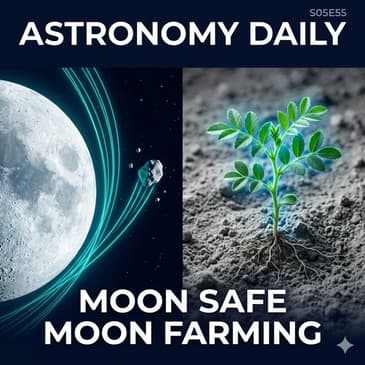
Hey, everyone, Welcome back to Astronomy Daily. I'm Ana and I'm Avery. Happy Friday, space fans, We've got a great one for you today. We do six stories, and honestly, this is one of the more varied lineups we've had in a while. We've got planetary defense, a cosmic laser from halfway across the universe, a solar superstorm hitting Mars, a SpaceX rocket polluting the atmosphere on its way. Down, a mystery satellite launch from the other side of the world, and my personal favorite scientists trying to grow chickpeas on the moon. Bon hummus. Avery, that's where we're headed. Moon hummus. Let's go. Okay, First up, great news for anyone who's been losing sleep over asteroid twenty twenty four y R four. NASA has now officially ruled out any chance of it hitting the Moon in twenty thirty two. Right, So let's quickly recap the story for anyone who hasn't been following it. This asteroid was discovered back in December twenty twenty four, and for a while it was genuinely alarming. It briefly became the most dangerous asteroid identified in the last twenty years with a small but very real chance it could hit Earth. That Earth impact risk was ruled out fairly quickly, but when the asteroid faded from view last year, astronomers were left with something almost as intriguing, a lingering four percent chance it could strike the Moon on December twenty second, twenty thirty two. Four percent sounds small, but in asteroid terms, that's enormous. We're talking about a sixty meter rock, roughly the same size as what caused the Tenguska event in nineteen oh eight, or what dugout meteor crater in Arizona. If it hit the near side of the Moon, it would have created a crater about a kilometer wide and put on the most spectacular light show humanity has ever seen from Earth. So everyone's been watching very closely. The problem was by spring last year, the asteroid had drifted so far away it was invisible to pretty much every telescope on Earth and in space, with one exception. The James Web Space Telescope, which pushed itself to its very limits To catch this thing. A team led by the JOHNS. Hopkins Applied Physics Laboratory used Web's near infrared camera in two observation windows in February the eighteenth and the twenty six to track down this incredibly faint speck against the background of stars. And the result was clear. The new measurements allowed scientists to map twenty twenty four y are forest trajectory with enough precision to rule out a lunar collision. Instead of hitting the Moon, It's going to pass at a distance of about thirteen thousand, two hundred miles from the lunar surface, which is yes, closer than some satellites orbit Earth, but it's a miss. Thirteen thousand, two hundred miles is basically next door in astronomical terms, but next door is still a miss. The Moon is safe, Earth is safe, and twenty twenty four yr four is just gonna keep trucking. NASA says they'll observe it again when it swings back near Earth in twenty twenty eight, So the story isn't quite over, but for now the threat is officially off the table. Good news to kick off the show What's next? Okay? Story two. This one comes out of South Africa and it involves what scientists are describing as a cosmic laser. And I mean that almost literally. Tell me more lasers in space. Sounds like something I need in my life. So astronomers using the Meerkat radio telescope in the Karu Desert have detected the most distant hydroxyl megamazer ever found. It's located in a violently merging galaxy four than eight billion light years away, and the signal is so powerful that researchers are actually calling it a gigamaser rather than a megamser. Okay, let's break this down for people. What exactly is a hydroxyl megamser? Right, So, on Earth, a laser works by exciting atoms or molecules until they release light in a very tight amplified beam. The same basic physics can happen in space, but instead of visible light, it happens at radio wavelengths. Hydroxyl molecules that's one hydrogen, one oxygen in massive gas clouds can be excited by the energy of colliding galaxies and amplify radio waves in exactly the same way. When the signal is extraordinarily bright, it's called a megamaser. So it's a natural radio laser powered by two galaxies smashing into each other. Exactly, and the one mirror caatound cataloged as hat Las J one four two nine three five point three dash zero zero two eight three six is the most distant and luminous example ever detected. We're seeing it as it existed when the universe was less than half its current age. And you said there was a gravitational lens involved as well. Yes, this is the really lovely part of the story. On its eight billion year journey to Earth, the radio signal happened to pass directly behind another completely unrelated galaxy sitting between us and the source. That foreground galaxy's gravity bent and warped space around it, acting like a natural magnifying glass and amplifying the signal even further before it reached Meerkat. So we have a natural space laser being focused by a natural gravitational telescope. That is genuinely delightful. The universe just handed astronomers a cosmic gift. The lead researcher, doctor Thoto Monomela, from the University of Pretoria, described it beautifully. He said they were seeing the radio equivalent of a laser halfway across the universe, and that it was a wonderfully serendipitous discovery. And the bigger picture here is that Meerkat is a precursor to the square kilometer array, the SKA, which is going to be even more powerful. So this is just a start of what's possible exactly. Bonamella's team wants to find hundreds, even thousands of these objects, and when the SKA comes online, that's going to become a real possibility. Incredible, all right. Story three and a bit of recent space history. Story three takes us back to May twenty twenty four and to Mars. You might remember that in May twenty twenty four, Earth was hit by the biggest solar storm recorded in over twenty years. Spectacular auroras were seen as far south as Mexico. I remember it well. Half the world was posting aurora photos, right. But that same storm also slammed into Mars. And thanks to Issa's two Mars orbiters, Mars Express and Exo Mars Trace Gas Orbital, we now know in unprecedented detail what that actually looked like. A new paper published today in Nature Communications reveals a full picture. So what happened to Mars? In short, Mars got absolutely hammered. The storm sent fast moving, energetic magnetized plasma and X rays flooding towards the red planet. When this barrage hit Mars's upper atmosphere, it stripped electrons from neutral atoms, causing two distinct layers of the atmosphere to fill up with charged particles at altitudes of around one hundred and ten and one hundred and thirty kilometers. How much of an effect are we talking? The electron density in those layers surged by forty five percent in one and a whopping two hundred and seventy eight percent in the other. Lead author Jacob Parrott from ISSA described it as the biggest response to a solar storm ever seen at Mars. And the orbiters themselves were affected too. Write they were both spacecraft suffered computer errors from the energetic particles, which is a known hazard of space weather, But crucially both had been designed with radiation resistant components and error correction systems, so they recovered fast and the time was incredibly fortunate. The researchers were able to capture the aftermath of the storm using a technique called radio ocultation just ten minutes after a large solar flare hit Mars. Radial occultation for our listeners that's where one spacecraft beams a radio signal to another at precisely the moment it disappears over the planet's horizon. The signal gets bent by the atmosphere on the way, and scientists can read all sorts of information about the atmospheric layers from the way it bends. It's a technique that's been used for decades here at Earth, but only recently has it been applied between two spacecraft that Mars. This was a perfect demonstration of how powerful it can. Be, and there's a broader significance here, isn't there. Mars has no global magnetic field the way Earth does, which is why the storm hits so much harder. Exactly on Earth, our magnetic field deflects a lot of the solar particles and channels the rest toward the poles as auroras. Mars lost its magnetic field billions of years ago, and that's almost certainly why it also lost most of its atmosphere and its liquid water over time. This study helps us understand that ongoing process, and it has very practical implications for future crude missions and radar operations on and around Mars. Really fascinating staff. Okay story four, and this one has a bit more of an edge to it. So this story starts with a SpaceX Falcon nine upper stage that back in February twenty twenty five failed to execute its planned de orbit burn after delivering twenty two Starlink satellites to orbit. It drifted uncontrolled for eighteen days before beginning an uncontrolled re entry about one hundred kilometers off the west coast of Ireland. I remember this one. Some debris came down in Poland, which caused a fairly significant diplomatic incident. Poland dismissed its head of Space agency over the lack of communication about where the thing was going to land. Right. But now there's a new dimension to this story. A paper just published in Communications, Earth and Environment by Robin Wing and her colleagues at the Leibnitz Institute for Atmospheric Physics in Germany has for the first time ever directly tied a specific rocket re entry to a measurable atmospheric pollution plume. How did they do that? They were operating a highly sensitive resonance fluorescence led our system in Kulan's Born, Germany, essentially a laser based atmospheric monitoring instrument. They weren't specifically watching for the rocket, they were just doing their regular atmospheric observations. But right around midnight on the twentieth of February twenty twenty five, just twenty hours after the Falcon nine came down, they detected a spike in lithium vapor levels in the upper atmosphere. Lithium, which which is not something that should be up there in any quantity. Normally, lithium in the upper atmosphere sits at about three atoms per cubic centimeter. They measured a spike to thirty one atoms per cubic centimeter at an altitude of between ninety four and ninety seven kilometers. That's a tenfold increase. And lithium is in the rocket because. Falcon nine upper stages carry an estimated thirty kilograms of lithium in lithium ion batteries and in the aluminum lithium alloy that makes up the whole plating. Critically, that alloy starts melting at precisely ninety eight point two kilometers altitude, which matches exactly where the pollution cloud was detected. That's a pretty compelling fingerprint. But did they need to do more than just say, well, there's lithium up there and a rocket just fell down. They did. They ran eight thousand simulations of backward wind trajectories from the light our station in Germany all the way back to the re entry point over Ireland. They checked every other possible source and everything pointed to the rocket. The case is solid. So what are the implications. Is a lithium cloud in the upper atmosphere a big deal? That's actually still an open question, and the researchers are honest about that. We don't yet fully understand the impact on atmosphere chemistry. But what this paper represents is a first. It's the first time a specific re entry event has been directly linked to a specific pollution plume. And with the growth of mega constellations hundreds and eventually thousands of satellites being launched and diorbited, this is going to become an increasingly important area of study. And presumably we need to start thinking about whether controlled re entries can be designed to minimize this kind of chemical contamination exactly. That's the question the paper ends with. It's not alarmist, it's more of a we need to start measuring this properly moment, which this paper very much is good. Story five slightly. Lighter, it's mystery launch time. Okay, story five. Rocket Lab launched an electron rocket from its New Zealand site yesterday evening local time, marking the company's eighty third launch to date. The mission is called Insight at Speed is a friend, indeed, which is exactly the kinds of cryptic mission name that drives people absolutely mad on the space forums. What do we know about it? Almost nothing, which is rather the point. Rocket Lab announced to launch just a few hours before liftoff, which is unusually short notice even for them. They confirmed it's a single satellite for a confidential commercial customer, deployed to an orbit about four hundred and seventy kilometers above Earth. That's it. The mission name is interesting, though, Insight at Speed. That sounds like it could be an Earth observation or intelligence related payload fast access to imagery. Maybe that's been the general speculation. And yes, small fast satellite for rapid imaging. But rocket Lab isn't saying anything beyond confidential commercial customer, and the customer isn't saying anything either, which is of course they're right. Rocket Lab has carved out quite a niche for exactly this kind of mission. Small, dedicated launches on relatively short notice for customers who want discretion. It's a good business to be. In eighty three launches in counting. They're doing just fine. Okay, last story, and I've been looking forward to this one all morning. That can only mean one thing. It's a food related story. Right. Scientists at the University of Texas at Austin, working with Texas A and M, have successfully grown and harvested chickpeas in simulated moon dirt, published today in Scientific Reports. First time it's ever been done. Okay, tell me everything. So the challenge with lunar regolith, which is the technical name for moon dirt, is that it is spectacularly hostile to plant life. It's fine as t powder, it's subrasive and clingy, it has no organic material whatsoever, no microbes, and it contains toxic heavy metals like aluminum, copper, and zinc. Previous attempts to grow plants in actual Apollo lunar samples resulted in stressed, stunted plants that absorbed dangerous levels of metals. So how did the Texas team crack it? Two ingredients. First, vermic compost, which is essentially worm castings. Red wiggler earthworms were fed food scraps and cotton waste, the kind of organic material that would naturally accumulate on a long lunar mission anyway, and their output provided a rich, microbiley diverse soil amendment that could be mixed with the reguliff simulant. Okay, so wormpoo got it precisely. Second ingredient are buscular micorrhizal fungi AMF, which were used to coat the chickpea seeds before planting. These fungi are remarkable. They extend into the soil like the secondary root system, improving nutrient uptake while simultaneously helping to sequester heavy metals away from the plant. They also produce proteins that bind loose regulith particles together, making the stuff behave more like actual soil. And it worked. It worked with caveats mixtures of up to seventy five percent reguli, simulants could successfully produce flowering seed bearing plants. Go above seventy five percent, and the plants started showing serious stress and dying early and across the board. The regulith plants produce fewer seeds than the control plants grown in ordinary earth soil, though the individual seeds that did grow were comparable in size and weight. Can they eat them? Not yet. The chickpeas are currently being tested for metal accumulation. They need to make sure no dangerous levels of aluminum or other heavy metals made it into the seeds before anyone takes a bite. The lead researcher, Jessica Atkins said, and I love this. Before anyone makes moon hummus, we need to confirm they are safe and nutritious. She has also promised to be the first one to make Moon hummus if they pass. That is a fantastic quote. And I love that she played bad Moon rising. To encourage the plants in the lab, she. Hung a poster of chickpeas growing on the moon above the growth chamber as well. Kind of silly, but something to aim for. This is the energy we want in space science. So what's the bigger picture here? This isn't just about hummus? I assume no. Although the hummus angle is doing a lot of heavy lifting for the press coverage, the real significance is this. As we plan for long term human presence on the Moon through the Artemis program and beyond. Food sustainability is a genuine challenge. You cannot shuttle all the food you need from Earth to a lunar base, and definitely the cost is prohibitive. So being able to grow crops from local resources, converting sterile regolith into living soil using biology that future astronauts could actually bring with them and maintain, is a crucial piece of the. Puzzle, and chickpeas specifically are a great choice for this right high protein resilient plant. Exactly high protein nitrogen fixing, they actually put nutrients back into the soil as they grow and relatively hardy. The team is now exploring whether seeds from the moon grown chickpeas can grow a second generation and what the nutritional profile of the harvest looks like. It's early days, but Sarah Santos, the principal investigator, summed it up well, this is a small first step toward growing crops on the Moon, but we have shown this is feasible and we are moving in the right direction. Moon Hummus coming to a lunar outpost near you. Eventually I will be first in line and. That's your Astronomy Daily for Friday, the sixth of March twenty twenty six. I'm Anna and I'm Avery. Thanks so much for listening, Space fans. If you enjoyed today's show, please leave us a review. Wherever you get your podcasts, it genuinely makes a difference. You can find show notes, our blog, and a whole lot more at Astronomy Daily dot io, and we're at astro Daily pod on x, Instagram, TikTok, YouTube and elsewhere. We'll be back tomorrow with more of the universe's greatest hits. Until then, keep looking up. Clear skies everyone. Sunny Day STARSTZ Starzo Star,