

Become a supporter of this podcast: https://www.spreaker.com/podcast/astronomy-daily-latest-space-news--5648921/support.
Sponsor Details:
Ensure your online privacy by using NordVPN. To get our special listener deal and save a lot of money, visit www.astronomydaily.io/nordvpn. You'll be glad you did!
Get the best secure and private email on the planet. Stop your Government, google and who knows who else spying on every email you write. Do what we did and use ProtonMail. They beleive in privacy and there are no ads in their business model...yet they still provide a free forever service. Check them out and get out special deal at www.astronomydaily.io/protonmail
Become a supporter of Astronomy Daily by joining our Supporters Club. Commercial free episodes daily are only a click way... Click Here
This episode includes AI-generated content.
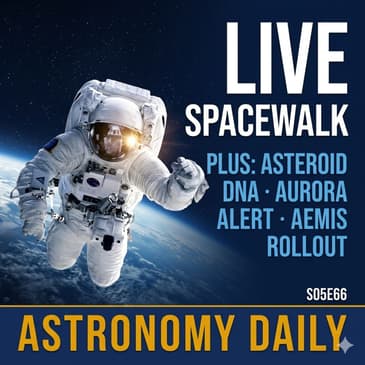
Right now as we record this, two NASA astronauts are floating outside the International Space Station two hundred and fifty miles above your head, rewiring the station's power grid in the vacuum of space. We've got the full story, plus asteroid DNA, a solar storm heading our way tomorrow night, a moon rocket on the move, and Blue Origins plan to defend Earth from killer space rocks. It's Wednesday, the eighteenth of March twenty twenty six. This is Astronomy Daily. Hello, and welcome to Astronomy Daily. You're daily briefing on everything happening in the cosmos and closer to home. I'm Avery and I'm Anna. We are deep into a week that feels like the universe is trying to grab our attention all at once, and honestly, we're here for it. Genuinely. Every story today has something remarkable about it, so let's get straight into it. Story number one, and it is happening right now. At around eight o'clock this morning Eastern time, NASA astronauts Jessica Meir and Chris Williams stepped out of the International Space Station's Quest airlock and into open space, beginning US spacewalk number ninety four. This one was a long time coming, Anna. It was originally scheduled for January the eighth, back when a different crew was meant to suit up. But then something extraordinary happened. The first ever medical evacuation from the International Space Station forced the early departure of the crew eleven mission, and everything was reshoveled. Right, And this is why the EVA you're hearing about today, right now as you listen to this episode is the very first spacewalk of twenty twenty six, the two hundred and seventy eighth spacewalk in support of Space station assembly, maintenance, and upgrades since construction began. Meer and Williams are out there preparing the station's to a power channel for future installation of another rollout solar array, the seventh of its kind. These IROSA arrays, as they're called, are like accordion style solar panels that unfurl once installed, and they've been systematically boosting the station's power generation capacity. For Jessica Miir, this is her fourth spacewalk. For Chris Williams, it is his first, and what a debut. Six and a half hours in vacuum, installing a modification kit and routing cables on the port side of the station. A second spacewalk, EVA ninety five is already planned to prep a different power channel, the three B, for yet another future solar array installation. That one is tentatively set for April first, which, yes, is also the day Artemis two is scheduled to launch. April Fool's Day is going to be a very busy day in space. If you want to watch the spacewalk or watch the replay, depending on when you're listening, NASA covered it live on Nasaplus, Amazon Prime, and YouTube starting at six thirty am Eastern. Worth a look. Story two is a genuine jaw dropper, and I want to give it the space it deserves. So. Scientists have now confirmed that samples collected from the asteroid Reugu contain all five canonical nucleobases, the molecular building blocks of DNA and RNA, all five adenine, guanine, cytozine, thymine, and uracill. For listeners who want the slightly deeper version. Nucleobases are the chemical letters that encode genetic information. DNA uses four of them. Adenine, guanine, cytizine, and thymine RNA swaps in uracill for thymine. Every living thing on Earth, every bacterium, every plant, every animal, every human being uses these five molecules as the foundation of their genetic code. And we just found all of them on a rock that has been hurtling through space since before the Earth existed. Samples were brought back to Earth in twenty twenty by Japan's Hyabusa two mission, a spacecraft that flew three hundred million kilometers to asteroid Reyugo, landed on it, fired a small projectile to kick up material, collected the debris, and flew home. The total hal was about five point four grams of pristine asteroid material that's barely more than a teaspoon, and. From that tiny sample, just about twenty milligrams. For this study, researchers at Japan's jam Stack Agency, led by biochemist Toshiki Koga, extracted and identified all five nucleobases, published this week in the journal Nature Astronomy. Now, the researchers are careful to say, and this is important, the presence of these molecules does not mean life existed on Reyugu. What it does mean is that the rock chemical ingredients for life can form in space without any biology involved at all, and can be preserved inside asteroids for billion of years. And here's where it gets really interesting for the big picture. For Yugo is a carbon rich asteroid, a C type, and they found all five nucleobases in roughly equal amounts. That's a different ratio to what's been found in the Murchison meteorites which fell in Australia in nineteen sixty nine, and different again from the asteroid Benu, samples of which were returned by NASA's Osiris REX mission. Those differences actually reflected different chemical histories of each space rock, different environments, different temperatures, different amounts of water and ammonia they were exposed to billions of years ago. But here's the headline. We now have pristine samples from two different asterites, Ryugu and Benu, both showing the presence of life's key molecular ingredients. That strongly suggests these molecules are widespread across the Solar System, and that raises a profound question. Did the these molecules rain down on early Earth via asteroid impacts and help kickstarred life here. The panspermia hypothesis, the idea that the building blocks of life, or even life itself can travel between worlds, gets a little more evidence every time we go looking, and stories like this one remind me why sample return missions are so extraordinarily valuable. Story three. If you are anywhere in the northern hemisphere and quite a few in the South, listen up because you might want to set an alarm for tomorrow night. On March sixteenth, active region AR four three ninety two on the Sun erupted with an M two point seven class solar flare, that's the moderately strong flare, and it hurled a coronal mass ejection or CME directly towards Earth. Noah Space Weather Prediction Center has issued a G two moderate geomagnetic storm watch from March nineteenth, with a chance the conditions could ramp up to G three, which is classified as strong. G two conditions can push Aurora displays to latitudes as far south as New York, the Upper Midwest, and similar latitudes in Europe and Asia. D three, if it materializes, could extend those sightings even further south, possibly as far as Illinois. And the timing here is really interesting from a science perspective. The CME is expected to arrive on March nineteenth, which is essentially the vernal equinox, and that matters because of something called the Russell mcpheerin. Effect, named after geophysicists Christopher Russell and Robert mcphern, who first described it in nineteen seventy three. Around the equinoxes, Earth's orientation in space puts its magnetic field at a right angle to the incoming solar wind. That geometry makes it much easier for charged particles from a CME to punch through our magnetosphere, so even a relatively modest storm can use far more spectacular auroras than you might expect. Basically, March and September are statistically the best months of the year to see the northern lights, and we have a CME arriving right at the equinox. Aurora chasers call it Aurora season, and this year it's living up to the name. The peak activity is expected overnight on the nineteenth, so the evening of Thursday the nineteenth into the early hours of Friday the twentieth, get yourself somewhere dark away from city lights. Check the aurora forecast apps, Space Weather Live my Aurora forecast, and keep an eye on the KP index. If it's climbing toward five or above, go outside and look north. And remember, Aurora displays depend on the orientation of the CME's magnetic field when it actually arrives, which is notoriously hard to predict until it's almost at Earth. The forecast could change, but right now the signs look promising. Four and this one is another one that's genuinely unfolding as we speak. The Artemis to Moon rocket, the massive space launch system carrying the Orion spacecraft and its four person crew, is about to roll back out to launch Pad thirty nine B at Kennedy's Space Center in Florida. And I say about two because the exact timing is being decided today. As of the latest update from NASA, engineers finish their close out work faster than expected, and as of this recording, they're deciding whether the rollout happens as early as tomorrow, Thursday the nineteenth, or Friday the twentieth. Either way, it's happening this week. Here's the backstory. The rocket first rolled out to the pad back in January, but two wet dress rehearsals. Those are full fueling simulations. Uncovered issues, including a liquid hydrogen leak and then a helium flow problem. The rocket rolled back into the vehicle assembly building in late February for engineers replace a dislodged seal in the helium system, fitted new flight termination batteries, replaced a seal on the core stage liquid oxygen feed line, and just recently replace an electrical harness in the flight termination system. No further wet dress rehearsals are planned. The next time the rocket is fueled, it'll be for the real thing. DASA is targeting April first for launch. They have windows running from April first through to the sixth, with additional dates later in the month if needed. The crew is Commander Reed Wiseman, pilot Victor Glover, and mission specialists Christina Koch and Jeremy Hansen of the Canadian Space Agency. If this launch goes ahead as planned, Glover becomes the first person of color to reach deep space, Kach becomes the first woman, and Hanson becomes the first non American citizen. It will be the first human mission to the vicinity of the Moon since Apollo seventeen. In dis December of nineteen seventy two, over fifty years ago. The mission itself is a ten day free return trajectory around the Moon and back, no lunar orbit, no landing, but they will travel farther from Earth than any human being has ever, passing roughly five thousand miles beyond the Moon, and it sets the stage for everything that comes after. This is the moment the whole Artemis program has been building toward the rollout. Whenever it happens in the next day or two, will be life streamed by NASA and takes about twelve hours, with the rocket traveling four miles to the pad at about one mile per hour, slow and steady. And story five a look at what Blue Origin has been quietly working on in the asteroid defense. Space def Bezos's space company has partnered with NASA's Jet Propulsion Laboratory and the California Institute of Technology to develop a mission concept called Neo Hunter Near Earth Object Hunter. The goal build a spacecraft capable of detecting, characterizing, and deflecting potentially dangerous asteroids before they become a problem. The platform they're proposing to use is Blue Ring Blue Origins modular spacecraft bus that can carry up to four thousand kilograms of payload across as many as thirteen connection ports. It's designed to operate anywhere from low Earth orbit all the way out to deep space destinations, including Mars. Meal Hunter works in two phases. Phase one, the spacecraft deploys a swarm of cube SATs to rendezvous with a potentially hazardous asteroid and characterize it, measuring its mass, density, composition, and precise trajectory. That information is critical because the right deflection technique depends entirely on what the asteroid is made of and how fast it's moving. If the asteroid is manageable, Phase one also deploys an ion beam emitter. This is fascinating. The spacecraft fires a concentrated stream of charged particles directly onto the asteroid's surface. The force of those particles over time is enough to nudge the asteroid onto a slightly different path. It's extraordinarily precise, it's non destructive, and if you have enough warning time, it works. But if the asteroid is too large or moving too fast for the ion beam to be effective, Neo Hunter switches to phase two, what Blue Origin calls robust kinetic disruption. The spacecraft simply crashes into the asteroid at up to twenty two thousand, six hundred miles per hour. Before doing so, it releases a smaller dedicated camera satellite, which they brilliantly named the Slamcam, to document the impact and confirm mission success. The slam Cam. I love that name. It's very honest marketing. This is, of course, the same basic approach NASA's Dart mission demonstration in September twenty twenty two, when it successfully changed the orbit of the asteroid moonlit dimorphous Dart proved the concept works. Neo Hunter would be a more sophisticated, multitool version. Of that, and it's worth noting planetary defense is getting increasing attention right now. The asteroid twenty twenty four YR four grabbed headlines earlier this year when it briefly appeared on NASA's impact risk list before being ruled out. Asteroids fly past Earth uncomfortably close more often than most people realize. Having a commercial platform capable of rapid response is genuinely valuable, and smart. Blue Origin described it as another example of how commercial platforms like Blue Ring can conduct a low cost, high priority science exploration and planetary Defense missions. No launch day has been announced yet, but the concept has been developed with JPL, which gives it serious scientific credibility. And that is a wrap on today's Astronomy Daily. What a lineup, a live spacewalk, the molecular ingredients of life found on an asteroid, a solar storm and root, a moon rocket preparing to roll, and a spacecraft that may one day save the world. Just the normal Wednesday. Really, if you're heading outside tomorrow night to look for the Aurora, we want to hear about it. Find us on socials everywhere as astro Daily pod and share your photos. We'd love to see them. And if you've enjoyed today's episode, please subscribe wherever you get your podcasts, leave us a review, and share us with a friend who thinks space is cool, which, let's be honest, should be everyone. Astronomy Daily is part of the bytes dot com podcast network. Find full show notes, transcripts and links at Astronomy Daily dot io. From Anna and Avery, Clear Skies and we'll see you tomorrow Sunday. Start the Store has The Soul Store has ConTroll