

Become a supporter of this podcast: https://www.spreaker.com/podcast/astronomy-daily-latest-space-news--5648921/support.
Sponsor Details:
Ensure your online privacy by using NordVPN. To get our special listener deal and save a lot of money, visit www.astronomydaily.io/nordvpn. You'll be glad you did!
Get the best secure and private email on the planet. Stop your Government, google and who knows who else spying on every email you write. Do what we did and use ProtonMail. They beleive in privacy and there are no ads in their business model...yet they still provide a free forever service. Check them out and get out special deal at www.astronomydaily.io/protonmail
Become a supporter of Astronomy Daily by joining our Supporters Club. Commercial free episodes daily are only a click way... Click Here
This episode includes AI-generated content.
00:00:00 --> 00:00:03 Anna: Somewhere over the Arctic this afternoon, the
00:00:03 --> 00:00:06 sun is about to go out. Not for long,
00:00:06 --> 00:00:08 a couple of minutes at most. But for the
00:00:08 --> 00:00:11 first time on mainland Western Europe since
00:00:11 --> 00:00:12 1999.
00:00:13 --> 00:00:15 Avery: And here in the studio, it's the middle of a
00:00:15 --> 00:00:17 Sydney afternoon. So we're gonna watch it the
00:00:17 --> 00:00:20 way most of you will on a screen in the small
00:00:20 --> 00:00:21 hours, wide eyed.
00:00:21 --> 00:00:23 Welcome to Astronomy AstroDailyPod. I'm
00:00:23 --> 00:00:24 Avery.
00:00:24 --> 00:00:27 Anna: And I'm anna. It's Wednesday 12th
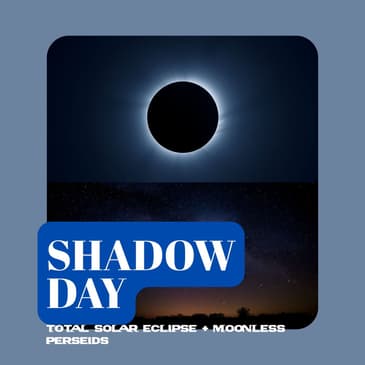
00:00:27 --> 00:00:29 August. Today, the only total
00:00:29 --> 00:00:32 solar eclipse of the how to catch it
00:00:32 --> 00:00:35 wherever you are, a NASA jet that chases
00:00:35 --> 00:00:38 the shadow. A magnetic field caught in the
00:00:38 --> 00:00:41 act of building a star. Why some
00:00:41 --> 00:00:44 worlds cook themselves alive. And
00:00:44 --> 00:00:46 tonight, a moonless meteor shower. Let's
00:00:46 --> 00:00:49 go. If you only clock one thing in the
00:00:49 --> 00:00:52 sky this year, it's happening in the next few
00:00:52 --> 00:00:55 hours. Today the moon's shadow falls
00:00:55 --> 00:00:58 across the far north of the planet and gives
00:00:58 --> 00:01:00 a lucky narrow strip of the world a total
00:01:01 --> 00:01:03 solar eclipse. The only one of
00:01:03 --> 00:01:04 2026.
00:01:05 --> 00:01:07 Avery: Give us the geography because this is a
00:01:07 --> 00:01:09 strange one. It doesn't run the usual way.
00:01:09 --> 00:01:12 Anna: It doesn't. Most totalities race
00:01:12 --> 00:01:15 roughly west to east. This one arcs
00:01:15 --> 00:01:18 up and over the pole. It begins at
00:01:18 --> 00:01:20 sunrise over the Taymyr Peninsula in
00:01:20 --> 00:01:23 Arctic Russia, sweeps across the top of the
00:01:23 --> 00:01:26 world and down the eastern side of Greenland,
00:01:26 --> 00:01:29 crosses western Iceland, Reykjavik included,
00:01:30 --> 00:01:32 then runs out over the North Atlantic, clips
00:01:32 --> 00:01:35 a tiny corner of northeastern Portugal and
00:01:35 --> 00:01:38 finishes by crossing northern Spain from
00:01:38 --> 00:01:41 Galicia to the Mediterranean, ending near the
00:01:41 --> 00:01:43 Balearics right at sunset.
00:01:43 --> 00:01:46 Avery: And um, this is a big deal specifically for
00:01:46 --> 00:01:46 Europe.
00:01:46 --> 00:01:49 Anna: A uh, huge deal. It's the first total
00:01:49 --> 00:01:52 solar eclipse over western Mainland Europe
00:01:52 --> 00:01:54 since 11 August
00:01:54 --> 00:01:57 1999, 27 years almost
00:01:57 --> 00:02:00 to the day. For Spain it's the first
00:02:00 --> 00:02:02 since 1905, for Iceland the
00:02:02 --> 00:02:05 first since 1954. People have
00:02:05 --> 00:02:07 booked these spots years out.
00:02:08 --> 00:02:10 Avery: So if I'm standing in the path, what do I
00:02:10 --> 00:02:11 actually get?
00:02:11 --> 00:02:14 Anna: Not long, but unforgettable. Maximum
00:02:14 --> 00:02:17 totality is about 2 minutes and 18
00:02:17 --> 00:02:19 seconds out over the Atlantic near the
00:02:19 --> 00:02:22 centerline. On land it's shorter. In
00:02:22 --> 00:02:24 Reykjavik, totality lands around
00:02:24 --> 00:02:27 17:48 Universal Time. That's
00:02:27 --> 00:02:30 just before six in the evening local and
00:02:30 --> 00:02:32 gives you a bit over a minute. Out on the
00:02:32 --> 00:02:35 Iceland's Snaefelsnes peninsula you do better
00:02:36 --> 00:02:38 then over in northern Spain, totality
00:02:38 --> 00:02:41 falls around 18:27 to
00:02:41 --> 00:02:44 18:33 UT that's
00:02:44 --> 00:02:46 8:27 to 8:33 in the evening,
00:02:46 --> 00:02:48 local evening.
00:02:48 --> 00:02:51 Avery: So the sun's getting low, very low.
00:02:51 --> 00:02:54 Anna: That's the catch. In Spain, the sun sits only
00:02:54 --> 00:02:57 about 10 degrees up on the north coast and
00:02:57 --> 00:03:00 as little as 4 degrees near the Balearic
00:03:00 --> 00:03:03 Sea. Gorgeous if you've got a clean horizon.
00:03:03 --> 00:03:06 But a hill, a forest, a building and you
00:03:06 --> 00:03:08 miss it. And the weather split is almost
00:03:08 --> 00:03:11 poetic. Iceland is climatologically
00:03:11 --> 00:03:14 the cloudier bet, Spain, the sunnier one.
00:03:14 --> 00:03:17 But Spain makes you pay with that low sun.
00:03:17 --> 00:03:19 Avery: Okay, now the part most of our audience
00:03:19 --> 00:03:21 needs, because most of us are nowhere near
00:03:21 --> 00:03:24 that strip, start with North America, our
00:03:24 --> 00:03:24 biggest audience.
00:03:25 --> 00:03:27 Anna: North America gets a genuine partial this
00:03:27 --> 00:03:30 afternoon. No totality anywhere on the
00:03:30 --> 00:03:33 continent, but a real bite out of the sun.
00:03:33 --> 00:03:36 And the further northeast you are, the bigger
00:03:36 --> 00:03:38 the bite. Eastern Canada does best.
00:03:38 --> 00:03:41 Nova Scotia sees around a third of the sun
00:03:41 --> 00:03:44 covered, about 33%. Northern
00:03:44 --> 00:03:47 Maine gets close to 28. Montreal
00:03:47 --> 00:03:50 about 18. Boston around 16,
00:03:50 --> 00:03:53 peaking near 155 in the afternoon
00:03:53 --> 00:03:55 Eastern time. New York around 9 or
00:03:55 --> 00:03:58 10% about 1:54. Eastern
00:03:58 --> 00:04:01 Toronto about 8, Washington D.C.
00:04:01 --> 00:04:04 about 10. And Alaska gets a lovely
00:04:04 --> 00:04:06 one in the morning. Fairbanks around
00:04:07 --> 00:04:08 37%.
00:04:08 --> 00:04:10 Avery: And um, crucially, that's a partial. So the
00:04:10 --> 00:04:11 rules are different.
00:04:12 --> 00:04:14 Anna: Completely different. And I'll say it
00:04:14 --> 00:04:17 plainly, if you're seeing a partial, the sun
00:04:17 --> 00:04:20 is never fully covered, so you must keep
00:04:20 --> 00:04:23 certified eclipse glasses on the entire
00:04:23 --> 00:04:25 time. We'll do the full safety line at the
00:04:25 --> 00:04:27 end, but that's the headline for North
00:04:27 --> 00:04:30 America. Glasses on, start to finish.
00:04:30 --> 00:04:33 Avery: Europe, outside the path, a deep partial
00:04:33 --> 00:04:36 Anna: low in the evening sky. London around
00:04:36 --> 00:04:39 91% covered. Paris, about
00:04:39 --> 00:04:41 92. Berlin 85.
00:04:41 --> 00:04:44 Vienna 87. Dramatic, but
00:04:44 --> 00:04:47 again, partial. So eye protection throughout.
00:04:47 --> 00:04:50 Avery: And then there's us, the Southern Hemisphere,
00:04:50 --> 00:04:51 Australia, New Zealand.
00:04:52 --> 00:04:54 Anna: Be honest with them straight up, we see
00:04:54 --> 00:04:57 nothing of this one directly, not a
00:04:57 --> 00:04:59 sliver. It's an entirely northern
00:04:59 --> 00:05:02 hemisphere event. But, and this is the good
00:05:02 --> 00:05:05 news, you can absolutely watch it live.
00:05:05 --> 00:05:08 NASA time and date and the exploratorium
00:05:08 --> 00:05:10 are all streaming from the path, including
00:05:10 --> 00:05:13 telescope feeds out of Spain in Australian
00:05:13 --> 00:05:16 Eastern time. That coverage runs roughly
00:05:16 --> 00:05:19 half past one to six in the morning Thursday,
00:05:19 --> 00:05:21 with the totality highlights landing
00:05:21 --> 00:05:24 somewhere around three to half past 4m am
00:05:24 --> 00:05:27 AEST, set an alarm, make a
00:05:27 --> 00:05:30 coffee and you'll see the corona in real
00:05:30 --> 00:05:30 time.
00:05:30 --> 00:05:33 Avery: That corona being the whole reason people
00:05:33 --> 00:05:33 chase these.
00:05:34 --> 00:05:37 Anna: That's it for those two minutes. The moon
00:05:37 --> 00:05:39 blocks the blinding disc of the sun and
00:05:39 --> 00:05:42 reveals the corona, the faint, pearly
00:05:42 --> 00:05:45 outer atmosphere we almost never get to see.
00:05:45 --> 00:05:48 It's not just beautiful, it's scientifically
00:05:48 --> 00:05:51 precious. Which, nice segue, is
00:05:51 --> 00:05:54 exactly why NASA is about to chase this
00:05:54 --> 00:05:55 shadow in a jet.
00:05:55 --> 00:05:58 Avery: So while millions look up One NASA team
00:05:58 --> 00:06:01 is going to look sideways at, uh, nearly
00:06:01 --> 00:06:03 50ft. As the eclipse
00:06:03 --> 00:06:06 crosses today, a NASA WB57
00:06:06 --> 00:06:09 high altitude jet will fly along the
00:06:09 --> 00:06:12 path and literally chase the Moon's shadow.
00:06:12 --> 00:06:15 Anna: Why fly it rather than just stand still like
00:06:15 --> 00:06:16 the rest of us?
00:06:16 --> 00:06:18 Avery: Because if you move with the shadow, you
00:06:18 --> 00:06:21 stretch out your totality from the ground.
00:06:21 --> 00:06:23 You get a couple of minutes from that jet.
00:06:23 --> 00:06:26 Cruising at around 740 kilometres
00:06:26 --> 00:06:29 an hour, the team extends your view of
00:06:29 --> 00:06:32 totality to nearly three. In the nose
00:06:32 --> 00:06:34 cone sit four cameras, visible and
00:06:34 --> 00:06:37 infrared, shooting at least 20 frames a
00:06:37 --> 00:06:40 second. The instrument's got a great name.
00:06:40 --> 00:06:43 Sci fi, scientifically calibrated in
00:06:43 --> 00:06:43 flight imagery
00:06:44 --> 00:06:45 Anna: and the science thereafter.
00:06:46 --> 00:06:49 Avery: The corona's biggest riddles. One,
00:06:49 --> 00:06:51 how the corona gets heated to something like
00:06:51 --> 00:06:54 a million degrees when the surface below it
00:06:54 --> 00:06:56 is a mere 5 thousand.
00:06:57 --> 00:06:59 Two, how those great looping prominences
00:06:59 --> 00:07:02 form and hang suspended above the sun. And
00:07:02 --> 00:07:05 three, how material in the corona feeds into
00:07:05 --> 00:07:07 the solar wind that washes over all of us.
00:07:08 --> 00:07:11 The printable investigator is Amir Caspi at
00:07:11 --> 00:07:13 the Southwest Research Institute in Boulder.
00:07:13 --> 00:07:16 And his line is lovely. The sun is always
00:07:16 --> 00:07:18 changing. Every eclipse is different. So we
00:07:18 --> 00:07:21 might see something we've never seen before.
00:07:21 --> 00:07:23 Anna: And a, uh, total eclipse gives them something
00:07:24 --> 00:07:25 no spacecraft can.
00:07:25 --> 00:07:28 Avery: Right, exactly. And this is the clever
00:07:28 --> 00:07:31 bit. Space telescopes block the sun's disc
00:07:31 --> 00:07:33 with a little occulting disc called a
00:07:33 --> 00:07:35 coronagraph. But that also hides the inner
00:07:35 --> 00:07:38 corona closest to the surface, the very
00:07:38 --> 00:07:41 region where the heating happens. A, uh, real
00:07:41 --> 00:07:43 eclipse with the moon as a perfect occulture
00:07:44 --> 00:07:46 hands you that inner corona for free,
00:07:46 --> 00:07:48 frying above the clouds. And most of the
00:07:48 --> 00:07:50 water vapour also opens up infrared
00:07:50 --> 00:07:52 wavelengths you can't get from the ground.
00:07:53 --> 00:07:56 These same cameras flew the 2024 eclipse over
00:07:56 --> 00:07:58 North America. The team fixed some
00:07:58 --> 00:08:00 overexposed frames and sped up the Software
00:08:00 --> 00:08:03 so the 2026 data should come back sharper
00:08:03 --> 00:08:04 and faster.
00:08:05 --> 00:08:07 Anna: And it's not just the jet, there's a whole
00:08:07 --> 00:08:08 balloon army.
00:08:08 --> 00:08:11 Avery: There is the NASA supported
00:08:11 --> 00:08:14 nationwide Eclipse Balloon Beijing project
00:08:14 --> 00:08:16 led by Angela Dejardins at Montana State
00:08:16 --> 00:08:19 University is sending students from US
00:08:19 --> 00:08:22 Icelandic and Spanish universities to
00:08:22 --> 00:08:24 launch scientific balloons, around
00:08:25 --> 00:08:27 86 of them from Iceland and Spain.
00:08:27 --> 00:08:30 Before, during and after the eclipse.
00:08:30 --> 00:08:32 They're measuring what happens to the
00:08:32 --> 00:08:34 atmosphere when day suddenly turns to
00:08:34 --> 00:08:37 dusk. The ozone and the so called boundary
00:08:37 --> 00:08:40 layer near the ground that shifts with
00:08:40 --> 00:08:42 temperature and moisture. As NASA's Eclipse
00:08:42 --> 00:08:45 Programme Manager Kelly Couric put it, an
00:08:45 --> 00:08:48 eclipse gives us a vantage point on the sun
00:08:48 --> 00:08:50 we can't get anywhere else in the solar
00:08:50 --> 00:08:53 system. And today, students get to grab
00:08:53 --> 00:08:53 it.
00:08:53 --> 00:08:56 Anna: From the Sun's outer atmosphere to the birth
00:08:56 --> 00:08:59 of a star entirely. And a 30 year old
00:08:59 --> 00:09:02 mystery just got solved. Using the Alma
00:09:02 --> 00:09:04 array in Chile, astronomers have captured the
00:09:04 --> 00:09:07 first direct high resolution image of a
00:09:07 --> 00:09:10 magnetic field wrapped tightly around the jet
00:09:10 --> 00:09:12 streaming out of a still forming star.
00:09:12 --> 00:09:14 Avery: Paint the picture. What does it actually look
00:09:14 --> 00:09:15 like?
00:09:15 --> 00:09:18 Anna: Picture a twisted funnel shaped field, a
00:09:18 --> 00:09:21 corkscrew of magnetism sheathing the gas
00:09:21 --> 00:09:23 that's blasting away from the young star. The
00:09:23 --> 00:09:26 target is a mouthful. NGC
00:09:26 --> 00:09:28 1333 IRS 4A,
00:09:29 --> 00:09:31 a young double star system tucked inside the
00:09:31 --> 00:09:34 Perseus molecular cloud about 960
00:09:34 --> 00:09:37 light years away. And seeing that field wound
00:09:37 --> 00:09:40 around the outflow confirms a prediction
00:09:40 --> 00:09:42 theorists have been making for decades about
00:09:42 --> 00:09:44 how these jets are launched and shaped.
00:09:45 --> 00:09:47 Avery: Why does a baby star even need a jet?
00:09:48 --> 00:09:51 Anna: Beautiful question. It's a survival trick.
00:09:51 --> 00:09:54 As a star gathers material, it also gathers
00:09:54 --> 00:09:56 spin. Too much spin and it would tear itself
00:09:56 --> 00:09:59 apart before it ever finished forming. The
00:09:59 --> 00:10:01 magnetic field and the jet act like a release
00:10:01 --> 00:10:04 valve M they carry away excess material and
00:10:04 --> 00:10:07 angular momentum so the star can keep growing
00:10:07 --> 00:10:10 rather than spinning itself to pieces. This
00:10:10 --> 00:10:12 image shows the mechanism doing its job.
00:10:12 --> 00:10:15 Avery: And there's a bigger echo here, isn't there?
00:10:15 --> 00:10:18 Anna: There is, and this is the part I love. The
00:10:18 --> 00:10:20 same basic physics. A magnetic field
00:10:20 --> 00:10:23 channelling a jet is thought to play out at
00:10:23 --> 00:10:25 wildly different scales across the universe.
00:10:25 --> 00:10:28 From a newborn star like this one, all the
00:10:28 --> 00:10:31 way up to supermassive black holes that fire
00:10:31 --> 00:10:34 jets across entire galaxies. Same
00:10:34 --> 00:10:36 trick, unimaginably different sizes.
00:10:37 --> 00:10:39 The work is led by Tao Chung Ching, a former
00:10:39 --> 00:10:42 Jansky Fellow at the US National Radio
00:10:42 --> 00:10:44 Observatory. Published in Nature
00:10:44 --> 00:10:46 Communications and a small point of pride for
00:10:46 --> 00:10:49 our part of the sky. ALMA sits high in the
00:10:49 --> 00:10:52 Atacama in Chile, very much a Southern
00:10:52 --> 00:10:53 Hemisphere machine.
00:10:53 --> 00:10:55 Avery: Here's a question that sounds simple and
00:10:55 --> 00:10:58 absolutely isn't. Why did Venus,
00:10:58 --> 00:11:00 Earth's twin in size, turn into a furnace
00:11:00 --> 00:11:03 while Earth stayed livable? A planetary
00:11:03 --> 00:11:05 scientist at UC Riverside, Stephen Kane,
00:11:05 --> 00:11:07 thinks a big part of the answer might be
00:11:07 --> 00:11:10 something we routinely overlook. How fast a
00:11:10 --> 00:11:13 planet spins then really,
00:11:13 --> 00:11:15 Anna: why would rotation decide whether a world is
00:11:15 --> 00:11:16 hospitable?
00:11:17 --> 00:11:19 Avery: Because rotation sets how a star's heat gets
00:11:19 --> 00:11:22 spread around a planet. It shapes the winds,
00:11:22 --> 00:11:24 the weather, the way an atmosphere and any
00:11:24 --> 00:11:26 ocean circulate. Earth's roughly 24
00:11:26 --> 00:11:29 hour day keeps the energy moving and the
00:11:29 --> 00:11:31 climate regulated. Spin a world down slow
00:11:31 --> 00:11:34 enough, Kane argues, and you may tip it
00:11:34 --> 00:11:36 toward a runaway greenhouse. Heat pours in,
00:11:36 --> 00:11:38 can't escape, and you end up with Venus, a
00:11:38 --> 00:11:41 uh, crushing atmosphere and a surface hot
00:11:41 --> 00:11:42 enough to melt lead.
00:11:42 --> 00:11:45 Anna: So to test that on other planets, we just
00:11:45 --> 00:11:46 measure how fast they spin.
00:11:47 --> 00:11:49 Avery: That's the rub. It's genuinely hard. In a
00:11:49 --> 00:11:51 paper accepted by the Astronomical Journal,
00:11:51 --> 00:11:54 Kane warns that when you look at a distant
00:11:54 --> 00:11:56 planet, the motion you detect might be its
00:11:56 --> 00:11:59 howling winds, not the solid body underneath.
00:11:59 --> 00:12:02 Exactly the confusion Venus throws at us. The
00:12:02 --> 00:12:04 proposed fix is to observe at several
00:12:04 --> 00:12:06 wavelengths that probe different depths of
00:12:06 --> 00:12:09 the atmosphere and separate the true spin
00:12:09 --> 00:12:09 from the wind.
00:12:10 --> 00:12:11 Anna: And there's a mission coming that could
00:12:11 --> 00:12:13 actually run this experiment at scale.
00:12:14 --> 00:12:17 Avery: There is ESA's Plato, due to launch in
00:12:17 --> 00:12:19 March 2027. It's built to find and
00:12:19 --> 00:12:22 monitor lots of planets. And Cain reckons it
00:12:22 --> 00:12:24 could turn up hundreds of Venus like worlds
00:12:24 --> 00:12:27 if they're all slow rotators. That's a strong
00:12:27 --> 00:12:29 hint that spin really is a switch between a
00:12:29 --> 00:12:32 living world and a hellish one. If they're
00:12:32 --> 00:12:34 all over the place, we look elsewhere. Either
00:12:34 --> 00:12:36 way, a uh, lovely testable idea.
00:12:36 --> 00:12:38 Anna: And the sky isn't done with us today.
00:12:39 --> 00:12:41 Tonight, the night of the 12th into the 13th,
00:12:41 --> 00:12:44 the Perseid meteor shower hits its peak.
00:12:44 --> 00:12:47 And here's the gift. It's genuinely moonless
00:12:47 --> 00:12:49 because the same new moon that's giving the
00:12:49 --> 00:12:52 north its eclipse leaves our meteor sky pitch
00:12:52 --> 00:12:55 dark. These are the best Perseid conditions
00:12:55 --> 00:12:58 in years. Best window between
00:12:58 --> 00:13:01 midnight and dawn. And best of all in the pre
00:13:01 --> 00:13:04 dawn hours of the 13th when the radiant
00:13:04 --> 00:13:06 up in Perseus climbs highest. For the
00:13:06 --> 00:13:09 northern hemisphere, North America
00:13:09 --> 00:13:11 especially, this is your night. Get away
00:13:11 --> 00:13:14 from town lights, look up after midnight.
00:13:14 --> 00:13:17 Give your eyes 20 minutes and let them
00:13:17 --> 00:13:20 wander. No telescope, no glasses,
00:13:20 --> 00:13:22 just a dark sky and patience.
00:13:23 --> 00:13:25 Avery: And um, for those of us down south where
00:13:25 --> 00:13:26 Perseus barely gets off the
00:13:26 --> 00:13:29 Anna: floor, for Cygny and the southern
00:13:29 --> 00:13:32 hemisphere, the Perseus radiant only just
00:13:32 --> 00:13:35 scrapes the northern horizon, so you'll catch
00:13:35 --> 00:13:37 a trickle at best. Don't fret. The
00:13:37 --> 00:13:40 evening sky pays you back right after
00:13:40 --> 00:13:43 sunset. Venus is blazing low in the
00:13:43 --> 00:13:45 west, magnitude minus
00:13:45 --> 00:13:48 4.4, impossible to miss
00:13:48 --> 00:13:50 and just past its half lit
00:13:50 --> 00:13:53 dichotomy phase. If you've a telescope
00:13:53 --> 00:13:56 then before dawn there's a fine lineup of
00:13:56 --> 00:13:59 planets strung across the eastern sky.
00:13:59 --> 00:14:02 And Comet 10P Tempel 2 is
00:14:02 --> 00:14:04 still a southern hemisphere favoured
00:14:04 --> 00:14:07 binocular Target 1 for our part of the world.
00:14:07 --> 00:14:10 Avery: And um, the eclipse times one more time for
00:14:10 --> 00:14:10 everyone.
00:14:11 --> 00:14:14 Anna: For North America it's an afternoon. Partial
00:14:14 --> 00:14:16 Boston peaking about 1:55,
00:14:17 --> 00:14:20 New York about 1:54 Eastern Time.
00:14:20 --> 00:14:23 Glasses on throughout. For Australia and
00:14:23 --> 00:14:25 the wider southern hemisphere it's the live
00:14:25 --> 00:14:28 streams roughly half 1 to 6 in the
00:14:28 --> 00:14:31 morning AEST Thursday with
00:14:31 --> 00:14:34 totality around 3 to half 4am M
00:14:34 --> 00:14:34 Thursday.
00:14:35 --> 00:14:37 And that brings us to the line we never
00:14:38 --> 00:14:41 never look at a partly eclipsed sun without
00:14:41 --> 00:14:44 proper protection. Use eclipse glasses
00:14:44 --> 00:14:47 or a handheld solar viewer that meet the
00:14:47 --> 00:14:48 ISO
00:14:48 --> 00:14:51
00:14:51 --> 00:14:53 standard. Ordinary sunglasses are not
00:14:53 --> 00:14:56 safe and neither is an unfiltered camera
00:14:57 --> 00:15:00 phone, binocular or telescope. If
00:15:00 --> 00:15:02 you're in the path of totality, you may look
00:15:02 --> 00:15:05 with the naked eye only during those brief
00:15:05 --> 00:15:07 seconds when the sun is complet completely
00:15:07 --> 00:15:10 covered and glasses go straight back on the
00:15:10 --> 00:15:13 instant the bright edge returns not in the
00:15:13 --> 00:15:15 path, then it's a partial the whole time.
00:15:16 --> 00:15:18 Protection stays on from start to finish.
00:15:19 --> 00:15:22 Avery: Whatever you catch today a uh, partial, a
00:15:22 --> 00:15:24 stream or the meteors tonight, tell us about
00:15:24 --> 00:15:27 it. Everything lives at astronomydaily
00:15:27 --> 00:15:30 IO the back catalogue, the daily news
00:15:30 --> 00:15:33 feed, the newsletter, and a spot to leave a
00:15:33 --> 00:15:35 review or drop us a line. We're at Astral
00:15:35 --> 00:15:37 AstroDailyPod Pod everywhere.
00:15:37 --> 00:15:40 Anna: We'll be back tomorrow to tell you how Shadow
00:15:40 --> 00:15:43 Day went, the images, the science, and
00:15:43 --> 00:15:46 whatever the sun decided to show us. Until
00:15:46 --> 00:15:48 then, from Avery and from Anna.
00:15:49 --> 00:15:50 Avery: Enjoy the eclipse.
00:15:50 --> 00:15:53 Anna: Mind your eyes and clear skies.