
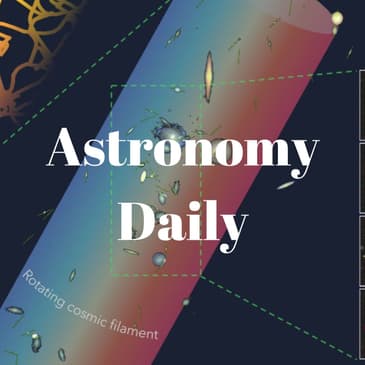

- Discovery of a Cosmic Filament: Astronomers have uncovered a remarkable string of 14 galaxies spinning in unison within a colossal cosmic filament, a structure that is about 50 million light years long and rotates at an astounding 110 kilometers per second. This discovery reveals the profound influence of cosmic structures on galaxy formation.
- China's Earth 2.0 Initiative: The China National Space Agency has unveiled ambitious plans for their upcoming missions aimed at exploring Earth-like planets. These missions include a radio astronomy experiment on the Moon's far side, a solar observatory, a space telescope for studying black holes, and an exoplanet-hunting satellite, positioning China at the forefront of space exploration.
- International Space Station Leadership Change: Expedition 73 is transitioning to Expedition 74, with veteran cosmonaut Sergey Rysakov handing over command to NASA's Mike Finke. This change comes as the crew prepares for their return to Earth, while scientific research aboard the ISS continues unabated.
- Mayonnaise Research in Space: Scientists are studying mayonnaise aboard the ISS to understand soft matter dynamics in microgravity. This research could reshape our understanding of materials and their applications on Earth, revealing that gravity significantly impacts the internal structures of these substances.
- NASA's Punch Mission and Comet Swann: NASA's Punch mission has released a breathtaking 40-day timelapse of Comet Swann, showcasing its stunning bluish-green coma and glowing tail. The footage also features an unexpected appearance by the interstellar visitor 3i Atlas, making for a spectacular cosmic event.
- NASA's Emmy Win: NASA has been awarded an Emmy for their production of the total solar eclipse broadcast from April 8, 2024. This monumental effort garnered nearly 40 million views and was recognized for its excellence in production technology, showcasing the agency's commitment to bringing celestial wonders to the public.
- For more cosmic updates, visit our website at astronomydaily.io. Join our community on social media by searching for #AstroDailyPod on Facebook, X, YouTubeMusic, TikTok, and our new Instagram account! Don’t forget to subscribe to the podcast on Apple Podcasts, Spotify, iHeartRadio, or wherever you get your podcasts.
- Thank you for tuning in. This is Avery and Anna signing off. Until next time, keep looking up and exploring the wonders of our universe.
Cosmic Filament Discovery
[NASA](https://www.nasa.gov/)
China's Earth 2.0 Plans
[China National Space Agency](http://www.cnsa.gov.cn/)
ISS Expedition Updates
[NASA TV](https://www.nasa.gov/mission_pages/station/main/index.html)
Soft Matter Research
[Scientific Reports](https://www.nature.com/srep/)
Comet Swann Timelapse
[NASA Punch Mission](https://www.nasa.gov/punch)
NASA Emmy Award
[Academy of Television Arts and Sciences](https://www.emmys.com/)
Become a supporter of this podcast: https://www.spreaker.com/podcast/astronomy-daily-space-news-updates--5648921/support.
Sponsor Details:
Ensure your online privacy by using NordVPN. To get our special listener deal and save a lot of money, visit www.bitesz.com/nordvpn. You'll be glad you did!
Sponsor Details:
Ensure your online privacy by using NordVPN. To get our special listener deal and save a lot of money, visit www.astronomydaily.io/nordvpn. You'll be glad you did!
Get the best secure and private email on the planet. Stop your Government, google and who knows who else spying on every email you write. Do what we did and use ProtonMail. They beleive in privacy and there are no ads in their business model...yet they still provide a free forever service. Check them out and get out special deal at www.astronomydaily.io/protonmail
Become a supporter of Astronomy Daily by joining our Supporters Club. Commercial free episodes daily are only a click way... Click Here
This episode includes AI-generated content.
00:00:00 --> 00:00:02 Avery: Hello, and welcome to Astronomy Daily, the
00:00:02 --> 00:00:05 podcast that brings you the latest news from
00:00:05 --> 00:00:07 across the cosmos. I'm your host, Avery.
00:00:07 --> 00:00:10 Anna: And I'm Anna. It's great to be with you.
00:00:10 --> 00:00:13 We've got a busy show today. From the largest
00:00:13 --> 00:00:16 rotating structure ever observed to. Man is
00:00:16 --> 00:00:16 in space.
00:00:17 --> 00:00:19 Avery: That's right. We'll also be looking at
00:00:19 --> 00:00:22 China's ambitious plans to find Earth
00:00:22 --> 00:00:24 2.0, checking in on a commander
00:00:24 --> 00:00:27 swap at the International Space Station, and
00:00:27 --> 00:00:30 celebrating an Emmy win for NASA. So
00:00:30 --> 00:00:31 let's get started.
00:00:32 --> 00:00:34 Anna: First up, an incredible discovery that's
00:00:34 --> 00:00:37 being compared to a cosmic teacup ride.
00:00:37 --> 00:00:40 Astronomers have found a string of 14
00:00:40 --> 00:00:42 galaxies that are all spinning in the same
00:00:42 --> 00:00:44 direction as the massive structure they
00:00:44 --> 00:00:45 belong to.
00:00:45 --> 00:00:48 Avery: And this isn't just any structure. It's a
00:00:48 --> 00:00:51 cosmic filament. A gigantic thread
00:00:51 --> 00:00:54 like formation made of dark matter, galaxies
00:00:54 --> 00:00:56 and gas. They're the biggest things in the
00:00:56 --> 00:00:59 universe, forming a kind of cosmic web.
00:00:59 --> 00:01:02 Anna: Exactly. This particular filament is about
00:01:02 --> 00:01:05 50 million light years long and is rotating
00:01:05 --> 00:01:08 at a staggering velocity of 110
00:01:08 --> 00:01:09 kilometers per second.
00:01:09 --> 00:01:12 Avery: Wow, 110 kilometers per
00:01:12 --> 00:01:15 second. And the galaxies within it are
00:01:15 --> 00:01:16 spinning along with it.
00:01:16 --> 00:01:19 Anna: That's the amazing part. Researchers looked
00:01:19 --> 00:01:21 at a section of this filament about 140
00:01:21 --> 00:01:24 million light years away. They found these 14
00:01:24 --> 00:01:27 galaxies, all rich in hydrogen gas,
00:01:27 --> 00:01:29 moving in a way that suggests the whole
00:01:29 --> 00:01:32 structure is rotating. And more
00:01:32 --> 00:01:34 surprisingly, many of the galaxies themselves
00:01:34 --> 00:01:36 are spinning in the same direction as the
00:01:36 --> 00:01:37 filament.
00:01:37 --> 00:01:40 Avery: Right. The lead researcher, Lila Zhang,
00:01:40 --> 00:01:42 used a great analogy. She said it's like the
00:01:42 --> 00:01:44 teacups ride at a theme park.
00:01:44 --> 00:01:47 Anna: Mhm. Each galaxy is a spinning teacup
00:01:47 --> 00:01:49 and the whole platform, the cosmic filament,
00:01:49 --> 00:01:52 is rotating too. This dual motion
00:01:52 --> 00:01:55 gives us a rare insight into how galaxies get
00:01:55 --> 00:01:58 their spin from the cosmic web they inhabit.
00:01:58 --> 00:02:01 It suggests these larger structures have a
00:02:01 --> 00:02:03 much stronger influence than we previously
00:02:03 --> 00:02:03 thought.
00:02:03 --> 00:02:05 Avery: A truly mind bending discovery.
00:02:06 --> 00:02:08 Now let's shift our focus a bit closer to
00:02:08 --> 00:02:11 home and look at the future of space
00:02:11 --> 00:02:13 exploration. The China National Space
00:02:13 --> 00:02:16 Agency, or cnsa, has
00:02:16 --> 00:02:18 outlined some very ambitious plans.
00:02:18 --> 00:02:21 Anna: That's right. In a video titled Earth 2.0.
00:02:21 --> 00:02:24 Um, China's plan to find New Earth. They
00:02:24 --> 00:02:26 detailed four major upcoming missions
00:02:26 --> 00:02:29 scheduled for their 15th five year plan
00:02:29 --> 00:02:31 between 2026 and 2030.
00:02:31 --> 00:02:34 Avery: And these missions cover a huge range of
00:02:34 --> 00:02:36 objectives. They're planning a radio
00:02:36 --> 00:02:38 astronomy experiment for the far side of the
00:02:38 --> 00:02:41 moon, a solar observatory to study space
00:02:41 --> 00:02:42 weather, duts.
00:02:42 --> 00:02:44 Anna: A space telescope to monitor black holes and
00:02:44 --> 00:02:47 neutron stars, and of course, the
00:02:47 --> 00:02:49 exoplanet hunting satellite that will search
00:02:49 --> 00:02:51 for Those Earth like planets.
00:02:51 --> 00:02:54 Avery: It's a clear statement of intent. China is
00:02:54 --> 00:02:56 positioning itself to be at, uh, the absolute
00:02:56 --> 00:02:59 forefront of space science and exploration in
00:02:59 --> 00:02:59 the coming decade.
00:02:59 --> 00:03:00 Anna: Absolutely.
00:03:01 --> 00:03:03 Now for a couple of updates from the
00:03:03 --> 00:03:04 International Space Station, where it's been
00:03:04 --> 00:03:07 a busy few days. First up, a change of
00:03:07 --> 00:03:08 leadership.
00:03:08 --> 00:03:11 Avery: Yes, Expedition 73 is handing the reins
00:03:11 --> 00:03:13 over to Expedition 74. On
00:03:13 --> 00:03:16 Sunday, veteran Roscosmos cosmonaut Sergey
00:03:16 --> 00:03:19 Rysakov will pass the symbolic stat key
00:03:19 --> 00:03:21 to four time NASA astronaut Mike Finke.
00:03:22 --> 00:03:24 Anna: And that handover marks the beginning of the
00:03:24 --> 00:03:26 end of the mission for three crew members.
00:03:26 --> 00:03:29 Risakov, along with flight engineers Alexei
00:03:29 --> 00:03:32 Zubritsky and NASA's Johnny Kim, are packing
00:03:32 --> 00:03:34 up for their return trip to Earth inside the
00:03:34 --> 00:03:37 Soyuz MS.27 spacecraft.
00:03:37 --> 00:03:39 Avery: Safe travels to them. But while the crew is
00:03:39 --> 00:03:42 changing, the science never stops. And our
00:03:42 --> 00:03:45 next story from the ISS is a fascinating one.
00:03:45 --> 00:03:47 Anna, uh, why are scientists studying
00:03:47 --> 00:03:48 mayonnaise in space?
00:03:48 --> 00:03:50 Anna: It sounds strange, but it's all about
00:03:50 --> 00:03:53 understanding something called soft matter.
00:03:53 --> 00:03:56 This includes things like gels, foams,
00:03:56 --> 00:03:59 colloids, and mayonnaise. These
00:03:59 --> 00:04:01 substances have internal structures that
00:04:01 --> 00:04:03 reorganize very slowly over time.
00:04:04 --> 00:04:06 Think about how sunscreen can change in the
00:04:06 --> 00:04:09 cabinet or how a cream loses effectiveness.
00:04:09 --> 00:04:11 Avery: Okay, that makes sense. And studying this
00:04:11 --> 00:04:14 process on Earth is complicated by gravity,
00:04:14 --> 00:04:14 right?
00:04:14 --> 00:04:16 Anna: Exactly. So researchers developed an
00:04:16 --> 00:04:19 experiment called Colis, which is now
00:04:19 --> 00:04:22 operating on the space station. It uses
00:04:22 --> 00:04:24 sophisticated optical techniques to look
00:04:24 --> 00:04:26 inside these materials without disturbing
00:04:26 --> 00:04:28 them in a microgravity environment.
00:04:29 --> 00:04:30 Avery: And are there any results yet?
00:04:30 --> 00:04:33 Anna: There are, and they're already surprising.
00:04:33 --> 00:04:35 Early data shows that gravity affects the
00:04:35 --> 00:04:38 structure of soft matter much more
00:04:38 --> 00:04:40 dramatically than anyone expected. This could
00:04:40 --> 00:04:43 have huge implications for everything from
00:04:43 --> 00:04:45 food production to pharmaceuticals right here
00:04:45 --> 00:04:46 on Earth.
00:04:47 --> 00:04:48 Avery: Incredible. What we can learn from looking at
00:04:48 --> 00:04:50 everyday items in an extraordinary place.
00:04:51 --> 00:04:54 Next, let's talk comets. NASA's Punch mission
00:04:54 --> 00:04:56 has released an incredible 40 day timelapse
00:04:56 --> 00:04:57 of Comet Swann.
00:04:58 --> 00:05:00 Anna: This might be the longest, most frequent
00:05:00 --> 00:05:03 observation of a comet ever recorded. The
00:05:03 --> 00:05:06 Spacecraft imaged Comet C 2025
00:05:06 --> 00:05:09 R2, also known as Swann, every
00:05:09 --> 00:05:11 four minutes from late August to early
00:05:11 --> 00:05:11 October.
00:05:11 --> 00:05:14 Avery: The video is just stunning. You can see the
00:05:14 --> 00:05:16 comet gliding through space with its bluish
00:05:16 --> 00:05:19 green coma and glowing tail. Clear visible.
00:05:19 --> 00:05:21 That glow is from the sun's heat vaporizing
00:05:21 --> 00:05:23 the comet's ices, a process called
00:05:23 --> 00:05:25 sublimation. Mhm.
00:05:25 --> 00:05:27 Anna: And there was an unexpected guest star in the
00:05:27 --> 00:05:30 video. The comet happened to be sharing the
00:05:30 --> 00:05:31 same patch of sky with the famous
00:05:31 --> 00:05:34 Interstellar Visitor 3i Atlas,
00:05:34 --> 00:05:36 which you can just glimpse in the footage. A
00:05:36 --> 00:05:39 true cosmic photobomb Fantastic.
00:05:39 --> 00:05:41 Avery: And for our final story today, we're
00:05:41 --> 00:05:43 switching from scientific observation to
00:05:43 --> 00:05:45 television production. NASA has won another
00:05:45 --> 00:05:46 Emmy award.
00:05:47 --> 00:05:49 Anna: They have. This time it's for their broadcast
00:05:49 --> 00:05:52 of the total solar eclipse back on April 8,
00:05:52 --> 00:05:55 2024. The Academy of Television Arts and
00:05:55 --> 00:05:57 Sciences recognized them for excellence in
00:05:57 --> 00:05:58 production technology.
00:05:59 --> 00:06:02 Avery: And it was a massive undertaking. The agency
00:06:02 --> 00:06:04 called it the most complex life project
00:06:04 --> 00:06:06 they've ever produced. The broadcast was
00:06:06 --> 00:06:08 three hours long, covered seven American
00:06:08 --> 00:06:10 states in two countries, and had hosts and
00:06:10 --> 00:06:13 correspondents all over the path of totality.
00:06:13 --> 00:06:16 Anna: The effort definitely paid off. The broadcast
00:06:16 --> 00:06:19 pulled in nearly 40 million views across all
00:06:19 --> 00:06:21 of NASA's channels, including their streaming
00:06:21 --> 00:06:24 service, NASA. From watch parties in
00:06:24 --> 00:06:27 libraries to Times Square, people all over
00:06:27 --> 00:06:28 the world tuned in.
00:06:28 --> 00:06:30 Avery: A well deserved win for a truly spectacular
00:06:30 --> 00:06:33 production that brought a celestial wonder to
00:06:33 --> 00:06:35 millions. And that, unfortunately, is all the
00:06:35 --> 00:06:36 time we have for today.
00:06:36 --> 00:06:39 Anna: Thanks for joining us on Astronomy Daily. If
00:06:39 --> 00:06:41 you'd like to stay on top of all the latest
00:06:41 --> 00:06:44 space news or listen to our back episodes,
00:06:44 --> 00:06:45 join us just visit our
00:06:45 --> 00:06:48 website@astronomydaily.IO.
00:06:48 --> 00:06:50 it's constantly updating, so there's always
00:06:50 --> 00:06:51 something new to check out.
00:06:52 --> 00:06:53 Avery: And that's it for today. See uh you Monday
00:06:53 --> 00:06:55 when we do it all over again. Until then,
00:06:55 --> 00:06:57 clear skies and keep looking up.
00:07:10 --> 00:07:21 Sam.