

Become a supporter of this podcast: https://www.spreaker.com/podcast/astronomy-daily-latest-space-news--5648921/support.
Sponsor Details:
Ensure your online privacy by using NordVPN. To get our special listener deal and save a lot of money, visit www.astronomydaily.io/nordvpn. You'll be glad you did!
Get the best secure and private email on the planet. Stop your Government, google and who knows who else spying on every email you write. Do what we did and use ProtonMail. They beleive in privacy and there are no ads in their business model...yet they still provide a free forever service. Check them out and get out special deal at www.astronomydaily.io/protonmail
Become a supporter of Astronomy Daily by joining our Supporters Club. Commercial free episodes daily are only a click way... Click Here
This episode includes AI-generated content.
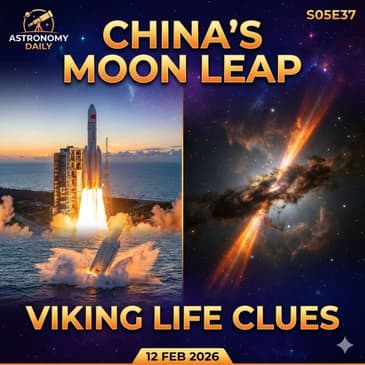
Good day, and welcome to Astronomy Daily, your go to source for everything happening in space and astronomy. I'm Anna and I'm Avery. It's Thursday, February the twelfth, twenty twenty six, and we have a packed show for you today. We really do. China has just pulled off a major milestone in its push to land astronauts on the Moon, including a pretty spectacular rocket splashdown that should have a few people at SpaceX paying attention. We've also got ULA's Vulcan centa rocket launching a pair of space surveillance satellites for the US Space Force, a deep dive into why Artemis two has so few chances to actually get off the ground, and a stunning new Hubble image of a dying star. Plus did NASA's Viking missions actually find life on Mars fifty years ago? New research says the answer might be yes, And astronomers are still hunting for the remains of a comet that dramatically fell apart during COVID lockdowns. Let's get into it. Our lead story today takes us to wang Chong Space launch site on the island of Hainan, where yesterday February eleventh, China conducted a landmark test that checked off multiple firsts in a single mission. This was a low altitude demonstration flight of China's next generation Long March ten rocket carrying the Mangjo crew capsule, and what they were testing was something called a max Q abort Basically, can the capsule safely escape the rocket at the moment of maximum aerodynamic stress during ascent? And for context, that's the point during any rocket launch where the vehicle is experiencing the greatest combination of speed and atmospheric resistance. If something goes wrong at max Q, the crew needs to get away fast. This was China's first ever test of that scenario with a crude class spacecraft. The capsule successfully separated from the rocket, It deployed its parachutes, and was recovered at sea. It was carrying lunar space suits and test dummies rather than actual tycho knots, obviously, but the abort system performed exactly as designed. Now here's where it gets really interesting. Avery After the capsule separated, the Long March ten first stage didn't just tumble into the ocean. It performed a powered vertical landing a soft splash down at Sea very much in the style of SpaceX's Falcon nine booster recoveries, and. That's a huge deal because until now, only the United States has had operational reusable orbital class rockets. This was China's first successful rocket recovery attempt, and it worked on the very first powered flight of the Long March ten prototype. And they even had a dedicated autonomous recovery vessel called the Linghangzer standing by, which is essentially China's answer to SpaceX's drone ships. The full Long March ten is going to be an absolute beast when it's complete. A tricore rocket standing around ninety meters tall with about twenty seven hundred tons of liftoff thrust. It's designed to be China's largest launch vehicle and the only one capable of sending both a cruse spacecraft and a lunar lander to the Moon in a single launch. If things continue at this pace, China is projecting a full orbital flight of the Long March ten by twenty twenty seven, with Tycho knots on the lunar surface before the end of the decade. That puts them in a very real race with NASA's Artemis program. Which is targeting its own crude landing with Artemis three no earlier than twenty twenty eight, and this. Test was conducted from the brand new launch pad number three and Wangchang, which was built specifically for these lunar missions, so the infrastructure is going in alongside the hardware. A genuinely significant day for the Chinese space program, and one that adds real momentum to what's shaping up to be the most exciting Moon race since Apollo. Sticking with rockets but moving to Cape canaveral, ULA's Vulcan Centaur rocket is set to launch early this morning, February twelve, with the window opening at three thirty am Eastern time. This is the fourth Vulcan mission overall, and the first of twenty twenty six. The payload is a pair of GSSAP satellites. That's the Geosynchronous Space Situational Awareness Program built by Northrop Grumman for the US Space Force. Think of GSSAP as a neighborhood watch program for geosynchronous orbit. These satellites monitor other spacecraft at that critical thirty five thousand kilometer altitude, improving flight safety and giving Space Force operators better situational awareness about what's happening up there. There's also a secondary payload called Propulsive ESPA, essentially a training spacecraft that Space Force guardians will use to practice precision orbital maneuvers and validate techniques for protecting assets in orbit. What's notable about this particular mission is that it's the longest Vulcan flight to date, nearly ten hours, because the Centaur upper stage is performing a direct insertion all the way to geosynchronous orbit rather than just dropping the satellites into a transfer orbit. ULA is under some pressure this year. They've got interim CEO John Elbon at the Helm after Tory Bruno departed to join Blue Origin late last year, and they're targeting eighteen to twenty two launches in twenty twenty six after falling short of their targets in twenty twenty five. They've invested heavily in infrastructure, a second mobile launch platform and a second integration facility at the CAPE. So the capacity is there. The question is whether Vulcan can deliver on the reliability and cadence that they're roughly eighty mission backlog demands. We should note that ULA's webcast coverage will end at faring separation about five minutes after launch, because the classified nature of the payload means the rest of the mission is conducted in silence. Now, speaking of getting rockets off the ground, let's talk about Artemis two, because if you've been following the countdown to the first crude Moon mission in over fifty years, you might have noticed something surprising about how few chances there actually are to launch. NASA has published the available launch dates, and there are just eleven opportunities across March and April combined. Five dates in March the sixth through the ninth, plus March eleventh and six in April. Each window is about two hours long. Eleven chances in sixty one days. That's it, and some of those could be lost to weather or the need to replace consumables like rocket fuel. So why so few? It all comes down to orbital mechanics and the specific requirements of this mission. Artemis two doesn't fly straight right to the Moon. The SLS rocket first delivers the Orion capsule to high Earth orbit, where the crew and ground teams run through a series of checkouts. Then comes a translunar injection burn to send Orion on its way. So the launch time on any given day has to thread the needle. SLS needs to reach the right orbit, Orion needs to be in the correct alignment with both Earth and the Moon for that translunar injection burn, and the whole trajectory has to work as a free return loop, using the Moon's gravity to sling the capsule home. And then there's a power constraint. Orion's solar arrays can't be in darkness for more than ninety minutes at a stretch, so NASA has to rule out any trajectory that would put the spacecraft in an extended eclipse. That alone eliminates a lot of potential dates. The return profile matters too, Orion needs a specific entry angle and conditions for splashdown, so that further narrows the field. Now, the reason we're talking about March and April specifically is that the first wet dress rehearsal that's the full practice run of fueling and countdown procedures, ended early on February second because of a liquid hydrogen leak that took February off the table entirely. A second wet dress attempt is expected soon, possibly this weekend, and NASA officials have been reassuring everyone that there are launch opportunities in every month beyond April as well. They just haven't published those dates yet. And it's worth remembering that Artemis I had similar hydrogen leak issues and still flew successfully in late twenty twenty two, so this isn't uncharted territory. Whenever it flies, it'll be historic. No astronaut has been beyond low Earth orbit since Apollo seventeen in December nineteen seventy two. That's over fifty three years. Moving on to our next story, and it's time for some pure cosmic beauty. NASA has released a breath taking new image from the Hubble Space Telescope showing the Egg Nebula in extraordinary detail. The Egg Nebula is about a thousand light years away in the constellation Signess, and it's what astronomers call a preplanetary nebula, which, despite the name, has nothing to do with planets forming. It's the early stage of a dying Sun like star, shedding its outer layers. And NASA describes it as the first youngest and closest preplanetary nebula ever discovered, which makes it incredibly valuable for studying how stars like our Sun eventually meet their end. What makes this image so striking is the structure. At the center. You have the dying star, the yoke of the egg, hidden behind a dense cloud of dust. Quinn Beams of light punch outward through gaps in that dusty shell, illuminating a series of concentric arcs of gas that ripple outward like waves. And unlike most nebulae, which glow because they're gas as has been ionized, the egg nebula shines purely by reflected light from the central star. The star hasn't heated up enough yet to ionize its surroundings. That's what makes this a preplanetary nebula rather than a full planetary nebula. The symmetry is remarkable too. Scientists say the patterns are far too orderly to have come from a violent event like a supernova. Instead, they point to coordinated sputtering events in the carbon enriched core of the dying star, though the exact mechanism is still poorly understood. There's also evidence of gravitational interactions with one or more hidden companion stars very deep within the dust, which may be helping to shape those dramatic outflows. This preplanetary phase only lasts a few thousand years, an absolute blink in cosmic terms, so catching a nebula at this stage is like catching lightning in a bottle, and the material being shed here is the same kind of carbon rich stardust that seated our own solar system four and a half billion years ago. Hubble has observed the agnebula before, but this new image, taken with the wide field camera three, combines multiple data sets to produce the most detailed portrait yet. Thirty five years in orbit, and Hubble is still delivering. Now for a story that could fundamentally change how we think about Mars. New research published in the journal Astrobiology is making the case that NASA's Viking missions may have actually detected signs of life on Mars back in nineteen seventy six. We just didn't know how to read the data. This is a big claim, so let's unpack it. The Viking Landers carried an instrument called the GCMs, the gas chromatography mass spectrometer, which was designed to detect organic molecules in the Martian soil. At the time, it returned what was interpreted as a negative result no organics found, case closed, and that. Can illusion essentially shut down the debate for decades. The Viking Project scientist Gerald Soffen famously said nobody's no life, and that became the textbook answer. But here's the twist. In two thousand and eight, NASA's Phoenix Lander discovered perchlorates in the Martian soil. Perchlorates are powerful oxidizing chemicals, and it turns out they break down organic molecules when heated, which is exactly what the Viking GCMs did to its soil samples. So in twenty ten, astrobiologist Rafael Navarro Gonzalez showed that if you take organic material and heated in the presence of perchlorate, you get methyl chloride and carbon dioxide, which is precisely the chemical signature that Viking detected and dismissed as either contamination or an unknown chemical process. Lead author doctor Benner puts it very directly, the GCMs didn't fail to discover organics. It did discover them through their degradation products. We just didn't understand what we were looking at. The team has even developed a model for what Martian microbes might look like. They call it barsoom that's bacterial autotrophes that respire with stored oxygen on Mars. The idea is that these organisms could photosynthesize during the Martian Day, produce and store oxygen, then use it to survive the freezing Martian Knights. I should emphasize this doesn't prove there's life on Mars, but it does reopen a door that was closed fifty years ago and makes a compelling case that the evidence was there all along, hiding in plain sight. And it raises a fascinating question if we go back to Mars with modern instruments designed with perchlorates in mind, what else might we find. Our final story today is a bit of a cosmic cold case. Remember comment see twenty nineteen why four at lists. Oh the pandemic comment. It was to discovered in December twenty nineteen, and as it flew toward the Inner Solar System in early twenty twenty, it brightened so rapidly that astronomers predicted it could become visible to the naked eye, a real lockdown spectacle. And then, like so many plans in twenty twenty, it fell apart literally in late April twenty twenty, the comet dramatically disintegrated into dozens of pieces. Hubble tracked about thirty fragments grouped into a few clusters of icy debris. But here's the thing. A new study in the Astronomical Journal by a team led by Salvatore Cordoba Quijano at Boston University has been asking if anything is still out there. Did the comet completely destroy itself or could a chunk have survived. The team scanned the skies in August and October of twenty twenty using the Lowell Discovery Telescope in Arizona and the Zwiki transient facility, which surveys the entire northern sky every two nights. They found nothing. But, and this is the intriguing part, that doesn't necessarily mean there's nothing left. Baryn Alysis suggests that a fragment up to about half a kilometer wide could still exist, but would be too small and too faint for those telescopes to detect. It could be out there right now, quietly tracing the comet's original orbit back toward the outer Solar System. The researchers pose a really thought provoking question, how many comets that we've assumed were completely destroyed? Might actually have surviving remnants still orbiting the Sun. And there's a wonderful historical footnote here. Comet Atlas is believed to be a fragment of the same parent body as the Great Comet of eighteen forty four, which itself may have been visible to Stone Age civilizations about five thousand years ago when it swept past the Sun. So somewhere out there, a tiny piece of a five thousand year old cosmic traveler might still be making its lonely journey through the darkness. I find that oddly beautiful. Me too, And the study serves as a heads up to astronomers. Next time a comet breaks apart, be ready to keep watching, because the story might not be over. And that is your Astronomy Daily for Thursday, February twelfth, twenty twenty six. What a lineup from China's moon ambitions to Viking's long lost life clues. If you enjoyed the show, please do leave us a review on your podcast platform of choice. It really does help new listeners find us, and you can find full show notes, links to all our sources and more at Astronomydaily dot io. For Avery and the whole Astronomy Daily Team, I'm anna keep looking up and we'll see you Tomorrowyday. Stars. Start story is the Trible