

Become a supporter of this podcast: https://www.spreaker.com/podcast/astronomy-daily-latest-space-news--5648921/support.
Sponsor Details:
Ensure your online privacy by using NordVPN. To get our special listener deal and save a lot of money, visit www.astronomydaily.io/nordvpn. You'll be glad you did!
Get the best secure and private email on the planet. Stop your Government, google and who knows who else spying on every email you write. Do what we did and use ProtonMail. They beleive in privacy and there are no ads in their business model...yet they still provide a free forever service. Check them out and get out special deal at www.astronomydaily.io/protonmail
Become a supporter of Astronomy Daily by joining our Supporters Club. Commercial free episodes daily are only a click way... Click Here
This episode includes AI-generated content.
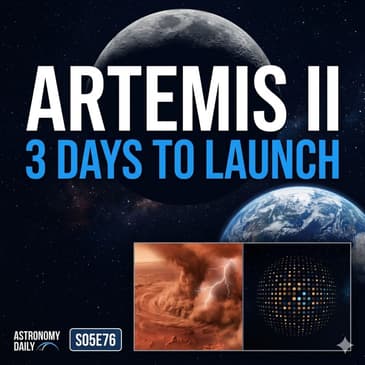
Hello, and welcome to Astronomy Daily. I'm Ana and I'm Avery. It is Monday, the thirtieth of March twenty twenty six, and this is season five, episode seventy six of your daily space and astronomy news podcast. What a day to be paying attention to space news, Avery. We are three days out from what could be the most significant human space flight event in over fifty years. We are absolutely leading with Artemis two today and the countdown is real. But we've also got a tough story about a major Mars mission that's now officially off the table, and the science end is just as compelling, from exoplanet hunting to the secrets of pulsars and lightning on the Red planet. If you've been following along with us this season, you know this moment has been a long time coming. NASA's Artemis two mission, the first crude flight to lunar distance since Apollo seventeen in nineteen seventy two, is now just three days away from launch. Person crew held a virtual press conference yesterday, March twenty ninth, and NASA officials confirmed they are currently tracking zero technical issues with the rocket or spacecraft. Everything is on track for liftoff on April first, and know that is not an April fool's joke. The launch window opens at six twenty four pm Eastern Time on Wednesday, with a six day window available if needed. The Space Launch System rocket and the Orion crew capsule are sitting at Launch Complex thirty nine B at Kennedy's Space Center in Florida, having completed that incredible overnight rollout to the pad back in March twentieth, and. The mission itself, Artemis two, will send the four person crew on a ten day voyage around the Moon and back. It won't land, but it will take humans to lunar distance for the first time in more than half a century. The mission's primary purpose is to test Orion's life support systems in deep space, the critical piece that will eventually keep crusafe for surface landings. Fifty four years since Apollo seventeen left the lunar surface and now here we are three days out. We'll be watching every second of it, and of course we'll have full coverage right here on Astronomy Daily Day tuned. Wednesday's going to be a big day. From the excitement of what's launching to the sobering reality of what's not one of the most ambitious planetary science missions ever conceived, has now effectively collapsed, and this week we got the final confirmation that the plug has been pulled on the ESA side. Essay's Earth Return Orbiter, the agency's primary contribution to the joint NASA ESA Mars Sample Return Mission, has been formally canceled after member states voted to end the program. ESA's Director of Human and Robotic Exploration, Daniel Neinschwunder, confirmed at a press conference following the three hundred and forty fifth ESA Council meeting that member states had, in hit words, asked for the cancelation of the Earth Return Orbiter mission. For those unfamiliar, the Earth Return Orbiter was the spacecraft designed to travel to Mars intercept a small rocket launched from the surface carrying Perseverance's sample tubes, and bring those samples back to Earth. ESA had awarded a four hundred and ninety one million euro contract to Airbus Defense and Space back in October twenty twenty to build it. The mission had been in trouble for a while. An independent NASA review board back in September twenty twenty three describe the budget and schedule expectations as and this is a direct quote unrealistic. Then in January this year, the US Senate voted to cut funding for the mission entirely, effectively killing it on the NASA side. Now ESA has followed suit. Noin's Fonder said the agency is working with Airbus to manage the transition and where possible, salvage technology that can be repurposed. The electric propulsion system was specifically mentioned as a candidate for reuse. It's a genuinely difficult moment for planetary science. The Mars samples Perseverance has been collecting for years were always seen as potentially the most scientifically valuable material ever returned from another world, with the potential to answer questions about whether Mars ever hosted life. That ambition hasn't gone away, but the pathway to getting those tubes back to Earth is now very unclear. It's a story about funding, about priorities, and about just how difficult and expensive doing science across interplanetary distances really is. On a brighter note, quite literally, this morning, SpaceX pulled off another remarkable feat of small satellite logistics with the launch of the Transporter sixteen mission. Transporter sixteen lifted off from Space Launch Complex for East at Vandenberg Space Force Space in California in the early hours of this morning, March thirtieth. The Falcon nine rocket carried one hundred and nineteen separate payloads to sun Sink in his orbit. That's a polar orbit that keeps the spacecraft in constant sunlight, ideal for Earth observation satellites. One hundred and nineteen payloads let that sync in the manifest included CubeSats, microsatellites, hosted payloads, a re entry vehicle, and eight payloads riding along on orbital transfer vehicles that will deploy them at a later time to their final orbits. This is the sixteenth transporter right share mission SpaceX has run, and it represents the company's third largest small SAT right share ever by payload count. And true to form, the Falcon nine's first stage flying for its twelfth mission landed successfully on the drone ship of course, I Still Love You in the Pacific Ocean about eight and a half minutes after launch. SpaceX has now launched more than sixteen hundred payloads through its ride share program in total. What these right share missions represents is something genuinely transformative affordable access to space for small organizations, university, these research institutions, and startups that simply couldn't afford a dedicated launch. The democratization of orbit continues at pace. Now to the search for life beyond Earth. With the Project Hail Mary film fresh in everyone's minds, this next story feels extraordinarily well timed. Astronomers at Cornell University's Carl Sagan Institute have published what they're calling a roadmap for finding life elsewhere in the galaxy. Out of more than six thousand confirmed exoplanets, the team has identified just forty five rocky worlds as the most promising candidates, the best bets for potentially hosting life. The study, published in Monthly Notices of the Royal Mastrological Society, was led by Professor Lisa Caltngeger and her students. They used updated measurements from ESA's Guya mission, combined with data from the NASA Exoplanet Archive to identify planets sitting in the habitable zone of their stars, the band of distances where surface temperatures could allow liquid water to exist. Some of the names on the list will be familiar to regular listeners Proximus and Tari b our nearest stellar neighbor at just four point twenty five light years away. Multiple worlds in the Trappiest One system about forty light years distant, specifically Trappist one D E, F and G and LHS one one four B, a dense super earth about forty eight light years out that some researchers consider the strongest current candidate for a habitable ocean world now. The team was deliberate about not just listing the most obviously habitable worlds. They also included planets that push the limits, like worlds with elliptical orbits, to help scientists understand just how much variation life can tolerate. And the practical application. This list is essentially a prioritized target list for future telescopes, including the James Webb's based Telescope, and future ground based giants like the extremely Large Telescope, helping researchers focus limited observation time on the place is most likely to yield biosignatures. Professor Kultingeger put it beautifully. She said, if we ever built a ship like the one in Project Hail Mary, this is where you'd point it. Forty five worlds. The universe suddenly feels both vast and strangely specific. From the search for life to the physics of some of the most extreme objects in the universe. Pulsars, those rapidly spinning, intensely magnetized remnants of dead stars, have been studied for decades, but a new study has just overturned a piece of pulsar science that astronomers thought they had figured out. For as long as we've been studying pulsars, the assumption has been that their radio signals are generated close to the star's surface, near the magnetic poles. These cosmic lighthouses were thought to beam their energy out from a relatively compact region close to home. A new study published in Monthly Notices of the Royal Astronomical Society says that's only part of the story, and for a specific class of pulsars, we've been missing something big. The research was conducted by Professor Michael Kramer from the Max Planck Institute for Radio Astronomy in Germany and doctor Simon Johnston from Australia CSIRO. They analyzed radio observations of nearly two hundred millisecond pulsars, a special class that spends hundreds of times per second, making them among the most precise clocks in the known universe. What they found was striking. About one third of these millisecond pulsars show radio signals coming from two or more completely separate regions, with gaps of silence in between and the key insight. Many of those isolated pulses line up perfectly with gamma ray flashes detected by NASA's Fermi Space telescope, suggesting both types of signal originate from the same extreme region of space far beyond the stars surface. That region is called the current sheet, a swirling zone of charged particles just beyond what's known as the light cylinder, the theoretical boundary where the magnetic field would need to spin at the speed of light to keep up with the pulsar's rotation. Radio waves have never been confirmed as originating from this far out before. And the implications go beyond pure physics. Millisecond pulsars are used as ultra precise cosmic clocks in pulsar timing arrays networks that scientists use to detect gravitational waves. Understanding exactly where their signals come from matters for calibrating those detections. These tiny, fast spinning stars, it turns out, are even more complex and surprising than we thought. We're ending today with Mars, and with a discovery that has literally been decades in the making. Scientists have confirmed the first direct evidence of lightning like electrical activity on the red planet. Lightning has been detected on Jupiter, Saturn, and Neptune, but Mars has been a persistent mystery. Its thin carbon dioxide atmosphere and the absence of a global magnetic field made scientists suspect that lightning like discharges could occur, particularly during dust storms, but no direct electromagnetic evidence had ever been captured until now. The detection came from NASA's MAVEN spacecraft, the Mars Atmosphere and Volatile Evolution Mission, which studied the Martian atmosphere from twenty fourteen until NASA lost contact with it in December twenty twenty five. Scientists sifting through more than a decade of data found one single extraordinary signal, a frequency dispersed whistler wave, detected in the Martian ionosphere on June twenty first, twenty fifteen. A whistler wave is a low frequency radio signal generated by lightning on Earth, they're well understood. What makes Mars special is that the planet lacks a global magnetic field, so these waves can only propagate under very specific conditions through localized, crustal magnetic fields, mostly in the southern hemisphere. The Maven spacecraft had to be at exactly the right altitude, in the right observation mode over exactly the right location at that one moment. Out of more than one hundred eight thousand measurements in the data set, researchers found one clear event. It lasted er point four seconds and spans frequencies consistent with what you'd expect from a powerful lightning like dis charge at the surface. The team, led by Czech researchers from Charles University modeled the propagation through the Martian ionosphere and confirmed it matched theory. Now scientists are careful not to call it definitively lightning. The Martian version is more likely a static electrical discharge from charged dust grains colliding in dust storms, rather than the dramatic bolts we see in thunderstorms on Earth, but the electromagnetic fingerprint is the same. And the significance goes beyond the novelty understanding electrical activity in the Martian atmosphere has implications for atmosphere chemistry, for the safety of future surface missions and equipment, and for our broader picture of just how earth like in some ways Mars truly is. And that brings us to the end of today's Astronomy Daily, Season five, episode seventy six. What a line of today. We're three days from humanity's return to lunar distance, watching the Mars sample return dream quietly end, and still finding lightning and new worlds in the data base never stops delivering. If you're enjoying the show, please do subscribe, leave us a review, and tell a fellow space enthusiast to tune in. We're on all the major podcast platforms and YouTube, and there's more at Astronomydaily dot io. We'll be back tomorrow with more from the universe. Until then, keep looking. Up from all of us at Astronomy Daily. Clear Skiesday. Starts. The Store is the Soul. Store is the Soul. M