
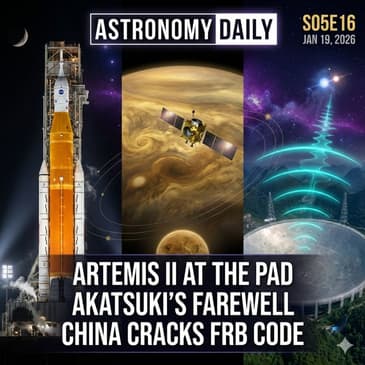

NASA's Artemis II rocket completes its journey to Launch Pad 39B, bringing humanity one step closer to returning to the Moon. We bid farewell to Japan's remarkable Akatsuki Venus orbiter after a decade of groundbreaking discoveries. China's FAST telescope solves a ten-year mystery about fast radio bursts, revealing they come from binary star systems.
Plus, we preview the incredible space science missions launching in 2026, discuss the devastating loss of Spain's brand-new military satellite to a tiny space particle, and explore new findings showing that dwarf galaxies host more active black holes than previously thought.
**Featured Stories:**
• NASA's Artemis II reaches the launch pad for wet dress rehearsal
• Japan's Akatsuki mission ends after 15 years and extraordinary Venus discoveries
• China's Sky Eye telescope cracks the fast radio burst mystery
• 2026 space science preview: Moon, Mars, and telescope missions ahead
• Spanish military satellite suffers catastrophic damage from millimeter-sized debris
• New census reveals surprising black hole activity in dwarf galaxies
Visit astronomydaily.io for full articles, images, and more space news!
#Astronomy #Space #NASA #ArtemisII #Venus #Akatsuki #FastRadioBursts #FAST #Mars #SpaceScience #BlackHoles #SpaceDebris
Become a supporter of this podcast: https://www.spreaker.com/podcast/astronomy-daily-latest-space-news--5648921/support.
Sponsor Details:
Ensure your online privacy by using NordVPN. To get our special listener deal and save a lot of money, visit www.astronomydaily.io/nordvpn. You'll be glad you did!
Get the best secure and private email on the planet. Stop your Government, google and who knows who else spying on every email you write. Do what we did and use ProtonMail. They beleive in privacy and there are no ads in their business model...yet they still provide a free forever service. Check them out and get out special deal at www.astronomydaily.io/protonmail
Become a supporter of Astronomy Daily by joining our Supporters Club. Commercial free episodes daily are only a click way... Click Here
This episode includes AI-generated content.
00:00:00 --> 00:00:03 Anna: Welcome to Astronomy Daily, your source
00:00:03 --> 00:00:06 for the latest news in space and astronomy.
00:00:06 --> 00:00:07 I'm Anna.
00:00:07 --> 00:00:10 Avery: And I'm Avery. We've got an
00:00:10 --> 00:00:12 absolutely packed show for you today with
00:00:12 --> 00:00:14 some really exciting developments happening
00:00:14 --> 00:00:16 across the solar system and beyond.
00:00:16 --> 00:00:19 Anna: That's right, Avery. NASA's Artemis 2
00:00:19 --> 00:00:22 mission just reached a major milestone that
00:00:22 --> 00:00:25 brings us closer to putting humans back on
00:00:25 --> 00:00:27 the moon. We'll update you on the m
00:00:27 --> 00:00:30 impressive journey their massive rocket just
00:00:30 --> 00:00:30 completed.
00:00:31 --> 00:00:33 Avery: Plus, we're saying goodbye to a spacecraft
00:00:33 --> 00:00:36 that refused to give up. Japan's
00:00:36 --> 00:00:38 Akatsuki mission to Venus has officially
00:00:38 --> 00:00:41 ended after more than a decade of incredible
00:00:41 --> 00:00:44 science. But not before delivering some
00:00:44 --> 00:00:45 stunning discoveries.
00:00:45 --> 00:00:48 Anna: We've also got a fascinating storey about
00:00:48 --> 00:00:51 China's fast telescope solving a
00:00:51 --> 00:00:53 cosmic mystery that's had astronomers
00:00:53 --> 00:00:56 scratching their heads for years. Fast
00:00:56 --> 00:00:57 radio bursts, anyone?
00:00:58 --> 00:01:00 Avery: Speaking of mysteries, there's some
00:01:00 --> 00:01:02 concerning news about a Spanish military
00:01:02 --> 00:01:05 satell. We'll explore what might be the most
00:01:05 --> 00:01:07 comprehensive year for space science in
00:01:07 --> 00:01:09 recent memory, with missions heading to the
00:01:09 --> 00:01:11 moon, Mars and beyond.
00:01:11 --> 00:01:14 Anna: And finally, astronomers have been taking a,
00:01:14 --> 00:01:17 uh, closer look at dwarf galaxies. And what
00:01:17 --> 00:01:20 they found is changing our understanding of
00:01:20 --> 00:01:23 supermassive black holes across the universe.
00:01:23 --> 00:01:26 Avery: It's going to be a great show, so let's get
00:01:26 --> 00:01:26 into it.
00:01:26 --> 00:01:29 Anna: All right, Avery. Let's kick things off with
00:01:29 --> 00:01:32 some really exciting news from NASA's Kennedy
00:01:32 --> 00:01:34 Space Centre in Florida. The Artemis 2
00:01:34 --> 00:01:37 mission just hit a huge milestone.
00:01:37 --> 00:01:39 Avery: This is big, Anna.
00:01:39 --> 00:01:39 Anna: Uh.
00:01:39 --> 00:01:42 Avery: After nearly 12 hours of careful travel,
00:01:42 --> 00:01:45 NASA's Space Launch System rocket and Orion
00:01:45 --> 00:01:48 spacecraft finally reached launch pad
00:01:48 --> 00:01:50 39B this past Saturday evening.
00:01:50 --> 00:01:53 Anna: And when you say careful travel, you really
00:01:53 --> 00:01:56 mean it. We're talking about NASA's Crawler
00:01:56 --> 00:01:59 Transporter 2 moving at a blazing
00:01:59 --> 00:02:02 maximum speed of just 0.82
00:02:02 --> 00:02:03 miles per hour.
00:02:04 --> 00:02:07 Avery: Right. I could literally walk faster than
00:02:07 --> 00:02:09 that. But when you're moving a massive moon
00:02:09 --> 00:02:12 rocket, slow and steady definitely wins the
00:02:12 --> 00:02:14 race. The journey from the vehicle assembly
00:02:14 --> 00:02:16 building covered about four miles.
00:02:17 --> 00:02:19 Anna: What I find interesting is that they had to
00:02:19 --> 00:02:22 make a planned pause. Along the way, the team
00:02:22 --> 00:02:25 needed to reposition the crew access arm,
00:02:25 --> 00:02:27 which is essentially a bridge that will
00:02:27 --> 00:02:30 provide the astronauts access to the Orion
00:02:30 --> 00:02:31 spacecraft on launch day.
00:02:32 --> 00:02:33 Avery: That's such a critical piece of
00:02:33 --> 00:02:35 infrastructure. Now that the rocket's at the
00:02:35 --> 00:02:38 pad, teams are preparing for what NASA calls
00:02:38 --> 00:02:41 a wet dress rehearsal, which is targeted for
00:02:41 --> 00:02:42 no later than February 2nd.
00:02:43 --> 00:02:45 Anna: Can you explain what that entails for our
00:02:45 --> 00:02:47 listeners who might not be familiar?
00:02:47 --> 00:02:50 Avery: Absolutely. During the wet dress rehearsal,
00:02:50 --> 00:02:52 engineers will load the rocket with its
00:02:52 --> 00:02:55 cryogenic propellants, super cold fuel
00:02:55 --> 00:02:58 run through the entire countdown. Sequence
00:02:58 --> 00:03:00 and then practise safely draining all those
00:03:00 --> 00:03:03 propellants from the rocket. It's basically a
00:03:03 --> 00:03:05 full mission simulation without actually
00:03:05 --> 00:03:06 launching.
00:03:06 --> 00:03:08 Anna: And this is absolutely essential. Before
00:03:09 --> 00:03:11 putting a crew on board, NASA wants to make
00:03:11 --> 00:03:14 sure every system works perfectly.
00:03:14 --> 00:03:17 Avery: Exactly. Now, they've noted that additional
00:03:17 --> 00:03:19 wet dress rehearsals might be required to
00:03:19 --> 00:03:22 ensure the vehicle is completely ready for
00:03:22 --> 00:03:24 flight. And if needed, they may roll the
00:03:24 --> 00:03:27 SLS and Orion back to the vehicle assembly
00:03:27 --> 00:03:29 building for additional work.
00:03:29 --> 00:03:32 Anna: Let's talk about the crew. This is going to
00:03:32 --> 00:03:33 be a historic mission.
00:03:34 --> 00:03:36 Avery: It really is. The Artemis 2 mission
00:03:36 --> 00:03:39 will send NASA astronauts Reid Wiseman,
00:03:39 --> 00:03:42 Victor Glover and Christina Koch, along with
00:03:42 --> 00:03:44 Canadian Space Agency astronaut Jeremy
00:03:44 --> 00:03:47 Hansen, on approximately 10 day journey
00:03:47 --> 00:03:48 around the moon and back.
00:03:49 --> 00:03:51 Anna: And this will be the first crewed lunar
00:03:51 --> 00:03:53 mission since Apollo 17 in
00:03:53 --> 00:03:56 1972. We're talking about more
00:03:56 --> 00:03:57 than 50 years.
00:03:58 --> 00:04:00 Avery: That's incredible when you think about it.
00:04:00 --> 00:04:03 And this mission is a crucial stepping stone
00:04:03 --> 00:04:05 towards landing humans on the moon's surface
00:04:05 --> 00:04:07 again, which will then help us prepare for
00:04:07 --> 00:04:10 the ultimate sending astronauts to Mars.
00:04:10 --> 00:04:13 Anna: The timeline is really coming together. From
00:04:13 --> 00:04:16 rollout to wet dress rehearsal to launch,
00:04:16 --> 00:04:17 it's all happening.
00:04:18 --> 00:04:21 Avery: And every step brings us closer to seeing
00:04:21 --> 00:04:23 humans venture beyond Earth orbit for the
00:04:23 --> 00:04:26 first time in over half a century. It's
00:04:26 --> 00:04:28 an exciting time for space exploration.
00:04:29 --> 00:04:31 Anna: Moving from the moon to our other planetary
00:04:31 --> 00:04:32 neighbour.
00:04:32 --> 00:04:35 We need to talk about the end of an era at
00:04:35 --> 00:04:38 Venus. Japan's Akatsuki mission
00:04:38 --> 00:04:41 officially concluded in September 2025
00:04:41 --> 00:04:43 after an absolutely remarkable journey.
00:04:44 --> 00:04:47 Avery: This is such a bittersweet storey, Anna. Uh,
00:04:47 --> 00:04:50 Akatsuki, which was operated by JAXA and
00:04:50 --> 00:04:52 iss, was Japan's first fully
00:04:52 --> 00:04:55 successful planetary orbiter. And it went
00:04:55 --> 00:04:57 through quite an ordeal to get there.
00:04:57 --> 00:04:59 Anna: Right, because the mission didn't exactly go
00:04:59 --> 00:05:01 according to plan from the start, did it?
00:05:02 --> 00:05:05 Avery: Not at all. Akatsuki launched back in 2010
00:05:05 --> 00:05:07 with the goal of studying Venus's atmosphere,
00:05:07 --> 00:05:10 but it actually failed to enter Venus orbit
00:05:10 --> 00:05:12 on its first attempt due to a main engine
00:05:12 --> 00:05:14 malfunction. So the spacecraft ended up
00:05:14 --> 00:05:17 drifting around the sun for five years.
00:05:18 --> 00:05:20 Anna: Five years. That must have been incredibly
00:05:20 --> 00:05:22 frustrating for the team. But they didn't
00:05:22 --> 00:05:23 give up.
00:05:24 --> 00:05:26 Avery: They absolutely didn't. In December 2015,
00:05:27 --> 00:05:29 JAXA engineers managed a second attempt using
00:05:29 --> 00:05:32 the spacecraft's smaller thrusters. And this
00:05:32 --> 00:05:35 time it worked. Akatsuki successfully entered
00:05:35 --> 00:05:37 orbit around Venus and became the only
00:05:38 --> 00:05:40 operational spacecraft there at the time.
00:05:40 --> 00:05:43 Anna: So what kind of work did it accomplish once
00:05:43 --> 00:05:44 it finally got into position?
00:05:45 --> 00:05:47 Avery: Well, the spacecraft weighed just over
00:05:47 --> 00:05:50 1150 pounds and carried five
00:05:50 --> 00:05:52 imaging instruments plus a six radio system.
00:05:53 --> 00:05:55 Its orbit was Highly elliptical, ranging from
00:05:55 --> 00:05:58 about 620 miles at its closest to
00:05:58 --> 00:06:00 Venus all the way out to
00:06:00 --> 00:06:03 223 miles
00:06:03 --> 00:06:04 at its farthest point.
00:06:04 --> 00:06:07 Anna: That's quite a range. I imagine that gave
00:06:07 --> 00:06:09 them different perspectives on the planet.
00:06:09 --> 00:06:12 Avery: Exactly. It allowed for both wide angle
00:06:12 --> 00:06:15 observations and detailed close up studies of
00:06:15 --> 00:06:18 Venus's thick toxic cloud layers. And
00:06:18 --> 00:06:20 Akatsuki made some really incredible
00:06:20 --> 00:06:22 discoveries during its decade of operations.
00:06:23 --> 00:06:23 Anna: Like what?
00:06:24 --> 00:06:26 Avery: One of the most striking findings was a, uh,
00:06:26 --> 00:06:29 giant stationary gravity wave about
00:06:29 --> 00:06:32 6 miles long. It's the
00:06:32 --> 00:06:34 largest of its kind in the entire solar
00:06:34 --> 00:06:34 system.
00:06:35 --> 00:06:38 Anna: That's enormous. What causes something
00:06:38 --> 00:06:38 like that?
00:06:39 --> 00:06:41 Avery: These gravity waves appeared as alternating
00:06:41 --> 00:06:44 light and dark bands in the atmosphere. And
00:06:44 --> 00:06:46 they're created when air is pushed upward by
00:06:46 --> 00:06:48 mountainous terrain on Venus's surface.
00:06:49 --> 00:06:51 What's fascinating is that how even the lower
00:06:51 --> 00:06:54 surface can influence the upper atmospheric
00:06:54 --> 00:06:56 layers despite the crushing pressure.
00:06:56 --> 00:06:58 Anna: Akatsuki, uh, also contributed to
00:06:58 --> 00:07:01 understanding Venus's super rotation
00:07:01 --> 00:07:02 phenomenon, right?
00:07:02 --> 00:07:05 Avery: That's right. Super rotation is this bizarre
00:07:05 --> 00:07:08 phenomenon where Venus's upper atmosphere
00:07:08 --> 00:07:10 moves significantly faster than the planet's
00:07:10 --> 00:07:13 surface rotates. Akatsuki provided evidence
00:07:13 --> 00:07:16 linking this wind acceleration to vertical
00:07:16 --> 00:07:18 momentum transfers through waves and
00:07:18 --> 00:07:18 turbulence.
00:07:19 --> 00:07:21 Anna: So how did the mission ultimately end?
00:07:22 --> 00:07:24 Avery: In late April 2024, contact with
00:07:24 --> 00:07:27 Akatsuki was lost during a period of low
00:07:27 --> 00:07:29 precision attitude control. Basically, the
00:07:29 --> 00:07:31 spacecraft's orientation and antenna
00:07:31 --> 00:07:33 positioning drifted off target. The
00:07:33 --> 00:07:36 transmitter likely kept working, but the
00:07:36 --> 00:07:38 radio signal could no longer reach Earth.
00:07:38 --> 00:07:40 Anna: And despite months of attempts to re
00:07:40 --> 00:07:43 establish communication, they couldn't get it
00:07:43 --> 00:07:43 back.
00:07:44 --> 00:07:46 Avery: Unfortunately not. JAXA
00:07:46 --> 00:07:48 officially sent the final command to
00:07:48 --> 00:07:50 terminate the mission on September 18,
00:07:51 --> 00:07:53 2025, just over 15 years after
00:07:53 --> 00:07:56 launch. This ensured no uncontrolled signals
00:07:56 --> 00:07:59 would continue broadcasting from the inactive
00:07:59 --> 00:07:59 probe.
00:07:59 --> 00:08:02 Anna: What a legacy though. Despite all the
00:08:02 --> 00:08:04 setbacks, Akatsuki delivered remarkable
00:08:04 --> 00:08:07 science about Venus's atmosphere and proved
00:08:07 --> 00:08:09 that you should never count a mission out.
00:08:09 --> 00:08:12 Avery: Absolutely. It's a testament to the ingenuity
00:08:12 --> 00:08:15 and determination of the team. They turned
00:08:15 --> 00:08:17 what could have been a complete failure into
00:08:17 --> 00:08:19 a highly successful decade.
00:08:19 --> 00:08:21 Anna: Long mission from Venus.
00:08:21 --> 00:08:23 Let's turn our attention to one of the
00:08:23 --> 00:08:26 biggest mysteries in modern astronomy. Fast
00:08:26 --> 00:08:29 radio bursts and Avery. Chinese
00:08:29 --> 00:08:30 astronomers have just made a breakthrough
00:08:30 --> 00:08:33 that's reshaping our understanding of these
00:08:33 --> 00:08:34 enigmatic signals.
00:08:35 --> 00:08:37 Avery: This is really exciting work, Anna. Um, an
00:08:37 --> 00:08:40 international team using China's FAST
00:08:40 --> 00:08:42 telescope, that's the 500 metre
00:08:42 --> 00:08:45 aperture spherical Telescope, also known as
00:08:45 --> 00:08:48 the China Sky Eye, has uncovered the
00:08:48 --> 00:08:51 first clear evidence that some fast radio
00:08:51 --> 00:08:53 burst sources actually originate in binary
00:08:53 --> 00:08:54 star systems.
00:08:55 --> 00:08:57 Anna: Okay, so for our listeners who Might not be
00:08:57 --> 00:09:00 familiar. Can you explain what fast radio
00:09:00 --> 00:09:00 bursts are?
00:09:01 --> 00:09:03 Avery: Sure. Fast radio bursts, or
00:09:03 --> 00:09:06 FRBs, are these incredibly brief
00:09:06 --> 00:09:09 but energetic pulses of radio waves from
00:09:09 --> 00:09:11 deep space. We're talking about flashes that
00:09:11 --> 00:09:14 last less than a thousandth of a second, but
00:09:14 --> 00:09:17 can release more energy than our sun emits in
00:09:17 --> 00:09:17 days.
00:09:18 --> 00:09:21 Anna: That's mind boggling. And most of these are
00:09:21 --> 00:09:22 one time events, right?
00:09:23 --> 00:09:25 Avery: Exactly. Most FRBs are one
00:09:25 --> 00:09:28 off events, which makes them really hard to
00:09:28 --> 00:09:31 study. But a handful repeat and those
00:09:31 --> 00:09:33 give astronomers rare opportunities for long
00:09:33 --> 00:09:36 term observation. That's what made this
00:09:36 --> 00:09:37 discovery possible.
00:09:37 --> 00:09:40 Anna: So tell us about this particular burst they
00:09:40 --> 00:09:41 were studying.
00:09:41 --> 00:09:44 Avery: The team led by Professor Bing Zhang from the
00:09:44 --> 00:09:47 University of Hong Kong focus on a repeating
00:09:47 --> 00:09:48 source called
00:09:48 --> 00:09:51 FRB2205.29A,
00:09:52 --> 00:09:55 located about 2.5 billion light years
00:09:55 --> 00:09:57 away. They monitored it for 17
00:09:57 --> 00:10:00 months using FAST, which is the world's most
00:10:00 --> 00:10:02 sensitive instrument for detecting these
00:10:02 --> 00:10:02 signals.
00:10:03 --> 00:10:05 Anna: And for most of that time it seemed pretty
00:10:05 --> 00:10:06 unremarkable.
00:10:07 --> 00:10:09 Avery: That's what's so interesting. For 17
00:10:09 --> 00:10:12 months, the signal appeared consistent and
00:10:12 --> 00:10:15 ordinary. But then near the end of
00:10:15 --> 00:10:17 2023, something truly exciting
00:10:17 --> 00:10:20 happened that transformed the entire study.
00:10:20 --> 00:10:21 Anna: What changed?
00:10:21 --> 00:10:24 Avery: They detected what they call an RM flare,
00:10:24 --> 00:10:27 a sudden dramatic change in the rotation
00:10:27 --> 00:10:30 measure of the radio waves. The rotation
00:10:30 --> 00:10:32 measure increased by more than a factor of
00:10:32 --> 00:10:35 100, then rapidly declined over
00:10:35 --> 00:10:37 two weeks before returning to its previous
00:10:37 --> 00:10:40 level. Think of rotation measure as
00:10:40 --> 00:10:43 describing how polarised radio waves twist
00:10:43 --> 00:10:45 as they pass through magnetic plasma. A
00:10:45 --> 00:10:48 sudden change like this reveals shifts in the
00:10:48 --> 00:10:50 environment surrounding the FRB source.
00:10:51 --> 00:10:52 Anna: And what does that tell us?
00:10:52 --> 00:10:55 Avery: Uh, well, this flare suggested that the
00:10:55 --> 00:10:58 FRB's environment was suddenly flooded by
00:10:58 --> 00:11:00 highly magnetised plasma, likely
00:11:00 --> 00:11:03 ejected by a nearby star. It's consistent
00:11:03 --> 00:11:06 with coronal mass ejections, those massive
00:11:06 --> 00:11:09 bursts of stellar material that our sun
00:11:09 --> 00:11:10 occasionally launches.
00:11:10 --> 00:11:13 Anna: So that's the smoking gun for a binary
00:11:13 --> 00:11:14 system.
00:11:14 --> 00:11:17 Avery: Exactly. By linking this RM flare
00:11:17 --> 00:11:20 to plasma activity from a companion star,
00:11:20 --> 00:11:23 the team provided the strongest evidence yet
00:11:23 --> 00:11:26 that some FRBs arise in binary
00:11:26 --> 00:11:28 systems containing a magnetar, which is a
00:11:28 --> 00:11:30 neutron star with an extremely strong
00:11:30 --> 00:11:33 magnetic field paired with a regular star
00:11:33 --> 00:11:34 like our sun.
00:11:34 --> 00:11:36 Anna: This contradicts the long standing belief
00:11:36 --> 00:11:39 that FRBs come solely from isolated
00:11:39 --> 00:11:40 magnetars, doesn't it?
00:11:41 --> 00:11:43 Avery: It does, and it's a major shift in our
00:11:43 --> 00:11:46 understanding. The findings were published in
00:11:46 --> 00:11:48 the journal Science and mark a real milestone
00:11:48 --> 00:11:51 for astrophysics. The observations were
00:11:51 --> 00:11:54 corroborated by data from Australia's Parkes
00:11:54 --> 00:11:56 telescope, which reinforces the reliability
00:11:56 --> 00:11:57 of these findings.
00:11:58 --> 00:12:00 Anna: Do these results fit into any broader
00:12:00 --> 00:12:01 theories about FRBs?
00:12:02 --> 00:12:04 Avery: Actually, yes. They align with a unified
00:12:05 --> 00:12:07 model recently proposed by Professor Zhang
00:12:07 --> 00:12:10 and colleagues, suggesting that all FRBs
00:12:10 --> 00:12:13 originate from Magnetars, but those within
00:12:13 --> 00:12:15 binary systems have specific geometries
00:12:15 --> 00:12:18 and environments that make them repeat more
00:12:18 --> 00:12:19 frequently.
00:12:19 --> 00:12:21 Anna: So we're starting to piece together the
00:12:21 --> 00:12:24 puzzle of, uh, why some FRBs repeat
00:12:24 --> 00:12:25 and others don't.
00:12:25 --> 00:12:28 Avery: Exactly. And this discovery was only
00:12:28 --> 00:12:31 possible because of persevering observations
00:12:31 --> 00:12:34 using the world's best telescopes and the
00:12:34 --> 00:12:36 tireless work of dedicated research teams.
00:12:36 --> 00:12:38 It's astronomy at its finest.
00:12:39 --> 00:12:41 Anna: Alright, now let's look ahead, because
00:12:41 --> 00:12:43 2026 is shaping up to be an
00:12:43 --> 00:12:46 absolutely incredible year for space science.
00:12:47 --> 00:12:48 Avery, where should we even begin?
00:12:49 --> 00:12:51 Avery: There's so much happening. Ana, uh, let's
00:12:51 --> 00:12:53 start with lunar missions, because we're
00:12:53 --> 00:12:55 seeing a real renaissance in moon
00:12:55 --> 00:12:58 exploration. Multiple commercial landers and
00:12:58 --> 00:13:00 government missions are on the schedule.
00:13:00 --> 00:13:03 Anna: And we learned some valuable lessons from
00:13:03 --> 00:13:05 2025's lunar landing attempts, didn't we?
00:13:06 --> 00:13:08 Avery: We certainly did. In early
00:13:08 --> 00:13:11 2025, three commercial landers
00:13:11 --> 00:13:13 attempted moon landings, but only one,
00:13:13 --> 00:13:15 Firefly Aerospace's Blue Ghost,
00:13:15 --> 00:13:18 succeeded. That was a major milestone as
00:13:18 --> 00:13:21 the first fully successful commercial lunar
00:13:21 --> 00:13:21 landing.
00:13:22 --> 00:13:24 Anna: Blue Ghost touched down near Mons Littrelle
00:13:24 --> 00:13:27 in Mar Criseum and operated for several
00:13:27 --> 00:13:29 days before shutting down during the lunar
00:13:29 --> 00:13:30 night.
00:13:30 --> 00:13:33 Avery: Right, And Firefly isn't resting on their
00:13:33 --> 00:13:35 laurels. They're planning Blue Ghost Mission
00:13:35 --> 00:13:38 2 for November 2026, launching
00:13:38 --> 00:13:41 aboard a Falcon 9. This mission will carry
00:13:41 --> 00:13:43 some really interesting payloads, including
00:13:43 --> 00:13:45 NASA's Lucy Night experiment.
00:13:46 --> 00:13:48 Anna: That's the Lunar Surface Electromagnetic
00:13:48 --> 00:13:51 Experiment at night. And it's particularly
00:13:51 --> 00:13:53 exciting because it'll become the first
00:13:53 --> 00:13:55 operational radio telescope on the moon,
00:13:56 --> 00:13:57 operating through the lunar night.
00:13:58 --> 00:14:00 Avery: Also flying on that mission is the United
00:14:00 --> 00:14:02 Arab Emirates Rasheed Rover 2.
00:14:03 --> 00:14:04 But what makes this launch even more
00:14:04 --> 00:14:07 interesting is that it'll debut Firefly's
00:14:07 --> 00:14:10 Elytra Dark Space Tug, which will boost Blue
00:14:10 --> 00:14:13 Ghost to the moon and insert ESA's Lunar
00:14:13 --> 00:14:16 Pathfinder communication satellite into lunar
00:14:16 --> 00:14:16 orbit.
00:14:16 --> 00:14:18 Anna: There are other commercial missions planned
00:14:18 --> 00:14:19 too, right?
00:14:19 --> 00:14:22 Avery: Absolutely. Intuitive Machines is planning
00:14:22 --> 00:14:24 its IM3 mission in the second half of the
00:14:24 --> 00:14:27 year with another Nova Sea Lander. And Blue
00:14:27 --> 00:14:29 Origin will attempt its first lunar landing
00:14:29 --> 00:14:32 with the Blue Moon Mark one Pathfinder
00:14:32 --> 00:14:34 mission, testing systems for future crewed
00:14:34 --> 00:14:35 missions.
00:14:35 --> 00:14:36 Anna: What about the Gryphon Lander?
00:14:37 --> 00:14:39 Avery: Astrobotics Gryphon Lander is scheduled for
00:14:39 --> 00:14:42 July 2026. And it'll carry
00:14:42 --> 00:14:44 Astrolabe's Flip rover, a, uh,
00:14:44 --> 00:14:47 prototype for their larger Flex rover
00:14:47 --> 00:14:49 being pitched. NASA's Artemis programme.
00:14:50 --> 00:14:52 Anna: And China's getting in on the action too.
00:14:52 --> 00:14:55 Avery: They are. Chang' e 7 is planned to launch
00:14:55 --> 00:14:57 this year and attempt a landing on the rim of
00:14:57 --> 00:15:00 Shackleton Crater near the south pole. It's a
00:15:00 --> 00:15:03 comprehensive mission with an orbiter, lander
00:15:03 --> 00:15:06 rover and even a small hopping probe.
00:15:06 --> 00:15:09 Anna: Let's shift to Mars. What's happening there?
00:15:09 --> 00:15:12 Avery: Well, 2026 marks another Mars transfer
00:15:12 --> 00:15:14 window, so we'll see new missions heading to
00:15:14 --> 00:15:17 the Red Planet. NASA's twin escapade
00:15:17 --> 00:15:20 satellites called Blue and Gold actually
00:15:20 --> 00:15:22 launched in November 2025 and are waiting
00:15:22 --> 00:15:25 at the Sun Earth Lagrange.2 until the
00:15:25 --> 00:15:27 transfer window opens in November.
00:15:27 --> 00:15:28 Anna: What will they study?
00:15:28 --> 00:15:31 Avery: They'll investigate how the solar wind has
00:15:31 --> 00:15:33 been stripping away at Mars atmosphere over
00:15:33 --> 00:15:36 time. And Japan's MMX M UM mission, the
00:15:36 --> 00:15:38 Martian Moons Exploration Mission, will also
00:15:38 --> 00:15:41 launch during this window to study Phobos and
00:15:41 --> 00:15:43 Deimos and even attempt to collect a sample
00:15:43 --> 00:15:44 from Phobos.
00:15:44 --> 00:15:47 Anna: There's also the ongoing situation with
00:15:47 --> 00:15:49 NASA's MAVEN satellite. Isn't there?
00:15:49 --> 00:15:52 Avery: Unfortunately, yes. MAVEN lost contact in
00:15:52 --> 00:15:54 early December when it failed to cheque in
00:15:54 --> 00:15:57 after passing behind Mars. A small fragment
00:15:57 --> 00:16:00 of telemetry suggests the spacecraft might be
00:16:00 --> 00:16:02 rotating and its orbit may have changed.
00:16:02 --> 00:16:05 NASA had to pause recovery efforts during the
00:16:05 --> 00:16:07 Mars solar conjunction, but they planned to
00:16:07 --> 00:16:09 start trying again over the weekend. No word
00:16:09 --> 00:16:11 yet on how that's going, but fingers are
00:16:11 --> 00:16:12 crossed.
00:16:12 --> 00:16:14 Anna: Indeed, fingers crossed for maven.
00:16:15 --> 00:16:17 Now, what about space telescopes? We've got
00:16:17 --> 00:16:19 some major launches coming up.
00:16:19 --> 00:16:22 Avery: Three new space telescopes are launching in
00:16:22 --> 00:16:24 2026. First up is ESA's
00:16:24 --> 00:16:27 Smile mission in April aboard a Vega C
00:16:27 --> 00:16:30 rocket. It'll study Earth's magnetosphere
00:16:30 --> 00:16:33 interacting with solar wind using soft X ray
00:16:33 --> 00:16:34 and ultraviolet observations.
00:16:35 --> 00:16:37 Anna: Then we have the Nancy Grace Roman Space
00:16:37 --> 00:16:38 Telescope in October.
00:16:39 --> 00:16:42 Avery: M that's the big one. Roman will launch on a
00:16:42 --> 00:16:44 Falcon 9 and features a 288
00:16:44 --> 00:16:47 megapixel camera that'll perform sky surveys
00:16:47 --> 00:16:50 with Hubble quality resolution, but producing
00:16:50 --> 00:16:53 images nearly 200 times larger.
00:16:53 --> 00:16:55 Construction was completed in November and
00:16:55 --> 00:16:56 it's currently in final testing.
00:16:57 --> 00:16:59 Anna: And ESA's Plato mission rounds out the year.
00:17:00 --> 00:17:03 Avery: Exactly. PLATO launches in December aboard,
00:17:03 --> 00:17:05 uh, an Ariane6.2 and will search for
00:17:05 --> 00:17:07 Earth like exoplanets in their star's
00:17:07 --> 00:17:10 habitable zones. It'll study up to 1
00:17:10 --> 00:17:11 million stars.
00:17:11 --> 00:17:14 Anna: There are also some exciting arrivals this
00:17:14 --> 00:17:15 year, right?
00:17:15 --> 00:17:18 Avery: Yes. ESA's HERA mission arrives
00:17:18 --> 00:17:21 at the Didymos binary asteroid system in
00:17:21 --> 00:17:24 November, a month ahead of schedule thanks to
00:17:24 --> 00:17:26 excellent spacecraft performance. It'll study
00:17:26 --> 00:17:28 the crater left by NASA's dart impact.
00:17:29 --> 00:17:31 Anna: And don't forget BepiColombo.
00:17:31 --> 00:17:34 Avery: Right. The joint ESA JAXA
00:17:34 --> 00:17:37 mission enters Mercury orbit on November 6th.
00:17:37 --> 00:17:40 After an eight year journey, it'll deploy two
00:17:40 --> 00:17:43 orbiters that begin science operations in
00:17:43 --> 00:17:44 early 2027.
00:17:44 --> 00:17:47 Anna: This really is going to be an incredible year
00:17:47 --> 00:17:48 for space science.
00:17:49 --> 00:17:52 Avery: Without a doubt. From the Moon to Mars,
00:17:52 --> 00:17:54 from nearby asteroids to distant galaxies,
00:17:55 --> 00:17:58 2026 promises discoveries will
00:17:58 --> 00:18:00 advance our understanding of the cosmos.
00:18:00 --> 00:18:02 Anna: Now we need to talk about a, uh. Concerning
00:18:02 --> 00:18:05 development in Earth orbit. Bain's His
00:18:05 --> 00:18:08 DAT company has confirmed that one of their
00:18:08 --> 00:18:10 military communications satellites has
00:18:10 --> 00:18:12 sustained what they're calling non
00:18:12 --> 00:18:13 recoverable damage.
00:18:14 --> 00:18:17 Avery: This is a significant loss. Anna. Uh, we're
00:18:17 --> 00:18:20 talking about the SpainSat NG2 satellite,
00:18:20 --> 00:18:22 which was struck by what's being described as
00:18:22 --> 00:18:24 a space particle. And despite the
00:18:24 --> 00:18:27 relatively small size of this particle, the
00:18:27 --> 00:18:28 damage is total.
00:18:28 --> 00:18:31 Anna: Let's give our listeners some context. This
00:18:31 --> 00:18:33 satellite was brand new, wasn't it?
00:18:34 --> 00:18:36 Avery: Very new. It launched aboard a SpaceX
00:18:36 --> 00:18:39 Falcon 9 just this past October
00:18:39 --> 00:18:42 2025. SpainSatNG2 was one of a
00:18:42 --> 00:18:45 pair of satellites built by Airbus to provide
00:18:45 --> 00:18:47 secure communications for Spain's armed
00:18:47 --> 00:18:50 forces. So what exactly happened
00:18:51 --> 00:18:54 on January 16? Hisdat released details
00:18:54 --> 00:18:56 explaining that while the space particle was
00:18:56 --> 00:18:59 estimated to be only millimetres in size and
00:18:59 --> 00:19:02 weighing just a few grammes, its extremely
00:19:02 --> 00:19:04 high velocity combined with the location of
00:19:04 --> 00:19:07 the impact caused catastrophic non
00:19:07 --> 00:19:08 recoverable damage.
00:19:08 --> 00:19:10 Anna: That really highlights the danger of space
00:19:10 --> 00:19:13 debris and micrometeorites, doesn't it?
00:19:13 --> 00:19:16 Avery: Absolutely. Even something tiny can be
00:19:16 --> 00:19:18 devastating when it's travelling at orbital
00:19:18 --> 00:19:21 velocities. The company did note that because
00:19:21 --> 00:19:23 a satellite is in a highly eccentric orbit,
00:19:24 --> 00:19:26 it doesn't pose any risk or interference to
00:19:26 --> 00:19:28 existing or future space missions.
00:19:29 --> 00:19:31 Anna: What are the financial implications?
00:19:31 --> 00:19:34 Avery: Well, his dad says the satellite was fully
00:19:34 --> 00:19:36 insured against this type of incident, so
00:19:36 --> 00:19:38 there won't be any direct economic damage to
00:19:38 --> 00:19:41 the company. However, here's the thing.
00:19:41 --> 00:19:44 While the insurance covers the loss, a uh,
00:19:44 --> 00:19:46 claim this large will almost certainly drive
00:19:46 --> 00:19:49 up insurance premiums for future satellites.
00:19:49 --> 00:19:51 Anna: How much are we talking about?
00:19:51 --> 00:19:54 Avery: The total SpainSat ng programme cost is
00:19:54 --> 00:19:57 around 2 billion euros, according to Spain's
00:19:57 --> 00:20:00 official foreign investment promotion agency.
00:20:00 --> 00:20:03 So this single satellite claim is likely in
00:20:03 --> 00:20:04 the hundreds of millions of euros.
00:20:05 --> 00:20:07 Anna: That's going to have ripple effects across
00:20:07 --> 00:20:08 the insurance market.
00:20:09 --> 00:20:11 Avery: It will. And there's another concern. The
00:20:11 --> 00:20:14 replacement timeline. Airbus secured the
00:20:14 --> 00:20:16 contract to build the first two Spain Sat Ng
00:20:16 --> 00:20:19 satellites back in May 2019 and the
00:20:19 --> 00:20:22 first one launched in January 2025.
00:20:22 --> 00:20:25 That's more than five years from contract to
00:20:25 --> 00:20:25 launch.
00:20:25 --> 00:20:28 Anna: So if we're looking at a similar timeline for
00:20:28 --> 00:20:31 SpainSat NG3, we might not
00:20:31 --> 00:20:33 see a replacement until around 2030.
00:20:34 --> 00:20:37 Avery: That's the concern. In fact, HISDAT has
00:20:37 --> 00:20:39 already initiated a request for quotation for
00:20:39 --> 00:20:42 the replacement satellite. In the meantime,
00:20:42 --> 00:20:43 they'll continue providing secure
00:20:43 --> 00:20:46 communications for Spain's armed forces using
00:20:46 --> 00:20:49 Spainsat NG1 and the original
00:20:49 --> 00:20:50 Spainsat satellite.
00:20:51 --> 00:20:53 Anna: Wait, the original Sveinsat from
00:20:53 --> 00:20:54 2006?
00:20:55 --> 00:20:58 Avery: Exactly. That satellite launched aboard an
00:20:58 --> 00:21:01 Ariane 5 in 2006 with a
00:21:01 --> 00:21:04 15 year design life. And here we are almost
00:21:04 --> 00:21:06 20 years later, still relying on it.
00:21:06 --> 00:21:08 That's actually a testament to good
00:21:08 --> 00:21:09 engineering and design.
00:21:09 --> 00:21:12 Anna: But surely it can't be operating at full
00:21:12 --> 00:21:14 capacity after all this time?
00:21:14 --> 00:21:17 Avery: You'd expect some degradation, yes, but it's
00:21:17 --> 00:21:20 remarkable that it's still functional. But
00:21:20 --> 00:21:22 this incident really underscores the
00:21:22 --> 00:21:24 vulnerability of our space assets and the
00:21:24 --> 00:21:26 importance of having redundancy.
00:21:26 --> 00:21:29 Anna: This also raises questions about space debris
00:21:29 --> 00:21:31 tracking and mitigation, doesn't it?
00:21:32 --> 00:21:34 Avery: Absolutely. If a particle just
00:21:34 --> 00:21:37 millimetres in size can cause total loss of
00:21:37 --> 00:21:40 a satellite worth hundreds of millions of
00:21:40 --> 00:21:43 euros, we really need to think seriously
00:21:43 --> 00:21:45 about the growing debris problem in Earth or
00:21:45 --> 00:21:46 orbit and around it.
00:21:46 --> 00:21:49 Anna: For our final storey, let's venture into the
00:21:49 --> 00:21:51 distant universe to talk about some
00:21:51 --> 00:21:54 fascinating new research on dwarf galaxies
00:21:54 --> 00:21:56 and the black holes at their centres.
00:21:57 --> 00:21:59 Avery, this is challenging some long held
00:21:59 --> 00:22:00 assumptions.
00:22:00 --> 00:22:03 Avery: It really is, Anna. Astronomers from the
00:22:03 --> 00:22:05 Harvard and Smithsonian Centre for
00:22:05 --> 00:22:08 Astrophysics and the University of North
00:22:08 --> 00:22:10 Carolina at Chapel Hill presented what
00:22:10 --> 00:22:13 they're calling the most comprehensive senses
00:22:13 --> 00:22:15 of active galactic nuclei in dwarf
00:22:15 --> 00:22:16 galaxies to date.
00:22:17 --> 00:22:19 Anna: Now, for listeners who might need a
00:22:19 --> 00:22:21 refresher, can you explain what an active
00:22:21 --> 00:22:23 galactic nucleus is?
00:22:23 --> 00:22:26 Avery: Sure. Active galactic nuclei, or
00:22:26 --> 00:22:29 agn, sometimes called quasars, are the
00:22:29 --> 00:22:32 incredibly bright core regions of galaxies.
00:22:32 --> 00:22:35 They're so luminous that they can temporarily
00:22:35 --> 00:22:37 outshine all the stars in the entire
00:22:37 --> 00:22:38 galaxy combined.
00:22:39 --> 00:22:41 Anna: And that's because of the supermassive black
00:22:41 --> 00:22:42 holes at the centre of.
00:22:42 --> 00:22:45 Avery: Exactly. These supermassive black
00:22:45 --> 00:22:48 holes accelerate infalling gas and dust and
00:22:48 --> 00:22:50 their accretion discs to near the speed of
00:22:50 --> 00:22:53 light, producing intense radiation across the
00:22:53 --> 00:22:56 electromagnetic spectrum. Everything from
00:22:56 --> 00:22:59 visible light in infrared to microwaves and
00:22:59 --> 00:23:00 X rays.
00:23:00 --> 00:23:02 Anna: For decades, we've known that many massive
00:23:02 --> 00:23:05 galaxies have supermassive black holes at
00:23:05 --> 00:23:07 their centres. And we assumed the same was
00:23:07 --> 00:23:09 true for dwarf galaxies, right?
00:23:10 --> 00:23:12 Avery: That was the assumption. But scientists have
00:23:12 --> 00:23:14 since learned that many dwarf galaxies
00:23:14 --> 00:23:17 actually don't have these central black
00:23:17 --> 00:23:19 holes. That's why this new census was so
00:23:19 --> 00:23:20 important.
00:23:20 --> 00:23:21 Anna: So what did they do?
00:23:22 --> 00:23:25 Avery: The team reassessed over 8 nearby
00:23:25 --> 00:23:27 galaxies for signs of active black hole
00:23:27 --> 00:23:30 activity. They grouped these galaxies by mass
00:23:30 --> 00:23:33 and analysed the latest optical, infrared
00:23:33 --> 00:23:36 and X ray observations to detect Even the
00:23:36 --> 00:23:38 faintest signs of AGN activity.
00:23:38 --> 00:23:39 Anna: And what did they find?
00:23:40 --> 00:23:42 Avery: Previous surveys generally found about 10
00:23:42 --> 00:23:45 AGNs per 1 dwarf galaxies. That's
00:23:45 --> 00:23:48 just 1%. But this new census yielded
00:23:48 --> 00:23:51 values of about 20 to 50 per 1
00:23:51 --> 00:23:53 or 2 to 5%.
00:23:54 --> 00:23:56 Anna: So they're finding AGNs are two to five times
00:23:56 --> 00:23:59 more common than we thought in dwarf
00:23:59 --> 00:23:59 galaxies?
00:23:59 --> 00:24:02 Avery: Yes. Now this is still significantly
00:24:02 --> 00:24:04 less than what we observe in medium sized
00:24:04 --> 00:24:07 galaxies at 16 to 27% or
00:24:07 --> 00:24:10 large galaxies at 20 to 48%.
00:24:10 --> 00:24:12 But it's a substantial increase from previous
00:24:12 --> 00:24:13 estimates.
00:24:13 --> 00:24:16 Anna: What's causing this discrepancy with earlier
00:24:16 --> 00:24:16 surveys?
00:24:17 --> 00:24:19 Avery: A big part of it was suppressing the glare
00:24:19 --> 00:24:21 from star formation, which had been obscuring
00:24:21 --> 00:24:23 emissions from accreting, uh, black holes.
00:24:24 --> 00:24:26 The team developed better detection methods
00:24:26 --> 00:24:27 to cut through that glare.
00:24:28 --> 00:24:30 Anna: So what does this tell us about how black
00:24:30 --> 00:24:31 holes relate to galaxy mass?
00:24:32 --> 00:24:34 Avery: Well, the results suggest that AGN
00:24:34 --> 00:24:37 frequency is mass dependent and increases
00:24:37 --> 00:24:40 sharply among galaxies with mass similar to
00:24:40 --> 00:24:43 our Milky Way. As lead author Magda
00:24:43 --> 00:24:45 Polymera explained, there's an intense jump
00:24:45 --> 00:24:48 in AGN activity between dwarf galaxies and
00:24:48 --> 00:24:50 mid sized galaxies.
00:24:50 --> 00:24:52 Anna: That's a significant finding. What might
00:24:52 --> 00:24:53 explain it?
00:24:53 --> 00:24:56 Avery: It could indicate a fundamental shift in the
00:24:56 --> 00:24:59 galaxies themselves as they grow. Or it might
00:24:59 --> 00:25:01 mean we're still not catching everything into
00:25:01 --> 00:25:03 smaller galaxies and need even better
00:25:03 --> 00:25:06 detection methods. Either way, it's an
00:25:06 --> 00:25:06 important clue.
00:25:07 --> 00:25:09 Anna: How does this relate to galaxy formation?
00:25:09 --> 00:25:12 Avery: Well, as co author Professor Sheila
00:25:12 --> 00:25:15 Kanopan pointed out, we believe the Milky Way
00:25:15 --> 00:25:18 formed from many smaller galaxies that merged
00:25:18 --> 00:25:20 together. So the massive black holes in those
00:25:20 --> 00:25:23 dwarf galaxies should have merged to form the
00:25:23 --> 00:25:25 Milky Way's supermassive black hole.
00:25:26 --> 00:25:28 Anna: So understanding these dwarf galaxy black
00:25:28 --> 00:25:31 holes helps us understand our own galaxy's
00:25:31 --> 00:25:31 history.
00:25:31 --> 00:25:34 Avery: Exactly. These results are essential to
00:25:34 --> 00:25:37 test models of black hole origins and their
00:25:37 --> 00:25:39 role in shaping galaxies over cosmic time.
00:25:40 --> 00:25:42 Are there still uncertainties in this census?
00:25:43 --> 00:25:45 Yes. There's still a margin of uncertainty
00:25:45 --> 00:25:47 where fainter creating black holes are
00:25:47 --> 00:25:49 involved. So these percentages are
00:25:49 --> 00:25:52 approximate. Future observations with more
00:25:52 --> 00:25:55 sensitive instruments will likely refine
00:25:55 --> 00:25:55 these numbers.
00:25:55 --> 00:25:58 Anna: But this gives astronomers a much clearer
00:25:58 --> 00:25:59 picture than we had before.
00:26:00 --> 00:26:02 Avery: Absolutely. It provides the clearest picture
00:26:02 --> 00:26:05 yet of how likely galaxies of different sizes
00:26:05 --> 00:26:08 are to host active black holes. And it
00:26:08 --> 00:26:10 demonstrates how cutting through the glare of
00:26:10 --> 00:26:12 star formation can reveal what's really
00:26:12 --> 00:26:15 happening at the centres of nearby galaxies.
00:26:15 --> 00:26:17 Anna: And the team is releasing their data for
00:26:17 --> 00:26:19 other researchers to verify and expand on.
00:26:19 --> 00:26:22 Avery: That's right. They're making their processed
00:26:22 --> 00:26:24 measurements available so other astronomers
00:26:24 --> 00:26:26 can confirm and build on these results.
00:26:27 --> 00:26:28 That's good science in action.
00:26:28 --> 00:26:30 Anna: Well, that brings us to the end of another
00:26:30 --> 00:26:33 packed episode of Astronomy Daily. From
00:26:33 --> 00:26:35 the Artemis, uh, two rocket reaching the
00:26:35 --> 00:26:37 launch pad to new discoveries about black
00:26:37 --> 00:26:40 holes in dwarf galaxies, it's been quite a
00:26:40 --> 00:26:42 journey through the cosmos today.
00:26:42 --> 00:26:44 Avery: It really has, Anna. Uh, we covered
00:26:44 --> 00:26:47 everything from the Moon to Venus to distant
00:26:47 --> 00:26:49 galaxies, and every storey reminds us just
00:26:49 --> 00:26:52 how active and exciting space exploration and
00:26:52 --> 00:26:53 astronomy are right now.
00:26:53 --> 00:26:55 Anna: Before we go, a quick reminder that you can
00:26:55 --> 00:26:57 find more space and astronomy news on our
00:26:57 --> 00:27:00 website@astronomydaily.IO.
00:27:00 --> 00:27:03 we've got detailed articles, images and lots
00:27:03 --> 00:27:05 more content for space enthusiasts.
00:27:05 --> 00:27:07 Avery: And if you enjoyed today's episode, please
00:27:07 --> 00:27:09 subscribe to Astronomy Daily. Wherever you
00:27:09 --> 00:27:12 get your podcasts, we're here every day
00:27:12 --> 00:27:14 bringing you the latest news from across the
00:27:14 --> 00:27:14 universe.
00:27:14 --> 00:27:16 Anna: Thanks so much for listening, everyone. I'm
00:27:16 --> 00:27:17 Anna.
00:27:17 --> 00:27:19 Avery: And I'm Avery. Keep looking up and we'll see
00:27:19 --> 00:27:21 you next time on Astronomy Daily.
00:27:21 --> 00:27:21 Anna: Clear skies