

Become a supporter of this podcast: https://www.spreaker.com/podcast/astronomy-daily-latest-space-news--5648921/support.
Sponsor Details:
Ensure your online privacy by using NordVPN. To get our special listener deal and save a lot of money, visit www.astronomydaily.io/nordvpn. You'll be glad you did!
Get the best secure and private email on the planet. Stop your Government, google and who knows who else spying on every email you write. Do what we did and use ProtonMail. They beleive in privacy and there are no ads in their business model...yet they still provide a free forever service. Check them out and get out special deal at www.astronomydaily.io/protonmail
Become a supporter of Astronomy Daily by joining our Supporters Club. Commercial free episodes daily are only a click way... Click Here
This episode includes AI-generated content.
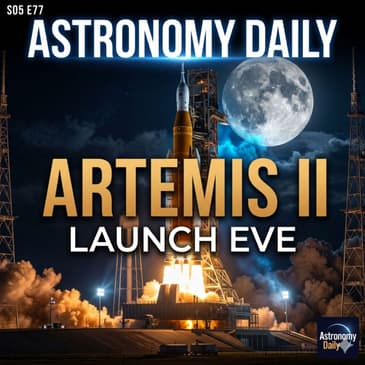
Hello, and welcome to Astronomy Daily. I'm Anna and I'm Avery. And if you're listening to this on the morning of Wednesday, the first of April, here in Australia, there is a rocket on a launch pad in Florida right now, fully fueled, fully crude, and pointed at the Moon. This is not an April fool's joke. Absolutely not. For the first time in over fifty years, human beings are preparing to leave Earth and head toward the Moon. And today, on this very special episode seventy seven of season five, we are your countdown companion. We have six stories for you today, and yes, Artemis two is front and center. But we've also got a record breaking space laser, a twelve billion year old comet, a star born from the ashes of the very first stars in the universe, and a new chapter in the mystery of Saturn's rings. It is, without question, one of the most extraordinary days in the history of human spaceflight. Let's go weave again. Where the world's attention is today Kennedy's Space Center, Cape Canaveral, Florida, where the countdown clock for NASA's Artemis two mission is ticking. At four forty four pm Eastern time yesterday. That's early this morning for our Australian listeners. NASA flight controllers started the official countdown. Liftoff is targeted at six twenty four pm Eastern, which is eight twenty four tomorrow morning AEDT. The crew has been in quarantine at the Neil Armstrong Operations and Checkout Building following a strict schedule of sleep, nutrition, and technical briefings. Commander Read Wiseman told reporters on the weekend, and I love this quote. Hey, let's go to the Moon. That is the energy we need. Wise men. Leads a crew of four Commander Read Wiseman, pilot Victor Glover, mission specialist Christina Cock, and Canadian astronaut Jeremy Hansen. Together they will become the first humans to travel to the vicinity of the Moon since Apollo seventeen in December nineteen seventy two. More than fifty three years. And this mission, Artemis two won't land on the Moon. It's a ten day test flight. The Orion capsule, launched aboard the Massive Space Launch System rocket, will perform a Figure eight trajectory out around the Moon, coming within about six thousand miles of the lunar surface on April sixth, then back to Earth for splashdown in the Pacific on approximately April eleven. The purpose is to stress test the Orion capsule's life support systems with humans on board for the first time. Everything they learn paves the way for Artemis three, now planned as a low Earth orbit docking test in twenty twenty seven and ultimately the first lunar landing since Apollo in twenty twenty eight. BASA Launch director Charlie Blackwell Thompson reported yesterday that the countdown run up has been quote extremely smooth, with only very minor ground equipment issues. Weather is currently forecast at eighty percent favorable. Some cloud cover and potential high winds on the ground are the primary concerns. And NASA has confirmed there's a six day launch window from April first through April six before the next opportunity opens at the end of the month, so there's some flexibility if they need it. For our Southern Hemisphere listeners. And this is genuinely moving. This is the moment our generation has been waiting for. The next chapter of human exploration of the Cosmos begins Thursday morning, April second, at nine twenty four am Australian Eastern time, and if in the US six twenty four pm Eastern daylight time on April first, which all translates to twenty two to twenty four UTC on April second. I hope I got all those conversions right. We will be watching every second now. There was a dramatic subplot to yesterday's launch preparations. The Sun decided to get involved. On Sunday night, a massive X one point four class solar flare erupted from an active sunspot region designated AR four four zero five. It peaked at just after eleven pm Eastern Time and triggered a significant high frequency radio blackout across the sunlit side of Earth, including, as it happens, parts of Southeast Asia and Northern Australias. Class flares are the most powerful category the Sun produces, and X one point four is serious business. The flare also launched a coronal mass ejection, a massive cloud of solar plasma with a possible Earth directed component. So NASA had something of an anxious Monday morning, but at the L minus two press conference, Associate Administrator Amic Kashatria gave everyone the all clear. Quote we're not expecting the CME to cause any effects. We're not tracking concerns for the mission in general. Artemis two is go for April first. Noah's Space Weather Prediction Center has issued a G two that's moderate geomagnetic storm watch for today, Tuesday, March thirty first, with G one minor storm conditions possible through launch day tomorrow. And here's the silver lining for our listeners. That geomagnetic activity means auroras could be visible at lower latitudes than usual tonight under G two conditions, the southern Aurora, the Aurora Australis may be visible further north than normal. Southern hemisphere Aurora watchers get outside tonight. We'll be watching the skies and the launch pad at the same time. All right, now, let's travel to the other end of the universe, because while everyone's been watching the launch pad, astronomers have spotted something extraordinary in the deep Cosmos. Scientists have discovered the most distant and most powerful natchal space laser ever detected. And I know that sounds like science fiction, but these things are very much real. They're called masers, the microwave equivalent of a laser, where a laser amplifies visible light. A maser amplifies microwave radiation. When a maser is powerful enough to be seen in other galaxies, it gets the name megamazer. And now astronomers have found something so powerful they're proposing an entirely new category. A gigamaser. The signal comes from a galaxy system designated Deep Breath Ha TLSJ one hundred forty two thousand, nine hundred thirty five point three minus two thousand, eight hundred thirty six, located approximately eight billion light years from Earth. The light we're detecting began its journey when the universe was barely half its current age. It was discovered by the mere Cat Radio Telescope ARRAT in South Africa, sixty four linked radio dishes working as one instrument. The detection was completely serendipitous. Team leader Tato Manamella from the University of Pretoria described it as quote, we are seeing the radio equivalent of a laser halfway across the universe. And the mechanism is spectacular. Two galaxies are colliding. The gravitational violence of the merger compresses enormous clouds of gas, triggering a burst of new star formation. The intense radiation from those newborn stars then excites hydroxyl molecules that's one oxygen atom bonded to one hydrogen atom, causing them to emit microwaves in a focused, amplified beam. The signal is so intense, roughly one hundred thousand times the luminosity of a star concentrated into a very narrow slice of the electromagnetic spectrum, that it warrants its own classification beyond megamser and it wouldn't even be visible without a stroke of cosmic luck. A completely unrelated four ground galaxy is perfectly aligned between the source and Earth, acting as a gravitational lens and amplifying the signal further. Bead researcher Monamela said, this is just the beginning. We don't want to find just one system. We want to find hundreds to thousands. The expectation is that when the square kilometer array comes fully online in South Africa, we'll start finding these gigamasers across cosmic history. The universe is remarkable. From one ancient signal to another. Our old friend, the interstellar comet three I Atlas, has just revealed a staggering secret about its age. We've been following three i at Lists since it was discovered back in July twenty twenty five, the third known interstellar object to pass through our Solar system. It's swung around the Sun, caused enormous excitements, and now it's heading back out toward Jupiter and beyond. But new analysis using data the James Web Space Telescope has given scientists a remarkable new insight. By examining the isotopic composition of gases out gassing from the comet, specifically the ratio of carbon twelve to carbon thirteen, and the deuterium content of its water. Researchers now believe three i at Lists may be between ten and twelve billion years old. Let that sink in our Sun is four point six billion years old. Earth is four point five billion years old. This comet may have formed nearly three times earlier than that in the very earliest epoch of the Milky Way's history, when the galaxy was first igniting with star formation. The chemical signature tells the story. Three idsh Atls's water contains more deuterium, a heavier form of hydrogen, than any comet previously studied. Its carbon isotope ratios are also markedly different from anything in our Solar system. These signatures point to formation in an extremely cold environment around thirty kelvin that's minus two hundred and forty three degrees celsius in the early metal poor protoplanetary disk of some ancient, long vanished star. And here's the haunting part. The star that gave birth to this comment. The star it originally orbited almost certainly no longer exists. It would have burned through its nuclear fuel and dyed billions of years ago. Three I slash Atls has been drifting through interstellar space alone for longer than our planet has existed. Researcher Romaine Maggiola of the Royal Belgian Institute for Space Aeronomy put it beautifully. He said, if three I dash ATLS is indeed as old as this study suggests, the large amounts of volatile molecules it contains indicate that rich prebiotic chemistry may have already been occurring in star forming reas engens very early in the history of our galaxy. A comet as a time capsule from the dawn of the Milky Way. We may never get another chance to study one like this in Staying. With the theme of ancient messengers, astronomers have found a star in our own cosmic backyard that preserves the chemical fingerprint of the very first stars that ever existed. The star is called Pictor II five oh three, and it lives in an ultra faint dwarf galaxy called Pictor two, about one hundred and fifty thousand light years from Earth, which in cosmic terms is practically next door. The galaxy itself is more than ten billion years old. Pictori five o three is what astronomers call a second generation star, meaning it formed from the debris of the very first stars in the universe. Those first stars, made almost entirely of hydrogen and helium, burned hot and fast, and exploded in supernovae, scattering the first heavier elements into the cosmos. Pictori five oh three formed from that debris. The evidence is unmistakable. The star contains less iron than any other star ever measured outside the Milky Way, less than a forty thousandth the iron content of our Sun, and it's enormously rich in carbon. That specific chemical signature is the hallmark of material enriched by the first generation of stellar explosions. The discovery, published in Nature Astronomy in March, was led by Annie Ruth Cheaty, a Brinson Prize fellow at Stanford University. It used the dark energy camera at the Victor M. Blanco four meter telescope at Saro Tolo Interamerican Observatory in Chile. So this is beautifully a Southern hemisphere discovery. MIT astrophysicist Anna Frable, who was not involved in study, told Science News, it's a fantastic discovery. I know how hard it is to find these stars. They are so so rare. What's making this particularly significant is that Pictor II five O three is the first unambiguous example of a second generation star found inside an ultra faint dwarf galaxy like Pictor two, which matters because it validates the theory that many of the most primitive stars we see in the Milky Ways halo were originally formed in tiny, ancient dwarf galaxies like Pictor two, which eventually merged with our own galaxy over cosmic time. As NSF program director Chris Davis put it, discoveries like this are cosmic archaeology, uncovering rare stellar fossils that preserve the fingerprints of the universe's first stars. I love that phrase cosmic archaeology. And we close today with Saturn, because who doesn't love Saturn and a fresh new chapter in one of planetary science's best mysteries, Where did those magnificent rings come from? Saturn's rings are one of the most iconic sites in the Solar System. But here's a thing. They're surprisingly young. Saturn itself is over four and a half billion years old, but its rings appear to be only somewhere between one hundred million and a few hundred million years old. The question has always been why are they so young? New research presented at the Lunar and Planetary Science Conference in Texas this month adds compelling new weight to what's become the leading hypothesis that the rings were created when Saturn destroyed one of its own moons. The hypothetical moon has been named Chrysalis, a beautiful name because it transformed into something else entirely. The scenario, led by Ye Feijao of the University of California, Santa Cruz, goes like this, Sometime between one hundred and two hundred million years ago, the orbit of Chrysalis became gravitationally destabilized, sending it on a fatal trajectory towards Saturn. Saturn's tidal forces then went to work. The simulations show that the planet would have preferentially stripped away the Moon's icy outer mantle, while leaving much of its denser, rocky core intact. That distinction is crucial because it explains a long standing puzzle, why are Saturn's rings composed almost entirely of water ice with almost no rock? Because the rock sank into Saturn and the ice became the rings. The stripped icy material remained in orbit was gradually shaped and sculpted by the gravitational influence of Saturn's larger moons, particularly tighten and spread into the magnificent ring system we see today. And there's a bonus explanation. Saturn has a surprisingly steep axial tilt. It's tilted about twenty six point seven degrees. The loss of Chrysalis is thought to have been the gravitational trigger that knocked Saturn out of a resonance with Neptune, which had been controlling its tilt for billions of years. Lose the Moon, lose the resonance, and the tilt changes. As lead researcher jowtoldspace dot Com this scenario can clearly explain why Saturn's rings are young. It's one of those moments where a single event, a moon falling to its doom, explains multiple mysteries at once. Chrysalis the moon that became a butterfly, or in this case, one of the most breathtaking sights in the Solar System. And that is your Astronomy Daily for today, episode seventy seven of season five, What a day to be a space fan. Tomorrow, if all goes to plan, four human beings will ride fire into the sky and begin the journey to the Moon for the first time since nineteen seventy two. It's hard to fully comprehend what that means. We'll be back as soon as we can with launch coverage. In the meantime. If you're in Australia or New Zealand tonight, look south. There may be Aurora's. And if you're watching the launch and you feel a lump in your throat when that rocket clears the tower, that's exactly the right reaction from. Anna and me. This is Astronomy Daily. Your skies, everyone, Sunny Day Star is the troll Star is The toll Star is the