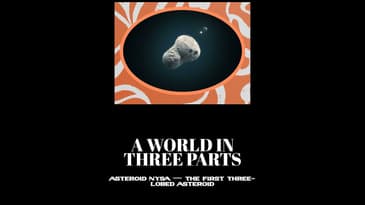
S05E155 · Friday 31 July 2026 · Astronomy Daily with Anna & Avery. Four stories and a both-hemispheres skywatch. Australian English. ① Asteroid (44) Nysa — the first three-lobed world, and its hidden moon ● trilobate body — three lobes joined by two narrow necks; a candidate “first” of its kind. ● A new ~1 km moon, S/2026 (44) 1, was found orbiting ≥170 km out — spotted using high-contrast imaging borrowed from exoplanet work, and confirmed moving across two observing runs. ● The moon lets astronomers weigh Nysa (mass → density), which should help decide between a genuine contact-trinary and a single, deeply indented body. ● Nysa is a bright, main-belt E-type (enstatite-rich) asteroid, ~75 km across, known since 1857. ● Source: Lowell Observatory / University of Arizona press release, 29 Jul 2026; study “Unmasking (44) Nysa: Evidence for a Trilobate Structure” (Minker et al.). Coverage: Space.com, Gizmodo, 29–30 Jul 2026. ② Mapping Alien Continents — a NASA concept to image an exoplanet’s surface ● NASA’s 2026 NIAC round funds 18 early-stage “visionary” concepts (~$175k each, 9 months). These are seed studies, not missions. ● Paul Stankus (Brookhaven) proposes “Mapping Alien Continents”: resolve the surface of an Earth-like exoplanet — continents, oceans — in visible light. ● Method: a novel “dynamic hierarchical nulling” interferometer to suppress starlight at 10¹⁰-to-1 contrast, then combine beams from two spacecraft ~100 km apart (optical VLBI-style imaging). ● Source: NASA “2026 Innovative Technology Concepts” release and NIAC selections (posted 21 Jul; consolidated release ~29 Jul 2026); Universe Today feature, 30 Jul 2026. ③ Solar-storm watch — CMEs inbound, minor-storm and aurora potential ● Two faint coronal mass ejections, plus coronal-hole solar wind, are set to give Earth glancing blows; forecasters flag possible G1 (minor) geomagnetic storms and auroras over the coming days. ● G1 means little grid impact but aurora visible at somewhat lower latitudes than usual — see the skywatch for where to look, both hemispheres. ● Source: NOAA SWPC (WSA-ENLIL model); EarthSky / The Sun Today, 30 Jul 2026. ④ ESCAPADE’s family portrait of Earth and the Moon ● NASA’s twin Mars orbiters (“Blue” and “Gold,” built by Rocket Lab) imaged Earth and the Moon as thin crescents in visible and thermal-infrared light from a loiter orbit near Sun–Earth L2. ● In infrared, Earth’s night side glows with its own heat; the Moon’s shadowed half is far colder — a calibration check before Mars. ● ESCAPADE’s science goal (arrival Sept 2027): measure how the solar wind strips Mars’s unshielded atmosphere — the payoff of today’s solar-wind thread. ● Source: NASA (Goddard) image feature, ~25 Jul 2026 (images captured 3 Jul); NAU / phys.org; Universe Today, 29 Jul 2026. Skywatch — both hemispheres ● Bright waning-gibbous Moon (post-Buck-Moon, 29 Jul) washes out faint targets. ● Southern Delta Aquariids + Alpha Capricornids just past peak (SH-favoured; Moon-hampered). Perseids build to a near-moonless peak on the night of 12–13 Aug — prime for North America, low in the north for the SH. ● 12 Aug total solar eclipse: totality across Greenland / Iceland / Spain; partial for parts of northern North America and Europe. ISO 12312-2 eye protection required for any partial phase. ● Pre-dawn planets low in the east (Sydney and North American framing). Aurora watch for high latitudes both hemispheres if the storms land. ● Diary: a spent Falcon 9 upper stage (2025-010D) is predicted to hit the Moon near Einstein Crater on 5 Aug 2026, ~06:35 UTC (~2:34 a.m. ET). North America best-timed; telescope needed, Moon ~56% lit, target the limb dust plume. From Sydney the Moon is down at impact — rely on LRO after-images. Callback to E125/E147. Source: Fernando et al., arXiv 2607.14625.
Sponsor Details: Ensure your online privacy by using NordVPN. To get our special listener deal and save a lot of money, visit www.astronomydaily.io/nordvpn. (https://www.astronomydaily.io/nordvpn) You'll be glad you did!
Get the best secure and private email on the planet. Stop your Government, google and who knows who else spying on every email you write. Do what we did and use ProtonMail. They beleive in privacy and there are no ads in their business model...yet they still provide a free forever service. Check them out and get out special deal at www.astronomydaily.io/protonmail (https://www.astronomydaily.io/protonmail)
Become a supporter of Astronomy Daily by joining our Supporters Club. Commercial free episodes daily are only a click way... Click Here (https://www.s...