
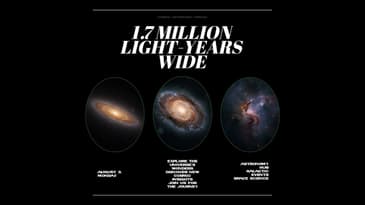
In this episode • The largest galaxy, measured at last. Ultra-deep imaging of IC 1101 in the Abell 2029 cluster has traced its outer edge for the first time: an edge radius of ~260 kpc, a diameter near 520 kpc (~1.7 million light-years), and ~3.4 trillion solar masses in stars — about 17× the width of the Milky Way. Faint outer structures aligned with cluster X-ray disturbances show it is still accreting. Source: Marrero-de la Rosa et al., “How large can galaxies be? Ultra-deep imaging of IC 1101”, accepted A&A (arXiv:2607.15340, 16 Jul 2026); phys.org, 31 Jul 2026; The Debrief, 1 Aug 2026. • Hayabusa2's record asteroid flyby. JAXA confirmed (press conference 30 Jul) that its Hayabusa2 probe passed just 400 m from the surface of near-Earth asteroid Torifune on 5 July — 744 m from centre at >18,000 km/h — the closest asteroid flyby by any mission, plus the first-ever laser ranging of an asteroid during a flyby. Torifune proved to be a contact binary. Source: JAXA press conference, 30 Jul 2026; phys.org / Japan Today (AFP), 31 Jul 2026; autoevolution, 1 Aug 2026. • UK's first orbital launch on hold. Rocket Factory Augsburg de-stacked its RFA One at SaxaVord Spaceport (Unst, Shetland) after finding a vehicle issue during hot-fire test prep (announced 28 Jul). The certified launch window opens 10 August; a successful flight would be the first orbital launch from UK soil. Source: RFA statement (X), 28 Jul 2026; Space.com, 1 Aug 2026; Shetland Times, 28 Jul 2026. • Andromeda is winding down. A new Hubble study mapping ~200 million stars across two-thirds of Andromeda's disk finds star formation has declined over ~500 million years (from ~1 to ~0.2 solar masses/year), with the steepest drop in the last 40 million years — possibly linked to an interaction with satellite galaxy M32. Source: Williams et al., The Astrophysical Journal, 27 Jul 2026; NASA/STScI release, 27 Jul 2026. Skywatch — both hemispheres • Comet 10P/Tempel 2 — perihelion 2 Aug; closest approach to Earth tonight (3 Aug). Binoculars/small scope, dark skies. Best pre-dawn from the Southern Hemisphere; ~9:30–10:30 pm local for mid-northern latitudes before moonrise. • Moon near Saturn tonight (3 Aug) — naked-eye pairing, both hemispheres, up into dawn. • Mercury at greatest western elongation (2 Aug) — low eastern horizon ~1 hr before sunrise, toward Gemini; Mars higher. Better placed for northern observers. • Diary (2 days out): Falcon 9 upper stage (2025-010D) lunar impact near Einstein Crater, 5 Aug ~06:35 UTC — ~2:35 am EDT / 11:35 pm PDT (4 Aug); North America best-timed on the dark limb. Southern Hemisphere: ~4:35 pm AEST (daylight) — await orbiter after-images. • Looking ahead: 12 Aug total solar eclipse (Greenland/Iceland/Spain) + moonless Perseid peak + six-planet dawn alignment. View partial phases only through certified ISO 12312-2 filters. Links & follow • Website, back catalogue, news feed & newsletter: astronomydaily.io • Social: @AstroDailyPod · Part of the Bitesz.com Podcast Network
Become a supporter of this podcast: https://www.spreaker.com/podcast/astronomy-daily-latest-space-news--5648921/support (https://www.spreaker.com/podcast/astronomy-daily-latest-space-news--5648921/support?utm_source=rss&utm_medium=rss&utm_campaign=rss) .
Sponsor Details:
Ensure your online privacy by using NordVPN. To get our special listener deal and save a lot of money, visit www.astronomydaily.io/nordvpn. (https://www.astronomydaily.io/nordvpn) You'll be glad you did!
Get the best secure and private email on the planet. Stop your Government, google and who knows who else spying on every email you write. Do what we did and use ProtonMail. They beleive in privacy and there are no ads in their business model...yet they still provide a free forever service. Check them out and get out special deal at www.astronomydaily.io/protonmail (https://www.astronomydaily.io/protonmail)
Become a supporter of Astronomy Daily by joining our Supporters Club. Commercial free episodes daily are only a click way... Click Here (https://www.spreaker.com/podcast/astronomy-daily-space-news-updates--5648921/support)
This episode includes AI-generated content.