In today's episode of Astronomy Daily (January 28, 2026), hosts Anna and Avery cover:
🛰️ NOAA SOLAR OBSERVATORY REACHES L1
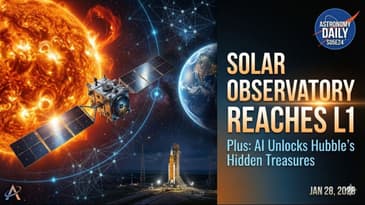
The Space Weather Follow-On satellite has arrived at Lagrange point 1, positioned 1.5 million km from Earth to provide 15-60 minutes advance warning of dangerous solar storms and coronal mass ejections. This is the first of a planned constellation that will revolutionize space weather forecasting and protect critical infrastructure from solar events.
🚀 CHALLENGER DISASTER: 40 YEARS OF LESSONS
On this solemn anniversary, we examine how unseasonably cold weather and O-ring failures led to the loss of seven crew members on January 28, 1986. The tragedy fundamentally transformed NASA's safety culture and decision-making processes—lessons that continue influencing spaceflight today, including the Artemis program.
🤖 AI DISCOVERS HUNDREDS OF COSMIC ANOMALIES
Advanced artificial intelligence algorithms have identified hundreds of previously undetected gravitational lenses in Hubble Space Telescope archives. These discoveries include rare Einstein rings and exotic configurations that provide windows into the early universe and dark matter distribution.
☄️ VENUS METEOR SHOWER PREDICTED FOR JULY 2026
Astronomers calculate that Venus may experience a spectacular meteor shower this July from debris of asteroid 2002 VT37—a rare opportunity to study how meteor showers interact with Venus's dense atmosphere.
🌌 STELLAR FIREWORKS AT THE GALACTIC CENTER
New multi-wavelength observations reveal intense activity near Sagittarius A*, our galaxy's supermassive black hole, including star formation, supernovae, and dramatic tidal disruption events.
📡 ARTEMIS 2 ROCKET: 24-HOUR LIVESTREAM
NASA has launched a continuous livestream of the Artemis 2 Space Launch System rocket on Launch Pad 39B as preparations continue for the first crewed lunar mission since Apollo 17.
⏱️ TIMESTAMPS:
00:00 - Introduction
01:15 - NOAA Solar Observatory Reaches L1
04:42 - Challenger Disaster: 40 Years Later
08:18 - AI Unlocks Hubble's Hidden Treasures
11:35 - Venus's Potential Meteor Shower
13:47 - Stellar Fireworks at Galactic Center
16:22 - Watch Artemis 2 Rocket Live
18:40 - Wrap-up & Credits
🔗 STORY SOURCES & FURTHER READING:
- NOAA L1 Observatory: https://spacenews.com/noaa-solar-observatory-reaches-lagrange-point-1/
- Challenger Weather Analysis: https://spectrumlocalnews.com/nc/charlotte/news/2026/01/26/space-shuttle-challenger-disaster-weather
- Hubble AI Discoveries: https://science.nasa.gov/missions/hubble/ai-unlocks-hundreds-of-cosmic-anomalies-in-hubble-archive/
- Venus Meteor Shower: https://www.space.com/astronomy/venus/venus-may-get-a-huge-meteor-shower-this-july-thanks-to-a-long-ago-asteroid-breakup