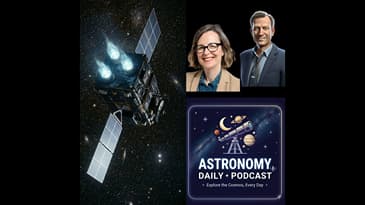
HERA's Grand Maneuver: Braking for Didymos and the Future of Planetary Defence
Show notes Hera Hits the Brakes ESA's Hera spotted its target asteroid for the first time last week and fires its first braking burn on Thursday — 93 minutes of thrust to start stopping at Didymos and Dimorphos, the asteroid pair NASA's DART hit in 2022. Plus: Solar Orbiter traces a solar-wind switchback back to the Sun, Gemini North finds chains of giant knots in the remnant of the supernova of 1181, Webb reads the dust of Mars-sized worlds colliding, and Perseverance becomes the farthest-driving vehicle on another world. In the skywatch: the Moon meets Antares, Venus bows out, Mars and Jupiter rule the northern dawn, and the Orionids are a week away. Hera Hits the Brakes Two years after launch, Hera caught its first glimpse of Didymos from about 236,500 km away — a sub-pixel dot. On Thursday 15 October three hydrazine thrusters fire for 93 minutes (BRM-1), taking a few hundred metres per second off its approach speed; BRM-2 (~31 min) follows on 22 October, then three small transition burns. The first signal after the burn comes through ESA's New Norcia antennas in Western Australia. Hera will measure the mass of Dimorphos so DART's single orbital-period result can become a repeatable deflection technique; its CubeSats Milani and Juventas will study dust, composition and the interior. Solar Orbiter traces a switchback home Coburn et al. (Nature Astronomy, 8 Oct) used heavy-ion charge states measured inside a large switchback crossed on 2 March 2022 to show it formed by interchange reconnection in hot closed loops at the Sun's surface — with waves and turbulence taking over once it left. Both leading theories are right, at different stages. The supernova of 1181 is strung with pearls Cunningham, Caiazzo et al. (ApJ, 6 Oct) used Gemini North/GMOS to show that Pa 30's radial filaments are chains of knots ~100 billion km across. Pa 30 is the Milky Way's only known Type Iax remnant, with a surviving 'zombie' star. The knots constrain models but don't yet settle what formed them. Webb reads the wreckage of colliding worlds Su et al. (ApJ, 1 Oct) studied 21 extreme debris disks with Webb and Spitzer. About a third are silica-rich, consistent with collisions between Mars-sized planetary embryos; older systems should be silica-poor. Quick hit: Perseverance's driving record On 11 October (sol 2,006) Perseverance reached 45.22 km, passing Opportunity's 45.16 km. More than 90% of the distance was driven on AutoNav. Sources · Hera braking campaign (ESA, 7 Oct 2026) — https://www.esa.int/Space_Safety/Hera/Brake!_Time_for_ESA_s_Hera_asteroid_mission_to_go_slow · Hera's first glimpse of Didymos (ESA, 7 Oct 2026) — https://www.esa.int/ESA_Multimedia/Images/2026/10/Destination_sighted_Hera_s_first_glimpse_of_Didymos · Finding Hera's way: Flight Dynamics team in action (ESA, 7 Oct 2026) — https://www.esa.int/Space_Safety/Hera/Finding_Hera_s_way_Flight_Dynamics_team_in_action · Solar Orbiter tracks origin of magnetic switchbacks (ESA, 8 Oct 2026) — https://www.esa.int/Science_Exploration/Space_Science/Solar_Orbiter/Solar_Orbiter_tracks_origin_of_mysterious_magnetic_switchbacks · Coburn et al., Nature Astronomy, DOI 10.1038/s41550-026-02928-0 — https://www.nature.com/articles/s41550-026-02928-0 · Gemini North reveals pearl-like knots in Pa 30 (NOIRLab, 6 Oct 2026) — https://noirlab.edu/public/news/noirlab2624/ · NASA's Webb provides crash course on planet-shattering collisions (NASA) — https://science.nasa.gov/missions/webb/nasas-webb-provides-crash-course-on-planet-shattering-collisions/ · Su et al., ApJ 1010:1, DOI 10.3847/1538-4357/ae88fe — https://doi.org/10.3847/1538-4357/ae88fe · Perseverance sets off-world record for total distance driven (JPL, 12 Oct 2026) — https://www.jpl.nasa.gov/news/nasas-perseverance-sets-off-world-record-for-total-distance-driven/
Sponsor Details: Ensure your online privacy by using NordVPN. To get our special listener deal and save a lot of money, visit www.astronomydaily.io/nordvpn. (https://www.astronomydaily.io/nordvpn) You'll be glad you did!
Get the best secure and private email on the planet. Stop your Government, google and who knows who else spying on every email you write. Do what we did and use ProtonMail. They beleive in privacy and there are no ads in their business model...yet they still provide a free forever service. Check them out and get out special deal at www.astronomydaily.io/protonmail (https://www.astronomydaily.io/protonmail)