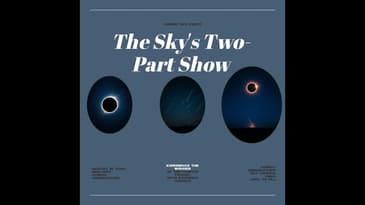
Astronomy Daily · S05E164 “Eclipse Eve” · Tuesday 11 August 2026. Sources are primary/agency where possible; aggregator dates were checked against originals. In this episode • LEAD — The 12 August total solar eclipse: the only total eclipse of 2026 and the first over mainland Europe since 1999. Totality arcs from Siberia over the North Pole to eastern Greenland, western Iceland, northern Spain and a sliver of Portugal; maximum totality ~2 min 18 s. Partial for much of North America near sunset; not visible from Australia. ESA livestreams from the Javalambre Observatory, Spain. • MIDDLE 1 — A state CASC Long March 7A exploded ~85 seconds after lifting off from Wenchang on 10 August, a total loss (payload reported as the Zhongxing-4B communications satellite). Separately, Landspace’s private Zhuque-3 was on the same-night manifest from Jiuquan for its second propulsive landing-legs recovery attempt — outcome unconfirmed at recording. China’s first orbital-booster landing (net-capture, Long March 10B) already succeeded on 10 July. • MIDDLE 2 — The Perseids peak overnight 12–13 August under a New Moon — the darkest conditions in roughly two decades. Parent comet 109P/Swift-Tuttle. Realistic ~30–50 meteors/hr from dark sites (nominal ~100), with a slim chance of a dust-trail boost; the next confidently forecast outburst is 2028. • MIDDLE 3 — Japan’s H3 launched Michibiki No. 7 (QZS-7) from Tanegashima, bringing the Quasi-Zenith Satellite System up to the strength Japan needs to run it as a standalone service — a regional navigation layer that keeps a satellite near the zenith over Japan/Asia-Pacific, reinforcing GPS and building navigation resilience. The satellite also hosts a US Space Force space-surveillance sensor (SACHI). • CLOSER — Both-hemispheres skywatch: eclipse viewing times (totality window ~16:58–18:34 UT, greatest ~17:46 UT) and the ISO 12312-2 eye-safety rule; Perseid how-to for the North (best 2 a.m.–dawn); and Southern-Hemisphere content — pre-dawn planets, evening Venus, Comet 10P/Tempel 2. Eye safety • A partial eclipse is never safe to view with the naked eye. Use ISO 12312-2 certified eclipse glasses/viewers, or indirect projection (pinhole). Direct viewing is only safe during true totality, and only inside the path (Greenland, Iceland, Spain). Links • astronomydaily.io — full back-catalogue, daily news feed, listener reviews, newsletter sign-up, contact form • @AstroDailyPod on your platform of choice
Sponsor Details: Ensure your online privacy by using NordVPN. To get our special listener deal and save a lot of money, visit www.astronomydaily.io/nordvpn. (https://www.astronomydaily.io/nordvpn) You'll be glad you did!
Get the best secure and private email on the planet. Stop your Government, google and who knows who else spying on every email you write. Do what we did and use ProtonMail. They beleive in privacy and there are no ads in their business model...yet they still provide a free forever service. Check them out and get out special deal at www.astronomydaily.io/protonmail (https://www.astronomydaily.io/protonmail)