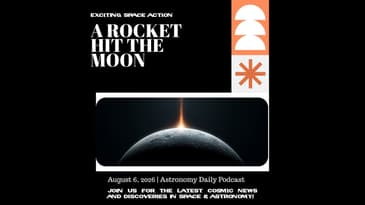
A Rocket Just Hit the Moon — And Telescopes Caught It
Astronomy Daily · S05E160 · 6 August 2026. In this episode: a Falcon 9 upper stage confirmed to have struck the Moon; a live ISS spacewalk; supernova SN 2026gzf caught at first light; SpaceX Crew-13 previewed; and a both-hemispheres guide to the 12 August eclipse and Perseids. FALCON 9 LUNAR IMPACT (LEAD) ● Spent upper stage 2025-010D struck near Einstein Crater (~19.4°N, 93.3°W) at ~06:35 UTC, 5 Aug 2026 — matching Bill Gray / Project Pluto predictions. ● ESO’s Very Large Telescope (Paranal) detected sodium and lithium in the impact plume for ~5–10 minutes — sodium from lunar soil, lithium likely from the rocket. ● NASA’s Lunar Reconnaissance Orbiter holds a pre-impact baseline and will image the fresh crater, giving a rare before-and-after dataset to validate hollow-body impact models for future landers. ● Origin: Falcon 9 launched 15 Jan 2025 with Firefly Blue Ghost 1 and ispace Resilience; the stage was left adrift and returned unplanned via solar activity and gravity. ● Sources: NASA; ESO / VLT; CNN; Project Pluto (projectpluto.com); Fernando et al., arXiv:2607.14625. ISS SPACEWALK — U.S. EVA 96 ● NASA’s Jessica Meir (Expedition 75 commander) and Anil Menon; ~6.5 h EVA beginning ~08:35 EDT, 6 Aug; live on NASA+. ● Task: reconfigure the 3B power channel to accept a seventh roll-out solar array later in 2026 — part of station upkeep ahead of the planned 2030 deorbit. ● Menon’s first spacewalk; two further EVAs scheduled 13 and 25 Aug. ● Sources: NASA / NASA+ ; NASA ISS blog. SUPERNOVA SN 2026GZF ● X-ray “shock breakout” (EP260321a) detected by China’s Einstein Probe on 21 Mar 2026 from a galaxy ~500 million light-years away; follow-up revealed a broad-lined Type Ic supernova. ● Unusually, no gamma-ray burst and no lasting relativistic jet — and the faintest shock breakout yet linked to this class; a possible missing link between ordinary and GRB-producing supernovae. ● Follow-up used NSF NOIRLab facilities including DECam and the Vera C. Rubin Observatory. Two teams: O’Connor et al. (CMU) and Rastinejad et al. (UMD), in ApJL. ● Sources: NSF NOIRLab; Carnegie Mellon University; The Astrophysical Journal Letters. SPACEX CREW-13 ● Targeting NET 12 Sep 2026 aboard Crew Dragon Grace from SLC-40, Cape Canaveral. ● Crew: Jessica Watkins (NASA, cmdr — first NASA astronaut to fly Dragon twice), Luke Delaney (NASA, pilot), Joshua Kutryk (CSA), Sergey Teteryatnikov (Roscosmos). 180-day stay; moved up from November. ● Sources: NASA; SpaceX; Houston Public Media. SKYWATCH — 12 AUGUST & BEYOND ● Total solar eclipse 12 Aug: totality across E Greenland, W Iceland, N Spain and NE Portugal (max 2m18s). Partial across northern US (Alaska–N Carolina), most of Canada, much of Europe and NW Africa. NASA livestream from 1:15 pm EDT. ● US partial highlights: Presque Isle ME ~29% (contiguous-US max); NYC ~9% from ~1:07 pm EDT; Boston ~16%; Toronto ~8%; Montreal ~18%; St John’s ~53%. ● Perseids peak 12–13 Aug under a new Moon (northern-favoured, up to ~100/hr from dark northern sites). ● Southern Hemisphere: pre-dawn planet parade (Saturn best, near opposition; Mars, Mercury, Uranus, Neptune), brilliant Venus in the evening west, and the winter Milky Way high overhead. ● Look-ahead: deep partial lunar eclipse 28 Aug (96% umbral), favouring the Americas. ● SAFETY: use only ISO 12312-2 certified eclipse glasses / solar filters during any partial phase. ● Sources: NASA; ESA; Sky & Telescope; BBC Sky at Night; EarthSky; timeanddate.com; The Planetary Society.
Sponsor Details: Ensure your online privacy by using NordVPN. To get our special listener deal and save a lot of money, visit www.astronomydaily.io/nordvpn. (https://www.astronomydaily.io/nordvpn) You'll be glad you did!
Get the best secure and private email on the planet. Stop your Government, google and who knows who else spying on every email you write. Do what we did and use ProtonMail. They beleive in privacy and there are no ads in their business model...yet they still provide a free forever service. Check them out and get out special deal at www.astronomydaily.io/protonmail (https://www.astronomydaily.io/protonmail)