
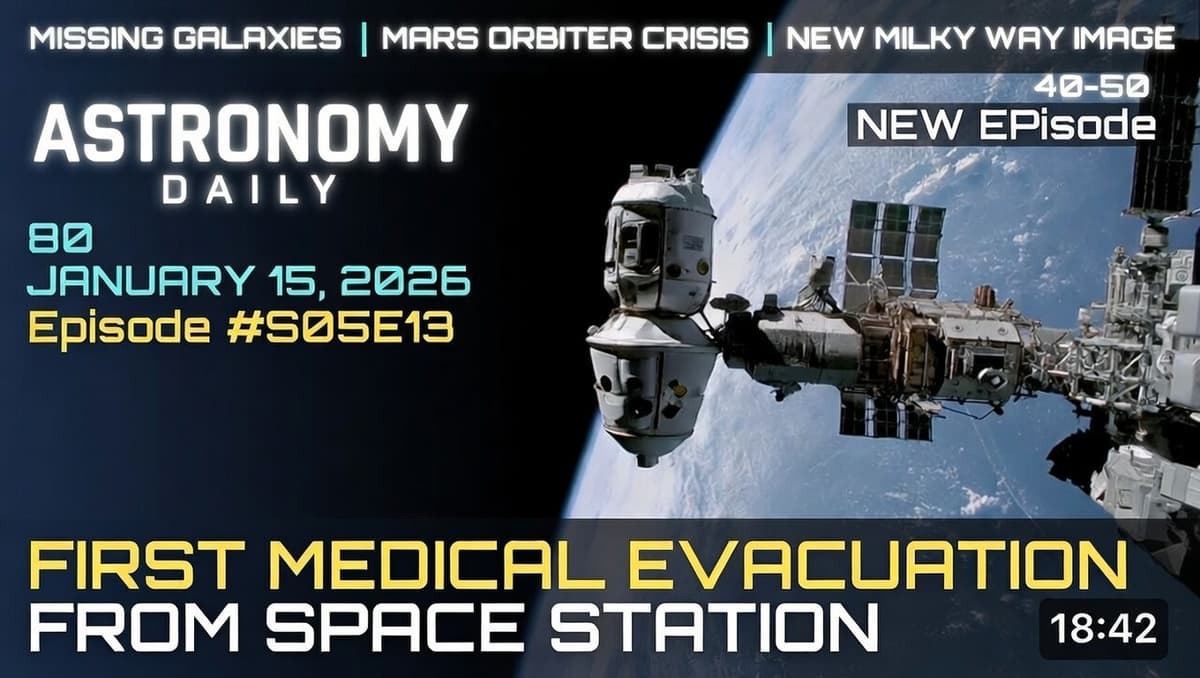
Today's episode of Astronomy Daily (S05E13) brings you breaking news from space exploration and astronomy research. From the historic first-ever medical evacuation from the International Space Station to groundbreaking discoveries about our universe's structure, we're covering six major stories that are shaping our understanding of the cosmos.
In This Episode:
🚀 Historic ISS medical evacuation brings crew home safely
🌌 James Webb Telescope reveals universe's missing tiny galaxies
🔴 NASA's MAVEN Mars orbiter faces uncertain future
🦠 Viruses behave differently in space—with potential Earth benefits
🪐 Two new exoplanets challenge our definition of habitable zones
📡 Most detailed radio image of Milky Way reveals hidden structures
1. Historic Medical Evacuation from International Space Station
In an unprecedented event marking a first in the International Space Station's 26-year history, four crew members successfully completed a medical evacuation, splashing down safely in the Pacific Ocean off the coast of San Diego at 12:41 AM Eastern Time on January 15, 2026.
The Crew and Mission Details
The SpaceX Crew-11 mission included:
Mike Fincke (USA) - Pilot
Zena Cardman (USA) - Mission Specialist
Oleg Platonov (Russia) - Cosmonaut
Kimiya Yui (Japan) - Astronaut
After spending five months aboard the ISS, the crew's mission was cut short due to a medical issue affecting one of the crew members. While NASA has maintained privacy regarding the specific health concern, officials emphasized that the situation was not an emergency and that the affected crew member "was and continues to be in stable condition."
A Deliberate Decision for Comprehensive Care
Mike Fincke addressed concerns via social media earlier in the week, stating: "First and foremost, we are all OK. Everyone on board is stable, safe, and well cared for. This was a deliberate decision to allow the right medical evaluations to happen on the ground, where the full range of diagnostic capability exists."
Dr. James Polk, NASA's Chief Health and Medical Officer, explained that "lingering risk" and uncertainty about the diagnosis led to the decision to return the crew earlier than their originally scheduled mid-February rotation.
Continuing ISS Operations
Three crew members remained aboard the station to maintain operations:
Chris Williams (USA)
Sergey Kud-Sverchkov (Russia)
Sergei Mikaev (Russia)
These astronauts arrived at the ISS in November 2025 aboard a Russian Soyuz spacecraft and will continue scientific research and station maintenance until the next crew rotation.
What This Means for Space Medicine
This first-ever medical evacuation highlights the sophisticated medical protocols and training that have been developed for long-duration spaceflight. Senior NASA official Amit Kshatriya praised the crew's handling of the unexpected situation, noting their extensive training in medical emergency procedures.
As space agencies plan longer missions to the Moon and eventually Mars, understanding how to handle medical emergencies in space becomes increasingly critical. This event will likely inform future mission planning and medical preparedness protocols.
2. The Mystery of the Universe's Missing Tiny Galaxies
A groundbreaking study using the James Webb Space Telescope (JWST) has uncovered a cosmic mystery: the early universe appears to have far fewer small galaxies than astronomers predicted, challenging fundamental theories about how the cosmos evolved.
Peering Into Cosmic History
Led by Xuheng Ma from the University of Wisconsin-Madison, the research team utilized JWST's UNCOVER program to observe galaxies from the Epoch of Reionization—a transformative period roughly 12 to 13 billion years ago when the first stars and galaxies began flooding the universe with ultraviolet light.
The team employed a clever technique, using the massive galaxy cluster Abell 2744 as a natural gravitational lens. This cluster's immense gravity warps space-time, bending and magnifying light from more distant objects—essentially creating a cosmic magnifying glass that allows astronomers to see galaxies that would otherwise be too faint to detect.
The Unexpected Discovery: Faint-End Suppression
For years, astronomers operated under a straightforward assumption: the smaller the galaxy, the more of them should exist. This pattern, visualized through what scientists call a "luminosity function," had held true across countless observations. But the new JWST data revealed something different.
Instead of the expected continuous increase in galaxy numbers as you move toward smaller, dimmer galaxies, the team discovered that below a certain brightness threshold, galaxy populations actually decrease. Researchers call this phenomenon "faint-end suppression."
Where Did the Baby Galaxies Go?
The most likely explanation is a case of "cosmic bullying." In the early universe, intense radiation from the first massive stars heated surrounding gas clouds to extreme temperatures. Small, low-mass galaxies couldn't generate enough gravitational pull to hold onto this superheated gas. Without gas, they couldn't form new stars, and without stars, they remained dark and effectively invisible.
These galaxies didn't disappear—they became cosmic ghosts, unable to grow and shine.
Implications for Cosmic Dawn
This discovery has profound implications for our understanding of the Epoch of Reionization. Scientists previously believed that tiny, ultrafaint galaxies were the primary engines driving this crucial transformation, providing the bulk of radiation needed to ionize hydrogen throughout the universe and clear the cosmic fog.
If these small galaxies are missing, astronomers must reconsider which objects powered this fundamental phase of cosmic evolution. Slightly larger, more established galaxies may have played a more dominant role than previously thought.
What's Next?
The findings depend heavily on understanding the gravitational lens effect of Abell 2744. Future observations of additional galaxy clusters will help determine whether this is a universal pattern or a localized phenomenon. With JWST continuing its survey work and upcoming facilities coming online, we'll soon know if the universe's baby galaxies are hiding or if they never existed in the numbers we expected.
3. NASA Pessimistic About Recovering MAVEN Mars Orbiter
NASA officials have acknowledged that recovering the MAVEN (Mars Atmosphere and Volatile Evolution) spacecraft is "very unlikely," marking a potential end to one of the agency's most productive Mars missions.
Timeline of the Crisis
MAVEN last communicated with Earth on December 6, 2025, after passing behind Mars as seen from Earth—a routine occurrence that spacecraft regularly navigate without incident. When the orbiter emerged from behind the Red Planet, NASA's Deep Space Network detected no signal.
Analysis of a brief fragment of tracking data recovered from a December 6 radio science experiment revealed troubling information: the spacecraft appeared to be tumbling and may no longer be in its planned orbit.
Recovery Efforts and Challenges
NASA has employed multiple strategies to reestablish contact:
Deep Space Network Monitoring: The agency's global array of giant radio antennas has continuously sent commands to MAVEN while monitoring for any incoming signals.
Surface-Based Imaging: On December 16 and 20, mission controllers used the Curiosity rover's Mastcam instrument to attempt photographing MAVEN as it passed overhead, assuming it remained in its expected orbit. The spacecraft was not detected, suggesting its orbital path has indeed changed significantly.
Solar Conjunction Complication: Adding to the challenge, Mars entered solar conjunction on December 29, 2025—a period when Mars and Earth are on opposite sides of the Sun. During this time, the Sun interferes with radio communications, forcing NASA to pause all contact with Mars missions until January 16, 2026.
MAVEN's Legacy and Impact
Launched in November 2013 and entering Mars orbit in September 2014, MAVEN has spent over a decade studying the Martian upper atmosphere, ionosphere, and interactions with solar wind. The mission's primary goal was understanding how Mars lost its atmosphere to space over billions of years—a key factor in the planet's transformation from a potentially habitable world to the arid desert it is today.
Key Discoveries:
Evidence of Martian auroras
Measurements of ongoing atmospheric loss rates
Insights into Mars' climate history
Data supporting theories about ancient liquid water
Recent observations of the interstellar object 3I/ATLAS
Communications Relay Role: MAVEN also served as a crucial communications relay between Mars surface missions (Curiosity and Perseverance rovers) and Earth, though it was not the primary relay in the network.
Maintaining Mars Operations
Louise Prockter, director of NASA's planetary science division, reassured the public that other orbiters can maintain communication capabilities:
Mars Reconnaissance Orbiter
Mars Odyssey
ESA's ExoMars Trace Gas Orbiter
"It is not a major part of our Mars relay network," Prockter noted. "We are taking steps to make sure we can retrieve the data from rovers on Mars."
Broader Context: Mars Sample Return
The potential loss of MAVEN comes amid ongoing discussions about NASA's Mars Sample Return program. Recent appropriations bills have concurred with NASA's proposal to cancel the program in its current form, though $110 million has been directed toward related technologies through the Mars Future Missions budget line.
As of this publication, NASA continues monitoring for any signal from MAVEN, but officials remain realistic about the spacecraft's fate. The mission has already far exceeded its planned lifetime, and the loss—while disappointing—represents the natural end of a tremendously successful scientific endeavor.
4. Space Viruses: How Microgravity Changes Viral Evolution
In one of the most fascinating studies to emerge from the International Space Station, researchers have discovered that viruses infecting bacteria follow dramatically different evolutionary paths in microgravity—and these space-adapted viruses might help us fight antibiotic-resistant infections on Earth.
The Experiment Design
A team led by researchers at the University of Wisconsin-Madison designed an elegant experiment using:
Escherichia coli (E. coli) bacteria as the host organism
Bacteriophage T7 as the viral predator
Parallel cultures: one set on the ISS, one on Earth as a control
Both sets of cultures were incubated under identical conditions except for gravity, allowing scientists to isolate microgravity's effects on virus-host coevolution.
What Happened in Space?
The results, published in PLOS Biology, revealed several surprising findings:
Delayed Infection Timeline: While T7 successfully infected E. coli in orbit, the infection only began after an initial delay. This suggests that microgravity slows the early stages of virus-host encounters, possibly by altering how viruses and bacteria physically interact in the fluid environment.
Distinctive Mutation Patterns: Whole genome sequencing revealed that both the viruses and bacteria accumulated unique mutations in space compared to their Earth-based counterparts. These weren't random changes—they represented adaptations to the microgravity environment.
Phage Adaptations: The space-flown viruses evolved specific mutations in proteins that recognize and bind to receptors on the E. coli surface, apparently improving their ability to attach to and infect bacterial cells under microgravity conditions.
Bacterial Counter-Adaptations: Meanwhile, the E. coli populations developed their own defensive mutations, potentially strengthening resistance to phage attack and enhancing survival in near-weightless conditions.
Deep Mutational Scanning Reveals the Details
To understand exactly how microgravity influenced viral adaptation, researchers employed "deep mutational scanning" on the T7 receptor binding protein—the molecular key that allows the virus to recognize and attach to bacterial cells.
This high-throughput approach systematically evaluated how thousands of possible amino acid substitutions affected receptor binding. The results showed that microgravity favored a different set of beneficial variants than those selected on Earth, demonstrating that the physical environment fundamentally alters evolutionary trajectories.
The Practical Application: Fighting Superbugs
Here's where the research becomes medically relevant. Follow-up experiments conducted under normal gravity tested these space-evolved viruses against disease-causing E. coli strains that:
Normally resist T7 infection
Cause urinary tract infections
Often show antibiotic resistance
The microgravity-associated receptor binding variants showed increased activity against these resistant strains, suggesting that spaceflight can inadvertently steer phage evolution toward functions with practical therapeutic value.
Why This Matters for Medicine
As antibiotic resistance becomes an increasingly urgent global health crisis, scientists are exploring alternative treatments. Bacteriophage therapy—using viruses to kill bacteria—represents a promising avenue, particularly for infections that no longer respond to conventional antibiotics.
This study suggests that the unique conditions of spaceflight could serve as an evolutionary laboratory, producing phage variants with enhanced capabilities that might not arise naturally on Earth.
The Bigger Picture
According to the study authors, "Space fundamentally shifts how phages and bacteria interact, slowing infection and pushing both organisms along evolutionary paths that diverge from those on Earth, yet those same adaptations can be harnessed to engineer improved phages for use in human health applications."
The research underscores the International Space Station's value as more than just a platform for understanding space—it's a unique environment for discovering solutions to Earth-bound problems. As we continue long-duration space missions, understanding microbial behavior in space becomes crucial not just for astronaut health, but potentially for medical breakthroughs that benefit everyone.
5. Two New Exoplanets Expand the Search for Habitable Worlds
Astronomers have discovered two exoplanets orbiting red dwarf stars that are challenging conventional definitions of where we should search for habitable worlds, introducing the concept of "temperate zones" that could broaden our hunt for life beyond Earth.
Redefining Habitability
The research, led by Madison Scott from the University of Birmingham and Georgina Dransfield from the University of Oxford, introduces a more nuanced approach to categorizing potentially interesting exoplanets.
Traditional Habitable Zone: The classic definition focuses narrowly on the distance range from a star where liquid water could exist on a planet's surface—roughly where Earth sits in our solar system.
Conservative Habitable Zone: An even stricter definition accounting for greenhouse effects at the inner edge and CO2 condensation at the outer edge.
Optimistic Habitable Zone: A broader definition considering factors like geothermal heating, atmospheric composition, and planetary rotation that might extend habitability beyond simple distance calculations.
Temperate Zone (New): Defined by insolation flux—the amount of stellar energy reaching a planet's surface—ranging from about 136 W/m² to 6,805 W/m². For context, Earth receives approximately 1,361 W/m² at the top of its atmosphere.
Why Temperate Zones Matter
As Scott and Dransfield explain in their research: "As the diversity of exoplanets continues to grow, it is important to revisit assumptions about habitability and classical HZ definitions."
The temperate zone concept recognizes that our understanding of habitability is evolving. Planets receiving moderate levels of stellar radiation might harbor conditions conducive to life in ways we haven't yet imagined—particularly as we discover more about extremophiles on Earth and potential alternative biochemistries.
Meet the New Discoveries
TOI-6716 b:
Size: 0.91 to 1.05 Earth radii
Classification: Likely rocky planet
Star type: Mid-type M dwarf (red dwarf)
Location: Inner (hotter) edge of temperate zone
Significance: Similar size to Earth; good candidate for JWST atmospheric study
TOI-7384 b:
Size: 3.35 to 3.77 Earth radii
Classification: Sub-Neptune, possibly rocky core with thick hydrogen/helium envelope
Star type: Mid to late-type M dwarf
Location: Within temperate regime
Significance: Suitable for atmospheric characterization
Neither planet falls within even the optimistic habitable zones of their stars, but both occupy an important position in exoplanet parameter space that has been sparsely populated until now.
Why Red Dwarf Stars?
The focus on M dwarf stars is strategic. These small, cool, dim stars offer several advantages for detecting and studying temperate exoplanets:
Higher Transit Probability: Because M dwarfs have lower effective temperatures, the temperate zone lies much closer to the star. Planets orbiting closer are more likely to transit (pass in front of) their stars from our perspective, making them easier to detect.
Better Signal-to-Noise: When a temperate planet orbits a small star, it blocks a larger percentage of the star's light during transit, creating a stronger detection signal.
Frequent Transits: Close-in orbits mean shorter orbital periods, providing more opportunities to observe transits and gather data.
Atmospheric Studies: The combination of small stars and potentially rocky temperate planets creates favorable conditions for characterizing planetary atmospheres with telescopes like JWST.
The TEMPOS Survey
These discoveries are part of the TEMPOS (Temperate M Dwarf Planets With SPECULOOS) survey, which aims to:
Produce a catalog of precise radii measurements for temperate exoplanets
Focus on planets transiting mid to late-type M dwarfs
Identify optimal targets for atmospheric characterization
Build a foundation for future habitability studies
SPECULOOS (Search for habitable Planets EClipsing ULtra-cOOl Stars) uses ground-based telescopes to hunt for Earth-like planets around the smallest and coolest stars.
Looking Ahead
TOI-6716 b has a predicted Transmission Spectroscopy Metric (TSM) similar to the famous TRAPPIST-1 planets, making it a prime target for JWST observations—if it has retained an atmosphere. TOI-7384 b's size and predicted mass also make it an appealing candidate for atmospheric studies.
The researchers conclude: "Together these discoveries show the power of combining TESS with coordinated ground-based efforts to build a catalogue of temperate planets around fully convective M dwarfs for atmospheric studies in the coming decade."
As our telescopes and techniques improve, expanding our search criteria to include temperate zones could reveal a much richer population of interesting worlds than a narrow focus on traditional habitable zones alone.
6. Stunning New Milky Way Radio Image Reveals Hidden Cosmic Structures
Astronomers in Australia have unveiled the most detailed low-frequency radio image of the Milky Way's southern sky ever created—a breathtaking patchwork of cosmic light revealing thousands of structures never seen before with such clarity.
The Technical Achievement
The image represents a monumental effort by the International Centre for Radio Astronomy Research (ICRAR) using the Murchison Widefield Array (MWA) telescope in Western Australia's remote outback.
The Numbers:
Data collection: 141 nights of observations between 2013-2020
Processing power: Over 1 million CPU hours
Resolution: 2× better than previous efforts
Sensitivity: 10× more sensitive than earlier surveys
Sky coverage: 2× more area than previous maps
Sources cataloged: Over 98,000 radio sources
What Makes This Image Special?
The GLEAM-X (Galactic and Extragalactic All-sky MWA) survey represents the first complete low-frequency radio image of the entire Southern Galactic Plane. Low-frequency radio waves penetrate cosmic dust and reveal phenomena invisible to optical telescopes, providing a unique window into the galaxy's structure and evolution.
Led by PhD student Silvia Mantovanini at Curtin University, the project assembled observations from multiple frequency bands, coloring and blending them into a single, cohesive image that maps our galactic neighborhood in unprecedented detail.
What We Can See
Supernova Remnants (Large Red Circles):
These expanding shells of gas and magnetic fields mark the locations of ancient stellar explosions. The improved resolution makes it easier to identify these cosmic scars against the cluttered background of the Milky Way. Hundreds are already cataloged, but astronomers believe thousands more remain hidden—until now.
Stellar Nurseries (Smaller Blue Regions):
These H II regions mark active star formation sites where ultraviolet light from young, hot stars ionizes surrounding hydrogen gas. The image captures these stellar cradles across the southern sky in remarkable detail.
Pulsars:
The spinning remnants of collapsed stars emit regular pulses of radio waves. Measuring pulsar brightness across different frequencies helps astronomers understand how these exotic objects function and map their distribution throughout the galaxy.
Distant Galaxies:
Beyond our own galaxy, the image captures radio emissions from distant galaxies, active galactic nuclei, and other extragalactic phenomena, providing context for our place in the cosmic neighborhood.
The Science Behind the Beauty
The Murchison Widefield Array operates in one of the world's most radio-quiet environments, far from the interference of human civilization. Located on Wajarri Yamaji Country in Western Australia, the telescope can detect faint radio signals that would be drowned out elsewhere.
Low-frequency radio observations are particularly valuable because they:
Penetrate dust clouds that obscure optical light
Reveal magnetic fields and high-energy processes
Trace the distribution of ionized gas
Show structures invisible to other wavelengths
Finding the Missing Supernova Remnants
One of Mantovanini's primary research goals involves hunting for supernova remnants. These objects are notoriously difficult to identify because:
They expand and fade over time
They blend into the complex galactic background
Many are partially obscured by dust
Their radio signatures can be confused with other sources
The improved sensitivity and resolution of this survey makes it possible to separate genuine supernova remnants from background noise, potentially revealing the thousands of "missing" remnants that theory predicts should exist.
Setting the Stage for SKA
Associate Professor Natasha Hurley-Walker, who leads the GLEAM-X survey, emphasizes the historical significance: "No low-frequency radio image of the entire Southern Galactic Plane has been published before, making this an exciting milestone in astronomy."
The current image, impressive as it is, represents just the beginning. The Murchison Widefield Array will eventually be surpassed by the Square Kilometre Array Low (SKA-Low), currently under construction in the same region of Western Australia.
When the SKA Observatory becomes operational, it will deliver:
Even sharper resolution
Greater sensitivity
Deeper surveys
Faster data collection
More comprehensive sky coverage
The GLEAM-X image serves as a foundational catalog that future observations will build upon, refine, and expand.
A Cosmic Atlas for Future Generations
With over 98,000 cataloged radio sources spanning supernova remnants, pulsar emissions, stellar nurseries, and distant galaxies, this dense, glowing map of our cosmic neighborhood represents more than just a pretty picture—it's a comprehensive reference that astronomers will use for decades.
As Mantovanini notes, "You can clearly identify remnants of exploded stars, represented by large red circles. The smaller blue regions indicate stellar nurseries where new stars are actively forming."
This single image encapsulates the full life cycle of stars: from their violent births in gas clouds, through their active lives, to their explosive deaths—all mapped across the southern sky in unprecedented detail.
The Milky Way continues to reveal its secrets, one wavelength at a time.
Join the Conversation
What story from today's episode fascinated you most? Are you excited about the temperate zone exoplanet discoveries, concerned about MAVEN's fate, or amazed by the new Milky Way image? Share your thoughts in the comments below!