
In S04E299 of Astronomy Daily, we embark on an exciting journey through the cosmos, exploring ground-breaking news that promises to reshape our understanding of space and our place within it.
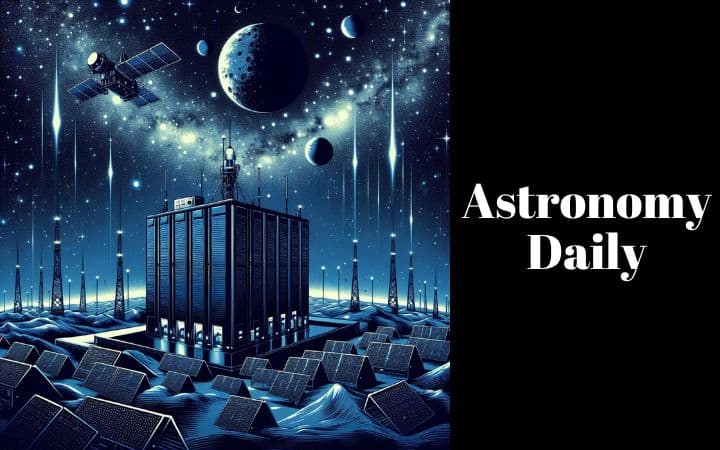
Hosted by Avery and Anna, the episode opens with a fascinating discussion about Google's ambitious Project Suncatcher. This initiative aims to establish data centers in space, harnessing the power of solar energy and the natural cooling of the vacuum. It's a futuristic concept grounded in practicality, as Earth’s data centers consume vast amounts of energy primarily for cooling. The first prototypes are set to launch in 2027, but the challenges of cosmic radiation and thermal management loom large.
Next, the episode takes a cautionary turn as we discuss a recent close encounter between a Chinese spacecraft and a SpaceX Starlink satellite. With only 200 meters separating them at orbital speeds, this incident highlights the urgent need for improved coordination among satellite operators. As the number of satellites in low Earth orbit skyrockets, the risk of collisions increases, raising concerns about Kessler Syndrome—a scenario where debris from collisions leads to further collisions, rendering orbit unusable.
From the present to the past, we explore a captivating new theory about our solar system's formation. Researchers propose that a rogue planet may have triggered a chaotic reshuffling of the giant planets, explaining the peculiar structure of the Kuiper Belt and the existence of Jupiter's Trojan asteroids. This revelation suggests that our solar system's layout could be the result of a cosmic encounter billions of years ago.
The episode continues with an intriguing discussion on how Mars, despite being much smaller than Earth, may have been subtly influencing our climate for eons. A recent study indicates that gravitational interactions between Earth and Mars amplify long-term climate cycles, potentially affecting the timing of ice ages. This interconnectedness of celestial bodies challenges our understanding of who the major players in climate change truly are.
Finally, we celebrate the Voyager 1 spacecraft, which is approaching a staggering milestone—one light day from Earth. Launched in 1977, Voyager 1 continues to send valuable data about the interstellar medium, proving to be a remarkable feat of engineering. As it drifts through the Milky Way, it serves as a silent ambassador of humanity, carrying with it a golden record of our existence.
This episode of Astronomy Daily is a reminder of the wonders and complexities of our universe. From innovative technology to ancient cosmic events, each story invites us to look up and ponder the vastness of space. Tune in to explore these captivating topics and more, ensuring that your curiosity about the cosmos is always satisfied.