
In S04E303 of our podcast, we take you on a thrilling journey through the cosmos, exploring ground-breaking discoveries that challenge our understanding of the universe. We begin with Titan, Saturn's largest moon, where recent data from the Cassini mission has sparked a fascinating debate. For years, scientists believed that beneath Titan's icy crust lay a vast ocean of liquid water, a prime candidate for extraterrestrial life. However, new findings suggest that what lies beneath may not be a swimming pool, but rather a thick, warm slush. This revelation complicates the idea of a single habitable environment, raising questions about the potential for life on this enigmatic moon.
Next, we shift our focus to SpaceX's Starlink constellation, which recently experienced an anomaly that resulted in the breakup of one of its satellites. While the immediate risk to other satellites is low, this incident highlights the growing concern over space debris and the long-term sustainability of low Earth orbit. As we plan for thousands of new satellites in the coming years, the specter of Kessler Syndrome looms large, making international cooperation on space traffic management more critical than ever.
In the realm of space policy, we discuss President Trump's executive order that aimed to accelerate NASA's Artemis program, with an ambitious goal of landing astronauts on the moon by 2028. While timelines have since been adjusted, the focus on sustainable lunar presence and preparation for Mars remains vital to US space policy, illustrating how governmental decisions can shape the future of space exploration.
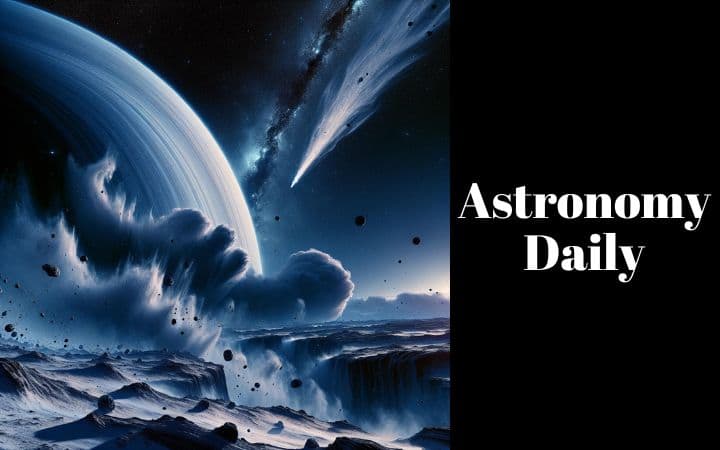
We then delve into the intriguing case of Fomalhaut B, once thought to be a planet but now revealed to be the debris cloud from a cosmic collision. This discovery provides a rare glimpse into the chaotic processes that shape planetary systems, reminding us that the universe is constantly evolving and full of surprises.
Finally, we discuss the interstellar comet 3I ATLAS, making its closest approach to Earth. Although it won't be visible to the naked eye, it offers a unique opportunity for scientists to study a pristine sample from another star system as it travels back into interstellar space.
To wrap up the episode, we highlight the groundbreaking work of NASA's Spherex Space Telescope, which has completed its first all-sky infrared map. This incredible tool will help answer fundamental questions about the universe, from the rapid expansion after the Big Bang to the distribution of water and organic molecules essential for life.
Join us as we explore these captivating stories that remind us of the wonders of the universe and the ever-evolving nature of scientific discovery. Listen to the full episode for an in-depth look at these incredible cosmic phenomena!