
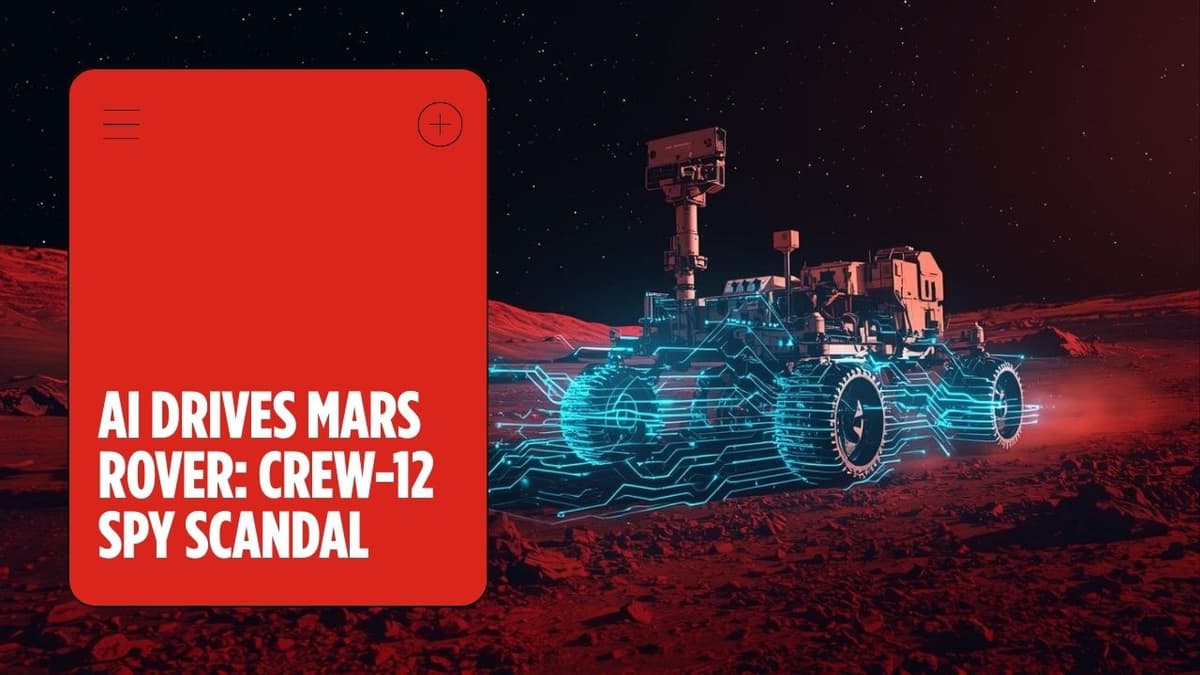
Space never sleeps, and today's episode of Astronomy Daily is proof. Six stories, six different corners of the cosmos — from a rocket stuck on the pad in Florida to a comet carrying four-billion-year-old secrets from another star system. Here's what we covered.
Crew-12 Faces Third Weather Delay — And That's Not Even the Most Interesting Part
NASA and SpaceX's Crew-12 mission to the International Space Station has now been pushed back to no earlier than Friday, February 13, after weather along the Dragon spacecraft's flight path forced scrubs on both February 11 and 12. The four-person crew — NASA commander Jessica Meir, pilot Jack Hathaway, ESA astronaut Sophie Adenot, and Roscosmos cosmonaut Andrey Fedyaev — remain in quarantine at Kennedy Space Center, waiting for a clear launch window.
The urgency is real: the ISS is currently running on a skeleton crew following the early return of Crew-11 in January due to a medical issue. Every delay adds to the workload of the astronauts already on board.
But the most striking element of this mission is a story that received relatively little coverage at the time. In December 2025, Russian cosmonaut Oleg Artemyev was quietly removed from the Crew-12 mission — replaced by Fedyaev. The official explanation from Roscosmos was a vague reference to 'other work.' Investigative outlet The Insider subsequently reported that Artemyev had been expelled from the United States after allegedly violating International Traffic in Arms Regulations — by photographing SpaceX engines, documents, and other sensitive technologies and exporting that information out of the country. Neither SpaceX nor Roscosmos has confirmed these reports publicly, but the story raises pointed questions about the security protocols governing international access to commercial launch facilities. Watch for Friday's launch window.
3I/ATLAS: A Farewell Gift of Alien Chemistry
Interstellar comet 3I/ATLAS — only the third object ever confirmed to have passed through our solar system from another star — is now on its final journey outward. It passed closest to Earth in December 2025, and is currently fading in the constellation Gemini at around magnitude 14.5, heading for a Jupiter flyby in March before leaving the solar system forever.
But it's not going quietly. NASA's SPHEREx space telescope, which observed the comet in December 2025, has revealed a dramatically enriched chemical coma — containing water ice, carbon dioxide, carbon monoxide, organic compounds, and unusually large chunks of rocky material being ejected from the nucleus. The scientists describe this material as a cocktail of chemicals that hasn't been exposed to space for billions of years, unlocked as the sun's heat finally penetrated deep enough to warm the pristine subsurface ices.
James Webb Space Telescope data added another revelation: 3I/ATLAS has a carbon dioxide-to-water ratio of approximately 8:1 — one of the highest ever measured in any comet. This strongly suggests the comet formed far from its home star, near a CO2 ice line, in a planetary system arranged quite differently from our own. In the coming weeks, data from ESA's JUICE spacecraft — which observed the comet in November but couldn't transmit the data until now — is expected to arrive, potentially adding one final chapter to this extraordinary story.
NASA Lets AI Drive Perseverance on Mars
In December 2025, NASA conducted a landmark test: an artificial intelligence system generated the driving waypoints for the Perseverance Mars rover, which then followed them without human control across two separate days — covering a total of 456 metres. The AI, built on Anthropic's Claude, analysed high-resolution orbital imagery from the Mars Reconnaissance Orbiter and digital elevation models to identify hazards and plan an optimal route. Before the instructions were beamed to Mars, they were validated on Perseverance's Earth-based engineering twin at JPL's Mars Yard.
This isn't a gimmick. Mars is so far away that a round-trip radio signal takes around 25 minutes, making every human-controlled driving decision inherently slow. The goal is to enable rovers to handle kilometre-scale drives autonomously, freeing human operators to focus on science rather than navigation logistics. Future developments aim to solve the positional uncertainty problem — currently, the longer a rover drives without human re-localisation, the less certain it is about where it is. AI-driven re-localisation could eliminate that bottleneck entirely, opening up a new era for planetary surface exploration.
Earth's Habitability Was Never a Given
A study published February 9 in Nature Astronomy presents a sobering new perspective on the conditions required for life. Researchers from ETH Zurich found that Earth's habitability depends on a chemical balance that may be extraordinarily rare. During planetary formation, when young planets are molten and metals are sinking to form their cores, the amount of oxygen present determines where phosphorus and nitrogen end up. Too little oxygen, and phosphorus is dragged into the core, removing a key ingredient for DNA and biological energy transfer. Too much, and nitrogen escapes to space. Life needs both — and Earth, apparently, hit the narrow window that kept them both accessible.
The traditional habitable zone — the orbital range where liquid water can exist — remains important, but this research suggests it is only part of the story. Stellar chemistry, the researchers note, may offer an additional filter: because planets form from the same material as their stars, a sun-like star is a better bet for producing a chemically life-friendly planet. The study adds another layer of specificity to the search for life beyond Earth — and another reason to appreciate how fortunate our own origin story turns out to be.
Ring of Fire Solar Eclipse: One Week Away
On February 17, 2026, an annular solar eclipse will sweep across Antarctica, creating a spectacular Ring of Fire effect for the small teams of researchers at stations including Concordia and Mirny. Partial phases will be visible from southern Chile, Argentina, and parts of South Africa. This is not a total solar eclipse — the moon's apparent size is slightly smaller than the sun, leaving a bright ring of sunlight visible around its silhouette for up to 2 minutes and 20 seconds. Eclipse glasses are required for safe viewing at all times. The eclipse also coincides with Chinese New Year and the first night of Ramadan, giving this celestial event an unusual degree of cultural resonance.
Starship Is Back — Flight 12 Testing Underway
After the failure of Booster 18 — the first Block 3 Super Heavy prototype, which cracked during cryogenic pressure testing — SpaceX moved rapidly to build and test Booster 19. On February 2 and 4, Booster 19 successfully completed two cryogenic pressure tests at Starbase, Texas, bringing Flight 12 back on track. Paired with Ship 39, the Block 3 stack is targeting a launch window in the February to March timeframe, with March currently the most realistic target according to those following the programme.
Flight 12 will be the debut of the full Block 3 Starship configuration, featuring Raptor 3 engines and new pad architecture at Pad 2 in Starbase. It carries significant weight for NASA's Artemis programme, which needs a successful Block 3 to proceed toward using Starship as the crewed Human Landing System for lunar missions. Meanwhile, SpaceX continues expanding its Starship infrastructure across Florida, with work progressing at Kennedy Space Center's LC-39A and environmental approval now in hand for a new complex at Space Launch Complex 37 — which would eventually give the programme five launch pads.
Listen to the Full Episode
Astronomy Daily S05E36 is available now on all major podcast platforms. Full transcripts, show notes and additional resources at astronomydaily.io. New episode every weekday.