
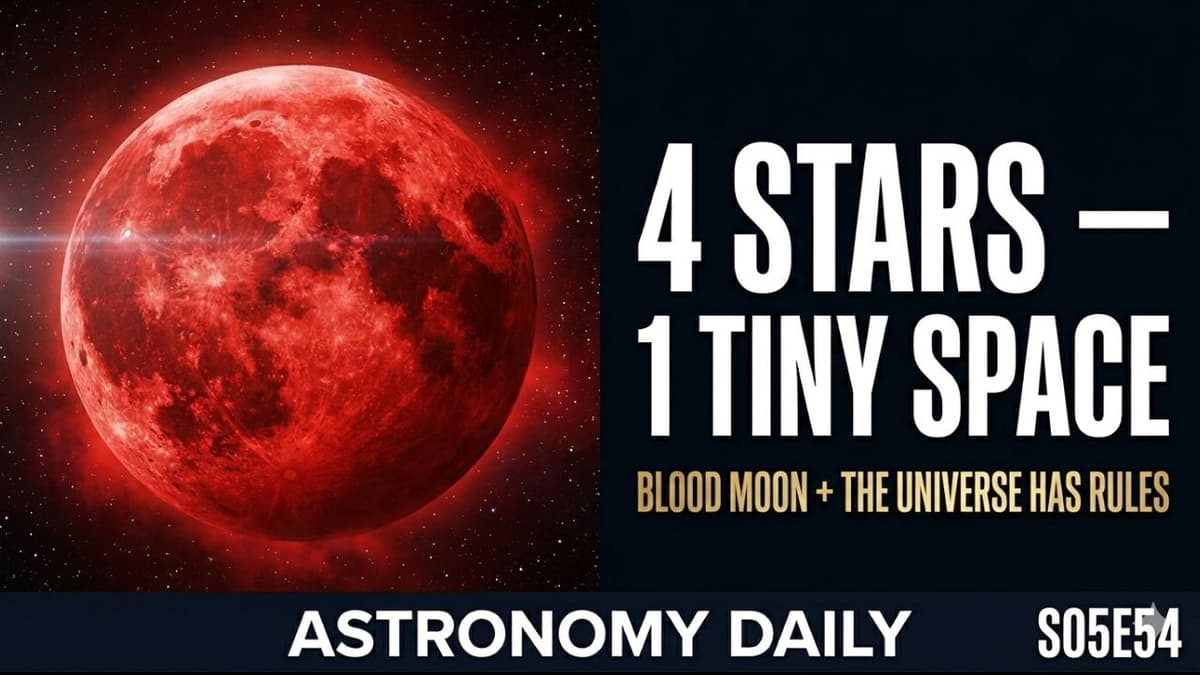
The universe delivered an extraordinary 48 hours of news, bookended by one of the most anticipated sky events of the year. In Season 5, Episode 54 of Astronomy Daily, Anna and Avery cover the total lunar eclipse recap, a critical milestone for NASA's crewed Moon mission, a star system that defies intuition, and a physics reality check on extraterrestrial visitors.
The Blood Moon: Last One for North America Until 2028
In the early hours of March 3, 2026, the Moon passed completely through Earth's shadow in a total lunar eclipse that turned it a deep, rusty blood red for 59 minutes. Visible across North America, Australia, New Zealand and Asia, it was the last total lunar eclipse visible from North America until New Year's Eve 2028. The vivid red colour results from sunlight scattered through Earth's atmosphere — the combined light of every sunrise and sunset on the planet projected onto the lunar surface simultaneously.
Artemis 2: The First Crewed Moon Mission Since 1972 Is Almost Here
NASA has confirmed that repairs to the Artemis 2 Space Launch System rocket are complete, keeping an April 2026 launch target in sight. Artemis 2 will carry four astronauts — Reid Wiseman, Victor Glover, Christina Koch and Jeremy Hansen — on a crewed flight around the Moon, the first time humans have travelled to lunar space since Apollo 17 in December 1972. The mission will take the crew further from Earth than any humans in history.
TIC 120362137: The Most Crowded Star System Ever Found
Published in Nature Communications, a new study led by astronomer Tamás Borkovits of the University of Szeged, Hungary, confirms that TIC 120362137 is the most compact 3+1-type quadruple star system ever discovered. Three stars — all larger and hotter than our Sun — orbit each other within a volume smaller than Mercury's orbit, while a fourth Sun-like star circles the trio at a distance comparable to Jupiter's position in our Solar System. Discovered using NASA's TESS satellite and confirmed with ground-based observatories across four countries, the system will eventually evolve into a pair of white dwarfs.
Gravitational Waves: The Referee in Cosmology's Biggest Argument
The Hubble Tension — a stubborn discrepancy between two independent methods of measuring the universe's expansion rate — may finally have a resolution. Scientists propose using gravitational waves from merging black holes and neutron stars as a third, completely independent measurement. Because gravitational wave detectors like LIGO operate on different physical principles to existing methods, they could provide the tiebreaker cosmologists have been seeking for years.
Mauve: The Dawn of Private Space Astronomy
Blue Skies Space's Mauve satellite — the world's first privately owned commercial space telescope — has captured its first stellar observation following its November 2025 launch on a SpaceX rideshare mission. The suitcase-sized spacecraft observes stars in ultraviolet light, filling a gap in space science left since the retirement of the International Ultraviolet Explorer in 1996. Over its three-year mission, Mauve will survey hundreds of stars to assess which might host habitable exoplanets.
Why Aliens Haven't Visited: It's Just Physics
A compelling analysis examines five physical barriers that may prevent civilisations from ever making contact: the vast scale of interstellar distances, the absolute speed limit imposed by the laws of relativity, the exponential fuel costs demanded by the rocket equation, the fragility of biological systems in deep space, and the challenge of cosmic timing — the likelihood that technological civilisations exist only briefly relative to the age of the universe. The conclusion is not that the universe is empty, but that physics itself keeps its inhabitants apart.
Listen to the full episode of Astronomy Daily on all major podcast platforms or watch on YouTube. New episodes every weekday. Find us at @AstroDailyPod.