
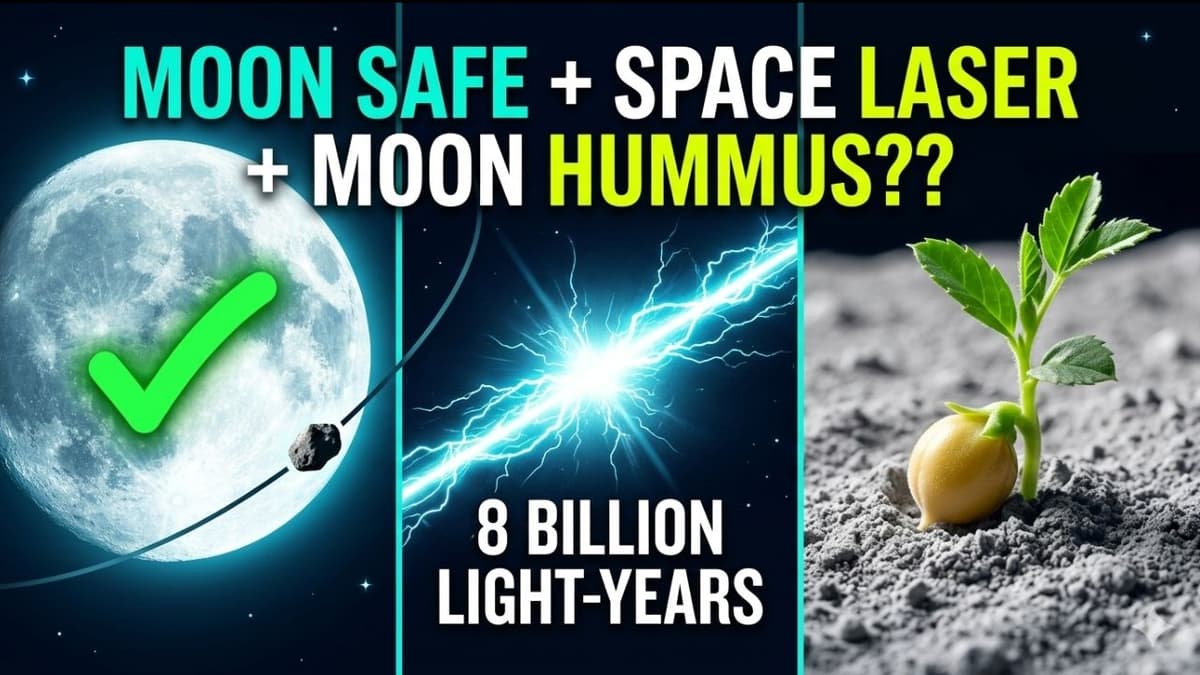
The Moon Is Safe, Space Lasers Break Records, and Scientists Are Planning Moon Hummus
Astronomy Daily | S05E55 | 6 March 2026
It's been a busy few days in space and astronomy, and Friday March 6th has delivered a particularly varied news cycle. From the resolution of one of the year's most-watched planetary defence stories to a world-record radio astronomy detection, a freshly-published study of Mars getting walloped by a solar storm, and a team of scientists who have successfully grown chickpeas in simulated Moon dirt — this is the kind of day that reminds you why following space science is worth it.
Asteroid 2024 YR4: The Moon Is Off the Hook
When asteroid 2024 YR4 was discovered in late December 2024, it briefly achieved the dubious distinction of being the most dangerous space rock identified in two decades. A small but statistically significant probability that the 60-metre object — roughly the size of what caused the Tunguska event in 1908 — could strike Earth on December 22nd, 2032 had the planetary defence community paying close attention.
Earth's safety was confirmed relatively quickly as more observations came in. But when the asteroid faded from view last spring, a 4% lunar impact probability remained on the books — the highest such probability ever calculated for the Moon. Had the impact occurred on the near side, it would have been visible from Earth and carved a crater roughly a kilometre across.
NASA has now eliminated that possibility. Using the James Webb Space Telescope — pushed close to its observational limits — astronomers from the Johns Hopkins Applied Physics Laboratory captured the asteroid in two dedicated observation windows in February 2026. The new trajectory data confirms 2024 YR4 will pass the Moon at approximately 13,200 miles, a close shave in cosmic terms but definitively not a collision. Webb will observe the asteroid again in 2028 for continued monitoring.
MeerKAT Finds the Most Distant Cosmic Laser Ever Detected
In South Africa's Karoo desert, the MeerKAT radio telescope array has made a record-breaking discovery. Astronomers led by Dr Thato Manamela from the University of Pretoria have identified the most distant hydroxyl megamaser ever detected — a natural 'space laser' operating at radio wavelengths, located in a galaxy more than 8 billion light-years away and undergoing a violent merger with another galaxy.
Hydroxyl megamasers occur when the collision of two gas-rich galaxies compresses enormous clouds of hydroxyl molecules — one hydrogen, one oxygen — into a configuration where they amplify passing radio waves, much like a laser amplifies light. The phenomenon is only visible at the extremes of cosmic collision, making each detection a valuable marker of violent galactic evolution in the early universe.
This particular detection — catalogued as HATLAS J142935.3-002836 — is so luminous that researchers have elevated its classification to a 'gigamaser'. Even more remarkably, the signal was gravitationally lensed on its journey to Earth, passing behind an unrelated foreground galaxy whose mass bent space and amplified the signal further. The discovery points the way toward systematic surveys with the coming Square Kilometre Array.
ESA Reveals What a Solar Superstorm Does to Mars
The record-breaking solar storm of May 2024 — the most intense in over two decades — didn't only light up skies on Earth. A new study published today in Nature Communications documents in unprecedented detail what that same storm did to Mars, using data from ESA's Mars Express and ExoMars Trace Gas Orbiter.
Without a global magnetic field to deflect incoming solar particles, Mars received the full force of the barrage. Electron densities in two atmospheric layers surged — by 45% at 110 km altitude and by 278% at 130 km — representing the most dramatic atmospheric response to a solar storm ever recorded at Mars. Both spacecraft also suffered temporary computer errors from the energetic particles, before their radiation-hardened systems brought them back online.
The study used a novel orbiter-to-orbiter radio occultation technique to characterise each atmospheric layer in detail. Beyond its scientific interest, the findings have practical implications for future crewed missions — an unshielded astronaut in Mars orbit during such an event would face serious radiation exposure, and the atmospheric ionisation caused by such storms can interfere with radar-based surface mapping operations.
SpaceX Rocket Re-entry Confirmed as Source of Atmospheric Pollution
A landmark paper published in Communications Earth and Environment has established, for the first time, a direct connection between a specific rocket re-entry and a measured atmospheric pollution event. Researchers at the Leibniz Institute for Atmospheric Physics in Germany detected a tenfold spike in atmospheric lithium vapour — rising from approximately 3 to 31 atoms per cubic centimetre — in the upper atmosphere over central Europe in the early hours of February 20th, 2025, approximately twenty hours after the uncontrolled re-entry of a Falcon 9 upper stage off the Irish coast.
Lithium is a trace element in the natural atmosphere, but a significant component of SpaceX's Falcon 9 upper stages — present in lithium-ion batteries and in the aluminium-lithium alloy hull plating, which begins to ablate at approximately 98 kilometres altitude, matching the altitude of the detected plume precisely. Eight thousand backward atmospheric trajectory simulations confirmed the re-entry as the source.
The paper is careful not to overstate the immediate environmental risk, but its significance lies in establishing proof of concept: the chemical footprint of re-entering spacecraft can be measured, tracked, and attributed. As satellite megaconstellations grow and launch rates climb, understanding the cumulative atmospheric chemistry implications of deliberate and uncontrolled re-entries becomes increasingly important.
Rocket Lab's 83rd Launch Cloaks Its Payload in Mystery
Rocket Lab successfully deployed a satellite from its New Zealand Mahia launch complex on March 5th, in a mission designated 'Insight at Speed is a Friend Indeed' — the company's 83rd Electron launch overall. Beyond confirming the satellite was deployed to a 470-kilometre orbit, Rocket Lab declined to identify either the customer or the purpose of the payload, citing commercial confidentiality.
The company gave just a few hours' notice before launch, characteristic of missions where discretion is paramount. The mission name has prompted speculation among the space community about potential Earth observation or intelligence applications, though nothing has been confirmed.
Scientists Harvest Chickpeas From Simulated Lunar Soil — Moon Hummus Inching Closer
In what may be the most charming science story of the week, researchers at the University of Texas at Austin and Texas A&M University have successfully grown and harvested chickpeas in simulated lunar regolith — the first time this crop has been produced in a material designed to mimic the composition of Moon dirt.
Lunar regolith poses a formidable challenge for agriculture. It is sterile, structurally poor, and laced with heavy metals including aluminium, copper, and zinc. The UT Austin team addressed this by combining vermicompost — produced from organic mission waste by red wiggler earthworms — with seeds coated in arbuscular mycorrhizal fungi. The fungi improved nutrient absorption and helped sequester toxic metals away from the plant, while also binding loose regolith particles into a more cohesive soil structure.
Published in Scientific Reports on March 5th, the study found that chickpeas could flower and produce seeds in soil mixtures of up to 75% regolith simulant. The seeds have not yet been cleared for consumption — testing for metal accumulation is ongoing. Lead researcher Jessica Atkin has promised that the first successful batch will be turned into moon hummus. She played Creedence Clearwater Revival's 'Bad Moon Rising' to encourage the plants in the growth chamber.
The scientific stakes extend well beyond dietary novelty. Long-term human habitation on the Moon will require on-site food production. The capacity to transform sterile regolith into productive soil using biological systems that astronauts could carry and maintain themselves represents a meaningful step toward that goal.
Listen to today's episode of Astronomy Daily on Apple Podcasts, Spotify, YouTube, or anywhere you get your podcasts. New episodes every weekday at astronomydaily.io.