
Episode Overview
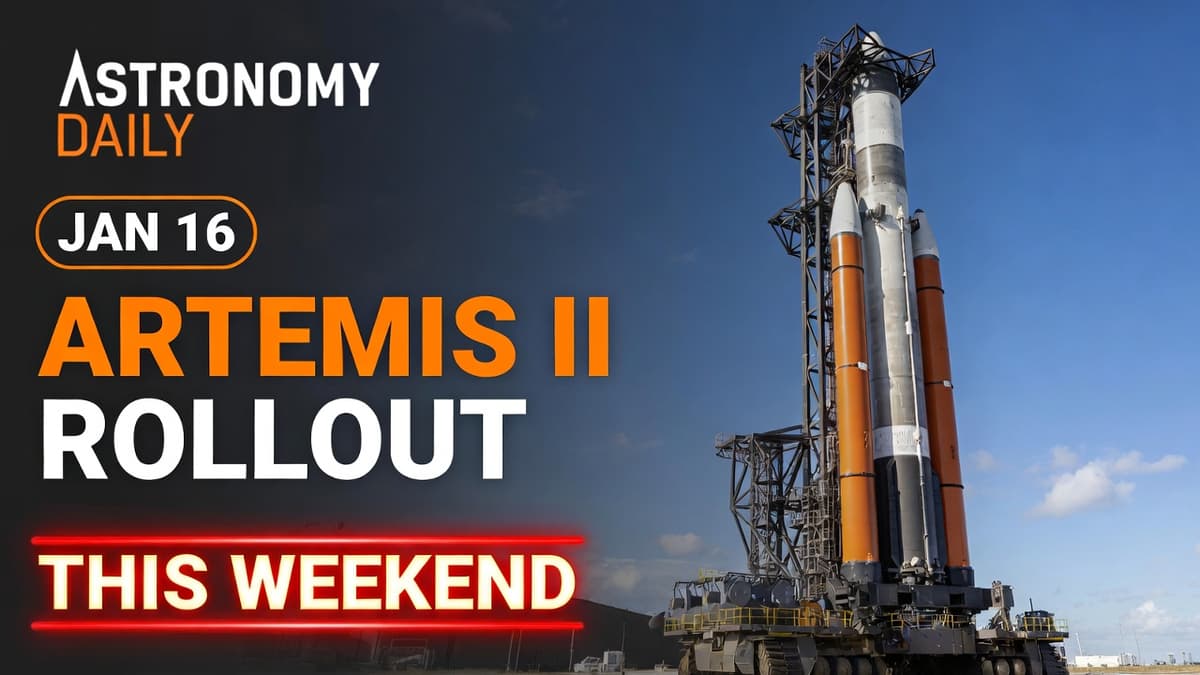
History is about to be made this weekend as NASA prepares to roll out the Artemis II mission stack to Launch Pad 39B at Kennedy Space Center. This marks a critical milestone in humanity's return to deep space exploration—the first crewed mission beyond low Earth orbit in over fifty years.
But that's just the beginning. Today's episode of Astronomy Daily brings you six major stories shaping the cosmos, from cybersecurity threats targeting space agencies to surprising discoveries about Jupiter's atmosphere, a mysterious iron structure hidden in plain sight, and the enduring legacy of Apollo's Moon Trees.
In This Episode:
🚀 NASA's Artemis II rollout scheduled for Saturday, January 17
🔒 ESA suffers massive cyberattack with 700+ GB of data stolen
🛰️ China launches key satellites to kick off ambitious 2026 space program
🪐 Scientists discover Jupiter contains 1.5x more oxygen than the Sun
💫 Mysterious iron bar found hidden inside famous Ring Nebula
🌲 The fascinating story of Apollo 14's Moon Trees and their global legacy
1. Artemis II: The Final Countdown Begins This Weekend
Historic Rollout Scheduled for Saturday
In what NASA officials are calling a defining moment for the future of space exploration, the Space Launch System (SLS) rocket and Orion spacecraft will begin their journey to Launch Pad 39B on Saturday, January 17, 2026—weather and technical conditions permitting.
The rollout marks the culmination of months of intensive preparation and brings NASA one giant step closer to launching the first crewed mission beyond low Earth orbit since the final Apollo mission in 1972.
The Journey to the Pad
The massive SLS rocket, standing taller than the Statue of Liberty, will travel approximately 6.5 kilometers (4 miles) from the Vehicle Assembly Building to the historic Launch Pad 39B—the same pad that launched many Apollo missions and later Space Shuttle flights. Riding atop the crawler-transporter-2, one of the largest tracked vehicles ever built, the journey will take up to 12 hours.
"We are moving closer to Artemis II, with rollout just around the corner," said Lori Glaze, acting associate administrator for NASA's Exploration Systems Development Mission Directorate. "We have important steps remaining on our path to launch, and crew safety will remain our top priority at every turn, as we near humanity's return to the Moon."
Meet the Artemis II Crew
Four astronauts will make this historic journey around the Moon:
Reid Wiseman (Commander, USA): A veteran NASA astronaut who previously served aboard the International Space Station, Wiseman will lead the mission and be responsible for all phases of flight.
Victor Glover (Pilot, USA): The first African American astronaut to participate in a long-duration space mission, Glover brings extensive experience from his Crew-1 mission to the ISS.
Christina Koch (Mission Specialist, USA): Holding the record for the longest single spaceflight by a woman, Koch's expertise in spacewalks and systems operations will be crucial.
Jeremy Hansen (Mission Specialist, Canada): Representing the Canadian Space Agency, Hansen will become the first Canadian to travel beyond low Earth orbit, highlighting the mission's international cooperation.
The Mission Profile
Artemis II will be a 10-day circumlunar flight—a figure-eight trajectory that will take the crew around the Moon without entering lunar orbit or landing on the surface. The mission serves as a critical dress rehearsal for Artemis III, currently scheduled for 2028, which will put the first woman and the first person of color on the lunar surface.
Unlike the uncrewed Artemis I test flight that successfully completed a similar trajectory in late 2022, Artemis II will validate all life support systems, crew interfaces, and operational procedures with humans aboard. The crew will travel farther from Earth than any humans since Apollo 17—approximately 370,000 kilometers at their farthest point.
Overcoming Recent Challenges
The path to this weekend's rollout hasn't been entirely smooth. In December, during a countdown demonstration test, engineers detected a problem with a valve associated with the Orion capsule's hatch pressurization system. The NASA team replaced the faulty valve on January 5th and successfully completed follow-up pressure tests.
Additionally, technicians resolved a leak in the ground support hardware responsible for pressurizing Orion with oxygen gas. These fixes demonstrate the meticulous attention to detail that defines human spaceflight operations.
What Happens After Rollout
Once the SLS and Orion arrive at the pad, ground crews will begin an intensive period of integration and testing:
Connections and Power-Up: Electrical lines, fuel control system ducts, cryogenic propellant feeds, and other ground support equipment will be connected. Then, for the first time, all of the rocket's integrated systems will be powered up simultaneously to ensure they work properly with each other, the mobile launcher, and launch pad infrastructure.
Wet Dress Rehearsal: Scheduled for the end of January, this critical test will involve loading the rocket with approximately 2.65 million liters (700,000 gallons) of cryogenic liquid hydrogen and liquid oxygen propellant. Mission controllers will conduct a full launch countdown, including several planned holds and recycles in the final 10 minutes before liftoff. The test will then conclude with safely draining all propellant from the vehicle.
NASA learned valuable lessons from Artemis I's wet dress rehearsal, particularly around loading liquid hydrogen. Engineers will closely monitor the propellant loading process and carefully watch how much nitrogen gas accumulates between the Orion crew module and the launch abort system—a concern addressed through recently updated procedures.
Flight Readiness Review: Only after a successful wet dress rehearsal will NASA's mission management team convene to assess whether all systems are truly ready for flight. This comprehensive review will examine every aspect of the mission before committing to a firm launch date.
Final Crew Walkdown: In what promises to be a major media event, the Artemis II astronauts will conduct a final walkdown at the pad, familiarizing themselves with the actual hardware that will carry them to the Moon and back.
Understanding the Launch Windows
The launch windows for Artemis II are dictated by complex orbital mechanics involving the rotation of Earth and the Moon's orbit. This creates a pattern of approximately one week of launch opportunities followed by three weeks without viable launch windows.
The current launch window opens as early as Friday, February 6, 2026, and extends through April. NASA has published specific available launch dates during this period, though the mission management team may select any date within this window based on readiness.
The Road to Artemis III and Beyond
Artemis II serves as the essential bridge between the uncrewed Artemis I test flight and the Artemis III lunar landing mission. Much like Apollo 10 was a dress rehearsal for the first Moon landing in 1969, Artemis II will validate the systems, procedures, and operational concepts needed to safely land humans on the lunar surface.
Artemis III, currently scheduled for 2028, will depend on several key technologies still in development, including the Human Landing System (HLS) being developed by SpaceX. That mission will last approximately 30 days and will establish the foundation for sustained lunar exploration.
The long-term vision of the Artemis program extends far beyond a few missions. NASA aims to establish a permanent human presence on and around the Moon through the Lunar Gateway space station and surface habitats. These capabilities will serve as a proving ground for the technologies and operational concepts needed for the ultimate goal: sending humans to Mars.
2. European Space Agency Suffers Major Cyberattack
Over 700 Gigabytes of Data Stolen in Christmas Week Breach
The European Space Agency is grappling with the aftermath of significant cyberattacks that compromised hundreds of gigabytes of potentially sensitive data, marking one of the most serious security incidents to hit a major space agency in recent years.
Timeline of the Attacks
The first breach occurred on Boxing Day 2025, when a hacker operating under the pseudonym "888" dumped over 200 gigabytes of ESA data onto dark web forums. The leaked information included proprietary software, authorization credentials, access tokens, and sensitive project documentation.
ESA initially downplayed the incident, issuing a statement that characterized the breach as "limited" to servers containing unclassified documents. However, just one week later, the situation escalated dramatically.
A cybercrime group known as Scattered Lapsus$ Hunters claimed they had stolen an additional 500 gigabytes of data from ESA systems, asserting that the security vulnerability they exploited remained unpatched. This second batch of stolen data reportedly included:
Operational procedures for ESA missions
Spacecraft and mission details
Subsystems documentation
Proprietary contractor data from SpaceX, Airbus Group, and Thales Alenia Space
ESA's Response and Criminal Investigation
Following these revelations, ESA launched a criminal investigation and is now fully cooperating with law enforcement authorities. During a press briefing on January 8, Eric Morel de Westgaver, ESA's director of European, legal, and international matters, confirmed the agency's commitment to working with investigators.
"ESA is fully cooperating with the authorities," Westgaver stated. "These authorities will manage the communication regarding the case, as those authorities will be in charge of the criminal proceedings."
The agency has declined to provide specific details about the investigation, citing the ongoing criminal proceedings and the need to avoid compromising investigative efforts.
How the Breach May Have Occurred
Cybersecurity researcher Clémence Poirier from the Center for Security Studies at ETH Zurich offered insights into how such breaches typically occur. According to Poirier, during her research on space cybersecurity, she frequently encounters email credentials of ESA employees—and even other space agencies—being sold on dark web forums.
"It may be due to a lack of cyber hygiene from ESA staff," Poirier explained. "Threat actors may have obtained credentials through infostealer malware, which can harvest web-browser-stored data, which includes credentials, session cookies, multi-factor authentication data, saved credit cards, etc."
Infostealers represent a particularly insidious category of malware. These programs can evade detection by traditional antivirus software and often spread through seemingly innocuous means—malicious advertisements embedded in popular websites, infected links in YouTube video descriptions, or compromised software downloads.
Once installed, infostealers silently harvest all data stored in web browsers, including:
Saved passwords and usernames
Session cookies that maintain login states
Multi-factor authentication tokens
Saved credit card information
Browser history and form data
A Broader Pattern of Attacks
Sources familiar with the space cybersecurity environment who spoke to Space.com on condition of anonymity revealed that cyberattacks against space agencies are far more common than publicly acknowledged. NASA, in particular, faces a continuous barrage of attempts, with vulnerabilities being disclosed "almost every day" via the crowdsourced cybersecurity platform BugCrowd.
This revelation underscores a troubling reality: as space infrastructure becomes increasingly critical to modern society—supporting communications, navigation, weather forecasting, and national security—these systems are simultaneously becoming prime targets for cybercriminals and state-sponsored actors.
Long-Term Implications and Risks
While the recently leaked ESA data "did not seem highly critical" according to initial assessments, Poirier warned of a more insidious long-term threat. Data from multiple breaches can be combined and analyzed to reveal strategic information that might enable sophisticated cyberattacks against space systems.
"We are not there yet, but it's important to keep in mind," she cautioned.
The vulnerability isn't limited to ESA's own networks. Third-party software providers, contractors, and service vendors may harbor their own security weaknesses that could be exploited to gain access to agency systems. The interconnected nature of modern aerospace projects—with multiple international partners and commercial contractors—creates a complex web of potential entry points for malicious actors.
The Challenge of Space Cybersecurity
As Poirier bluntly concluded: "Data leaks and breaches against space agencies are common. It can happen to each agency and will happen to each agency in the future considering the rise of cyberattacks against the space sector."
This assessment presents a sobering reality for an industry increasingly reliant on digital systems, software-defined spacecraft, and interconnected ground infrastructure. As nations and commercial entities invest billions in expanding space capabilities, the cybersecurity dimension of space operations can no longer be an afterthought—it must be a foundational element of mission planning and execution.
The ESA breach serves as a wake-up call for the entire space community: the same digital technologies that enable unprecedented capabilities in space also create unprecedented vulnerabilities that must be addressed with the same rigor and resources devoted to traditional engineering challenges.
3. China Launches Key Satellites to Begin Ambitious 2026 Space Program
Dual Long March Missions Mark Strong Start to Year
China's space program kicked off 2026 with a demonstration of its growing capabilities, successfully launching two Long March rockets on January 13 from the Wenchang Space Launch Center. These missions deployed critical satellites that will expand China's Earth observation and telecommunications infrastructure while supporting future deep space exploration goals.
Yaogan-50 01: Advanced Remote Sensing from an Unusual Orbit
The first mission carried the Yaogan-50 01 remote sensing satellite aboard a Long March 6A rocket. What makes this satellite particularly noteworthy is its unusual orbital configuration, designed to maximize Earth observation capabilities from unique angles.
Unlike typical remote sensing satellites operating in standard low Earth orbits, Yaogan-50 01's orbit provides enhanced capabilities for collecting high-resolution data across broader geographic areas. This innovative orbital design allows the satellite to observe Earth from perspectives unavailable to conventional observation platforms, potentially providing more detailed and comprehensive coverage.
The satellite is part of China's rapidly expanding portfolio of remote sensing technology, which serves multiple purposes:
Agricultural Monitoring: Tracking crop health, soil moisture, and farming patterns to support food security initiatives.
Natural Disaster Response: Providing rapid imaging of floods, earthquakes, landslides, and other catastrophic events to support emergency response efforts.
Resource Management: Monitoring water resources, forests, minerals, and other natural assets.
Scientific Research: Supporting climate studies, environmental monitoring, and Earth science investigations.
National Security: While not explicitly stated, remote sensing capabilities have obvious applications for military surveillance and strategic intelligence gathering.
As China continues developing and deploying advanced remote sensing satellites, the nation is positioning itself as a leader in Earth observation capabilities, with technology increasingly competitive with American and European systems.
Guowang Constellation: Building China's Space-Based Internet
The second January 13 mission deployed multiple satellites for the Guowang constellation into low Earth orbit. This constellation represents China's answer to commercial satellite internet systems like SpaceX's Starlink, with ambitious goals extending beyond mere telecommunications.
The Guowang constellation is designed to:
Enhance Communications Infrastructure: Provide high-speed data transmission capabilities across large regions, including remote and underserved areas.
Improve Global Connectivity: Extend reliable internet and communications services to regions lacking terrestrial infrastructure.
Support Space Exploration: Provide real-time communication and data transfer capabilities for future lunar and Mars missions.
Enable Advanced Applications: Support emerging technologies requiring low-latency, high-bandwidth connectivity.
By establishing a robust constellation in low Earth orbit, China aims to reduce dependence on foreign satellite communications systems while simultaneously building infrastructure crucial for its long-term space exploration ambitions.
The strategic importance of the Guowang constellation extends beyond commercial applications. Reliable, high-bandwidth satellite communications will be essential for China's planned missions to establish a permanent presence on the Moon and eventually send astronauts to Mars. The constellation will enable mission controllers to maintain constant contact with spacecraft, astronauts, and robotic systems throughout the Earth-Moon system and potentially beyond.
A Record-Breaking Year Ahead
According to the China Aerospace Science and Technology Corporation (CASC), these January launches mark just the beginning of what's expected to be a record-breaking year for Chinese space activities. The nation has ambitious plans for 2026, including:
Additional remote sensing satellite deployments
Continued expansion of the Guowang constellation
Progress on the Tiangong space station
Lunar exploration missions
Continued development of next-generation launch vehicles
International cooperation initiatives
The Growing Space Competition
China's aggressive launch schedule and technological advances underscore the increasingly competitive nature of the global space sector. No longer dominated solely by the United States and Russia, the "new space race" includes China as a major player with capabilities approaching—and in some areas matching—traditional space powers.
This competition is driving innovation across the industry, spurring developments in reusable rockets, satellite technology, deep space exploration, and commercial space applications. While concerns about military applications and geopolitical tensions persist, the expanded participation in space activities is also accelerating humanity's overall capabilities and presence beyond Earth.
The successful January 13 launches demonstrate that China's space program continues maturing into a sophisticated, multi-faceted enterprise capable of conducting complex missions across multiple domains simultaneously—a capability previously limited to only NASA and a handful of other space agencies.
4. Jupiter Holds Surprising 1.5 Times More Oxygen Than Our Sun
Groundbreaking Atmospheric Study Reshapes Understanding of Gas Giant
A comprehensive new study published in The Planetary Science Journal has overturned previous assumptions about Jupiter's composition, revealing that the solar system's largest planet contains approximately 1.5 times more oxygen than the Sun itself.
This discovery, led by researchers from the University of Chicago and NASA's Jet Propulsion Laboratory, represents a major shift in our understanding of Jupiter's formation and evolution—with implications extending to our knowledge of planetary systems throughout the universe.
Resolving a Long-Standing Debate
"This is a long-standing debate in planetary studies," explained Jeehyun Yang, a postdoctoral researcher at the University of Chicago and the study's lead author. For decades, scientists have disagreed about Jupiter's oxygen content, with some recent studies suggesting the gas giant contained far less oxygen than the Sun.
The precise quantity of oxygen on Jupiter matters far more than simple curiosity. As one of the most abundant elements in the universe, oxygen plays a crucial role in:
Planet Formation: Understanding oxygen abundance provides clues about the conditions in the early solar system and how gas giants accumulate material.
Water Distribution: Since oxygen is essential for water formation, knowing its abundance helps scientists understand where and how much water might exist in Jupiter's atmosphere and potentially within its interior.
Habitable Worlds: Insights gained from studying Jupiter can inform our understanding of giant planets around other stars, some of which might host habitable moons similar to those suspected around Jupiter and Saturn.
A Revolutionary Atmospheric Model
What enabled this breakthrough was the development of the most comprehensive atmospheric model of Jupiter to date. Previous models struggled to accurately capture the complex interplay between chemical reactions and atmospheric circulation on the giant planet.
As Yang explained, earlier approaches suffered from fundamental limitations: "Chemistry is important but doesn't include water droplets or cloud behavior. Hydrodynamics alone simplifies chemistry too much. So, it's important to bring them together."
The new model successfully integrates both chemical kinetics—tracking how molecules interact and transform—and hydrodynamics—understanding how gases flow and mix within Jupiter's turbulent atmosphere. This holistic approach allows for far more accurate predictions about the planet's composition and behavior.
The Challenge of Studying Jupiter
Jupiter presents extraordinary challenges to atmospheric scientists. The planet's famous Great Red Spot—a storm system twice the size of Earth that has raged for centuries—represents just one of countless violent weather patterns obscuring our view of the deeper atmosphere.
Thick cloud layers prevent direct observation of Jupiter's interior, and the extreme pressures and temperatures at depth make in-situ measurements extraordinarily difficult. NASA's Galileo spacecraft, which deployed a probe into Jupiter's atmosphere in 1995, could only measure conditions in the upper atmospheric layers before being crushed by mounting pressure.
More recently, NASA's Juno spacecraft has revolutionized our understanding by providing detailed measurements of Jupiter's upper atmosphere, including concentrations of ammonia, methane, and carbon monoxide. However, building a complete picture still requires sophisticated modeling to extrapolate from surface observations to deeper conditions.
An Unexpected Discovery: Slow-Motion Atmosphere
Beyond the oxygen findings, the study revealed another surprising characteristic of Jupiter's atmosphere: molecular diffusion occurs 35 to 40 times slower than previously assumed.
"For example, it would take a single molecule several weeks to move through one layer of the atmosphere, rather than hours," Yang noted.
This dramatically slower mixing has significant implications:
Heat Transport: The rate at which thermal energy moves through the atmosphere affects Jupiter's temperature profile and weather patterns.
Cloud Formation: Slower diffusion influences how and where different types of clouds form and dissipate.
Chemical Distribution: The movement of chemical species through atmospheric layers affects the planet's observable composition and color banding.
Storm Dynamics: Understanding atmospheric circulation is essential for comprehending Jupiter's iconic storm systems.
Implications for Planetary Science
These findings reshape our understanding not just of Jupiter, but of gas giant planets throughout the universe. As astronomers discover and characterize exoplanets around other stars, many turn out to be "hot Jupiters" or "super-Jupiters"—worlds even larger than our solar system's biggest planet.
Understanding how gas giants form, what they're made of, and how their atmospheres behave provides a framework for interpreting observations of these distant worlds. The techniques developed for modeling Jupiter's atmosphere can be adapted to study planets we'll never visit, helping determine which might host habitable moons or provide clues about the formation and evolution of their planetary systems.
Moreover, oxygen abundance in Jupiter—and its formation history—provides insights into the chemical composition of the early solar system. Since Jupiter likely formed relatively quickly and incorporated significant amounts of the primordial solar nebula, its composition serves as a chemical fossil, preserving information about conditions 4.6 billion years ago when our planetary system was taking shape.
The research demonstrates that even well-studied objects in our cosmic backyard can still surprise us, yielding discoveries that fundamentally alter our understanding of planetary science and the broader universe.
5. Mysterious Iron Bar Discovered Hidden in Famous Ring Nebula
Mars-Mass Structure Went Undetected for Decades
In a discovery that stunned the astronomical community, a European research team has found a massive bar-shaped cloud of iron hidden within the iconic Ring Nebula—one of the night sky's most familiar and frequently observed objects.
The structure, described for the first time in Monthly Notices of the Royal Astronomical Society, stretches roughly 500 times the distance between the Sun and Pluto and contains an amount of iron comparable to the entire mass of Mars. Despite decades of intense scrutiny from some of the world's most powerful telescopes, this enormous feature went completely unnoticed until now.
How Did We Miss It?
The discovery raises an obvious question: how could such a massive structure remain hidden in an object studied by countless amateur and professional astronomers since its discovery in 1779?
The answer lies not in improved imaging quality, but in a revolutionary approach to analyzing light. The iron bar was discovered using WEAVE (WHT Enhanced Area Velocity Explorer), a new instrument installed on the William Herschel Telescope in the Canary Islands.
Unlike traditional imaging that captures light intensity across different wavelengths, WEAVE's Large Integral Field Unit (LIFU) mode captures detailed spectra—essentially chemical fingerprints—at every point across the nebula simultaneously. This allows astronomers to map not just what the nebula looks like, but precisely what elements exist at each location.
"Even though the Ring Nebula has been studied using many different telescopes and instruments, WEAVE has allowed us to observe it in a new way, providing so much more detail than before," explained Dr. Roger Wesson, the study's lead author based jointly at University College London and Cardiff University. "By obtaining a spectrum continuously across the whole nebula, we can create images of the nebula at any wavelength and determine its chemical composition at any position."
When the team processed their data, the iron bar emerged with startling clarity. "When we processed the data and scrolled through the images, one thing popped out as clear as anything—this previously unknown 'bar' of ionised iron atoms, in the middle of the familiar and iconic ring."
Understanding the Ring Nebula
To appreciate the significance of this discovery, it's important to understand what the Ring Nebula actually is.
Located approximately 2,600 light-years away in the constellation Lyra, the Ring Nebula (also known as Messier 57 or NGC 6720) is what astronomers call a planetary nebula—though the name is misleading, as these objects have nothing to do with planets.
Planetary nebulae form when sun-like stars reach the end of their fuel-burning lives. As the star exhausts its nuclear fuel, it expands into a red giant, eventually shedding its outer layers into space. These ejected layers coast outward, illuminated by ultraviolet radiation from the exposed stellar core, which continues to shine as a white dwarf—essentially the dead heart of the original star.
The Ring Nebula represents this fate awaiting our own Sun in approximately 5 billion years. The nebula formed about 4,000 years ago when a star slightly more massive than our Sun underwent this transformation.
What makes planetary nebulae like the Ring so beautiful in images is that different chemical elements emit light at specific wavelengths when energized by the central white dwarf's radiation. Oxygen produces green and blue-green light, hydrogen emits red, and nitrogen contributes red and orange hues. This creates the vivid, multi-colored structures that have captivated observers for centuries.
Two Possible Explanations
The origin of the massive iron bar remains a mystery, but researchers have identified two primary possibilities:
Scenario 1: Asymmetric Ejection Process
The iron bar might reveal previously unknown details about how the dying star expelled its outer layers. Rather than a uniform, spherical shell of gas expanding outward evenly, the presence of the iron bar suggests the ejection process may have been directional or uneven.
This could indicate:
Magnetic field effects channeling material along specific directions
Rotation of the star affecting how material was ejected
Interactions with a companion star influencing the outflow pattern
Instabilities in the star's outer layers during the ejection phase
Scenario 2: Destroyed Planet (The More Intriguing Possibility)
The iron might represent the vaporized remains of a rocky planet that wandered too close as the star expanded into a red giant. As the star swelled to potentially hundreds of times its original size, any planets orbiting nearby would have been engulfed.
The extreme temperatures and intense radiation within the expanding stellar atmosphere could have:
Melted and vaporized the rocky planet
Stripped away lighter elements, leaving iron-rich material behind
Created a metal-rich plasma that remains trapped within the nebula
Formed the elongated bar structure through complex dynamics within the nebula
This scenario is particularly intriguing because it would represent direct evidence of a planet's destruction—a process we can only infer from indirect evidence in most cases.
The Need for Further Investigation
Professor Janet Drew, also at University College London, emphasized the need for additional data: "We definitely need to know more—particularly whether any other chemical elements co-exist with the newly-detected iron, as this would probably tell us the right class of model to pursue. Right now, we are missing this important information."
The research team is planning follow-up observations using WEAVE at higher spectral resolution to:
Determine if other elements are present alongside the iron
Measure how the iron-rich material is moving
Map the three-dimensional structure of the bar
Search for chemical gradients that might indicate its origin
Not Unique?
Professor Albert Zijlstra from the University of Manchester noted the significance of the discovery method: "We selected the Ring Nebula as an early target because it is bright, well studied and ideal for testing the instrument's capabilities. However, when the data were analysed, we noticed something entirely unexpected—a bar of highly ionised iron that had gone unnoticed in decades of previous observations. Discoveries like this show how many surprises there still are to be found in even the most familiar objects in the night sky."
Dr. Wesson added an important perspective: "It would be very surprising if the iron bar in the Ring is unique. So hopefully, as we observe and analyse more nebulae created in the same way, we will discover more examples of this phenomenon, which will help us to understand where the iron comes from."
WEAVE is conducting surveys of many ionized nebulae across the northern Milky Way over the next five years. If the iron bar is not unique to the Ring Nebula, these surveys should reveal similar structures in other planetary nebulae, providing the comparative data needed to understand how they form.
A Lesson in Looking Differently
The discovery of the iron bar demonstrates a fundamental truth about scientific observation: sometimes the most profound discoveries come not from looking harder, but from looking differently. The Ring Nebula has been photographed countless times by amateur and professional astronomers alike, including detailed observations by the Hubble Space Telescope and, more recently, the James Webb Space Telescope.
Yet none of these observations revealed the iron bar, because iron doesn't contribute strongly to the visible appearance that makes the Ring so photogenic. Only by systematically mapping the chemical composition across the entire nebula could this massive structure be detected.
As Professor Scott Trager, WEAVE Project Scientist at the University of Groningen, concluded: "The discovery of this fascinating, previously unknown structure in a night-sky jewel, beloved by sky watchers across the Northern Hemisphere, demonstrates the amazing capabilities of WEAVE. We look forward to many more discoveries from this new instrument."
6. The Legacy of Apollo 14's Moon Trees: From Lunar Orbit to Global Forests
400+ Living Monuments to Space Exploration Stand Across the Globe
When Apollo 14 splashed down in the Pacific Ocean on February 9, 1971, it brought back more than just Moon rocks and scientific data. Hidden in astronaut Stuart Roosa's personal kit were hundreds of tree seeds that had orbited the Moon—seeds that would grow into living symbols of humanity's greatest adventure.
Today, over 400 "Moon Trees" stand across the United States and around the world, and a new generation continues this unique tradition connecting Earth's forests to space exploration.
The Forgotten Experiment
Stuart Roosa, the Command Module Pilot for Apollo 14, had an unusual background for an astronaut. Before joining NASA, he had worked as a smoke jumper for the U.S. Forest Service—firefighters who parachute into remote wilderness areas to combat forest fires. This connection to forestry inspired a small but meaningful experiment.
Working with the Forest Service, Roosa carried several hundred seeds of five species in his personal kit during the mission:
Loblolly pine (Pinus taeda)
Sycamore (Platanus occidentalis)
Sweetgum (Liquidambar styraciflua)
Redwood (Sequoia sempervirens)
Douglas fir (Pseudotsuga menziesii)
While Commander Alan Shepard and Lunar Module Pilot Edgar Mitchell explored the lunar surface, Roosa remained in orbit, piloting the Command Module "Kitty Hawk" and completing 34 orbits of the Moon. The seeds traveled every kilometer of the journey.
Crisis and Resurrection
Upon return to Earth, disaster nearly struck. As NASA recounts: "Unfortunately, the seed bags burst open during the decontamination procedures after their return to Earth, and the seeds were scattered about the chamber and exposed to vacuum, and it was thought they might not be viable."
The incident seemed to doom the experiment. Seeds exposed to vacuum and contaminated with decontamination chemicals seemed unlikely to germinate. Nevertheless, Forest Service officials decided to attempt planting them anyway—if only to satisfy scientific curiosity about whether any might survive.
The results were extraordinary. Many of the seeds sprouted and grew normally, showing no apparent ill effects from their cosmic journey. Over 400 seedlings eventually matured into healthy trees.
The Bicentennial Distribution
The timing of the Moon Trees' maturity coincided perfectly with America's Bicentennial celebrations in 1975 and 1976. NASA and the Forest Service distributed the trees to state forestry organizations, government facilities, and international locations as living symbols of American achievement and international goodwill.
As NASA explained: "Some of these were planted with their Earth-bound counterparts as controls (as might be expected, after over forty years there is no discernible difference), but most were given away in 1975 and 1976 to many state forestry organizations to be planted as part of the nation's bicentennial celebration."
Each tree was accompanied by a telegram from NASA that read:
"This tree which was carried by Astronauts Stuart Roosa, Alan Shepard and Edgar Mitchell on their mission to the moon, is a living symbol of our spectacular human and scientific achievements. It is a fitting tribute to our national space program which has brought out the best of American patriotism, dedication and determination to succeed."
Notable Locations
Moon Trees found homes in remarkable locations:
The White House: A loblolly pine was planted on the White House grounds, symbolizing the nation's commitment to space exploration.
State Capitols: Many states received Moon Trees for planting at capitol grounds and state parks, creating a network of lunar-touched forests across America.
International Sites: Trees were sent to Brazil, Switzerland, and even presented to the Emperor of Japan, demonstrating how space exploration transcended national boundaries.
Universities and Research Centers: Educational institutions received Moon Trees as living laboratories for studying the effects of space exposure on biological systems.
Public Parks: Numerous Moon Trees were planted in accessible locations where the public could visit and connect with space history.
No Difference After Decades
One of the most significant scientific findings from the Moon Trees came from the control group. Trees grown from space-flown seeds were planted alongside trees grown from Earth-bound seeds of the same species. After more than forty years of growth and observation, researchers found no discernible differences between the two groups.
This finding was scientifically valuable, demonstrating that brief exposure to the space environment—including cosmic radiation, microgravity during launch and return, and other spaceflight factors—did not produce detectable genetic changes or growth abnormalities in the seeds.
The Moon Trees grew at normal rates, showed typical health characteristics, and reproduced normally, producing seeds of their own. Their existence proved that biological material could survive the rigors of spaceflight without degradation.
The Search for Lost Moon Trees
Over the decades, some Moon Trees have been lost to history. Trees died from natural causes, storms, disease, or development. Plaques were removed, lost, or weathered beyond recognition. Some trees were never properly documented in the first place.
In recent years, NASA and interested researchers have worked to catalog and locate surviving Moon Trees, creating a database of known locations and seeking information about "lost" trees. This crowdsourced effort has recovered the history of numerous trees and helped ensure their preservation for future generations.
Moon Tree 2.0: Continuing the Tradition
The legacy of Stuart Roosa's experiment continues with the "Moon Tree 2.0" initiative. During the uncrewed Artemis I mission in late 2022, NASA flew seeds from various tree species aboard the Orion spacecraft as it orbited the Moon and returned to Earth.
This modern continuation bridges the pioneering Apollo missions with the new Artemis era of lunar exploration. Once germinated and grown, these second-generation Moon Trees will be distributed to educational institutions, museums, and public spaces, connecting new audiences to humanity's ongoing space exploration endeavors.
The Artemis I seeds represent more than just a nostalgic nod to the past—they embody the continuity of human space exploration and the enduring connection between our home planet and our aspirations beyond it.
Living Monuments to Human Achievement
The Moon Trees serve multiple purposes that transcend their botanical nature:
Educational Tools: They provide tangible connections to space history for students and educators, making abstract concepts about space travel real and accessible.
Historical Markers: They commemorate not just Apollo 14, but the entire Apollo era and the collective effort that put humans on the Moon.
Scientific Legacy: They demonstrate that life from Earth can survive spaceflight, an important consideration for future long-duration missions and potential colonization efforts.
Symbols of Hope: They represent how exploration and environmental stewardship can coexist—how reaching for the stars doesn't require abandoning care for our home planet.
International Cooperation: Trees planted in multiple countries symbolize how space exploration can unite humanity around common goals and shared achievements.
A Growing Legacy
From the forests of the United States to royal gardens overseas, Moon Trees stand as silent witnesses to one of the most extraordinary chapters in human history. They're living proof that the pursuit of knowledge and exploration can literally take root and flourish.
As these trees continue growing—some now reaching heights of over 100 feet—they create an expanding legacy. Each year's growth rings contain atoms that once orbited the Moon. Birds nest in their branches. Children climb their limbs. Leaves fall and decay, incorporating lunar-touched carbon into Earth's soil.
In this way, the Moon Trees represent the ultimate connection between terrestrial and celestial—between the soil beneath our feet and the Moon above our heads. They remind us that exploration is not about escaping Earth, but about extending our understanding, our capabilities, and ultimately, our reverence for life itself.
Stuart Roosa passed away in 1994, but his unique contribution to space exploration continues growing, branching, and inspiring new generations to look upward while keeping their roots firmly planted on Earth.
Join the Conversation
Which story from today's episode excites you most? Are you counting down to the Artemis II rollout this weekend? Concerned about space cybersecurity? Amazed by Jupiter's atmospheric surprises? Share your thoughts in the comments below!